Sep 9, 2015
Bifff67 I know I should know this, but what exact number do we want for CAC (Calculated Amp-hour Capacity)?�
Sep 10, 2015
supersnoop Higher. 160 is perfect. I don't think we know if the new, larger pack is going to change the scale.�
Sep 12, 2015
Bifff67 thanks, was not clear, what I mean is what is the method of getting the desired number: I guess after normal mode charge I see 181 and range mode 206. So I claim 181. How do you get 2 more decimal points? I am missing something.�
Sep 12, 2015
djp For those who have placed an order for a new 3.0 battery
CAC is the Calculated Amp-hour Capacity, not the range. It's available in the log file - you'll need to download the log to a USB stick and run it through a parser to retrieve the CAC.�
Sep 12, 2015
wiztecy Your 181 standard mode charge sounds high compared to your range mode charge. Did you allow your Roadster to sit for 1-2 hours before reading the std. mode charge? The battery needs to balance before you get the real range. Range mode you read it as soon as the charge has completed, so I guess you did that.
Also what would be nice from all this CAC data points is that what ideal miles do you get in Std. as well as Range mode. Just for the people in the side-lines really, I'd like to know how far the Roadster can go on a given CAC, especially the lower ones. Makes me gauge how much usefulness I have based upon how many miles I drive per day.�
Sep 13, 2015
djp The calculated ideal range depends both on CAC and balancing. If one brick has a lower SOC than the rest, the range will be limited by that one brick. This formula seems pretty close from watching the CAC, SOCLIM and range for my own car, and it seems right intuitively based on nominal voltage, number of bricks and rated efficiency.
Ideal Range = CAC * 3.7V * 99 * SOC LIM / 230Wh/mi
A perfectly balanced pack would have a SOCLIM of 85% for a Standard charge and 95% for a Range charge.
Subtract 25 miles when driving in Standard mode.�
Sep 13, 2015
djp If your pack is in balance then based on the formula above your CAC would be 152, which is pretty good. I assume the 206 miles is your Standard charge but driving in Range mode, not a Range charge.�
Sep 13, 2015
supersnoop Ideal mileage also varies based on how you charge. 240v/30A gives me 183 miles, while 110v/13A gives me 189. Quoting miles is not a consistent measure of battery health.�
Sep 13, 2015
BartJ Ansd what is the ideal cooldown targer temperature ?�
Sep 13, 2015
wiztecy 26C, but you typically have to shoot 1 to 2 degrees below that so 24-25C and after 5 mins it equalize back up to 26C. If ambient temp is cooler out, it will stay at 26 and no need to go down any further. Also if its hotter out, it will never hit 26, so you'll have to take what you get. And for me I usually hit 28-29C under that condition.�
Sep 13, 2015
ecarfan My CAC situation as calculated by the VMS Parser:
Approximate CAC: 143.40 Ah as of 11/10/2014 odometer: 11525 (shortly after I bought my Roadster)
Approximate CAC: 135.97 Ah as of 09/09/2015 odometer: 21645
My Standard charge range displays at 159 - 163. That is what is shows several hours after my nightly charge is complete.
I live in a mild climate (coastal hills on the SF Bay peninsula). I charge nightly at 56A from my Roadster HPC in my garage.�
Sep 13, 2015
wiztecy Is there a reason why you have to charge at night? I typically charge as late as I can, I schedule the Roadster to charge at 6AM, its done around 8AM and when I hop in for my daily commute at 10AM the Roadster is fully balanced. That way its not sitting at a higher SOC than it needs to be overnight. Over time those hours add up. The only time it sits at a higher SOC is when its balancing. And even then, I still need to get my OVMS up and working, I want to use OVMS to stop the charge at 174 ideal miles. I do this manually at times for now. That is just enough over the threshold so it can balance without going under the bottom floor where the balancing cuts off. There's no need for me to really go all the way up to a full std mode charge which is currently at 181. If I miss a day or two with balancing, then I will want to do go all the way up to 181.�
Sep 13, 2015
ecarfan I charge at night between 2400 and 0700 because that is when electricity is least expensive on my EV TOU plan ($0.11/kWh compared to $0.40 in the summertime).
I almost always do a Standard charge, I rarely Range charge so my battery does not sit at 100% SOC. I do not have a fixed daily commute, I start driving between 0500 or as late as 1200 (and some weekdays not at all), my distance varies and it can change on short notice. I need my car ready to go to up to 145 miles.
I appreciate that you are very careful about managing your SOC and timing your charge. That's not really feasible for me, nor do I want to spend time every day micro-managing my battery.
If there was a battery charging regimen I could follow for a few days every several months that could potentially raise my CAC by a significant amount I would consider doing that. What do you recommend?�
Sep 13, 2015
Strib Same for me. Also, I have solar and so I deliver energy to the grid during the day at that more pricey rate. I'd rather not consume it then by charging the car.�
Sep 13, 2015
wiztecy Yes, you have to charge to fit your schedule of course and with your job you do have to be ready at a moments notice. I'm following this charge at the latest possible time from a tip that was provided from a Tesla engineer. The mail is buried somewhere here on TMC. And that practice is typically general for any lithium battery really where you don't leave the battery sit at a higher CAC then needed. But don't get too worried, I'm pretty anal when it comes to my ESS and taking care of it. Kind of a long term experiment. The high end of the std. mode charge SOC is still in the area where it does not stress the battery too much, I'm just trying to wring out as much life out of it as I can and see where it goes.
As for raising your CAC, its really experimental. Note that I have not range mode charged in a year and won't do it unless I really really need it. I know that 90-100% SOC and 0-15% SOC can be stress on the pack. I also try to keep my SOC sitting at around 55-65% over the weekends or when the Roadster is not in use. And I try not to punch the accelerator too hard when I'm below 50% SOC. Odd thing is that the Zero motorcycles really are set to abuse their batteries and they're holding up well. Constantly at 100% and 0-10% SOC, they have no thermal cooling so they heat up, they get hammered for amps below 50%, etc, etc. I'm not seeing anyone complain about a huge loss of capacity, so that's pretty wild. I do believe that the Roadster's cell chemistry is more delicate than Zero's current chemistry. And that's why I'm a little depressed that we can't upgrade our 1.5's to the 3.0 battery. I don't care about the extra range, what I want is a more durable battery chemistry.
So back on track... I saw my CAC dive as I mentioned in other posts, it dove from 153 and kept going down where it reached 146. My job location changed where I had access to the Chargepoint chargers. So when I moved to that location I started doing cool-downs whenever I arrived at work, [email�protected] Sometimes I'll do 12amps on cool-downs, but feel that the 16amps covers the HVAC overhead better. And when I get home from work, I do a cool-down. Don't have any real data other than my own observation and personal charge/cool-down algorithm I created, but seeing promising results. Is it the trickle charge at lower amps? The cool-down in the morning and evening? Or both? I really don't know, but they appear to be a positive input for the ESS. Staying with the consistent cool-down protocol above, mostly cooling at work, I started seeing my CAC slowly creep up. Then after the creep, the climbs became bigger. I'm at 153.63 CAC now and its still going up, so we'll see where it goes.
Looking at my logs I discovered brick #75 & #90 were the weakest brick during the low CAC time. They'd rotate out with one another, so everything was normal and appeared to possibly be something weak going on in those cells. Also, the avg. CAC is really high for my pack except for those two bricks. So somehow I possibly managed to break a cell(s) degradation path for the time-being. All I know is that I found a behavior I'm doing to the Roadster that's in-turn providing a positive result to the pack. So I'll continue to do that behavior. Also seeing that the CAC dropped like a rock, I'll be more delicate to the pack. Such as not taking the Roadster on trips where there are really high temps. I know that the pavement on 280/92 where you live can feel like the surface of the sun. Whenever I drive in hot road conditions like that, I really want to for sure drive the battery temps down and not allow it to hot-bathe for too long of a duration.
Truth is every pack has its own character and quirks. You have to do something, watch your CAC and either stop or keep doing that thing depending on what direction your going. Its all about data really and what / how to process it.
Here's a link showing how people have observed the Roadster's CAC going up and down:
Tesla Motors Club - Enthusiasts & Owners Forum
Below is a capture from my VMSparser -b call where it was @ 146 and showing the climb. Also you can see that the avg CAC of the bricks is 157.22 and lowest brick is 153.29. CAC in diags always reports a little higher for some reason, where it says 153.63:
timestamp, brickahmin, brickahave, bricknumber
...
05/20/2015 00:49:27, 146.79, 150.61, 75
05/21/2015 00:49:27, 146.91, 150.50, 75
05/22/2015 00:49:27, 146.85, 150.38, 75
05/23/2015 00:49:28, 146.51, 150.16, 75
05/24/2015 00:49:27, 146.51, 150.16, 75
05/25/2015 00:49:28, 146.51, 150.16, 75
05/26/2015 00:49:27, 146.51, 150.16, 75
05/27/2015 00:49:27, 146.39, 149.98, 75
05/28/2015 00:49:28, 146.28, 150.04, 75
05/29/2015 00:49:27, 146.51, 150.16, 75
05/30/2015 00:49:28, 146.51, 150.16, 75
05/31/2015 00:49:28, 146.51, 150.16, 75
06/01/2015 00:49:28, 146.51, 150.16, 75
06/02/2015 00:49:28, 146.68, 150.27, 75
06/03/2015 00:49:28, 146.91, 150.38, 75
06/04/2015 00:49:27, 147.19, 150.50, 75
06/05/2015 00:49:28, 147.36, 150.67, 75
06/06/2015 00:49:29, 147.59, 150.73, 75
06/07/2015 00:49:29, 147.59, 150.73, 75
06/08/2015 00:49:28, 147.59, 150.73, 75
06/09/2015 00:49:29, 147.76, 150.90, 75
06/10/2015 00:49:29, 148.27, 151.35, 75
06/11/2015 00:49:30, 148.62, 151.70, 75
06/12/2015 00:49:30, 148.62, 151.75, 75
06/13/2015 00:49:30, 148.79, 151.87, 75
06/14/2015 00:49:30, 148.79, 151.87, 75
06/15/2015 00:49:30, 148.79, 151.87, 75
06/16/2015 00:49:30, 148.50, 151.52, 75
06/17/2015 00:49:30, 148.39, 151.35, 75
06/18/2015 12:11:55, 148.45, 151.18, 75
06/19/2015 12:11:55, 148.67, 151.41, 75
06/20/2015 12:11:55, 148.73, 151.52, 75
06/21/2015 12:11:56, 148.73, 151.52, 75
06/22/2015 12:11:56, 148.73, 151.47, 75
06/23/2015 12:11:56, 148.67, 151.52, 75
06/24/2015 12:29:23, 148.27, 151.13, 75
06/25/2015 12:29:23, 149.07, 151.81, 75
06/26/2015 12:29:23, 149.70, 152.32, 75
06/27/2015 12:29:22, 149.47, 152.09, 75
06/28/2015 12:29:23, 149.47, 152.09, 75
06/29/2015 12:41:57, 149.47, 152.04, 75
06/30/2015 12:41:58, 150.27, 152.78, 75
07/01/2015 12:47:15, 150.38, 152.89, 75
07/02/2015 12:47:16, 150.38, 153.06, 75
07/03/2015 12:47:16, 150.33, 153.06, 75
07/04/2015 12:47:16, 150.33, 153.06, 75
07/05/2015 12:47:16, 150.33, 153.06, 75
07/06/2015 12:47:16, 150.33, 152.95, 75
07/07/2015 12:47:16, 150.73, 153.35, 75
07/08/2015 12:47:17, 150.27, 153.12, 75
07/09/2015 12:47:17, 150.10, 153.01, 75
07/10/2015 12:47:17, 149.70, 152.61, 75
07/11/2015 12:47:18, 149.70, 152.61, 75
07/12/2015 12:47:18, 149.70, 152.61, 75
07/13/2015 12:47:18, 149.70, 152.61, 75
07/14/2015 12:47:19, 149.70, 152.61, 75
07/15/2015 13:32:04, 149.53, 152.44, 75
07/16/2015 13:32:04, 149.93, 152.84, 75
07/17/2015 13:32:03, 150.27, 153.23, 75
07/18/2015 13:32:04, 150.16, 153.23, 75
07/19/2015 13:32:03, 150.16, 153.23, 75
07/20/2015 13:32:04, 149.93, 153.01, 75
07/21/2015 13:32:05, 150.21, 153.35, 75
07/22/2015 13:32:05, 149.87, 153.12, 75
07/23/2015 13:32:05, 149.76, 153.18, 90
07/24/2015 13:32:05, 149.64, 152.72, 75
07/25/2015 13:32:05, 149.76, 152.84, 75
07/26/2015 13:32:04, 149.76, 152.84, 75
07/27/2015 13:32:05, 150.10, 153.18, 75
07/28/2015 13:32:05, 150.50, 153.52, 75
07/29/2015 13:32:06, 150.73, 153.98, 90
07/30/2015 13:32:05, 151.01, 154.26, 90
07/31/2015 13:32:06, 150.95, 154.26, 90
08/01/2015 13:32:07, 150.67, 153.92, 90
08/02/2015 13:32:06, 150.67, 153.92, 90
08/03/2015 13:32:07, 150.73, 153.75, 75
08/04/2015 13:32:08, 150.27, 153.63, 90
08/05/2015 13:32:08, 150.10, 153.35, 75
08/06/2015 13:32:07, 150.10, 153.52, 90
08/07/2015 13:32:08, 150.73, 154.03, 90
08/08/2015 13:32:09, 150.84, 153.98, 90
08/09/2015 13:32:08, 150.84, 153.98, 90
08/10/2015 13:32:09, 151.24, 154.32, 90
08/11/2015 13:32:10, 151.58, 154.66, 90
08/12/2015 13:32:09, 151.18, 154.60, 90
08/13/2015 13:32:09, 151.24, 155.00, 90
08/14/2015 13:32:09, 151.35, 155.29, 90
08/15/2015 13:32:09, 151.35, 155.29, 90
08/16/2015 13:32:09, 151.35, 155.29, 90
08/17/2015 13:32:10, 151.75, 155.57, 90
08/18/2015 13:32:10, 151.92, 155.80, 90
08/19/2015 13:32:09, 152.21, 155.63, 90
08/20/2015 13:32:10, 151.92, 155.12, 90
08/21/2015 13:32:11, 152.21, 155.34, 90
08/23/2015 11:57:58, 152.15, 155.40, 90
08/24/2015 12:17:10, 151.64, 155.34, 90
08/25/2015 12:17:09, 151.70, 155.57, 90
08/26/2015 12:17:10, 151.58, 155.57, 45
08/27/2015 12:19:18, 151.64, 155.69, 45
08/28/2015 12:51:25, 151.92, 156.03, 45
08/29/2015 12:51:26, 152.09, 156.14, 45
08/30/2015 12:51:25, 152.09, 156.14, 45
08/31/2015 12:51:26, 152.15, 156.31, 45
09/01/2015 12:51:25, 151.64, 156.37, 45
09/02/2015 12:51:26, 152.04, 156.83, 45
09/03/2015 12:51:27, 152.32, 156.43, 45
09/04/2015 12:51:26, 152.55, 156.60, 45
09/05/2015 12:51:27, 152.27, 156.48, 90
09/06/2015 12:51:27, 152.27, 156.48, 90
09/07/2015 12:51:26, 152.27, 156.48, 90
09/08/2015 12:51:27, 152.38, 156.37, 90
09/09/2015 12:51:28, 152.61, 156.54, 90
09/10/2015 12:51:28, 153.01, 156.94, 90
09/11/2015 12:51:28, 153.12, 157.00, 90
09/12/2015 12:51:29, 153.29, 157.22, 90
--------------
�
Sep 13, 2015
smorgasbord I'd like to get real here:
1) CAC is a number from an equation that is somehow related to how much energy (supposedly in AmpHours) the BMS (Battery Management System) thinks the battery can store.
2) CAC is NOT an indicator of the health of the battery.
3) That many Roadster owners have seen their CAC go down the then up (146 to over 153 in wiztecy's case) shows that the number is not a true reflection, except in the most crudest terms (which makes the calculation to hundredth of an AmpHour silly), of the battery's health.
4) Whatever chemical degradation has occurred in the battery is not reversible simply by charging and driving.
5) The range numbers supplied by the car are apparently calculated from the same information used to calculate the CAC, as the two move in the same direction. We do know the relationship between the two is not just a simple multiplier. My guess there is that how you charge, and from what initial charge, has more of an effect on reported Ideal Range than on CAC.
Therefore, all the games we play tracking our CAC and trying to boost our CAC number are just that - games. Whether it's cooldown cycles or not keeping the battery "full" or whatever, the actual chemistry of the battery is NOT being improved - at best it's merely being preserved.
When we see CAC numbers go up, do not be fooled into thinking that your battery is better now than it was. Your battery can only be worse than it was before, never better. What you're seeing is the BMS calculations getting a different handle on what's going on inside.
I recommend re-reading Martin Eherhard's post from 2006 on Roadster batteries. Yeah, it's still live. Some tidbits from there:
A) Charge limiting to 4.15 volts/cell (rated 4.2 volts), or 95%. Eberhard says: We advise and encourage a full (4.15V/cell) charge only when it is needed. Meaning that is for the Range Charge and that the Standard Charge charges to 4.1 volts/cell (~90%). Talking about the 4.15V Range Change: Unfortunately, further reduction of charge has a much smaller benefit on cycle life.
B) Temperature: Our cooling system engages to try and keep the temperature of the cells below 35� C at all times and the lifetime average temperature at or below 25� C. On the recent NorCal Roadster drive, a number of cars were pushing 39� C when we stopped for lunch (little shade and no chargers to cool down, btw). So, perhaps Tesla has changed their algorithm to limit at 40 instead of 35.
My take-aways:
� Not doing a full Standard Charge is not worth the effort unless you're not going to be using your Roadster for months (plural) and/or is being stored in very high ambient temperatures.
� Cool-down of the battery is a good thing, especially if the battery temp is running over 35� C. Cooling down below 30� C may not be worth the energy you're consuming. I personally use OVMS to cooldown to 28� C (BTW, 28� C = 82� F, which is an easy to remember data point).
� Do not believe that CAC is a true measurement of the health of your battery. It's merely an indication of what the BMS thinks the capacity is, and the value can change by up to 10 AmpHours without your battery chemistry being actually better or worse. And especially, if your CAC goes up, do not believe that your battery is better than it was. It's worse - it's always worse the next day.
� Very low states of charge (less than 2%) will hurt battery life.
� Keeping the battery cool will help preserve your battery. Tesla says best life is from average lifetime temperature of 25� C, and to avoid exceeding 35� C as much as possible (but we know that the Roadster itself doesn't kick in cooling while driving until 40� C).
Finally, in 2006, Eberhard expected 100K "aggressive" miles and 5 years to result in a battery capacity of only 70% of new. That would mean CAC values of 112. We have Roadster that have exceeded both that mileage and time and are doing better than he/they expected.�
Sep 13, 2015
wiztecy I have to disagree, CAC is the best indicator we have for the health of the battery pack. Amp hour capacity is how much the battery can hold in terms of energy, as the battery degrades its less and as its healthier its more. So the 7 extra standard ideal miles I'm getting on a charge is just smoke?
Also depth of discharge is a HUGE factor on how many cycles you can get out of your pack, so 2% is really low. Look at the table in this link and compare the number of cycles when a pack is discharged to 25% vs. 10% over time:
How to Prolong Lithium-based Batteries - Battery University
The battery state of health (SOH) is a measure of the
battery�s ability to store and deliver electrical energy.
Typical SOH methods characterize either the battery power
or energy. In this paper, new SOH estimation methods are
investigated based on the battery energy represented by the
Ampere-hour throughput (Ah). The methods utilize
characteristics of the Ah to estimate the battery capacity or
the useable energy for state of health estimation:
https://www.phmsociety.org/sites/phmsociety.org/files/phm_submission/2011/phmc_11_044.pdf�
Sep 13, 2015
smorgasbord Look, a while ago your CAC was 146.
Today it's over 153.
Is your battery healthier today than it was some months ago? No, it has suffered from use degradation and calendar degradation. All that has happened is that your BMS has a different view of what the true state of the battery's capacity is.�
Sep 13, 2015
wiztecy Yes. Have you ever recovered a bad/dead cell before? Its possible. If you trickle charge it you can break it out of its weak pattern it learned. Typically it won't go as high in terms of Ah capacity, but it will be usable. So in that case, its always dead and that recovery is just an illusion? Again, where did these magical 7 miles come from? Wouldn't you say gaining more miles is better?
In my case I've identified two bricks that were going south, and from what I can take out of this the low amps and cooler temps have snapped them out of their downward cycle. Question is, will this be a long-term fix or just a short-term.
One last thing I need to do for this experiment is to do a higher SOC charge and bring it down to 30% on the one key drive to see where things settle in at. The pack needs to do close to a full charge and discharge to find their "real" true capacity, but what we have is just an estimation really(I'll do that step when observe the CAC has hit its ceiling). If the CAC drops back down to 146 after that, then I'll agree with you. But since I'm seeing that my amp hour capacity of the cells are rising, I'm happy. If I get more miles out of my pack per charge, I'm happy.
I still have to analyze my ahr.log and the individual voltages, need to import that data into a spreadsheet.�
Sep 13, 2015
smorgasbord For NMH, yes, but not LiIon, which doesn't exhibit the memory effect.
They are AmpHours, not miles. They came from different imperfect data being supplied to an imperfect equation.
I believe all you have done is convince the BMS that the bricks are actually better than it thought they were. You haven't shown a chemical change inside the cells.
it's just a number from an equation based on very non-perfect data. The actual chemical state of the battery isn't better.
Using reported estimated miles out of the VDS is silly, as chances are that's closely based on the same imperfect data on which the CAC calculation is based.
To show us that you're actually getting more miles out of your pack per charge, you'd have to actually drive a certain number of miles to reach a known, indisputable battery state, and then show that your efforts to cool the battery and not full charge tricks equate to being able to drive more actual miles before that known, indisputable battery state is reached. The problem here is that all the battery states we know of are from equations based on very imperfect data. I think you'd have to do a chemical analysis of the cells, which is very cost-prohibitive.
EDIT: Note that I'm not saying that cooling isn't helpful. I believe it slows degradation down. I don't believe it improves the chemical state of the battery, however. There is a difference.�
Sep 13, 2015
djp In general I agree CAC is just an estimate and it can overshoot the true capacity of the pack, but it is the best number we have. The only time that CAC gets accurately measured is when the car is driven from a full charge down to close to zero. If you're only using the middle of the range the CAC slowly drifts upward and overstates the true capacity.
As far as I've seen the displayed range is a simple multiplier of CAC and SOC LIM. The pack reaches a higher SOC LIM when charging on 120V. I usually see a Standard charge SOC LIM of 83% on 240V and 84% on 120V, which accounts for the difference in displayed range.
Disagree on this one. The NREL study has a graph of degradation rates at various temperatures and SOCs. I agree with Martin that the biggest step is from 100% to 80%, but there are still meaningful benefits in maintaining a lower average SOC. For example, at 25C the graph shows it would take 11 years to lose 20% capacity at 80% SOC and 17.5 years at 60% SOC. I'll take the extra 6.5 years.
View attachment 23281�
Sep 13, 2015
gregd From the above paper is a table that says:
50% Depth of Discharge gets 1,200 - 1,500 cycles
25% Depth of Discharge gets 2,000 - 2,500 cycles
If depth of discharge is a direct indicator of miles driven, 50% depth is twice the miles driven as 25%, right? So, one should get somewhat MORE miles by doing a 50% depth and then charging, vs doing two 25% depths with a charge for each. Two times 1,200 is more than 2,000.
So, without hitting the very low SOC levels, it's better to do fewer, longer cycles than it is to plug the car back in after every short errand. Let it get down to 50% or so, then charge it. (They didn't publish a 75% Depth number so I can't tell where things begin to get worse...)
Is this correct?�
Sep 13, 2015
smorgasbord Maybe you didn't attach the right graph? The ones you attached only show 5, 8, and 10 years in what is a non-linear time-scale that's not marked beyond 10. Or, maybe there's an equation the uses the "Capacity fade rate" that's in the article, not the graphs?
There are also the usual caveats to this:
� This wasn't done on the exact chemistry that's in Roadster.
� This was done with the battery not being used, simply stored. I agree that for long term storage, lowering the state of charge is a reasonable thing, just not for an overnight charge when the car is to be driven within two months.
� This was obviously done on some sort of accelerated/predictive process. That is, they didn't actually take 10 years to generate the data for the 10 year life, so there's some kind of acceleration and/or extrapolation going on.
� We've seen better results that Eberhard predicted, and that's almost entirely from cars charging to full Standard most of the time. I think this also calls into question the accuracy of the predictive models being used, including in this report.
Another data point is a fellow Roadster owner who has a very short commute and so didn't charge his car every night - he has ended up with a worse CAC than other cars of his vintage (and much more mileage). Was he better off keeping the car at lower states of charge than he would have with the car on the charger overnight? Not according to his CAC. Is his battery actually far better than his low CAC value is reporting? I don't know. From what we can tell from CAC/estimated range, his car is worse off for being kept at lower states of charge than it would have been had he full standard charged every night.
So I continue to take a dim view of both relying on CAC as anything other than a +/- 10% battery charge capacity estimate and that not charging your car everynight to keep it at a lower state of charge is worthwhile. Tesla recommends and the data we have shows that plugging in and charging is the best thing for your car's battery. I believe it's better to charge to full Standard every night in every case except where you're not going to drive the car for 2 months, and even then, you have to plug it in at Storage Charge to get a benefit. Keeping the car unplugged at low SOCs is worse than having it plugged in and charged to full Standard.
Your opinions may differ, of course, but I know of no compelling data that contradicts what I've said.
- - - Updated - - -
Like I just posted, I know of one owner (perhaps he'll speak up) who did just that and his CAC/estimated range have suffered far worse than other cars of his vintage and with more miles than his.
Now, perhaps his battery is really really good, but his BMS doesn't know it and thinks its much, much worse than it really is. Which would then go to show that CAC is very inaccurate and raise the question as to how we know how good a battery's health really is.�
Sep 13, 2015
djp You can calculate any time span by reading the capacity fade rates off the graph and doing some math. The 5, 8 and 10 year lines are there for reference but any other combination of % fade over time can be reverse engineered from the data.
Agreed with the caveats, but the data is still useful. A typical car is sitting in storage 95% of the time, unless you're driving more than an hour a day. I'd rather have my car parked at lower SOC than higher. I generally keep mine between 40-60% and after 5 years my CAC is still 155, even after full cycle road trips. Of course all the usual caveats on being a single data point and the inaccuracy of CAC. �
�
Sep 13, 2015
shrink How often do you charge to full standard to balance the pack?�
Sep 13, 2015
djp About once every two weeks - I usually top up the pack on Friday nights for the weekend. The balancing cycle wraps up quickly and all bricks are within 0.02V of each other, so balance looks good.�
Sep 13, 2015
bart513 Just as an FYI about 1 year ago I had a conversation with JB Straubel about my CAC, ideal and range mode miles and my weekly commute. In summer and winter when having to use the AC and heat I would barely make it ( or not) of course being aware of speed . His response was not to worry about Range Mode charging as much as I needed to in order to reach my destination. This reply isn't to challenge the data collected by my fellow and well respected Roadster colleagues who are far more sophisticated than me, but rather to share information from a high level, intelligent Tesla battery expert.�
Sep 13, 2015
hcsharp It's not correct for an EV in my opinion. In addition to smorgasbord's caveats:
These studies do not emulate the use of a battery in an EV. Specifically, they don't take into account the fact that temperatures are higher when driving at lower SOCs. In all those studies they were careful to keep temps constant so that it wouldn't corrupt their data. They were testing the effect of depth of discharge, not the effect of temperature. If you are driving 65 mph at 80% SOC your pack will not generate as much heat as it will at the same speed at 60% SOC.�
Sep 13, 2015
gregd Ok, interesting. So as one would expect, there are multiple factors affecting the outcome, and the evidence is that temperature management is more significant than depth of discharge in determining long-term pack life, so long as one doesn't go too deep.
So, now my own dilema seems to be answered... My commute is about 60 e-miles round trip, nearly all of it freeway. I live about 1,000 ft higher in elevation than my workplace, so it takes about 20 e-miles to get to work, and 40 to get home. But I get 4 hrs of free charging at work, and 3 hrs will cover a full round trip. Do I:
A) Continue to be cheap, and only charge at work? That means that the car sits at home at night and on weekends with ~135 miles of ideal range on it (about 60% SOC)? The lower SoC drive is down-hill in the cool of the morning, so not much heat is generated anyway. Why increase the home electric bill?
B) Not bother charging at work, since it's a hassle because the charging ports are a long way from my cubicle, and it's only 20 e-miles worth of charge coming down the hill.
C) Charge at work and at home, even though the at-work charge only needs to replenish ~20 ideal miles worth of juice? That way, the ride up the hill is with a pack that starts at full Standard charge, and a few hours later, the pack can rest easy with a full stomach for the night / weekend.
Sounds like I should be doing C), and pay for the 40 miles worth of charging every night, to keep the car topped off at Standard levels whenever possible, and suck it up and get my exercise walking to the more remote parking lot so the car can start the up-hill ride home with a full battery. Yes?�
Sep 14, 2015
ecarfan In your case I would not bother charging at work. You've only used 20 miles of range to get there. That's trivial. Let the car sit at a lower SOC during the heat of the day (and where you work it is pretty warm for half the year). Do a Standard charge every night at home when it's cooler.
Don't over think it. [emoji3]�
Sep 14, 2015
spaceballs Yeah I agree with ecarfan, save time and wear and tear on your charging connectors and just charge from home.�
Sep 14, 2015
wiztecy I agree, if you're commuting only 20 miles, don't worry on plugging it in. But for me, I'd rather look at the ESS temps and make a judgement call. If its hovering above 33C I'd cool it down. But if you're only going to spend 2 hours at work, then no. If 8+ hours, then yes.
So with the CAC, the reverse could be true. Our CAC could be better than what its reporting right? If its just an estimate. Lastly, all this looking at the CAC when people are buying a used car is phony?
As I mentioned before, yes, you need to not take just data points from the middle/85% of the battery discharge/charge group but most importantly it needs to be pulled up and most of the way down to re-calibrate.
Just my observation from 3 battery packs, I did all that and my CAC is rather close to what it reported in the middle. I've see at most 2 maybe 3 CAC point rise/fall from it after doing the full Range mode, drive to 15% on one key and charge method. Maybe if I was lazy or neglected to balance my pack, but I keep my pack balanced every day with 0's on the grid before my 1st key-turn in the morning. My spread between Vmin and Vave are all within 0.02v. Again this works in my Universe, different Universes may yield a different result. Everybody's driving / charging / balancing behaviors are different. Again, I'll do the calibration after I've hit a ceiling and come back to the CAC discussion.
As for the Range mode charging, I have to disagree with Jerome's answer. That's why Tesla warns you about dong Range mode charges when you select it. I think he's thinking more on the Model-S side of things. Now if you do Range mode charges every so often, then its placed in the mix and averages out across the overall health of the pack. But we do recall that person who tried the PR stunt with Tesla claiming his pack degraded faster than expected and wanted a new one, but then we found out he was doing Range mode charges most of the time. Now in that case, I believe he was on the edge of the std. mode range in the beginning for his commute, then he ran out of capacity, but instead of using a charger to bump up the miles (which would be more healthy for the pack) he chose to do Range mode charges. And we all know where that went who were following that thread.
And in the end, yes EVs battery packs are a little different than the raw Lithium-Ion cell. However, the base / root of the battery pack is the Lithium-Ion cell, and that's what we have mostly out there in terms of datapoints for life cycle, care, health, and capacity over time. We also have datapoints from EVs such as the Leaf and what not to do in terms of degradation. i.e.: 100% charges, 0-10% discharges, no thermal cooling, etc...�
Sep 14, 2015
supersnoop When I see people ask questions about Roadsters for sale, they always want to know "the standard charge miles." Since that can vary based on how the car was charged, obviously the CAC is the more (and most) accurate measure of battery capacity and health. I guess if we're splitting hairs, it's the car's interpretation of the battery's health. And it's the best number to use.�
Sep 14, 2015
smorgasbord Would you pay more for a Roadster with a CAC of 153 but 4000 more miles than a Roadster with a CAC of 146 in similar condition?
(careful, it's a trick question).
- - - Updated - - -
This. No need to put it on the charger at work for such few miles and no need to cool the battery.
Actually, if you want to optimize, get an OVMS box and set both work and home locations for COOLDOWN cycles at, say, 26 degrees, but set for actual Charging only at work. That way, you'll charge at the "free" place as much as possible, and use not-free charging solely to cool the battery. And, if you need to charge differently, you can do so from your smartphone.�
Sep 14, 2015
supersnoop Are you sure it's a trick question and not a loaded question?
Depends if the CAC's are accurate (with recent 100%-10% single-key-turn drive)
Depends if the 4,000 mile difference is between 8,000 and 12,000, or if it's 44,000 to 48,000.
Obviously, it will also depend on the accessories included. And maybe the color.
But, for the sake of argument, and so I can hear the "trick," I'll say the higher-CAC car would be worth about $1,500 more to me.�
Sep 14, 2015
wiztecy Show me a Roadster that had a 153 CAC, got re-calibrated, and now shows 146 or below. I know that some owners have taken long Road trips in their Roadster, had sub 148 CAC, seen it drop after a series of Range mode charges on their trip, but then later seen their CAC recover back up, typically not reaching the pre-CAC of the trip but coming in pretty darn close.
If that was true, we'd see owners who based their buy on CAC, and the first range mode charge, the CAC dives and goes to crap. I've never seen it nor heard any owners complaining about their CAC diving after that event. And that's what the majority of educated Roadster owners have been basing their buy upon.
And in terms of a buyer picking up an "out of balanced" pack, from my experience they'll always make out. All the packs whacked like that typically get better (ie: Tesla's Refurb Pack) and the out of balance CAC reading is the worse case scenario for the pack.
And yes I'd pick up a Roadster with higher miles with significant higher CAC. Look at the refub pack case, and in any event yes, someone who takes care of their pack vs some guy who bakes the Roadster in the sun and hot bathes it at night.�
Sep 14, 2015
hcsharp The best answers to that are quoted below. Basically you don't want to come home with an elevation gain which heats the pack and then let it hot-soak until you go back to work the next day. So charge when you get home at least enough to cool it down.
�
Sep 14, 2015
dhrivnak A wealth of information is at the Roadster owners battery survey. And if you have not taken it please add to the results. It looks like the CAC starts out at the high 150's and shows a slow decline mostly with usage. Plug In America�
Sep 14, 2015
frequencydip I thought ideal miles are partly based on driver behavior. I have noticed when I drive the car more inefficiently it shows a lower ideal rang for a few days until I drive it more Eco and reset the ideal range based on recent historical performance.�
Sep 14, 2015
wiztecy I see the behavior you metioned with "Estimated" miles, but Ideal miles is directly correlated to your CAC and there's a formula to figure that out. Possibly your pack is out of balance and your CAC is fluctuating?
However if you have 180 ideal miles and you drive with a lead foot, you won't get 180 miles that day! I know you know that.... but that driving behavior won't carry over to the next day's charge cycle and ideal mile estimate.
For my daily driving commute, I'm avg. at 235kWh if I take it easy, 245-255kWh if I drive a little aggressive, and up to 265-275+kWh if I'm really having fun (playing on the back roads). I'm in the 245-255 range typically....�
Sep 14, 2015
smorgasbord They're the same Roadster, as reported earlier in this thread: CAC 146 in May and CAC 153 later, in September. Figuring an average of 1K miles/month. So, the earlier, less used version of itself is the better buy.
- - - Updated - - -
Hey, Wiztecy, I'm talking about your Roadster. At least one person here would pay you $1.5K more in Sept than they would have in May for your car, even tho you added thousands (I'm guessing) on the odometer.
Have I made my point?�
Sep 14, 2015
wiztecy No.
I understand that CAC can jump up and down with Roadsters. And I'd be happy to buy a Roadster that had a dip and was able to recover that CAC any day. I always can get out exactly the ideal miles ([email�protected]&181 ideal) to match the real miles my Roadster if I drive 65mph. Same when [email�protected]&174 ideal. So with that I'm confident with what my CAC reports is very darn close to the actual and there's no smoke and mirrors.
So I'm pulling these magical miles out of thin air right!? Honestly, where I'm curious, is that "Unknown" zone. The lower 20% SOC, and how the BMS/Roadster handles that with the CAC going down and up like this.
Truth is that the cells in the ESS need to be Range mode charged and then driven down to a lower SOC, then the BMS will get all the information it needs to recalculate and provide the user with the most accurate CAC. I'd like to try doing it with a std. mode charge and do a 30% SOC to see what the numbers reflect. And with my theory / belief, they won't be off too much but we'll see when that time comes.�
Sep 14, 2015
smorgasbord Of course, you could be buying a Roadster whose CAC has climbed higher than the battery chemistry can really support. So, paying more for 7 additional Amp Hours of capacity isn't worthwhile unless you know the recent driving history of the car and whether the CAC is at a dip. Sellers of Roadsters should spend a few months to convince their BMS to report higher CAC numbers - we've seen that buyers might be willing to pay thousands of dollars more for an older car with more miles!
You're not understanding the mechanisms at play here. Let's go back to basics:
1) What is an "Ideal Mile" really? Well, it's not a distance. It's a certain amount of energy, around 215 watt-hours (assuming a full Range Charge stores 53kWh in a new battery that's rated at 245 Ideal Miles).
2) That you can drive a mile and use exactly 215 watt-hours says nothing about how many watt-hours your battery can hold.
3) That the car's BMS ticks off every 215 watt-hours used says very little about how many watt-hours are still left in the battery.
Therefore, the accuracy of the CAC calculation is not bolstered by being able to drive a mile and consume only 215 watt-hours.
Does anyone know how the BMS actually calculates CAC? I've seen lots of black magic things, like one-key driving, range charging, slow charging, etc. but haven't seen any rational explanations as to why those are helpful/necessary.�
Sep 14, 2015
wiztecy So what test do you want me to do? I'd be happy to go head to head with your CAC and do a range test on a route that's relatively flat/straight, set the cruise control to 60/65mph and see where our mileage ends. We know each other and live close, so that's do-able.
And what makes you confident my CAC dip is cell degradation? And not Tesla who possibly found a bad datapoint or possibly even a bug that caused it to dive, and then some action that was done to bring it back? With this pack I've done at most 3 Range mode charges and always performed cooldowns and never hot-bathed the pack. I don't see any of my habits adversely affecting the pack in any unusual way to account for the dip. I definitely am not contributing habits that typically build up resistance on the cathodes and anodes from build-up other than the 30k miles.
Anyways, I'm using the CAC as "my" gauge on pack life. Either way, I'm happy with what I have. And no-matter if my CAC is high or low, as long as my Roadster can get me to where I want, then my Roadster & I have accomplished all that I need which always brings a smile to my face, and that's what counts. And if I follow what's been found to be healthy for Lithium Ion batteries for longevity and practice and see promising result, I'll keep doing it.
And honestly its the brick's voltage we need to look at, a data point needs to be taken when a 100% charge is done and also when a low discharge is done. That will show the weak brick for that it will charge faster & discharge faster. A metric will also be recorded for the voltages of that/those bricks as well as for all the bricks in the ESS from the ahr.log file. And that will show a better snapshot of the pack's health, in particular the weakest link or brick.
But also remember that Refurb packs usually start out in the 145 CAC and climb. So that's not the walking dead happening here. I will say that most of the gain does come from the pack having time to balance, but still after its balanced the CAC climbs in most cases if its a "healthy" pack.�
Sep 15, 2015
bart513 Once again may I complement the Roadster community? Another example of Roadster owners disagreeing on a specific topic, and discussing it in an intelligent manner without the need to insult one another!! Of course I love Wiztecy's idea of doing a head to head trial. Wish I lived closer than NY LOL :wink:�
Sep 15, 2015
wiztecy Ok, so I talked to some people @ work who're hardware engineers and have worked with Lithium Ion batteries. I discussed what we put on the table with this thread, and thanks smorgasbord for keeping it going and helping us understand what's really going on here.
So it is correct, once a cell/battery pack has degraded chemistry-wise it *cannot* be reversed. Secondly, the CAC is *NOT* an accurate way of judging a pack's health as smorgasbord has argued appears to be correct. Reason being, Lithium Ion cells don't bounce up and down in health. They gradually go down in capacity for an ideal cell, or dive tremendously for a sick one. But they will never come back up. Recovering a cell from a very low voltage is a different story, we won't discuss that one here. My friend also said what Tesla is doing is "calculated", so their doing some funky business behind the scenes. Same with rotating out the lowest bricks and he found that to be odd and does not know why they do that. He also indicated there can also be "bugs" in their algorithm, so this diving and coming back up very much well could be that particular scenario. That is not "real" or useful data that has any meaning.
Ok, so how to we gauge "true" health of our packs. That was the question I asked next.
He said the full SOC charge, recording the voltages of the bricks and finding out which bricks reach the highest voltage first is one data point. Lets call this (a). The second, call it (b) is the close to full discharge, same thing, record the first brick(s) that discharge their voltages first. So the once that reach the highest voltage first upon a full charge are identified as "weak" bricks/cells. And for the discharge test, the first ones that drop and have the lowest voltages are also the weakest. There should be an intersection / relationship between (a) & (b).
Another test to identify the health or weakest brick/cell is to monitor the voltages while the battery is under load. Meaning floor the accelerator and in real time or somehow log the individual brick's voltage, the bricks that drop the fastest under load are the weakest bricks. I'm curious if we can pull this data from "diags".
He also state that "Ah" or amp hour capacity is a more accurate way if measuring the health of the pack/bricks.
Again, who knows what and why Tesla is doing the CAC and what ropes the "Oz" behind the curtain is pulling but it does appear the CAC might not be the best way after discussing this to fully gauge the Roadster's ESS health.
By the way, I'm still down for the CAC range test and if others want to join this could turn out to be educational as well as really fun.�
Sep 15, 2015
ecarfan How is the "Ah or amp hour capacity" different from the "CAC" (Calculated Amp-hour Capacity)? I'm confused.�
Sep 15, 2015
shrink I was going to ask the same thing.
Per Tom's paper:
http://www.pluginamerica.org/surveys/batteries/tesla-roadster/PIA-Roadster-Battery-Study.pdf�
Sep 15, 2015
wiztecy My best guess is:
Amp-hour (Ah) is how much capacity a battery has when discharged over a given period, say 20 hours, at a constant discharge rate.
CAC or Calculated Amp-hour Capacity relates more to Peukert's law, which reflects more of the EV world, where the battery is measured and discharged in a shorter time, say 1 to 3 hours vs. 20 hours, at a higher discharge rate as well as being given a wider range of current variations. The constant for Peukert's law also takes into account and can be adjusted to take into account aging of the battery. So CAC has more variables going into it and its rather dynamic and also part of the reason why I believe we see the CAC jump up and down with our Roadsters.
https://en.wikipedia.org/wiki/Peukert's_law�
Sep 15, 2015
markwj We know what Tesla has available in the roadster. It is clearly shown on the CAN bus, and displayed on the VDS 'ESS SOC' diagnostic screen. Tom (and others) have also found these in the vehicle log files.
Not sure if I should post the screen shot here, as I guess it is Tesla proprietary information (and we all know they didn't like the Model S diag screens being posted publicly). So, I'll err on the side of caution and describe it.
At the top of the screen is the calculated stuff (SOC, CAC, AR), then the instantaneous stuff (#Ah, #kWh, EVC, kWhR, RR, dRMS, dAI, dWhM), then a historical log for each day (date, LRV, duration, SOC, #Ah).
Anyone with access to a roadster can put in the not-so-super-secret code and see this for themselves.
It is pretty clear that Tesla is calculating the SOC, CAC, AR, because they can't directly measure those. You can't look at a battery and say "what's your Ah capacity?". You can measure instantaneous voltage, and sum up current over time to know what you've put in / taken out, but you can't measure capacity directly. So, you have to estimate it, averaged over time, based on the behaviour of the battery (voltage, etc) during daily driving charge and discharge cycles. They call that 'calculated' because it sounds better than 'estimated', or 'blind guess'. If you go for a long drive, or do a long charge, that is going to give the algorithm more information and it'll be able to get a better estimate (calculation). If all you do is short discharge/charge cycles at the top of the pack, the estimate is going to be extremely limited and could very well drift off 'true' over time.
It is also pretty clear that CAC is scaled to 160 for a new pack, and that it is related to ideal miles by a conversion factor. I've always suspected that it is just "AR" times a factor to get 160 at new, and that factor is stored in the car's config somewhere. No idea why they chose the magic number 160.
In an ideal world, if you were buying a second hand roadster, you'd drive it for a long distance, over time, and see how the range changed. See what real world range you were getting out of the car, and how the battery held up. Right? Well, that is exactly what CAC is measuring (changes in real world observed range/battery capacity, averaged over time). Variations in CAC are most likely caused by variations in the driving/charging behaviour behind the calculation, not the health of the battery itself.
So, is CAC perfect? Obviously, no. Is it the best we have? Yep.�
Sep 15, 2015
supersnoop Can you maybe restate your point? Because I don't think you've proven anything. So, either we disagree, or I have no idea what you're trying to prove.�
Sep 15, 2015
markwj Well, Ah would be a specific measured thing, as described previously. But let's assume it is estimated in some way.
In my opinion, CAC is this estimated Ah value normalised (via a calculated/entered factor, and the current SOC%) to the magic number 160 for a full new pack.
The actual Ah usable remaining in the pack goes up and down, depending on state of charge. The CAC is always for a fully charged pack, irrespective of the current SOC%. At it simplest, 100-((CAC/160)*100) is the estimated percentage degradation in the pack since new.
Also remember that SOC%, ideal range remaining, Ah remaining, are all related via simple factors.�
Sep 16, 2015
djp I don't think it's normalized, the 160 number is Ah per brick.
160Ah * 3.7V nominal * 99 bricks = 58.6kWh
A Range charge is 95%, which gives us the rated capacity of 56kWh.�
Sep 16, 2015
smorgasbord OK, to re-restate the obvious: You were willing to pay $1500 more for the same car, despite it being older and having more miles on the battery, simply because its CAC number was higher by 7 AmpHours. Clearly, CAC is not an accurate number, and its calculation to hundredths is silly. One should not spend more money on cars solely on the basis of reported CAC values.
To give this post some new relevance, if I were buying a used Roadster, I'd want as many of the log files from the car as are available and run the VMSParser on them. That would show me:
A) How long the battery spent at very low or very high SOCs
B) How long the battery spent at very high temperatures, and what the maximum temp was.
C) What the average lifetime temperature of the pack is.
D) How balanced the pack is (brickahmin, brickahave, and which brick).
If the previous owner didn't collect logs, or doesn't want to share them, you'd still be able to pull the latest log and run VMSParser on that, which would still be better than relying on CAC alone.
For instance, today my CAC is 149.69 at 39,378 miles. I have a OK log file history of 5.5 years with 166 days missing (mostly from when I first got the car).
A) My SOC has been below 18% only for about 13 hours, never exceeded 96%, and was above 90% for only 107 hours total.
B) My battery temperature never exceeded 41� C (and was there for only 13 minutes), and was never below 4� C.
C) My battery's lifetime average temperature is 21.08� C.
D) The worst brick has varied a lot over the 5.5 years I've owned the car - there's not just one or two bricks that are bad relative to the others.
The largest difference between brickahmin and brickahave was 4.38, with the average difference being 1.21 and median difference 1.26.
Brick 54 was historically the worst brick most of the time (705 days), but most recently it's been oscillating between bricks 88, 32, 35, 54, and 81. So, no big worries there.�
Sep 16, 2015
wiztecy
I would pay more for the same car being older with more miles if the CAC has climbed for that I have confidence in the Tesla electrical engineering team for that they know and understand what their doing with Lithium Ion battery packs in many respects, including their CAC algorithm computations.
I had a talk with my hardware engineer discussing my dip and rise of the CAC, and we know that Tesla is feeding in variables into this algorithm to best estimate the health of the pack. What we've concluded is that since I've been doing these additional cool-downs at work driving the pack temps down to a target temp of 26C, that Tesla is picking up this charge behavior as well as the pack's idle / sitting temp while in the garage at work, as well as the lower temps when I drive back home. As we all know, temperature is a huge factor in an ESS's health and degradation rate as well as the breakdown in the cell's chemistry. And when this "new" behavior is fed back into Tesla's algorithm, the the CAC gets recalculated and as a result, the CAC improves since the given behavior does not contribute to battery degradation as much as before, such as without the cool-down at work and other good rules of thumb in order to keep the pack in a healthy state.
Lasty, I can also monitor my pack's lowest brick voltage since the Vmax, Vmin, and Vavg of each brick is displayed in real time in Diags. To get your weakest brick, have the appropriate screen up with the V's and punch it. No need to have a high or low SOC for this test. The brick that drops to the lowest voltage is your weakest brick. And I'm happy again to run a test with anyone who would like to charge the comparing cars to the same SOC and compare our voltages with this test. Note there will be some variances in resistance and load here, such as with the motor, PEM, etc. But its a close approximation to compare the CAC between the cars and add another data point for discussion.�
Sep 16, 2015
smorgasbord I'm screaming inside my head quite loudly.�
Sep 16, 2015
wiztecy
�
Sep 16, 2015
hcsharp Umm... This contradicts what you said in post #46.
All the nice things you do to your pack to preserve its life are great, but they're not bringing your cells to better health than they were a few months ago. All you did was bring the CAC up, not the cell health. You also prevented the cells from degrading as much as they would have without those measures.
- - - Updated - - -
LOL.
Maybe somebody will lend you some "mothers' little helper." (I didn't really mean that).:smile:�
Sep 16, 2015
wiztecy Correct, because I have more information from people who have a better understanding on batteries than I and my best guess from post #46. That's part of life if you you have an open mind, to take in new information, respect those who have a higher understanding but asking questions on why things act a certain way given a set of inputs and outputs. At least that's how I try to live day by day.
So to restate what I believe is happening here. The CAC is our and Tesla's best gauge for overall health of the ESS. Tesla's proprietary algo takes a set of given inputs or behaviors and conditions and crunches this data to give the best projection over time on the health of the ESS. This number can go up and down, but will settle in on a number that is the best guess on the health of the pack. I'm not saying that when this number dives low, that that's degradation or not. What I can say is that it can be a trend that's pointing to degradation down the road if the inputs / behaviors don't change. It appears the argument that's happening here is that some believe it is, that a dive is purely degradation of chemistry and the CAC no-way can jump back up, that this number is useless. My point is that I disagree with that statement. When the number comes back up, an action, input, or condition has changed and gets recalculated into the algo and a new curve or number is generated. I don't know about others, but my CAC always gets recalculated constantly. This occurs after every cool-down and also after every drive after a drive, no matter where the SOC is.
I'm happy to hear others join in with their opinion and add in their expertise like Mark and djp did, otherwise we're not moving forward in understanding our Roadsters better.
Note that any temp that's 30C and higher is considered an elevated temperature for a lithium ion cell. When you can change the behavior of a pack that was sitting at 33-40C for over 10 hours, but instead, drove the temp of the ESS down to 24-26C for that 10+ hour duration, that new input is fed into the algo and recomputed to come up with a new curve or trend of the CAC.
I still have not heard back from anyone regards the head-to-head CAC milage-athon road trip challenge either. That is the real world test for which we can come up with a valid and concrete conclusion with the CAC. So it would be a challenge with an ESS that I believe is at 149 CAC (call this Roadster A) vs an ESS that dove down to 146, but recovered back up to 153 (call this Roadster B). If the Roadster A keeps driving and the Roadster B runs out of range, we have a valid result. Also if Roadster B passes up Roadster A in this test, again we'd have a valid "real" world result and a better understanding the CAC value.�
Sep 16, 2015
smorgasbord Incorrect. A complete log file history provides the best information. Heck, a single log file provides better information and is easily obtained.
No-one has made the argument as you state it. You're creating your own strawman to take down.
For me, that's because I consider it pointless.
What I have repeatedly said is that the CAC number is simply not accurate. We have in wiztecy's own Roadster a case where his battery at 146 was better than his battery at 153. So, CAC values have to at least be greater than 7 Amp-Hours to possibly make a noticeable difference in battery health, but we don't have enough information yet to know just how much bigger than 7 the value has to be to actually point to a true battery chemistry health difference.
It's too bad what I'm saying isn't penetrating, but as sellers of Roadsters you should take advantage of people's ignorance to coddle your battery to raise its CAC number. Even though you may have to wait a few months, some people will think it's worth more when it's older and has more miles on it.�
Sep 16, 2015
qwk As pointed out above, the CAC number can be manipulated. Shallow charging the pack for a long time will bring it up. That's why Tesla takes multiple things into account when considering battery health when you take the car in.�
Sep 16, 2015
wiztecy Well like I mentioned, Tesla has the brick's Vmin when the ESS is getting hammered, that alone is a strong data-point Tesla grabs and uses for the CAC data that's fed to the algo. That is not dependent on a shallow charge behavior. Its the same, the weak brick no-matter what SOC will dive like a rock compared to others.
And where do you think the "logs" go??? Into the CAC algo. Have you even realized Tesla keeps all the Temp data as well as the charge behavior in their logs? Why do you think they're collecting that? Its more data fed to the algo. Have you even analyzed what's on the stick/logs? Understand what it means? Everyone passed up and didn't know what the ahr.log file was, but I was looking though all this data and understood the relation and knew this was a key part of the data on the ESS, and identified it to the forum. Honestly I'm sure others have understood what this file was, but nobody pointed it out to open a discussion about it. And now that people who understand what this file is, they now can use it as a tool to understand what's going on with their ESS better than without it.
And again, a pass on the challenge. When someone says its "pointless" I say that's a cop-out. I'm trying to provide more information with real data, not arguing back in forth which gets people no where.
So after a range mode charge and low discharge, and even after a year where if my CAC is higher than 146, you'll still be a disbeliever. But like I mentioned before, I'm not trying to impress anyone nor tell people what to do. I'm providing data points and my best guess on how this stuff works to contribute in a positive fashion to the Roadster community.
Your personal CAC may vary depending on your attitude with life.�
Sep 16, 2015
supersnoop Now it seems we have a comprehension problem. CAC is the single most accurate measure of a batteries health. Or it's the most accurate single measure. Would a full analysis of the complete history of the vehicle provide more information? Yes. Would it provide better information? Maybe, maybe not.
My CAC increased from 141 to 154. Why? Because the battery was replaced. But you won't see that in the logs. And it takes a long, long time for the CAC to recover from that event; eight months in my case. So, would I pay more for a car with a higher CAC? As I qualifi d in my initial response, maybe, maybe not. It depends on why. I never said I would pay more for wiztecy's car, so stop basing the success of your argument on that falsehood.�
Sep 16, 2015
qwk Voltage only tells a small part of the story. This is why Range predictions vary so wildly between different manufacturers. If you have driven a Leaf, you will know what I mean.�
Sep 16, 2015
wiztecy But that's what Tesla got right and the others didn't, that's what's so proprietary about their algorithms, computations that give them the competitive edge. I *never* had a false range reading on my Roadster with a properly balanced pack. Ever. And I'm sure part or all of that same team worked on the CAC algorithm.�
Sep 16, 2015
qwk That's my point. If taking only Voltage into account was most of the picture, then there wouldn't be such a wide variance in range estimates.�
Sep 16, 2015
wiztecy Battery Voltage Information – Battery University
"The voltage behavior under a load and charge is governed by the current flow and the internal battery resistance. A low resistance produces low fluctuation under load or charge; a high resistance causes the voltage to swing excessively. Charging and discharging agitates the battery and full voltage stabilization takes up to 24 hours. Temperature also plays a role; a cold temperature lowers the voltage and heat raises it."
"Voltage" does help us understand and it directly represents what's happening in terms of resistance is of the battery, and that's very important as to what's going on and how its doing overall unless I am not interpreting the above information correctly. A battery that has degraded chemically will have higher resistance holding other variables like temp constant. And there are other tests that can be done, as I mentioned to get a clearer picture and overall health of the pack.�
Sep 16, 2015
smorgasbord You know, supersnoop, when your argument is based parsing individual words, you should watch out.
When your argument is based on reordering individual words differently, you're in trouble.
And when your argument is based on reordering individual words that weren't actually said, there's no hope.
witztecy said: The CAC is our and Tesla's best gauge for overall health of the ESS. There was no use of the word "single" in that statement. So, um, who's got the comprehension problem?
I'm screaming inside my head again. That's an argument against my saying using logs is better than just using CAC?
Hey, I gave you fair warning in advance that it was a trick question. I'm sorry it succeeded in tricking you, but maybe it's taught others not to put too much faith into CAC values that differ by only about 5%.�
Sep 16, 2015
qwk PI really don't know what point you are trying to make. If it's as easy as you say, maybe you need to forward that link to Nissan's engineers, obviously they must have missed it...�
Sep 16, 2015
smorgasbord That doesn't mean the CAC fully replaces the logs when evaluating battery health.
Have you even realized that I recently posted my battery temp data in this very thread? Post #54 to be exact.
Only because you're ignorant of the reasons, and apparently don't need to hear the reasons to attack them.
You're clearly arguing about something I never said. Earlier you said: "some believe it is, that a dive is purely degradation of chemistry and the CAC no-way can jump back up, that this number is useless." This is wrong on many counts:
1) No-one said that a CAC dive is "purely" due to degradation of chemistry.
2) No-one said the CAC can't "jump" back up.
3) No-one said that CAC is "useless."
What some, like me, have said is:
1) CAC values are not very accurate (no more than 5% overall), and Tesla reporting them in hundredths of an amp-hour is silly.
2) CAC values can be manipulated by driving and charging in certain ways.
3) CAC values aren't as good as looking at the car's entire log file history.
4) One should not spend more money on cars solely on the basis of reported CAC values.�
Sep 16, 2015
wiztecy Ohh really? I easily could make the same statement. Its part of a discussion and educational argument. And how am I "attacking"? I'm disagreeing and that is a totally different thing.
What I'm seeing here is eristic.
You're stating (a) and I'm stating (b) based upon observations, habits, and characteristics of a battery. I am trying to validate my side in a concrete and educational manner to come up with a real true result. Not this back & forth thing. But you don't want to validate your side. If you have nothing to lose I don't see why you don't line them up to see where the numbers end.�
Sep 16, 2015
markwj Take a breath guys....
My CAC is at 149ish. It has been there for about a year now, having fallen gradually and steadily over the 4 1/2 years and 40,000km (25,000miles) I've driven. I've no doubt that my pack degradation has been impacted by the brutal summers we have here (where even with cooldown cycles it is hard to get the pack <31C for six months of the year). I've range mode charged perhaps once or twice in my 4 1/2 years of ownership. I standard mode charge to 90% most days in the summer, having driven it down to perhaps 80% on my 40km/day commute. In the winter, I worry less about pack temperature, don't need cooldown, so charge perhaps once or twice a week. I don't see any appreciable difference in CAC between the winter deep-cycles and summer shallow-cycles.
I guess the background is that I understand how a low CAC can suggest a pack is worse than it really is (unbalanced, bad estimate, whatever), but can a CAC ever be higher than the pack condition really is?
So, my question is: how do I bring my CAC back up? Tell me, and I'll try it for the next few months to see if we can see any difference.�
Sep 16, 2015
smorgasbord You said I was copping out and you said it without knowing my reasons.
Because the test you propose isn't worthwhile. But, you don't really want to know why, you just want to attack me.
I would like to find the truth. But, what you propose has too many variables, and with CAC's that vary by about 3%, you're going to find that the variables outweigh the CAC differences.�
Sep 16, 2015
wiztecy Adding a thread of a similar discussion:
CAC value can jump up and down - Page 4�
Sep 16, 2015
markwj wiztecy, smorgasbord: I really suggest you guys take a breath. This is an interesting technical discussion. If it denigrates to personal attacks, mods are gonna step in and start carving things out.�
Sep 16, 2015
djp There's another test that any Roadster can run to verify CAC without the variables of driving:
1. Charge to Standard
2. Turn on heat and fan to max
3. Watch the #kWh on the SOC diagnostic screen
4. Run the battery down to the "Cannot estimate range" level and record #kWh
Actual CAC Ah = Wh / 3.7V / 99 / 85%
For 153 CAC the test should take just under 16 hours and produce 47.6kWh. 147 CAC would be about 15 hours and 45.7kWh.�
Sep 16, 2015
supersnoop You're splitting hairs. My comment is obviously discussing the one best measure of battery health. You're claiming that some in-depth, detailed analysis of the vehicle logs (which may or may not actually be available) is more accurate? You cannot definitively prove that. Your personal analysis of the logs will never be the measuring stick. Now cool it on the personal attacks. That BS is out of line.
In my example, the CAC is more accurate than the logs. It's one argument. I never said the logs were useless, but, unless you're a Tesla engineer with a comprehensive background in battery management, the CAC is the better measure, and the logs may assist in explaining any anomalies.
No, you didn't trick me. I can't even tell if you actually read my answer. My answer was, "it depends." But I set the hook for you anyway. And now, while you claim others are building a straw man, you're building one of your own. If you have to resort this tactic to make your point, then you have no point to make.
- - - Updated - - -
I'm pretty sure we already got there.�
Sep 17, 2015
dhrivnak I will try to weigh in here as well hopefully as a bit of middle ground. I do agree that CAC is directly related to range an is Tesla's best estimate of a simplistic number representing the health of the pack. I believe they calculate it based on 3 major variables, the true health of the pack, the state of balancing and a recalibration of the sensors/algorithm.
We can really affect only 1, the balancing. Balancing only occurs when the pack is above about 82% hence the reason the standard charge charges to 83%. There is a slight balancing that occurs and if you perform a full standard charge 2 or more times a week your pack will remain balanced and so there is little one can do to improve this. Now if you get a new pack like Wiztec has done or you get a pack from a car that spent a long time in storage mode it is VERY likely the pack is out of ballance and here is where a range charge can help significantly. As it will bring you pack in balance much faster. This is mostly due to more time above 83%. But if the pack is already balanced there is little to gain from this. The second issue is calibration of the software and sensors. Like many EV'S Tesla is counting amps going in and out of the pack. These instruments are very bad for drifting. Time and temperature affect them so the can easily be off. The only way to recalibrate is to fully charge your pack and drive to near empty. If you go from full range charge to empty on one key turn that is best but you can get most of the benefit going from 90 to 10% without any charging inbetween. Here you are towing the dice and CAC most likely will change but it can change up or down. For me it goes up in summer and down in winter but differences will vary.
And we have pack age and possible abuse. This can only hurt. Mileage, hot packs and frequent range charges and performance modes will all hurt the pack and all in one direction.
Finally as with any number there is variation. My weight can vary 4 lbs in a day. That does not necessarily mean in am losing or gaining weight as much an if I am fully hydrated or not. So one should not be overly excited or concerned with a change of a few CAC.
Over 5.5 years mine has drifted down with a cycle between summer and winter. I have posted graphs on the battery health thread.�
Sep 17, 2015
m0rph From my experience, I can tell the pack also balances way below 82%. Then it also changes the CAC value. I see 5 to 20 CAC value changes each week!�
Sep 17, 2015
wiztecy Try not to get confused between the CAC doing its recalculation and the balancing of the brick/cells. The CAC will re-calculate multiple times taking account new dynamic information it receives. And as I mentioned I can see this occur after a (and some) charge no matter what CAC, after a drive (even a 35 mile one). Balancing happens only after the SOC reaches a minimum state ( I found that to be 82% in my case and after the charge has stopped by the car or request) and you can verify that in the diags screen in the grid. After the key is turned all balancing stops and will not continue unless a charge again has been initiated and the SOC is greater than or equal to 82%.�
Sep 17, 2015
smorgasbord This is a really good question. Without knowing the details of how CAC is calculated, or without knowing how to actually measure pack health, I don't think we can give a definitive answer. But, my guess would be "yes." If you do only shallow discharge/charge cycles for a period of time, the software probably doesn't know how the cells will behave when you eventually do perform a deeper discharge. So, it could overestimate as well as underestimate.
Could it be that Tesla designed the system to always underestimate? Maybe, but there certainly are failure modes that would break any such algorithm.
Follow wiztecy's approach from post #15:
As for raising your CAC, its really experimental. Note that I have not range mode charged in a year and won't do it unless I really really need it. I know that 90-100% SOC and 0-15% SOC can be stress on the pack. I also try to keep my SOC sitting at around 55-65% over the weekends or when the Roadster is not in use. And I try not to punch the accelerator too hard when I'm below 50% SOC.
I would add that avoiding high battery temps is key, so running an OVMS COOLDOWN whenever the battery temp is above 35 degrees helps. And as people like slcasner have reported, one hot track day can ding your CAC permanently. In my case, leaving my car at Tesla service for a few weeks in the summer dinged my CAC permanently - they left it sitting outside in the hot sun without plugging it in.�
Sep 17, 2015
markwj I doubt that the CAC algorithm includes things like time sitting at temperature. It is Calculated Amp Hour (reportedly). That would be based on measurements of the capacity of the battery itself, perhaps averaged over time, and perhaps based on delta changes in charging and discharging cycles. That is what the ESS SOC screen on the VDS shows, anyway - all related to changes in current over time and no mention of temperature.
I can see how short cycles vs long cycles would make a difference. A long discharge then charge cycle would give a better estimate of capacity than a short one (or bunch of short ones).
I think I'm going to try a range mode charge, then long discharge cycle, as I haven't done that for several years. I'll let you know if there is any appreciable difference in CAC.�
Sep 17, 2015
djp It would be interesting to double check the CAC calculation when you do the long discharge cycle. Make a note of the SOC LIM before and after the cycle, along with the #kWh used. With those three numbers you'll be able to estimate the total kWh capacity of your pack. The wider the SOC range the better. The #kWh is reset when you turn the key off, so doing the discharge on a single key turn would be ideal.�
Sep 17, 2015
wiztecy I'd also grab the ahr.log after the Range mode charge and also grab another snapshot of it when you've performed your discharge.�
Sep 17, 2015
m0rph I have noticed that 64A displayed on the VDS, is only 61.8 - 62.0A in real life... So my guess is that the displayed total kWh is also a bit higher than in reality.�
Sep 18, 2015
slcasner I have a dedicated kWh meter on the circuit used for charging the Roadster. In 2009 I complained to JB that the total kWh for a charge as shown on the VDS was consistently low by a ratio of real/VDS = 1.13 or so. Some part of the power was not being counted. They updated the firmware to fix that. Now I find that the kWh displayed on the VDS is typically less than 0.5 kWh, but it would be nice to have another digit in that display.�
Sep 18, 2015
smorgasbord I agree, but having a hot battery does ding your CAC, as some have seen, including myself. So, there's some at least indirect effect.�
Sep 18, 2015
hcsharp How did you measure the 62A? Most of the times that I've measured the amps I've found it fluctuates up and down, although the average was always very close to what was displayed on the VDS.�
Sep 18, 2015
hcsharp To clarify, I think you mean it doesn't ding your CAC directly because it's not included in the CAC algo. Time at high temp does, however, ding your battery health which in turn dings your CAC.
Most everyone experiences a decline in CAC in the winter, and a rise throughout the summer. I'm curious how the CAC algo takes pack temps into account. I assume it adjusts for pack temp when making the calculation, but perhaps not enough which results in seasonal variances? For example, a pack will have a lower real-life Ah capacity when it's colder, but the CAC doesn't change significantly on a daily basis with large pack temp swings. If I wake up to a 9C pack it won't have a significantly different CAC than the day before when I woke up to a 23C pack, but the 9C pack won't have as much capacity.�
Sep 20, 2015
tonybelding OK, I give up. Where-and-how does one find this information in the logs?�
Sep 20, 2015
djp Try using Tom Saxton's log parser tool:
VMS Log Parser for Tesla Roadster
Log Parsing tool available - Page 6
One section of the file has records labelled "timestamp, brickahmin, brickahave, bricknumber". The brickahave column is your daily CAC.
I did a long drive this afternoon to check my pack's capacity. Not exactly scientific, but the numbers beat my expectations:
Starting SOC LIM: 84%
Ending SOC LIM: 32%
#kWh used: 30.54kWh
Implied total capacity of the pack: 58.7kWh
Not bad for a five year old pack.�
Sep 20, 2015
wiztecy The (ahr.log) is in the "tar file" bundle once you've "untarred" the logs.�
Sep 20, 2015
djf When I click on the ahr.log file in the "flash" folder per Tom's written instructions, I just get this data set:
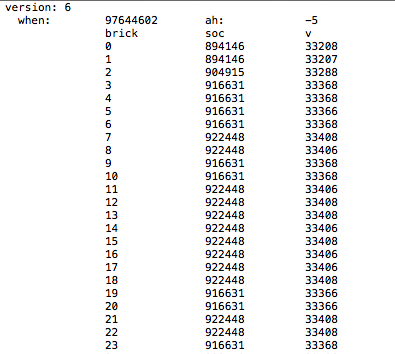
and this below it:

I can't find the CAC or "brickahave" that you smart guys refer to. Can anyone help me figure out how to see my CAC? If so, THANKS!�
Sep 20, 2015
djp The CAC isn't in the ahr.log. It's in the output file from Tom's parser. You'll need to run the parser against your log files and open up the results.�
Sep 30, 2015
Strib This thread has been valuable, not so much for how to improve the battery pack (because I don't think you can reverse any degradation) but for suggesting good discipline for preserving battery health as much as possible.Two, perhaps dumb, questions? - Can you do a cool-down without using OVMS? - Though doing a full Standard Charge, is it helpful to charge and lower current overnight if you have sufficient time (less thermal stress, etc., on battery)?�
Sep 30, 2015
hcsharp It's easy to do a manual cool-down. Just charge your car for 30 - 40 minutes. You can do it at any amperage although it will take a couple minutes longer to cool at 70A than 16A. Lower amps are better if you are on TOU rates.
Charging at about 40A is generally the most efficient rate although it depends on several factors. By efficient I mean the most energy stored in your pack per kWh consumed from the grid. Charging slower does not create significantly less thermal stress than charging faster. A lot of people dispute this but there is no empirical evidence that charging at 70A all the time has any impact on CAC.
�
Oct 1, 2015
wiztecy I've been doing cool-downs manually myself, still can't get my OVMS going due to the Geo SIM card. I do my cool-downs at [email�protected] amps. Reason being is that I only want to cover the overhead of the HVAC system and don't want miles / a higher SOC. I've tried [email�protected] but I've found many times the car never dropped the temp down fast enough. Could be just chance since if the ambient temps are higher, the cool-down can only do the best it can. So I settled in at 16AMPS.
Also I don't believe anyone is disputing that a "real" / "true" battery chemistry degradation cannot be be reversed. However the argument is more on what metric Tesla uses with the Roadster ESS to best guess and estimate the battery health over time, and that environmental changes can directly affect this metric depending on the environment conditions and / or how you care for your pack.�
Oct 1, 2015
hcsharp I've also found that 16 and 24A cool faster than 12A. Not sure why.�
Oct 1, 2015
spaceballs If my pack is already cool before I start charging (due to my location) I actually prefer 120v 12amp charging, as it never kicks on the HVAC, so it doesn't do any wear and tear on it i.e. cooling fans/pump/mechanical relays, etc.�
Oct 1, 2015
wiztecy That's a good point and I'll try to keep that in mind.
Whenever the HVAC system is running I typically don't just shut it off which sounds/feels like it stresses it but rather allow the HVAC system to run its course before performing a shutdown. If you listen to the way the HVAC system shuts down by itself, its rather smooth. However if its up and running and you just hit "stop" to request the charging to stop. Everything comes to an abrupt halt which sounds really rough on the system.�
Oct 1, 2015
supersnoop That's because 120V/12A isn't powerful enough to run the HVAC. I don't think that's a good thing. The battery is still going to heat up while charging. The car just won't be able to use the HVAC to cool it.�
Oct 1, 2015
spaceballs Note: I only do this if my battery is already cool.
I've logged battery temps when charging at 120V/12A at my location (cool external temp) and it's doesn't heat the cells enough to even worry about it.
i.e. 120v/12a * 85% eff = 1,224 watts going into the ESS. That's ~0.179 watts, or 0.045 amps per cell when charging.�
Oct 1, 2015
hcsharp The AC probably wouldn't kick on while charging at 240v in those same conditions. And your charging would be a lot more efficient.�
Oct 1, 2015
spaceballs I just started a charge of 240v at 12A (cooled ESS), and about 5 min in, it kicked the HVAC on for under one min then turned it self off (self test?).
EDIT.
Looks like your right, the HVAC didn't kick on 240v/12A! My HVAC kicked on due to something else.�
Oct 1, 2015
wiztecy What was your starting ESS temp in C?�
Oct 1, 2015
spaceballs 17C (62.6F).
Edit, Doh I had one thermal sensor in manual mode set to 33c (92f), which could have prompted the HVAC. After canceling and restarting at 240v/12A I didn't have the HVAC kick on so far.
9 hours later temperature is 2c higher, I stopped stopped the charge as it was starting to taper off the current.
Battery temp rise looks ok on 240v/12a, and the HVAC didn't need to kick on during that time.�

Không có nhận xét nào:
Đăng nhận xét