Feb 13, 2016
vchadha Model S 70D
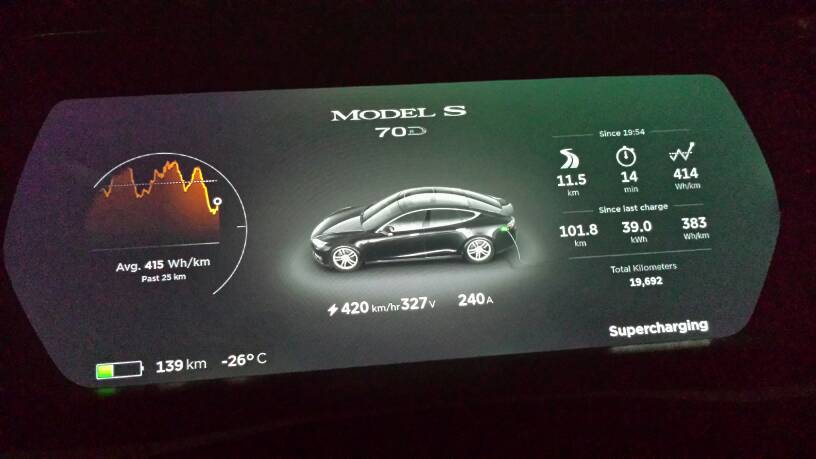
So it is -25 celcius (-35 with wind chill). I started out with a cold battery from my garage with 337km rated range. I drove local and highway during the day and the actual range was only 115km. This equates to a range loss of 66%. Driving style was generally slow acceleration due to snow and slippery conditions.
 �
�
Feb 13, 2016
Skotty Wow. That's cold. Instant booger freeze temperatures there.�
Feb 13, 2016
AWDtsla Says 101.8km since last charge???�
Feb 13, 2016
cinergi snow on road = major range loss
Pic shows low tire pressures = range loss�
Feb 13, 2016
vchadha 101.8km is what i drove. When i arrived to supercharge i had 30km rated range left which equates to about 10km.�
Feb 13, 2016
vchadha The tire pressure were only slightly off.�
Feb 13, 2016
RiverBrick I drove from Quebec City to Montreal Friday morning at 105 km/hr with average conditions of -22C and 8 km/hr headwinds. It took 396 rated km for 260 actual km, so the loss was just a third. The roads were dry, though, and nothing like today's swirling winds. The car was also in a 15C garage where I overinflated the tires to 50 psi.
Sorry about your experience today. We could use more than 1.5 Supercharger sites in Quebec to alleviate range loss due to severe weather. If you have concerns about specific trips, evtripplanner's range estimates are much more accurate the car's navigation system in the Winter.�
Feb 13, 2016
mibaro2 This cold weather really cuts into the battery mileage. Here, it was -20 overnight. I still had the regen limiter line after charging the car for 5 hours and then driving for an hour.
I lost about 50% of my range.�
Feb 13, 2016
vchadha Yes, on a long trip with highway driving it makes sense that you experienced a range loss of 35%. Due to stopping and starting i lost 65%.�
Feb 13, 2016
vchadha Yes, i think it is important for everyone to know the effect on range with such cold weather to help plan better�
Feb 13, 2016
Miousic Futures buyers should be aware of that. Even with a warm car, driving at 100km/h at 0c on the highway, I drove 55km instead of the 100km indicated. This is far from the 12% lost Tesla's salesman told me!�
Feb 13, 2016
RiverBrick Thanks to regen, stop 'n go doesn't usually eat into EV range as much a highway driving, but I guess your regen was limited due to cold.�
Feb 13, 2016
InternetDude Try to finish charging right before you leave as charging warms the battery. Also if you are connected to power, prewarm the interior before you leave also to help reduce consumption on the road.�
Feb 13, 2016
flankspeed8 That is pretty cold, about -12 F. In the depths of winter we often get -20 to -25 F here. However, I don't believe windchill has any effect on the car, unless it is a headwind you are driving into.�
Feb 13, 2016
Canuck Cold weather really is a killer. If you think it's bad in a Tesla, try it in a Leaf. You're lucky to make it out of the driveway (slight exaggeration to make a point).�
Feb 13, 2016
Quantum` Wait... you have electricity in Canada?!�
Feb 13, 2016
TexasEV Snow and wind will affect gas mileage also. By the way, a car doesn't feel wind chill.�
Feb 13, 2016
Canuck Yes, igloos have come a long way.�
Feb 13, 2016
vchadha Once the battery is warm you lose 35 to 40% range at -25 celcius temperature�
Feb 14, 2016
darthy001 Must be additional factors such as heavy snow, heavy wind or rain for such a bad efficiency to occur. I have driven my P85D just over 300km without issues in those temperatures at over 100kph average speed. Not hypermiling either. Of course using range mode.
I have _never_ seen anywhere close to 50% reduction in range even en -20c temps on the highway. Worst I've had was maybe a 33% reduction in heavy snow, winds and cold temps.
city-driving with stop and go traffic is another story. Easily more than double the energy used per km. But then I rarely do more than 200km of city-driving �
�
Feb 14, 2016
widodh I don't agree. Last year I drove in -22C from Sweden to Norway over a snowy road. My usage was 230Wh/km over a stretch of 240km.
Is a post on my blog about it: Fiskevägen and entering Norway Widodh�
Feb 14, 2016
Soolim Yes, and part of what you use came from BC.:tongue:�
Feb 14, 2016
doctorwho -35! I don't know how or why you do it, migrate to Australia!�
Feb 14, 2016
jerry33 ICE cars can easily lose the same amount of range when it's that cold. They just don't tell you about it as clearly.�
Feb 14, 2016
Yodeller Regardless of the debated range, I think one core point is that Tesla should build more dense supercharger concentrations in places that get very cold, for safety reasons.�
Feb 14, 2016
Barry Do you still have to be a criminal to get in? :smile:�
Feb 14, 2016
Zythryn I think the core point is Tesla built the superchargers in the perfect spot for a worst case scenario.
Low tire warnings only pop up when the pressure falls more than 5psi below normal, that definitely contributed.
Extreme cold, snow, wind and not preheating the car all will impact range.
Low tire pressure, extreme cold, snow and wind will also affect the range of an ICE vehicle. The 12% the Tesla rep mentioned is the additional loss that the Tesla experiences.
As always, if you are short on range, turn off cabin heat and use seat heaters, slow down, or draft a semi (not too close though).�
Feb 14, 2016
mmccord Yeah, the cold is tough on range. Good supercharger density helps. I drove about 125m yesterday in NY/NJ but with several stops. No charging available at those stops, so the battery was quite cold after each leg. Started with 235m of range and rolled into my garage with 4 rated miles left. Going about 50 miles out of my way to Paramus was an option, but they are having power issues there and Tesla roadside assistance told me I'd only get about 100a there, so i picked up 5 miles at a ford dealer and limped the last 20 miles @35mph without heat.
Anyway, a well placed supercharger or l2s at any of my stops would have mitigated the whole thing. The lack of infrastructure in rural areas is frustrating.
Other options were a chademo charger (out of service since November so i didn't bother), and a chargepoint l2 (out of service for some reason).�
Feb 14, 2016
mibaro2 That's what I normally do, but I was surprised when the car was charging for 4 hours and (after l had to stop the charge before leaving) the limiter was still there. I preheated it with the app also. I think Tesla changed the battery heating since last winter. Maybe through one of the firmware updates during the last year.
I think anyone driving in cold weather should read Doug G's winter driving blog here .�
Feb 14, 2016
TSLA Pilot Actually, it does in a way. The wind chill is a factor as it pulls anything above ambient temperature back to ambient temperature that much faster. Thus, assuming a warm battery has more capacity, the wind will drop/lose that heat faster (plus headwind potential).
Granted, not a huge factor, but it IS something to consider.
That said, the OP also needs to pump up his tires ASAP--that's huge. Try riding a bike with low tire pressure and see the impact . . . .�
Feb 14, 2016
DMC-Orangeville +1 here. Doug's comments are bang on
Last night, out for a 2 hour dinner, parked on the street (of beautiful downtown Orangeville ON), I returned to a cold soaked car in -24C windy weather. It's about 10KM home, and I averaged 700 w/km. Cold, windy, and hilly - the 3 horsemen of the electric car apocalypse. It was improving as the battery warmed up, but I can see how one can eat up a significant chunk of power prior to settling in at the normal 25-35% losses in winter.�
Feb 14, 2016
Barry Doug G ays, "As you drive the car, the drive train will naturally heat up. Once that happens, Model S uses the drive train coolant to help heat the cabin."
I've never heard this before. Is this fact or assumtpion?�
Feb 14, 2016
Jeeps17 I agree with the above. This winter with 7.1 I sometimes leave for work with a car that is charging or has just finished, in a heated garage, and still have a regen limiter somewhere between 30-60 kW. Pre-heating the cabin while plugged in does not seem to change anything.
It often stays present during my entire commute.
I did not see this with previous FW (this is my 3rd winter with my P85).�
Feb 14, 2016
ItsNotAboutTheMoney What were the actual tire pressures at the time?
An important point in there is the signifcant windchill, which implies significant wind. What speed were you driving on the highway?�
Feb 14, 2016
TheDane I recommend you change settings from "rated" to "typical". The rated range is so far off you can barely never trust it. Typical range usually equals 200 wh/km, which is not that far off most real-life use, on average. During the past 25.000 km I've driven, my average use is 198 wh/km, as far as I remember. Obviously during winter, it will be off, but during summer, you can sometimes drive further than what "typical" suggests (depending on speed of course).
According to Remote S app, my battery is currently at: 76%
Estimated (by Remote S): 267 km
Typical (Tesla): 285 km
Rated (Tesla): 356 km
If I were to get 356 km out of 76% battery, I'd need to drive around 170 wh/km, very unlikely, especially during winter.�
Feb 14, 2016
RiverBrick In North America the settings are a bit different, perhaps due to lower speed limits. I have a choice between "Ideal" and "Rated." Rated is around 185 Wh/km, whereas Ideal is something unrealistic like 165 Wh/km.�
Feb 14, 2016
CHGolferJim I've seen 35% loss in 20*F temps around the Carolinas and Virginia (mostly interstate at 70-75 mph cruise control; rated miles used / actual miles driven, without preheating). Today we're off on a 120-mile round trip and I've charged to 100% at 239 rated miles and will preheat to 80* for 30 minutes while plugged in to see if it makes a difference.�
Feb 14, 2016
SMSMD Cold Weather Driving - Blogs - Tesla Motors Club - Enthusiasts & Owners Forum by Doug_G
A bit long but a good one to watch for some ideas about charging and preheating. Posted on TMC by m1ker .
tesla009 - Christmas, Doughnuts, Vulcan and the Starship Enterprise - YouTube�
Feb 14, 2016
dgpcolorado Tesla did do that here in Colorado, although I presume that it was more because of mountains and snow than cold (-25�C is unusual here in the daytime).
Grand Junction to Glenwood Springs: 145 km (90 miles)
Glenwood Springs [over Vail Pass, 3251m/10,666 feet] to Silverthorne: 151 km (94 miles)
Silverthorne [through the Eisenhower Tunnel, 3401m/11,158 feet] to Denver: 128 km (79 miles)
That last one, through the tunnel, is quite steep on both sides and can be "interesting" in snowy weather and very slow going at skier rush hour (Sunday afternoons eastbound).�
Feb 14, 2016
Yodeller Thanks dgpcolorado,
Definitely the right thing to do.
I wonder if there are any members of the Musk clan who live in the area .
I also wonder if Elon himself spends some of his holidays in the area too...�
Feb 14, 2016
AWDtsla Exactly. I thought certain trips were on the edge of possible, but knowing what I know now, I would _never_ take the Tesla on long trips in these areas. I've sent emails directly to Tesla about building superchargers and I got some form letter about how they use "advanced modeling" to figure out where to put superchargers. Great.
But namely:
1. Stopping in cold weather destroys whatever limited range you thought you had. evtripplanner/etc estimates do not include warm-up consumption.
1.a. Pack heater is small, can't use regen power for heating when regen is disabled, and the pack is not insulated or using other means of heat preservation (like Prius has a coolant thermos)
2. Snow on the road causes huge unplanned energy usage
3. Charging from AC becomes a serious problem when it's really cold out, adding multiple hours to charge times
4. If you turn range mode on, you're going to be really cold. It's not like it's California and you can just crack open a window because of "reduced climate control performance".
- - - Updated - - -
The pack heater will shut-off before long before full regen temperature. I've also done commutes with regen basically off for the entire duration, let's say if you've left it in range mode.�
Feb 14, 2016
Jamriman Makes the Volt look like a life saver! Just kiddin, but it does solve this problem.�
Feb 14, 2016
Matias Did you park during the day so that car got cold again?�
Feb 14, 2016
vchadha Yes, twice for an hour and once for 30mins.�
Feb 14, 2016
Matias Ok. That explains the big loss.
Maybe Tesla should make thermally insulated packs for cold climates, so that pack shouldn't lose warm so quickly. IIRC someone was experimenting with insulation.�
Feb 14, 2016
Cottonwood See Realistic Range Expectations in Crummy Winter Weather - Page 2 for my description of some winter hypermiling 2.5 years ago.
I used what some would consider extreme techniques, but made it 228 mile, climbing a net of almost 2,000 feet in Colorado winter conditions in a Sig P85. There is now a 70 Amp J1772 in Salida that greatly relieves tensions on this route.�
Feb 14, 2016
FrederikBoivin i email tesla every week for them to add SC... Please do so too!!!
i drive a lot - 60k km per year, and in the winter time, i usually need 1.5 more range than what i drive. If 200 km are in front on me, i need and use 300...
- - - Updated - - -
+1...�
Feb 14, 2016
Barry Interesting question. Kimball Musk, Elon's brother, has a restaurant in Boulder. Don't know where exactly he lives.�
Feb 14, 2016
DMC-Orangeville -25C daytime is unusual in Southern Ontario as well. Much more common in the northern Praries. This cold snap brought out all of the posts that one might expect on a first really cold bit of winter weather. Our neck of the woods IS finally getting more Super Chargers, with Port Hope, Grimsby (opening soon) and Oakville (opening soon(?)), but most of the rest of the country needs more, to cut range anxiety.�
Feb 14, 2016
David29 Oh, I disagree with that. My experience is just the opposite. Local, short trips consume a lot of power because the car's cabin has to be heated every time you get back into the car after a stop, which takes considerable energy on a cold day. Personally I found that longer trips are more efficient. Of course, mys statement is qualitative, as was yours. So I suppose the energy use comparison depends upon how long the local trips are, how long the stops are, and how fast the travel is for both local and highway trips. As usual, devil is in the details...�
Feb 14, 2016
Beltsbear No, they really don't. On any long trip it is going to be less then 15% with no special measures. In that kind of cold covering the grill helps regain some of the loss and also an engine block heater helps as well.�
Feb 14, 2016
CHGolferJim
Chapel Hill to Winston-Salem r/t = 200 rated / 160 actual = +25% at 28*F, mostly 70mph but had to take a detour for last 30 miles on a 55-60 mph road, so not conclusive.�
Feb 14, 2016
flankspeed8
My former car was a TDI and I can tell you it took about a 30% hit in the subzero temp range. As an added bonus, it spewed thousands of times the legal limit of noxious exhaust to boot. It has been said that one of the reasons for range drops in with the colder temps has to do with air density at colder temps. Obviously ICE cars are susceptible to this also.�
Feb 14, 2016
davecolene0606 Hey I thought like every single parking space has a plug for engine block heaters...
Sooo, can't they warm a battery too? I mean if they can keep oil from having the consistency of bitumen...
Just sayin, eh?�
Feb 14, 2016
AWDtsla Eh.. In the winter you utilize the waste heat from engine, thus making the car MORE efficient in terms of stored energy put to work. In an EV you have 2 additional large power draws, pack heating and cabin heating.
You have to get very very very cold before considering covering grills on an ICE.�
Feb 14, 2016
RiverBrick I agree with you. I mean stop n go traffic, not drive, stop for a break, n go. Of course if you can plug into even something as weak as 120v it will prevent much of the range loss associated with stops.�
Feb 15, 2016
Miousic No, we export it to USA! [emoji4]�
Feb 15, 2016
Miousic No snow, warm car... 45% lost. Confirmed by Tesla service with many other owners.�
Feb 15, 2016
511keV Definitely saw a 30ish percent range hit in Northeastern Massachusetts this weekend with the extremely low temperatures.. Was averaging over 400 WHr/mi at 65 mph and cabin heat set to 64F. Car sat out for part of the day so the battery was quite cold in the afternoon. As a result, not only was there no regen, the max power available was about 75kW which increased to about 300 kW after 20 minutes of highway driving. I'd never seen such a large power limit before this.�
Feb 15, 2016
AWDtsla That usage was pretty low given the temperatures...�
Feb 16, 2016
yobigd20 yea on saturday i drove from the finger lakes to south jersey and the cold (minus 10F), ate up almost half range. i averaged about 600Wh/mi to make it to binghamton, and this was going slow. then i charged to full at binghamton SC and arrived at allentown SC with less than 30 miles range. that's segment over 200 miles range for 130 mile drive. damn that weather. during the summer I can make it from binghamton all the way to south jersey without stopping but here I can barely make it to allentown. big difference.�
Feb 16, 2016
Cottonwood Most people are reporting usage at temperatures and conditions, but starting conditions are also very important. The energy to warm the battery and cabin can be very significant for a cold-soaked car.
If at all possible preheat with shore power before departure; turn on cabin heating with the App for one or two 30 minute cycles immediately before departure. Turn off "range mode" during preheat to heat the battery pack more effectively, and then turn "range mode" on for driving if you think you will be range challenged. If available leaving the car in a garage is better, and a heated garage is the best.
EV's are wonderfully efficient, but the downside of that is that there is very little waste heat for vehicle heating in an EV...�
Feb 16, 2016
AWDtsla Assuming warm start conditions are unrealistic. It basically assumes you drive continuously until you are back and parked in your warm place.
...and Tesla needs to fix the broken range mode.�
Feb 16, 2016
ThosEM I'm glad to see folks here complaining about this and perhaps getting ready to demand that Tesla do something about it. I can't understand why the Norwegians among us are not more vocal about this, since they and the Canadians are dealing with it frequently.
There is a middle course between pure EV and ICE hybrid, which involves carrying a heat source separate from the traction battery, which really should be reserved for "traction" in my view. I've expressed it in a greencarreports article.�
Feb 16, 2016
AWDtsla I get the feeling they've complained. But you can't engineer a product through complaints. There's probably about two dozen software tweaks I'd do immediately. As far as heat preservation, well that requires some hardware changes, though the cost should be minimal.�
Feb 16, 2016
mknox It does not. The glycol loop does not not enter the cabin and is used to control the temperature of the battery, inverter and motor. The on-board chargers are also on this loop to cool them during charging. The cabin is resistance heating only.�
Feb 16, 2016
dgpcolorado Haven't heard this complaint before, can you explain? (Model S newbie here.)�
Feb 16, 2016
tezzla it's 88 degrees right now in sunny Los Angeles (although it'll get down to 55 degrees overnight).�
Feb 16, 2016
AWDtsla If you turn on range mode pack heater doesn't work when you want it to, i.e. shore power. Neither does it warm up the cabin effectively, again while plugged in.
If you turn on range mode while traveling, it basically breaks the climate control. While you don't need to have the pack heater on because driving should warm it up, everyone inside the car is freezing to death. You can try and compensate by cranking up the thermostat to 88, but then you end up wasting power as you overshoot the setpoint and don't notice. Then it's a fight to dial the thermostat up and down to keep warm. I mean there's a reason it's called a thermostat, and by definition Tesla has broken it as soon as you turn range mode on.�
Feb 16, 2016
green1 I don't know what this particular complaint was about, but the most common one is that Range mode limits battery heating even when plugged in to shore power which can be quite counter-productive, as the best way to maximize range is to start with a warm battery.
There's also a lot more they could do to help range that they don't, for example, in range mode it could limit max power, and allow the cruise to drift by a few km/hr, or brake earlier/accelerate slower to be more efficient.�
Feb 16, 2016
AWDtsla Sort of the reaction I expect from Fremont as well to this thread.�
Feb 16, 2016
Cyclone Please note that reports are that in v7.x, Range Mode ON has lower target levels for battery warming than w/ Range Mode OFF. This can make a big difference in the regen limiter going away and charging speed at a Supercharger.�
Feb 16, 2016
dgpcolorado Sunny and lovely here too: 48� and the snow that was more than knee deep two weeks ago is showing bare patches of ground now. It's all relative...�
Feb 16, 2016
CHGolferJim
How does Range Mode ON or OFF affect supercharging time?�
Feb 16, 2016
mdevp I wonder why we don't hear stories like this more often from the Norway? I'm sure they have their fair share of -25C days.�
Feb 16, 2016
Cottonwood Because the climate is actually pretty mild. See Oslo - Wikipedia, the free encyclopedia�
Feb 16, 2016
Cyclone If the battery is too cold, charging is slowed. It was anecdotally seen on one of of the Facebook groups. Being in range mode during the cold left the battery cold enough that supercharging was slower than expected whole range mode off charged normally. Presumably, the same way cabin heating isn't overridden on shore power, battery heating isn't overridden on a SpC (or takes long enough that the battery is in the taper by the time it's warm enough to get high kW charging).�
Feb 16, 2016
widodh Oslo is mild indeed, you have to go to the North to places like Alta in Finnmark. But Sweden probably has more winters which drop to -30C then Norway.�
Feb 17, 2016
doctorwho No, t's optional because if you aren't when you arrive you soon will be:smile:�
Feb 17, 2016
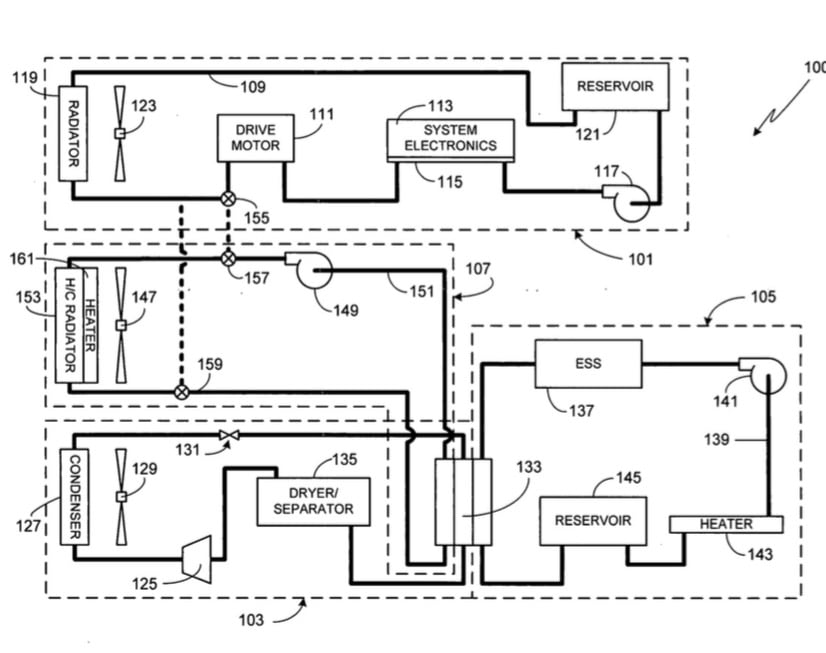
ThosEM The attached figure from the Tesla patent for it's HVAC system shows that a connection can be made from the drive motor cooling loop to the cabin heating loop (via 155, 157, 159 valves) and from there to a heat exchanger that connects with the Energy Storage System (main battery). So I think there is scavenging of waste heat from the motor, most directly to the cabin. That would explain why on any given cold weather trip, the energy efficiency rises steadily and the heating load nearly vanishes or seems to.
 �
�
Feb 17, 2016
AWDtsla This would also imply the cabin heater could be used to augment the pack heater. That doesn't seem to happen either.
Someone will just have to dismantle their car.�
Feb 17, 2016
green1 That would be consistent with statements that Tesla has made in the past about how things work.�
Feb 18, 2016
ThosEM I think it actually implies that the cabin and battery resistance heaters are coupled but needn't be, since either is more direct than the other at doing its job. There would be little point in activating the cabin heater to warm the battery, but if there is heat coming from the drive motor into the cabin, it can be shared with the battery through the exchanger.
The most remarkable thing about this system to me is that the heat pump has no reversing valve to permit it to pump heat into the cabin or the battery loops. That was my motivation for chasing down the patent. We really ought to pile on Tesla and demand that they design that feature into the car. Even the lowly LEAF has a reversing heat pump.�
Feb 18, 2016
AWDtsla Unfortunately being warm and comfortable while also being efficient and preserving range in the winter are not "sexy" compared to automagically parking your Tesla badly, so I don't expect anything to happen anytime soon.�
Feb 18, 2016
wjhepworth I noted a distinct difference between having Range Mode On or Off. With Range Mode off I was losing approximately 20-30% at temps around 5 degrees in an S70D -- higher when I had to park the car outside for lengthy periods. As soon as I turned it back on the loss was more in the 10-20% range. Makes a pretty big difference.�
Feb 18, 2016
mknox They haven't implemented this in the Model S. I got into a long debate with another member here about this a while back, and he convinced me otherwise. You can verify for yourself that the glycol loop does not enter the cabin and there is no liquid heater core in the car. There is only electric resistive heating in the cabin.�
Feb 18, 2016
rypalmer I drove from Toronto to Montreal round trip this weekend in this -25�C weather (in an ICE car, I have a Model S 70D reservation). My consumption was under 10L/100km (2010 Mazda 3 Sport). I've been making mental notes on all my road trips well before even reserving my 70D. Just for reference, here are the driving distances between superchargers on this journey:
Tesla Montreal to Cornwall: 113km
Cornwall to Kingston: 177km
Kingston to Port Hope: 155km
Port Hope to Tesla Lawrence: 95km
This post has caused me to seriously re-think Supercharging spacing in Canada, based on snowy, cold, and generally unpredictable conditions just being a fact of life. We're going to need maximum spacing under 100km!�
Feb 18, 2016
AWDtsla Pretty much the figure I came up with. You have a ~70 mile radius around a supercharger for travel in a P90D. You can do longer distances if you know your next stop will be a supercharger only, but it can't go to 140 miles or you have "no mans land" for off-highway travel between those two superchargers. I wasn't even counting the deep extreme cold like Montreal either.�
Feb 18, 2016
jerry33 I believe they originally intended to because there's a video that talks about it. However the car cost more to build than originally expected and so it wasn't implemented.�
Feb 18, 2016
mknox That is my understanding as well. I ordered about a year before production and was told that they did use a kind of "heat pump" to harvest power train heat for the cabin. This was why I got into a protracted argument with the other forum member on this. Aside from expense, I also heard there just wasn't enough heat to make a dent in the cabin, and it made more sense just to circulate the heat through the battery and drive unit. Even there, the battery/drivetrain loop still needs supplemental electric heating in certain conditions.�
Feb 18, 2016
flankspeed8 Makes it even worse when you take into account a Model X that is trying to tow a rack of snowmobiles�
Feb 18, 2016
AWDtsla The answer is don't, not if you plan to hit the highway. I got the pano roof because I thought I would put a roof rack on. I realize now that was a mistake.�
Feb 18, 2016
green1 There are a few places where Tesla stated that they did this. Seems like it's yet another of their lies... add it to the horsepower, acceleration times, timelines, battery capacities, etc.�
Feb 18, 2016
ThosEM Likewise, I learned to look for the patent and diagrams after such a long discussion here. What documentation did the other member provide that convinced you Tesla has not implemented its own patent?�
Feb 18, 2016
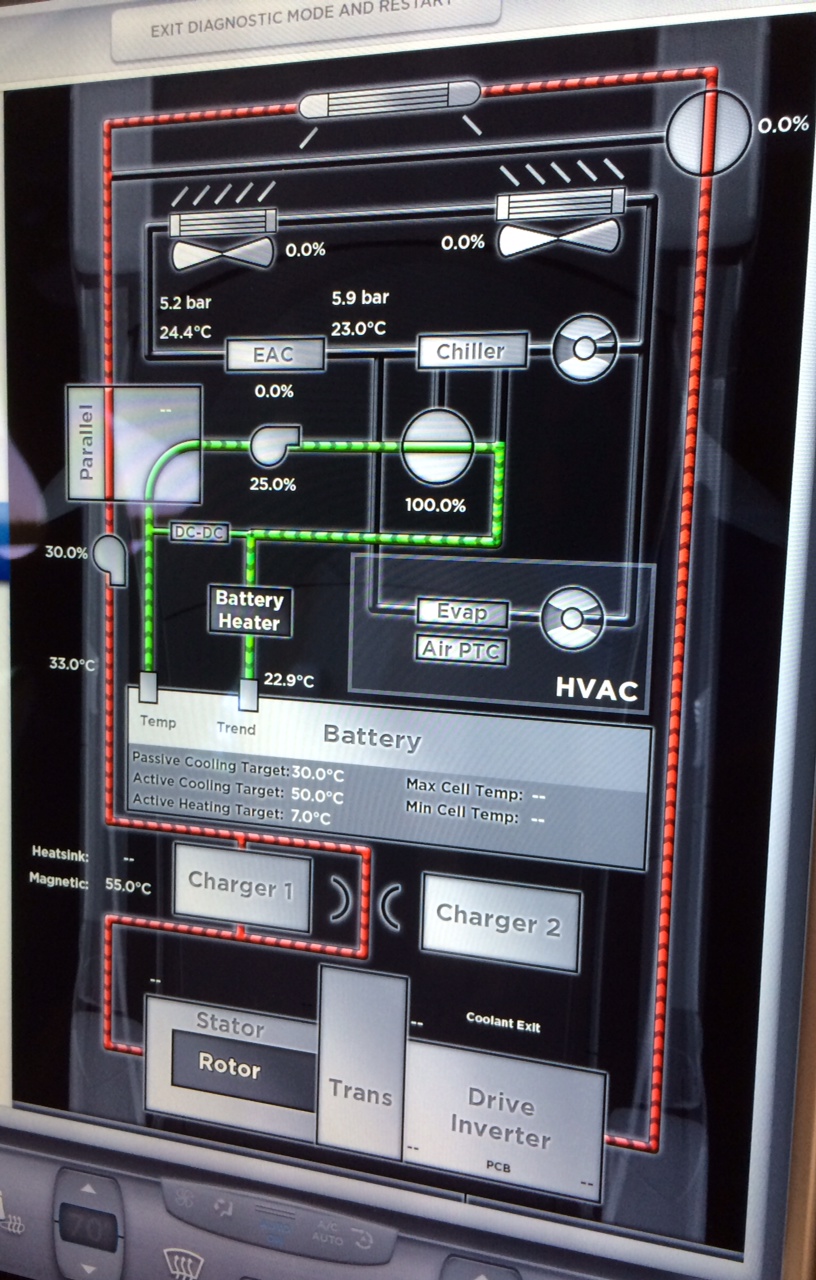
AWDtsla Maybe start with the diagnostic screen that shows the implemented coolant loops in the center console.�
Feb 18, 2016
Cottonwood Here you go...
 �
�
Feb 20, 2016
Trev Page
The section on the left labelled "parallel" can switch to "series". Judging by the diagram I think series is the mode used to preheat the battery/cabin and parallel switches the battery to it's own heat/cool cycle.�
Feb 20, 2016
AWDtsla It never connects to the cabin, it only connects the battery to the drivetrain and chiller.�
Feb 20, 2016
Trev Page What I meant to say is the loop can open or close to capture cabin heater into the circuit for battery temperature management.�
Feb 20, 2016
AWDtsla It can't. Coolant doesn't run to the cabin only R134A. The coolant loop is overlapped with the R134A loop, it doesn't intersect except through the chiller. Hot R134A from the cabin evaporator goes straight to the compressor and the condensors. The segment between EAC and chiller is a suction line.�
Feb 20, 2016
eloder Coming from a Leaf, the cold alone isn't the biggest factor. Things like headwinds I find to be the biggest impact, followed by snow or crappy road conditions.
My ~25-30 degree temperature range has varied from just a 15% reduction of my normal battery, down to something like a 40% reduction, even without heater use.�
Feb 20, 2016
AWDtsla The Model S has a much smaller drag area than a leaf. So winds should affect it less.�
Feb 21, 2016
ThosEM Perhaps you could say how to get to this screen? I'd like to catch it in different states of operation...
- - - Updated - - -
By no means do I claim to fully understand this diagram, but it looks to me like the motor cooling loop can be switched via the valve at upper right between the exterior radiator and the interior cabin radiators, reducing the need for resistance heating once the motor and inverter warm up. That is consistent with the patent diagram in that area, no?�
Feb 21, 2016
jerry33 The two blower icons (closest to the Parallel box) labeled 25% and 30% appear to indicate that both hot and cold can be provided to the cabin fans as required. I don't see any other interpretation for this. (Unless those icons don't indicate blowers, but something else).�
Feb 21, 2016
MP3Mike I assumed that they were coolant pumps.�
Feb 21, 2016
AWDtsla They are coolant pumps.
The diagram does not show battery coolant going to the cabin, period.�
Feb 21, 2016
ThosEM I'm congenitally doubtful of anyone who is so confident of their knowledge that they shut out contrary evidence. Mknox claimed there is no thermal loop though the cabin, and so did AWDtesla. Yet both the patent diagram and the diagnostic screen clearly show such a loop. How else would air conditioning of the cabin be implemented, by cooling the resistance heater?
The diagnostic screen could certainly use some interpretation. It's the first time I've studied it and I'd be very interested in having each of the items on it identified by those who are more familiar with it. Also, I'd like to know how to access it.�
Feb 21, 2016
AWDtsla You're reading the diagram incorrectly, confusing the refrigerant loop with the coolant loop. I think it's pretty clearly laid out, except for the loop graphic not indicating the contents. The only place the two loops intersect is in the chiller, which is after the thermostatic expansion valve. Only refrigerant enters the cabin loop. There's two expansion valves, one for the chiller, one for cabin AC. Coolant is not what goes into an evaporator, or expansion valves.�
Feb 21, 2016
mknox A refrigerant loop enters the cabin for the cabin a/c evaporator, but no glycol loop enters the cabin (as it would in a conventional ICE for the heater core).�
Feb 23, 2016
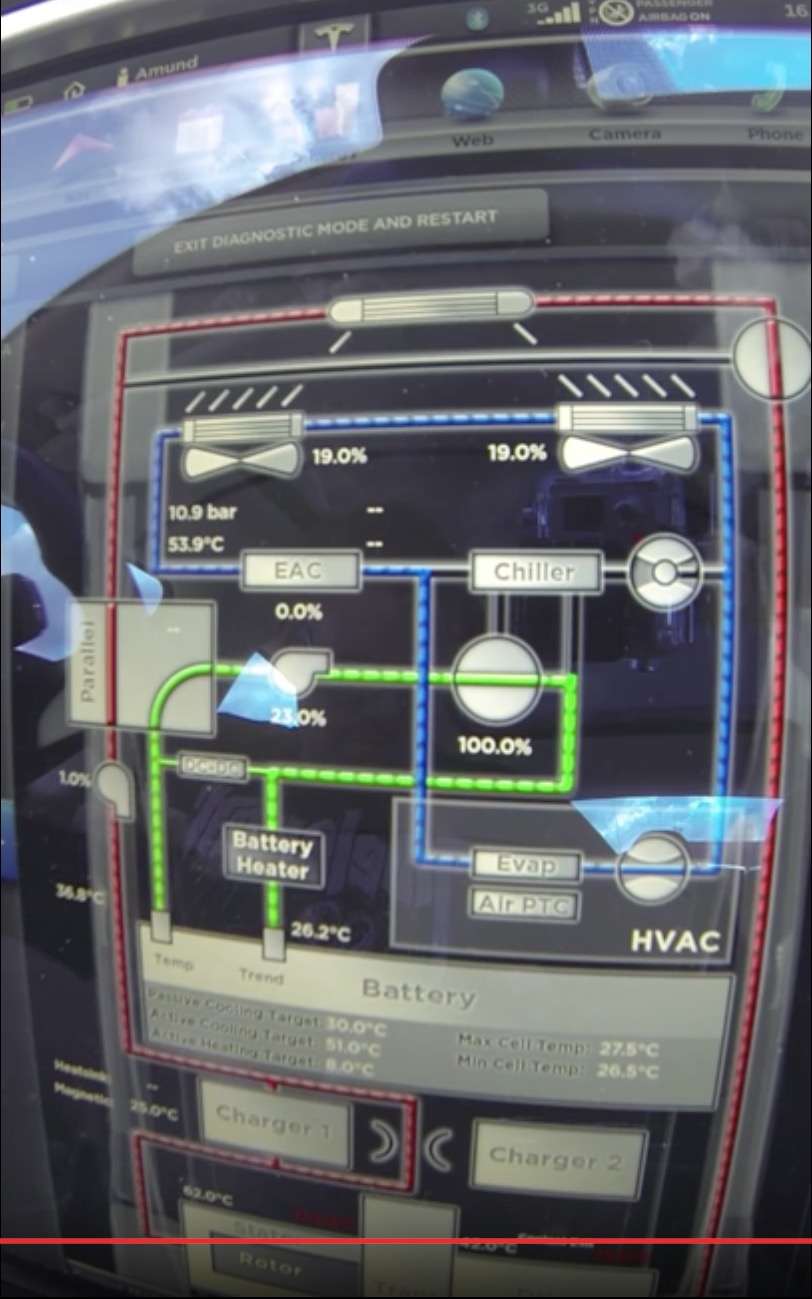
ThosEM The valve in the upper right controls whether the coolant loop goes through the external radiator at the top, or apparently (at least to me), though the cabin heater where the refrigerant also flows in parallel. It does look a bit ambiguous, but do you know of any other function that bypassing the external radiator could serve other than to dump heat in the cabin?
Attached is the graphic when cooling is being done by the AC (found in a Youtube video). Under those conditions, the motor cooling loop is directed to the external radiator, but when calling for heat in the cabin, it seems the valve at upper right could be used to get as much as possible from the motor-inverter waste heat before activating the resistance heaters.
 �
�
Feb 23, 2016
AWDtsla Valve in upper right only diverts glycol through front radiator when passive cooling is enabled, has no impact on cabin. This diagram should really clear things up for everyone. Note the blue loop for refrigerant, it does not mix with the other loops. Chiller is a refrigerant/glycol heat exchanger.�
Feb 23, 2016
green1 How about not dumping the heat at all and keeping it in the drivetrain? at cold temperatures you don't want it through an external radiator because you want to keep it, that doesn't mean you're dumping it in the cabin instead. You'll notice that the alternate path shown does not include a radiator/heater core at all.
I'd like to think that after Tesla specifically stated that they used the waste heat from the drivetrain to heat the cabin that it was true. But we've just seen no evidence of it, and considering how many other things Tesla have said that turned out to be false, I think this is another one of them.�
Feb 23, 2016
mknox I think they do keep all the heat in the battery/inverter/motor loop when it's cold enough. Likely at any time they're dumping heat overboard, you wouldn't want it in the cabin anyway (i.e. it's summer).
Yeah. I was told this when I was reviewing the Beta car by a Tesla engineer myself which led to a lot of later confusion. I think they found, after keeping the huge battery pack warm with "waste" heat, there just wasn't enough for the cabin anyway.�
Feb 23, 2016
AWDtsla This, basically. The problem isn't the heat energy itself, it's more the maximum temperature of the glycol loop. They probably discovered you couldn't accomplish cost-effective heat transfer to the cabin this way. Maybe with a gigantic heat exchanger that you couldn't fit behind the dash.�
Feb 24, 2016
ThosEM This doesn't make sense. To interrupt the external radiator cooling, one would simply put a thermostat in to interrupt the flow or shut off the circulating pump. One would not put in a separate line to nowhere controlled by a valve. It doesn't wash.
IMHO there is ample evidence that the heating load on the resistance heaters drops to essentially zero when the motor gets warmed up, even when it is quite cold outside. So I believe Tesla actually did this right.
OTOH, they didn't implement a reversible heat pump, which is a real shame, considering that the LEAF has that feature.�
Feb 24, 2016
AWDtsla I have seen none of this evidence. The draw drops hugely from the initial 6.6kW sure, because 6.6kW is just MASSIVE. That's not evidence that it gets assisted by other means, it's just the thermostat working.
- - - Updated - - -
You're going to make me dismantle my car over some wishful thinking aren't you?�
Feb 25, 2016
Barry Not compared to what the motor draws on a launch :smile:
Also, at 400V, it's only about 15A�
Feb 25, 2016
AWDtsla We're not talking about launches. We're talking about range. 6.6kW adds 35% to cruising consumption of a 70D at 65mph.�
Feb 25, 2016
brkaus They would still want the circulation within the battery to avoid hot/cold spots and ensure consistent temperature throughout. So I don't think turning off the circulation pump would be a good idea.�

Không có nhận xét nào:
Đăng nhận xét