Sep 7, 2016
privater Thanks! @Ingineer I think it's what we desperately needed. Looking from this forum, nobody post any detail Supercharger data with new 75kw battery fully unlocked.�
Sep 7, 2016
Xenius What would be really fun is to take detailed data on a 60, then do the unlock and take the same data. I'll accept donations as the fall guy �
�
Sep 7, 2016
Ingineer That would definitely void your warranty. I suppose we could do it the other way though and then put it back.�
Sep 7, 2016
Chopr147 So, we all built our own consensus and decided the pack is limited on the top end and charging to 100% is all good.
DS and the like agree -- Tesla is mum.
Now Ingineer you are telling me it may be lower end locked and we are all damaging our battery packs?
I will have to keep an eye on this thread because I don't know jack sh%$# about my battery pack. (but I am learning)
Seriously though it would give the shine on the bargain of a 60kwh a little dulling�
Sep 7, 2016
Ingineer If your voltage is around 352V at 100% SOC, then most definitely you are causing accelerated degradation by letting it stay that high.�
Sep 7, 2016
emir-t That is exactly what I'm saying. People say charging voltage is different than the resting voltage and we need someone with a CAN logger, I get that, but charging voltage reaching 4.2V means that the cells are at trickle charge at that point, which means they're more than 95% full.
I'm also starting believe they're bottom limited. But that doesn't explain later tapering.�
Sep 7, 2016
Ingineer Yes, if the charger is over 4.2v/cell then there will be cell damage, so before that happens, the amperage should have tapered enough so the voltage sag (or rise) is immaterial.
On a old 40, 60, 70, new 60, and 75 there are 14 modules with 6 strings in series, so there is a total of 84 in series, so 4.2v/cell is 352.8v.
On the 85/90/100 there are 16 modules for a total of 96 which is 403.2v.�
Sep 7, 2016
fallen888 It's not ugly! Looks like a very nice doggy. And I like that your four-legged friend has a choice of muscle milk and ginger ale.�
Sep 7, 2016
Xenius She's actually a gorgeous dog, a Dalmation / English Bulldog mix. I talk about how much I hate her and she's ugly, but that's me code for "she's the best".
Yeah, wife probably drank too much over the weekend and had an upset stomach. I'm working on losing some weight and getting back in a regular gym schedule so I was on muscle milk�
Sep 7, 2016
Master One I don't know about the voltages, but bottom limiting would make no sense at all, charging up to 100% would be slow, especially when approaching 100%, which has not been reported by any new 60 owner.�
Sep 7, 2016
Ingineer We don't need to speculate. The proof will come soon enough. If it's top limited, then they must have an alternate scheme for balancing then.�
Sep 7, 2016
jelloslug Here was the top end at my local Supercharger just before I hit 100% the other day:
![[?IMG]](https://lh3.googleusercontent.com/blogger_img_proxy/AEn0k_v1r5cy1OK4ZxJ47VjhXFiKAmkHYE5aLHMR3xjKizKtDNdQApYWGpJd3XJ61pkEKR_mFWWdNixbFwOGFg8VVlOsYbWo-G3zdv0kksAj3oRH24ndojxwWOU=s0-d) �
�
Sep 7, 2016
MP3Mike No Tesla keeps a portion of the bottom of the SOC off-limits as an anti-bricking buffer. I think we have heard it is around 5 kWh. The difference is that the Tesla batteries are bigger so you don't notice 5 kWh being unavailable as much.�
Sep 7, 2016
RogerHScott You've been around these forums for how long?�
Sep 7, 2016
Dynastar Even easier, run a 60 most of the way empty then unlock it. If the charge % goes up it's bottom limited.�
Sep 7, 2016
MikingCO I'm willing to do this for the sake of science and discovery. That's the sacrifice I'm willing to make.
Now, who is willing to Venmo me the money?�
Sep 7, 2016
Ingineer If that's a 60, then yes, I was correct and 100% is a true 100%. Do not charge to that level unless you need it, just as on all other models. I recommend a 100% charge occasionally, like at least 3-4 times a year to get the pack balanced, just schedule it so it doesn't SIT long at 100%. The time it sits fully charged equates to more degradation.�
Sep 7, 2016
jelloslug Yep, it's a new 60. I only charge to 100% when I need the range.�
Sep 7, 2016
Master One What are you talking about? A Tesla (not even a 90) with unlimited or supposedly bottom limited battery does not charge with 36 kW when already being at 99% SOC.�
Sep 7, 2016
jelloslug I have see 50kw right up to 100% before also.�
Sep 7, 2016
Master One With a new 60 software limited at the top, but not with any other Tesla.�
Sep 7, 2016
mkjayakumar
Well.. well. Then how can that be true 100%. Ingineer had to explain this before he can say with certainty that it is bottom limited.
50kw near 99% means it is not true 100%.
Although now I am wondering if the kW rate we see on the screen is a running average just like mph value�
Sep 7, 2016
jelloslug Well, you have the amps and the volts right there on the other side....�
Sep 7, 2016
??ELECTROMAN?? That would be a big disappointment if it's bottom limited. I really like the idea of having full range without degrading the battery as much as a full charge would. I'll call and ask them about it.�
Sep 7, 2016
chris5639 I have a new 60D and recently completed a road trip in Texas from Dallas to Galveston utilizing the Corsicana, Huntsville and Houston superchargers. In almost all cases I range charged to 100%. The charge rate never tapered off and again, in almost all cases the car waited for me rather than the other way around. I was telling my wife that it almost charged too fast. Like others, this leads me to believe the 60 is software limited at the top end and not the bottom end. What would be the alternate explanation? That due to a software bug, the superchargers are charging at an unsafe rate for all new 60's that have the 75 kWh batteries? Wouldn't we have overheated batteries in that case? At times when I returned to the car right after it finished charging (I HATE taking up a space), I did not hear the battery management system cooling the battery. Perhaps I missed it but I usually can hear it.�
Sep 7, 2016
??ELECTROMAN?? I called the service number on the website. It took ten minutes of trying to explain my question and what made the question significant. The conclusion was, that the guy I talked to, had no idea if the battery pack was 80% charged or 100% charge when the 60 kWh car's screen said 100%. Should I call and ask sales? I'm guessing they would be even more clueless, if that is possible. So, is anyone out there getting ready to pay for the upgrade to the 75 kWh?
�
Sep 7, 2016
MikingCO I've already volunteered my car if someone will simply volunteer the funds. I will even take time out of my schedule to get it rebadged. I'm 90% of the way to solving this puzzle. Who is going to help me the last bit?�
Sep 7, 2016
??ELECTROMAN?? It's very tempting to pay for your upgrade just to find out, but I'm kind of a tightwad. Maybe it's top limited now, but with the pack needing to be 100% charged a few times a year, for balancing, they might make it bottom limited with an over the air update. Maybe I should call the service center again and ask how I'm going to balance my batteries if it's not actually charging to 100%.�
Sep 7, 2016
chris5639 Here's a blurb from BU-803a: Cell Matching and Balancing � Battery University
active balancing shuttles the extra charge from higher-voltage cells during discharge to those with a lower voltage. Active balancing is the preferred method for EV batteries, but it requires DC-DC converters. The corrected currents are in the mA range only. Applying a heavy load during acceleration, followed by rapid-charging with regenerative braking requires well-tuned cells in a high-voltage battery to attain the anticipated life. EV batteries in the Tesla, BMW i3 and other EVs employ active balancing to minimize cell stress.
This would suggest balancing by charging to 100% is not necessary?�
Sep 7, 2016
Steveb48 I was told by sales last weekend that you could charge a 60 to 100% without degradation of the pack and that supercharging would be faster due to the later taper.�
Sep 7, 2016
??ELECTROMAN?? \�
Sep 7, 2016
jelloslug I would still prefer something "official" from Tesla.�
Sep 7, 2016
privater Maybe you can ask those people for help: Upgrade to 75kWh�
Sep 7, 2016
mkjayakumar I stopped reading right there...�
Sep 7, 2016
RogerHScott And they will gladly offer you the full, complete, definitive Truth that has thus far been withheld from all others.�
Sep 7, 2016
emir-t OK so I'll try and comment on this confusion with the limited scientific knowledge I have and try to clean things up a bit. I've been obsessed with batteries since I got into EVs about 4 years ago and have been reading about them ever since. I'm no engineer by any means so take everything I say with a grain of salt but here goes;
I'll write my conclusion first for TL;DR: I think we need more data to tell if it is perfectly OK to charge to 100% daily, but it most defintely is. Here's why;
All the data we have so far has been from the superchargers. And superchargers have one thing in mind; charging really really fast. Also becaue lithium-ion batteries use CC-CV charging method (constant current, constant voltage) battery charging current reaching 4.2V per cell (~353V) doesn't mean the 'real' 75 pack is actually full and the pack is bottom limited. (I'll have to disagree with Ingeneer on this upon second thought)
We have to first get rid of looking at only the kW. We should be looking into amps and voltages. A CC-CV charge means the battery is applied a constant current (give or take) until it reaches max. allowed voltage of 4.2V and then it is at CV stage. At constant voltage stage the voltage stays the same and current tapers off. From 60D supercharging data we have so far we can conclude that it indeed does enter the CV stage since voltage at 100% is 354V --> 4.2V per cell.
Here's the tricky question; at what percentage does the battery switch into CV stage? Definitely not 100% because as soon as it reaches that state if you disconnect you'll see voltage going down. This is determined by the C rate of the battery. (C rate: current the battery is charging/discharging at compared to capacity, for example a 3Ah cell charging at 3 amps is 1C, same cell charging at 1.5 Amps is 0.5C)
Now this article briefly mentions the CC-CV charging and C rates used. It says; (I quote)
When charging at higher currents, the cell voltage rises more rapidly due to overvoltage in the electrode reactions and the increased voltage across the internal resistance of the cell. The constant-current stage becomes shorter, but the overall charge cycle time is not reduced because the percentage of time in the constant voltage stage increases proportionately.
So this leads me to believe - again, I might be wrong - that Tesla is comfortably using higher C rates in supercharging the 60, getting the cell voltages up very quickly and not worrying about CV stage taking long because they never have to CV charge all the way anyway. The battery is limited to 80% max charge with the limit at the top. (Tesla isn't using a strict linear CC-CV because cell amperage and voltage taper gradually per Tesla's algorithm, so I mean they can taper the current rate later on and afford that higher overall C rate)
Let's look into the new 75 pack configuration to get Amp and voltage levels, using the 3.3Ah cells all Teslas use right now;
Pack capacity; 3,3Ah cells, 74 in parallel = 244Ah.
Pack voltage: 3.7V nominal cell voltage, 84 in series (14 modules in 6 strings each) = 311V (nominal)
311*244 = 75,8kWh. (around 72kWh should be usable for the owners)
Now let's "reverse engineer", so to speak, the virtual capacity of the software limited 60 pack; (because 100% is from the virtual standpoint)
Voltage should be the same for motor and drive train usage, so 311V.
60kWh/311V = 193Ah
To support my argument I'll look at the very limited data we have. Everyone either shares their data in kW, miles added or SoC % all useless from this standpoint. We need amperage and voltage. Here's an old video of Bjorn's 85kWh pack Supercharge video. Notice the empty pack starts charging at about 1.25C (charging at 286 amps with the old 229Ah pack; 286/229) Tapers to 1C around ~45% and continues below 1C. Pack starts CV charging (404V) around 90%.
Comparing this 60D supercharging data and privater's data form this thread with Bj�rn's we can see that at 37% virtual SoC (real 30%), 60D is charging at ~295A (1,21C) and 85kWh's 30% supercharge speed is 1.16C. Further into the charging at virtual 80% (real 64%) 60D is pulling from both reddit and privater's data average 0.77C. Whereas at that point 85 is pulling 0.64C.
So the actual comparable speed difference got from 4% faster to 20% faster, 60 didn't taper as much as 85 did. As a result 60D obviously gets to CV stage way earlier than 80%, allowing for faster supercharging. (actually from reddit data it's as if it's getting to 100% right around the beginning of CV stage)
I'm pretty sure about my theory but I need an engineer's input.
With all this in mind, AC charging is a different thing. Because they don't need speed there, the charger probably doesn't charge all the way up to 4.2V per cell. We need much more Supercharging videos and BMS, CANBUS information to be perfectly sure about this but I would think that it is OK to charge 100% daily on the new 60D, just not on the Supercharger, because upper level voltage is what hurts the battery.
All in all we need a Supercharging video of 60D vs 90D in amps and voltages. Since at the proof I provided I compared old 85kWh 3100mAh cells with new 3300Ah cells. They could've improved cell chemistry too to accept higer C rates but I don't think by that much.
I know it has been a long read but I finally feel like I figured it out, what do you think?�
Sep 7, 2016
privater I think we only need a 75 kwh Model S supercharger data to compare with soft-lock 60 kwh. All myth will be debunked. My personal bet is front 0-80% is same with 60kwh 0-100%, and last 80-100% is similar to S85/90
But the truth is those 75 kwh Model S are extreme hard to find in here.
And also don't forget about this soft lock is meant to be modified from Tesla, they can lock bottom, top, or both whatever they like, whenever they like.
If your theory is right, those 75 kwh put itself in a awkward position: worst $ spend for actual daily usage. why spend another $9000+tax for extra range only benefit a little in road trip?�
Sep 7, 2016
Ingineer I've collected detailed data logs from a refresh 75 (not locked), but not yet on a locked car.
The 75 behaves exactly like the older 70's voltage-curve wise, with the exception that the new 75 charges with higher current and way less taper. I think this may be due to 3 things; improvements to electrochemistry, thermal management, and the doubling up on the bond wires that connect each cell to the bus plates.
Until I get real data myself from a new locked 60 pack, I can't state for sure, but evidence presented from several members here indicates that the pack voltage is at 352 volts when completing a 100% supercharge. This means 4.2v/cell, which is 100% charge. Going over that is instant damage to the cell. There has been a theory proffered by some here that Tesla/Panasonic changed the electrochemistry such that is supports a higher 100% charge voltage, which is highly unlikely due to the way voltage is established in the cell. Also, if this were the case, then I'd see it on the 75 pack. Nope!
If there is anyone with a new 60 in the SF Bay Area and you'd like to participate in this experiment, please PM me. We will take detailed logs from your car and get to the bottom of this once and for all.
You absolutely cannot go on the word of a random Tesla employee. They have been proven to be wildly inaccurate with technical information time and time again. Until Tesla releases a public statement which will have been vetted by engineering, you cannot place your pack's longevity on their guesses!
For health and accuracy of the SOC information, I recommend an extended 100% charge on AC power at least 3 times a year, preferable done when the pack is cool. This means plug it in and wait until about an hour after the UMC disconnects (the green Xylon LEDs stop sequencing), before you drive the car.
What's most damaging to a pack is to charge it to 100% and let it sit there unused. This is exacerbated as the pack's temperature rises. It's also good for the pack and your range to ensure it's balanced, so this is why I recommend a 100% charge on occasion.
For daily use, only charge at most to 90%. If you can comfortably only take it to 80%, that's even better. Anything lower is not going to really be observable. Lithium packs like to be treated like people. Fed, but not too much, and kept comfortably cool. Over-eating, especially when it's hot, is not good! =)
Right now I can't provide any proof, but I'm convinced enough by the anecdotal evidence. Don't keep your pack at 4.2v/cell! You will definitely cause degradation!�
Sep 7, 2016
Alketi Ingineer, Randy Carlson at Seeking Alpha is speculating that Tesla is using a new chemistry to finally exceed the 4.2V threshold for their 60/75 pack. He wrote a long post about it here: http://seekingalpha.com/article/4001134-tesla-already
He derives his theory from weight measurements of the S70 vs S60/75 vehicle, concluding that the weight difference doesn't match what one would expect by the difference in battery capacity (5kWh). It's an interesting, if not enticing theory. One confirmation, as he mentioned, would be to measure the pack voltage of a fully charged 75 and back-calculate to see if the 4.2V threshold has truly been breached. Hopefully someone may be able to do that soon. Let me know your thoughts. [Sorry for the off-topic nature of this post]�
Sep 7, 2016
Ingineer Here's a partial data dump from a new Refresh 75 recently charged to 100%. This proves there is no new electrochemistry that allows charging over 4.2v/cell.
Code:bms_cac_min 243 bms_contactor_state OPEN bms_current -0.10A bms_inlet_active_cool_target 52 bms_inlet_active_heat_target 8 bms_inlet_passive_target 30 bms_iso 3.58M? bms_max_temp 84.2�F / 29�C bms_min_temp 82.4�F / 28�C bms_nominal_fullpack 73.4 bms_pack_temp 80.6�F / 27�C bms_pack_temp_pct 44 bms_state STANDBY bms_values 4.185,4.185,4.185,4.185,4.185,4.185,4.185,4.185,4.184,4.184,4.183,4.184,4.185,4.185,4.185,4.185,4.184,4.183,4.185,4.184,4.184,4.185,4.184,4.184,4.184,4.184,4.183,4.183,4.183,4.184,4.185,4.185,4.185,4.186,4.185,4.185,4.184,4.182,4.183,4.183,4.183,4.185,4.183,4.183,4.185,4.183,4.183,4.185,4.185,4.185,4.185,4.185,4.185,4.185,4.182,4.182,4.182,4.182,4.183,4.184,4.185,4.185,4.185,4.185,4.186,4.184,4.185,4.185,4.185,4.185,4.186,4.185,4.185,4.185,4.185,4.185,4.185,4.184,4.185,4.185,4.185,4.185,4.185,4.185,--,--,--,--,--,--,--,--,--,--,--,--,28.43,28.43,28.55,28.54,28.45,28.52,28.45,28.69,28.48,29.05,28.27,28.70,28.04,28.60,28.19,28.02,28.09,28.56,28.36,28.75,28.23,28.37,28.36,28.55,28.20,28.23,28.09,28.16,--,--,--,-- bms_voltage 351 cfg_efficiency_package S2 cfg_energy Energy75 cfg_pack 80 cfg_soft_pack 0 SOC 100 SOE 100 soft_pack_energy_limit_pct 100 USOE 100�
Sep 7, 2016
Chopr147 This in a nutshell is why I think we do not have an answer from Tesla. If it is top limited why should Tesla make this known when they don't have to. They can still sell the 75kwh as a full 15 kwh more and 41 more miles than the 60. 41 more miles with a 75 can be the difference for some people. But if those same uninformed buyers learned it is actually only 15 more miles daily with the 90% charge , would they pay $9000? I know I wouldn't. So I don't have much confidence Tesla will give an answer to this question and I can't blame them.
When I purchased my 60D I did not even bother to entertain the thought of upgrading to a 75 and ignored that option completely.
Mainly due to TMC and the wealth of knowledge one can learn about a car. Geez, we have engineers and wanna be engineers calculating, crunching,researching and testing all manner of the tech in a Tesla.�
Sep 7, 2016
privater That's right, kudos for them!
And I concur with your assumption. It really put Tesla in a paradox position:
Locked top? it might agitate forever debate, S60 is essentially have an 20% battery buffer than others for free.
Locked bottom? bad customer experience, for an $70000ish EV, the daily usable range is around 160 Mi.
Maybe they find a neat solution on middle ground, who knows.
However, keep silent and keep the rights to change anytime might be the best option for them�
Sep 7, 2016
Ingineer The reason for the 60 was to create a low price of entry. Mission accomplished. Personally, I've seen more 75's, so someone is buying them. Nothing wrong with a 75 if you can afford it and need the extra range.
A neater way to handle the software limit would be a sliding window, where the "window" is in the middle most of the time, but when the BMS thinks the pack is out of balance, or on a set interval, it would slide the window up temporarily and force a balance charge. The only artifact would be that the user would see a longer than normal charge time. The CID could show a pop up to indicate that balancing is needed, and inform the user that it will add some time to the charge process, and ask for the user to decide if it's ok to perform it.
I think Tesla should do something like this to either automate an occasional 100% charge (all cars) or at least tell the owners to do it once in a while. There are people that NEVER do it and wonder why they are losing range.
The 100% charge also re-calibrates the BMS so it can better determine SOC and you get a more linear instrument.�
Sep 7, 2016
joeytree My understanding is that the LEAF is limited to discharge only 21.3 kWh. This is because discharging to true 0 would be very bad. VERY bad. I believe Something similar happens in the Teslas, but I can't find information on the exact number.
Another thing I've seen in Tesla posts here is that "0" miles left really allows you an 18-mile or so idiot buffer (so you don't get stuck if you really try to push the limit). While I can't vouch for that, I'm 95% sure this happens in the LEAF. I've run it down until everything is blinking, which is well under 5%. But I can see I've only used around 16.5 kWh when I check the app the next day. Even based off a 21.3-kWh discharge limit, I should have well over 4 kWh left. That's over 16% of the 24-kWh pack, let alone the 21.3-kWh discharge limit on which the % calculations should be based. So I tend to give credence to the reports of others that something similar happens in the Teslas.�
Sep 7, 2016
joeytree See the posts on page 2 from privater:
Some exciting observations about the new Model S60 (software limited 75 kWh)
He has some charge date that only makes sense if the battery is top limited. Otherwise the car would be charging dangerously fast at the end, harming the battery and potentially leading to unnecessarily premature battery warranty claims. Also if the battery we're bottom limited, then 90% of the full 75-kWh pack is 7.5 kWh less than the 60-kWh limit. That means you should only be charging to 87.5% daily if you are to charge to 90% or less. But the car shows the daily charging window up to 90% of the 70-kWh limit. Again, I find it unlikely that Tesla would provide guidance that is known to decrease battery life. The only sensible conclusion is that the packs are top limited.�
Sep 7, 2016
joeytree Even easier, charge to full before a long trip and unlock. If your charge stays the same, then it's bottom limited. If it goes down to 80% then it's top limited. Anything else is a combination of the two.
As for the combination situation, 90% of 75 kWh is 67.5 kWh. And 90% of 60 kWh is 54 kWh. So you could limit the battery on both ends so that the two 90% points are the same in terms of the total pack. This would make a full charge 73.5 kWh, or 98% of the full pack. But this wouldn't make sense with the wattage at which the car charges at a SpC station when approaching "100%".�
Sep 7, 2016
Ingineer Speculate all you like, but the voltages don't lie. We'll know soon enough! I've got a few volunteers for data collection.
There is no "18 mile reserve" in a Tesla. There is a variable amount depending on how balanced your pack is and how calibrated your coulomb counter is. The car tries to estimate it accurately, but it will always err on the side of pessimism. This means it will give you power at least down to 0%, but any more than that is a bonus, and you can't count on it. You also don't really want to take it that low if you can avoid it.�
Sep 7, 2016
emir-t Ingeneer, please read my long post on the previous page. I want to know what you think about it.
In a nutshell I think Tesla is applying a higher overall C rate for the 60's supercharging and getting the cell voltage up to 4.2V quickly but that doesn't mean a 100% charge. They just stop charging as soon as they come to CV part of charging. If the intent was to charge to real 100% this wouldn't make sense as CV charging would take longer and nothing overall would change. But they don't care they only want 80%
So I think it is safe to charge to 100% AC daily but not so much at the superchargers.�
Sep 7, 2016
Ingineer What causes the degradation at high SOC's is the cell voltage. If we find out that the resting voltage at 100% on a 60 (not the supercharging voltage), is 4.2v then we know it's effectively at a high enough SOC to cause degradation. 90% on a new 75 is just under 4.1v. Fact. All we have to do is see what the 60's voltages are, no more speculation needed.�
Sep 7, 2016
Fanatic1 Pretty much all locals every time I go to the MTN View Charger...�
Sep 8, 2016
Master One We don't have our new S 60 yet. What's needed and how to find out these voltages?�
Sep 8, 2016
JRP3 Can't someone just do a 100% charge using the AC charger and read the finishing voltage and current? That would show the taper, and the final voltage would be closer to resting voltage if they allow a full low current taper.�
Sep 8, 2016
emir-t They can't, not using the charging interface at least. When you AC charge you get the voltage and amp rating of wherever you plugged in, 110V, 240V etc.
Charger transforms that into whatever the battery wants in DC and pumps into battery. So those voltage readings mean nothing. Supercharging bypasses the charger and puts in DC at whatever the battery wants so the interface reading is accurate.
We need someone to get BMS data from their AC charge. There are some apps that show it I guess but I don't know how it is done as a no Tesla owner.
My money is on 100% AC charge not reaching 4.2V per cell. As I've explained, Tesla is using higher c rates and putting in more current in the CC stage and they don't care about the otherwise would take longer CV stage because that other 20% of the battery doesn't exist in 60D.
So a 75D supercharging would either have lower relative current(earlier taper) than a 60D supercharging and reach max voltage ~90% or reach max voltage of 354 right at 80% and have same amperage. (Same taper curve)
60D just skips CV stage of charging and because of that luxury it makes CC stage faster. Easy.�
Sep 8, 2016
Ingineer If anyone is in the SF Bay Area with a new 60, I can easily give you access to the data. (and more) If you are not in the area, but can set up a Linux laptop or Raspberry Pi (or similar), I can work with you remotely, just not as easy. I'd prefer to have someone local. I'll give you access to the internal data for free in exchange for us sharing the battery data with the community. Drop me a PM if interested.�
Sep 8, 2016
Jlwine As an 60D owner for six weeks now I am surprised this is still being discussed.
Multiple Tesla employees whose names I will not mention for obvious reasons, from both sales and service department have told me the exact same thing. Tesla's official word is "to just charge to what you need" they will not officially say one way or another. However, they all also said "off the record" charging the 60D to 100% is the same as charging the 75D to 80%, therefore there is no harm in doing such.
Additionally, when I am charged to 100% I do not experience any reduced regen--which I rely on heavily--rarely use the break peddle.
Finally, my three visits to SC's have all been similar, in that there is not a dramatic drop off in charging rate in the final 10-15% as would otherwise be expected.
For those who are interested in continuing to explore this from an academic perspective just for entertainment sake, I guess I understand. But in my experience and in my humble opinion there is no doubt--thus I charge to 100% ever time I charge.�
Sep 8, 2016
RogerHScott I asked this question before and no one answered, so maybe you can this time: what happens to your SoC when you start at 100%
and regen? Does it go to something greater than 100, or just plateau there? If you didn't live where you do
try rolling down a hill starting at or near 100% and see what happens.�
Sep 9, 2016
Master One That's something very important, that I have asked before as well without conclusion.
So it really is true, that full regen is available when the new 60 is charged to 100%? Did you check that also with the energy display in the dash?
That would totally make sense, with regular charging and charging from regenerative braking being two separate logics, and the software limitation only applied to the regular charging logic.
This will be very interesting to experience first hand, because we have to go downhill for about 1 km each time we leave the house.�
Sep 9, 2016
emir-t I think at this point there's sufficient evidence to conclude 60 is indeed top limited and can be charged to 100% daily with no worries. However Supercharging to 100% is not the same story, it's the same as Supercharging another Tesla pack to 100%.
Only clue against it being top limited is the 354V Supercharging voltage (4.2V per cell) and I've explained how that is possible with the later taper and higher C rates (current)
Let's look at the data from a 60 to be sure anyway, it will only approve what we found out.�
Sep 9, 2016
JRP3 And it's quite likely this is correct, but we've also seen many examples of multiple Tesla employees being quite wrong, hence the discussion. We need solid data before we come to a concrete conclusion.�
Sep 10, 2016
S4WRXTTCS They were referring to the top end, and not the bottom end. They were referring to what they felt was different in the Tesla versus the other EV's.
The funny thing is they asked to be corrected, but you didn't correct them. Instead you talked about something they didn't even mention.�
Sep 10, 2016
gaswalla On my 85, if I consistently (3 days) keep my slider at 100%, I get a warning that charging like that can damage the battery. Are 60 owners seeing the same?�
Sep 10, 2016
S4WRXTTCS But, how can they do that given the fact that the supercharger itself is limited to how much current it can put out? Especially considering that odds are (at least in populated areas) that you're going to be sharing the supercharger with someone else.
To me it makes way more sense to keep the charge profiles the same between the 60 and 75, and then simply top limit it. Ingineer did point out the drawback in that there is no 100% charge if it's top limited so how do they do cell balancing?�
Sep 10, 2016
MP3Mike Yes, people have said they still get the warning.�
Sep 10, 2016
Canuck I've been around long enough to know Tesla sales and service people are the last people to have reliable information.
Doing harm is one thing. Extending the life of your battery is another. We know that the best thing for lithium ions batteries, when it comes to longevity, is to cycle them around 50% as much as possible and, in fact: Lower charge voltages prolong battery life.
"Lower charge voltages prolong battery life and electric vehicles and satellites take advantage of this. Similar provisions could also be made for consumer devices, but these are seldom offered; planned obsolescence takes care of this."
But what if they leave some locked out at the top and some at the bottom? Isn't that possible? Then the no regen and not a dramatic drop off in SCing still make sense but you may actually be charging to 85% or 90% daily? Is that good for the battery to do consistently? That's at the top end of my "daily driving" slider for a reason.
So if 100% is 80% then you should arrive home with 20%, which has you cycling around 50% if you want to do what's best for your battery. But what if you usually arrive home with 40 or 50%? Is charging to 100% causing more degradation than charging to 80 or 90%? Yes. Is it an amount to be concerned about? I don't know, and maybe not. But what if your 80% is actually 85% or 90%?
People should understand that keeping more electrons in the battery than needed for cycles around 50% does degrade the cathode more than having less electrons in there. It's fine for you to tell everyone all is fine charging to 100% every day but it may not be and I don't see it as academic. I don't charge my 85 battery to 80% unless I need the extra range since I like to cycle it around 50% and I rarely come home with 20% left. If I had a 60, I'd keep the slider in the daily driving range unless I needed more range, or it was causing my cycles to go lower than cycling around 50%. All the research says that's the best for long battery life.�
Sep 10, 2016
ggnykk 36 kw charging rate at 99% is crazily high!! 60 kwh Tesla is a bargain.�
Sep 10, 2016
u00mem9 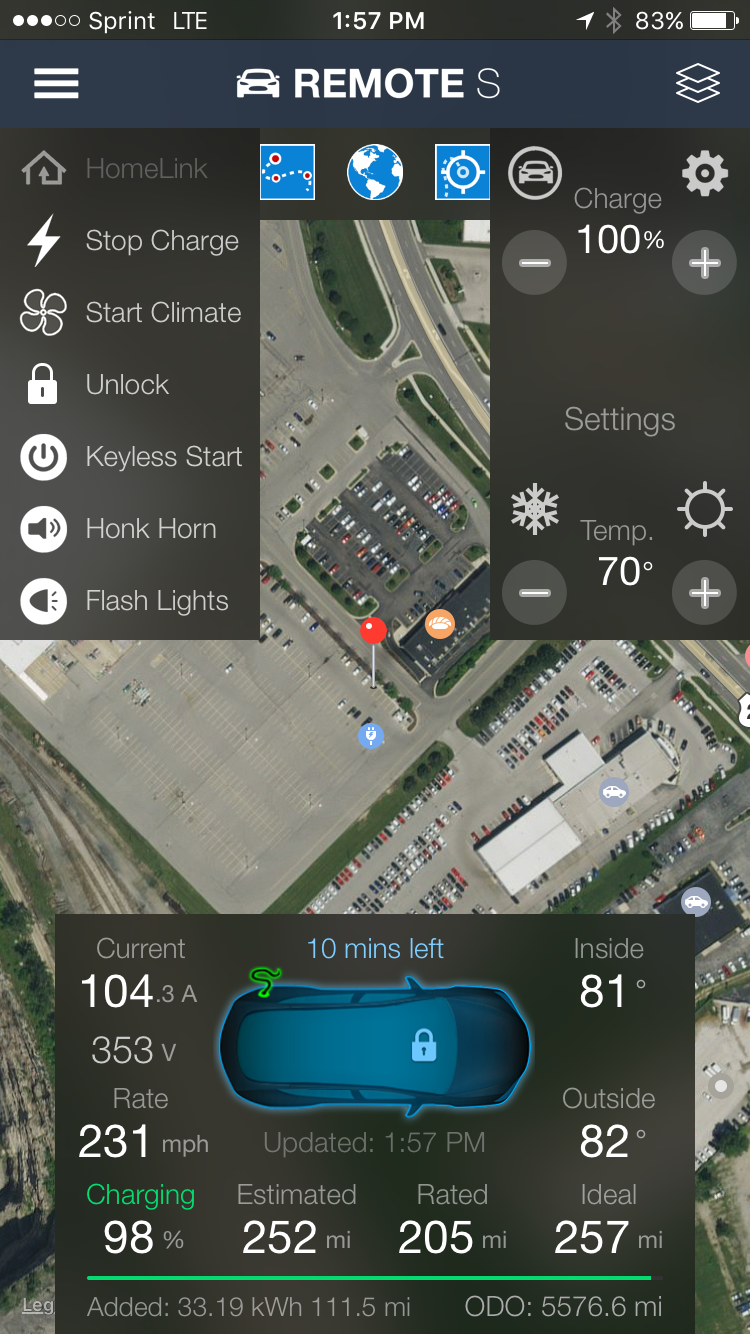
Supercharging a new 60 at the Maumee, OH station near Toledo...
This was the rate when I disconnected, fwiw.�
Sep 10, 2016
emir-t Superchargers are not that limited. Every 2 stalls of a Supercharger share a bank capable of delivering up to 135kW. Those are marked "A" and "B" on Superchargers. So when you begin the supercharging of a 14 module battery (75 or 60) you start out with 300V. So in theory you can got 430+ amps from the supercharger. However Tesla, in order to protect cells, starts supercharging on a depleted battery around 1.2C, so ~300 Amps, maximum. (If they started with 450Amps that would mean 6 amps per cell; 1.81C. Would drsatically reduce battery's life)
The increaes I'm talking about isn't drastic, maybe they added ~20-30 amps or sdded nothing at all. However they are more likely to start out with the same amperage but taper it way later. So a later taper on a 60 makes it reach 4.2V charging voltage per cell around 80% (60's 100%) and gets it there quicker compared to a 75 supercharging(early taper). If the intent was to fill all 75kWh of the pack like in 75, that ending part would take longer making no difference in the end. However with the 60 they don't care about the remaining 15kWh, so they just pump up to 80% as quickly as possible.
A 60D on 98% is getting 353V, 104 Amps. 353V divided by 84 groups in series is 4.2V, max voltage. However it is pulling a whopping 104 Amps. 104 Amps / 244Ah pack = 0,42C. When you take a look at when the old 85 pack was pulling that C rate from the Supercharger it turns out to be 81% SoC, another proof. (229Ah old pack *0,42C = 96Amps.) Also when the old packs reached max voltage of 4.2V they were pulling 0.34C, 80 Amps after 88%. 60D however reaches max. voltage with above 100Amp pull kind of proving they are applying higher overall c rates to get a quicker 80% (60's 100%)
I'm getting more and more sure about this.�
Sep 11, 2016
ggnykk That is 36.8 kw at 98%, consistent with other impressive results.�
Sep 11, 2016
u00mem9 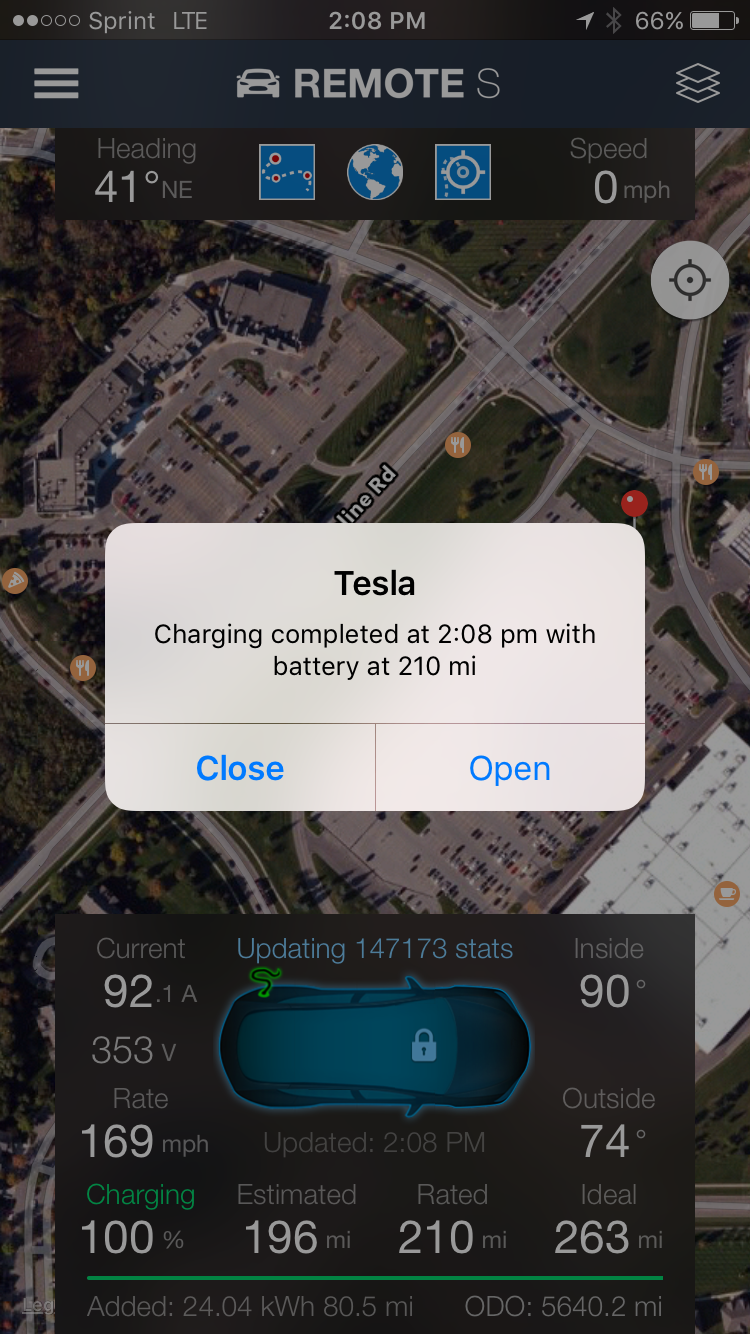
Snapped one in Ann Arbor, and happened to get it right as it hit full charge!�
Sep 11, 2016
mkjayakumar There is no way you can pump in 36 Kw at 98% SoC, if it is true 100%. I don't think we need more proof than this that you can charge a 60 to 100% everyday without any worry of undue degradation.�
Sep 12, 2016
Chopr147 Well, this issue was "settled" by consensus on another thread prior. I'm sure there will be another one. We love to argue the merits here�
Sep 12, 2016
u00mem9 Yeah sorry if I was adding old news. I was just stoked about the charge rate. Supercharged 3 times this weekend, and not once did my family get finished eating, etc. before the car was at 100%. That was really significant to me because the idea of only charging to 80% and then leaving the SC always made me a little conflicted.�
Sep 12, 2016
ggnykk 32.5 kw charging rate at 100%, haha. It used to be extremely lucky if you get 4 kw at 99 or 100% state of charge.�
1/1/2015
guest @Ingineer, I'm a Chem.E. not an EE, so I had to refresh much of my recollection of E&M and circuits. But I'm having a hard time understanding how the charging voltage can equate to the storage voltage of the battery modules (which is what you are using to determine the cell voltage, correct?) if there is also a high current. All the SpC videos I've seen have the kW start high with maximum amperage and a coordinating voltage to apply the maximum kWs. The kWs then slowly drop as the amperage drops at a faster rate than the rate at which the voltage increases. If the applied voltage is viewed as electrical "pressure", similar to fluid pressure in a fluid-flow pipe system, then the applied voltage will always have to be greater than the battery voltage to have enough electrical "pressure" to push current (akin to gal./min.) into the battery, no? If I view it as a water pump filling a water tower, the pump can no longer fill the tower once the pressure in the tower equals the maximum pressure that can be exerted by the pump. So to continue to fill the tower, the pump has to be able to increase the applied pressure so that it is greater than that of the tower. Is it not the same for a battery?
I've tried looking on the internet for a couple of days, and I'm having a hard time finding anything clear on this. the closest I've come is this video showing a power source charging a capacitor where there is a multimeter connected to the capacitor showing the capacitor's voltage along with a display on the power source showing the voltage and amperage being applied by the charging power source:
This also matches the way an alternator charges a "normal" car battery:
Alternator & Charging System Checks (Alternator Testing)
The above seems to confirm that the voltage of the energy storage unit being charged (battery or capacitor) will always be less than the voltage being applied. As the storage voltage nears the applied voltage, the current will decrease. So holding the applied voltage at the maximum fill voltage of the battery allows the amperage to eventually drop to a "trickle" as the battery nears it's "full" voltage level. So, regardless of the voltage shown on the Tesla display, which is the voltage being applied by the SpC, it seems that the amperage reading (and thus also the kW reading) is the appropriate indicator for how close the battery is to full.
Please let me know if I'm missing something. I would also appreciate if you, or anyone else, knows of a good websites that explain how a battery charges in terms of applied voltage vs. battery voltage at a given time. I'm having a difficult time understanding how the two can be the same if there is current flowing into the battery. It that were the case, then it stands to reason that you would also have to be able to have a current flow from a lower-voltage source into a higher-voltage storage unit, and I just don't see how this is possible. Any enlightenment would be appreciated.�

Không có nhận xét nào:
Đăng nhận xét