Jul 18, 2016
privater Hi, I'm on my new Model S 60 for 4 days, and I've noticed some good bits about this new Model s60:
1. You can safely charge to 100% all the time, that confirmation is from the orientation session with Tesla technician.
That means for daily usage, normal Tesla car's follow a guideline of charge around 80-90% percentage for battery longevity. This won't pose such problem on new S60. because a full charge on new S60 is only 80% of full battery, that's exactly the same percentage follow Tesla's longevity recommendation.
For daily charge considering battery longevity range comparison:
S90 is charged with 80%-90% limit only provides 72 kWh - 81 kWh range.
old S70 is charged with 80%-90% limit only provides 56 kWh - 63 kWh range.
new S60 can always give you a full 60 kWh range.
2. I went to Supercharger twice, a documented charging time shows:
went with 16 Mi left, shared a superchager port with another Model X:

It started charging from 6:30pm, and fully charged on 7:29pm, so I'd say 1 hour is almost enough to get a full charge on S60, and 40 min will give you 80% for sure.
Tesla do need to update their app though, it still shows 1 hour and 40 minutes for full charge. on car it shows 1 hour and 20 minutes.
The amperage I see is varies from 180a to 244a which is lot better than old s60 which cap around 170a


So, it's a big plus for this new 75 kWh disguised 60: the charge time is matching with 90 kWh version.
Reading from previous report: Supercharging Tesla Model S 60 kWh Versus 85 kWh - Video + Graphs
The old S60 is a lot slower. The new S60 battery is smaller but will get your cars full charge quicker. S90 does come with bigger battery, but it will need 1 hour and half to get a fully charge, and you can drive to your next supercharger half hour faster, so no time lose here.
3. It shows 60 kWh in all places in car, but you can access unlock 75 kWh online in Tesla website if you need and have money to spare later:

4, I haven't tried wall charger yet, but 48a in a single charger configuration is well suited for the S60, you don't really need a dual charger 72a upgrade for it. for comparison, the old charger is 40a, and dual charger provides up to 80a it's already fast enough with single charger.
Hope this can help you to decide~�
Jul 18, 2016
RogerHScott Presumably had you not been sharing the SpC (*) your SpC time would have been significantly less?
(*) -- what, you have more than one or two cars at a time using your SpCs there in CA? �
�
Jul 18, 2016
jlutzwpi I picked up my new 60 last Wednesday and drove from Massachusetts to New York this weekend. At one of the Superchargers I saw over 300 mph charge at over 260A. Off the Merritt it was about 220 mph with amps the same. Was significantly slower when charging next to another (A/B).�
Jul 18, 2016
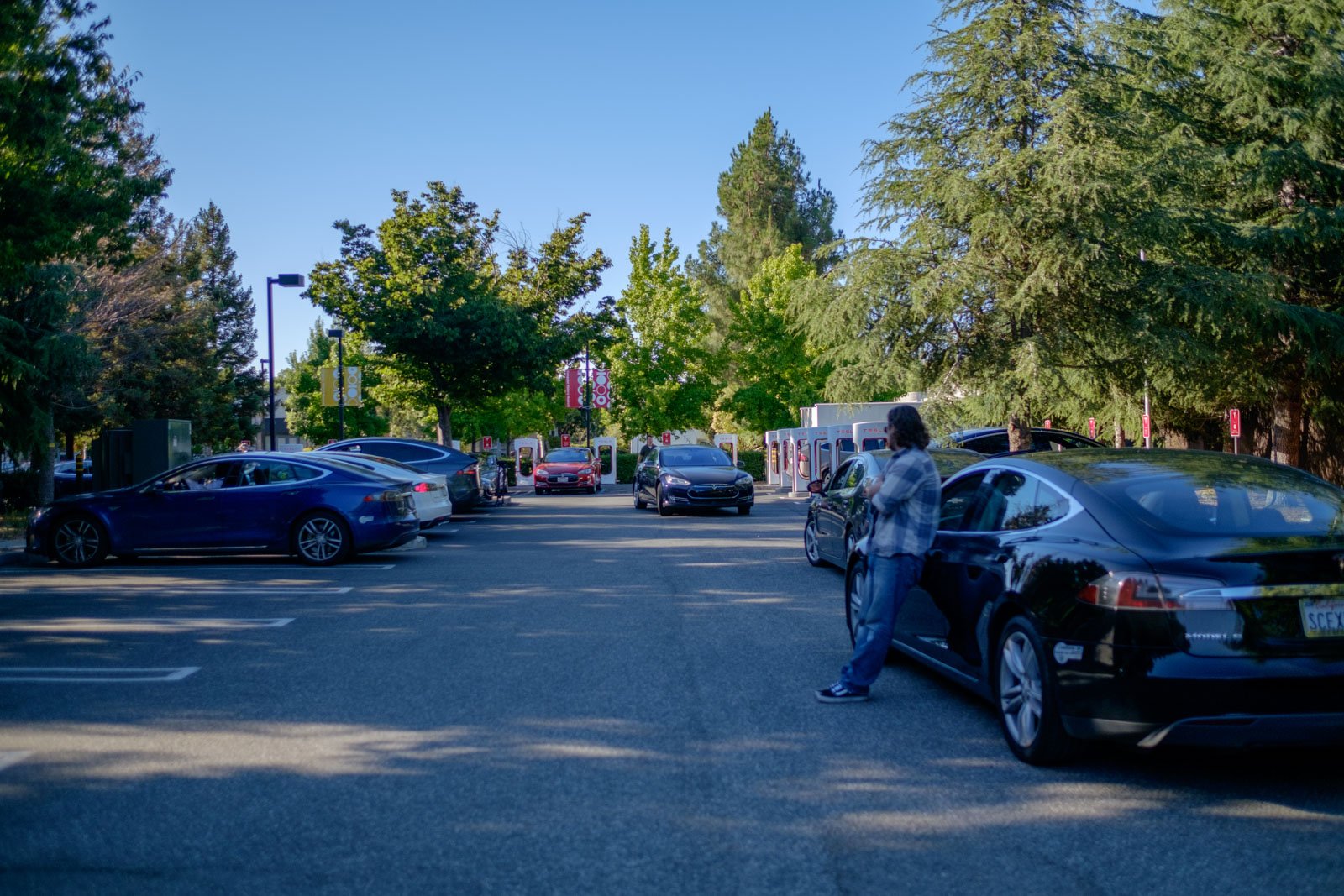
privater Yeah, CA is a crowded place, I have to wait in queue for others to leave to get a charge:
waited 10 minutes for my turn... can't imagine what will happen when Model 3 start ramp up production.
 �
�
Jul 18, 2016
privater 260A, That's amazing... Thanks for sharing~�
Jul 18, 2016
AndreSF Mountain View Supercharger? Lots of "locals" sucking up "free" electricity saving a couple of bucks...
I try to avoid that location if I can.�
Jul 18, 2016
RogerHScott Is that you with your sleek black 60 there? Isn't it beautiful? Don'tcha love it?�
Jul 18, 2016
privater yup, it's in MT view
I agree... but that's Tesla's problem, right? unless the supercharge 'pay once and free for all' business model drastically changed, people line up in Costco waiting for 30 min to save $5 in gas too.�
Jul 18, 2016
AndreSF Hmm. Screenshot above suggests OP has a red one...�
Jul 18, 2016
privater Haha, that's the guy in front of me~�
Jul 18, 2016
AndreSF Yeah, one way to view it...�
Jul 18, 2016
RogerHScott D'oh. Of course. Well, the OP clearly owes us a picture, doesn't he?�
Jul 18, 2016
privater Sorry about that, picked up 4 days ago:
 �
�
Jul 18, 2016
glhs272 A bit confused here. Your picture shows charging at 52.4kw (177A x 296V). That's slow. That indicates your charging sessions was sharing power with another charging Tesla. Your car should charge much faster than that at such a low SOC (State of charge).
I would expect shorter than an hour to go from ~8% to 100%. That's about what it takes for my old slow 60. Your screen grabs from your phone show that you were likely not getting a full rate from supercharger earlier in the charge. I think you will find your car can do better.
Also the original S60 can get up to at least 325 amps during charging(~105kw).�
Jul 18, 2016
Gizmotoy I've never seen the Mountain View charger so full. Big travel day, I guess.�
Jul 18, 2016
privater Thanks for sharing the information~ I'll try a vacancy supercharger site when possible and redo the test.
At least I know in the worst case scenario, new S 60 could make full charge within an hour even with ports shared with another Tesla.�
Jul 18, 2016
DrManhattan Just supercharged my S60 for the first time yesterday. I got 304 mi/hr peak, and 296 Amps. At 181 miles, it dropped to about 160 Amps. I went from 63 miles to 181 miles in 30 minutes. Not too shabby!
�
Jul 18, 2016
glhs272
Kman (a.k.a. islandbayy, a.k.a Chris A.) does a lot of those types of videos. You might get a jump on him if you post it sooner.�
Jul 18, 2016
RogerHScott Reading the OP a little more carefully: "I went to Supercharger twice, a documented charging time shows: went with 16 Mi left, shared a superchager port with another Model X" (emphasis added)�
Jul 18, 2016
glhs272 yeah, nevermind, I should read more carefully sorry.�
Jul 21, 2016
joeytree @privater, I received different information than you about fully charging the new S60. I recently ordered an S60D (set to hit production first week of August). I asked my delivery specialist the same question about charging, and he said that the software limitation makes 15 kWh of the battery completely dormant by taking it off line so that it's as if those 15 kWh don't truly exist. The down side is that you still should only charge to 80-90% regularly for longevity of the 60 kWh you're using. The upside is that while the 60 kWh you're using will slowing degrade and loose maximum charging potential, the 15 kWh that is dormant will not. That means that if you ever upgrade and activate the additional 15 kWh, you will have a larger battery capacity than if you had paid for the full 75 kWh up front (in which the capacity of the extra 15 kWh would degrade along with the rest of the battery).
I think this would make sense if the batteries are wired in parallel as this cite indicates (Battery Pack - Tesla Motors Wiki). If you're charging to 80%, then each set of cells in parallel is only charged to 80%. So if that is what maximizes battery capacity over time, then you would still need to charge to only 80% even if sets of cells amounting to 15 kWh were taken off line. Put another way if you have five 15-kWh cups (e.g., S75) and the idea is to only fill each cup to 80%, then closing off one 15-kWh cup doesn't change what needs to be done�namely, the other 4 cups (e.g., S60) should still only be filled to 80% most of the time.
So I would double check with your Tesla technician to make sure you have the full picture. I had the same though as you, but that was assuming the software limitation was a permanent 80% limitation on how much the battery would charge. But instead it seems that the car software charges in the same manner on both the S60 and S75, the only difference being that 15 kWh of the battery is switched off (like a physical electrical switch) on the S60.
That being said, maintaining battery life may be a bit more complicated than just charging to 80%. For example, I've had a LEAF for 3 years, and it just hit it's 30k-mile service a couple of weeks ago. In that time, I have fully charged the car every day with a handful of exceptions, and have yet to see any loss of bars in my 12-bar battery capacity meter. That may be because my round-trip commute is 46+ miles. Even driving really efficiently, I get to work with 75% or less capacity and get home with 40% or less capacity. And in the winter I get home with 30% or less capacity. So even though the car has been fully charged every day, it spends around half the time at 75% or less capacity. I've also read that charging to 80% may not be as important as trying to only charge the car when it goes below 80%. For most Tesla owners who use around 20% or less of the battery on a typical day, this means only charging to 80% if you want to keep the car plugged in all the time when at home. But if you have a really long commute, or like to drive on the aggressive side, you may use enough battery capacity over the course of a day that charging the car to 100% every night isn't an issue.
My Tesla delivery specialist also said that using the SpCs frequently affects maximum battery capacity. Adding another reason, in addition to long SpC lines, to get a Level 2 charging solution installed at home and use it most of the time.�
Jul 21, 2016
privater Hi, @joeytree, thanks for a replay, that's a huge amount of read though.
I think what you been told by that technician might be wrong. Here is the reason:
In the eye of your technician, a new software limited 60 kWh should work exactly the same with the old 60 kWh: Same battery capacity, totally dormant 15 kWh leftovers, which should conclude a same charging characteristics, right?
Let's debunk the myth.
When charging it's not the same:
Let's see how Tesla explain how supercharger doing with efficiency and time:

Thus we can concludes:
First 40 min is quickest, gives you 80% of total battery capacity. Let's call it stage 1
Last 35 min is slowest, only gives you 20% of battery capacity. Let's call it stage 2
That means stage 1 is 4x efficient thant stage 2.
Let's watch a real world S85 how to supercharge 100%:
Let me extract some screenshots:
one from stage 1 : Actual charging power 228a x 376v = 86.7 wh

This one from just jump from stage 1 to stage 2:
Actual charging power 98a x 398v = 39 wh

another one from stage 2:
Actual charging power 36a x 404v = 14.5 wh

And a screen capture from final stage 2:
Actual charging power 12a x 404v = 4.8 wh

From this real world data, I think you can conclude it's highly matching what Tesla explained in that charging graph.
Let's take a look at the real world charging on new 60 kWh:
Like I mentioned in the original post, mine is sharing a supercharger with another Tesla, so my top charging speed is cap around 60 kW, not 120 kW.
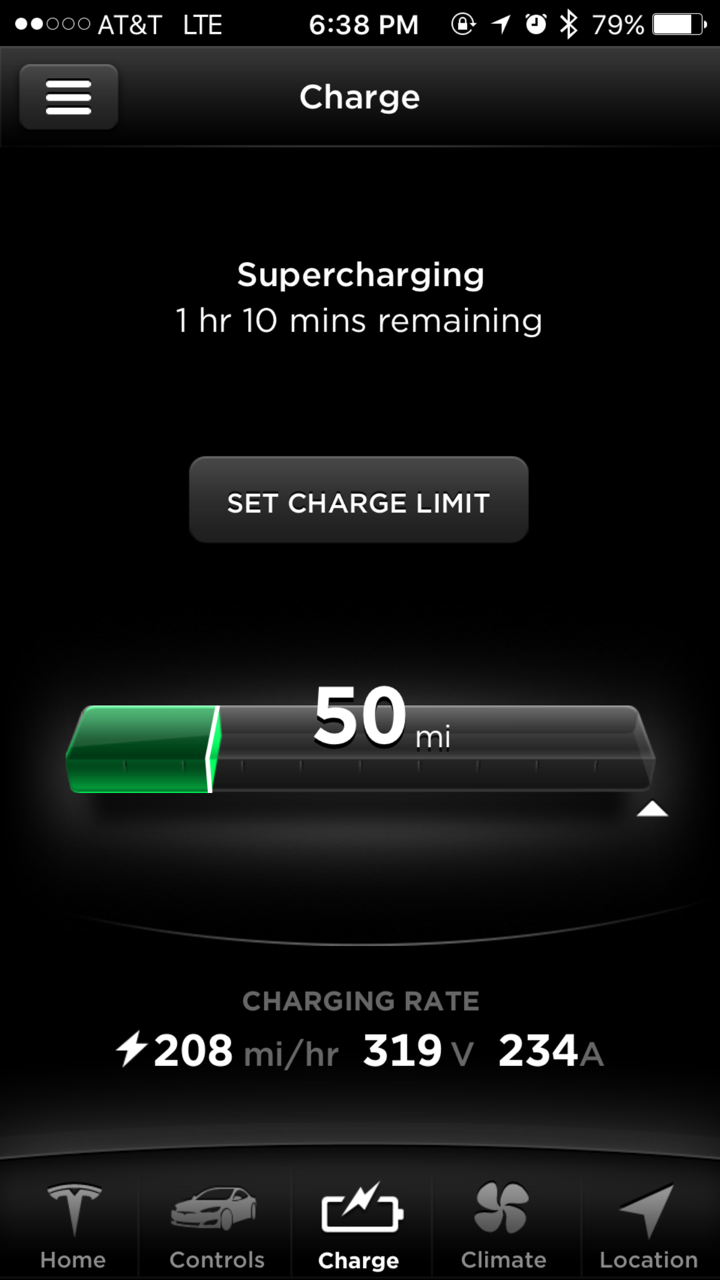
This is capture from stage 1:
Actual charging power 234a x 319v = 74.6 wh
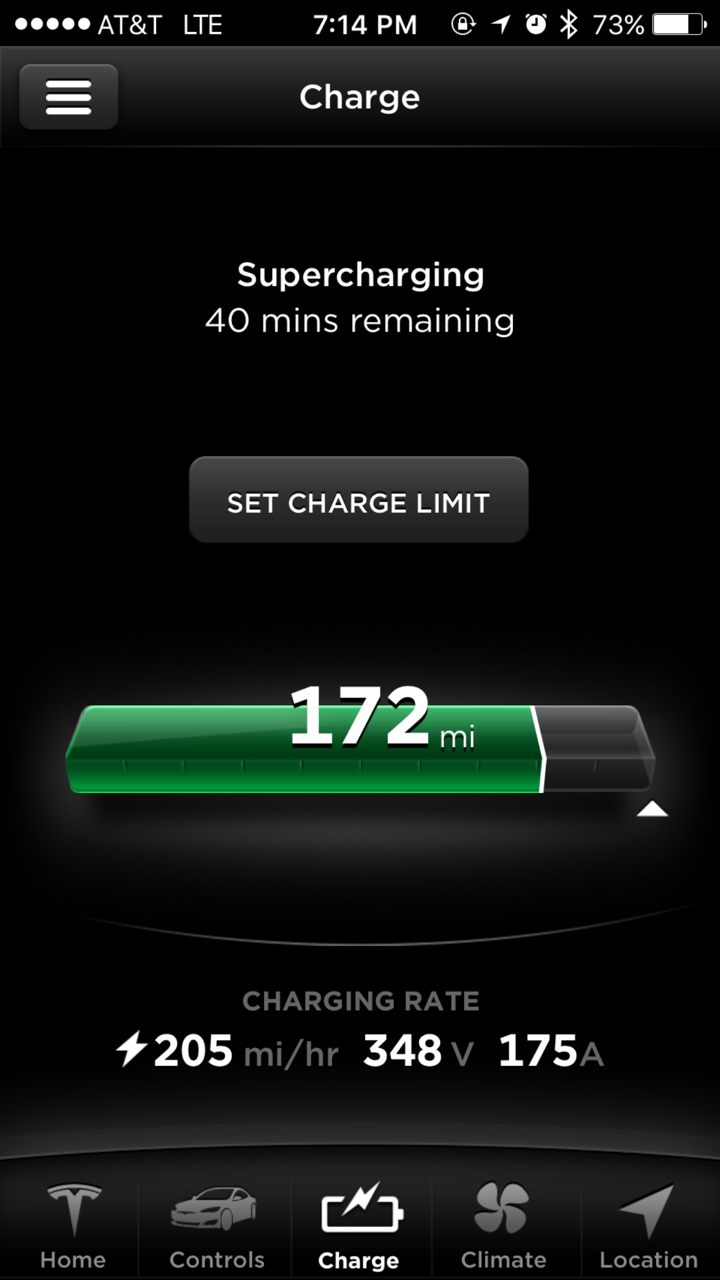
This is capture from stage 1 jump to stage 2:
Actual charging power 175a x 348v = 60.9 wh
Notice the difference? it almost doesn't stop high speed at 80% mark!
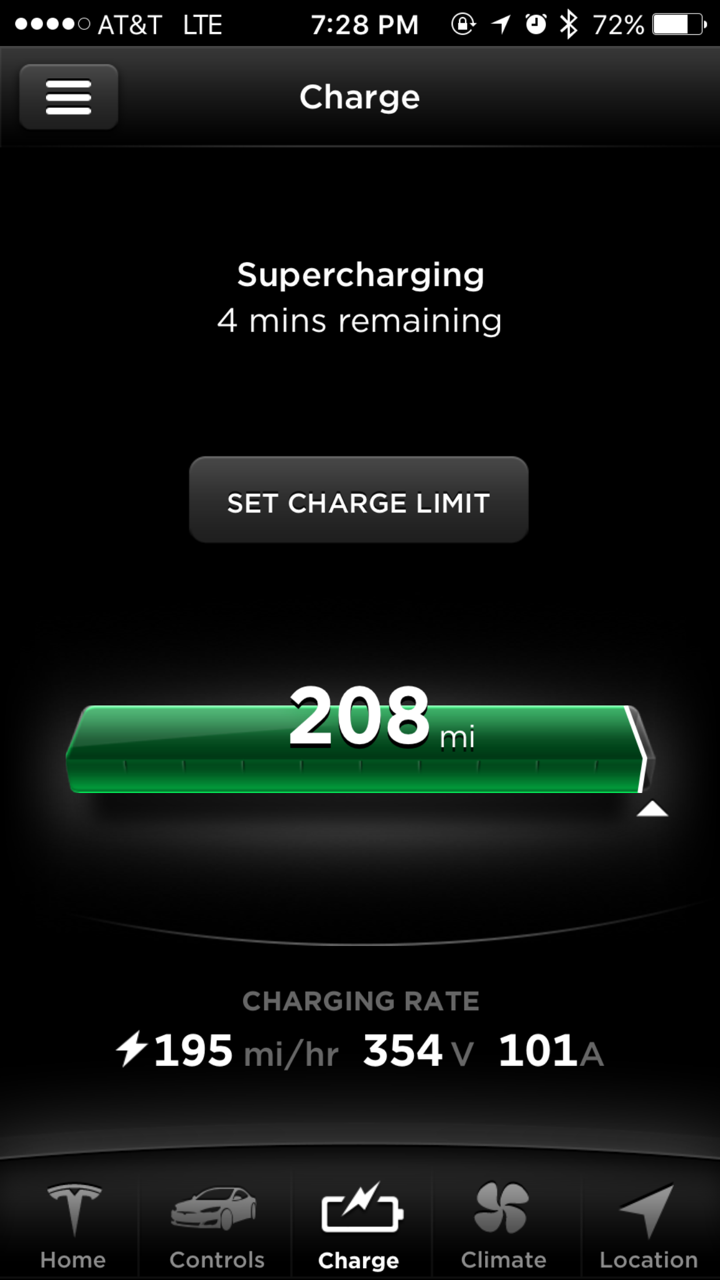
This is capture from stage 2 final moment:
It's 98% charge, but still
Actual charging power 101a x 354v = 35.7 wh
Now let's think a little bit about the result:
The new S 60 charging speed doesn't dampen much around 80% mark, and still have high speed even with last 20% capacity.
The only reason it can do that, is because it's a 75 kWh battery in supercharger eye, when approaching software limited 60kWh mark, Supercharger still sees it as a 80% charge state of 75 kWh battery. So no huge charge speed penalty.
So I'd say the technician you quote might be wrong, the real world experience more towards better side.�
Jul 21, 2016
joeytree Nice! Thanks for the data @privater! I'll have to go back and ask my delivery specialist, and might have to wait to ask one of their service technicians when I take delivery. Your conclusion is the most reasonable from the data. Otherwise the S60 would likely be charging harmfully fast towards the end.�
Jul 21, 2016
Mike K Is this Mountain View? We took a trip to San Francisco a couple months ago and I dropped by Mountain View early Sunday morning to get some juice only to be greeted by a similar situation. When a charger finally opened, it ended up being broken. I thought we had it bad in LA.�
Jul 24, 2016
Dithermaster Your delivery specialist could not be right - there is no way to leave 15 kWh of cells "dormant". They would self-discharge and become worthless.
�
Jul 24, 2016
javawolfpack More would likely do more harm to the cells if they were left dormant vs it actually charging the 75kWh battery and stopping at 60kWh effective charge limited by software. The majority of DS/technicians/articles seem to indicate that it's safe to charge to 100%, mind you Tesla likely would prefer this to be less known as reduces our incentive to pay for the upgrade later as this provides a better daily effective range w/ out paying extra.�
Jul 24, 2016
Three60guy Talking with a Tesla Tech in Chicago who specializes in Tesla batteries, confirmed that my software limted MS 70D with a 75 kwh physical battery (like the 60D) can be charged to 100 percent all the time without any fear of long term longevity issues. I see no reason to upgrade to 75 kwh.�
Jul 24, 2016
ShockOnT This is very interesting because I have a software limited 70D on the way. I suppose I can get away with regular 90 or 95% charging.�
Jul 24, 2016
ucmndd I think the most damning evidence for suggesting that all of the cells are used is the identical performance characteristics of the "60" and software unlocked "75".�
Jul 24, 2016
SageBrush No doubt about it -- a software limited to 60 kWh, actual 75 kWh battery is quite a perk compared to a real 60 kWh battery.
How is the buffer handled ? Is it part of the "unused" 15 kWh ?�
Jul 24, 2016
Canuck I'd like to see the "Set Charge Limit" screen on the new 60. Does it show a "Daily Driving Range"? If so, does it end at 90%?�
Jul 25, 2016
jlanceho Yes, it ends at 90%.�
Jul 25, 2016
Chopr147 Not the first one to get bad information from the Tesla rep.'s. I will give them a break though because they are learning about these cars , batteries, AP, software, solar etc..............as they go. Many recent hirees and mostly young (won't hold that against them )
I spoke with a DS at Manhasset NY and two others appeared to be "in training" and were a little light on details. But all seem to be eager and overly friendly�
Jul 25, 2016
Canuck If I had a 60, I would go with this (which is what Tesla "officially" recommends right in your vehicle's settings) unless I needed extra range. You want to cycle around 50% to avoid degradation so unless you do a lot of daily driving, even if the extra locked out portion is at the top, you probably should charge less than 100%.
How to Prolong Lithium-based Batteries - Battery University�
Jul 25, 2016
Master One There is just no point in limiting charging of a software-limited battery with a 15 kWh buffer even further. When the new S60 shows 100% it's actually 80%, that's definitely of no harm for battery life and good for daily charging. So I'll be charging whenever possible and alway till "full" (so 80% of the real total capacity), keeping the charging cycles small, which is way better for the battery than larger or full charging cycles. I am confident that I will not have to worry about premature battery degradation that way.�
Jul 25, 2016
Canuck The ideal is to have charging cycles around 50%. So small charging cycles starting at 80% is only ideal if you arrive home with 30%. If not, then 70 or 60% may be better (or whatever the number so you cycle around 50%).
Also, if 100% is "definitely of no harm for battery life and good for daily charging" then it's odd Tesla recommends 90% max in your vehicle. Sorry, but I'd go with Tesla over someone's advice on the internet.
Lower charge voltages prolong battery life and electric vehicles and satellites take advantage of this. Similar provisions could also be made for consumer devices, but these are seldom offered; planned obsolescence takes care of this.�
Jul 25, 2016
Master One @Canuck, the point here is that displayed 100% in the new S 60 is actually 80% of its real 75 kWh battery capacity, displayed 80% are 64% of its real 75 kWh battery capacity.
Cycling around 50% may be ideal, but cycling below 80% of the real battery capacity (which actually means below 100% displayed) isn't far from ideal. You would not start charging at real 80% but charge until real 80% (because that's the charge limit implemented by software).
There is no point in "Tesla recommended 90% charging" because that's only valid for Tesla models with unlimited battery capacity.
Our local Tesla Service Center has already confirmed that this information is correct, hence you can charge to displayed 100% at any time without fear of a negative impact on battery life, because in the new S 60 that's only 80% of the real 75 kWh battery capacity!
BTW General guides on charging regular consumer batteries are less useful in connection with EV batteries, because EV batteries are handled and protected by a BMS (= battery management system), however consumer batteries are just plain cells.�
Jul 26, 2016
Canuck I understand the point but if you drive using 28% of the battery daily, then charging to 80% (which is 64%) is better for battery longevity than charging to 100% (which is actually 80%).
BMS does not change the inherent characteristics of lithium ion batteries -- rather, it mitigates them. But when you say BMS, you probably mean TMS (thermal management system) since that does most of the degredation mitigating as heat is the very good friend of degradation, especially when you combine heat with charging -- hence the problems with Leaf batteries in hot climates. The link that I referenced specifically mentions EV's. Cyling around 50% is best for lithium ion battery life and the shorter the cycles the better. Those facts don't change regardless of BMS or TMS.
I've been around here long enough to have heard that statement mentioned a number of times when the information is later proven wrong. But even accepting that it is correct, charging to 100% (even if it is in fact 80%) isn't ideal for battery longevity for someone with a new 60 and short daily commutes. I just want to make sure people understand that and can decide what is best for them. I doubt in the long run the difference will be all that much but if it was me, and I didn't need the full range daily, I'd keep my slider in the range recommended in the vehicle.
(BTW, I was in Salzburg recently with my family and we really enjoyed your country.)�
Jul 26, 2016
FlatSix911 Good analysis - well done
�
Jul 26, 2016
Master One @Canuck, indeed, thinking more about it, I will just leave the charge slider in the 80% position for our daily drives in town nonetheless, which should keep charging cycles between displayed ~50% and 80% (so that's between ~40% and 64% actual charge then). The new S 60 offers enough range for our usage case that we do not have to worry about it anyway.
A more serious concern than battery life in the consideration of regenerative braking, because we live on a hill, which means every time we leave, we go downhill for about 1 km first. If I would charge to 100% (= actual 80%) and the software-limitation of the 75 kWh battery does not allow regenerative braking in that condition, I would have to go all the way down with using the actual brake, and that's really not what I have in mind.
Can someone with a new S 60 answer the following questions:
Of course I want what's best for the car, we have a very long holding period in mind.
- Is it true, that regenerative braking does not work when fully charged (= 80% of the actual battery capacity)?
- Is generative braking fully working with a charge level of displayed 90% (= 72% of the actual battery capacity), or is generative braking limited in that condition the more the charge level is to displayed 100% (as it is with our Nissan LEAF)?
�
Jul 26, 2016
MSullivan I wish NH was a little more crowded. I have been to a charger four times and seen a total of zero other Tesla's whilst there. I wanna look inside an X.�
Jul 26, 2016
Master One I'd make an appointment for a X test drive at your local TS (in fact, I just did�
Jul 26, 2016
jbumps While this isn't overly helpful now and I certainly would hope you'll get a look at one sooner - I'll be headed through the West Leb SC for Thanksgiving and would be happy to alert you to my ETA.�
Jul 26, 2016
jbumps I realize this isn't an ideal location for this question (search yielded nothing relevant) - how can a forum member 'react' to another's post? i.e. 'like', 'dislike' etc... I've been a member for a couple of years, but lack much activity as we hadn't become owners until ordering last week.
Thanks in advance for any assistance.�
Jul 26, 2016
jlanceho I have a new S 60.
1. I have never tried charging to 100%, but I read somewhere else on this forum that regenerative braking does not work when fully charged. I believe the regenerative braking is software limited at 100% charge.
2. I charge to 98% to avoid limitation (1) above. I have not noticed any limitation to regenerative braking at 98% SOC.�
Jul 26, 2016
Master One It would be great if you (or someone else with a new S 60) could try (1) and maybe some other experiments.
For (2), that's interesting. Our Nissan LEAF does not even allow full recuperation through regenerative braking when around 90% battery charge. The LEAF has those double circles showing the level of regen braking with a max of 30 kWh on recuperation. Around 90% charge one or two of the double circles to the left are missing, hence it does not recuperate with 30 kWh any more, but only with less.
A Tesla can recuperate more with regen braking (up to 50 kWh?), so I would assume it also limits recuperation the higher the battery charge level is. Recharging the battery with up to 50 kWh from regen braking when at 98% charge definitely would not be healthy for the battery cells, but then again with the new S 60 a displayed 98% charge really is just 78.4% of the battery capacity.�
Jul 26, 2016
MSullivan We are heading to Ct. next week. Think I will schedule a test drive at Natick.�
Jul 26, 2016
hybridbear While it's true that 60 / 75 = 0.8, wouldn't it make sense on Tesla's part when limiting the 75 kWh battery to 60 kWh to increase the minimum SOC by 10% and decrease the maximum SOC by 10%? Do we have any authoritative information that the software limited 60 kWh car has the same lower SOC limit as the 75 kWh car? Since extremely low SOCs, and thus low cell voltages, put the cells at risk of degradation due to stress because of the lower cell voltage.�
Jul 26, 2016
BigAirHarper When logged in, you will see the variety of icons in grey at bottom right hand side of every post. Click icon for reaction you want to provide. HTH�
Jul 26, 2016
jdw I also wondered that, but also because the battery management system balancing is not triggered until ~93% charge on an unlimited battery. I suppose the balancing point could be adjusted when in 60kWh mode, but then there is also the "problem" of not allowing a stranded driver to actually use the 10% charge remaining ...
It would be interesting to know what portion of the battery is accessible and where battery balancing kicks in on 60/75kWh cars.�
Jul 26, 2016
Jlwine I received my new Model S 60D last Wednesday--and I love it. When I ask a highly trusted Tesla employee (I will keep it generic) he told me that the official Tesla answer is not the same as the factual answer. The factual answer is yes you can charge to 100% daily as you are in fact only charging to 80% of the true 75kWz capacity. My experience backs this up, as I do not experience significant slow down in charging of the last 20% of the battery's 60 kWz "capacity." Also, I have not experienced any degradation in regen when fully charged to 100%.�
Jul 26, 2016
Master One The battery limitation is applied to the top end, which has already been confirmed by charging data (no point in limiting at the bottom, it would increase charge time at the SuC).�
Jul 27, 2016
jbumps Thanks for the help. Turns out I was short of the 6 post requirement to gain access to those features.�
Jul 27, 2016
Yonki Great observation/thread! Has anyone done a similar comparison of the 90kWh battery to the 85 to see if the 90 might actually be a software-limited 100?�
Jul 27, 2016
Joostdz This is a great thread, I am almost ordering a Model S60(D) (in the Netherlands), but the fact that you can charge to 100% makes this a sweet deal, no need to spend extra on the 75.�
Jul 27, 2016
NikeWings Yah, I made THAT mistake and ended up ordering an X. No more test driving for me.�
Jul 27, 2016
Chopr147 You have been warned. I was warned by this forum before taking a test drive and now I'm waiting on delivery�
Jul 27, 2016
Master One Yeah, it was really bad. Sat in a X last Friday during The Tesla On The Road Event, they didn't let me drive it because X test drives were fully booked, but I immediately wanted one! Went completely nuts, played around with configurations on the mobile, envisioned bringing the kids to school with the falcon wing doors opening, called a leasing company for some offers, before reason came back. Our S just went in production the day before, and the X would clearly have gone over budget, mainly because we would have lost input tax reduction. The new S 60 is just great and a real bargain, the X 60D however suffers from the reduced range, so you clearly want to go for the X 90D. I love bargains, still going to do the X test drive though...�
Aug 8, 2016
kaypay @privater: thanks for sharing your charging data.
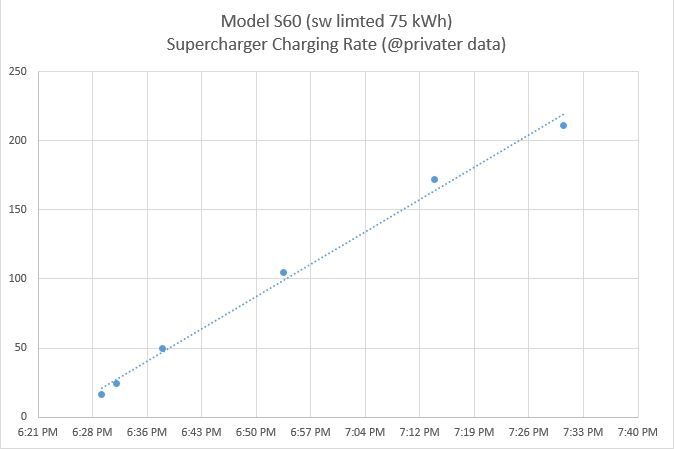
I took the time and range values from your original post and threw them into Excel. Almost perfectly linear increase in range over time, but most importantly, very minimal tapering at the top end. Great news for new S60 / S60D owners.
 �
�
Aug 8, 2016
Kenriko Anyone who has worked with multiple battery packs (series or parallel) knows that you need to try and keep the battery levels as even as possible, discharge as even as possible and keep cycle count the same. Also take into account that the charge system can't just "ignore" that 15kwh as it needs to keep the cells charged and even to maintain them. Trust me, the full battery pack is being used just software capped when charging to 80%.�
Aug 9, 2016
kaypay The charging times show they definitely are limiting the 75 kWh battery pack in the s60 at the top end so that you do not see a taper in the charge rate. I think the only open question is whether all of the 20% that s60 owners are prevented from using is at the top. While simply limiting the battery to 80% state of charge would be the simplest (and probably most likely) mechanism to achieve this, it could be they are limiting something like the top 15% of the charge range and the bottom 5%. By placing some of the limitation at the bottom end, they would protect the pack from over discharge. Given that a fair number of the s60's will be lease vehicles and Tesla can "unlock" these packs when they (re)sell them after the lease ends, Tesla does have some incentive to put some of the buffer at the bottom end of the range to help protect the packs.�
Aug 9, 2016
SageBrush Thanks for the detailed posts.
FYI -- amps*volts = watts.
So e.g.,
175a*348v = 60,900 watts = 60.9 kW
It terms of watching the battery charge rate as the battery fills up, it is simpler to use the miles/hour number Tesla supplies on your screen. As you point out the rate (of about 200 miles/hour) is pretty constant.�
Aug 9, 2016
freeewilly I'm getting mix information from another thread. The software capped S40 with 60 kWh battery are getting less mileage over time.
I'm wondering how does Tesla software calculate battery degradation on the new S60 with 75 kWh battery.�
Aug 9, 2016
kaypay Not sure I fully understand your comment, but the fact that owners of software limited batteries are seeing some (presumably normal) levels of degradation is not necessarily surprising. If Tesla is limiting the state of charge (SOC) of the battery to 80%, as the battery experiences its normal degradation (which will happen to a certain extent even if the battery is never charged above 80% SOC), the range at 80% SOC will see some reduction too.
I haven't thoroughly read the S40 with 60 kWh battery related threads, but the few I have seen the owner seem satisfied with the battery performance. Are some owners seeing significant degradation issues with their software limited S40s?�
Aug 14, 2016
kr200 I'm sure it's just limited to a fixed % of the 75kwh battery so would show proportional degradation. That's how the 40's worked.�
Aug 21, 2016
FloridaScott I have an appointment to test drive an S tomorrow. This thread was very helpful, thank you everyone. I'm going to order the 60 based on the information here, I don't see the benefit in paying for the 75.�
Aug 21, 2016
javawolfpack Enjoy the test drive!! Definitely sold me that the entry level battery was still an amazing car!! And don't forget to make use of a TMC member's referral code if you choose to order one between now and Oct 15th. Will save you $1000 USD off the price.�
Aug 21, 2016
fsubrett48 Where in Florida are you? The Tesla team was great in Boca Town Center.�
Aug 21, 2016
fallen888 I test drove and couldn't get the MS out of my head after that. I was hooked and ordered the 60. You'll love it. Use my referral code to get $1,000 of your order - Referral | Tesla thanks!�
Aug 22, 2016
Jlwine I have had my new 60D for five weeks. Three Supercharger visits and every time no appreciable reduction of charge rate as it reaches 100%. I have also asked two separate employees and "unofficially" they both confirm that the assumption that charging the software limited 60 to 100% is the same as charging the 75 to 80%, thus no harm.�
Aug 22, 2016
mkjayakumar That's excellent�
Aug 23, 2016
Cnasty Mine said to definitely not do it to 100% on pickup yesterday and stay in the happy zone of 50-90%.
I am scared to go to 100% everyday!!! I really don't need to but 210 miles looks prettier than 189.�
Aug 23, 2016
TSLATed If you're interested in "looking pretty"... then just change from "Rated Range" to "Ideal Range" in controls -> settings. If you have an S60 it will "add" about 50 miles of "range" displayed on a 90% charge.�
Aug 23, 2016
Cnasty The pretty part was sarcastic but you piqued my interest. What's the difference between ideal and rated?�
Aug 23, 2016
TSLATed Copied from another thread:
Ideal - how far the car will go if driven at a steady 55 mph on level ground at moderate temperatures.
Rated - how far the EPA says the car will go given their tests. Equals 88% of Ideal. Just a slightly more conservative version of Ideal.�
Aug 23, 2016
RogerHScott Congratulations! There seems to be a growing consensus that the new 60s are really great.
How is that possible? If you start at 100% and add charge via regen, what % does that leave you at?�
Aug 23, 2016
RogerHScott Since that was two days ago, can we safely assume you've already placed your order?�
Aug 24, 2016
Chopr147 Same here. Pretty quick all the way to 100%. The DS on pick-up agreed 100% will not do any damage but Tesla "official" stance is 90%. Whether it's to avoid confusion or just a way to encourage 75 kwh purchases is unknown. My guess is sales. Certainly not worth $8500 for an extra 8-15 miles doing the 90%-90% math�
Aug 24, 2016
Cnasty I guess with all the feedback here I will go 100%!
Not sure I need to but may try for a while.�
Aug 24, 2016
jelloslug Here is my charging speed at my local Supercharger on my 60D:
![[?IMG]](https://lh3.googleusercontent.com/blogger_img_proxy/AEn0k_ukf0bpAcoW-bwkewog3nYo2rCIyHA4EyG4MSSEkuABTb-09HZ80iU0Pr3eaJn6f_cg95uhb67IeSU9EzsVLL5gJ-IZeqCV6WZtnQ=s0-d)
As I hit 100% I was still pulling 60 kw from the Supercharger.�
Aug 24, 2016
mkjayakumar Can someone clock (close to) 0 to 100% and post the elapsed time ?�
Aug 24, 2016
Zeromus-X Wow! I rarely go past about 250mi/h. I think the Vacaville supercharger is the slowest one out there.�
Aug 28, 2016
Pawilson3 This is a great summary and consistent with info I was given recently by an owner advisor.�
Aug 28, 2016
jelloslug I can say that my 60D does not taper as much as the 2013 85 that we have at work as it reaches 90 to 100%�
Aug 28, 2016
emir-t What about the usable energy of the 60?
Tesla usually limits packs to 95% DoD to prevent over discharge from the 'actual' capacity of the pack, not the marketed one. For example;
85 pack - 3,1Ah * 3,7V * 74S * 96P(16 modules in 6 group) = 81,4kWh --> 95% DoD = 77kWh. Consistent wth people's use.
Upgraded silicon anode 90 pack - 3,3Ah * 3,7V * 74S * 96P = 86,7kWh --> 95% DoD = 82,3kWh.
My guess for 75 --> 3,3Ah * 3,7V * 74S * 84P (14 modules in 6 groups) = 75,8kWh --> 95% DoD = 72kWh usable.
So if Tesla is limiting it actually 20%, usable energy should be about 57,5kWh. But it may be so that they limit usable energy to 60kWh, in that case 100% on a 60 would actually be 83%. I think usable energy is important because that is how I estimate my range. If I can get a realistic 320Wh/mi in a 60D, I'd actually get ~180mi range. To get 200 I'd need to average 287Wh/mi, not impossible but certainly not an everday occasion.�
Aug 28, 2016
Chopr147 Alot of back and forth here on this issue. The consensus seems to be charging the 60 to 100% all the time will not do damage to the battery due to it being a 75. So you really get the full capacity out of your 60kwh making it an even better deal�
Aug 28, 2016
Cnasty I'm still scared though as it is unproven and doubt we will ever see if there is a legit way to prove it.
I do go to 100% on a busy errand Saturday or of course trips but not daily as my commute is only about 35 miles round trip.
I do love the flexibility though and confirms the 60 is plenty for me and a hell of a lot of car for the price.�
Aug 28, 2016
MikingCO I posted this a few weeks ago: Refreshed 60 Supercharging Info�
Aug 28, 2016
180r Yes, so many stalls with issues at Vacaville. I hope people keep calling issues in to Tesla when they experience unusual slow charging there.�
Aug 28, 2016
mkjayakumar Thank you. Your data is from 24% to 100% with an unexplained dip in amps in the middle. So I am guessing a 0 to 100% with the expected ramp down of a 75kWh will take no more than 1 hour? Or even quicker maybe ?�
Aug 28, 2016
MikingCO TBD on the amps. I'm going to log the data again next time I SC. However I highly doubt that charging a 75 will be faster because why would it be?�
Aug 30, 2016
Pawilson3 Thanks for taking the time to record the data and post! Looking forward to the next data set.�
Aug 30, 2016
MikingCO She's in the shop this week so it'll probably be next Thursday before I can try again.�
Aug 30, 2016
??ELECTROMAN?? Why in the shop? How old is this car?�
Aug 30, 2016
MikingCO Almost 60 days. On day 8 someone backed into the front bumper in my office parking lot...and then bolted. I'm getting her fixed and the bumper repainted. My heart still hurts.�
Aug 30, 2016
Alketi Does anyone have the 75kWh option yet? If so, can you report the pack voltage when charging to 100%?
This will be the key point in calculating whether or not Tesla has made any stealth upgrades to individual cell voltages. Really good to have this piece of data.�
Aug 30, 2016
??ELECTROMAN?? That's some horrible luck. I was worried it needed some mechanical repairs already.�
Aug 31, 2016
ggnykk So based on your data, 100% SOC is at 35 kw charge rate. So it basically confirm that refresh 60 kwh battery is a 75 kwh battery software limited at 80%.
But I must say that 35 kw at 100% soc seems a bit low though, while other people are reporting higher number.�
Aug 31, 2016
Xenius Do we need more data? I'd be happy to run my 60D down and hit up the Newark supercharger for some data. If this is still needed/wanted someone please quote me or @ me here and I'll schedule a time to do it.�
Aug 31, 2016
Ibrido Battery capacity is 75kWh so charging 60kWh to 100% is anyways not charging to 100%, safe. You will not be able to charge to 100% if you upgrade to 75kWh !!�
Aug 31, 2016
MikingCO Well it needs that too. I'm dropping it off at Tesla next week:
The sunroof opens very shaky the first few inches.
The front door handles aren't quite aligned so the paint under the handles is chipping.
The rubber around the rear windows isn't installed right.
The Velcro under the driver's floor mat came unglued.
I think there are one or two additional items but I can't recall off the top of my head.�
Aug 31, 2016
??ELECTROMAN?? Damn, I thought they had the Model S all dialed in. I guess they dial them in after delivery. Good thing my service center is near by.�
Aug 31, 2016
emir-t Wow, I thought they got way over production issues in 2016. I was very confident in the build quality of the S at least in this second half of 2016. I know of someone who has a misaligned lift gate in their 2015 P85D and their tail lights are fogging up with moisture and the sunroof has a pool. Service centre in Munich patched the sunroof but it didn't help, tail lights are worse after service and they said they couldn't do a thing about misaligned lift gate.
I also know someone with a 2016 P90D built April '16, build quality was perfect. So I'm surprised you have issues with a 60D.�
Aug 31, 2016
MikingCO Yeah, the Denver service center is literally 2.5 miles from my office.�
Aug 31, 2016
ggnykk We need more data. We basically need to know the kw (volt x amp) number in every 10% increment state of charge.�
Aug 31, 2016
ggnykk So according to the 5 screen shots that you show, the fastest charging speed you ever got was 75 kw (319 x 234 / 1000) even at very low SOC. That is really slow.�
Aug 31, 2016
ggnykk Charging rate is all about Power (unit is kw). This is the wrong graph. Come on guys, you can't own EV without knowing Power [watt] = current [amp] x voltage [v].
kw = (amp x v) /1000.
Some people also confused "miles/hour" on the screen means charging rate, which is wrong also. The "miles/hour" is NOT an instantaneous number, it is just an average over the entire charging session. Power in kw is instantaneous number, and this is the number you should be looking at. Not the amps, not the volt, not "miles/hour". All the reports about "i am not seeing much slow down near 100%", I kind of doubt the newbies here even know what they are talking about. Show us all the data in kw, then we will know for sure.
By the way, why is couple of the supercharging test done here actually shared the same charger with another Tesla?? You can't park next to an empty spot to do a real test?�
Aug 31, 2016
privater Best I've seen with standalone stall is around 96kw from lower 10% to 40%, due to this fourm limitation, I can't edit and show you my latest findings.
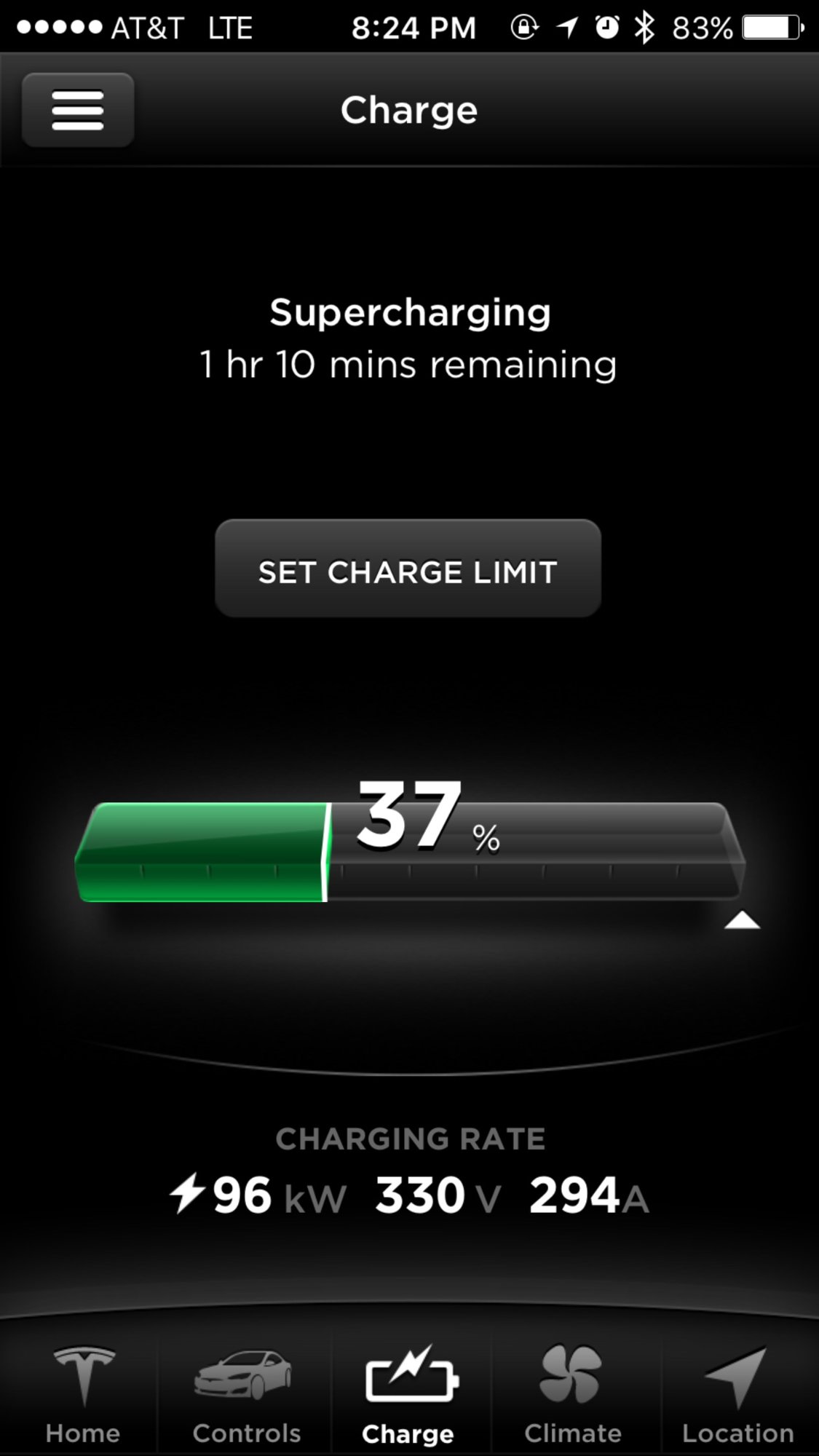
California is such a crowded place, What can I say. People waiting in queue for 30 minutes for a charge. No luxury to get a standalone stall for test.
From Bj�rn Nyland's video, Top 10 busiest supercharger at that time 6 are in California.
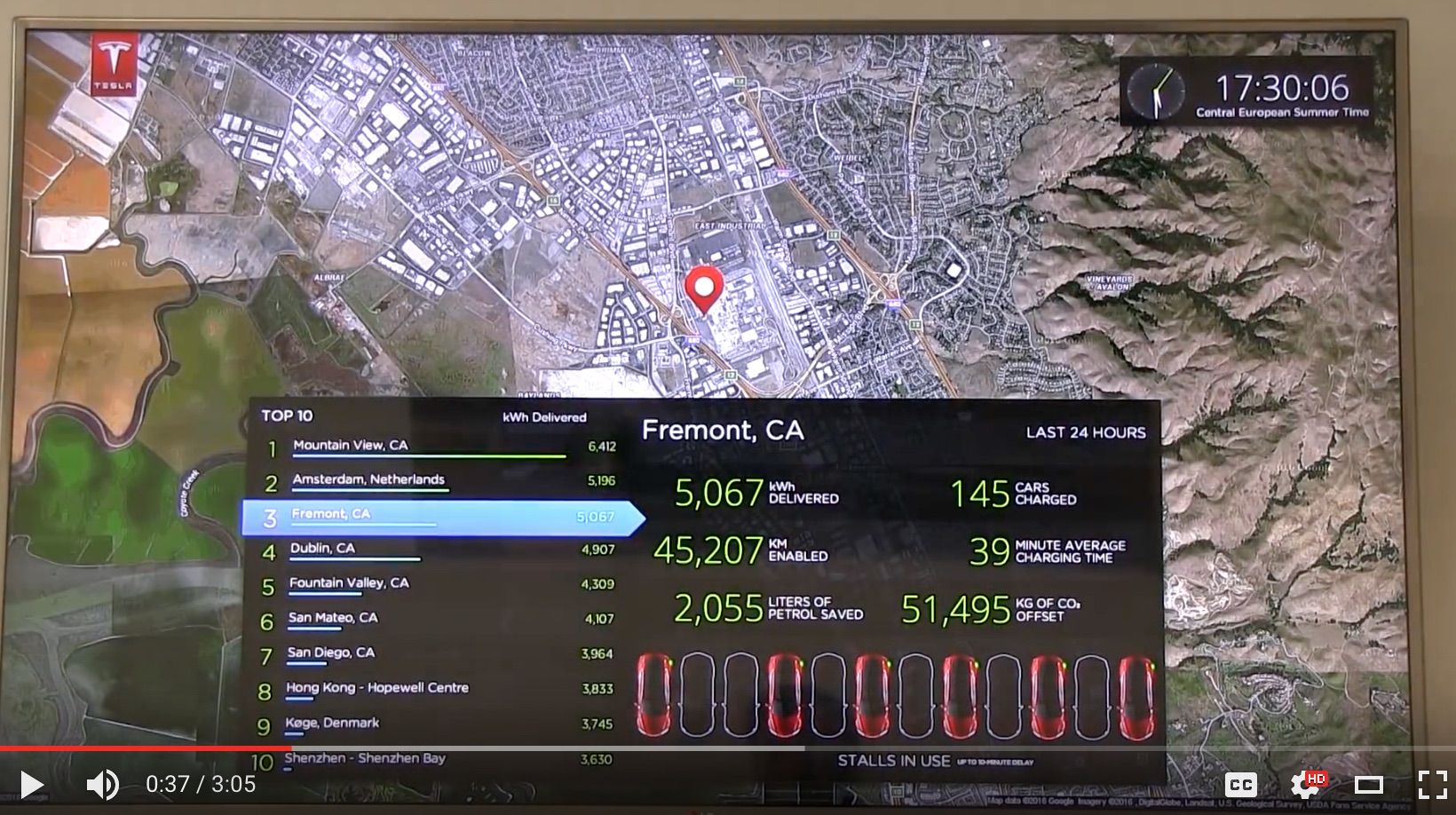
waiting for a spot is pretty norm here if you ask me.

So please ask nicely, I'm sure someone have time to answer your question.�
Sep 1, 2016
Xenius Alright, will attempt a burn down to near zero and sit with the car for the charging. Going to use Newark, DE for the test.�
Sep 2, 2016
Xenius So I didn't have time to do this last night. I'm doing a trip up to upstate NY this weekend, so I'll log some data while we're charging. I may not be able to get all 10% increments, but I'll log what I can. Stay tuned.�
Sep 2, 2016
emir-t Thanks for doing this. Could you also share with us SoC % used vs. energy used in kWh? Longer and more uninterrupted its driven the better. I wonder if the usable part of the 60D is actually 60kWh or ~55kWh.�
Sep 6, 2016
Xenius Being with the wife for our trip this weekend I wasn't able to take the data I wanted. I'm currently sitting at 25% charge or so right now. I may pop down to Newark after work today depending on traffic (it's *sugar* around here and school just started).
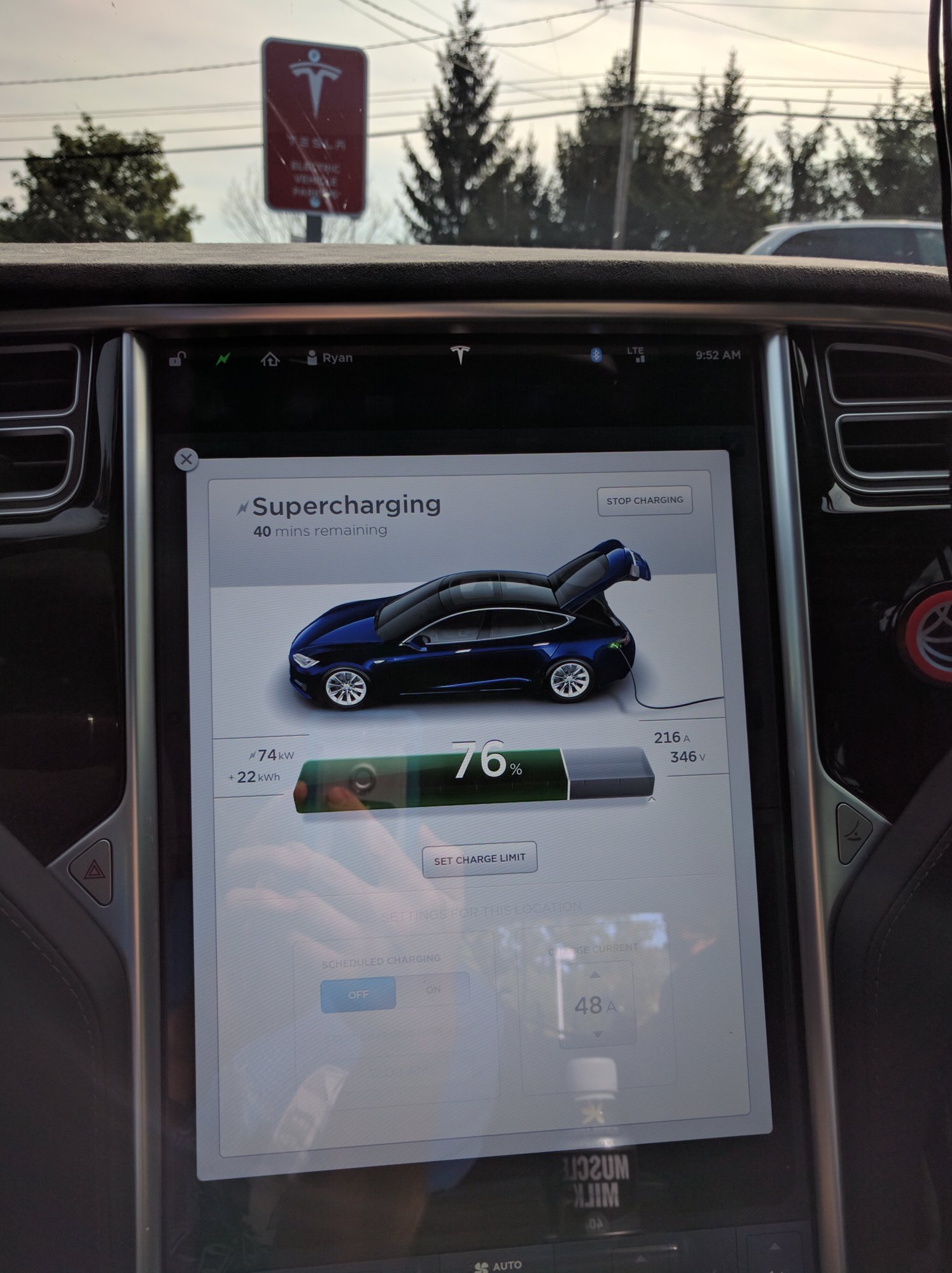
Anyway, here's some screenshots from the SuperCharger at the Albany, NY supercharger.

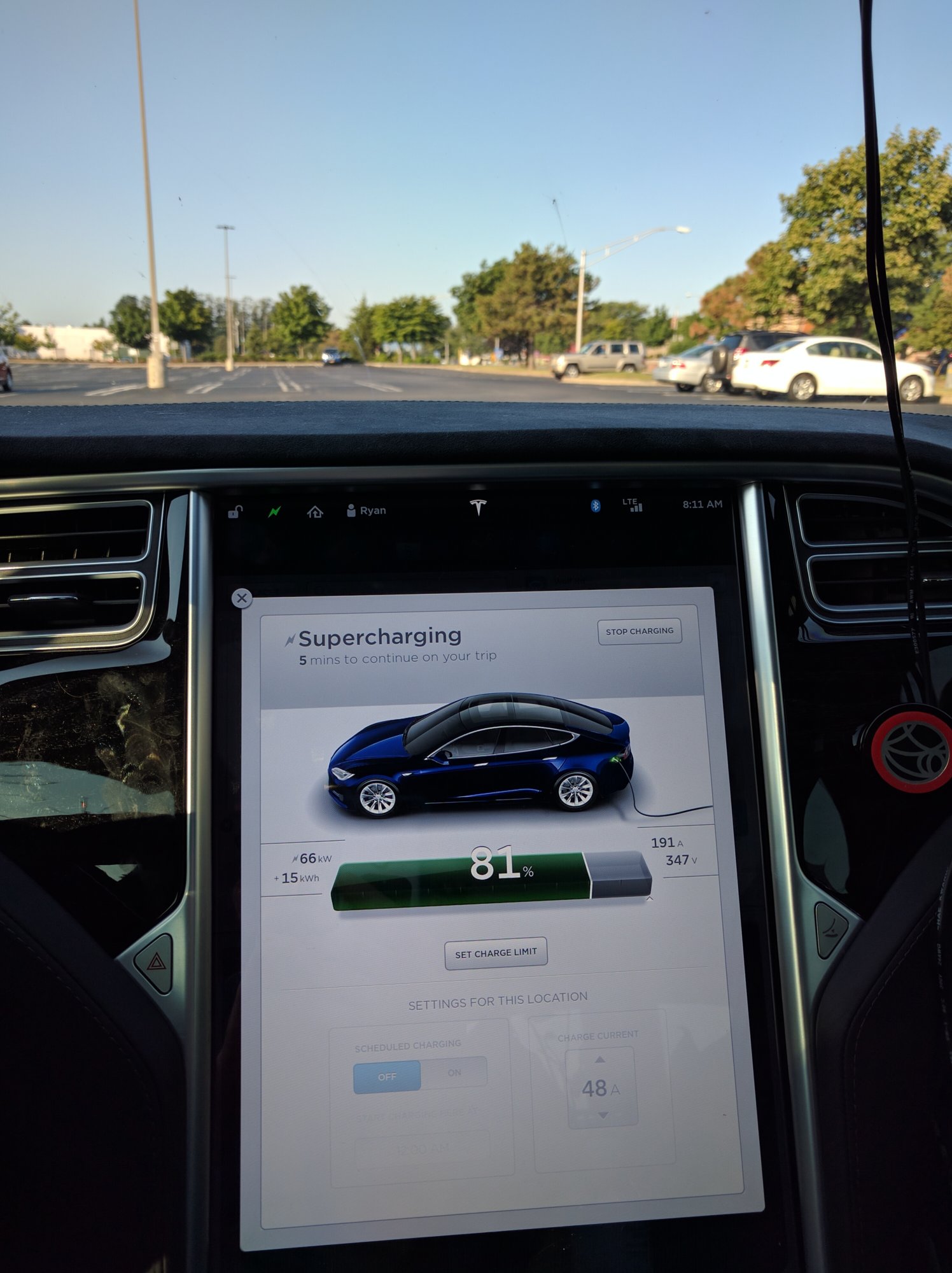

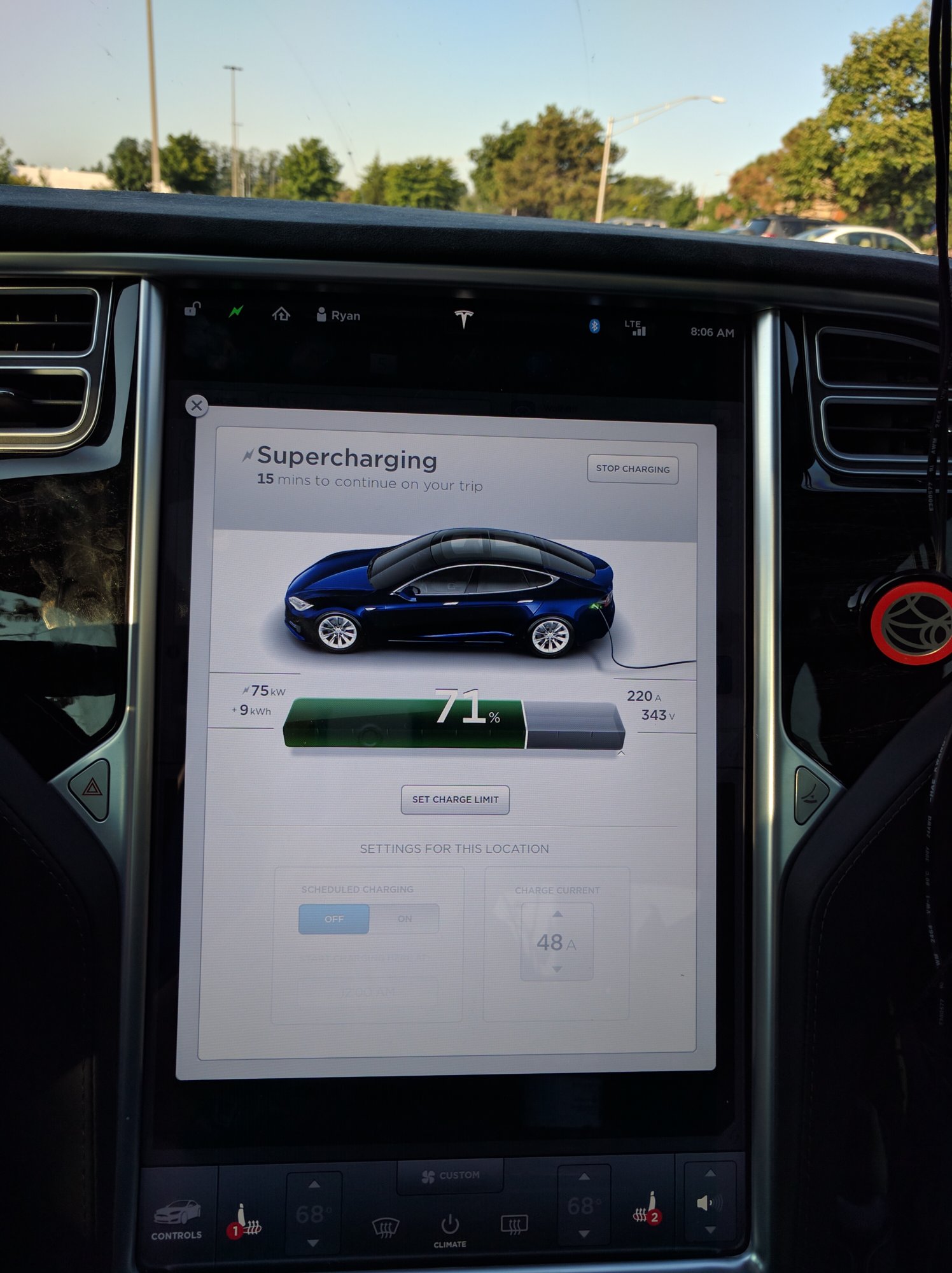
Certainly seemed to be some sort of taper going on here.�
Sep 6, 2016
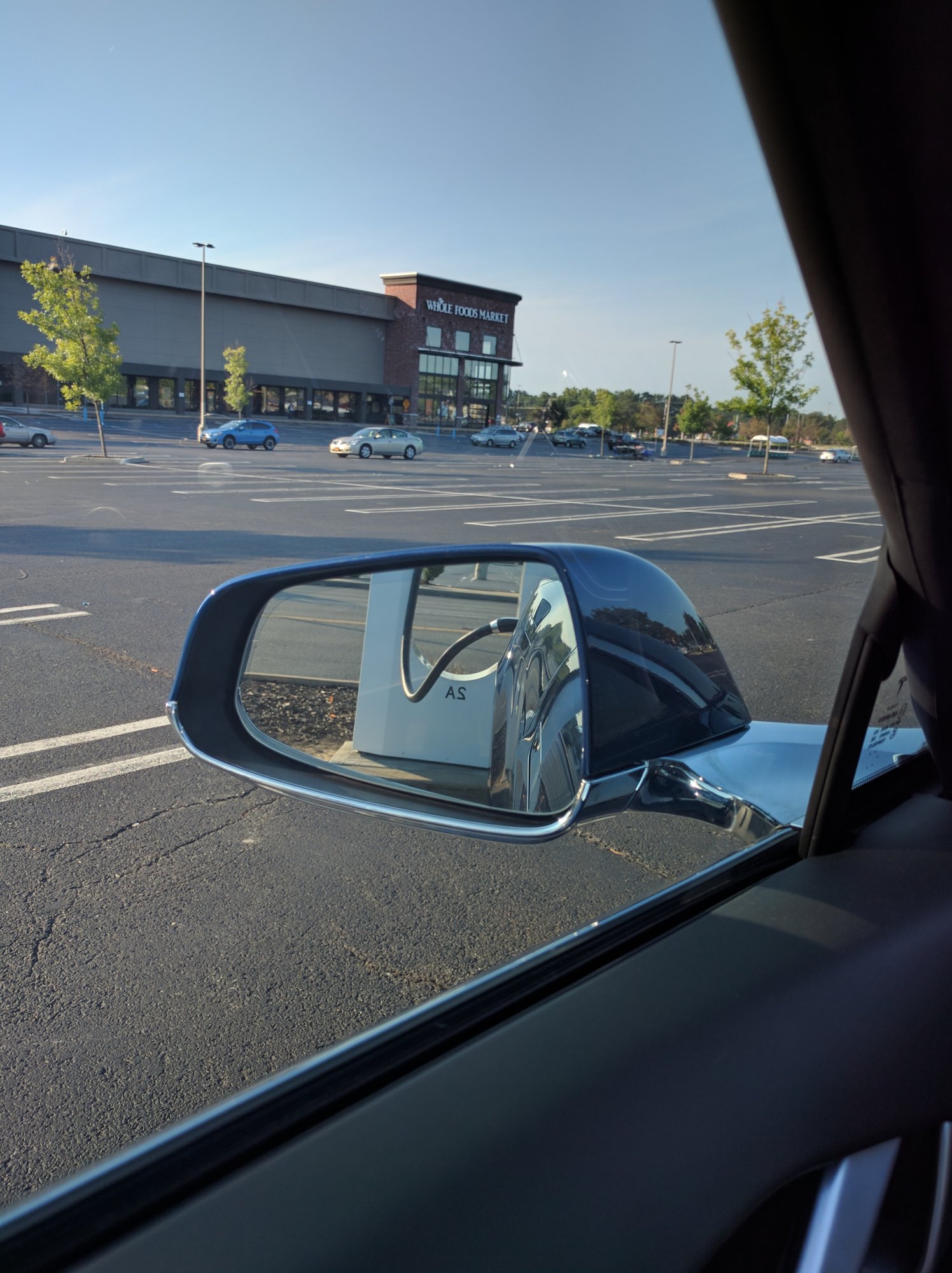
Xenius And here are some shots from the Newburg, NY supercharger.

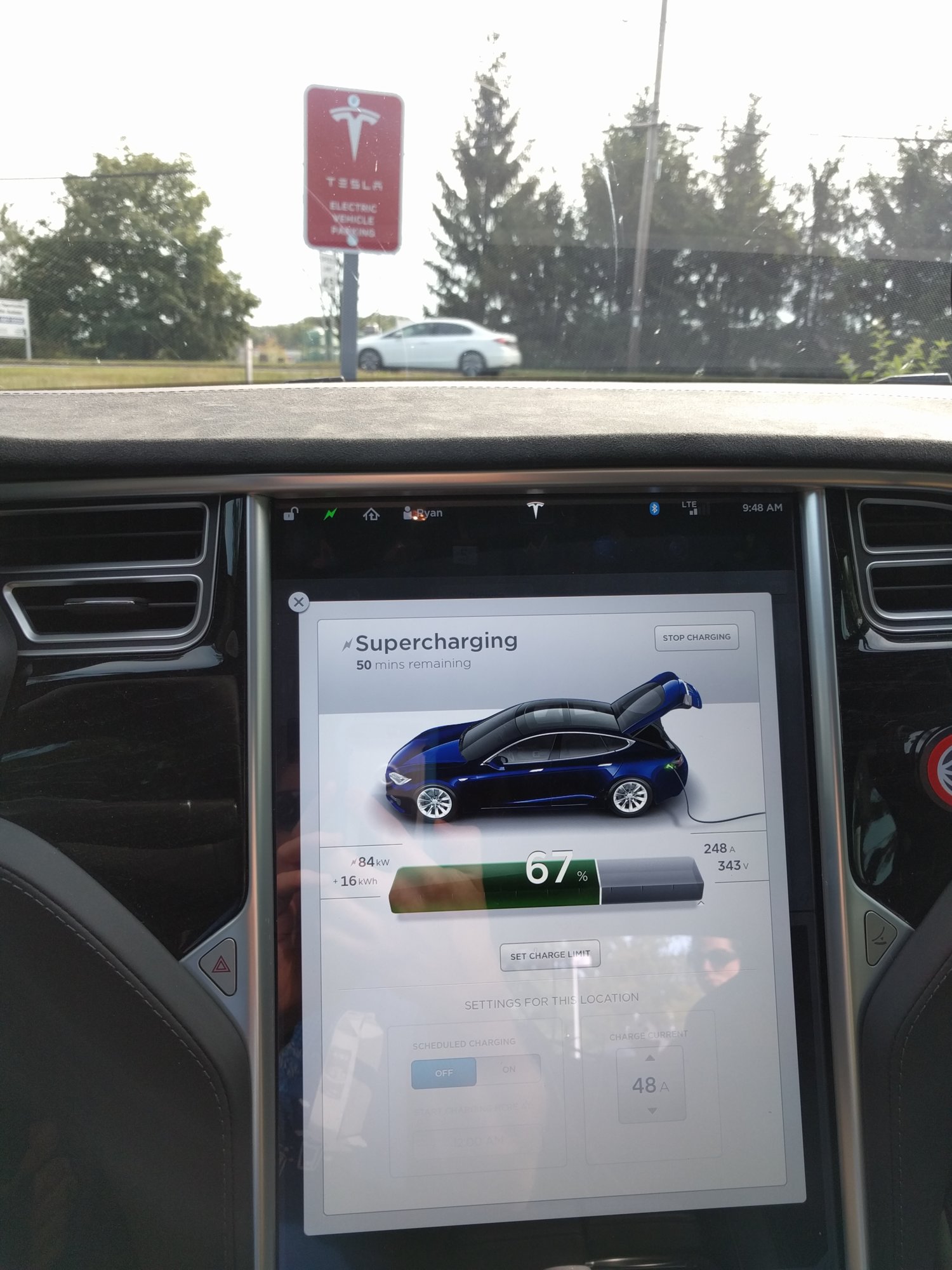
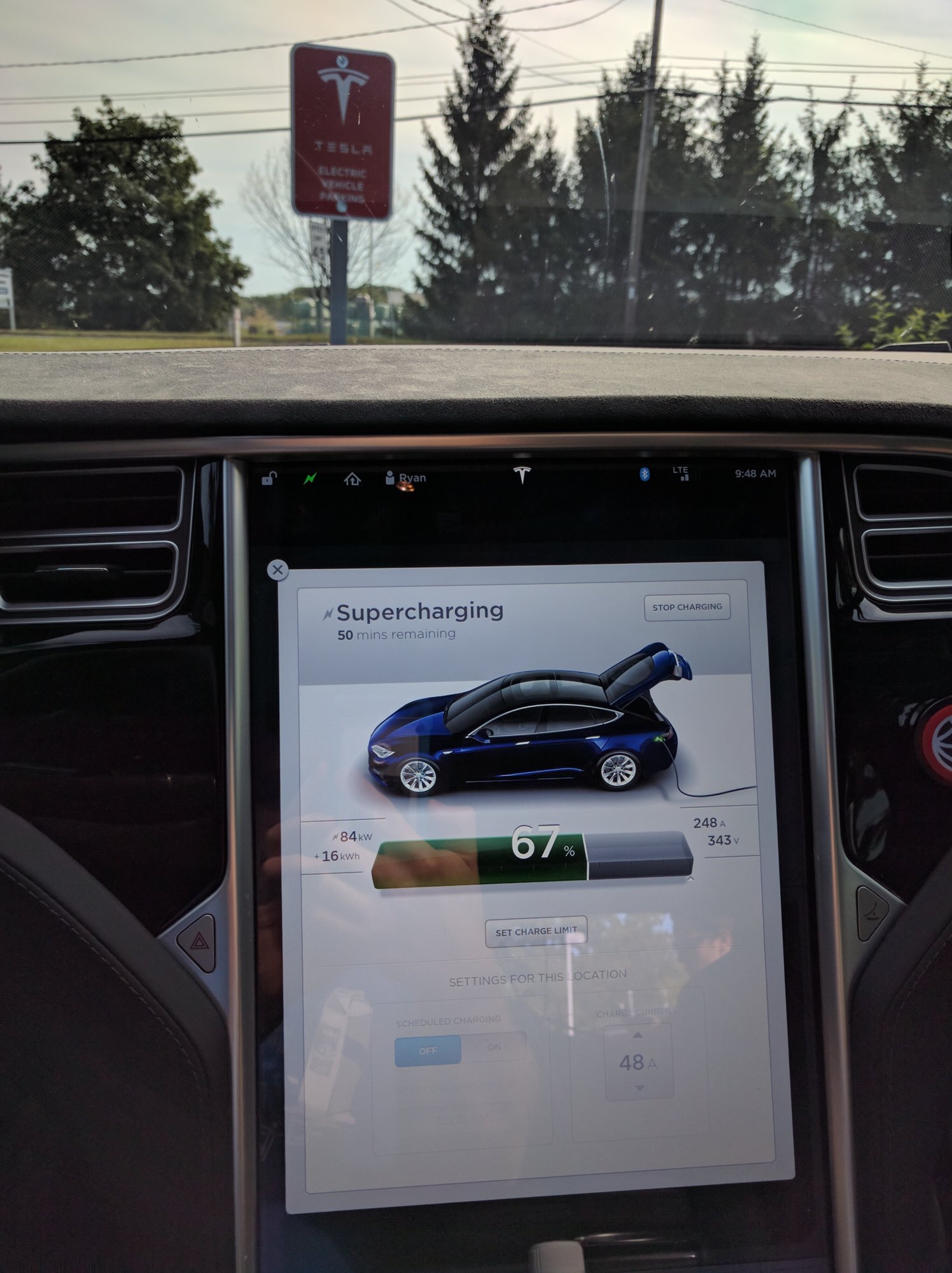
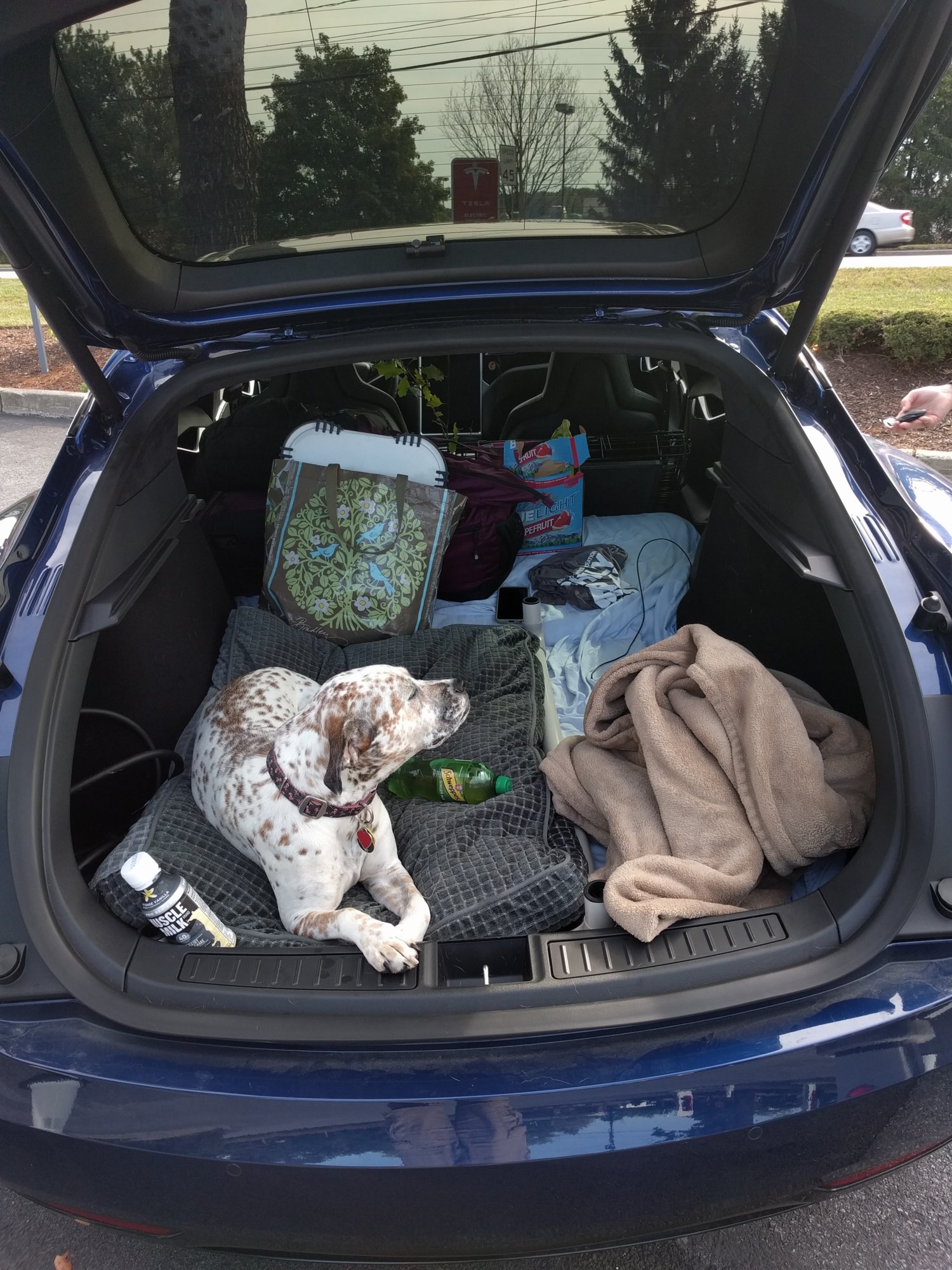
Obligatory ugly dog in the back, in her mobile suite.�
Sep 6, 2016
Chopr147 LOOKS LIKE YOUR DOG IS GIVING YOU THE "TALK TO THE PAW" LOOK
AHHHHH! sorry for screaming but I don't feel like going back and changing to lower case
We use some of the same SC's . I'll be charging at Albany tomorrow. Nice mall there.�
Sep 6, 2016
emir-t I can't believe how they charge these all the way up to 4.2V per cell (4.2 * 84 = 352V pack level) Could there be dead cells left around 60%-ish so they don't die while they wait to become 75kwh pack if they do at all? But that doesn't explain supercharger's lack of tapering like on the 75.
Some folks here suggested that reaching 4.2 charging voltage doesn't mean 100% but I researched very thoroughly and nothing even on battery university state the difference between resting voltage and charging voltage. Every charging voltage and % graph I've seen for batteries seem to be above 95% prior to reaching top voltage. The rest is classical lithium battery trickle charge anyway.
I wish someone could explain.�
Sep 6, 2016
joeytree Sorry if it's already been said, but I thought I'd offer some practical advice. I live in north NJ. We just picked up our 60D this past weekend (yay!), but have owned a 2013 LEAF for the last 3+ years. We always charged the LEAF to 100%, and still have all 12 of the capacity bars. I'm guessing this is because the daily round-trip work commute uses anywhere from 60-70% in the warm months and 70-80% in the cold months. So the car doesn't typically sit at over 80% for long. So if your daily commute uses a sufficient amount of the battery, charging to 100% routinely should be fine. Otherwise just charge to 80%. You get no benefit to charging higher and only have potential negatives. So why risk it when it's so easy to reset the charging limit on the phone app when needed?�
Sep 6, 2016
MP3Mike I think the problem is that you are looking at the charging voltage which is almost always higher than the actual cell voltage once charging is stopped. To get the actual pack/cell voltage I think you would need someone with a CAN logger.�
Sep 6, 2016
decrypt Someone correct me if I'm wrong but I believe this is due to a fundamental difference between Tesla and other EV manufacturers... Tesla actually permits you to make use of 100% of your battery if you so choose to do so. This is compared with nearly every other EV, including the Nissan Leaf and the BMW i3. In the case of the 24kWh Leaf, the cars systems actively manage things such that about 21.3 kWh is treated as 100% where in reality it's closer to 90%. It reserves/manages in this manner specifically for battery longitivity. Where as I think Tesla is treating us like adults, warning us about the tribulations of excessive charging, but letting us make our own decisions...�
Sep 6, 2016
ggnykk 60 kw charging speed at 85% SOC is pretty good.�
Sep 7, 2016
Ingineer I think that they are bottom limiting the new packs. This would explain how they can still balance a software limited pack, because it can still go to true 100%. This also means that 100% is really 100%, and you shouldn't do this daily. Ignore what the DS and Tesla Techs say, they are not engineers and have been proven to spew all kinds of incorrect information.
I'll start gathering proof for this as I can.
For now, an older 70 would be at about 343V when charged to 90%. I'll do some tests on a new 75 and see what it's voltages are, and then all we need is someone to report on a new 60.
Before anyone says it, the new battery cells can take a much higher charge rate, which explains why there is less taper.�

Không có nhận xét nào:
Đăng nhận xét