Apr 11, 2016
theganjaguru With the large glass roof, would you opt for a solar panel (like the Prius prime) instead of the glass roof? It would only add a few miles of range per day, but would negate vampire drain.
2017 Toyota Prius Prime Options/Specs: Solar Panels, Fast Charging (regionally), Heat Pump And More�
Apr 11, 2016
TerribleOne923 Not even practical.�
Apr 11, 2016
Incredulocious A friend just spotted this in Sunnyvale (CA) last week � here's how it's done:
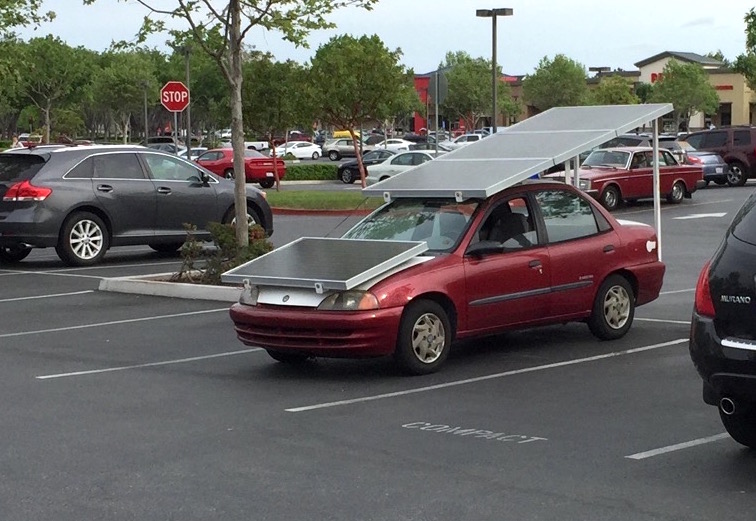 �
�
Apr 11, 2016
favo Presumably, vampire drain is only an issue where you can't plug in and will be gone a while, so mainly on trips. Airports and hotels frequently do have a place to plug in. So what's left, camping? Visiting people who only have street parking for you? Seems like it would never save you more than you would have to pay to add the solar panels. For the few who would benefit, I can't see Tesla putting in the effort to do it.
P.S. If you can swing it, putting solar panels on your house and charging from the electricity generated is a better idea.�
Apr 11, 2016
SebastianR To me that just doesn't make sense: it makes the car more complex, the glas more expensive, I don't want to think about the cost of repairs, you need to curve / shape the panels and most of the time the car will not be placed in perfect conditions for them to charge. I think for the same amount of money you get vastly superiorly positioned panels on your car port / house etc. that should do more/better.
But it's just expensive and won't harm anything? Well, I would say, solar panels on the roof encourage people to purposefully expose their cars to scorching heat ("I won't park it in the shade to make sure them panel generate some [email�protected]!!") which is not particularly good for the battery / requires energy to cool the battery. So while it is a nice idea, I don't think it is practical at all.�
Apr 11, 2016
theganjaguru Toyota thinks it is.�
Apr 11, 2016
AB4EJ When I discuss electric cars with people, they often ask me about this idea - solar panels on the car - what I tell them is that the juice you could collect using such a panel is so minuscule in comparison to how much power a car needs to drive, that it is not worth it; unless all you want to do is run a little fan to keep the inside cooler in the summer (I think Prius or somebody has this). Besides, it looks dorky.�
Apr 11, 2016
cdub No.. You're sadly misinformed... It would add almost zero miles per day. The amount of solar power that would be able to be collected on a small solar panel on the car's roof is ridiculously small.
Toyota uses the small solar panel to run.. a fan.�
Apr 11, 2016
TerribleOne923 The eniter
I thought I read somewhere that the it would only yield a few miles of extra range at most..�
Apr 11, 2016
theganjaguru Read the inside EV article I posted. It appears as though the Prius prime is able to charge the drive batteries.�
Apr 11, 2016
theganjaguru The majority of cars are parked outside in the "scorching heat" anyways.�
Apr 11, 2016
eye.surgeon A rooftop solar panel wouldn't add a few miles per day. It would add a couple of feet. It's a gimmick on other cars.�
Apr 11, 2016
cdub Well previously it was just to run the fan... maybe in the new one it charges the batteries.
What if all the passengers had pedals so they could get some exercise and charge the batteries? �
�
Apr 11, 2016
PTADO Much rather spend my option budget on many, many other things. A solar roof to power some ACC functions would be close to, if not very last on my list.�
Apr 11, 2016
cdub �
Apr 11, 2016
Boourns I believe the highest trim Leaf has or had one in previous model years. From my understanding it charges the 12-volt battery, so if you parked outside for a long time it would prevent that from draining.�
Apr 11, 2016
cdub My Leaf has had it since 2011... you're correct... it only charges 12 volt. The panel is also tiny tiny tiny.�
Apr 11, 2016
SebastianR I'm aware of that. But I don't think it should be encouraged when it is not required. Right now, the thought process when parking a car is "oh, let me look for shade" if you have panels on the car, it would be more like "let me keep it in the sun, so I use the panels" - neither good for the passengers (car will heat up quicker than any panel driven fan could cool a car) nor for the car paint (UV exposure over long times damages the paint) nor for the battery.
I love solar panels. I just humbly suggest to keep them mounted in a way that they have all-day uninterrupted exposure to the sun and not on a car�
Apr 11, 2016
cdub Didn't the Fisker have one that would actually charge the batteries?�
Apr 11, 2016
BluestarE3 The actual "roof" section of the Model 3 is pretty small: Would You Prefer A Solid Roof?
The rest of what is traditionally considered part of the car roof is occupied by the oversized windshield and rear window, so you can't place solar panels there. In other words, the amount of available real estate on the roof of the Model 3 is very small and the potential benefits from such an installation would be even less than on other comparably sized cars.�
Apr 11, 2016
mspohr They also think hydrogen fueled cars are practical.�
Apr 11, 2016
JRP3 I voted yes because I like the idea of having something that can eliminate the vampire drain, I think properly done panels can look good, like the one on the Karma, and because I think it's cool to have a vehicle that is at least somewhat self sustaining. Unfortunately because of the roof design of the 3 there isn't much area available, unless they covered some of the rear window glass over the rear seats as well.�
Apr 11, 2016
BravoSarah That would be a great idea. If someone could build a solar panel efficient enough to be effective on the roof of an EV, they'd become very wealthy.
I'd love to see it in my lifetime.�
Apr 11, 2016
physicsfita Unfortunately, solar irradiance is about 1000 W/m^2 -- Solar irradiance - Wikipedia, the free encyclopedia
Assuming 100% conversion (which won't happen for many reasons), and assuming you somehow have 2 m^2 of panels perfectly placed and tracking the sun (good luck!), you MIGHT get 6 mph of charging (assuming no charging losses). More realistically, you'll get maybe 1 mph at best (panels can't use the low-frequency end of the spectrum for quantum-mechanics reasons, and you can't get ideal tilt) -- for all the weight penalty and expense, plugging into a 120-V outlet will almost certainly work better for you.�
Apr 11, 2016
King H Question? How about using the super think flexible solar panels? I have seen people install them on their vans.. It would not add the weight of a conventional glass panel?�
Apr 11, 2016
King H *thin�
Apr 11, 2016
EVnut And inefficiently cheap cheap cheap. Totally for greenwashing. I have one too!�
Apr 11, 2016
EVnut Oh, snap.�
Apr 11, 2016
Denarius You win the internet today.�
Apr 12, 2016
JRP3 I think they are less efficient, but an integrated conventional panel needn't weigh more than the planned glass roof. The weight penalty that some claim wouldn't really exist.�
Apr 12, 2016
tdelta1000 NO!!!! The power yield would be insignificant and extremely expensive.�
Apr 12, 2016
JRP3 Not sure why you think it would be that expensive. Roof sized solar panels would be a few hundred dollars, and Elon might know a solar panel company that could make them cheaply and give him a deal...�
Apr 12, 2016
gregincal OK, but I still think it's a gimmick. Park out in the sun all day long to get an extra 2 or 3 miles of range (at most; given the non-glass roof area of the 3 it would probably be only about 1 mile per day).�
Apr 12, 2016
JRP3 Sure somewhat of a gimmick, like many features in cars, though this one actually gives you some range, and, more importantly, kills the vampire drain. Remember, people spend thousands on things like rims which do nothing for the car other than look different, this actually produces something usable.�
Apr 12, 2016
King H I agree.. even if its 1/2 a mile.. its 1/2 mile that someone without a panel would not have. Not practical, but it does something�
Apr 12, 2016
EVnut If that same bit of capital equipment were instead put where it belongs (up on the roof of a building or shade structure) along with the rest of a reasonable solar array - it can capture the sun's energy efficiently all day. Correct orientation. No shade. And it can work up there for 60+ years. And when you plug your car in at home, you'll get more than the few feet of extra range that the panel would have given you were it attached to your car.
Now you take that bit of capital equipment (no matter how small) and attach it to your car that will likely NOT last 60+ years. Where the orientation will likely never be optimal, and where you will park in the shade, in the garage, under a car cover etc.
You are correct that it is not practical. And if we want it to "do something" why not have it do more?�
Apr 12, 2016
JRP3 Because all those panels on the roof are completely useless for extending range or eliminating vampire drain any time the car is not plugged into them or anything else. I do hope people realize that most vehicles spend most of the daylight hours in open parking lots, not connected to anything. The idea that if you put a panel on the car then you can't put one on your house isn't reasonable. You can do both.�
Apr 12, 2016
Evbwcaer I think it is very realistic to think a car with a solar roof and hood could generate 500 watts for 8 hrs a day in many places on the planet. That is 4kw/hrs, around 14 miles of range. I'd love it if my car would have 10-15 miles more range after work. I would also love it if my car gained 50 miles of range when I was parked for camping trips or at the airport for a few days.
A pano roof is expensive, an aluminum hood is expensive, you could subtract these costs from the costs of the panels likely.�
Apr 12, 2016
RobStark Not practical but still cool looking.
Would rather have one of these
Than an equally useless wing
Sometimes people want cool for coolness sake.�
![[?IMG]](https://lh3.googleusercontent.com/blogger_img_proxy/AEn0k_vAm85WQ2kNswHqV-C4DuBTC0RYfVfAGZnTFql2fyq4Yg-ik8SZxoGhmivXo6LWAvh2aRuQqY5JBkzAbl2497txqaH9GMXDpJCPw0_S1ZGxqT0F1nANuw=s0-d)
![[?IMG]](https://lh3.googleusercontent.com/blogger_img_proxy/AEn0k_u3maDhXpmTyTUQrSXD0FzMeEUdlasuKKNkeWL7CwgxTc6fm8M12uU0-xAEWEbt4CbOPS53BD43nSu9awhGeCLRhEhrSgOB8PnjT0w=s0-d)
Apr 12, 2016
Topher The first problem is voltage. Solar cells are 0.5 apiece. So 30 or so will charge your 12 volt accessory battery. In order to charge the 375 volt battery pack you would either need 750 solar cells, or DC voltage step up electronics. The second is wattage, which has been addressed above. So no range increase.
If you want to negate vampire drain, put a small solar panel in the window, connected to the acc circuit. (Does the Tesla shut off the 12v outlet when the car is off?) Price: $50 at most.
Thank you kindly.�
Apr 12, 2016
JRP3 Last I knew vampire drain was more than a small accessory panel would counteract.�
Apr 12, 2016
EVnut 100% of the "range" of my 1/4 million EV miles has been generated by the panels on the roof of my house. So calling this process "useless" may be overstating things a bit. My roof-mounted PV system doesn't extend my range. It fully charges my car every day.
Do you have a source for this realization? I can certainly show you that the roof of my house is never in the shade, is never parked in a garage, and is always oriented toward the sun all day, every day without fail. And most of that time, my car is parked in the shade of my garage or the trees in the parking lot at work.�
Apr 12, 2016
Topher The process isn't useless. The size is useless. You most likely have 750 cells [not modules] on your roof. (though you probably convert to AC and then back to DC, which allows easier change in voltage at the cost of efficiency.)
Thank you kindly.�
Apr 12, 2016
Topher In which case someone really ought to put solar PV panels over the top of those parking lots, to harvest that energy, and keep those cars cool.
Thank you kindly.�
Apr 12, 2016
CyberKnife If I had the extra cash I would invest into a solar panel system on my roof instead if I was in a more sunnier state. So no this would not make sense on a model 3 a budget consensus car, heck I wouldn't want it on any car as it would look weirdsmobile.�
Apr 12, 2016
EVnut Two things come to mind, if I may be so bold:
1. You don't need to cash to purchase a solar system (or car or home or...)
2. The only thing more expensive than buying a solar system is... not buying a solar system.
So far, my PV system has saved me well over $20,000 in gasoline. PLUS my entire electricity bill for the house. Total cost of system with zero subsidy: $15,000.
Cheers,�
Apr 13, 2016
JRP3 You conveniently left out the rest of my quote:
If you work from home and the car is plugged into your panels all day, that's great. Most people do not fit that description.
Yes, the same source you have, functioning eyeballs which are able to see most parking lots. Please don't try to pretend that the majority of parking lots are not open spaces.
And I can show you that the roof of my house is shaded most of the time so solar panels make no sense on my house. However I'm not pretending that my anecdotal experience is universal. I'm also not saying everyone needs to have a solar panel on their car, I'm saying it's a useful option for many if they wanted it, more useful than other similarly priced options that do nothing functional.�
Apr 13, 2016
JRP3 Great idea, why don't you get right on that? In the mean time, before you cover the world with solar panels, I'll take one on the roof of my car, thank you kindly.�
Apr 13, 2016
Topher Already working on it. But I don't live in Central New York, you might have to help there.
Thank you kindly.�
Apr 13, 2016
EVnut Right, because the other part of your post was correct. A small panel could help offset vampire drain. I was merely refuting the part that was incorrect.
Excellent. Then we can stop bickering about all this, because we basically agree.
I already have a PV panel built into one of my EVs. And it is a waste of resources. If that money and effort had instead gone into one more incremental improvement in aerodynamics, the benefits would have been greater. We only have so much money to spend on every car design and build. My approach is to always go after the most cost-effective improvements first.�
Apr 13, 2016
EVnut This is happening on a huge scale where I live.
Can't put my finger on a good picture immediately, but honestly - thing of double-benefit beauty. Oh, here. I don't have to show you mine... thousands of them across the country now.
solar-covered parking - Google Search�
Apr 13, 2016
mspohr Big Pine, California High School:
Google Maps
Sierra College, Rocklin, CA:
Google Maps
Rocklin, California Tesla Service Center:
Google Maps: Report Inappropriate Image�
Apr 13, 2016
JRP3 And what is the cost benefit of options such as leather interiors, alcantara headliners, oversized rims, carbon fiber trim accents, multi color paints, etc.? The problem seems to be that you ignore the fact that people add options all the time to vehicles that have no concrete benefit at all, and that companies put time, resources, and money into developing them. Again, if people want those options I'm fine with it, but don't pretend the option of a solar panel, which actually does produce something, is more ridiculous than all those options which produce nothing.�
Apr 13, 2016
JRP3 Those are all great, I hope we have many more. Currently they are a drop in the bucket, and will be for many many years.�
Apr 13, 2016
mspohr Renewable investments last year added more capacity than fossil fuel investments. The tide is turning quickly.
Clean energy defies fossil fuel price crash to attract record $329bn global investment in 2015 - Bloomberg New Energy Finance
Also:
Peabody Coal Co. (the largest private coal company in the world) just declared bankruptcy.�
Apr 13, 2016
JRP3 When you can show me data that even 50% of all parking lots are covered with solar panels I'll consider that a vehicle mounted solar panel might not be worth it. Right now 100% of the lots I see on a daily basis are not covered with solar panels.�
Apr 13, 2016
mspohr Considering that there are about 800 million parking spaces in the US at 25 m2 per space, that's about 20 million km2 of surface area. When you consider that it would only take about 5,000 km2 of solar panels to supply all the electricity needs of the US, asking for 10 million km2 to be covered in solar panels would be overkill. About 0.025% coverage would give us all we need.�
Apr 14, 2016
JRP3 Still missing my point. Parking lots without plugs don't provide any charge for the car and don't counter the vampire drain. So 0.025% coverage does basically nothing to address the actual subject at hand, which is countering vampire drain and adding some range when not plugged in. Additionally it proves that significant parking lot coverage is unlikely if all needs will be met by 0.025% coverage. It also points out the shortcomings of the few examples of solar covered parking lots: Unless all those spaces have outlets, which I'm betting they don't, the cars aren't getting any benefit from them other than some reduced cooling loads in hot climates, which is probably countered by the loss of solar heating in colder climates. I get good solar gain in my car when parked in the sun on a cooler day, and orient my car when parking to take advantage of that when needed.
To summarize reflecting your data:
Solar parking coverage is not likely to be significant, ever.
Parking spaces of any type without plugs provide no counter to vampire drain and no range extension.
Onboard panels can provide both.
Few other options provide any tangible returns for their expense.
I like the look of a well designed solar panel, I'd like to see it on the hood, roof, and trunk lid, though I don't expect it to happen.�
Apr 14, 2016
BBryson Living in Florida, I would really like to see cars that run the cabin fan via a solar panel. It would go a long way keeping the inside temperature below 120F and saving energy conditioning the car.�
Apr 14, 2016
Topher I think you will be shocked by what exponential growth can do. Currently Solar represents about 1% of electric generation, and is growing at a rate of 40% per year (call it a doubling time of 2 years). How long until that 1% reaches 100%? Fourteen years.
Yes, yes, other things need to happen (like storage), and we are unlikely to want 100% PV in our energy mix. But the point is that solar growth isn't the limiting factor.
Thank you kindly.�
Apr 14, 2016
JRP3 See my previous post as to why that will not translate into significant numbers of solar covered parking lots.�
Apr 14, 2016
Topher It will be the ones you want to park in though, those with chargers.
It could go either way, a few places get their acts in gear, and blanket their lots completely with panels, and reap the benfits, or most places put out enough to cover their use and their chargers. So we get either a (relatively) few large solar plants or a lot of parking lots with a bit coverage. Hard to predict.
Thank you kindly.�
Apr 14, 2016
theganjaguru If Toyota appears to have found a way to charge the traction battery, then it appears possible. Besides. What about using a solar roof to provide power to the vehicles climate control system. Solar is continuing to become more efficient and cheaper�
Apr 14, 2016
BluestarE3 Someone should make a car cover that's covered entirely with solar cells. This way, you can park outside all day in unshaded spaces and not worry about overheating the interior of the car or fading the paint job, yet the entire surface area of your car will be generating electricity and not just the limited roof area. It would be a PITA to fold up and stow away though. Or maybe with fully autonomous driving, you can just lift up one side of the cover, climb in and let the car take you where you want to go with the cover remaining in place and charging the battery throughout the trip.�
Apr 14, 2016
dsm363 They think it's practical to run a small fan. Not charge the battery.�
Apr 14, 2016
theganjaguru Please read the link at the beginning of the thread. It clearly states the roof is for charging the traction battery, not a small fan�
Apr 14, 2016
dsm363 I see. I was browsing on my phone and didn't see the text of the article. That's a little more useful but in climates where it is the most useful, people do everything they can to find shaded parking. 8 miles of range a day isn't much for the Model S but it's 30% of the pack on the Prius so more useful there maybe. If it adds more than $500 to the cost of the car I'd rather just save the money and have a sold roof. Many people have garages so the it wouldn't help then either.�
Apr 14, 2016
sandpiper You can certainly charge the traction battery. But you'll be there for a LOOOOOONG time. If you manage to get, say, 3 square meters of solar panel (optimistic) that will give you, in great weather, 0.45 kw of output during the sunniest part of the day. Assuming that, over the course of the day, you can get the equivalent of 8 full-sun hours (highly optimistic), then you would get 3.6 kw, or 19 rated km of range per day, less the vampire drain. Even assuming the vampire drain was zero, you'd be 22 days to add 80 kw of charge.
Once you allow for rainy/snowy days, parking in poor locations and vampire drain, I can see that you'd get pretty much nothing out of the panels.�
Apr 14, 2016
EVnut There aren't any benefits that I can think of. Though I'm certain that others could come up with some way to benefit from these items.
Yes, in fact I am ignoring those options, as this is a thread about adding a silly solar panel, not about adding silly carbon fiber trim accents.
I agree that the solar panel idea is no more ridiculous than those other options which produce nothing.
Most amusing to me is that in another thread I'm pushing for a hatch back over a trunk, and the people who are arguing against me, sound just like me in THIS thread. "It is silly, it'll cost more, it is of no value".... and on and on. We all find benefit in the things we feel will make our situation better. We don't find benefit in the things that won't help us enjoy our days. I would love for you to enjoy a solar panel on your car. I just don't wish to have a bunch of engineering and development time spent on that, when I find it generally useless to adding any value to *my* car. Like carbon fiber dash accents, it is the right product, used in the wrong place, IMO.�
Apr 14, 2016
EVnut Much, MUCH more cost effective is to reduce vampire drain through proper engineering of the systems. Remember the Roadster? Huge strides were made in vampire drains for the S. And now maybe (I hope!) the X is even better. And the Model 3 should be better yet. As I always tell my customers, the greenest energy is not from solar panels - Greenest is the energy that you don't use in the first place. If vampire drain is a significant issue, that should be addressed directly instead of finding an expensive bandaid to apply over it.�
Apr 14, 2016
JRP3 Sure, take the vampire drain to zero, that just means I get even more usable range from my vehicle mounted solar panels�
Apr 14, 2016
JRP3 Counteracting vampire drain is something, and unless you live in Seattle or some place similar I think most would have a net gain overall. Excluding those who regularly park in covered areas during they day, and presumably they would not choose the solar panel option anyway.�
Apr 14, 2016
Topher I looked (casually) and wasn't able to find any DC voltage converter that would do the job of enabling such a small area of solar cells to charge a large high voltage battery. Nothing even close.
Thank you kindly.�
Apr 14, 2016
EVnut Sadly, it doesn't work that way. You'll have to hope (!) that the car will have enough vampire drain to make the solar investment worthwhile.
Because.... what Tropher points out below. Trying to charge a ~400V batttery pack from a few volts on the roof is a problem.
You are asking to drain (I guess more accurately you are trying to fill) the ocean with a spoon. You say hey, at least using the spoon is better than using a fork! And I again agree with you.�
Apr 15, 2016
UKM3 I think a solar roof option would be feasible - especially for the major benefit of eliminating vampire drain when not plugged in. It's also pretty darn cool�
Apr 15, 2016
JRP3 Except you're both wrong, as the first post in this very thread points out. From that link:
Step up voltage converters are not that exotic, in fact the Prius has used one to step up the 200 volt traction pack to 500V for the motor.�
Apr 15, 2016
Topher The quoted passage is at the very least confusing (presumably translated from Japanese). I would like to see something written by someone (preferably an electrical engineer) who's first language is English, as I suspect there are some issues we aren't seeing.
The Prius is DC -> AC. Nor is that jump nearly as big.
My point was not that it was physically impossible. Just that is was an unsolved technical challenge that I don't think should be put in the way of delivering those 400,000 cars, as the gain will be 'cosmetic'.
Thank you kindly.�
Apr 15, 2016
EVnut Allrightythen.... get your spoon!�
Apr 15, 2016
EVnut Totally feasible, and arguably darn cool! And it may very well be added as the model matures.�
Apr 15, 2016
gregd Wow, this takes the term "Spoiler" to a whole new level!
But to the original question, I would be interested in a solar option, not so much for the traction battery, but to run a fan to keep the car cool(er) when sitting in the sun. The main battery is not available for such things, and the (very small) 12v system on my Roadster is too wimpy to be trusted. It's needed to get the car going, even if the main pack is full.�
Apr 15, 2016
bxr140 Solar panels on roofs don't make sense now.
They will make sense as a viable option when the cost/mass/efficiency eclipses battery technology (when compared to 'just put in a bigger battery') for things like legitimate cabin thermal management (not just a fan), lights, and possibly even traction pack thermal management.
They will become ubiquitous if the efficiency of cars increases and the cost/mass/efficiency/technology/simplicity of a solar collection device evolves to a point where you can get a legit dozens of miles of range per day.�
Apr 15, 2016
JRP3 DC/AC is more complicated than DC/DC.
Regarding the "jump", I'm guessing you think the solar panel has to operate at 12V. It doesn't. You can wire a higher number of solar cells in series to increase voltage to whatever you want when you build a panel, just as you do with battery cells. I think the Fisker Karma panel was a 120V panel.
It's not an unsolved technical challenge at all.�
Apr 15, 2016
JRP3 Odd that you spend so much time arguing against it then...�
Apr 15, 2016
Topher Nope.
I am guessing you didn't read my previous posts. Solar cells are 0.5 Volts fixed. That is the voltage band gap. In order to get 375 Volts you would need to string 750 of them together.
Thank you kindly.�
Apr 15, 2016
JRP3 Support that claim.
So you agree with me, that your suggestion that the voltage "jump" would be greater is not necessarily true. It depends on how the solar panel is built.�
Apr 15, 2016
gregd Cells are 0.5-ish volts each, yes. But with an external DC-DC or DC-AC inverter, they can be made to drive any voltage. Power stays the same (or 90% of it), so you don't get a lot of current, but matching the voltage is not an unsolved problem. In fact, I'd recommend a tour through the search engine of your choice for the topic "MPPT". Get enough cells for the power, and match them (series / parallel) to the controller.
Given the available glass surface on the M3, you could probably gather a few hundred watts. What's the best use for that? I'm still thinking a semi-active thermal management while parked, but being in the CA Central Valley, and looking at an approaching summer season, I may be biased.�
Apr 15, 2016
sandpiper I don't see it. An imaginary 100% efficient solar panel would output 1kw / square meter in full sun on an absolutely clear day. Good quality commercial panels are 15-20% efficient right now. And MAYBE you'll see 30-35% one day - so roughly 1 kw for a 3 square meter panel. So, again, assuming 8 hours per day of clear sky, full-sun equivalent, you'd need 10 days to charge a 80kw-hr battery. And the reality is that you'll pretty much never get anywhere near that.
As to the efficiency of cars... electric drive-trains are pretty darned efficient. The motor is likely>90% and you might lose another 10% in the gearbox. And I seriously doubt you're going to see cars with coefficient of drag of much less than 0.2 (Model S is 0.24) In both of these cases, we've been working on the basic tech for >100 years and we're at the point of diminishing returns.
The sun simply doesn't deliver enough photons to do the job.�
Apr 15, 2016
Noob1 Elon has said it will not work, I do wonder about air flow from the front of the car could not help?�
Apr 15, 2016
M0DEL� I've got to wonder, how much extra would you be willing to pay for that extra 1/2 mile range?
If there was to be a solar roof - and I'm not totally against the concept - I'd prefer to see it be engineered to live-support a climate control system so the interior was maintained at more comfortable temperatures during the day when the car was simply sitting out in the sun. But even then I would have to wonder what the weight impact of that apparatus would be on range.
I own a 49 KW off-grid Solar Plant, and my son is a PhD researcher in the world of perovskite solar cell development, so we have conversations about the practical, near-practical, and totally impractical in the world of solar. The idea of meaningful range extension is an impractical goal, and will continue to be so for the foreseeable future.�
Apr 15, 2016
theganjaguru Germany sure doesn't have a problem with cloudy days and their solar infrastructure.
Most Americans drive around 20 miles a day, you're telling me you don't think people would not like roughly half their commute back (if we use your generous 19 km estimate) from free green energy?
In California, (one of the largest car markets) most of the cars are parked outside in very sunny weather. Sheltered parking spots are rare for the most part. How many rainy snowy days out of the year are there really going to be? 300? I'm dubious that there will be that many rainy days. Again, I point you back to Germany.
Taking this a step further, eventually, these cars with solar roofs (along with other BEV's could be connected to a vehicle to grid program wherein they could help load balance the grid during times of peak usage (which usually occur during the middle of the day in the summer) and prevent rolling blackouts.�
Apr 15, 2016
theganjaguru
8 miles a day is almost half a commute for the average American. Again, you don't think people would like almost half their commute back from free green energy? Shady parking spots are a premium and not widely available. Most people have to park in the sun. As I said a second ago, solar roofs in a vehicle to grid program along with other BEV's could totally modernize the grid.�
Apr 16, 2016
JRP3 Why would you pretend that a battery pack needs a 100% recharge each day? A 12K mile per year vehicle does an average of 33 miles per day, using 250Wh/mi that's 8.3kWh per day.�
Apr 16, 2016
nwdiver I seriously doubt many people here are arguing against solar powered cars.... my car is solar powered but I keep my panels on the roof of my house not the roof of my car.
Aside from the high cost and low return... most people would prefer NOT to park their car in the sun of they can avoid it... further decreasing the usefulness of car mounted panels.
As this becomes more common... solar panels on car rooftops would be less and less productive.
![[?IMG]](https://lh3.googleusercontent.com/blogger_img_proxy/AEn0k_v5R_75b8pb0QHkuu-ft2fULVd-LtZlCPOYw24pSo4HxgY3OYYsed-XDa3oYACIyoVMYjpocyfOQJB27eC7yFaW4hBTyvJGwXHXBtu_ZYvPTiCYN4tRSAR5rnHnQ-9CmpFrDmztHRpswAcgW1jBuWz_o-IAU8RS8OPi=s0-d)
Plugging into a simple 110v outlet would deliver more power than covering your car with the worlds most efficient solar panels.�
Apr 16, 2016
JRP3 Sure, but that's assuming all those parking spots under the solar panels have plugs, which in most cases they don't seem to, and it's still assuming a significant portion of open parking lots will be covered with solar panels, which, if previous calculations are correct that all our power needs could be met by covering only 0.025% of all open parking lots, simply will not happen. Once all our power needs are met by renewables there is no reason to keep putting up solar panels other than on new construction.�
Apr 16, 2016
nwdiver What previous calculations? The US uses ~4000TWh/yr. There's an estimated ~800M parking spaces and each one could support ~2kW of solar... that's 1.6TW of solar for an average annual generation of ~2600TWh if we covered all of them... and some of those 800M would obviously not be viable if they're on not the top floor of a parking garage
As EVs become more common I would expect public charging to also become far, far more ubiquitous.�
Apr 16, 2016
EVnut I know! I'm complicated, right?
Might serve you better to pay more attention to just what it is I'm arguing against. Being "cool" and maybe available in the future does not equate to it being a good idea to implement on this car today. Very much like what the trunk lovers are telling me about a hatchback option.
Our opinions on this have no bearing on much, really. The only benefit from threads like this is the education that's available from listening to other people share their knowledge and opinions. Note that there are some folks in this thread who know what they're talking about well beyond what looks cool, and what would be great to have. Arguing is sometimes fun though, so carry on!
My advice is to stick with the vampire drain replacement, or ventilating fan, and back off the range-extender idea. We have a lot of EVs on the road today. Including from the brilliant folks at Tesla. There's a compelling reason that none of them have solar range extenders built in, or even as an option.�
Apr 16, 2016
AZ Desert Driver So you were in line at 10:00 am and got RN 107x, and I was online at 7:43 and got RN 1078. Think the RN might be closer to a random number generated values instead of a sequence?�
Apr 16, 2016
stevejust I had a deposit on the Fisker Karma, the first car with a solar roof. I also owned a 2010 Prius with the solar roof option. I also had a Nissan Leaf, but did not have the solar spoiler option.
The short answer is that putting solar on a car is incredibly stupid. (and I'm a guy that loves solar, and has a 9kW solar array on the roof of my house/garage where solar belongs).�
Apr 16, 2016
JRP3 Posted up thread:
Obviously you reached different conclusions, maybe you could clarify.
In any case, probably for the next 10+ years an EV mounted panel is going to be more useful than the essentially nonexistent solar car ports with plugs. Again, my perspective is that as "silly" as a vehicle mounted solar panel may seem it's much less so than other potential options which people could spend money on.�
Apr 16, 2016
nwdiver There's two errors here...
- A parking space is closer to 15m� than 25m�
- 800M x 25m� = 20k km� not 20M km�
You'd need to cover all parking spaces to cover 50% of annual US electricity demand.
..... as an aside... this is what ~10M km� looks like on a map
![[?IMG]](https://lh3.googleusercontent.com/blogger_img_proxy/AEn0k_sfsiXV1vUH6kTH5nOaBJSu4WCFZVza66NCex1F1FI3g6o4FjTW875P1z7Xy8FqlZXWwTHncvxyyast_HKYq6oMiU4eD4WwhqbQVJ5lpvXqzOXKXsSIkg=s0-d)
The entire US is 9.8M km��
Apr 16, 2016
JRP3 Ok, fair enough, I should not have taken the math at face value. So yes I can see there will potentially be a day when the majority of open parking spaces may be covered and may have plugs. It's not going to happen during the lifespan of Model 3 V 1.0�
Apr 17, 2016
bxr140 It's okay. There was a time when that was the general sentiment of BEVs...to say nothing of the fact that even with Tesla's progress, many people still don't 'see it'
You can take it to the bank--there will be a day when some kind of onboard solar collection is ubiquitous.�
Apr 17, 2016
nwdiver The opposition to EVs was based on economics.
The opposition to onboard solar is based on physics.
Economics can change... physics not so much.�
Apr 17, 2016
bxr140 I guess it comes down to the fact that I'm looking farther down the road. I agree that solar is pointless today. I agree that physics limits us to something significantly below a fully perpetual solar BEV.
Historically, EV progress was mostly technology limited (which we could argue is financial)...but you can say the same for solar collection today. Time will increase efficiency of harvesting (PV or otherwise), drive up the efficiency of vehicles and decrease the cost of both.
So what's your bogey?�
Apr 17, 2016
nwdiver It's not about efficiency... it's about available resources... there simply isn't enough sunlight hitting the surface of a car to make it worth while. Even if you could harvest 100% of the energy it would still be barely worth while...�
Apr 17, 2016
JRP3 To some people.
Look at it this way, you could spend money on an expensive paint job to make your car look "cool", (subjective), or distinct, or you could do the same thing with solar panels, AND actually get something useful.�
Apr 17, 2016
bxr140 We're going around and around now on the definition of "barely enough". Hence the "whats your bogey" question.
Certainly, the kWh or three that current technology might get today is not worth it, most pertinently because of the mass and cost impact (and then mostly cost to the finite engineering resources at tesla).
But what if technology could harvest 5-6 or even 8-10kwh/day and drive mass to negligible? That's not a physics problem, that's a technology problem. And at the same time what if technology drives BEV range to a reliable 5mi/kWh? Given that some BEVs are already close, that's pretty feasible too.
IMHO, that's more than 'barely enough'.�
Apr 17, 2016
EVnut Oh, my friend... you missed the big one! It was based on economics and ignorance.
... and knowledge (but I guess that's assumed when sciences is involved). But you know what? This isn't really "opposition" - it is merely pointing out the current limits of reality.
To Mr. JRP3, I mention again: It isn't by shear misfortune and ignorance that no EV makers are including range extending PV in the roof of their cars.
One day this could happen. Today there's no reason to waste money on it. And I totally understand that you would rather have *this* useless option than the fancy paint useless option. But fancy paint garners great margins, and will be offered at every turn. Wasteful PV, not so much. PV is becoming incrementally better and cheaper every year, and we can all assume that EVs can become incrementally more efficient with advances in electronics, batteries, aerodynamics and policy (get rid of side-view mirrors, please!) At some point it may very well make sense to include a PV range extender in the roof - especially as it becomes cheaper and less resource intensive to make PV panels. These improvements will all come... but talking about this like it makes sense today is not getting us anywhere. Do you really think that nobody (Tesla!) has thought of this before?
There's your ocean. Here's your spoon.�
Apr 17, 2016
EVnut One has nothing to do with the other. The "general sentiment" against EVs was based in ignorance and came from people who had no clue. The challenges of range-extending PV are expressed by experts in the field. The Experts are making awesome EVs today. The experts are not including PV range extenders.
The ignorant think we should put generators on the wheels of EVs to extend their range. And they think that Hydrogen fuel cells are the way to go because H2 is the most common element in the universe... or that we can just fill a fuel cell car with water and let it run. Yes, these are the folks who thought BEVs would never be viable.
I agree with you, though I've chosen to bank elsewhere.
....And this has very little to do with the subject of this thread.... which is wanting the option *today* when it is just a cute little expensive distraction that wastes resources.�
Apr 18, 2016
JRP3 Sorry but there is no ignorance or lack of knowledge on my part, at all. There is only a different value placed by me on countering vampire drain and gaining a few miles each day. Simple as that. Even you seem to agree that at some point it makes sense, I just see the value before you do. Sort of the way early adopters of EV's saw the value before everyone else....�
Apr 18, 2016
dsm363 If they're part of a V2G program then that means they are plugged in
Potentially is the key word. No major player is doing V2G. Tesla certainly has no interest at the moment. Better to put more panels on your house to charge your car. You don't need solar panels on the car to do a V2G anyway. Just a car with the capability and a willing energy provider.�
Apr 18, 2016
NoEggs Hey there.... better be careful using facts and mathematics in thread's so driven by Kool-Aid desires! Such threads are don't take kindly to your kind.
![[?IMG]](https://cdn.meme.am/instances/500x/59227381.jpg) �
�
Apr 18, 2016
sandpiper Well... I can't fault your optimism. But there are only so many photons coming from the sun and physics is physics. Unless solar radiation increases by an order of magnitude, then a solar roof cannot be of much use. And if it does increase by an order of magnitude... well, we've got bigger problems!�
Jun 17, 2016
theganjaguru I'd take a solar roof of it could gain me 10% increase in efficiency.
Toyota Prius Plug-In to Feature Solar Panels in Japan, Europe - Motor Trend�
Jun 17, 2016
nwdiver 10% efficiency is a different number for an EV vs ICE. A kWh generated from ICE for a hybrid is ~70% more valuable than a kWh in an EV. That's the irony... it makes more sense to but solar on a hybrid than a BEV.�
Jun 17, 2016
theganjaguru I don't know about that. I know that my range take a significant hit in the summer. Well above 10%. If a solar roof could handle all the HVAC power needs, it would easily extend the range 10%�
Jun 17, 2016
nwdiver A solar roof CAN'T handle the HVAC needs... here's the math;
The entire surface area of the car is <3 sq meters. In a perfect world that's ~600w of power... at noon... The HVAC consumes 1-3kW.
Any money invested in a solar roof would be better spent on a larger battery.
For some context.... the solar roof option for the Karma was 150w and cost $5k. That's not just a Gimmick... that's a scam.�
Jun 17, 2016
theganjaguru Fisker wass built in 2012. Solar efficiency gets better every year. If you took the time to read the MT article I posted, you'd see that Toyota states it will power HVAC. How do you know how much power the HVAC will consume when the final specs of the mode 3 haven't been laid out?
Please check your math against Toyota as they've appeared to have figured out how to power the Prius AC with solar panes and are bringing it to production.�
Jun 17, 2016
nwdiver It powers a fan... not the compressor.�
Jun 17, 2016
Booga His point was that even with 100% efficiency, it's not worth it. Maybe there is a very specific circumstance in which it might be useful, but you're adding a good bit of complexity and so it depends on your goal. If you really just want to prove a point, and you have money burning a hole in your pocket, sure, go ahead. Realistically, if the goal is to further the progress of an EV, increase range, decrease environmental impacts, etc., then there are better avenues for that. It really just comes down to what your goal is.
To provide perspective, 40% efficiency is what NASA is capable of. And if it doesn't make sense at 100% efficiency, you're not going to get much at 40%.
Let's do some basic math, just to get a ballpark idea of what is possible. Let's say that the usable roof of a car for PV panels is 1 square meter. And let's assume you can get 20% efficiency (this is likely a stretch considering it isn't a flat surface). Every square meter gets about 1000 watts of solar energy at high noon on a clear day. Using the 20% efficiency rate, this means you can convert it to about 200 watts of power. If you figure 12 hours of sunlight, then on average with a standard distribution, you'll get 6 hours of full power. In this case, 200 watts times 6 hours is 1.2 kwh. If you have 10% efficiency (I think more likely for this surface), you'll get 0.6 kwh.
If the Model 3 comes with a 60 kwh battery, this would add 1% per day, on an average day. In the winters, it might be even less. And that 1% assumes no AC/DC conversion losses. We know that the Tesla Model S has lower efficiency when charging from a standard 110v plug (80% I believe) versus higher output plugs where you can get 95% efficiency. Given that this is even slower than 110v outlets, your effiency would drop more, call it to 60%. So your 1% per day could become more like 0.6% or 1.29 miles per day (0.6% times 215 rated miles).
While I have no doubt my math is simplified and wrong in many places, I don't believe there is any economic sense in putting a solar panel on your BEV unless you just want to do it as an experiment, because based on my math, you would only be adding about 1.29 miles per day of range to a Tesla Model 3. Maybe this is different for some, but in general, if your goal is to have clean energy, stick more solar panels in the middle of a field and connect them to a grid. Putting them on your car is way too indirect to help the environment or extend range. Honestly, for range purposes, you're better off using a 110V outlet for an hour per day.
Some data points came from this website: US Solar Insolation Maps�

Không có nhận xét nào:
Đăng nhận xét