May 11, 2013
Right_Said_Fred Going through the SEC-filing for Q2 I found this very interesting piece of information:
"our capability to rapidly swap out the Model S battery pack and the development of specialized public facilities to perform such swapping, which do not currently exist but which we plan to introduce in the near future."
It's the first proof I've seen that Tesla is considering battery swapping as an alternative or addition to supercharging.
It's on page 38 of the SEC-filing, which was posted earlier by DonPedro in this thread.�
May 11, 2013
Enadler Good catch! I read the doc but completely missed this bullet. Your highlighted portion is fairly straightforward and leaves no room for interpretation. Tesla is going to introduce battery swapping soon. The big question is how quickly this can be ramped up.
Second question is - Is this the 5th announcement that is right under your nose?�
May 11, 2013
highfalutintodd I'll be shocked out of my mind if battery swapping turns out to be something that Tesla actually intends to roll out. It just seems like a bizarre solution - expensive, unwieldy, technically complex, and inelegant (at least IMHO). Besides, if they were actually going to go down this path, why would they bother with the Superchargers at all?
But what do I know? Elon's the genius billionaire playboy philanthropist here, not me. ;-)�
May 11, 2013
Hank42 Battery swaps absolutely make sense - particularly from a standpoint of shifting control of energy distribution. Battery swap, supercharges, your local outlet - they all combine to make the most use for what is convenient for the consumer.
What was the big problem with EV's a few years ago(and today still)?? "There are not enough chargers like there are gas stations", and "It took decades to build out our gas stations, nobody's ever gonna do the same with charging stations"...
Well - look - a company is actually doing it - with superchargers. Before you know it, superchargers will be everywhere. Follow that up with the possibility of a battery swap station, and voila - just like dandelions - they're everywhere, and impossible to get rid of. Slowly replacing the delivery of energy to our vehicles. With enough capital, a single company could "own" all the batteries and charge by the mile of energy used (or KWh etc), and cycle out old, or weak batteries.
Nice!
(I don't think this will actually happen either - not with the S at least, but It would be nice!)�
May 11, 2013
stopcrazypp I can see two reasons why Tesla might want to build at least one battery swap station.
1) It gives Tesla access to 7 ZEV credits per car rather than 4 credits per car because battery swap would satisfy the fast refueling requirements necessary to get full credits.
2) It'll shut up the last naysayers who say supercharging still isn't fast enough and it's useful PR. The fact that it's very hard to make it work in the practical world has little to do with how convincing the idea is to the public (see hydrogen and Better Place).�
May 11, 2013
brianman playboy?
- - - Updated - - -
Interesting. A single "compliance swapping station" in the center of the U.S. could be worth a lot of $ to build apparently. Even if it was never used?�
May 11, 2013
AudubonB Darn! You beat me to creating this thread!
As I've written in other posts, battery swapping has been my long-cherished dream about how to make EVs truly practical. Thus, for me, a practical and economical means of doing same is what will make Tesla the powerhouse those of us who are long TSLA are dreaming. IF I still worked the options market - and from high in the Alaska Range, that is an unjustifiable condition - I would start writing $500 calls...... �
�
May 11, 2013
mitch672 If they are only going to build a limited number of them, they will ALL be in California, that's where half the Model S's have been sold, and also closer to the engineers to maintain such a complex system, even if a nationwide rollout is planned, the first of them will certainly be in CA�
May 11, 2013
SteveG3 makes a lot of sense Mitch.�
May 11, 2013
stopcrazypp Yep. You only need to demonstrate your car can do battery swapping and that's enough to get it the full credit. It's not the automaker's responsibility to ensure a practical number of battery swap stations pop up or that they get used (or analogously quick charging stations or hydrogen stations).
That is unless CARB decides to write in some extra terms, but currently the ZEV requirement only requires the capability of doing so (which Tesla obviously has to demonstrate in at least in one location).�
May 11, 2013
ViperDoc Tesla noted the goal of battery swapping way before the Model S was released (and way before I even signed up for our Signature). They talked about it years ago, and when the car came out and there was no talk of it, I asked, and Tesla employees implied it had gone by the wayside. It is looking like maybe they will be able to make good on their initial thoughts from back in the beginning.�
May 11, 2013
yobigd20 two plugs, couple bolts, battery drops out, new battery in, couple bolts, couple plugs and done. doesn't seem all that complex to me.
the battery packs were engineered to enable a swap as quickly as one minute. this was a requirement of the design. this is not new 'news' either. Elon's been saying for years that his goal was to be able to have battery hot swapping for the Model S....that the battery pack design must allows en-route swapping at a highway roadside station (thus now known as 'supercharger stations'). Also, you do realize that Better Place is headquartered directly across the street from Tesla's headquarters in Palo Alto....coincidence?
At last June's annual shareholder meeting, Musk did say the Model S was "intentionally architected to support fast battery swapping, in under one minute". He also said "I think we will show you something interesting in that regard," - hence the "upcoming demonstration" in a few weeks.�
May 11, 2013
brianman At various times it's been "minutes", "under a minute", "under 2 minutes, and "under 5 minutes". I get the feeling Tesla thinks in units of 30 minutes. Kind of like they think in units of $10k for some categories of options.�
May 11, 2013
Shakespear More like 16 bolts :scared:�
May 11, 2013
mitch672 Yup, but a "jig" with 16 heads matched to the pack could unbolt them all at the same time, it's going to have to be specialized equipment anyway.
Edit: to all of those doubting Tesla will do this, read the post above about going from 4 ZEV credits to 7 ZEV credits, that alone is worth millions of dollars to Teslas bottom line. Regardless of if they ever deploy this widely, you can bet they are going to at least demo this capability to prove it can be done and capture 3 extra ZEV credits per vehicle.�
May 11, 2013
ToddRLockwood I remember reading this as well. It's hard to imagine that the economics of a battery swap station can compete with a free supercharger. And you have the additional problem of giving up YOUR battery. I can't fathom why Tesla would be going down this road again, other than to satisfy an arbitrary regulation.
It's true that the Model S battery pack can be removed and reinstalled quite easily. Quick disconnects are provided for the cooling system and electrical connections. This will certainly make servicing the battery less difficult. But I don't understand the renewed interest in swap stations.�
May 11, 2013
brianman If they do decide to go the route of introducing some "compliance swappers" and they do so in California, it might be fun to try it out @ TesLive. Driving around with a borrowed pack (or packs) for the weekend could be fun. Unless they make me sign an "I won't use my Perf to its full potential" waiver.�
May 11, 2013
holstein13 When my battery is about 8 years old, I'll be happy to bring it in for a swap.�
May 11, 2013
ZestyChicken I agree with the folks doubting the practicality of this. It's nearly a 1,000 lb battery. You can swap it in under 5 minutes using specialty equipment and a lift, but it's hardly an easy thing to do. If you were driving cross country, I couldn't imagine pulling in and out the battery multiple times per day. Seems like it would be awfully hard on the screwholes...�
May 11, 2013
aronth5 Agree, sounds like Midas Muffler for batteries but with robots doing the work. A supercharger station is small, no real weather issues to deal with and simple. Battery swaps feel anything but that. I cannot see Tesla investing in the infrastructure needed and people, but I suppose they could contract with a third party that already has the buildings and infrastructure needed.�
May 11, 2013
callmesam I have a theory that goes something like this:
Announcement 4:
Tesla announces about the Superchargers. Lots of new stations announced.
Announcement 5:
1. Tesla announces battery swap for 60's for 85kWh batteries at Service Center before/during big road trips. This is a service that will hardly get used since most people will be able to use a Supercharger, but will offer 1 minute swap with appointment. Each Service Center will only need to maintain a few large packs since the demand will be mild.
2. They couple this "faster than a fill-up" recharge with 120kWh charging so that Supercharge fill times drop significantly.
3. The cost of swap service will be complimentary for anyone with a service plan and some nominal amount if you choose to pay on a per use basis.
Evidence:
A. Tesla said in SEC-filing for Q2 "our capability to rapidly swap out the Model S battery pack and the development of specialized public facilities to perform such swapping, which do not currently exist but which we plan to introduce in the NEAR future." [Emphasis added]
B. 120 kwh charging has already been baked in.
C. It gives Tesla access to 7 ZEV credits instead of 4 credits per car as battery swap satisfies the fast refueling requirements.
D. Adding battery swaps at Tesla Service centers effectively triples Tesla's fast charging network. (Add all Superchargers (9) to all Service Centers (25?)
This scenario is extremely cost effective since it only requires:
1. Upgrade to vehicle software.
2. 10 battery packs per service center x 25? Service Centers x $20,000/pack = $5 Million
3. Battery swapping machine�
May 11, 2013
woof I'm reading lots of posts about "storing the owner's batteries" and "I want to get MY battery back". As long as there limitations on the battery warranty, this mindset has merit, as people will always think they take better care of their pack than someone else.
However, what if Tesla changes the rules on the battery so that no matter what, in any condition and at any age, they will replace a pack with a pack?
This removes all the degradation issues entirely. Packs become fungible like dollar bills, one is worth just as much as another no matter the condition. Tesla will always trade one like pack for another. No need for leasing batteries either, as an 85kWh pack came with the car, and an having an 85kWh pack is like a "coupon" good for getting an 85kWh pack. Just like a beat up dollar bill can be exchanged for a crisp new dollar bill at a bank, a used battery pack can be exchanged for a full battery pack at a Tesla swapping location.
Tesla will weed out and recondition the "bad" packs, so there should never be a bum one in stock. And they'll happily repurpose the degraded cells from packs as a means of buffering the grid to lower demand charges on their charging equipment, and perhaps even feeding back to the grid in a smart grid configuration, and/or do time of use arbitrage to buy low and sell high.�
May 11, 2013
RDoc Is it possible that a battery swapping infrastructure might actually be cheaper than the current Supercharger system?
Suppose the swapping station was just a single robot swapper plus a cassette of say 10 batteries with no special connection to the grid, or perhaps no connection at all. The cassette of depleted batteries would be exchanged for another with charged batteries as needed, once every day or so depending on traffic. The cassettes would then be trucked to a central facility where all the batteries for a region would be recharged. It might even be possible to have the swapping station mobile, running off a generator, so areas with high episodic demand could be covered as needed. For example, a ski region only on weekends in winter.
There'd only be a single bay for swapping since it would be so fast and only a single location with a high power (very high power) connection to the grid for several swapping stations. That location could be in an area already well connected such as an industrial park.�
May 11, 2013
jomo25 If all thats needed to move from 4 to 7 SEV credits is to prove the vehicle is capable of it, then it doesn't promise that the swap stations need to be rolled out anytime in the near future. And none of Elon's tweets or hints say what he's talking about will be readily rolled out or available. But gaining the 3 extra ZEV credits, and the promise of this capability in the MS will certainly attract more potential buyers.�
May 11, 2013
brianman Not quite. They will replace it when? Suppose my morning charge drops from 237 to 235. Should I be able to have it replaced at no cost immediately via ranger service?
To my knowledge, thus far there are no crisp definitions of "early degradation" for example.�
May 11, 2013
jbini1 being a race car driver i would think the swapping would ultimately be used in racing, most high performance cars race to gather data to improve ther vehicles and aquirre a cult like following... they have that though. racing can also prove how good your engineering is against the other manufactures. Audi is a great example, win enough 1st place races and your domestic car sales will out perform you competitor just as you did on the track.
i think for all practical purposes charging is logical. humans need rest rooms, food, a break from driving after 200+ miles etc. Elon has said via twitter that you you will soon charge faster than you can pump gas, or as fast at least. From a auto or mechanic prospective, as well as a business owner the liability and rate of return on cost would probably not make it worth while. Teslas super chargers have ample storage (since they use the same battery packs for super stations and the model s) and they could add more to create a super charger with faster charging, plus they can sell power to the grid when needed making the super station not only free for us, but profitable to tesla, and a much better business plan.�
May 11, 2013
mhpr262 From what I have heard he used to be a pretty wild one in his younger days ... not that there is anything wromg with that in my book�
May 11, 2013
green01 The additional ZEV credits for battery swapping might disappear.
The California Air Resources Board has a ZEV Workshop planned to discuss this and other changes on May 20, 2013.
http://www.arb.ca.gov/msprog/mailouts/msc1313/msc1313.pdf
One proposed change is to exclude battery swapping as a �fast refueling� technology.
If Tesla is thinking of battery swapping, they should attend this workshop.�
May 11, 2013
Duckjybe I will be very surprised if they provide battery swap as a solution to long distance travel. Too expensive and complex. It's like swapping out the engine every time you want to fill up. It's the most expensive component on the car and I do not want to mess around with it. Its a risk getting someone else's battery that may have been abused. No thanks, not for me. I'll use the superchargers. Better Place has tried battery swap and are failing.�
May 11, 2013
callmesam @Duckjybe
I don't think this is a "solution" to long distance travel. It is an inexpensive insurance policy for people that bought the 60kWh and those that need to quick swap if they are in a rush.
It's a way to get ZEV credits.
It's a way to add quasi-supercharging station by installing a flange of extra swappable batteries.
The swapping tech is already in place.
The equipment to swap is very simple to engineer.
The costs almost nothing in capital. In fact, Tesla could keep the spare packs and sell energy in the afternoon and charge at night for grid backup. There are many ways to squeeze revenue from this model.
It just won't be utilized often, IMO.�
May 12, 2013
Royal TS(LA) I think you are spot-on. To optimize Gen3 model costs, leasing would most likely have to be an option though. Sell the Gen3 model for $18500 and lease the pack for $1500 a year.
- - - Updated - - -
It's rather equivalent to swapping the empty gas tank with a preloaded one. Quality management of those components is completely Tesla's responsibility and not the customer's. There is no reason to assume that there is no per-battery-pack characteristics and aging/usage monitoring in place. The battery packs are very well defined and monitored systems (they must be, it's what keeps the thing moving). Tesla is certainly going to try and manage battery aging to the best of their abilities to keep any kinds of inconveniences and annoyances from the customers.�
May 12, 2013
walla2 I thought about the my battery pack for your pack issue before and didn't see a way for it to be done. What if you could have the option for swapping and keeping a less degraded battery? They could charge you 5% for your 95% battery and you could keep the new one. Tesla would just need to make sure packs in the swapper were good and give the option of getting back your old one.
The old 85 packs could be put in a 60 car (since ballast makes the 60 the same weight) and 60 packs could be used for solarcity battery backups.�
May 12, 2013
Soflason Wow, great catch - like digging up a hidden treasure on page 38 of the SEC filing. I know Israeli company Better Place, the brainchild of Shai Agassi, more here for those interested...
Our Story | Better Place
... has been pretty hot with the investment community (on and off), governments, and forward-thinking consumers for quite some time. It's got it's detractors but it's an intriguing solution that's (currently) faster than supercharging.
I thought this solution was off-the-table. But, this could indeed get interesting...�
May 12, 2013
GSP Tesla already demonstrated battery swapping in the required time (10 min?) to CARB before start of production. They are most likely already receiving 7 ZEV credits per car. They used a practiced "pit crew" of their top notch technicians to do the demo.
Elon said on the investors call that they expect revenue for ZEV credits to be zero by the fourth quarter of this year, since the buyers will have all they need by then. I don't know if this is for 2013 only, or if no further ZEV credit revenue is expected ever.
Also, if CARB eliminates fast battery swap as a fast refilling option, and ZEV credits can be sold in future years, then Tesla is likely to demonstrate even faster charging ("UltraSuperCharging?") to get the fast refilling credits. This could be done with a 5C charge to 60% SOC with upgraded connector and cables.
GSP�
May 12, 2013
Volker.Berlin Until now I was very confident that Tesla would not anytime soon pursue battery swapping, for all the reasons mentioned in this and other threads, but the case you make is pretty convincing -- particularly in the light of the SEC filing.�
May 12, 2013
Duckjybe In its end function but not in its complexity. You cannot compare a tank full of liquid to a highly complex 1,000 pound "tank" full of 8,000 batteries, thermal management tubes, sensors, high voltage lines, etc. Its also a structural member of the car. And then are they going to have a team of trained technicians at all of the 200 or so swap sites across the country just sitting there waiting for people 24 hrs a day. And then when they have battery problems with packs or need more of them at other sites, ship 1000 lb packs all over the place? No way. Not going to happen. I will not mess with this kind of integral component of the car every time I want to fill up!�
May 12, 2013
Zarb I too thought battery swapping was in the rear view mirror. From a brand perspective to not confuse the message it will need to have a clear different purpose than the superchargers. Starting with the assumption that it is battery swapping, what is the logical play, what is the customer use case? My guess would be a quick stop for a step change, say 500+ mile pack. Then use the supercharges on your trip and get your pack back when you return. Provides clear differentiation to superchargers. Also could provide real world use of next gen 4.1 batteries in rental packs before having to warranty them in customer cars.�
May 12, 2013
callmesam I'm also convinced that this works into their strategy of creating a bigger battery pack in the future. If they produce the 105kWh battery pack for the swapping, then there WOULD be a good business case for using a swap for a long trip as it will allow a much further distance traveled without having to stop. And you could offer the upgraded packs for sale (or exchange) for a modest fee.
BTW, 3 years of improved battery chemistry provides for movement from 85kWh battery to ~107kWh battery pack over three years = 375 mile range.
- - - Updated - - -
1. If a swap happens in ~1 minute, then the swap is by definition NOT complex or time consuming. If the swap is done with minimal intervention, then they already have a "team of trained technicians".
2. Who said anything about 200 or so swap sites. Why not just have them at Tesla Service Centers?
3. Who said anything about 200 miles a day. Superchargers are open 24 hours a day. Swaps are scheduled for business hours.
- - - Updated - - -
Agree, although they may not wait for the 500 mile pack for differentiation.�
May 12, 2013
jerry33 Right, the service folks have plenty of spare time and space to devote to swapping batteries, it's not like they are busy or anything�
May 12, 2013
Right_Said_Fred Although the piece of information I found is convincing, I don't expect Tesla to introduce battery swapping for Model S and X. But it could be a very serious option for Gen III (I'd still consider 2017 to be 'the near future').
- People are buying a Model S including a battery. They own the battery. From a psychological standpoint it's difficult to see them swap their own battery, which many 'cherish' and take really good care of, with someone else's battery. And imagine an owner driving 200,000 miles in five years and then selling the car, but not before swapping the battery which degraded to 85-90% capacity for a brand new one? I can't see that happen.
- The supercharger model will work well for Model S and X, especially when charging times can be cut back some more. But with Gen III there will probably be 3 to 5 times more cars on the road. Those cars would swamp the Supercharger-network. It would be hard for Tesla to keep up with peak demand for supercharging. For this reason battery swapping does make sense for Gen III.
- Gen III still has to be developed. It's still easy to build it around battery swapping and also to introduce a sales model where you buy the car and lease the battery (which will make the car much cheaper, thus increasing sales!). Swapping the battery then poses no problems, since you don't own it.�
May 12, 2013
callmesam Jerry,
You know its not going to be that way forever. Plus it's 1 minute. They really don't have 1 minute? BEST SERVICE ANYWHERE is the claim. I don't think Elon believes adding swap is going to be the one item that will push them over the edge.
- - - Updated - - -
I think you will pay a charge per day for the swapped battery and get your personal battery back (fully charged of course) after your road trip. Thus the concern of swapping your tired battery for a "new" battery is eliminated. It also addresses the concern about what if you took really really really really good care of your battery. What if you got some elses etc.�
May 12, 2013
jerry33 Not forever, but for the foreseeable future--at least the first couple of years.
Let's say the actual swap is one minute (the last post on the topic that I saw from Elon was five minutes). Then there is the paperwork, which will be at least five minutes and probably ten. Shuffling the car--a couple of minutes total. So it's more likely to be twenty minutes of employee time. This would work if they also have "Swapping specialists" at the service centres, but it will add significantly to the costs.
You're making two assumptions: 1) The road trip is never going to be longer than one battery swap. 2) You will travel the exact same route in both directions. I don't believe either of those assumptions are valid.�
May 12, 2013
callmesam Jerry,
We are both making assumptions, but mine are based on the way Tesla has worked in the past and yours are based in traditional car dealer modes.
1. What paperwork? Tesla does most everything electronically. Why not adding swap to the app? No paper needed. (Tesla should hire me ;-)
2. Swap most likely will work from your home Service Center. If you have a 60kWh, then you are the most likely candidate for swap before a trip. Why? Because you need the bigger battery to reach Supercharging or your destination is outside the range of your smaller battery. Therefore, you WOULD be in proximity to your original battery.
If you want the 5 minute swap far from home for convenience, then you'll have to bring it back. Not a big problem. I just don't see the issue.
3. The assumption I make is that Supercharging is the answer for 99% of the long distance trips. Swap is the solution for small batteries or a fast recharge in a pinch. (1%)
4. My other assumption is that 99% of trips are less than 100 miles. So swap is simply a Piece-of-mind solution that doesn't cost Tesla much in the way of hardware or resources.�
May 12, 2013
EarlyAdopter Another data point: the service tech that came out to swap out my 12v battery mentioned that he's done 4 high voltage pack swap outs and that they're way easier than the 12v swap. Also, he's been with Tesla for 1.5 months.�
May 12, 2013
ckessel I'm not so sure. Obviously not forever, but for long enough as to make no difference. Tesla service has been slammed and hasn't remotely caught up yet. They don't even have the loaners available yet (at least in Portland) and when they do that's even more time dropping off/picking up loaners from customers.
Then Tesla is talking about 30,000 guidance in the future, a 50% increase so you'll want a 50% increase in service staff and stations.
Then the Model X is coming out and it'll have a whole new host of buyers and a few new wrinkles for service to figure out.
Then by the time service catches up on staffing for that, we're talking the Gen3 is right around the corner with a 5x expected increase in volume.
I'm not sure service is going to have spare time until Tesla finally hits a steady state and that may be 5-10 years from now.�
May 12, 2013
callmesam I'm just not convinced that Elon musk can figure out a way to make money with solar panels, electric cars and rockets, but can't figure out how to do battery swaps. Sorry.�
May 12, 2013
brianstorms Then there's 3) Trips always end up having random things happen. Like, bad weather, road closures, hour long stoppages out in the middle of nowhere on the freeway resulting in 20-mile backups due to an overturned 18-wheeler, you name it. Will the battery swapping site be open 24/7? It'd have to be. What happens if we planned to retrace our route and dutifully swap back our original battery but we get there at midnight because of massive delays on the highway, only to find Tesla's SuperSwapper site closed? What then? We use the SuperCharger? Okay, but with someone else's battery? Then we drive home? With someone else's battery? How do we get our own back?�
May 12, 2013
Todd Burch It surprises me that there are still people out there who doubt Elon. I'm a fan of what Steve Jobs was able to do with Apple, but damn...Elon Musk makes Steve Jobs look like an amateur. Elon will likely go down in a list of some of the greatest world changers ever.�
May 12, 2013
jeff_adams Swapping batteries at service centers is not the answer. Look at locations. Superchargers are BETWEEN travel destinations (for a reason). Service centers are near or at destinations. The batteries are already charged up there. Why swap them???�
May 12, 2013
callmesam Because swaps are used MOSTLY near home or between Superchargers. You Don't NEED Superchargers near swaps and vice versa. This fills in the areas that aren't quite served by Supercharges. They are a complement to Superchargers, not a substitute.�
May 12, 2013
jdevo2004 Battery swapping will only be for those who want to RENT a larger battery for long distance driving. This will especially be applicable in 2-3 years when newer larger capacity battery packs become available and degradation of existing packs starts to kick in.
Here is how it works. You own a Model s with a 60 kwh battery and want to go on a road trip. You drop by an automated battery swapping station to rent the newest largest pack available to the model S, 105 kwh is a good assumption in a 2-3 years. Come back and switch back to your own pack when you have finished the road trip.
This is especially valuable for Tesla to sell Gen 3s. They can sell a low end 45Kwh Gen 3 to a customer and tell them that they can rent a 100Kwh pack any time they want for a road trip. They can also tell the customer that they will always be able to rent the highest capacity battery that can be produced in the future. Easy, fast, convenient.
I do not believe that Tesla will ever Lease batteries. Tesla will always include a battery pack with the sale.�
May 12, 2013
mhpr262 Maybe in the future Tesla will offer the option to buy the car without the battery - for a considerably lower price - and offer the customers the chance to lease the battery, similar to what Renault is doing with the Twizy and the Zoe. That would eliminate all concerns about not getting ones "own" battery back.
Only yesterday I read (insideevs) that the Zoe was a real hit in France, with three out of four EV sold being a Zoe! The battery leasing idea doesn't appear to be utterly unattractice to customers, judging from these sales numbers.�
May 12, 2013
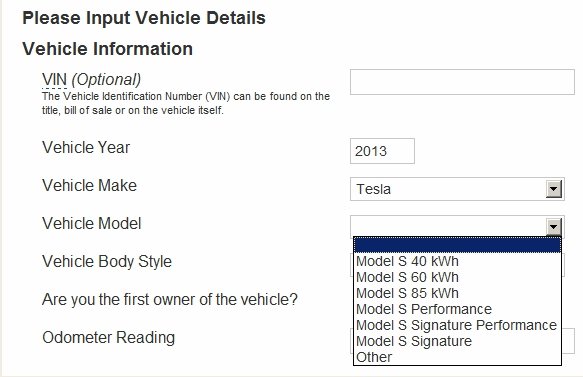
Iz Is there an assumption that swapping a 60 kWh battery to 85 or higher is a seamless process? I've gotten the impression that a software update would also be required for a different capacity battery. Another possible caveat is insurance. Rates may be based on battery size because of the sliding scale with regard to battery size as shown in the Geico quote page below.
 �
�
May 12, 2013
brianman If I could convert my Sig Perf to a shell where Tesla owns the battery and refunds me $40K or whatever, then this would be an interesting option. Until then, I will naturally be inclined to protect my investment in the battery.�
May 12, 2013
callmesam Great analysis. If it doesn't happen during this announcement, then its very likely to happen near term.
- - - Updated - - -
I don't think they would lend out your battery if you came in for a swap. I think they'd just hold it until you came back.�
May 12, 2013
jeff_adams Still not buying that. Service centers will NOT be located in the boonies. They will be located close to where the highest concentration of owners live. Those owners will be charged up for the road trip and will not benefit from a swap. So having your service centers in LA and Vegas DO NOT benefit you for a road trip from one to the other. The only way a swap can benefit you if it's in Barstow. No way will "service centers" be in places like Barstow.�
May 12, 2013
CapitalistOppressor This scheme made some sense when there was going to be 40kWh cars on the road. It makes almost no sense to me now.
If the primary justification for investing in battery swaps is because Tesla is concerned that their batteries are going to degrade into uselessness in 2 years, or that the current packs are not large enough, that will not be a good thing for their investors.
With all 60kWh cars being SuperCharger capable, the marginal benefit of an extra 20 or 30 miles of range on a trip is virtually nil. The only reason for Tesla to do battery swap is if they do the rapid automated swaps that they keep saying the Model S is capable of.
- - - Updated - - -
You are both correct, and incorrect. Battery swaps will occur on the highway. These sites will be called "service centers" and many might well have service facilities attached to to provide additional coverage to the region. Perhaps only staffed with mobile technicians of some sort.. lets call them "Rangers".
But the swapping will be entirely automated. And fast.�
May 12, 2013
stopcrazypp Do you know this to be true (if so source?) or are you speculating? If this is true, it changes the intentions of Tesla completely (it means they may be serious about battery swapping, depending on if this decision to build a battery swap demonstration is related to the recent proposal by CARB to eliminate battery swapping as a fast refill option).
I expect this to only apply for 2013. If Nissan continues to not sell any ZEV credits, Tesla will still have a market for them.
I don't expect a 5C charge to be safely done on the NCA chemistry. Even 2C is pushing it. Tesla is pretty close to the battery limits already. The fastest charging chemistries are lithium iron phosphate (a123) and lithium�titanate (SCiB/Altairnano) at 10C.�
May 12, 2013
ToddRLockwood I still find it hard to believe that battery swapping stations will be economically feasible, especially over the vast stretches of the American Midwest. Imagine how much it cost to build one of these BetterPlace swapping stations...
Better Place Battery Replacement Station in Ekron - YouTube
This looks like a multi-million-dollar installation, not to mention the land required. A typical Supercharger installation costs about $250K, usually working with existing parking infrastructure. Certainly, the swapping stations would not be free to drivers.
Perhaps in urban areas only.�
May 12, 2013
bollar I doubt Tesla will implement a system where you'll get your original battery back when returning after a swap. All of their communication, from the basically unlimited warranty on the battery, to the removal of the "range charge" in the upcoming software is designed to remove consumer concern that they have to treat the battery a special way to get maximum life out of it. I think they see this issue as ultimately limiting to sales and are willing to work around the problem with the swap.
If they don't offer to return the battery to you, then this dramatically simplifies inventory, doesn't it? If it takes five minutes to change a pack and an hour to fully charge, then you only need 12 packs for a lane plus a couple of spares for packs that somehow fail.
I do see this as being implemented primarily in the most remote of locations -- places where you don't want to wait an hour to charge -- between Amarillo and Albuquerque, for example (no offense to the residents of Santa Rosa).
Although I don't see wanting to use swapping often, I know that I would like to to be able to take the Tesla on a destination vacation -- Destin, FL is popular from Dallas, but it's a 700 mile drive -- I know plenty of people who do that in a long day with ICE, so they can maximize their stay in Florida *and* have their own car to drive around. Alternating swapping with Superchargers on the route would be a great way to allow a Tesla to make that journey.�
May 12, 2013
ckessel That's a total non-sequitur. Figuring out how to do batttery swaps has nothing to do with the difficulties in staffing.
Tesla service is understaffed right now. By your logic, that should not have happened since he's figured out building rockets...�
May 12, 2013
callmesam This works great for Urban Areas and supplements SUPERCHARGING, does not supplant or replace. This is not an either/or proposition.
- - - Updated - - -
No. My argument was that during the ramp up and launch, labor is constrained, but they continue to hire and that this will be solved. My comment was to this being "impossible" to accomplish in anything but the very long term.
Hiring ramp-up is a problem when you go from 10 employees to 100 employees.
Not when you go from 100 employees to 120 employees.�
May 12, 2013
CapitalistOppressor You only need a few of these though. Better Place needed them every 25 miles, which would require a substantial portion of the entire U.S. vehicle fleet to use the system before the business case closes. Tesla can have a skeleton system to cover the whole nation with maybe 100 locations.
Their business case doesn't need to close because they are already a commercial success. But if they charge a reasonable fee for this (as opposed to just giving it away) their business case closes almost as soon as GenIII hits the road. And if GenIII gets a million vehicles on the road they can be minting money with this, and the capital cost will be seen as puny, because you can cover almost any volume with the same 200-400 stations.�
May 12, 2013
Nickjhowe Battery swapping will almost certainly be needed for racing, so that's a great use case.
To me the most logical conclusion is that it is primarily to support servicing - either in the event of battery problems, or as part of an annual service. It is OK having a manual lift and an air wrench when there are only 2200 Roadsters worldwide, but when there are 100,000 Model S - as there could be in as little as three years, plus Model X let alone GIII - you really need automated battery swaps to drive operational efficiency. We know that Elon is focused on the bottom line.�
May 12, 2013
CapitalistOppressor Yes, if they were able to offer some plan where it is acceptable to not pick up your old battery it simplifies things greatly. I am just skeptical that they can offer a plan that will make existing owners happy.�
May 12, 2013
ckessel When/where was that announced?�
May 12, 2013
bollar It's in the 4.5 release notes thread. Sorry I can't multi-quote the link, but:
�
May 12, 2013
ckessel Oh, that's not removing Range charging at all. It's just changing from 2 charge options to basically an infinite number of charge options.�
May 12, 2013
ohmslaw Yes, but by calling "range charge" merely "100%," it is an implied message that it's fine to charge to that amount.�
May 12, 2013
ckessel
That's not the implication I get at all from the release note wording.�
May 12, 2013
bollar Fair enough, but now, there's no documentation that suggests that you only charge to X% unless you need the range. It's clear to me that Tesla is trying to make the battery into an appliance / black box part of the car and they really don't want people trying to figure out some way to squeeze more life out of it -- set it to 100% and forget it, unless you have a special need like putting it in storage, or some kind of tiered power rate, or even just staying at a friend's house and you don't want to be rude.
To be clear, I don't think early adopters and power users will like this, but I do think the next 90K users will definitely want to leave it at 100%, just like it was when it was delivered to them, and never think about it again...�
May 12, 2013
ohmslaw Yeah, that's the mystery of it. From a human-interface perspective, it's odd to expect people to associate "87%" (or whatever) with "normal." If we're not supposed to set it to 100% as a matter of course, from a man-machine interface perspective they should change the scale so 100% is "normal" charge and 110% (or whatever) is "range" charge. Psychologically, it will be hard to explain to people that they should set this value to a non-round number.�
May 12, 2013
stopcrazypp But I think people will still accept setting it at 80% or 90%. The Leaf's charge mode is either 80% or 100% (no "range" or "standard" mode) and most people still know to set it to 80% for daily use.�
May 12, 2013
ToddRLockwood Perhaps the change in the upcoming firmware which eliminates standard vs. range charging is related to this � moving owners away from the idea that there is a good way and a bad way to charge your battery.�
May 12, 2013
ohmslaw Just because Nissan is too dumb to understand human nature doesn't mean Elon is.�
May 12, 2013
stopcrazypp I just don't think it's that hard for people to learn that regularly charging at 80% or 90% is better for the battery than 100%. That's just a simple fact that as people get used to BEVs that people will pick up (and it applies to all BEVs not just the Model S).
The alternative proposal of 110% goes against all SOC conventions (both from an interface and technical perspective) and I think that will cause more problems than it would solve.�
May 12, 2013
teslasguy Swapping makes a lot of sense to me. Solves the wait time with Superchargers. I think the recent "unconditional warranty" statement regarding our batteries might in fact be a precursor to the swap out plan rollout. If our batteries are guaranteed unconditionally for 8 years then who cares what battery we use. That only leaves the issue of the condition of the battery at the end of the 8th year. All Tesla has to do is state that our battery will be as good at the end of 8 years as our original and all is well. Probably have to guarantee a certain level of condition after 8 years. Kind of like the car residual value promise. And hooking up with Better Place makes a lot of sense. Would really be a big boost for them that they really need. Limiting swap stations to service centers makes no sense. A lot of them are in out of the way locations not conducive to a lot of traffic.�
May 12, 2013
bollar I'm with ohmslaw on this. If there is an optimal setting, the manufacturer needs to make it clear -- like it is on the software most Tesla owners have today.�
May 12, 2013
brianman If the term "range charge" is removed from the UI itself, then that means "removed" in my book. At least technically speaking.
If you #define "range charge" in your personal CPU to "100% charging", then no "100% charging" is not removed in 4.5 AFAIK.
YMMV of course.�
May 12, 2013
stopcrazypp The thing is there is no real "optimal" number that applies for everyone. You can go all the way down to 40% and still see reduced degradation. 80%, 90%, etc is largely an arbitrary number. Tesla seems to have chose the cut off point based on the estimated range number rather than the actual battery impact.
From an interface perspective they can show this kind of like for an rpm gauge (where a range of rpm values are noted as "redline" using a block of color).�
May 12, 2013
brianman For some of us there's a concept of the "capacity of the battery". Charging to "above 100%" is like your gym teacher telling you to give 110%. Even back then I was like "f you, teacher, and your bad math."
That said, I get why "full" means "100%" to some people and that a number < 100% as "full" can be confusing. In part this is why I generally avoid the term full, in favor of "standard" and "range" terminology.�
May 12, 2013
bollar But what's happening is that the cutoff point is going away completely from Tesla's perspective. They don't want you to think about it. Recall Musk's announcement:
I find it interesting that they mention low charge serveral times -- and never mention high charge.
I'm sure that "knowledgeable" people will charge at 80-90%, but the remainder of users won't have to think about it at all, thanks to the warranty, and won't have any ill effects. From an investor perspective, this is important to me, since it removes one barrier to adoption.�
May 12, 2013
djp The warranty is against battery failure, not battery degradation. If you lose capacity on your battery after a few years of keeping it at 100% that's your risk, not Tesla's.
I'm sure the new firmware will still have a warning if you set the charge above 90%, and will automatically reset it to a lower charge level after doing a 100% charge.�
May 12, 2013
markwj The physics of battery degradation get in the way here. No matter what, an 8 year old battery is going to have significantly reduced range than a 1 month old battery. Hard to put a figure on it, as the long-term degradation studies are just coming in now, but let's be optimistic and say 33% loss of capacity after 8 years.
So, you take your brand new Tesla, with 100% charge 250 mile range, on a road trip and stop by a battery swap station. 10 minutes later your new 100% battery is in place and shows a range of 167 miles, and that is now the battery your car keeps. How happy would you be?
I haven't seen the wording on Tesla's new 'unconditional battery warranty', but there is no way that it will say the range of the battery will be as good in 8 years as it is new. Perversely, on the 40kWh batteries, delivered as range-limited 60kWh, they might get away with that, but not with a normal full-capacity-used battery.�
May 12, 2013
stopcrazypp They mention only low charge because the warranty is only intended to protect the user from a "bricked" battery, which will virtually never happen to a high charge battery (but can happen to a low charge battery, like it did to a couple of Roadster ones). It does not cover gradual capacity loss (you get a battery of the equal or better capacity has when the battery "failed", which implies total failure or factory defects, not gradual capacity loss). If the battery covers gradual capacity loss it'll have a hard x% in x years in which Tesla will replace your pack if it falls under that number. I doubt the updated warranty will have that.
Charging to 100% daily (rather than a lower number) accelerates your gradual capacity loss. That's just a simple battery fact. I agree most people can ignore that (the battery will still last past its 8 year warranty even if you did so), but for people who want to the most capacity left in their batteries past those 8 warrantied years, charging at 80-90% is a relatively easy way to help reach that goal.�
May 12, 2013
FreeOfPge Seems to me that you could keep yourcurrent battery in place, then use the frunk to store and swapsmaller mileage extending batteries. It is under your nose cone andseems to all of the issues...�
May 12, 2013
ckessel I've said it before in other threads, but I'll repeat it here. There is absolutely zero chance of a frunk battery or any other battery extension. It'd require redoing all the crash tests.�
May 12, 2013
cwerdna I've only read a few posts in this thread and I'm surprised it took so long for Better Place to be mentioned a few times. Re: the above, are you kidding?
Better Place has been going down the tubes. I wouldn't be surprised if they go bankrupt in the next year or two. See Project Better Place - Page 67 and all the posts that follow.
CA spends $3M on 6 EV Taxis clearly went down the tubes w/good $ thrown after bad given CA spends $3M on 6 EV Taxis - Page 2, Better Place closes US, Australian operations - Globes then Coda going bankrupt.
- - - Updated - - -
Is that still true?
Better Place shuts down Palo Alto location, ceases U.S. operations - Silicon Valley Business Journal
Better Place To Shut Down U.S., Australian Operations - Forbes
I see no US location listed at About | Better Place.�
May 12, 2013
FreeOfPge They would have to re do safety testingfor occasionally using the frunk? Is there safety testing done forevery temporary change, for instance the occasional use of thespare donut? Or using chains in snow? Sorry if I am being na�ve, itjust I do not know that much about safety testing of cars.�
May 12, 2013
stopcrazypp I think most people have Better Place in the back of their minds, but the reason why I didn't mention it (and I suspect most people) is that Better Place is pretty much almost dead. As your links show, they are only "alive" in Israel and Denmark (and even there they are cutting staff). They have no presence in the US anymore.�
May 12, 2013
ckessel For putting high energy, potentially explosive items connected to the power train? Uh, yeah, without a doubt.�
May 12, 2013
mitch672 Better Place doesn't have to be in business for Tesla to license/adopt their swapping station technology/IP
It certainly will not be a %100 copy, Teslas pack is a different design, but a similar robot could be used.
Here are a few patents for Teslas battery pack:
Patent US8286743 - Vehicle battery pack ballistic shield - Google Patents
Patent US20130049971 - Battery Thermal Event Detection System Utilizing Battery Pack Isolation ... - Google Patents
Patent US20100136402 - Sealed battery enclosure - Google Patents
Patent US8247097 - Method of controlling battery pack humidity utilizing an active reactivation ... - Google Patents
Patent US20120183815 - Thermal Management System with Dual Mode Coolant Loops - Google Patents
Patent US20110091760 - System and Method for Inhibiting the Propagation of an Exothermic Event - Google Patents
Patent US7923144 - Tunable frangible battery pack system - Google Patents
Patent US20120037310 - Selective cure of adhesive in modular assemblies - Google Patents
Note: didn't realize they had SO many patents on the pack/pack technology...
Here is one on a metal-air battery: Patent US20120040253 - Collection, Storage and Use of Metal-Air Battery Pack Effluent - Google Patents�
May 12, 2013
stopcrazypp I would rather Tesla not have to license their swapping station tech. The Tesla pack is sufficiently different that Tesla can/may have to use significantly different equipment anyways. It does depend on the development cost though (vs licensing).
Looking at the video, Better Place uses hooks to secure the battery and also has a battery connector that is directly on top of it (so it connects/disconnects simply by moving the battery up or down).
http://www.youtube.com/watch?feature=player_embedded&v=OHHvjsFm_88#!
Tesla uses bolts and I believe a wired connector (not something that is directly on top of the battery).
http://www.google.com/?tbm=pts#q=inassignee:%22Better+Place+GmbH%22&tbm=pts&psj=1&ei=cVqQUb3UNofhiwKJ1YDIBQ&start=10&sa=N&bav=on.2,or.r_qf.&bvm=bv.46340616,d.cGE&fp=a4dd32fe4eedb9d&biw=1024&bih=677�
May 12, 2013
ItsNotAboutTheMoney I don't see why anyone would have a problem with > 100% charge. Doesn't every car owner understand the concept of topping off?�
May 12, 2013
cwerdna Yeah. I think some people are pretty confused or unaware of the dire straits they (not surprisingly) have found themselves in.
I haven't read this thread carefully and don't intend to either, but I highly doubt Tesla will adopt anything as elaborate and capital intensive as what Better Place has tried, at least not on a widespread basis. I could envision something like this at select locations (e.g. service centers) but not much beyond it. The capital and staffing costs look insane vs. deploying more Superchargers.�
May 12, 2013
ohmslaw Doesn't the volume go to 11?�
May 12, 2013
stopcrazypp Problem: how many percent is a "full charge". With the standard convention used by virtually everyone, it's 100%. With a > 100% charge convention, it's not immediately obvious and something that has to be learned (might even be different for every model).
I much prefer having a default "preset" than having some kind of > 100% convention.�
May 12, 2013
ohmslaw Hence the problem with switching to numbers. Either you have 100% be standard charge, thus providing important psychological feedback to guide people's daily behavior (but then you confuse people who think in terms of absolute soc), or you have to train people to charge at 87% under normal circumstances (or, even worse, do what some people are suggesting, which is think about their own usage and charge accordingly - electric cars will never take off if people have to give it that level of thought).
Hence the suggestion that by making "100" correspond to what's currently range charge, Elon is telling people go ahead and range charge every day and don't worry about it.�
May 12, 2013
FreeOfPge Okay, I can see that, but even if they have to re do crash testing, why would that stop them? Is getting additional crash testing really that cost prohibitive?�
May 12, 2013
cwerdna It's probably not that cheap. See 2012 Toyota RAV4 EV-Safety - YouTube, for example. All the major automakers also do tons of simulations prior to physical crash tests.�
May 12, 2013
stopcrazypp From an interface perspective, I don't see why we can't have both a suggestion about charging lower for daily use AND also 100% corresponding to a full charge. That's why I mentioned the Leaf (which has a 80% and 100% charging mode), although that's still not perfect as it suggests 100% as default daily behavior as you say.
For the Model S specifically, have a mark at 80% or 90% that says "Standard Charge" and a mark at 100% that says "Range Charge" (or something similar depending on space in the interface) and then have the car preset to the "Standard Charge" mark. That preset will essentially be Tesla's suggestion for daily charging.�
May 12, 2013
brianman "Topping off"
Ok, so you have a 15 gallon tank in your other car. You fill it to 110% so you leave 1.5 gallons on the ground by your tires?
The problem is that it's deficient math. I prefer non-deficient math when buying a technology-heavy product.�
May 12, 2013
jdevo2004 I am positive the system they are going to implement will only be available in large cities. When you want to take a long distance trip, say from New York to LA and back you will leave your personal battery pack at the first swap station and pick up the latest, greatest, largest most advanced battery pack available for a weekly fee. You can then drive from city to city swapping or supercharging as needed for free. Once you return from LA to New York you just go to the original swapping station to get your own battery pack back. No one else is going to use your battery pack. It is that simple. Your warranty applies to your own battery pack, there is no way Tesla is going to let other people use it.
Tesla is smart to do this since then can sell the used battery packs after a year or two to people wanting to upgrade in 5-10 years. Remember that in a few years the batteries in current Teslas will be comparatively small.�
May 12, 2013
ohmslaw Actually, it's not deficient math. This isn't like the case where you say "I'm giving 110% effort." In this case, it's just a choice of reference point.
You have to pick two reference points. The bottom one (0%) seems pretty uncontroversial. So the question is the top one. It's no different than how 100 degrees Farenheit was picked. You can say "100%" must mean "maximum state of charge," but I doubt even range charge really is the maximum SOC for the battery. And, for example, for the software-limited 40's, what does 100% refer to? It's all just arbitrary.
So the idea is that you pick reference points in order to encourage the right behavior by users of the machine.
In any event, it's all sort of off-topic. It doesn't look like 4.5 does some sort of tach-like "red line" above 80%, nor is there any evidence of any other mechanism to tell you that the proper daily setting is less than 100%. So right now, with the limited information we have, in combination with Elon's battery announcement, it may be that what Tesla is trying to do is encourage people to just go ahead an "range" charge starting in 4.5.�
May 12, 2013
CapitalistOppressor No. They dont. It's a far superior system and a much better match for Tesla's strategy in the next 10 years.�
May 13, 2013
NotTarts Far superior? I can't think of any advantage a battery swapping system would have over supercharging apart from turnover rate. And honestly, I don't think that alone is worth the large increases in capital and complexity, not when there's a possibility that charging could be reduced to 15 minutes in the future.�
May 13, 2013
cwerdna Seriously? Have you looked at how badly Better Place is doing?
You mean to tell me that it's cheaper to build a building w/mechanism like Better Place's (or an equivalent), keep the place staffed, keep a bunch of expensive battery packs on hand, have to charge them, etc. vs. building Superchargers that don't need any of this?
Think also about the physical footprint that would need to be covered/enclosed vs. Supercharger stations.
FWIW, there were a couple confused folks on the Electric Vehicle LinkedIn group who before the Supercharger announcements kept arguing that Elon was going to announce battery swapping, despite the rep at the Santana Row store saying it wouldn't be swapping. Well, those folks were wrong.�
May 13, 2013
SteveG3 Another angle of speculation.
I think a SuperSwapper is likely the announcement, but what if it is not the heart of the plan.
They could announce SuperSwapper for SF to San Diego corridor as a study for a rollout.
With this they will clearly accomplish:
1. Selling more cars in CA given the added value of S-SWs. Given ZEV credits, no Model S is as profitable to Tesla as one delivered in CA. Will more than pay for 3 SuperSwapper stations.
2. They've been racing to add more and more SCs in CA with the very heavy usage. This allows them to get ahead of the demand issue with S-SWs that are 10X as fast as SCs... in and out quick, means lines go away.
3. Small scale makes storing owners batteries and filling S-SW system with batteries easier.
4. Small scale greatly reduces risk of potentially serious accidents rolling out a complex automated process with heavy equipment.
What it may accomplish without detection:
If Tesla's real aim for distance travel is a metal air range extender, they can work on this quietly with the other automakers off their scent. A small S-SW network in CA lets them test out the reliability, safety, and practicality of S-SWs in case metal air range extenders are not ready fast enough.
Why I think metal air may be the cloaked heart of the plan:
1. Look in the Frunk... nice spot for a range extender.
2. Much cheaper implementation. Stock M-A extenders at service centers and about 15 SuperCharger locations spread around the country. With a 1,000 mile range, you'd only need about 15 travel locations to cover the country. It would bring the station much more to the scale of a gas station. 2 or 3 attendants, a small building with stock, and 4 or 5 much simpler less expensive bays where a new range extender can be put in your Frunk if necessary en route (which will be rare given 1,000 mile range), and checked for proper installation by an attendant.
3. Much smoother during holidays. Service centers could stock metal air and the smaller cheaper equipment to put the extender in. Instead of showing up at a S-SW station at 11AM the day before Thanksgiving along with 30 other people, you pick a time weeks ahead to drop by service center and have extender put in.
4. More clearly complementary to SCs. a) you don't have an extender in your car, you need SC, b) you have extender in car: Say you're traveling 800 miles, you have options... if you are stopping to eat anyway SuperCharge, (incentive: using less of extender will lower the fee Tesla charges when you return extender at home service center). If you just want to zip through this SC location, drive by or if needed stop in for two minutes to put some water in the car for extender.
5. While storing your battery at the first SC on your way out and picking it up on return with S-SW model is realistic, going to the nearest service center on your own schedule to install and remove extender will almost always mean less effort, and always give you more flexibility.
While I think a full SuperSwapper rollout could work, I think buying time for metal air makes more sense to do.�
May 13, 2013
Kaivball I don't think the battery swapper proponents appreciate the complexity or liability involved here.�
May 13, 2013
cwerdna Yep.�
May 13, 2013
WarpedOne And the cost of the needed infrastructure for it not to be useless. Costs go way above the cost of a new factory.
It is peanuts demonstrating battery swapping at some existing Service Center, the problem is many orders of magnitude bigger if you want to offer every-day usable battery swapping across the country AND the world.
It * just * ain't * gonna * happen.
Do you really think future cars will have exact the same battery dimensions and kWh?
Do you really think they will setup swap centers near SS and stock all different batteries in enough quantities? Who will pay for this?
Metal Air Range Extenders (MARE) on the other hand *could* work, across the globe, in current and future Tesla vehicles and vehicles from other manufacturers.
As every vehicle will still have its own primary battery designed to meet its daily needs, MARE modules could stay unchanged (except for kWh) for long time. They could be easily sold at existing gas stations ...�
May 13, 2013
Yggdrasill Using the frunk is mostly unworkable, though, it can't hold enough weight and volume.
Aluminium-air has an energy density of 2 kWh/kg at best, and a Model S would need around 400 kWh to travel 1000 miles. That means that for the remaining 315 kWh you need to stuff 157 kg or 350 lb into the frunk. That amount of mass at the front would leave the car fairly unbalanced, the crumple zone would be gone, and the remaining allowable payload would be reduced substantially.
Here at least, it seems like the total allowable weight is 2590 kg (5700 lb), and the curb weight is 2108 kg (4640 lb) without driver. That means the allowable payload is 482 kg (1060 lb). Losing 157 kg means all occupants and luggage would need to weigh less than 325 kg (715 lb). With 2 occupants weighing 75 kg (165 lb) each, and 3 occupants weighing 40 kg each (88 lb), that would leave 55 kg for luggage, or 11 kg (24 lb) per person. Putting 7 people in the car would be out of the question, as would putting 5 adults in it be.�
May 13, 2013
SteveG3 What I've read in past (link below) Phinergy said 8 kWh/kg, so we're talking about 100 pounds... no major impact on the car, cubby whole low and as close to center of car as you'll find with easy access (other than in cabin itself).
Phinergy's metal-air battery could eliminate EV range anxiety�
May 13, 2013
Yggdrasill The aluminium itself has around 8 kWh/kg, but the aluminium is only one part of the battery, you also need water, all sorts of electronics, structural elements, etc. On the battery pack level, you're talking about more like 1.5-2 kWh/kg.�
May 13, 2013
SteveG3 Yggdrasill, I'm not a battery engineer, but it sounds a bit surprising to me that in one of these packs the aluminum itself would be only 25% of the weight. Water, other components... it just doesn't seem like they'd weigh hundreds of pounds.
Granted the pack for the small car Phinergy used in the video required only half as much aluminum, but the way their employees handle the pack at the start of the video, it doesn't seem anywhere near 200 pounds.
Do you have a point of reference for this?�
May 13, 2013
Yggdrasill I calculated using the figure 2 kWh/kg on the battery pack level.
Here's one study saying the current batteries achieve 1300 Wh/kg and future batteries can achieve 2000 Wh/kg. http://www.sciencedirect.com/science/article/pii/S0378775302003701
The study is from 2002, so I assumed they have achieved closer to 2000 Wh/kg by now.
- - - Updated - - -
I am at work, so I can't watch the video, but here's a few things to keep in mind:
- Are they lifting the entire battery pack, or merely some parts of it?
- Is it filled with water and aluminium?
- How strong are they?
Basically, any video won't give the full picture. Until Phinergy releases information about the energy density and power to weight ratio of their batteries, I'll assume they haven't had a major breakthrough. (I haven't seen them claim so either.)�
May 13, 2013
WarpedOne There is *NO* need to include water tank into the MARE modul.
It would contain only Aluminum sheets with 8kWh/kg and supporting components. Water tank should be external and not big enough to burn through a new MARE modul.
One would need additional stops to tank water (if there isn't any rain and AC condenser doesn't remove enough water from air).�
May 13, 2013
aronth5 If Elon was tossing out a battery swap trial balloon looking for feedback he certainly was successful:smile:�
May 13, 2013
SteveG3 Thanks for link Yggdrasill certainly consistant with the numbers you used, and you're right a video is certainly nothing conclusive (fwiw, it looks to be entire pack from the design of the compartment in the car they put it in, they don't look like they are handling 200 pounds, but yes, your point is valid, this is nothing conclusive looking at a video).
So, if today the best that can be done is 2 kWh/kg that article was projecting at the time, it seems right about on the border of making sense... i.e. a 200 pound range extender offering 500 extra miles for long distance.
As to best results with pack weight in 2013 perhaps someone knows more about current developments/Phinergy.
- - - Updated - - -
yes indeed aronth! perhaps crowd sourcing us for business strategy as well!�
May 13, 2013
Yggdrasill Well, like I was saying in the similar thread in the "Tesla Motors" subforum, I am not entirely dismissive of aluminium-air batteries in the Model S. I just think that if we are talking about aluminium-air batteries, it makes a lot more sense to swap out the Model S battery pack with a long range aluminium-air battery pack. It could contain 10-20 kWh of regular li-ion and 400 kWh of aluminium-air, without weighing more than the current 85 kWh battery pack.
You simply drive into a battery swap station, they remove your battery pack for storage and transportation to any other battery swap station you desire, then they put in a 410 kWh battery pack and you're ready to go. 1000 miles later you pull into a different battery swap station, they replace your battery pack with one that's fully charged, and refill the depleted one with aluminium and water for the next customer. When you arrive at your destination, you return the al-air battery and get your battery pack back. (If the destination is far from where you handed off your battery pack, you wait a couple of days until they ship it to your nearest battery swap station or tesla service center, and collect it. While you wait, you make due with the 40 miles of range on the regular li-ion and any remaining range on the aluminium-air.)�

Không có nhận xét nào:
Đăng nhận xét