Jan 28, 2014
nkohlimd Just an update-For the last month, I have had problems charging from the 6-50 outlet at work. Kept getting a bad cable warning message. We tried a new adapter and the electrician had checked the line. Nothing had changed on their end to cause these problems. This morning, the Watertown TSC uploaded the new firmware as a fix and, viola, everything is working back to normal...........for those who are having charging problems all of a sudden, the new firmware may be the solution.......�
Jan 28, 2014
Chipper New firmware??? What version?�
Jan 28, 2014
mnx I saw on another thread a mention of 5.8.6.
�
Jan 28, 2014
Alexander My car rightfully tripped when the current jumped unexpectedly.
Although at the time I didn't realize that that was the reason why my car had stopped charging. So like an idiot I unplugged the car and plugged it back in (thinking it just wasn't seated right) until my UMC finally broke. Tesla service took care of me and got me a new UMC within hours of breaking mine. So kudos to Tesla service�
Jan 28, 2014
JPP Another data point....yesterday I was charging at a ChargePoint station where I work. Initial voltage about 205V--appropriate for 3 phase power. Plugged in, amps ramped up to 30A and voltage plummeted to 185ish. S automatically dropped the amps by 25% and the usual error message popped up. Tried to run amps back up on the MCU--locked out. Disconnected and reconnected-no joy. Moved to another ChargePoint on the same feed with the same result. Sent e-mail to the facilities folks to have an electrician check the feed, wire gauge, connections, etc.�
Jan 28, 2014
glhs272 Maybe unrelated but after upgrading from 4.5 to 5.8 this weekend, I noticed at work my charging was cutting out. Rather it would from [email�protected] to [email�protected] it would stay there for about 30 seconds then go back to 16amps then drop back down towards zero. Do this over and over and not really make any progress charging. I turned on the pre-heat and then it stayed steady at 16amps. -2*F temps. After a 30min cycle of preheat it stayed charging for a while until I was ready to leave. I think the battery was just cold, but I hadn't had this happen before and it has been colder.�
Jan 28, 2014
Doug_G Here's a minor nit. When you have your iPhone connected by bluetooth, you don't hear the email and text message alert sounds. They must get routed to the car, which doesn't play them because it's listening to slacker etc. instead.�
Jan 29, 2014
jerry33 I play music from a thumb drive (no idea why anyone would do anything else) and it still doesn't play any alerts other than just for a phone call.�
Feb 9, 2014
islandbayy This is really annoying me. My perfect 14-50 install is starting to drop the amps to 30..... 8 months with no issues, My wiring doesn't heat up, my outlet doesnt heat up, my breakers don't even get more then a very slightly warmer then room temp, and the car is dropping me down to 30 amps. I just updated to the 5.8.7 Never a issue on any firmware before this. I have even had other people with the rate limiting firmware charge, as well as charged a loander successfully 2 days in a row with no issues. On hold to talk with Tesla to report false limiting. only thing I can think of is voltage drop. I'm at the end of a row of 15 homes on a single transformer. My voltage is around 240 at start and 225-230 during full 40 amp charging.�
Feb 17, 2014
DavidM Tesla is learning about the wonderful world of major appliances. Essentially, the Model S is a pretty darn expensive "major appliance". Major appliances designed to operate on Residential 240V circuits have to accommodate voltage fluctuations from 228V to 252V+/-. Can you imagine if your electric heat pump just stopped working when it saw a voltage fluctuation? And you woke up to an ice cold house? How about if the cake in your oven just stopped baking because the circuit shut down due to "voltage fluctuations". How about your electric water heater, or your washing machine? That would be outrageous.
So Tesla designs a much more complex "appliance", that can charge from 240V or 120V or 208V and any number of amps, in both residential and commercial environments. If they didn't get ALL the hardware and ALL the software just right, you're gonna have a problem. Well, they had a problem, and they're scrambling to fix it. In the meantime, the band-aid fix is to charge with 25% less amps whenever the voltage isn't "behaving". And the really annoying band-aid fix is to automatically stop charging completely, whenever the voltage momentarily goes outside the tightened range. So maybe you think your car is still charging, but it isn't. And consequently, you're not gonna get home tonight. Separately, Tesla is redesigning the charging adapter to include a fuseable link. Not sure how ultimately having a new adapter impacts the software (charging) issues that owners are experiencing today. Maybe it does, maybe it doesn't.
It will be interesting to see if the subject comes up on this week's earnings call.�
Feb 17, 2014
Cosmacelf Tesla's original sin was the hardware design of the interchangeable plug adapters for their Model S UMC. It isn't robust enough based on the evidence of melted adapters. So now they are trying to manage their hardware problem with software and finding that it isn't working very well. Plan C is their heat fuse, which isn't safe in my opinion.
They need to redesign the UMC interchangeable plug adapters. Since most people don't pop on and off different adapters on a routine basis, I would suggest they make the contacts much heavier duty with a much tighter fit. The contrast between the bulky NEMA 14-50 blades and Tesla's slim round interior pins is quite dramatic. The adapters slide on and off so easily (and even the new ones have a millimeter or two of play after they are clicked in), that I wonder how good the connection really is.�
Feb 18, 2014
Rainbow Ditto.
While I feel the addition of a thermal fuse is a welcome improvement in safety, it still does not fix the "original sin" of a UMC design that is not robust or safe enough. Adding a thermal fuse is a step in the right direction, but is still only a Band-Aid. The underlying problems still need to be fixed.
I also think the UMC and adapters should be redesigned so they don't allow so much heat to build up near wall outlets and don't put so much stress on wall outlets.�
Feb 18, 2014
qwk Yep. This is what I have been saying all along. Since Tesla went with the bare minimum pin diameter(and everything else for that matter), the adapters need some sort of a screw on ring that ensures a tight fit. Unless one is OCD, and makes sure the adapter is always butted up as far as it can go, there are going to be problems. Any other solution is going to be half-baked, as Tesla is quickly finding out.�
Feb 18, 2014
Theshadows Take the 14-50 plug adapter off the end of charging cable and look for signs of melting. Mine was acting up a little before I started to have the charge port latching problem. When I returned it I pulled the 14-50 plug off to look at it and it had heated up and melted. (It was actually hard to get apart because it had partially fused together.) I think this is what was causing mine to kick to the lower current a few times.�
Feb 19, 2014
VolkerP I would consider this a true positive. Works as designed.�
Feb 23, 2014
Andrew Charging today at a public L2 charger (Clipper Creek), since we're in the middle of rewiring during our solar installation... Started at 200v/30A and about an hour later I checked on the app and it's showing 189V/22A (22A Max). On latest firmware, 5.8.8 (.90). Looks like the circuit protection kicked in; I'd be surprised if it were really necessary.�
Feb 23, 2014
TexasEV You would have been more surprised had you found the car wasn't charging at all because there was an electrical fire. Give these guys a break. Even if there would be no problem with such voltage drops 99.9% of the time, can you imagine the damage that would be done to Tesla, and EVs in general, from the other 0.1% of the time that a fire happened?�
Feb 23, 2014
Andrew Yeah, I totally get that...and that's why I haven't complained about the protection that's been tripping at my home setup (even though I can't find anything wrong with the wiring). I'd definitely rather err on the side of caution.
However, at this public charging station, I'd be surprised if there were really a problem that warranted dropping the power. It's a commercial installation with Clipper Creek chargers... Obviously Tesla had to make a judgement call about the algorithm that trips the protection -- and it makes sense to be conservative. But if they have too many false positives, it's a problem too.
(Having said all that, I did just edit my previous comment to remove the "Boo." at the end.)�
Feb 23, 2014
jerry33 Unless the charger is defective (like many Blinks). However, I've had to monitor the charging at RV parks and lower the amperage manually on several occasions. What seems to happen is that more load is put on the infrastructure (someone turns on a stove or heater elsewhere in the RV park) and the voltage start to drop. I lower the charging amps until the voltage is stable. When the voltage increases I increase the amps again.�
Feb 23, 2014
neroden It's not necessary. The software is doing stupid things at public chargers.
I suppose the problem is that Tesla can't, through software, tell the difference between a sloppily wired RV park / home installation and a public charger which is heavily wired but prone to voltage sag due to general electrical load in the neighborhood. That data just isn't there.
It's a good thing I was not planning to take this car on a road trip ever again -- because with this version of the software, I can't take the car on a road trip.
You have to be able to rely on getting the expected charge rate from public chargers in order to take a road trip, and all the directions I'd go have no Superchargers and depend on L2 chargers. Hopefully this completely asinine and idiotic software update will eventually be reversed, once the UMCs are replaced.�
Feb 23, 2014
Cosmacelf As far as I know, Tesla has no plans to replace UMCs. 14-50 adapters, yes, but not UMCs. Were you referring to the adapters?�
Mar 11, 2014
mep I was hoping that with the firmware update 5.8.8 my charging problem would be resolved. Unfortunately not. Still the same thing. Every time after about 30 min charging is reduced from 40A to 30A. Frustrating.�
Mar 13, 2014
Theshadows If you know the building wiring and the feeder circuits are good and you have the UMC. take the 14-50 plug off of the UMC and look for signs of melting. If you see any at all (or can't get it apart because it's melted together) call your service center and request a new one. I was having problems with mine and it turns out it was melting inside and reducing the charge current.�
Mar 13, 2014
Doug_G I've yet to see a false trigger since upgrading. Perhaps you have more supply variation than most. You should mention your ongoing problem to Tesla; perhaps they can pull some logs or something.�
Mar 13, 2014
FlasherZ It's bigger than just building wiring and feeder circuits. Voltage fluctuations can sometimes go all the way back to the substation, if a distribution node is overloaded. This is why troubleshooting is important.
Troubleshooting can be complicated here, because it can be a factor of transformer overloading, or distribution circuit overloading, or service conductor overloading, or a not-quite-torqued service conductor... and complex interdependencies can exist - for example, you may not see that your service conductor is overloaded until you have the Tesla charging and suddenly your A/C compressor kicks in, drawing the voltage down because of high resistance there. But is that an issue with your service conductor, or perhaps is it the start capacitor or compressor motor on your A/C compressor going bad that makes it draw 200A for a few seconds instead of a fraction of a second?
Start local and work your way back. First, inspect the UMC - it's the easiest thing to check. Then, check your branch wiring - that your outlet is tight, that your conductors are the right size, that the breaker is tight, and that there is no damage along the branch circuit. Then you have to start narrowing potential problematic loads in the building - turn off all breakers but the Tesla charging one and see if it still backs off. If it does, then you know it's not anything related to loads inside the house but likely something with the power company. If it doesn't, begin turning on your loads, starting with the largest, and work through them slowly to see when the car backs off. Narrow down the potential problematic appliances on the load that seems to trigger the back-off and try to isolate it. A repair might be necessary there. If it doesn't seem to be isolated to a single appliance, you may have an aggregate load problem on the service conductors, transformer, or distribution network. Your power company will have to help you, and you may have to connect them with Tesla to figure out what might be triggering it.
A good electrician will be able to help diagnose this for you if you don't feel comfortable doing it.
The one thing I do know is this: I have a 2-4V fluctuation the entire time I'm charging, and the car doesn't back off. It takes a pretty good fluctuation to make the Tesla back off, and it's an indictor that *something* is wrong. You just have to work with the power company, Tesla, and perhaps an electrician to find it. Public chargers aren't immune to these problems, either, sometimes they're on an overloaded transformer or an undersized run, etc. But most importantly, I am happy knowing that at least Tesla wants to ensure the safety by having a check on the infrastructure rather than blindly drawing what will be the largest load seen in 95% of our homes.�
Apr 14, 2014
FlasherZ Ok - now that we've had 5.9 out there for a little while, time to revisit this topic. For those of you who said that the car had "falsely" backed away from the max charge current, have any of you received the 5.9 update and has the behavior changed for you (i.e., does it no longer back down)?�
Apr 14, 2014
Forty Creek 5.9 just installed and I am going to be checking this issue very closely. Since December's software update, I've been experiencing reduced charge rates with my HPWC. The HPWC has been replaced once, as was the car's charge port. The car seems to charge successfully at the service center, so the cause must be local. I have had our hydro utility out once to check the power to the house and they could not detect any problems (we are rurally situated, so I suspected a possible problem with power from the street). I routinely do schedule charges which start at 2:00 AM when nothing much else is drawing power. The house has a 200 amp electrical panel with a 100 amp breaker dedicated to the HPWC. The hydro people tested the line to the house without the car plugged in so I am wondering if the 79-80 amp load could cause enough drop in voltage to trigger the set back? They offered to come back if the problem wasn't resolved and so I'll arrange it sometime when I can actually be there with the car plugged in. The folks at Tesla Service in Mississauga have been great by the way in trying to help. The issue has simply been elusive.�
Apr 14, 2014
dirkhh Yes and yes
5.8.x would drop down about once a week. 5.9 not a single time since I've had it.�
Apr 14, 2014
efxjim Same backing off. I wish we had a one time override for specific locations.�
Apr 16, 2014
Forty Creek
Had my first charge since 5.9 and it didn't back off. The graph shows my home's power usage with a 2:00 AM scheduled charge. Anything around 19 kwh tells me all is well. Will keep an eye on it in the coming days.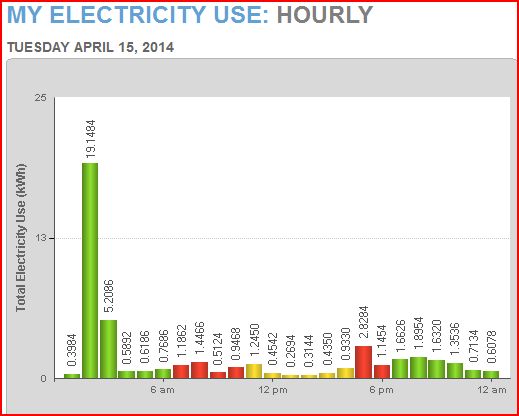 �
�
Apr 16, 2014
mnx I was charging my Model S this past Sunday afternoon and it dropped to 30A from 40A... I've never had a problem charging overnight however.�
Apr 19, 2014
Doug_G I charged at the Hotel Mortagne in Boucherville Quebec a couple of days ago. It has a CS-90. Unfortunately the voltage is rather low there, and the predictable result is that it always falls back to 50A, even though there's absolutely nothing wrong with the circuit.
Good thing I was staying overnight. The last time I was there I waited for three hours for a charge. That would have increased to 4.2 hours with the current reduction. That's kinda like the anti-Supercharger. Adds over an hour to your wait!
I complained to ownership and they said they downloaded the logs and were looking into it.�
Apr 19, 2014
islandbayy I had same issue, even on 5.9 I got downgraded to 30 amp the other night. Install is perfect. Just a lot of houses on my transformer and I'm at the end of the long string of homes.�
Apr 19, 2014
Doug_G The thing can and does trip on utility fluctuations. One of the owners I was talking to in Montreal said he could charge at full power at night, but if he tried to do it during peak demand hours it would always back off.
Prediction: once the rollout of replacement NEMA 14-50 adapters is complete, they'll quietly remove the "feature".�
Apr 23, 2014
DavidM Yeah, I have 5.9 and the car still backs down to 30A. Doesn't do it every time. Only about 1/3 the time. I had a great year of use with my UMC cable (prior to 5.8.4), no errors, no melting, 40A whenever I wanted. Then the software changed, no specs were published, and 30% of the owners have to be inconvenienced. I'm guessing the local transformer has fluctuations (within the utility's tolerances), but the new software updates don't like it. All my other major appliances don't seem to care, and operate normally. I guess we're waiting for software update 6.0, along with my center console, and my new adapter. On the brighter side, I did get the titanium shield installed yesterday. - babysteps . .�
Apr 23, 2014
FlasherZ Please read the FAQ (in my signature below) for why the "back-down" is critical and some of the troubleshooting steps you can take. Just because something works doesn't mean it's safe, and when you're dealing with electrical current this large, safety is an issue because of the intense heat that can be generated.
All of your other appliances don't seem to care because they are either a) resistive heating devices which don't care or b) typically draw less than 2 amps and therefore produce 1/400th the heat at the same resistance.
The car backs down because *something* is overloaded or undersized in your particular case, which creates a fluctuation that looks like a high-resistance heating point.
- - - Updated - - -
I doubt it. They may loosen the sensitivity, but I can't see them removing it. It is needed at currents this high. The fused 14-50 doesn't stop a fire from developing at a bad wiring junction elsewhere, a loose screw on a breaker, a subpanel lug, etc. It only deals with a local problem at the specific receptacle, whether a loose adapter on the UMC or a loose screw on the outlet.
Can you imagine if someone's electrical panel caught fire because of a loose screw at the breaker, and it was discovered that Tesla's safety feature may have stopped it by backing down the current but that the feature was removed? That's why I don't see it ever being eliminated.�
Apr 23, 2014
DavidM FlasherZ - "The car backs down because *something* is overloaded or undersized in your particular case, which creates a fluctuation that looks like a high-resistance heating point."
That's possible. But it's also possible, and more likely (given the high percentage of owners experiencing the backoff), that "fluctuations" are simply coming from the transformer and are no more dangerous on the Tesla circuit, than they are on your electric oven circuit, or your heat pump circuit. I don't believe that 30% of all installs involve loose connections or undersized wiring as you suggest. I give electricians more credit than that. I also don't believe that those 30% of owners did their own electrical work, and that 100% of those installs are botched.
FlasherZ - " b) All of your other appliances don't seem to care because they typically draw less than 2 amps and therefore produce 1/400th the heat at the same resistance."
A 40A oven circuit draws a lot more than 2 amps. Likewise with a heat pump. That's why they are on 30A and 40A circuits. And I know all about startup spikes that some appliances have. Many major appliances have an initial surge when they cycle on, but then running amps are lower.�
Apr 23, 2014
qwk This is taking it too far IMO. There is risk in everything we do. The world doesn't live in a bubble, and electrical problems exist even without EV's in the mix. Tesla's UMC design deserves most of the blame, as the Roadster UMC, and the Roadster Foundry units never had these issues(they were by far much more safety oriented, and had oversized components).
Tesla sold the car with a 10kw charger and a UMC capable of charging at that speed, they either need to keep it at 10kw, or advertise the car having only 7kw charging capability.
BTW, software doesn't have the capability of differentiating between safe and not safe. It's just a guess.�
Apr 23, 2014
FlasherZ You're mistaking my use of "undersized wiring" to mean only the conductors. Undersized wiring also includes the size of the wiring in the transformer -- i.e., transformer size. An undersized transformer is a safety hazard - it generates extra heat and in some cases will boil the oil right out the top. It *is* a problem.
You left out my a) qualifier. A 40A oven circuit is an intermittent resistive heating device. It doesn't care because the nichrome wire element does exactly what Tesla is trying to protect against. Furthermore, these circuits are not used with continuous loads - an oven or range cycles its elements intermittently, and never draws the full 40A for hours on end all at once. With regard to heat pumps, they are motor loads and almost always draw nowhere near the circuit breaker's capacity. Both of them are non-continuous loads.
I know that those of you who are affected by this really would like for it to go away, but wishing it away does not get rid of the safety issues associated with high-current, continuous load applications. I have seen first-hand the results of the problems, and I applaud Tesla for the safety intelligence they've added.
- - - Updated - - -
It's not a wild-ass guess, but rather an educated comparison to a known electrical pattern aligned with ohm's law. The new AFCI requirements are also the same - they look for the electrical loading patterns that represent an arc flash characteristic of a broken appliance. Likewise, the Tesla looks for the electrical loading patterns that represent a high-resistance or overloaded component.
A 40A continuous load is not the same as an oven circuit, or a heat pump circuit, or a handful of computer server appliances. There are some things that it does come close to -- and there was a thread here previously on one of them. For 95% of homes out there, the Tesla represents the largest kWh load the home will ever see.
See this post:
Incoming utility cable capacity - A cautionary tale
When installed properly, and when the capacity is managed properly, the Tesla can charge at 10 or 20 kW. No need to rate it at 2, 5, 7, 8, or 9, when the infrastructure is properly installed and rated for the load offered. In my case, had I kept my old 15 kVA transformer before installing my HPWC, it would likely be backing down right now because I would have stressed the ~60A limit of the transformer with the Tesla alone.
Many people make the assumption that just because they have a 200A rated service to their home, that the infrastructure will happily support 200A. My 200A service had 2/0 aluminum service cable, which the NEC rates to ~135A. My transformer was rated at 15 kVA (~60A). They had to be upgraded - and even today, my 400A service is the sole service connected to a 37.5 kVA transformer rated for ~150A. There is no doubt that many Tesla owners here are connected to transformers rated at less than 200A, *and* there are 3-5 homes connected to them.
The Tesla is backing down because it sees a high-resistance signature. Yes, it may be in a transformer out on the street that is high on a pole and is relatively safe (save from boiling oil falling from the pole) from the issue at hand -- but it's still overloaded.
The right thing to do is to follow the troubleshooting steps, involve the PoCo, and connect them with Tesla if you have to do this. Tesla would be stupid to pull off a (IMO smart) safety feature and open themselves to liability when a loose breaker screw causes an electrical panel to catch fire. Not a stove - cycling elements allows for components to cool; not a motor - inrush current vs. operating load allows for components to cool; it's a continuous load.�
Apr 23, 2014
qwk I agree with most of your observations, but just because a range, welder or any other appliance is not a continuous load, doesn't mean that the outlet for those cannot handle a continuous load. Sure there are shoddy installations, but that is not the norm. I also don't need the software to make an educated guess for me, I'm smart enough to determine if an outlet is safe to charge from, or not.
Having said that, I have absolutely no experience with any of this software backing current off stuff(just going off others miserable experiences), as I'm still on 5.8(.24), and will continue to be as long as this nanny feature is there. I think that everyone here that has any kind of electrical experience can agree that if the Model S UMC was engineered properly, very few, if any of these melting issues would have happened.�
Apr 23, 2014
FlasherZ It is true that the engineering of the UMC plays a part in the adapter's reworking. That said, even a properly-engineered UMC wouldn't have stopped the garage fire that resulted in this feature's insertion. That was due to a loose wire on the back of an outlet. Even if you install it properly, breaker screws and outlet screws can work their way loose over time (I just fixed a loose neutral in my outside shed this weekend - and yes, I can guarantee I installed it correctly 15 years ago) and when you couple that with continuous loads, you can end up with fires.�
Apr 23, 2014
DavidM FlasherZ - It seems to me that if what you say is correct, and I assume it is, then Tesla should have figured that out sometime between 2003 and 2012 (when Model S went into production). It also seems to me that it might have been more prudent to either overdesign the UMC as was apparently the case with the Roadster, or design the charging session to NOT be a continuous, sustained load (ie. 40A for 20 minutes, then 20A for 5 minutes to cool, then repeat). Afterall, these are smart guys (Stanford, etc.). You have to design a product with a FULL understanding of the environment it will be operated in, blemishes and all. Either they didn't agree with the criticality of your statements, or they weren't as smart as we all assume they are.�
Apr 23, 2014
qwk Tesla, or anybody else for that matter will not be able to eliminate house wiring fires completely. Just like ICE car fires cannot be eliminated completely. What you are asking for is perfection, which doesn't exist.
The only reasonable solution I see to this problem is a better UMC(even if it costs extra), and the current limiting software, BUT with an override, coupled with a warning message. A company cannot take away features that have been paid for, especially when that feature is the most important aspect of the vehicle.�
Apr 23, 2014
FlasherZ No, it's neither... just like any other product, they couldn't possibly anticipate every single electrical installation or grid attachment out there. The Roadster MC / UMC / HPWC has nothing to do with it. There were only 2,500 of the Roadsters manufactured (compared to 16x that in Model S today), and the customer base was less diverse. They didn't run into some of the same issues that they are running into with a much larger, more diverse customer base today. They are also more prominent -- being under the microscope means having to be more careful, hence the titanium plates or the charging back-off algorithm.
The continuous load aspect really can't be changed without increasing charge time, and that's a trade-off Tesla must make. Rather than forcing everyone to have an average of 37.5A as you suggested, they chose to address the risk by allowing those installations that "look good" in terms of the ohm's law profile to work at continuous, and for those that look marginal, they back off the charging current.
- - - Updated - - -
Sorry, I'm boggled by the response. It's not like Tesla is just deciding to screw with you and backing off the current arbitrarily. It sees a significant fluctuation that points to a problem in the electrical system where you're charging. Just because you don't believe that, or just because the segment from your meter to your receptacle is good, doesn't make it untrue. Do you really consider it a bad thing that the manufacturer of the largest kWh load your home will ever see is protecting you?
I've said it several times, I'll say it again - just because something works doesn't mean it's safe. Placing an override there will cause the average person to hit it every single time, regardless of whether he understands the risks or the physics of the situation -- "my electrician said my side was safe, so why not?" Just the fact that someone would ask for an override without being able to explain precisely why the Tesla detects that profile and backs off is proof why it is needed.
It has been established that a manufacturer *CAN* take away features that have been paid for, when they're unsafe. This happens in child toy recalls all the time. There were several examples cited in the "low" suspension thread. Charging works at the full rate when the infrastructure is there to support it. Fix your infrastructure, and the product works as designed.
The FAQ (below) has the appropriate troubleshooting steps. Call in your power company, explain what you're seeing. Have them talk to Tesla about the voltage fluctuations that are seen. My power company was happy to hear that I was going to give them more business and upgraded, no questions asked. If, however, the answer is not satisfactory, file a complaint with the PUC -- some PoCo's are living in the 1960's where we only used power for incandescent light bulbs, refrigerator and sawmill motors, and resistance heating, and they have to be sync'ed up with the reality of the world. That 10 kVA transformer serving 3 houses isn't going to cut it anymore, and they need to be held accountable, not Tesla.
- - - Updated - - -
Finally found the post I was looking for:
Smokin' transformers
In this case, I'm sure Adelman's home wiring was just fine... the transformer was horribly undersized. I think that protection is a good thing.�
Apr 23, 2014
markb Note that this could also be a hardware problem with the car. I had called Tesla with this problem, they checked my logs and told me they needed to bring it in. They picked it up this morning and are still trying to figure out why the car forces a drop to 30 amps.The loaner (same 5.9.44 as my car) they dropped off charges at 40 amps.�
Apr 23, 2014
FlasherZ Good point. I may need to add to my troubleshooting steps in the FAQ.�
Apr 23, 2014
qwk Like I said, I'm still on 5.8(.24) so this does not affect me at all. We must have differing opinion on what "significant fluctuations" are, because I have looked at fluctuation graphs posted here when the software current limit happened, and it was not significant. Let's say a Model S owner lives near a power plant which inevitably leads to fluctuations and current limit. Not an unsafe scenario, but the Power company will laugh when one tells them what you suggested. If that Model S owner has a long commute, he is screwed, even though he paid big money for a feature that was there, and then got taken away.
Again, companies can TRY to take things away that they sold, until someone gets pissed off enough to seek action. Not too far fetched. You cannot compare child toy recalls to $100k cars. Two opposite ends of the spectrum.�
Apr 23, 2014
FlasherZ From what I have seen from both owners that are not experiencing it and those owners that are, I can tell you that these fluctuations are pretty significant when the Tesla drops back. Help me define what you consider "not significant". My voltage fluctuates 2-5v during any given charge session, and my voltage drop is ~3-4%, and it does not back off. The 1960's standards used by the power companies may tell you it's not significant, but they're thinking oven elements, motor loads, and light bulbs.
They both involve the life safety of the person using the device. I don't consider them opposite. But we can rule that out for a second, the suspension thread had a couple of examples of car manufacturers removing a feature during a safety recall.�
Apr 23, 2014
DavidM FlasherZ - The biggest part of the problem is that Tesla didn't publish the old specs or the new specs for unacceptable "voltage fluctuations". By not making that information available to either the homeowner or the power utility, both entities are spending time and money guessing at what the problem might be. Tesla could help their customers by making this information available, but they won't. And that's what really upsets me. If the power utility knew what "condition" was in "Tesla's New Tolerance" to avoid backing off to 30A, they would know if the problem was on the transformer side or the homeowner side. So when the electrician says "everything's wired up right" and the power utility rep says "we are within our tolerance", the Tesla customer is screwed because he doesn't have anything to hang his hat on.�
Apr 23, 2014
qwk If I remember correctly it was between 2-7V. This was with FW 5.8.4, and Tesla might have changed the software tolerances. There is no way to tell though, so I'll stay on the my current FW for now.
I know exactly how much that current limit affects charging, as the UMC will dial back to 30-32A, when the "brick" portion gets any sunlight while the car is charging. It can be a significant amount of extra waiting time added to a charge when on the road, even when using a safe outlet.
It's amazing how much slack Tesla is given for their POS UMC design, even from experts in the field. It actually harms the company more than it helps. Tesla made a superb car, but the mobile charging solution is just junk engineering, to put it mildly.�
Apr 23, 2014
FlasherZ This I agree with. I'm sure if you connected Tesla with the PoCo they'd be willing to help. I suspect it's more of an issue of Tesla still tweaking the parameters based on their data during minor software revisions. Some have reported that their back-offs were reduced with 5.9, others haven't.
Even if Tesla did release its specs for backing off, you may be stuck with the PoCo saying "within specs" anyway. That doesn't automatically create a license to blow away safety -- it just means perhaps that the PoCo doesn't understand. It may require a PUC complaint and hearing, to get the PoCo's engineering arm to look at it vs. the guy who sticks his analog meter and says "it's +/- 10%".�
Apr 23, 2014
DavidM Actually, they have avoided direct contact with the power company. Can you imagine how bogged down they would be if they had to work with hundreds of power utilities for thousands of Model S owners who can no longer charge at 40A? That would be a bigger pain than just shipping 30,000 better quality UMC cable/adapters. What are they gonna do anyway when the fuseable link in your brand new adapter breaks connection and you can't charge at all? That's even worse than charging at 30A.�
Apr 23, 2014
FlasherZ First, there is no evidence that there are "thousands" of Model S owners who can no longer charge at 40A. This poll at the top is worse than non-scientific, because it's not a representative sample. Unfortunately, there seems to be this belief that 30% of Tesla Model S owners are experiencing this backing off... that's just simply not the case. The thread title will only draw those who have interest in charging or who experience the specific problem. It will not draw in those who don't have the problem (or at least will only attract a disproportionate number). At worst, you know of ~60 people who have had charging current back down. Then, to make matters worse, you ask people who are not experts in electrical infrastructure to make a determination as to whether it "rightly" or "falsely" backed current down. I *guarantee* you that a good number of the people who claim that they have "falsely" been subjected to back-down have an infrastructure problem. It might not be in their house, but it will be in their transformer, or on their service conductors.
This is not a "bigger pain", because only in a few circumstances will you run into the issue where Tesla and the PoCo need to converse. Only if you run into a condition where the PoCo refuses to do anything and says everything is just fine do you need to consider this. When I've helped others track down this issue, EVERY time we've found the issue without needing to call the power company. I look up and see a 10 kVA transformer feeding 2-3 homes, one with an HPWC; or I see that their incoming service conductors are 2/0 or 3/0 for a 200A service. If the power company refuses to deal with it, then you tell them you'll file a PUC complaint. Follow through with the PUC complaint if that doesn't fix things.
With that said, I can't help you any more if you somehow believe your infrastructure is perfect and that the Tesla is just backing the charge current off for the hell of it, so my best to you. I wish you luck if you choose to engage the PoCo; I wish you happiness if you just want to sit and stew and watch your current decremented by 25%.�
Apr 24, 2014
mnx FlasherZ I take it you haven't experienced the car dropping you down to 30A? I'm willing to bet the % of owners experiencing this issue is higher than you think.
I've only seen it happen a handful of times and I believe all those times were during peak/mid peak hours. It hasn't been an annoyance yet for me, although I have had trouble a couple times charging off a 120V outlet and been very annoyed. I'm not sure if it's 5.8.4 related or not.
FWIW, I contacted the utility before I installed anything and asked if a 40A continuous load for EV charging would be ok. They told me it wasn't a problem, but if I decided to install an 80A HPWC that I'd need to give them advance notice so they can preform some upgrades.�
Apr 24, 2014
Doug_G The algorithm seems to trigger on different things, one of which appears to be a fixed voltage threshold. It appears to always trigger at 190V. Surely that's inappropriate if the open circuit voltage upon connect was only 200V in the first place. It causes the CS-90 at Hotel Mortagne in Boucherville (south shore of Montreal) to always back down from 70A to 50A. This makes a huge difference to your charging time, effectively neutering a rare high power Level II station.
The other thing that seems to trigger it is voltage fluctuations. Unfortunately the grid has voltage fluctuations all the time. That said, it appears less likely to trip on variations if your voltage is higher rather than lower. I don't know for sure what their algorithm is, but I don't think it's entirely well thought-out. Certainly it is too sensitive.�
Apr 24, 2014
DavidM FlasherZ - It doesn't matter what you or I believe. It's a fact that Tesla believes there is a problem. That's why they changed the software in 5.8.4. But that's a band-aid solution as we all know. It's also a fact that Tesla believes there is a problem with the hardware (UMC), that's why they redesigned the adapter and are shipping it out to all the customers. Another band-aid solution. Everyone agrees a better solution would have been an integrated adapter that's not removable from the cord. It's amazing that your only suggestion in response to these known problems is for the un-electrically educated customer to spend time and money attempting to troubleshoot his own install. It's great that you have this expertise. But the majority of Model S customers do not (nor should they be expected to have this expertise).�
Apr 24, 2014
FlasherZ No - my car has, to the best of my knowledge and looking through the REST data collection logs, never dropped to the 75% mark -- at the airport, at the lake campground, at home, at my father-in-law's, and at J1772's at Illinois State University. That's a pretty broad base of chargers in many different environments (e.g., the St. Louis airport is @ 199V, 16A). I do have empathy, though - I have had to back down my charging on a faulty breaker once that would trip far before its load was truly reached; I don't blame Tesla for that.
I don't know what the actual %age of owners is, but I do know that assuming 30% based upon the poll in this thread is far off the mark. I've taken the opportunity to ask owners (in Facebook, in the St. Louis Enthusiasts' Group, and elsewhere), and it doesn't seem to be as prevalent as 30% or even 10%. Tesla knows, though - and that will give them the opportunity to look it over.
What I do know is that if your utility connection is sized correctly and your wiring is good, the car never backs down from charging at 100%. PoCo's are all different -- some, like mine, are really accommodating and the operations manager spent some significant time working with me on my requirements (and we re-engaged them the other day for any prep-work for Model X & a second HPWC -- they felt comfortable that I am within design capacity). Some, like PG&E, are a pain in the ass - see the post I linked above where PG&E claimed that Adelman would have to pay for the upgrade because of PG&E's excuse that his transformer was just fine and his solar PV system was the cause of transformer stress. You may have to file a complaint with the PUC (by the way, I had an acquaintance need to do this in PG&E land about 15 years ago, and it's amazing how responsive utilities can become when you threaten to do that, and follow through). Residential capacity management to many PoCo's is "wait until the transformer explodes/fails, then replace it" - evidenced by the many 1970's transformers still up on poles in neighborhoods around the US. The transformer serving my parents' home (built in 1884) is a 1970's vintage unit - I don't even know what the rating is but from its size, I'd guess about 5 kW.
Bottom line: the blame on Tesla for the safety provision in their software is misplaced. Just because it "worked fine" before doesn't mean that something wasn't overloaded and that it will continue to work. Perhaps they can tweak it to make its effects less pronounced in some infrastructure situations, but your charging load is different than traditional loads in the home. I do agree that they should release the technical specs that triggers a back-down so it can help troubleshoot the issue with the PoCo.�
Apr 24, 2014
cschock I use a newly installed (just before getting the Model S) by Solar City 50 amp breaker running new proper gauge wiring to a NEMA 14-50 connection in my garage. If I set the system to charge at 40 amps it will start out that way and then always at some point in the charge drop down to 30 amps.
There is no sign of heat damage or other problems with either the UMC or plug/receptacle.
I always charged at 40 amps until 5.8.4 without issue (again using same setup.)
Voltage appears pretty stable under charge but then I am not sitting and monitoring it for the full charge time.
I reported this as a false positive and look forward to getting the new 14-50 adapter and being able to charge at the rated speed of the outlet again.�
Apr 24, 2014
FlasherZ It seems that we've now hit the point where the points are all out on the table and what's left are disagreements: whether this is Tesla's problem to solve or an infrastructure problem with particular installs; whether there should be an override so that a consumer can, upon having checked that everything south of the meter, override the limit; or whether there's infrastructure problem at all. So this should be my final post here.
There are two different problems, you're conflating them.
The first is the issue of melting UMC adapters, a local issue caused by a product design. On this, you and I agree it's a problem and needs to be solved. Tesla solved it by placing thermal protection into the adapter. I do not agree with you (contrary to your assertion that everyone agrees a better solution would have been an "integrated adapter that's not removable from the cord") because it would severely limit the adaptation ability of the UMC. Not everyone uses only the 14-50, and the Roadster's solution of having multiple cords would be difficult for me to manage. We will only know if this continues to be an issue if we see the reports of melted UMC's changing to reports of charging that stops all the time because of bad contacts in the adapters, and it's too early to determine. Perhaps heat was causing a runaway effect with the old adapters that just made things worse, perhaps we'll see a bad mechanical design fail in a safer way (stops charging vs. melts) and the root cause is yet to be fixed. Let's set this one aside because it has nothing to do with this thread and the charging back-off.
The second is the issue of continuous loads and potential infrastructure issues. The garage fire that triggered the 5.8.4 software fix had nothing to do with the UMC or its adapters. It was the result of a loose screw on the back of the NEMA 14-50. Tesla uses ohm's law to determine when it appears there might be a high-resistance problem in the infrastructure. This serves to protect the infrastructure (whether wiring in the home, overloaded transformer, etc.) I disagree that "we all know" this is a "band-aid" solution - I certainly don't agree with that statement on the 5.8.4 feature.
The only cross-point of these two problems is that when it involves a loose screw at a NEMA 14-50 receptacle feeding a UMC--you might get lucky enough that the heat generated in that junction will travel through the prongs of the 14-50 to the adapter where the heat link may cut off the power. That's not guaranteed to happen, though. And it most certainly won't happen if the loose screw is a breaker screw, or a loose lug in a meter pan, or a bad connector in a junction box, or in an HPWC, far away from that adapter. That's why it's my belief Tesla will never remove this feature (but may tweak it so that the impact in certain cases, like Doug's below where voltage starts outside of tolerance already, may be lessened).
Tesla added a safety feature. Those who are affected by this safety feature because something in their infrastructure is undersized are claiming that a) Tesla is wrong about it being undersized, and b) are demanding that Tesla remove a safety feature for their (40A) convenience, both without fully investigating the problem at hand and coming to a full conclusion as to why the car is backing down. I side with Tesla on this one, because I've seen people lose their houses and family members due to electrical infrastructure fires. The car is not arbitrarily backing down, so figure out what infrastructure problem is causing it to back down.
Finally, the final bad assumption I'd like for you to stop making is that I'm asking all of the "un-electrically educated customer to spend time and money attempting to troubleshoot his own install". First, if you don't like the backing off, you will have to invest time, money, and perhaps both... because there's something wrong with your infrastructure. If you're able to troubleshoot, you'll minimize money at the expense of time. If you don't have the time, but have the money, you can engage people (electricians) who can help. I offer suggestions for people to find out where the problem is within their infrastructure. My first suggestion in the FAQ says that if you're uncomfortable with it, you call people who can help.
- - - Updated - - -
ANSI C84.1-2011 specifies a nominal voltage of 120V above ground for each leg with a 5% tolerance. On a three-phase 208Y/120V system, this means that the official voltage tolerance is between 197V and 218V for L-L phase voltage. If you're seeing 199V even before a load is applied, then something is undersized -- perhaps it's a long run to the charger from the distribution panel or transformer. Larger conductors will minimize that, or the transformer should be adjusted to provide a slightly higher voltage, or a boost transformer is required.
I think this is an area where a tweak to the algorithm might be appropriate, if there is a hard voltage threshold. It might be ok to look purely at voltage drop when load is applied, and ignore an out-of-spec voltage, considering it's a switching supply and can handle anything from 85V to 265V (277V in Superchargers). Perhaps Tesla will make this tweak in the future.
I don't know the specifics, either, but in each case that has been solved it has come down to something that was undersized or overloaded. It may not be in the home or "south of the meter", but it has been there.
- - - Updated - - -
See the FAQ in my signature, especially the question about this. This algorithm can't determine whether it's infrastructure inside your home, between your transformer and your home, or in the distribution grid -- it just knows that based on ohm's law, there appears to be a higher resistance than expected somewhere. Could be overloaded transformer, could be undersized service conductors, could be overload (even if temporary) in the primary distribution grid to your transformer.�
Apr 24, 2014
DavidM FlasherZ - Yes we disagree on numerous issues. But the problem associated with backing down amperage to 30A is clearly something initiated by Tesla with 5.8.4 (for whatever reason). I'm not debating the merits of their decision, just the implementation. You know banks provide protection for their customers at ATM machines by limiting withdrawals to $400 or $500 per 24 hour period. They could give customers even more protection by limiting withdrawals to $50 per 24 hour period. But the overall benefit of having an ATM would be diminished if banks were to do that. So after allowing me to charge at 40A for one year without incident, Tesla has decided to "protect me" and themselves from legal action (presumably), by diminishing the utility of their product (40A to 30A) for me and many of their other customers. The implementation of the additional "protection" is flawed. Even you and I agree that Tesla should publish the specs that trigger the backing off event, so electricians and power utility personnel can effectively troubleshoot. But if they published the specs I'm sure some would question the reasonableness of those specs. So better to not publish them - I guess.�
Apr 24, 2014
FlasherZ Perhaps they consider the specs to be trade secrets. Perhaps they consider the specs to be non-final and subject to tweak, and publishing them would only create confusion before they are satisfied with the algorithm. Perhaps they are trying to rectify differences with ANSI standards. Your suggestion that it is due to Tesla not wanting to be questioned doesn't seem to line up with my experiences with Tesla.�
Apr 25, 2014
Larry Chanin Flasher I want to thank you for your thoughful responses in this thread.
In the above quote am I correct that it is your speculation that Tesla is using ohm's law to determine if high-resistance exists in the supply circuit to determine the trigger points of this lastest firmware upgrade? In other words, Tesla didn't actually tell you that they use omh's law to calculate the resistance of the circuit and they use some value to trigger the current reduction, correct?
The only thing I have seen on the record from Tesla is the following excerpt from a blog article:
My point is that all we know for sure is that unexpected fluctuations in delivered power to the car triggers the 25% current reduction.
I agree with virtually all of your main points, but don't you concede that other loads, both in the Model S owner's home and in other neighbors' homes on the same supply transformer, or even utility switching/voltage regulation, could also cause a fluctuation in power delivered to the car? If so, that could be responsible for false positives without there having to be faulty wiring or higher than normal electrical resistance in the owner's home or even the utility supply circuit.
In other words, you do accept that it is possible to encounter legitimate false positives due to load fluctuations?
Hopefully these situations are limited, but we don't really know for sure.
Thanks.
Larry�
Apr 25, 2014
FlasherZ Hi Larry,
Indeed I do not know the specific parameters that are used. There seem to be multiple components from the data I've seen in various forums - the absolute low-voltage component, a faster-than-normal voltage drop component (high-resistance), and a sudden voltage drop / voltage surge component (arc protection).
Technically, short of a supply-side generator problem, all of the fluctuations are load-induced somewhere. In the FAQ I address how to rule out appliances in your home that may have problems (such as a heat pump or A/C compressor with a bad start capacitor). If you combine an overloaded transformer (a common occurrence) with bad appliances at a neighbor's house, it can indeed result in the Tesla seeing a voltage fluctuation. If the transformer is properly sized, then an appliance at the neighbor's would have to be behaving extremely badly to cause the fluctuation required to trip the algorithm. It's certainly not out of the question, though, and if it happens more than just once in a great while, then it points to something in the system that is highly stressing the system.
Any time this happens repeatedly or regularly, it points to a problem in the infrastructure somewhere and will likely require the PoCo help to track it down.
I'm coming around to the idea that the "low voltage" element might need to be tweaked - Doug's comment that the car seems to be more sensitive to fluctuations at lower voltages has been growing on me a bit. It seems that if that is a part of the algorithm, I'd be in favor of eliminating it and looking purely at the ohm's law and arc prevention portions.�

Không có nhận xét nào:
Đăng nhận xét