Dec 22, 2011
onlinespending Well I for one could afford much more than the 40 kWh car, but can't justify the extra cost. It's illogical to spend that money when 99% of my driving is well within the range of the 40 kWh car. Just would be nice to have the option to Supercharge in the rare event I want to take the Model S on a longer road trip. But it looks like I'll be doing the sensible thing and just rent a nice car for those road trips. I do believe the twin-charger is available for all models. I likely will be getting it, if no supercharge option is offered on the 40 kWh battery pack option.�
Dec 23, 2011
VolkerP The forum buzzes with people demanding 90kW supercharging for a 40kWh pack that is designed for maximum energy density and thus has low power density. Others want a quick charging capability that deserves that name, something around 40kW. They don't find 20kW charging sufficient for the "occasional road trip" scenario. Solutions are demanded from Tesla.
Well good luck, guys.
Some Europeans here demanded capability to charge while traveling with more than a measly 7.7kW and are denied a solution, be it the Roadster or Model S. Tesla states that the only planned solution is supercharging, and all they really care about is the U.S. market.
Now that we share a common bitterness between European and US base model customers, let's demand a solution that works for all of us. Tesla should provide an option for a unified on board charger that delivers 20kW at 240V80A single phase and 44kW at [email�protected] 3~ AC.
The expensive super charger installations along the highways can be interspersed with cheap three phase sockets
- 40kW charging becomes possible for base Model S on a highway stop
- overnight charging with 11kW or 22kW becomes a possibility for residents with 3 phase support but balanced load requirements
- road trips of European main land becomes possible with 44kW AC charging
A charger efficiency of 92% for the 10kW is pathetic and clearly leads to thermal problems, be it inside the car or inside a supercharger using 9 of these. They should license a decent 3 phase design with 97% efficiency. The freed up cooling capacity then can be redirected to the pack.�
Dec 23, 2011
ljbad4life The "option" to super charge costs money. It costs for the 60kwh pack and if it were available would cost for the the 40kwh pack. So why spend cash for 1% whether it be 2k or 10 k? I was not directing that statement to you, but there a more than a few threads and post that go "I can haz no super charger because Tesla hates me". The twin charger gives you 62 miles per hour charged, which can be used for trips of 250-300 miles or less and still be speedy enough to get you to your destination in a reasonable amount of time. If you want a highway road trip car the 60kwh pack is the least someone can buy.�
Dec 23, 2011
Eberhard With the upgrade to 230miles, your getting real value as well. the battery will last at least 50% longer. But it will only work, if your mileage is more then 15.000miles/year�
Dec 23, 2011
onlinespending You're right. I'm pretty sure this was ultimately a cost and business decision by Tesla. They really wanted to hit that sub $50k price target on the baseline model. And removing the cost of Supercharging allowed them to get there. I would at least like the option, just as the 60kWh pack will have the option (currently it says the price of Supercharging on the 60 kWh is TBD), but I am somewhat resigned to the fact that I'll simply have to rent a car for those trips longer than the Tesla's range.
I wasn't aware that EU costumers were limited to just 7.7 kWh charging. Sounds rough. I'm all for trying to persuade Tesla to improve its charging technology on all battery pack models. What efforts have EU members made? (petition? written letters?)�
Dec 23, 2011
dsm363 Tesla could have said ok, we were able to design the 40 kWh car with everything you want but it's now $57,000 after tax credit. Would that have made people happier? The 40 kWh car will still perform well and be a great car without Super Charging. Roadster owners don't have super charging and are largely happy. It would be nice ok but one owner in Germany has over 40,000 miles on his car! All without a super charger.
This is not to diminish anyones frustration with the 40 kWh Model S not including a feature they thought it would have, just to try and point out it may not be a big a problem as they think it is.�
Dec 23, 2011
Cobos I'm not sure where I would find use for the 20kW charger. As far as I know Norway has currently 3 options for charging.
1: 230V 10A or 16A which is regular plug, that's upto 3.6kW, and usually only 3.0kW is sustainable.
2: ChadeMO DC quickchargers several paid for by Nissan, others paid for by utilities or Statoil, usually upto 50% financed by the state/county
3: 3-phase "industrial" plug might be 40A or more I'm not sure.
Currently Tesla supports option 1 upto 3.0kW. Any superchargers installed in Norway (which I find doubtfull) will not be available for me with a 40kW pack.
Does people see why I think this is a problem for Tesla in their second largest market.
I have spoken with my contact at Tesla and he said Tesla would suppport quickcharging of some sort, but he would get back to me with specifics. I'm guessing noone knows right now, but the sensible thing would be access to the ChadeMo network of QC which is currently being built out.
Cobos�
Dec 23, 2011
Kevin Sharpe a lot of effort...
http://www.teslamotorsclub.com/showthread.php/6440-Endorse-my-letter-to-Tesla-for-supporting-3-phase-charging-for-the-Model-S�
Dec 23, 2011
Doug_G When on road trips, I've never been able to get more than 9.6 kW charging for my Roadster. It would be very nice to have twice that, let's say, uh... 20kW.�
Dec 23, 2011
Robert.Boston I'm puzzled -- how do electric ovens, electric clothes driers, and similar high-load home appliances get enough power? 230V 16A is not enough power for a double wall-oven.�
Dec 23, 2011
jkirkebo I take road trips in the Leaf, if 200 miles one way can be called a road trip. It's usually around 1-1.5 hours driving and 20-30 minutes charging. Works for me. Top legal speed over here is 62mph anyway.�
Dec 23, 2011
Kevin Sharpe I don't think that maths works... 1.5 hours x 62mph = 93 miles �
�
Dec 23, 2011
Kevin Sharpe Many homes in Mainland Europe have 3 Phase....�
Dec 23, 2011
TEG Seems typical Norweigan home oven would be slow to warm up by USA standards...
DÅTID OV8 Varmluftsovn - IKEA
Translated:
You can still get hot enough with lower current (230V single phase 16A), just takes longer to warm up.�
Dec 23, 2011
jkirkebo Clothes dryer does not need more than 16A, I know of no models that require more. Space heaters are max 2kW, usually much less. Cooktops usually have a special 25A connector, so 5.75kW max. Ovens are 16A 3.6kW. Double-wall ovens don't exist here, you'd have to use two single ones on different 16A sockets.
But I suspect he was talking about public charging spots. We have in excess of 3000 of those (with a population of 5 million, so the US would have to have 2 million of them to equal the density) but they are all 230V 16A Shuko-sokects. No J1772, no Mennekes, no 32A CEE sockets. We also have quite a few CHAdeMO stations with many more to come next year. Along my usual 200 mile road trip to my cabin I can access 5 different CHAdeMO chargers, next year there should be at least 10.
You might find larger sockets somewhere, like 3x32A 400V behind stores for garbage compactors. They are usually not for public use�
Dec 23, 2011
jkirkebo 62mph is the max. On a few roads. Most of the roads I travel on have speed limits of 43 or 50mph with quite a few 37mph stretches. So 1 hour at 62mph or 1.5 hours at 50mph to use 70-80% of the battery.�
Dec 23, 2011
jkirkebo Don't confuse kWh with kW. The ovens are 3.6kW and a typical one uses about 5 minutes to warm up to 200 degrees C (392 F).�
Dec 23, 2011
Kevin Sharpe sorry, still don't get the maths... 1.5 hours x 50mph = 75 miles
Are you saying that to do a 200 mile trip you drive 4 hours x 50mph and fast charge three times to 80% (total trip time ~6 hours)?�
Dec 23, 2011
Cobos Hmm our clothes-dryer pulls max 2kW so are a lot slower than the ones you've got in the US.
My little 1 bedroom apartment has a main breaker which is 40A 3-phase and the bathroom breaker is just 16A 230V, and that can run the washing machine and the clothes dryer at the same time.
Our electric oven has a separate dedicated breaker which is 20A 230V. That I believe is pretty normal. You can of course get more than 16A but then it's almost always 3-phase unless it's just 20A. As I live in an apartment I doubt I'll get my garage owner to install anything but 16A. I don't need anything else anyway for overnight charging. It's the faster than overnight charging I'm worried about, where I need a lot more than 20A 230V which is just 4kW.
Cobos�
Dec 23, 2011
jkirkebo Average speed usually ends up at about 45mph so it's more like 4.5 hours of driving (and 205 miles total). Next year another needed fast charger (at least for winter) goes up so it's more like this:
Drive 60 miles, charge for 20 minutes
Drive 40 miles, charge for 10 minutes (20 minutes in winter)
Drive 35 miles, charge for 15 minutes
Drive 30 miles, charge for 45 minutes (need a full battery for the last leg and back here on the return trip)
Drive 40 miles to destination. Only generator charging available here.
So yes, it's about 6 hours total, somewhat more in the winter months.�
Dec 23, 2011
Kevin Sharpe ah, I see now.... here's a trip I make on a regular basis;
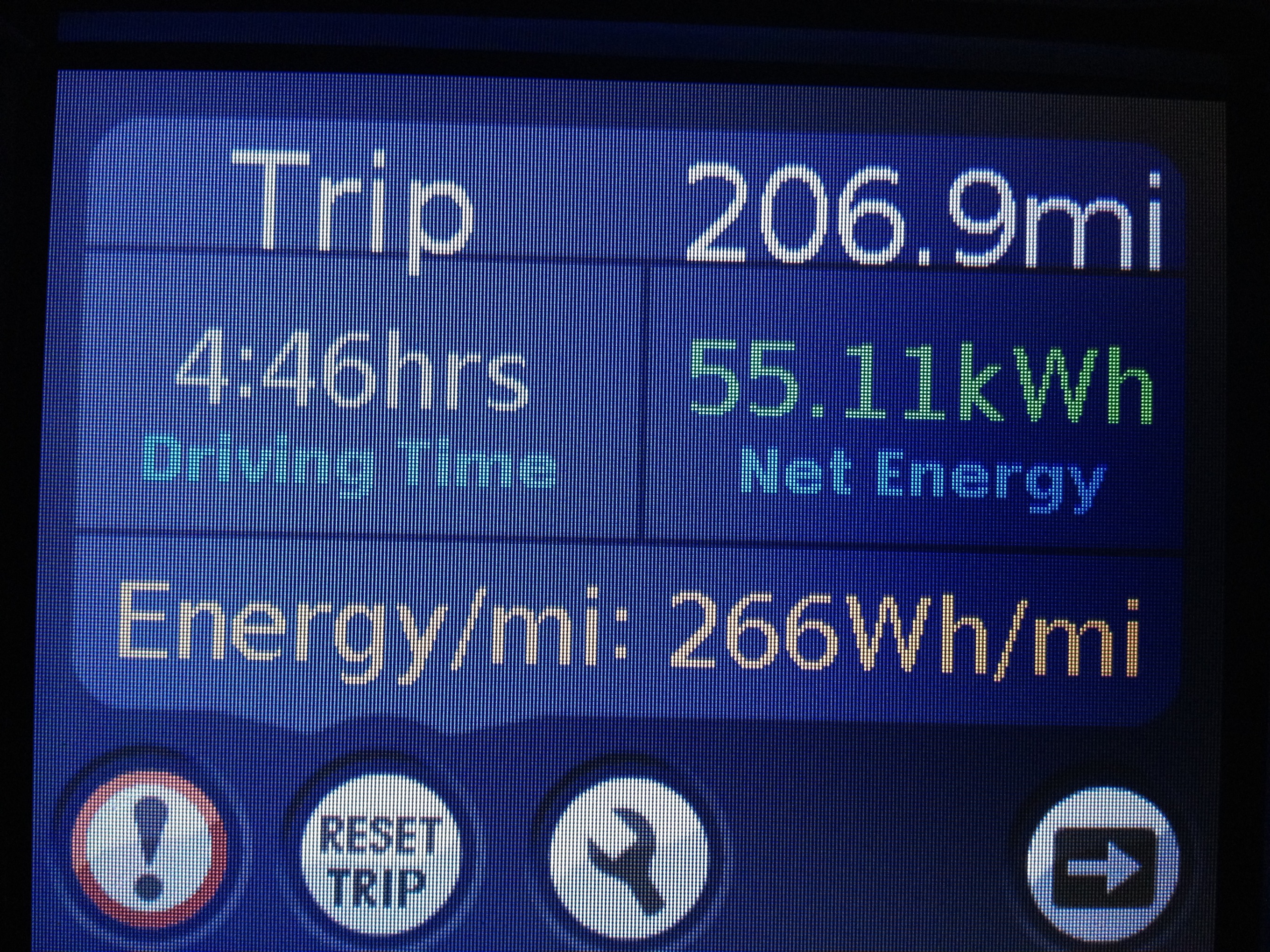 �
�
Dec 23, 2011
jkirkebo Faster yes, but it couldn't fit all the gear I need to carry with me
Also it would need to recharge completely on generator at my cabin, since it can't take a fast charge. That is ~10 hours on the genset (Honda EU65is, 5.5kW continous) and probably 7 gallons of fuel. The Leaf only needs to charge for 2-3 hours at 3.7kW�
Dec 23, 2011
EVNow I wrote down some scenarios - and made a new thread for it. Hopefully this will give a better perspective on why I need QC.
Quick Charge Scenarios Near Seattle (or Why I need QC with a 160 miler))
 �
�
Dec 23, 2011
NigelM EVNow, if you make those trips on a regular basis don't you think that sooner or later there are going to be enough EV's that you'll risk having to wait for a chargepoint?�
Dec 23, 2011
EVNow I think if there is a big enough demand - more chargers will come up.
Only if we buy a vacation home in Ocean Shores and we start driving every week would I need to worry.�
Dec 24, 2011
fairlycool So I spoke to Tesla customer rep and they confirmed the 40Kwh will never have a QC option. The fastest it can charge is ~2 hours if you buy the twin charger. If not it'll take ~4hours.
Also they only expect the 60Kwh and 80Kwh owners to quick charge ONLY in emergencies. They expect supercharging for those battery packs to only happen 2% of the time during the entire life cycle of the battery. So don't be planning on supercharging everyday.
This is because supercharging regularly will actually kill the battery and they obviously don't want that. The Nissan Leaf has a smaller battery pack and different chemistry so it can quick charge more often than the Tesla battery packs.
It's a good thing my reservation won't come up till 2013, since this now gives me time to see if BMW or other car manufacturers can come up with a better solution (for their i series cars) in 2013 or if they too will recommend quick charging only 2% of the time.�
Dec 24, 2011
Robert.Boston Very interesting info -- though I wouldn't characterize "2%" as "emergencies only." Still, this clearly rules out driving SF-LA-SF every weekend (unless you drive ~40k miles a year, and these are your only supercharging events).
It might be a useful exercise to maintain (or reconstruct) driving logs for ourselves. I took exactly one driving trip in 2011 where Supercharging might have been needed, and even that was marginal: 275 miles almost entirely on interstates, so with my 85kWh pack and aero wheels, conservative driving could have gotten me there, perhaps with a bit of extra charge at a coffee stop somewhere just using normal charging.
Regardless, this new info makes me rethink getting the second 10kW charger.
Tesla should also think about having the ability to dial back the 90kW Supercharger to, say, 50kW that could be used fairly regularly (such as my SF-LA roundtrip example) without serious battery degradation.�
Dec 24, 2011
Norbert +1. Let's hope the situation is a bit better than that... and that future battery packs will allow much more frequent supercharging.�
Dec 24, 2011
Mycroft Even with the 85kWh pack, I'll probably still trade cars with a friend when I need to make a long trip with lots of storage needed. The friend I trade with will be ecstatic and I won't have to worry about taxing the battery or wasting time.�
Dec 24, 2011
Larry Chanin Hi Robert,
If I understand your remark, you are thinking about getting the second charger as a safer alternative to Supercharging when making frequent road trips?
If so, would you be relying predominantly on charging at RV parks? I gather that Tesla has only commited to building a Supercharger network, not a high amperage Level 2 network, and I haven't read about others installing high amperage Level 2 chargers along highways.
Larry�
Dec 24, 2011
Mycroft The "West Coast Green Highway" initiative is installing level 2 chargers up and down the west coast. WA state is also installing them east-west across part of the state.�
Dec 24, 2011
EVNow I'm not sure about the accuracy of this information. If this is indeed true - what is Tesla's plans for the future ? Will they continue to rely on batteries that can't be charged even at 1C ?
Future belongs to EVs that can be driven for 3 hours and quick charged in 15 minutes.�
Dec 24, 2011
Mycroft Yeah and the future isn't here yet. I mean to say that Li-Ion won't be the technology that will be able to do that.�
Dec 24, 2011
EVNow The L2 chargers will be 6.6kW only, AFAIK.
Not in terms of QC. Toshiba's SCiB can charge in 5 minutes - and last 1000s of cycles. They still need to get the cost down, though. Since the market for $80K cars is rather limited, EVs will smaller batteries but capable of QC will likely form the volume market.
My question was really about Tesla's affordable car - Blue Star.�
Dec 24, 2011
dpeilow Isn't this the battery in the i-MiEV?�
Dec 24, 2011
EVNow Not sure - Honda Fit is supposed to have that battery. There was some talk earlier of VW using thos ebatteries - not clear what the current status is.
BTW, I should also note that Leaf's battery is capable of being 80% charged in 15 minutes. Nissan has demonstrated even quicker charging.
Tesla's strategy has been to use generic, high density batteries. Apparently there is a problem with quick charging of these (though I've always assumed 1C charging to 80% should be easy for even the LiCo batteries). May be Tesla is seeing some failures after a large # of charges ?
ps : According to Mitsu - they use GS Yuasa batteries.
Mitsubishi i Electric Car Battery & Range / Mitsubishi Motors
�
Dec 24, 2011
Norbert I guess we will also be checking what DBM and A123 are doing these days...�
Dec 24, 2011
EVNow Vanadium batteries are intriguing. A lot of companies are reasearching them (apart from DBM).�
Dec 24, 2011
dpeilow That may have changed Toshiba SCiB to be used in Mitsubishi i-MiEV, recharge to 80 percent in just 15 minutes -- Engadget�
Dec 24, 2011
dpeilow Interesting charge graph on both the Panasonic 2900 and 3100 mAh cells...
http://industrial.panasonic.com/www-data/pdf2/ACA4000/ACA4000CE240.pdf
http://industrial.panasonic.com/www-data/pdf2/ACA4000/ACA4000CE254.pdf
Is either of these the 160 mile cell? Because the former can charge at 1C.
http://batteries.sanyo-component.com/fileadmin/EDITORS/BATTERIES/industrial/datasheets/li-ion_li-po/UR18650E.pdf
http://batteries.sanyo-component.com/fileadmin/EDITORS/BATTERIES/industrial/datasheets/li-ion_li-po/UR18650F.pdf�
Dec 24, 2011
Norbert Yep.
Green Car Congress: Toshiba's SCiB battery for the Fit EV
However, a comment is talking about "average energy density and high cost"...�
Dec 24, 2011
Norbert As I just posted in this thread:
Converted Audi A2 goes 605 km (378mi) without charging
Tesla apparently at least tried to contact DBM early 2011. However that surely would be a long-term project.�
Dec 24, 2011
Larry Chanin Hi Mycroft,
I'm not sure whether you were responding to my question about high amperage Level 2 chargers. Perhaps I missed it in your references, but the Level 2 chargers that I saw referenced were only 30 amp and dual on-board chargers wouldn't charge any faster.
Electric Vehicle Charging Station Configurations
Larry
�
Dec 24, 2011
Mycroft Yeah, I just saw "level 2" and didn't notice the amperage.�
Dec 24, 2011
dpeilow That's true, but you can still get a 40kWh one in the same mass as the 85kWh using 18650s.
However, as I posted above, there's a cell from Tesla's preferred supplier that charges at 1C and seems to fit the number of cells for the 40kWh battery previously quoted. So what's the problem? Nothing technical...�
Dec 24, 2011
Norbert From the PDF I wouldn't be able to tell the effect of the charging rate on cycle life. Another consideration is that immediately after charging, (highway speed) driving itself will add a larger stress to a smaller pack, so that there could be accumulating effects from the combination of these demands on the battery.�
Dec 24, 2011
Lloyd What about the existing network of HPC's which charge at 16.6 Kw's ? Most have been converted to J1772�
Dec 24, 2011
Larry Chanin Hi Mycroft,
So to recap my point, if DC fast charging more than 2% of the time is ill-advised even for 85 kWh batteries, and the utility of dual on-board chargers is only realized when connected to high amperage sources, then in the absence of high amperage roadside chargers, when taking repeated long road trips our only option is to reroute to RV parks. I guess its going to be hit or miss whether the detour to a high amperage RV site will actually result in shorter duration trips than stopping roadside 30 amp chargers.
Unless I've missed something I find it difficult to justify the second on-board charger at this time, with any size battery pack, knowing the second charger can be retrofitted later if the EV infrastructure makes it feasible to do so.
Larry�
Dec 24, 2011
Larry Chanin Hi Lloyd,
Could you please elaborate? How extensive is the network? Are these connections that were originally designed to accommodate the Tesla Roadsters?
Thanks.
Larry�
Dec 24, 2011
Lloyd Yes Larry,
Most of the Public HPC's at least in California have been converted to J1772, and most have retained their full 70 amp capability. I posted a thread to add or convert to J1772 an existing HPC to allow charging at the increased amperage. I'm not sure how many were installed on the east coast, but in California there are public one's spaced on the freeways to allow the roadsters to go between San francisco and Los Angeles, Sacramento etc. Some of the other Roadster owners my know how many of these were sold. Some will still have the Tesla connectore designed for the Roadster. If someone wants to convert one it is easy, takes about an hour.
We may find that we can order a Model S connector alone to allow conversion of an HPC to a model S EVSE! If this is the case this will provide an additional use for the existing HPC's. To use their full potential with the model S you will need the 2nd onboard charger. Otherwise you will be linited to 10 Kw. You wont be able to use the full potential of the 2nd, but most of it! I paid $900 for an HPC on Ebay!�
Dec 24, 2011
dpeilow 1C would certainly give an 80% point of under 500 cycles if one for a similar Sanyo cell is any guide, but the point is that you don't do this every day.
In the same way that when you select range mode the VDS pops up a dialogue about reducing battery life, do the same for rapid charging. Maybe limit uses and certainly log it for the warranty.�
Dec 24, 2011
Norbert In general, it appears to me at this point, it might take battery development a bit longer to fully support everything we are asking for. However the goal should remain the same, my vote would be that Tesla remain committed to realizing the combination of 200+ mile range and 90 kW charging (with as few detours as absolutely necessary).�
Dec 24, 2011
Lloyd This is from the Nov Elon interview with Elon. From this statement it appears that Tesla has intentions to make adapters for may connector formats, including Chademo!
"Since most public stations will be set up to charge with the J1772 plug, this is a potential problem, but Tesla says it will supply adaptors to accommodate any existing standard. The company also unveiled its home charger (which it calls a �connector,� since the actual 10- or 20-kilowatt charger is on the car). The wall-mounted unit is an ultra-sharp angular design, in various colors to match customers� cars."�
Dec 24, 2011
EVNow Went to the Bellevue Store to take a look at the Beta car. Chatted with a couple of reps.
They are equally surprised like us that the 160 miler won't have QC capability. One of the reps said she had been telling everyone that all three models will support the supercharger. She had heard that part of the reason for this decison is that they felt they can't give 8 yr warranty if they allow QC. She was till hopeful they will have a CHAdeMO adopter that works with the 160 miler.
The reps were telling everyone about the 160,230 & 300 models. They haven't switched to 40,60 & 85 kwh yet.�
Dec 24, 2011
WhiteKnight One reason to have the Twin Chargers (20 kW) is the ability to use any of the High Power Connectors at the Tesla Stores which will be in every major American city within a few years.�
Dec 24, 2011
WhiteKnight I think the main reason the 40 kWh car has been dialed back in terms of 0-60 and Supercharging is the warranty. They weren't feeling comfortable with an 8 year warranty otherwise and wanted to keep them all at 8 years.�
Dec 24, 2011
Larry Chanin Hi,
Every little bit helps, but in using Robert's example where he wants to make repeated long road trips he would be forced to detour off the highway to recharge at an RV site or a Tesla store. In many, perhaps most cases I doubt he would be saving any time adding these detours to his direct highway route. In a few years if there are sufficient high amperage chargers/connections along strategic highway routes he will always have the option of retrofitting the car with a second on-board charger. In the short term I seriously doubt there will be any immediate use for the second charger for the vast majority of early adopters.
Larry�
Dec 25, 2011
Trnsl8r I'm thinking getting the twin chargers may be worth it from a resale value perspective. Not that I plan on selling the car, but you never know. This seems like one of those things that it's better to have and end up not needing, than the other way around (like the 85-battery)...�
Dec 25, 2011
Larry Chanin True, but there is good reason to believe that the second on-board charger could be retrofitted later when the widespread availability of high amperage sources is assured.
Larry�
Dec 25, 2011
Trnsl8r Yeah but that sounds like a hassle... Plus I'm going to guess it'll cost more than 1500...�
Dec 26, 2011
stopcrazypp The cell density of the NCR18650A (in 85kWh pack) is (note I'm using prismatic volume so not cylindrical):
3.6V*3.1Ah / 45.5g = 0.245 Wh/g
3.6V*3.1Ah / (18.6mm*18.6mm*65.2mm) = 0.495mWh/(mm^3)
http://industrial.panasonic.com/www-cgi/jvcr13pz.cgi?E+BA+3+ACA4001+NCR18650A+7+WW
The cell density of the SCiB is:
2.4V*4.2Ah / 155g = 0.065 Wh/g
2.4V*4.2Ah / (62mm*95mm*13mm) = 0.132mWh/(mm^3)
http://www.toshiba.com/ind/data/tag_files/SCiB_Brochure_5383.pdf
So SCiB pack of the same capacity would be 3.79x cell weight and 3.75x cell volume of the NCR18650A, so even a 40kWh SCiB pack with have about 1.8x the cell weight/volume of the 85kWh pack. The SCiB does save some weight/volume from not requiring liquid cooling, but I doubt the cooling system used by Tesla takes up half the volume and weight of the 85kWh pack.
In general, I'm guessing a A123 cell (like the APR18650) is a better match. It keeps the same form factor and is better than the SCiB cells in density (A123 pack of same capacity would be 2.63x weight, 2.88x volume vs NCR18650A):
3.3V*1.1Ah / 39g = 0.093 Wh/g
3.3V*1.1Ah / (18mm*18mm*65mm) = 0.172/(mm^3)
http://www.a123rc.com/goods-102-Nano-Phosphate+LiFePO4+Original+A123+APR+18650+M1A+Cell.html
And what's this talk about 1C? There's no doubt the 40kWh pack can charge at 1C safely (40kW), since the 85kWh pack can charge at that rate (there's some slight chemistry differences, but in general lithium cobalt 18650s are cycle tested from 0.5-1.0C charging rate, so 1C shouldn't be an issue for most cells). I thought this was already established in previous discussions.
The argument was over whether it can safely charge at 90kW ("supercharger" speeds); that's 2.25C. I'm pretty sure even if that can be safely done, it's going to severely effect the life because that's twice the charging rate of the cycle test. And even that 1C rate only gives the 40kWh pack 80k miles life (corresponding to the typical 500 full cycles * 160 miles); Tesla gets the other 20k miles (125 full cycles more) by treating the pack better than the cycle test does.�
Dec 26, 2011
dpeilow Well, all we have to go on is the Roadster ESS. If you calculate the cell mass vs pack mass for that, it is roughly half.
Actually go and look at the charge curves in the Panasonic datasheets. They are not 1C for those larger capacity cells, more like 1/3. The Sanyo was the only one I came across that really shows 1C.
Agree the A123s look interesting, even if you do need 11,000 to reach 40kWh.
No, most people are saying they'd be happy with 1C (to get the same 80% in 45 minutes or close to it). It seems to be the "300 milers" who are steering the argument towards 90kW all the time.
And this is the straw man, because it assumes the owner fast charges every time - rather than the reality of a few times a year in the vast majority of cases.�
Dec 26, 2011
Norbert At least according to these specs: A123 @Mavizen ,
the numbers of A123's "prismatic pouch cell", AMP20, look better on paper:
Converted to the units you use above:
0.131 Wh/g
0.246 mWh/(mm^3)
Using your numbers for the NCR18650A, it would be 1.88x weight and 2.02x volume for the same capacity. And 0.88x the weight and 0.94x the volume for a 40 kWh pack, compared to the 85 kWh pack using NCR18650A. So it might fit.
With apparently *much* higher charging power possible (not sure which of those numbers to use, though). Apparently "only" a question of cost.�
Dec 26, 2011
Norbert While only Tesla can tell us the specific reasons and details, I think it is a combination of several factors (such as the overall stress on a smaller pack), which caused Tesla to make this decision.
People where hoping for Supercharging, but see the technical reason for limits around 1C. So they say 40 kW (or 35 kW due to the other stress factors) is better than 20 kW. Which of course it is.
In the end, I think, this becomes more an argument in favor of a CHAdeMO adapter. But don't forget that the warranty for the 40 kWh pack is already reduced to 100K miles, perhaps without any DC charging capability at all.�
Dec 26, 2011
dpeilow I guess we now know why the new Rav4 EV won't have CHAdeMO.
And probably why Mercedes switched the Smart ED to a different pack supplier for the new version with 22kW 3 phase charging.�
Dec 26, 2011
stopcrazypp I figured you might say that. That's assuming all of the extra weight is from the liquid cooling system. I'm pretty sure the bulk of the weight is from interconnections, module enclosures, and the main enclosure. These elements will also be required by the SCiB pack (as well as the air cooling system, which replaces the liquid cooling system). You have to subtract all the overlapping elements to see the effect of only the liquid cooling system (minus the air cooling system on the SCiB pack). Given the cell weight is roughly half of pack weight, I'm pretty confident the liquid cooling system is less than half.
It'll be more clear once we can get the pack density of the Fit EV vs the 300 mile Model S.
Yes, in general the lowest capacity cells are charged at 1C (this is true of Panasonic's datasheets for lower capacity cells too), while the higher ones are charged at lower speeds (like 0.5, 0.7). But I don't take that necessarily as indication that higher capacity cells can't charge at that rate, but that may have more to do with the charging equipment (I notice they keep the charging current around ~1500-2000mA for the 18650s). Note: I'm looking at charging current/rate for the cycle test (not the charging characteristics graph).
http://industrial.panasonic.com/www-data/pdf/ACI4000/ACI4000CE2.pdf
I realize that, but I thought it was already established 1C is going to be fine for most cells.
Actually, that is a fairly standard calculation for pack life (that I use personally even before Tesla ever said anything about the supercharger and that I also use for other manufacturers). That's the baseline life in miles (the only measured indication of pack life), which Tesla will have to do significantly better than in order to provide the 100k mile warranty.
And in general, even if I was assuming quick charging (which I'm not); I think manufacturers tend to assume worse case in calculating warranty length (which minimizes the chance of warranty claims). As long as there is a possibility of the user relying solely on quick charging, Tesla has to account for that in the warranty to limit liability (or as I suggested, write a limit on quick charging into the warranty terms). Another warranty related factor is the fact that the 160 mile pack will have to quick charge roughly 2x to travel the same distance. Since the warranty is by miles, that means over the lifetime of the warranty, the 160 mile pack will have the potential to quick charge roughly 2x over the same miles.�
Dec 5, 2012
GDH Why you can't supercharge a 40kWh battery:
Why can't you supercharge the 40 kW battery?�
Dec 5, 2012
Oyvind.H Short version: Why can you fill a big bucket with your garden hose at full pressure, but not a regular coffee cup....
Serious version: the superchargers put out so much current the 40kWh battery would probably be harmed if charged that quickly.
With 90kWh charger the battery will theoretically fill up in one hour (charge rate 1C), but the 40kWh battery would refill in less than half an hour. That`s (most probably) too powerfull for the battery cells to receive.
In comparison, the superchargers seem to charge the 85kWh at full speed from about 0-50% SOC, then slow down gradually until the battery is full. It`s the battery chemistry that limits the charging current.�
Dec 5, 2012
rolosrevenge I still will never know why they didn't simply add identifying software which dials down the current to only a 40 kW charger when you plug in a 40 kWh pack. It would take the same time to get you on your way at least. Here's hoping they put a 20 kW AC charger at the locations to accommodate any 40 and non super charging 60 packs that may end up in desperate need of a charge.�
Dec 5, 2012
palmer_md The supercharger at 90kW on an S85 is about 150 miles in 30 minutes. For a 40kW charge it would be about 70 miles in 30 minutes. Given that they plan to put these about every 100-150 miles on the highway, a S40 could not make the distance from one to the next without a full charge. The charger will throttle back when above 50% SOC, so your talking about more than an hour charging the car. Lets say 1:20 for conversational purposes....I have no idea what a real value would be. So in a S40 you'd have to keep your speed down to 60mph to reach the next station, and it would take about 2 hours and then you'd have to wait 1:20 to charge up before heading to the next one. Because of this, the S40 is just not well suited to be used for long distance, which is the purpose of the supercharger network. I realize most people who are buying the S40 probably want it, and I'd want it also if I had ordered that car. On the other hand it makes sense for Tesla not to offer it because someone would order one and then try to make a long distance trip in it and find it is difficult and then they'd drive 75mph and not reach the next station. You know some reporter would do it just to make the car look bad. I'm sure this is the main reason it is not offered. I have to say I agree with the decision, even though (like I said) I'd like to have it offered on the 40 as well.
Recap: The S40 is not well suited to long distance travel because you have to compromise both speed on the road and spend more time charging to make it viable. Tesla only wants to build "no compromise" vehicles, therefore opted to not allow the S40 supercharger network access.�
Dec 6, 2012
brianman To me it seems fairly simple:
Tesla has designated "supercharger" as "much faster than 20kW". According to Supercharger | Tesla Motors, they decided 90 kW is "much faster" than 20 kW.
I think you're asking "but why can't they just drop that down to like 40 kW". Because a factor of 2 is not "super", it's just "double"? That's my read at least.�
Dec 6, 2012
GDH Makes sense. For someone like me that does not do long trips the 40 is more than enough, however the longer charge time and the lack of charging stations around Portland is lame. I can do the 65 but 10K 70 more miles is out of my range with the added options. It also looks like they are discontinuing the 40 in Europe?, I wonder if they will do that in the US?�
Dec 6, 2012
RDoc I continue to hope that the reason it's discontinued in Europe and not available on the X is that they're dropping the 40 and adding a 120. :smile:�
Dec 6, 2012
GDH Says the person that can afford a 120.�
Dec 6, 2012
Citizen-T Why didn't they invest more time and money into building a system that would encourage their customers to spend less money on their products? The world may never know...�
Dec 6, 2012
doug Please do a search first. This topic is discussed at length here: No Supercharging for 40Kwh
Also please choose thread titles more descriptive than "40". Will merge.�
Dec 11, 2012
Brian H Clogging the pipeline
Since QC 40s would have to SC more often, and take longer (because of need to hit high SoC, etc.), they would potentially clog and monopolize some stations (near cities, e.g.). And even then could charge only enough to maybe limp to the next station -- or to the next city (since stations will mostly be inter-city, not intra-city).
Feels like the wrong tool for the job.�
Dec 18, 2012
jcstp Charging a leaf with 25kw takes 7 to 10 minutes longer (instead of 1h 30)
http://www.americas.fujielectric.com/sites/default/files/DC%20Quick%20Charging%20-%20FEA%20Comparison%20Study%20%20%2825kW%20vs%20%2050kW%29%207-3-12.pdf page 4
I think this shows that charging much faster for such "little" batterys is overrated and not necesary.
That is why I think Tesla did not add supercharging to the 40Kw Battery
Do you think waiting 1h30 iinstead of 1h40 is worth 500$ ? (price twin-charger 1500$, price for supercharging = 2000$ (+ 10000$ for 60kw battery) )
Maybe instaid comme together with Tesla-owners and start installing HPC's!�
Dec 18, 2012
markb1 The problem is, with Tesla's announced supercharger rollout plan, superchargers will be far more common than public 90A HPWCs. But, yeah, if there were lots of places to take advantage of the dual chargers, supercharging wouldn't make much sense for 40kWh packs.�
Dec 31, 2012
Eeyago This question may have already been answered on the forum, so I apologize in advance since I'm unable to find it.
Is it worth getting the twin chargers for the 40kWh if I don't plan to quick charge at home? Are there public chargers in the wild that we can take advantage of with the twin chargers?
Phil�
Dec 31, 2012
stopcrazypp They will be rare (most of existing 20kW chargers are for the Roadster), but the J1772 spec does go up to 20kW, so you never know. Part of the problem is for some reason, the publicly funded chargers are only allowed to go up to 10kW (there's some conspiracy theories about this in terms of favoring PHEVs over BEVs, although I guess the practical reason is that only the Roadster and Model S with dual chargers support 20kW charging). If the twin chargers can be added later, you can choose to do that instead (don't know if this is an option anymore, ask your rep).�
Dec 31, 2012
markb1 My understanding is that a lot of the public Roadster chargers have been converted to J1772. But those are mostly in California.�
Dec 31, 2012
aviators99 If you think BEVs will become more popular, then you can assume that 20kW chargers will become more commonplace. In the spring, someone at Tesla told me that the twin charger would be something that could be added later. I choose to disbelieve that.�
Dec 31, 2012
jerry33 If you are in Canada, there is already a network that would make use of the twin chargers. My thinking is that as more EVs are sold, high powered chargers will become more common. It's 100% certain that it will cost more to add the second charger later then to have them put it in when the car is built. And perhaps in a year or two you'll want the HPWC. My opinion is that twin chargers are a good way to future-proof your Model S for very little additional cost. Flexibility in charging is always a good thing.�
Dec 31, 2012
stopcrazypp Problem is none of the non-Tesla EVs in the horizon have 20kW onboard chargers (they max out at 10kW, a lot are just 3kW), so it might be a long wait. I guess it's "safer" to add it now because it might not necessarily to be available later (even if the reps say it can be added).�
Jan 1, 2013
Brian H Surprisingly, yes! My S Baby on his East Coast trip, I think, used a kind of "splicer" to plug into two campground 50V outlets at once, and charged at 2 x 40A = 80A. So you wouldn't even have to count on upgrades of other systems.�

Không có nhận xét nào:
Đăng nhận xét