Feb 26, 2015
breser As I mentioned in my 85D First impressions thread my car is limiting itself to 79A on an 80A HPWC setup.
To be clear I'm not talking about the perfectly normal variability in the amperage you see for what current the car is currently receiving (what I'll refer to as instantaneous display). This instantaneous view always bounces around a bit and it's perfectly normal for it to show 79/80A while charging. To repeat, that's not what I'm talking about.
In the charging menu there is a the selector that lets you set the maximum amperage to use. You can set this all the way up to 80A (with dual chargers) when not plugged in. When you plug in the maximum is limited to whatever the pilot current is (i.e. whatever the connector says is available to the car). In my case the car lowers the maximum amps to 79A. It then doesn't let you raise it back to 80A until you unplug. Plug back in and most of the time it lowers back to 79A. This lowering also seems to be sticky, you have to keep raising it to 80A. So far I've only ever seen it stay at 80A once. My S85 never did this.
In the other previously mentioned thread two P85D owners showed up and said they had the same strange behavior.
Andyw2100 made a video of it and shared it with both of us privately and we confirmed that all 3 of us were having this strange behavior. So it's possible this is something specific to D's. I have a service appointment on Monday for this and a couple other minor things on my 85D. But given that there's 3 of us with this behavior and wk057 says the P85 doesn't do the same thing with the same HPWC, I think there is something weird going on here. I'm splitting this out here under the hope that may other people have seen this and I can walk into the service center with more evidence.�
Feb 26, 2015
wk057 I've noted that my energy monitoring setup also reports 79A of power draw from the P85D and 80A from the P85, so it doesn't appear to be a rounding issue.�
Feb 26, 2015
Andyw2100 I'm guessing this affects a bunch of cars...possibly even all of the Ds. I think the reason we haven't heard more about it is that everyone experiencing it probably felt it was trivial enough not to worry about, or may have received or believed the same information I had, which we now know to be incorrect--that the display was showing 79, but that the car was actually receiving something closer to 80. And perhaps a lot of people just didn't notice. And some may not have known what to expect, but also didn't really have any place to go to ask. (When I first saw the 79 instead of 80, as a first-time Model S owner, I wondered if it was actually normal, but I came and inquired here. Someone who wasn't using the forums probably wouldn't bother to call a service center to ask about that.)
I'd be shocked if this is limited to a small number of cars.
By the way, below is the post I had made inquiring about this the second day I owned the car. As breser and wk057 and I have been talking about this, I've been feeling a little guilty about not having done a better job of bringing this to light when I noticed it, and wondering if I just didn't describe the issue correctly. I was a brand new Model S owner, after all. But looking at what I wrote now, I think I actually did describe the issue reasonably well, for a newb. Perhaps other P85D owners just never saw that post, or hadn't noticed the issue with their cars yet. (Or perhaps breser, wk057, and I have the only three cars doing this. I guess we'll find out soon enough.)
Model S - HPWC - Page 86
�
Feb 26, 2015
Puff ive plugged into almost all the HPWCs at the service center. 79A.�
Feb 26, 2015
breser Yup if I hadn't had the previous car I would have thought it was normal. When I got the first car I watched charging a bit like a hawk to get some understanding of it. This time I came home, plugged it in and didn't think much about it. It took me a couple days to notice the charge limit was at 79A and then I just thought it was because maybe the service center had lowered it to that. Raised it and it took me a couple more charges to realize it was back at 79A and then I started investigating.
- - - Updated - - -
Don't be so hard on yourself. So far quite a few people who have seen the posts about this in other threads have concluded we were just talking about getting 79/80A on the instantaneous current display which is perfectly normal. I don't remember seeing your post but if I had I probably wouldn't have thought too much of it.�
Feb 26, 2015
Andyw2100 The video is available at the URL below, if anyone wants to watch it to see if their car is exhibiting the same behavior or not, or just to see what our cars are doing.
P85D charging at 79 Amps instead of 80 Amps - YouTube�
Feb 27, 2015
RiverBrick I don't have a D, but 80A and 70A charging dropped by one amp after a software update. Not 100% sure, but I think it was when going from 5.9 to 5.11.�
Feb 27, 2015
FlasherZ We're talking about two different things...
The first is when the car shows "79/80A" which mine does: Tesla has told me that's a tolerance issue - they have to make sure there's room for the EVSE overhead and such.
But breser is pointing out (and the video confirms) that his maximum current drops to 79A and won't go up to 80A. It seems like there might be a duty cycle sense problem somewhere, such that the car is calculating the maximum current is 79A.
My car shows "79/80A", reporting a maximum current of 80A - but the car sometimes never draws that.�
Feb 27, 2015
breser My guess is a software bug in calculating the max amperage from the pilot signal. Perhaps an off by one bug in the calculation (though usually I'd expect that to be consistent and this one isn't always). Possibly some sort of rounding happening in the calculation that wasn't before. Maybe the hardware is a little more or less sensitive and that's causing the off by one issue. It's hard to say but in my opinion it's a bug.
Losing 1 amp out of 80 isn't a dramatic loss in charge rate. You go from 19.2 kW to 18.96 kW and if the voltage is lower than 240 it's even less of a difference. However, at lower charging rates it becomes more and more significant. I actually haven't tried charging at lower rates but I wonder if they aren't impacted too. I'd guess that people would have said something about this earlier though if it did impact NEMA 14-50/40A charging.�
Feb 27, 2015
FlasherZ The J1772 duty cycle is calculated differently for 51A+ vs. 0-50A. There's a wider margin for error below 50A... 0-48A takes up 80% of the duty cycle, then the remainder of the range (49-80A) gets to use a 16% range of duty cycle before it's considered an error, in 2.5A steps per 1% of duty cycle. 50A+ is (amps / 2.5) + 64.
Weird, though, that 79A would be detected - I wouldn't think they'd use that granularity in their duty cycle. Wonder if it's a different approach in the firmware to the 79/80A situation I see.�
Feb 27, 2015
wk057 I have two HPWCs and both give the same result. 79A max on the P85D (9 times out of 10) and 80A on the P85.
The first thing I considered was the duty cycle being misread, but I haven't been able to test that.�
Feb 27, 2015
breser I'm going to be lazy and ask if you know where the docs are on that. I'm hoping there's a source I don't have to pay some absurd fee to see the spec.
Could be but it's annoying since it makes the 79A sticky. Once it detects 79A max when you unplug the location is still 79A. You have to turn it up every time to get 80A. Most of the time it reverts back to 79A but I did have it stay at 80A last night. So it's definitely intermittent.�
Feb 27, 2015
rlang59 You can find some of the info over on the OpenEVSE wiki:
https://code.google.com/p/open-evse/wiki/J1772Basics�
Feb 27, 2015
breser Thanks that helps me visualize the potential problem. Looks like the duty cycle for 80A would be 96% and 79A would be 95.6%. Can't really fathom why they'd round that down to 79A in software. Seems more likely this is a hardware issue that's causing a misread of the duty cycle.�
Feb 27, 2015
andrewket Sounds like a software bug.�
Feb 27, 2015
FlasherZ So those of you with the P85D have never seen 80A as the pilot-current max on any chargers?
I'm just guessing here that they may have simply changed the code in the newer cars to show 79/79 instead of 79/80, all to achieve the same means.
I'll ask a few folks I know.�
Feb 27, 2015
Cottonwood I have never seen the 79/79 display on my P85D with multiple firmware versions and two different HPWC's. I consistently see 80/80 or occasionally 79/80.
In an earlier version of firmware on the P85D, I saw 70/0 displays while charging on two different 70A Clipper Creek J1772's. I just treated this as a curiosity because while the max was displayed as 0 Amps I got the 70 Amps delivered to the car.�
Feb 27, 2015
Andyw2100 Well there goes my theory that it affects all the Ds.
Was yours a fairly early P85D, Cottonwood? I know WK057s and mine were built at around the same time, because at one point I thought they might have been on the same truck. (In retrospect they almost certainly weren't, but they arrived at their respective SCs on the same day.)
So I'm wondering if there could be some small hardware change.�
Feb 27, 2015
breser I've seen 80/80 and 79/80 and 79/79. Based on wk057's post I believe he has as well (note his comment about 9 times out of 10).�
Feb 27, 2015
mknox FWIW I see a similar situation on 100 amp Clipper Creek / Sun Country Highway J1772 chargers. In theory, they should deliver 80 amps.
When I plug in with my car initially set to 80 amps, it will drop to 79 amps and once charging, you can't bump it back up to 80. While charging, I will see 79/79 amps but more typically 78/79 amps.�
Feb 27, 2015
Cottonwood My P85D started production on 12/1, finished on 12/17, and was delivered on 12/23/14. Does that count as an early P85D?�
Feb 27, 2015
Andyw2100 Well, I was going to say yes, because of when it started, relative to mine. But then I thought about it another two seconds, and realized that I'm pretty sure wk057, while having his car delivered at the same time my car was, also had his car started quite a bit earlier. (My car had a smooth ride through production and delivery.) So the timing of production start probably isn't a factor, or at least not as it applies to the three of us.�
Feb 27, 2015
Cottonwood BTW, I think that is great that you are pursuing this, but realize that 79A vs 80A has the same effect on charge rate as 237V vs 240V. It is of interest, but is only about a 1.25% difference in charge rate and charge time.�
Feb 27, 2015
Andyw2100 I almost never charge at 80 amps anyway. I charge at 56 amps, because someone smart suggested that.
(It would just be nice to get to the bottom of what is going on. For all we know, this could be some hardware problem indicative of a bigger problem, or something that could eventually cause a bigger problem, so it's probably worth looking into.)�

Feb 27, 2015
Cottonwood Touch�
I agree completely.
Remember that the interface is an analog interface. The Charging Current offered is encoded as the width of the pulse (PWM Pulse Width Modulation). In the region of 80 Amps, each 4 �s of a 1,000 �s period is 1 Amp. That means an error in time measurement of 0.4% in the analog signal will cause this error. Of course, it's hard to buy an oscillator today with an error worse than a part in 10[SUP]-4[/SUP] or 0.01%. In the generation of the PWM waveform and it's measurement, it should be easy to get much better than 0.4% error, but as an old friend says, "There are only a few ways to do sometime correctly, but a nearly infinite number of ways to do it wrong."�
Feb 27, 2015
wk057 That 1.25% extra time adds up!
Yes, I've seen 80/80, 79/80, 79/79 in order from least common to most common with only ~10% split between the first two. The P85 on the other hand is 80/80 nearly 100% of the time with flirting to 79/80 for a few moments rarely.�
Feb 27, 2015
billarnett I've only had my car a few days (VIN 69xxx, started production Feb 9) so I can't say what's typical but this afternoon I remembered this thread and tried 80A on my HPWC:
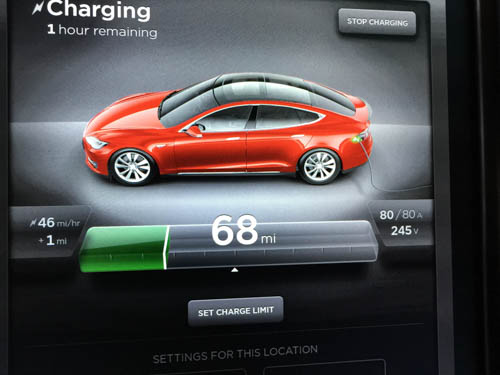
When I first started the charging cycle, it ramped up to 80/80 and then flickered back and forth between 79/80 and 80/80 for a few seconds before settling at 80/80. As you can see I'm fortunate to have a relatively high voltage. Do you suppose that matters wrt this bug?
I don't intend to use 80A regularly as my HPWC is connected to a 90A breaker (left over from my Roadster's HPC). I guess I could "legally" go as high as 72A but "someone" suggested 56A so maybe I'll use that most of the time. But why is 56A better than any other number between 40 and 72?�
Feb 27, 2015
Cottonwood Charging at 80 Amps with a 90 Amp breaker, besides not meeting code, puts you at serious risk of having the breaker trip. If you have #3 or larger copper wire, have your electrician see if the breaker can be upgraded with a 100 Amp breaker.
56 Amps is a simple math tradeoff. Because Ohmic losses and heat generated scale as current squared, charging at 56 Amps gives you a 70% charging rate, but cuts Ohmic heating to 49%, or about half of the full current heating.�
Feb 27, 2015
andrewket That's interesting. Could we have an oscillator that is too sensitive to temperature? Is there a correlation based on geography?�
Feb 27, 2015
billarnett I let it charge for about 20 minutes this evening at 80A. It never really settled down as I noted earlier, it kept jumping between 79/80 and 80/80. I also noticed similar behavior when I lowered the rate. And sometimes when I set the rate to N it settled down at N+1. This sure feels like some sort of a round-off error
I noticed after a few minutes that the cable from the HPWC to the car got a little warm. Not a lot, maybe a little less than the heated steering wheel. But certainly more than my Roadster's cable got at 72A. The HPWC itself was cold. The breaker itself was slightly warmer than the adjacent (idle) ones but cooler than the HPWC cable.
I have AWG 6 THWN-2 wire from the breaker to the HPWC but it's only about 12 inches long; my HPWC is mounted directly on the other side of the wall from the breaker panel. My reading of the ampacity charts says this wire is good for 75A. But I've set my car to 56A anyway. At that rate a full charge will take maybe about 8 hours. That's just fine for my needs. No sense in taking unnecessary risk, even a small one.�
Feb 28, 2015
Andyw2100 Am I understanding correctly that your charging is going to be limited because a one foot piece of cable is too thin? If so, I've got to ask why didn't the electrician or whomever installed the HPWC use the correct cable, and/or why don't you have it changed now?�
Feb 28, 2015
breser Yes I totally understand it's a small difference. I've pointed out as much earlier in the thread. For what it's worth the last two charges I've done I've gotten 80A and it hasn't reverted.�
Feb 28, 2015
gg_got_a_tesla Fwiw, I've seen this fluctuation too at HPWCs at work that are capped at 64A. I've seen the draw stuck at 63A on a few occasions of late.�
Feb 28, 2015
Andyw2100 Perhaps you scared your car into compliance.�
Feb 28, 2015
breser Maybe it's just shy and doesn't want to go to service. Now if it would fix the clicking sound in the back seat when nobody is sitting there it could avoid service on Monday.�
Feb 28, 2015
FlasherZ This is normal, according to Tesla - they leave some room for overhead to ensure the total draw won't exceed 80A. That, combined with rounding down, will make it show 79 occasionally on the left side of the "79/80" equation. I have a question into a couple of folks at Tesla about why it occasionally senses 79A as the pilot current value.
While the charts will show you that the wire is rated at 75 amps, the terminations are only rated at 75 deg C, which makes it only good for a 65 degree rating, which means 52A max charging current (continuous load rules).�
Feb 28, 2015
breser Doesn't that mean that his Roadster HPC install on a 90A breaker was in violation of code?�
Feb 28, 2015
FlasherZ The HPC was a 70A Clipper Creek device that could be configured for different currents. Assuming it was configured for the maximum, a 70A continuous load requires circuit conductor and breaker rating of 90A. Very few residential device terminations are rated for 90 degC, and most new are for 75 degC. As a result, #3 wire is required - while #4 is good to 95A from a conductor temperature, the termination temperature is also important. The 90A breaker on a 70A-configured HPC is not a violation. If wire smaller than #3 was used, then it was a violation.
An HPWC configured for an 80A continuous load requires circuit conductor and breaker rating of 100A. #3 is good for that. The 90A breaker is a violation.
Even if you set the car to charge at only 56A, if the HPWC is configured for an 80A pilot current, it's a violation.
You adjust accordingly if you configure the HPC/HPWC for a lesser charging current. The device is considered installer-configured, so you don't have to supply it for the possible maximum, only what's configured.�
Feb 28, 2015
breser Yup. My impression was the HPC was installed with a 90A breaker and #6 wire. The mismatch of the wire and breaker was what drew my attention.�
Feb 28, 2015
AmpedRealtor My P85 has always charged at 79/80 with an 80A pilot current (according to VisibleTesla). I've never once seen it go to 80/80. I asked service about this and they told me it's a rounding error and nothing to be concerned about. I haven't worried about it since. My voltage drops from 245v at 0A to about 237v at 79/80A.�
Feb 28, 2015
breser Installed .179 this morning and after the install finished it was back at 79A. Think I just had a couple lucky connections.�
Feb 28, 2015
Andyw2100 But just to be clear, you know that's not what we're talking about happening here, right? We're charging at 79/79. (Check the video to see what I mean if you like.)�
Feb 28, 2015
AmpedRealtor I saw mention of 79/80 versus 80/80 and figured it wouldn't hurt to add a data point.�
Feb 28, 2015
Andyw2100 Sure, no problem. I just didn't want you to think the thread was started with that as the issue. (There has apparently been much confusion over this in the past.)�
Feb 28, 2015
TomE The current is actually encoded as the duty cycle of the pulses. So, it's a matter of measuring the pulse width and the pulse period and doing a division to determine the duty cycle. So, the absolute accuracy of the oscillator used to perform the measurements isn't really a factor.
The EVSE will be designed to ensure that all cars measure a valid duty cycle, meaning that some allowance for vehicle error has to be made. According to J1172, a measured duty cycle in excess of 97% prevents charging, and the vehicle is allowed to have up to 2% measurement error.
So, to avoid no-charge issues and such, an EVSE designer could aim for 95% so that there is no argument about the pilot being valid, even with the worst case allowable vehicle measurement error. A 1% reduction in charge rate is a small price to pay, more so since it also reduces resistive heating in the EVSE wiring and contactor by ~2%.�
Mar 1, 2015
scottm I think you might have hit on the answer. When S detects voltage drop to something below 240 it dials back current draw assuming something is starting to stress (heat).
Anybody report this phenomenon when voltage is constantly at or above 240?�
Mar 1, 2015
FlasherZ No it doesn't. I start at 248-249V and drop to 242V. That's perfectly normal, and is not the reason for 79/80.�
Mar 2, 2015
billarnett Actually, the HPC was installed with #2 wire. When I removed it and installed the HPWC I couldn't get the #2 wire to fit into the HPWC's terminals. So I replaced it with something smaller. But I was wrong when I said above that I used #6. I just checked and while I can't read the markings on the wire it is clearly much larger than #6. So it's most likely #3 as specified in the HPWC installation instructions. That means all I need to be totally up to code is to replace the breaker with a 100A one. But that seems like a lot of bother for a circuit that can never go over 80A. Isn't a smaller breaker actually slightly safer; won't it trip sooner if there's a problem? I suppose it's more likely to fail and trip too soon but that seems unlikely and wouldn't do much harm anyway.�
Mar 2, 2015
breser Got my car back from being in service. They tested it on their equipment and saw the same behavior as I have been seeing. They could not find any "service bulletins or Toolbox articles" and have opened a "toolbox case to service engineering." They don't believe that there are any problems with the cars hardware. They suspect it is a firmware issue and hope that a software update in the future will resolve it. So for now we're waiting on engineering to look into the problem.
- - - Updated - - -
I installed my HPWC with #2 wire. It does fit in the lugs but it is a complete pain to make it fit. This is compounded by the limited space there is to work inside the enclosure. So I can totally understand why you'd not use #2 wire for this.�
Mar 2, 2015
davewill My understanding is that you could end up with a nuisance trip, and might end up with stressing the breaker by running it that close to it's trip point for extended periods. Best to just follow code instead of improvising.�
Mar 2, 2015
Danal NEC states that the "protection device" (breaker) must be sized at 125% of continuous loads. Another part of the code defines "continuous" as "over 3 hours". 80*1.25=100. Therefore, you must have a 100A breaker on an 80A HPWC to be code compliant.
Same thing applies to the wires, if only because they must match the breaker.
That's why all the charts in the US version of the HPWC install guide show 100 amp breaker for 80A DIP switch setting, and so on and so forth.�
Mar 2, 2015
Cottonwood Correct, except that the 125% rule for continuous loads applies to conventional breakers, but not to the wires. The breaker rating must be matched to the wire rating. There is an exception for breakers that are specifically built for 100% continuous load, like the fancy electronic sensing ones used in the Supercharger Distribution Center.
I have attempted running conventional breakers continuously at 112% margin, and they tripped after an hour or so. Follow the code...�
Mar 2, 2015
breser Can we try to guide this thread back to the 79A issue. I've engaged in the side discussion about bilarnett's install and code violations myself. But there is probably better threads for that discussion. The thread is getting more and more cluttered with this side discussion.�
Mar 3, 2015
Danal There seems to be some speculation the 79A issue affects all D.
Just to add a single data point:
I picked up a P85D yesterday. This car reaches 80A correctly after ramp up, and stays there. V6.1 (2.2.179), car had been outside for hours on 40F ambient, spent the prior 3 days in colder temps. Then driven 70 to 80 for 45 minutes, then sat for an hour, then charged. Beginning SOC somewhere around 1/2 to 2/3rds, charged to 90%, I did not watch every minute of the charge... as mentioned, after ramp, consistent 80A.�
Mar 3, 2015
widodh I have this with my S85 (EU) as well. It sometimes charges on 31/32A (3-phase) and never goes fully up to 32A.
My S is from Sept 2013, so it's not only D related.�
Mar 3, 2015
Andyw2100 Good to have the data point. It does make me wonder more about my car, and the others that aren't working as yours does.
Congrats on the new car!
You may want to take another look at a couple of the dates in your sig! You were probably just so excited to have the car your fingers were flying!�
Mar 3, 2015
ra-san My P85D was one of the December delivery, started first week of production cars. When charging it shows 80 amps available and typically flutters between 79 and 80 amps current. The voltage is pulled down to 220 +/- a volt, typically. I've seen it settle for a few seconds at both 79 and 80. Definitely doesn't cap at 79 nor sit cemented at 80. This may well be charger specific for me. Haven't tried another charger at 80 amps.�
Mar 3, 2015
breser From my experience that's perfectly normal.�
Mar 3, 2015
ra-san Yup, is what I thought too. Providing as a data point of another P85D that isn't showing a 79/79 issue as was described earlier in the thread, since there were comments that all D's were affected.�
Mar 3, 2015
Andyw2100 I don't think anyone ever said anything about all the Ds being affected. I think I probably came closest to that. This is what I said:
�
Mar 3, 2015
FlasherZ I reached out to some contacts to see if this is intended or merely a side-effect. I am still awaiting an answer.�
Mar 4, 2015
ricci21 My P85D, delivered on December 23, 2014 has the same 79/79 charging issue with the HPWC.�
Mar 4, 2015
mknox While not directly related, I questioned Sun Country Highway as to why their 80 amp unit would only deliver a 79 amp pilot signal to the car. I would set the car to 80, plug in and the car would drop down to 79 and could not be bumped up beyond that as long as it was plugged in. I get 79/79 amps and sometimes 78/79. SCH's response was that it was a "rounding error" or something like that in the way the car interprets the signal that it is receiving.�
Mar 5, 2015
andrewket So is it the car that is out of tolerance or the HPWC, or the environment (temperature)?�
Mar 5, 2015
Andyw2100 It doesn't sound like this could be an issue with the HPWC, as both breser and wk057 have had other cars charging on the same HPWC that don't exhibit these characteristics.�
Mar 12, 2015
FlasherZ I heard back today. As I understand, there is a rounding error created in the chargers' interpretation of the pilot signal; there is an open ticket to be addressed in a future release.�
Mar 12, 2015
Cottonwood How is this for an error? This is from Charging at a 70 Amp Clipper Creek J1772 in Pagosa Springs. The pilot should indicate 70 Amps available from this EVSE, it's being displayed as 0 offered, and the P85D is charging at 71 Amps!
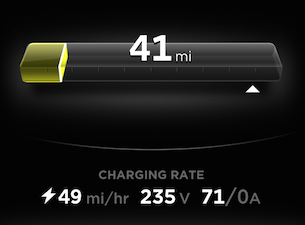
BTW, the Voltage drooped from 243 Volts to 235 Volts with no current limiting...�
Mar 12, 2015
andrewket It means the electricity is free.�
Mar 13, 2015
mknox Interesting. This is exactly what Sun Country Highway told me when I questioned why my 80 amp EVSE would only send a 79 amp signal to my car.�
Mar 13, 2015
MrClown One more data point - my 85D reports 80/80 on my HPWC every time so far (about 6 times). I'm on .179.�
Mar 13, 2015
Danal I made one report above... so forgive if this is redundant. I've been keeping an eye out due to this thread, and it is very consistently 80/80, with only the occasional "flick" to 79 (normal). P85D .179
Danal�
Mar 31, 2015
breser My initial observation is that this is resolved in 6.2. But I haven't had it for very long so it's still possible that I'm just getting lucky and getting 80A.�
Apr 1, 2015
Andyw2100 I noticed yesterday that with the new software, the car seemed to be properly recognizing the 80 amp pilot signal from one of my two HPWCs. Today I tried briefly charging at 80 amps at the other one and it worked, with the actual charging amperage varying between 79 and 80 amps. So it definitely looks to me as if this has been corrected in 6.2�
Apr 1, 2015
wk057 Yep, saw 80A pilot current for the first time in a while today as well. (Hadn't really checked earlier when I first installed 6.2)�
Apr 3, 2015
llavalle Same here. Was on 6.1 when I got the car and 6.2 did not change the behavior.�
Apr 3, 2015
wk057 6.2 definitely appears to have resolved this issue.�
Feb 23, 2016
ggenge I say BS on the Tolerance answer, its a BUG!
�
Feb 23, 2016
wk057 The amperage is a rounding error with the gen2 chargers. Not a huge deal. It's adding up six sub modules worth of current and losing precision along the way to the UI.
The range per hour meter is silly, IMO, but to get the full rated range per hour you need to have virtually no voltage drop on your HPWC wiring. I can pretty much guarantee 99% of homes will end up with less than 240V at the car while charging at 80A, and thus less than maximum range per hour. This is from your home's wiring, utility, etc, not the car or Tesla.�
Feb 23, 2016
pchilds http://www.teslamotorsclub.com/showthread.php/62989-crazy-hack-20-faster-charging-with-your-single-charger-Model-S�
Feb 23, 2016
DCGOO I was wondering if the line voltage was high (250-270) the chargers might throttle back a bit to keep things from exceeding 20kw. I have no ability to test here, because I rarely see 250.�
Feb 23, 2016
wk057 Gen1 throttles at 10.5 kW last I checked, gen2 works up to 300V no throttle.�
Feb 23, 2016
brantse My house is always supplied "hot" (252-257v). I often see 10.1 or 10.2 kW.�
Feb 23, 2016
Andyw2100 Before anyone checks the link above, and thinks "What a great idea!", this is what FlasherZ, one of the most knowledgeable and well-respected posters here with respect to all things having to do with electrical power, wiring, etc. had to say about it:
�
Feb 23, 2016
pchilds It's all in the link. Do you think people can't read? If they can't read, repeating the warnings won't do any good. I have been charging at 277 vac for 3 years, no warranty or safety issues, if done properly.�
Feb 23, 2016
FlasherZ While you may not have had an issue, if someone else's charger were to fail while using such a device and Tesla were to look at the logs, the person you "helped" may not receive warranty coverage for his error. It's important to let people know that.
I can't change your mind, obviously - but I can continue to tell people that it is simply a bad idea, period. Good luck with your car, but please don't tell others to do something that may affect their warranty or safety.�
Feb 23, 2016
Andyw2100 I think they can read, but I also think sometimes people skim things and don't read things thoroughly.
I also think people don't appreciate having their time wasted.
I know if I saw a link to a random thread that sounded interesting and someone then showed excerpts from that thread from a highly respected poster saying essentially "this thread is dangerous, and probably a waste of your time" I would appreciate the heads-up, and the fact that the second poster was saving me time, and looking out for me.
That's what I was doing for the readers of this thread by showing them what FlasherZ had to say.
People are, of course, still free to read your thread if they so desire.�
Feb 23, 2016
pchilds The same chargers are run at 277 vac in Superchargers, they are not going to fail from 277 vac. To deny a warranty claim, Tesla would have to prove that the 277 vac made the charger fail and if they run the same chargers in their Superchargers, that doesn't fly.
You say safety? Are you trying to say the charger could catch on fire? How many Superchargers have caught on fire? The chargers are designed for 277+ enough scaremongering.�
Feb 23, 2016
FlasherZ No, they would not have to prove that the 277 VAC made the charger fail. In the case where a supercharger is used, 277 VAC doesn't get fed to the car -- DC voltage does. All Tesla would have to do is demonstrate that you were using a voltage out of spec, as J1772 level 2 charging specifies 208/240V split-phase. It doesn't matter whether the same charger can be repurposed in the supercharger cabinet or not.
From J1772-2010 spec:
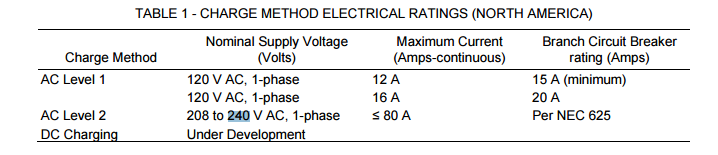
Tesla's AC charging is based upon the J1772 spec (with a different form-factor connector).
And yes, safety -- autotransformers have some peculiar characteristics that create safety concerns. I mention them in the other thread.
It's not scaremongering... it's the truth. It's time for you to stop spreading misinformation.�
Feb 23, 2016
pchilds #6 THHN wire is good for 52 amps continuous with a 70 amp breaker. I am not using a UMC, the contactor in my EVSE is rated for the current. If you don't know that, when you are boosting the voltage, the input of the transformer will have more current than the output, don't do it. I am not spreading misinformation, just sharing what works.�
Feb 24, 2016
mknox I see the same thing on my Feb 2013 build car with the dual charger option... but only sometimes. I installed a pair of 80 amp J1772 stations at my office, but can only get 79 amps max at them. I can't even dial it up beyond 79 amps so I suspect that is the pilot signal the car is seeing. Oddly other Tesla cars can get the full 80 amps. A Tesla rep stopped by with a brand new P90D and he was able to get the full 80. We chatted about this for a bit. (I'm honestly not worried about 1 amp).�
Feb 24, 2016
AmpedRealtor I also have a 2013 build and my screen has always said 79A even though it's receiving an 80A pilot signal. I asked service about it, they said it's a rounding error. I asked this question before the D and Autopilot.�
Feb 24, 2016
mknox Oddly, I do get an 80 amp pilot signal (and 80 amps delivered) when connected to a HPWC. It was only on my 80 amp J1772 stations that I saw 79. The curiosity in my mind was around the fact that other Teslas saw 80 amps at those same J1772 stations.�
Feb 24, 2016
FlasherZ My car very rarely shows 80A.
Only 29 times have I ever seen 80A. Roughly 46,000 other times I've seen 79A.
Voltages when I've seen 80A:
It appears that lower voltages permit 80A, the only outlier is 246V.�
Feb 24, 2016
mknox Hmmm. The 80 amp J1772 stations at my office were on a 208 volt circuit and I generally saw about 200 volts at the car. Only got a 79 amp pilot signal there. Other Teslas saw 80. I don't have 80 amps at home and can't recall what the voltage was at the HPWCs where I do see 80 in my car.�
Feb 24, 2016
Andyw2100 The original issue as reported by breser, discussed in the first few posts in this thread, was eventually resolved via a software update. My car had always shown 79 amps as the pilot signal, even though 80 was available. Since the issue was resolved via the firmware update, my car has always shown 80 amps available.
I'm sure there are other issues involved here as well. I just wanted to point out that the original issue has been resolved.�
Feb 25, 2016
mknox Hmmm. I still see the 79 amp pilot signal and am on the most recent version of 7.1 (installed at the Service Center earlier this week).�
Feb 25, 2016
FlasherZ Mine shows an 80A pilot signal (charger_pilot_current = 80) but the car very, very rarely will bring the charging current (charger_actual_current) above 79.�
Feb 26, 2016
mknox When I'm at my office's 80amp J1772 stations I see 79/79 amps and my car will not let me dial it up past 79. Other Model S's are getting 80/80 at the same station. I have been at 80 amp HPWCs and see 80/80 amps at those.�
Feb 26, 2016
Andyw2100 Well, the issue as reported was affecting the Ds, and perhaps other newer cars. That issue was corrected. You may have a different issue, since your car is older.�
Feb 26, 2016
mknox Again weird. The Tesla rep who stopped by my office with a brand new P90D was getting 80/80 amps at my station, but my early 2013 S85 only sees 79/79.�
Feb 26, 2016
Andyw2100 Well, that --IS-- consistent with the issue being resolved for newer cars, but not for yours.�
Feb 29, 2016
breser Just to clarify. The issue here that I had was that the car was only allowing up to 79A to be selected in the adjuster. I still see 79A a lot in the actual charging amperage. But the car hasn't shown 79A as the maximum possible charging selection since the firmware update that fixed the issue. My guess would be slightly different hardware that had different error ranges than the software was aware of and caused it to calculate the duty cycle signal incorrectly coming up with 79A.�
Feb 29, 2016
Andyw2100 And if I may, I'd like to clarify your clarification, at least as I recall things at the time. (We were experiencing the same issue.) Obviously feel free to correct me if any of this is wrong as it applied to you.
When you write you could only select up to 79A in the adjuster, this would be true for a location once you had plugged in there, and the pilot signal was read or saved. But if that was cleared, or for any new location, or the first time you tried to charge, you would be able to select 80 on the selector, but it would immediately change to 79 Max either once you plugged in or once you started charging (I don't recall which, but I think it was as soon as you plugged in.) From that point on, the display would show 79/79 instead of what it sometimes shows now, which is 79/80. And from that point on you could no longer select 80.
Right?�
Feb 29, 2016
breser I think so based on your explanation. When I plugged in I would either get a max of 79 or 80A. Mostly just 79A but every once in a while it would go up to 80A. After charging for a while even when it was at 80A it would change to 79A and would not go back to 80A unless you unplugged the car and plugged it back in. Once it went down to 79A the car would stay at 79A at the location unless you raised it back to 80A (if you happened to get lucky and it read that maximum). But it would always end up back at 79A max.�
Mar 1, 2016
FlasherZ As an observation, this is what the Model X does when the voltage is higher than 240V... you see the maximum is at 72A *before* you plug in, but the minute you plug in, the car will show somewhere between 68-71 based on the voltage the car senses. Tesla explained that the phenomenon occurred because of the higher voltage present (my home operates between 248-253V usually) and limits the charger to 17.5 kW.�
Mar 1, 2016
breser Interesting. Though I don't have voltage over 240V very often at my house, so I don't think that was the issue in my case.�
Mar 1, 2016
FlasherZ It's definitely not the case for all Model S's, as my Signature car has shown an 80A pilot & maximum charging current even at those high voltages. I'm wondering if one of the generations of chargers was limited at one point.�

Không có nhận xét nào:
Đăng nhận xét