Dec 31, 2013
Mayhemm Firmware version 5.8.4 introduced a new feature where the car will automatically back off the charge current by about 25% if it detects a problem with the circuit (exact criteria for current reduction are unknown at this time). This is presumably a reactionary addition in response to the recent garage fire incident.
Some people have reported occurrences of the car reducing charge current when it shouldn't be doing so. In other words, getting a false positive on the condition of the charging circuit. Effectively, this would unnecessarily reduce charging capacity to ~75% of previous levels.
Can people who have experienced this please report below so we can get an idea of how widespread the problem is? Please provide details about your charging situation (typical normal rate, reduced rate, type of charger (UMC, HPWC, etc)) so we can see it there is a commonality to any false positive readings.
P.S. Could a mod please correct the spelling on my poll title? Thanks.�
Dec 31, 2013
mknox I have not yet seen the behavior and I have charged at some public 90 amp units with voltages below 200. I do not have a HPWC and charge at a reduced rate at home, so cannot comment there. I would hope it senses more than just "low" voltage and that it has to see some rapid spiking before lowering the rate.�
Dec 31, 2013
efusco I answered yes and tripped falsely...but how the heck would I know if it was false or not? AFAIK the connection is good...it's actually a 6' run from the breaker on appropriate gauge wire and a brand new connection and the voltage seems stable and I've had no past issues on this particular NEMA 14-50, but there's no way I can know if there were voltage variations.�
Dec 31, 2013
bluetinc Mayhemm,
Could you define what a false positive looks like? Are you simply assuming that because you were able to charge at a specified rate in the past at a location and now you are not? I'm not sure if "there wasn't an issue before, and now it thinks there is" is by definition a false positive.
Because this is a technical issue, I think we need to get very detail oriented if we are going to discuss causes for trips, and false positives. I suggest collecting the following information from anyone who has had a "trip".
(Chargepoint info)
Location(Home/Work/Etc.):
Original Charge Current:
Type of Outlet/Charger:
Wire gauge size and run length to Outlet/Charger:
Has the installation been re-verified to meet NEC, with all connection point properly torqued, and outlet not worn:
(Charge Cycle info)
Voltage at car without load:
Voltage at car with full current, immediately at start of charge:
Voltage at car with full current at 5 min:
Voltage at car with full current at 15 min:
Voltage at car with full current at 1 hour:
Charge time that current backed down, and backdown current:
Other notes:
Peter�
Dec 31, 2013
robaross Before 5.8.4 I was charging at 32 amps with a max of 40 amps. Now I can only charge at 28 amps, with a screen indicated max of 30 amps. This is occuring automatically. I rebooted 17" screen which restored the 40 amp max, but when I subsequently charged it dropped back to 28 amps with a max of 30 amps. As others have stated, a licensed electrician ran the new line per Tesla instructions, installed 50 amp breaker, and I see approx 248 volts when starting charge, dropping to 244v during charge. Since this is at home home it is not a major problem but it is disconcerting.�
Dec 31, 2013
Cottonwood I have tried my UMC on a 14-50 that has a 0 current Voltage of 245 Volts and drops to 239 Volts with a 40 Amp load, and an HPWC that goes from 245 Volts to 239 Volts, going from 0 to 80 Amps. Neither showed a charging current reduction running 5.8.4 (1.49.57). Both are happy and keep charging at rated capacity.
Both are in my second home garage. The 14-50 is about a 40 foot run of #6 Cu from the 200 Amp CB panel to the 14-50. The HPWC is connected with a 40' run of #2 Cu from the 200 Amp CB panel to the HPWC. All connections have been recently tightened.�
Dec 31, 2013
qwk Let's face it, this is a bandaid for a ****** UMC design. I don't know why a $100k car comes with a UMC designed to save Tesla a few hundred bucks per unit. I really doubt that someone paying $100k cares about the $500 extra it would take to get a quality mobile charging option. Without a charge your car won't do you any good. It's the most important aspect of the vehicle.�
Dec 31, 2013
Zextraterrestrial I had one evening when my UMC dropped power to 30A. Techs said it looks like I had some 'flaky values on my proximity' and wanted me to use my other UMC and see if that was the problem. I have a load that pulls on one leg of my 14-50 and thought it could cause problems but I have turned it on/off and charging seems ok. I was logging on Visible Tesla when I had the A drop so I know when it happened just haven't figured out why yet & VT logs don't show any V spike�
Dec 31, 2013
Electric700 I think Tesla's solution to have the car detect voltage irregularities was intended to be completely independent of the UMC, as some people might use another charging setup such as the J1772 to Model S adapter.�
Dec 31, 2013
qwk How do you figure? In the garage "incident", the car was charging on a UMC. There are a ton of documented, melted 40A adapter cases here. It isn't that difficult to make the connection as to why the firmware limitation was rolled out.�
Dec 31, 2013
Electric700 Good points Qwk,
It would seem likely that Tesla went that route because the change applies to any charger. This doesn't rule out investigating/fixing the UMC adapter issue(s) though I am not 100% sure if it's not a wiring setup related issue for at least some of the cases. May be other members have an update on that.�
Dec 31, 2013
mep It was only today that I noticed that my 40A line only charges with 30A now. I can go to the car and set it back manually to 40A and it responds but after a while charging is back to 30A. A bit frustrating. The 50A outlet was installed by a professional electrician for a lot of money in a high rise only 4 years old. So old or faulty wiring can almost be excluded. Can this be the result of the new update?
- - - Updated - - -
Guess I just got the answer to my question. A moment ago car went back to 30A charging. Went downstairs to check and found two warnings. One of them informed me that charging has been reduced due to either extension cord use or faulty wiring. Restarted charging and it has now been stably charging at 40A for the last 10min. I am just glad that Tesla did not decide to turn of charging completely every time there is some fluctuation in the power line.
- - - Updated - - -
Nope, 15 min later back to 30A. Not sure what to do. Should I call that electrician who installed the outlet to check on the line? Will be interesting to see what he has to say.�
Dec 31, 2013
Mayhemm Good points, guys. Unless you are an electrician, there's not really any way to KNOW you're getting a false positive. All we can do is report cases where we SUSPECT it is the case. Good examples of this are outlined in the replies by robaross and mep. They have strong reason to believe there is nothing wrong with the circuits in question (due to intimate knowledge of the installation) yet they are still seeing current reductions.
For public chargers, you would have to go on the word of the proprietor. If they say the work was performed correctly yet current is still being reduced, then this would be considered a "public charger false positive". On the other hand, if a public site with reduced current shows obvious signs of neglect (exposed wiring, damaged charging equipment, etc) this would go under "public charger, current rightly reduced" in the poll.�
Dec 31, 2013
Cottonwood It would be great if you reported the Voltage before the current ramped up, and then the Voltage and current after the current has ramped up. Maybe a Voltage at 40 Amps and then after the fold back to 30 Amps. From the Voltage drop at load currents it is possible to get a rough estimate of the resistance in the installation and see if that is a threshold for the charge reduction.�
Dec 31, 2013
stopcrazypp Yes, this is a good suggestion. Should be easy to report for those that have had it trip and should give at least an idea of the parameters for tripping.�
Dec 31, 2013
dirkhh I had the line checked by an electrician. There should be NO reason for the reduction. The voltage varies between 237 and 241 which is well within code (which suggests less than 5% drop). Still, as of 5.8.4 my Model S only charges at 30A.�
Dec 31, 2013
Cosmacelf Well, I just did a test in my garage. Started at 241V, ramped down to 235V at 40A from a NEMA 14-50. Charged at 40A just fine. On firmware 5.8.4 (1.49.57).�
Dec 31, 2013
riceuguy I had two Chargepoint public chargers show the error on the cars display and limit charging by 25%...frustrating! and Chargepoint chargers seem to be the common thread...�
Jan 1, 2014
Mayhemm Heh, the only silver lining to that is no one in their right mind would roadtrip using Chargepoint chargers.�
Jan 1, 2014
Forty Creek For the past three nights the charge from my HPWC was reduced and the car display a warning about bad wiring or extension cord use. HPWC wiring is straight forward and was properly done / inspected. We have just been through a severe ice storm and our area experienced total power loss for 3 1/2 days. Ontario Hydro crews worked tirelessly to restore power but I wonder if our rurally located home might be getting some voltage fluctuation due to changes at the road. I'll give Hydro a call in a day or two to ask if they could do some sort of check of line.�
Jan 1, 2014
AmpedRealtor During the day when my solar is generating, car pulls 79A @ 241v. In the evening when there is no solar activity, car pulls 79A @ 235v. When I charge in the evening, the 0A voltage starts at 245v but drops to 235v when it hits 79A. Fluctuation at 79A while charging is +/- 1v. My car has not reduced power after 5.8.4.�
Jan 1, 2014
Cottonwood Because the Public Pagosa J1772 that I put in is on an old pole transformer with a long, relatively small gauge wire feeding the house with some pretty good Voltage drops (most on the utility side of the meter), I am concerned about resistance triggers.
To do a test, I pulled out all of the heavy duty extension cords, adapters, etc, that I have in my kit from owning Tesla cars for 5 years. I put all of them that I could, in series with the 14-50 outlet in my garage and plugged in the UMC with its 14-50 adapter. The 0 current Voltage was 246 and it drooped to 232 Volts with a 40 Amp current. I was pretty full on the battery SoC, but was able to let this charge continue for 20 minutes with no reduction in charge rate. This is a resistance of 14V/ 40A or 0.35 Ohms. See Wiki American Wire Gauge; that is equivalent to about 275 feet of #8, Cu extension cord. The other way to look at this is between the transformer feeding my house and the car, there was 14*40 or 560 Watts being dissipated.
It seems the current reduction mechanism must be pretty tolerant of simple resistance. I wonder what the trigger is...maybe loose, intermittent connections?�
Jan 1, 2014
Chipper How would I know if the charger tripped correctly or falsely?�
Jan 1, 2014
wcalvin Just guessing but I presume that what they want to detect is not voltage swings but source resistance increasing (that is what will cause overheating at some upstream junction). Detecting source resistance changes is simple: when voltage at the charger is varying, does the input current vary in unchanged proportion? It is Wheatstone Bridge type of problem.�
Jan 1, 2014
Doug_G Whoops... just got a false detection. Have to change my vote! Dropped into our office and am charging on our 208V 70A charge station. I guess the voltage got a little low (usually in the mid 190's at full power) because it dropped to 50A. Grrr... the entire electrical system of the building is only a year old. There's absolutely nothing wrong with it. This was caused by having 3 phase power source.�
Jan 2, 2014
dirkhh I played around with this a bit. Sat in the car and manually changed the charge limit down to 20A and then up to 40A. Plugged in again. Charged fine at 40A.
When I came back home in the evening I simply plugged the car in without anything and it again charged at 40A.
I'll keep observing the behavior...�
Jan 2, 2014
bluetinc Dirkhh,
I'm trying to picture what you are seeing better. When you say the voltage varies between 237V and 241V, do you mean when you start charging (no load) the voltage is 241 and then under full load (40A), it drops to 237V, or do you mean that during charging you watch the voltage fluctuate between 241V and 237V?
Peter
�
Jan 2, 2014
dirkhh Under no load it shows 247-249V. As the current increases voltage drops to about 240V. And while charging it varies between 237V and 241V�
Jan 2, 2014
bluetinc What is the period on the oscillation between 237V and 241V?
The S should appear to the power grid as a constant and almost entirely resistive load (provided there isn't an issue in the S itself). You shouldn't be seeing any real oscillations on the voltage. When my car charges anywhere from 40-80A my voltage is constant and only varies slightly (by a couple of volts) over a period of 10's of minutes as the wires warm up slightly.
Peter
�
Jan 2, 2014
dirkhh I see fairly random and frequent "oscillation" up and down one volt. So it will switch between 239 and 240 every few seconds - which to me seemed to be nothing more than measuring errors. Next time I charge it may be 238/239. But it never varies by more than a couple of volts during any 30 minute stretch. I see the same on the supercharger. The voltage is never constant. It always goes up and down - and on the supercharger it tends to go up and down by 2 or 3V.�
Jan 2, 2014
dtaubert My NEMA 14-50 was brand new a year ago and has safely put more than 8k miles into my 85 at 40A. After the latest software update, the car complains about the charging cable every single night and reduces to 30A. NOT HAPPY.�
Jan 2, 2014
rbergquist Warning tripped and reduced charge to 30A and then it shut it off. Called Tesla service & they reviewed logs. Turned out to be the UMC cable had heat damage. Tesla provided replacement.�
Jan 2, 2014
kitk I also had the warning trip and reduced charge to 30A. Tesla reviewed the logs and states that they are observing voltage spikes. I took my UMC and vehicle to the service center and everything tested out OK and they suggested I call an electrician to check the house side. Charged when I returned home today and haven't received any errors yet. Charge completed at 40A.�
Jan 2, 2014
Doug_G Now here's an interesting result. A friend of mine is currently charging on a 208V, 70A charger. He reports that twice now it's backed off from 70A to 51A, but after a while "recovered" back to 70A again. That is without any manual intervention whatsoever.�
Jan 2, 2014
milotron My charging was dropping from 30 amps to 40 at home on the 14-50 with UMC and giving the charging error. I emailed Tesla about this and they tracked the logs for awhile. They replaced the onboard master charger today which seemed to resolve the issue as of the charge I did today.
Tech said that they logs showed it constantly ramped down to 30 amps after one hour of charging, but also showed some odd current ramping down in logs prior to the software change. They figured something has wrong in the charger and the new firmware found it. I had already tested my wiring and no issues were there, so glad to see a legitimate issue show up.
The tech said they have been getting many calls about this, mostly from people who regularly use extension cords. I guess that in the past it would warn about a high connection cable impedance but now will shut it down under that condition.
The techs and engineers at Tesla are monitoring this closely to refine the algorithm, so let them know if you having problems. They can track and read all of these logs remotely, if you flag it to them as an issue. They do not routinely poll these records from the car though, nor does the car send any error message to the mothership for a charging cable issue.�
Jan 2, 2014
islandbayy The way it sounds, it is much to sensitive. I'd like to see what specifically they are measuring for.
I for one am NOT updating to 5.8.4 until this is worked out. If I HAD my choice (Service center updated me without telling) I'd still be on 4.5 as I have had constant trouble on 5.6 and 5.8 flavors.
At home, I can charge no problem at 40 amps. I have a 60ft run from my breaker box to my outside charge on my garage. Starting Voltage is 242 usually. And when charging at 40 amps, I drop down to about 230-232v. I have 200 amp service to my home. When I flip on the cloths dryer, voltage drops about 2v to my car. so 228-230v. When Air Conditioner kicks in, Voltage drops to about 215-217. Nothing wrong with my service, everything is proper. Part of the problem, I'm on a under-sized transformer and at the end of the string of 15 houses being fed by that transformer.
Given the fluctuations, I most certainly would get limited charging speeds, if not cancelled charging all together! This would be un-acceptable, given I need at least 120-150 miles/day range, and I have a 60kW battery, so not much room for error. A Simple toggle on the settings menu would resolve the problem. It would allow people to turn the feature on to see if their is a problem. If their is constant cut-outs, and it has been deemed OK by a electrician or power co etc... or in my case, known fluctuations due to under sized transformer (2012, the hottest summer in around 50-60 years in Milwaukee County, we saw voltages drop as low as 200-210 under the load!!!) it can then be turned off. Or in other words, turned off due to "nuisance tripping".�
Jan 2, 2014
NigelM I'm assuming there is a screen alert when you return to the car (IIRC someone mentioned it in one of the threads), but did anyone post a photo?
I guess many folks are like me: I plug in every evening but the car is set to charge at 3.00am and most days it would be fully charged (even if it dialed back) before anyone gets in it anyway. I wouldn't know it had dialed back if there's no screen report....�
Jan 2, 2014
Theshadows There is a possibility this is caused by a transformer running at its max. Cold weather can really tax them especially if the utility is running them at max with multiple homes with electric heat.
The power outage could easily cause a strain on the transformer with everyone's heat, freezers, refrigerators, etc. all coming on at the same time and working for hours to warm the houses back up.�
Jan 2, 2014
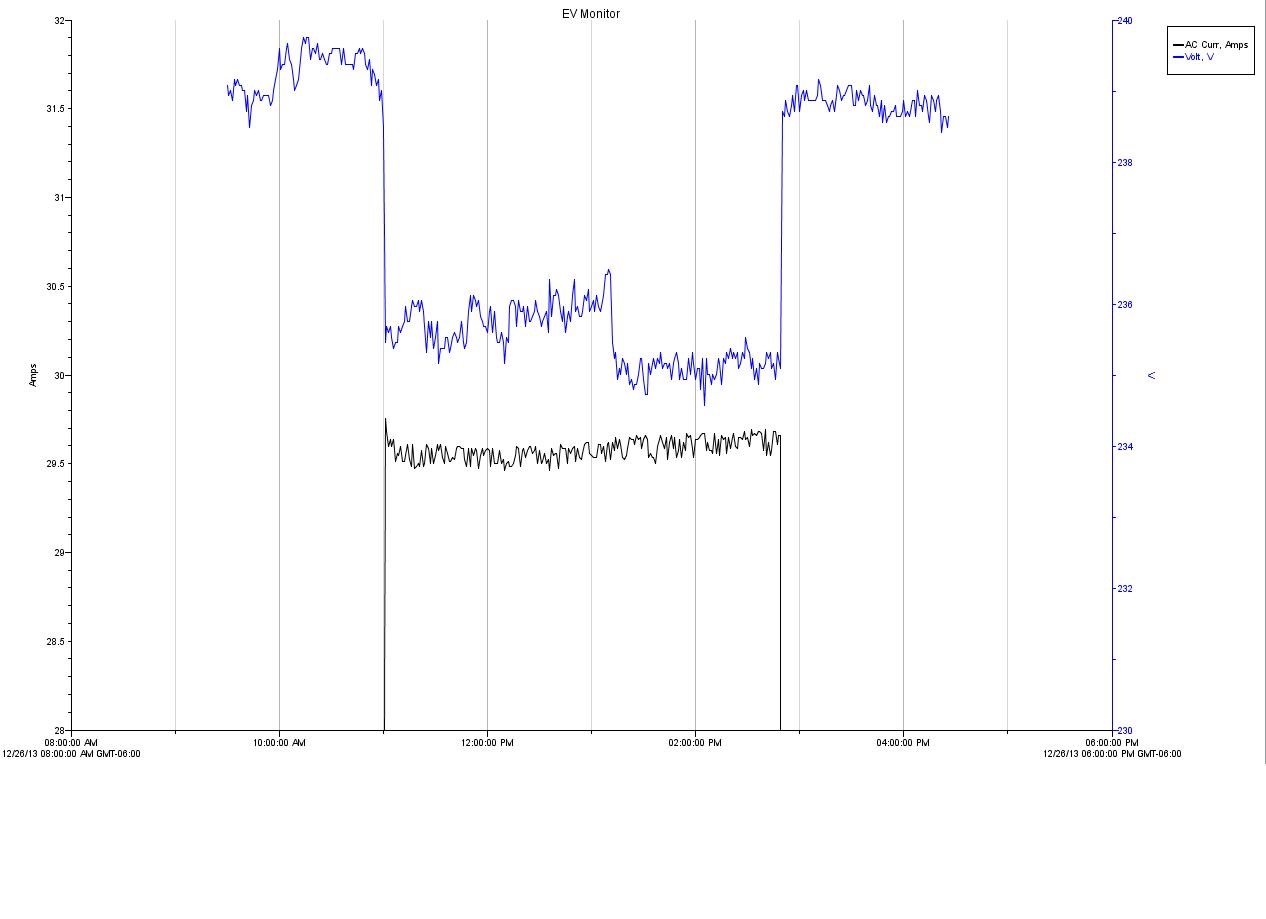
tezco This is a typical charging scenario measured when charging via my J1772 the day after Christmas. I'm measuring the current and voltage at the wall. See also http://www.teslamotorsclub.com/showthread.php/12706-Measuring-the-Total-Energy-Consumption-of-Your-EV
(Axes are scaled so that the swings are more visible.) Total voltage swing during the charge is about 0.7% of the nominal voltage and current swing is about 0.3% of my nominal 30A charging current. The voltage drop during the charge is about 1.5%. I haven't had any current reductions with this level of "noise" in the charging supply.
 �
�
Jan 2, 2014
100thMonkey I'm limited to 30A at home on a 14-50, but I didn't really pay attention before the new update. my UMC is on a 14-50 in my garage that shares a 125A circuit with my Clipper Creek CS 100 (80A) at the end of my driveway. I still get the typical 79 A on the clipper creek. I did attempt to charge at a chargepoint at a local store a few days back and had it dropp way down, with the warning that I was either using an extension cord or there was a faulty wiring.
At first, this kind of irked me, feeling like Tesla rushed to release the new software but the J1772 was 2+ years old and didn't really plug in all that well. After having some time to think about it, I think this is a good thing. It's hard to admit some times that we are still at the beginning, that in many respects the mass adoption of this technology is still in it's infancy. I've had a shift in my thinking a bit and now feel positive that Tesla is zeroing in on finding a sophisticated way for the car to prevent overheating, whether it be from a faulty UMC or some other bad connection and this is a very good thing. The road to EV adoption is going to be a bumpy road but I suspect Tesla will nail it with some time, making a significant advancement in risk management that will likely benefit the whole industry. Few things in our home draw large amounts of current for long periods of time without being hard wired, it would not surprise me if the standard for EV charging needs to be beefed up a bit to account for the new variants we are introducing into home usage. I would suggest that everyone try and take a deep breath and simultaneously be prompt in alerting Tesla to any issues you come across while at the same time keeping a positive attitude, knowing you are helping to advance one of the biggest shifts in transportation technology in history!�
Jan 3, 2014
pbrulott I posted this in the Firmware 5.8.4 thread before knowing this one existed:
Reduced current and Ring of death struck me for the first time; really unpleasant experience. Some of it is related to 5.8.4 for sure. There seems to be 2 or more things at play here, it's not only the -25% current draw but also, in my case, charging stopped every now an then with the red charging port ring every time.
Story:
Left my place with 291km of range, arrived at destination - Bromont - with 123km (a 102km ride took 168km of range)
Stayed there 2 days, needed 175km of range to be comfortable to come back
I plugged at 10am the first day on a 110V outside outlet with my usual extension cord (gage 14, 50 feet) - I plugged many times with it without issue
After the ski, at around 5pm, I noticed that the car is not charging anymore and has 108km of range ... => red ring
I pulled the UMC and plugged back a couple of times, I reset the screen before it works again, checked all the connections and all looked good (I was getting messages like "bad wiring or extension cord, reduced current and then unable to charge, contact Tesla service" alternatively depending if it was charging or if charging was stopped; it finally charged from 6pm to noon the next day at 4km/h which was ok for what I needed (the last time I checked before going to ski I was at 164km of range)
Called Tesla hotline and they were not helpful at all; they said the Service Center would call me the next day which they didn't
The next day, I went to ski and checked the app while skiing => charging had stopped
Came back to the cottage and red ring again with 160km of range
Needed to leave so I plugged it back for maybe 15 min and when it started to work (after a couple of unplug/plug) I got 0km/h of charge but range started to increase (it was -17C/0F outside) so battery must have been heating before charging.
Left with 164km of range, put the heating on at minimum (64F) and drove at 55 mph
I finally reached destination with 10 miles remaining but quite a bad experience of charging in a remote location
Not something my dad or my wife would have been able to deal with
Anybody knows what could have happened. I sent the same message to the Service Center. I don't like this latest update :-(
_____
forgot to mention that I charged using the same extension cord and UMC when I arrived home and was getting 6km/h no messages...
PB�
Jan 3, 2014
Electric Machete After the most recent software update, my mobile connector stopped working. I took it to Tesla in Dania Beach, FL and they said the connector was fine and they have had issues with the UMC since the update. I returned home and it was working again, but I am only charging at 30amps when I had been at 40amps for the last year prior to upgrade. I assume they will sort this out with the next update.�
Jan 3, 2014
Theshadows I am currently charging at 30 amps. 238v, first time I have noticed the reduced charging rate. The battery is warm too so it is not reducing it for that reason. I'll check the voltage at the breaker when I head out again.�
Jan 3, 2014
kota23 From an electrical standpoint the reduction in charging amperage makes a lot of sense. Voltage can vary widely depending on time of day and what else is loading the system. Until electrical code catches up and creates better standards for EV charging then we are faced with what we have now, Tesla reacting as best they can. The fact that Tesla is reacting when problems arise and not just standing idly by is a positive. I'm sure this will not be the last firmware update to deal with charging. Recently the National Electric Code added arc-fault breaker protection for all new home branch circuits and any remodel work to electrical home circuits now requires installation of arc-fault breakers. Garages are still excluded, but I would say requiring an arc-fault breaker for EV charging circuits is not far off. Will be big money for GE, Square-D, Eaton, etc.
http://www.geindustrial.com/cwc/Dispatcher?REQUEST=PRODUCTS&id=cb-qafci�
Jan 3, 2014
mep It took me a few days of testing to catch the car in the act, so to speak. I am charging at a NEMA 14-50 at 40A. Industrial power provided by ComEd in the Chicago area is 208V.
Without load it shows 214V. When charging starts I read between 198V and 201V, it fluctuates a bit. It always takes some time (between 10min and 1 hour) before I get that error message about faulty wiring or use of extension cord and the car reduces charging to 30A. Once it charges at 30A I cannot manually increase to 40A. I have to unplug and reinsert the charging cable. Then I still need to manually increase charging back to 40A until the next "event". Today I was sitting in the car for a full hour waiting for the moment. What happened is that the voltage for a very short moment fluctuated down to 196V. I was watching the screen at that moment and in that split second I got the error messages and the car went down to 30A. So in case of a 208V line and 40A charging it appears that the low limit is set at 196V. Not sure whether it is a faulty line. In fact power provided by ComEd might fluctuate. However, from reading this thread it could also be the charger in the car? What is the email address that people use to contact Tesla to look at the logs? I would like to get in touch with them.�
Jan 3, 2014
dirkhh So NEC (national electric code) suggests a maximum drop of 5%. As it happens 197V still rounds to 5% drop, but 196V rounds to a 6% drop. Could be coincidence.
If that were the threshold, I'd assume that on a 240V circuit the cutoff would be at 226V - I have never seen anything nearly as low in my data... but of course it could be very brief fluctuations that trigger this that my logging might have missed (as that samples only once a minute).�
Jan 3, 2014
Theshadows This is good to know. This is expected behavior then. All it takes is a huge load in the building or in another building to draw a startup load and dip the voltage for a second to trip it out.
In my case today I could manually raise the voltage back up. I just started using visible tesla two days ago to try and track when it dips. I looked at the log and my car had been charging at 30 amps both days. It stayed at 40 once I dialed it back up again.�
Jan 3, 2014
Larry Chanin When I first charged after the update my car charged as it always has at 40 amp.
I just checked my charging and it had dialed itself down to 30 amps without providing any warning message.
I proceeded to manual dial it back up to 40 amps and after watching for about 10 minutes it continued to charge at 40 amps. The no-load voltage was 246. The full 40 amp voltage was 243.
I'm inclined to consider this a problem especially since the car didn't provide an error message after dialing back the current.
Larry�
Jan 5, 2014
Forty Creek My HPWC has been consistently dialed back by 25% over the past week and displaying the 'extension cord in use or bad wiring' message. I manually lowered the amps a couple of ticks (80 to 77) to see if that would make any difference. It didn't. So next step will be to call Ontario Hydro to have the line checked at the street. We live in a somewhat rural setting and our neighbors had a problem with a load unbalance in the line a few months back. Perhaps this is our issue as well.�
Jan 5, 2014
Rainbow I think it is wrong for people to assume they are getting false positives. Have you monitored the voltage and amperage? Have you monitored it properly? Do you know what to look for? Do you have the right monitoring equipment?
While there should be limits to the input voltage, the most common, signature of a connection failure is not typically slow or slight voltage/amperage changes. I don't know what type of detection Tesla uses, but the I think charging detection should look for the signature of arcing. Very fast and significant voltage changes.
If you are getting fault messages or if your charger is charging at a reduced rate; I would strongly suggest inspecting your cords and connectors for signs of overheating and arcing. If you are getting fault messages or if your charger is charging at a reduced rate you should contact Tesla.
If Tesla is has advanced detection: It's possible to get false positives from other devices on your service or possibly on neighboring services. High amperage devices especially with coils, could give false positives, especially if those devices have faults. Air-conditioners, heat pumps, arc welders, refrigerators, often emit an arc signature. Especially if they have a have a bad capacitor, failing coils, bad or dirty contacts.
You also might get more false positives in rural setting, using extension cords, long runs, and or if your service is marginal capacity.
By assuming false positives, you might be over looking potential danger.
BTW "you" in this context, is a figure of speech that can mean anyone.�
Jan 5, 2014
wcalvin That second voltage drop at 01:15PM shows no change in current, nicely illustrating a sudden source resistance increase, exactly what I was mentioning earlier at #24.
That resistance increase is what they need to detect, not voltage drop per se. Usual reason is likely a decrease in plug-receptacle surface contact area, as plug resettles into a new position slightly out from earlier. Usual setup for arcing.�
Jan 5, 2014
Theshadows I'm running visible tesla all the time now so I can see what is going on.
I noticed that once it gets reduced it stays reduced and you need to manually turn it back up. A better behavior might be to automatically dial back up 1 amp at a time every 10 minutes. Then reducing again if it runs into problems on the current charge cycle and sending a notification to the owner.�
Jan 5, 2014
Cottonwood Or some other load coming on. I have an ETS (Electro Thermal Storage) heater in my house that charges when the rates are low. When it turns on all of its elements to heat the ceramic bricks, it can pull almost 50 kW. The off-peak rate starts at 11pm. Look at the graph below. The ETS coming on with a 50 kW load at 11 pm caused a drop of about 6 Volts out of 240 Volts or a 2.5% Voltage drop that had nothing to do with a resistance change; it was just increased current in a common resistor (HV lines, transformer, and feeds to my house).
The power is only that power going to my MS, but the Voltage is measured in the breaker panel feeding the HPWC. See Charging while preheating cabin w/ HVAC for more detail on the MS power draw.
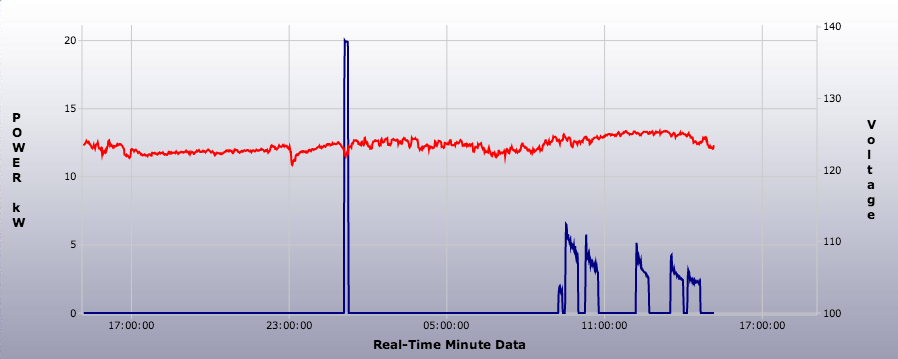
Update:
I went through the paths for the power into my house. Even though the load (its actually 46kW) is pretty large, my electrical connections are very stiff.
My house is the only user on a 100 kVA transformer fed by a 7.2 kV line. There is less than 20 feet of cable from the transformer to my main distribution panel. I am not sure what the wire size is, but I bet it is probably something on the order of 1000 MCM Al wire (1" diameter Al!). These wires go through current transformers that feed the meter, so there is no loss at the meter. Those big ass wires feed a big ass 600 Amp breaker. The breaker is especially big because it has to handle the short circuit current of that 100 kVA transformer and not weld itself in a connected state. This distribution panel has 2, 200-Amp circuit breakers that each feed a 200 Amp sub panel near the ETS heater. The ETS heater is fed by 4, 60 Amp breakers, two in each of the 200 Amp panels. Also back in the first 600 Amp distribution panel is a 400 Amp breaker that feeds my garage and other parts of the house above the garage. The HPWC is fed by a 100 Amp breaker in the 400 Amp garage panel.
All of this is to say that the only common path is the HV line, the transformer, the 20 feet of giant wire to the 600 Amp distribution panel, the 600 Amp breaker and the big bus on the distribution panel for the ETS heater to cause voltage swing to my HPWC. That is a lot of heavy duty wire, etc, and the 46 kW load still gives a 6V, 2.5% drop.
Whatever Tesla is using as a detection algorithm, it must take into account the fact that other loads/users of the grid will cause Voltage swings of several percent.�
Jan 5, 2014
tezco Here's a week's worth of voltage measurements. (Voltage axis not nearly as magnified as in the previous post.) Fairly active swings out here on the farm. I don't think I have a load at the house that would explain the voltage drop over such a long interval, and I have 400A service, so it's probably happening outside of my neighborhood. I do have solar, but insolation values for that time period were also steady.
I suspect that the reason that there is no change in current despite a drop in voltage is that the MS is regulating the current input based on my setting of 30A max.
 �
�
Jan 5, 2014
cinergi I just got nailed by this twice tonight on my newly-installed HPWC and 200 amp service. Power in my area sucks -- I usually start out around 230V and then under load I see 220-218 ... the neighborhood has a fair amount of fluctuation so this evening I observed it fluctuate from 218 to 213. And at some point it decided to reduce the current. I've got a message into Tesla about it.�
Jan 5, 2014
Andrew I'm encountering the problem on my home NEMA 14-50, and am in communication with Tesla (waiting to hear back from them after they review my logs).
I haven't voted in the poll yet, because I'm not sure if it's a "false positive," or just a "positive." Though I expect our wiring should be just fine -- the entire circuit is brand new, with a new panel/meter/weatherhead run just for the car. Additionally, the drop from the utility pole was replaced about two years ago. It's about an 80' run from the breaker to the garage outlet, and our electrician used 6 AWG wire.
Will report back once I learn more...�
Jan 5, 2014
Lloyd I had 198V at a chargepoint station yesterday with full amperage (30A) yesterday with no degradation from the car for three hours in San Jose.�
Jan 5, 2014
laalan Home 14-50 lowers to 30a every few days. No rhyme or reason.�
Jan 8, 2014
notailpipe2112 I saw this happen on a Sun Country CS90 charger at Hotel Mortagne in Boucherville, QC in the past two weeks. The scenario for me was that I was driving out east over the holidays and I stopped to use this charger before Christmas, and before the software update. I believe I was getting 69 amps with about a 200-ish volt situation. Power was consistent when I first used it and I think I was getting 60 km+ charge rate per hour. At the time, I never saw a warning on this charger that it needed to be limited by 25%, or anything like that, and my charge rate was consistent the whole time.
On the way back I stopped at the same charger, and after the software update, and around the same time (dinner hour) looking for the same amount of charge (200 km worth). This time I plugged in and it was fine for the first 5 minutes and then it suddenly gave the limiting warning that is new to the new software. The net result was that I got limited to only 50 km charge rate per hour, and it meant I was waiting much longer (with my whole family and dog) in Boucherville. Soon as I saw the message, I knew it had to be related to the software update. I was cursing Tesla, I have to admit, because I knew this wasn't an issue with this charger just 5 days prior but now the car/software suddenly deemed this charger unfit. Bugger! It was my fault for taking a software update in the middle of my trip.
On the plus side, I have note seen this issue at my home or cottage, which both have a clean 40 amp/240 volt set-up consistently providing a charge rate of 45 km per hour for my car.�
Jan 8, 2014
neroden Well, yes, and I was smart enough to NOT get the software update in the middle of my trip. But the underlying problem is entirely Tesla's fault. Tesla's new software algorithm for preventing charging is crap. The Sun Country CS90 is obviously just fine -- it just runs on a lowish voltage. I plugged in at four Sun Country CS90 locations with voltage patterns like this during my road trip. I can't imagine how ruined my trip would have been with the 5.8.4 "upgrade" to the firmware.
If Tesla has any sense, Tesla will simply revert this firmware degradation ASAP. Time enough to figure out a better algorithm without breaking everyone's road trips.�
Jan 8, 2014
notailpipe2112 This brings up a very good question I'd love to ask you, and everyone, if you've lived a real cold weather long road trip before. In my case, that means -15ish temperature, snow, high wind and even some elevation. The question is if providers like Sun Country should be listing not just the amps of a charger, but also the volts. On my trip out east, I'd say I used about about seven different Sun Country chargers. Some Sun Country CS90 chargers gave my car charge rates of 60-69 kms per hour charge rate, and just two of them gave me the full 79-80 km per hour that I was expecting/hoping on a CS90 charger. The issue is simply that some chargers had the full 240 volts, and some had only 210-ish, and some were sub 200. It seems to me that the only way to truly get a sense of how long you'll be sitting at a charger waiting is if you know both amps and volts. The difference between 80 km hour charge rate and 60-ish is huge if you need to add like 200+ km charge to your car. I had planned out my times for my road trip on the assumption that we would only stop during the day at CS90's, so the net impact of this extra waiting was huge. As a result, along with my dog...I'm now in the dog house too!!!�
Jan 8, 2014
neroden Most of the Sun Country Highway chargers are on nominally-208-volt circuits. (And yes, that should probably be listed.)
They actually varied from 215 to 189 volts, and I don't think there's any way that could be listed, since it probably depends on local conditions.
(Also, I tested voltage drop by fiddling around with the current setting. On most of them, when near the top of the amperage range, when I lowered the current draw by 1 amp, the voltage would rise by roughly 1 volt, and this would continue for at least 10-20 amps. I didn't test lower amperage draws as I was in a hurry to charge! Anyway, this is probably a lot more voltage flexibility than Tesla expected, but it's NORMAL.)
There is another little issue. You'd think that a CS-90 would handle 72 amps continuous? Well, it doesn't. The nameplate rating of most of these is 70 amps continuous, as I read on the side of the charger, and they're strictly limited to that.�
Jan 8, 2014
Cottonwood Yes, the 240 Volt vs 208 Volt issue. In North America, Split-phase electric power systems are used in most homes and many small businesses. With this you get 120 Volt and 240 Volt connections. Most larger installations use Three-phase electric power systems with 120 Volts and 208 Volts. Line resistance, other loads, etc can make this higher or lower.
There are commercial boost/buck transformers that will convert a 208 Volt connection to 240 Volts, and vice versa. I have looked into this for the CS-90 that I have helped install in Salida, CO, because the owner there, Wood's High Mountain Distillery, is considering moving to 3-phase power to run some larger stills. A 208 to 240 Volt boost transformer costs about $500, plus install. If Woods goes 3-phase, I will probably put the boost transformer in, but for most places, is it worth a $1,000 or so total cost to improve charge rate by 15% (240/208)?�
Jan 8, 2014
Zextraterrestrial This may be due to the UMC handle if that is what you are using.
My original handle is a bit loose now and will trip the 25% drop. Just spoke w/ techs about this.
If you jiggle your UMC handle and it causes the charge port to engage/disengage it probably needs to be replaced�
Jan 8, 2014
Mayhemm While this would be handy information to have, I don't think Sun Country Highway should have to provide it. They provide the model of charger installed at any given site (90-amp, 60-amp, etc) and that is where their involvement ends. The voltage is determined by the location's electrical service, not the charging station. As I understand it, residential power is nominally 240V with some variance based on load, and commercial power (like where most SCH chargers are located) is nominally only 208V with some load variance.
As it stands, people that use the charging stations will sometimes report the voltage level during charging when they check in on sites like Recargo and Plugshare. These reports are also handy for providing details as to the charger's specific location at a site which is not always apparent. You're right though, I would appreciate a database of the actual available power at any given site to help with trip planning. In fact, I plan to record this info for all the charging stations I visit in the spring when I travel across the country.�
Jan 8, 2014
notailpipe2112 Thanks everyone for the guidance on 240 vs. 208 volts. I figured that was something that the true heads would be aware of, and now I am too!�
Jan 8, 2014
laalan Will. Check out handle jiggle tonight. I was also informed that charger has a reset button which I will check out.�
Jan 8, 2014
qwk I don't see how you wore out your handle in just one year. So what happens when you wear out your HPWC handle? New handle and cord, or new HPWC? Does Tesla do all of the work?�
Jan 8, 2014
J in MN So, I had my first charge current reduction this morning.

A couple of interesting items to note:
Voltage measurements are at the distribution panel, i.e. service entrance.
Scheduled charge start time was 05:00.
Battery heater ran for 5 minutes before charging started to ramp up. From REST logs, heater ran for 22 minutes.
At 05:13:05 voltage jumped up 2.1 V. Fluctuations of exactly this magnitude happen often, and according to an engineer at my utility, are due to voltage regulator tap changes.
At 05:35:46 voltage dropped 2.1 V (246.0 to 243.9 V). Shortly thereafter charger load dropped to zero, and then restarted at 30 A.
Zooming in a bit:

The time between the voltage drop and rise was 37 seconds.
The charger shut off when the voltage went up by about 1.7 V (The total rise at 05:36:23 was 2.9 V, of which 1.2 V can be attributed to the loss of 40 A load).
The charger restarted after 15 seconds and ramped up to 30 A within 2 seconds.
So, it looks like the current algorithm is something along the lines of look for a voltage drop greater than a certain magnitude followed by a voltage rise of approximately equal magnitude within a certain amount of time. Voltage drop in this example was 0.85%, so my first guess at the parameters would be 0.5% and 60 seconds.�
Jan 9, 2014
mep Update: As a reminder, since the update I haven't been able to charge at 40A once. 5-60 min into every charge event I experience a brief voltage drop (from 201 to 196V, under load) and a reduction to 30A. I have now tried different charge cables (no change) and had an electrician check out the line and the receptacle. Everything seems to be fine. Today I have a loaner from Tesla with the latest update. It stopped charging at 40A after 5 min. I am stuck. The service center cannot do anything about it. I can only hope that Tesla modifies the algorithm to be less sensitive.�
Jan 10, 2014
Mayhemm In the interim, you may want to manually drop the current back an amp or two (say to 38 or 37). This may allow the car to charge uninterrupted. While it is still not the full 40A you should be getting, it is better than 30A.�
Jan 10, 2014
mknox Had my first false positive yesterday. I plugged in to a 40 amp GE Wattstation in Toronto and when I looked in the car's window after connecting, saw the message and my charge current was reduced to something like 22 amps. This particular station had fairly low voltage... something like 190 volts, but it was stable and not fluctuating.
I pressed the J1772 handle switch, held for a few seconds then released to re-start the charging session, and it seemed to hold at the proper full amperage.�
Jan 10, 2014
Zextraterrestrial not sure? what is the warranty of the UMC and HPWC?
I should take a pic of the inner holes to compare my newer and older UMC. I am not sure if the Tesla connector of the UMC was changed at all or not but the older one looks worn compared to the newer. I was wondering about the HPWC connection myself. I used my original UMC for a while before getting a second to keep in my car and leave the first plugged in at home. I am thinking maybe I should get a HPWC instead of the UMC for my home + this area sucks for road trips and others might benefit from me having a HPWC (I don't have a 2nd charge inverter)�
Jan 10, 2014
laalan Tesla announced we will receive new wall charger adapters with a thermal fuse in two weeks.�
Jan 10, 2014
brianman Can you be more specific? Which plug?�
Jan 10, 2014
Benjamin Brooks NEMA 14-50�
Jan 10, 2014
Doug_G The Sun Country CS-90 at our office is getting the power limits too. It's a one-year-old building so the wiring is fully up to standards. We have nominal 208V but it's actually a bit lower than that, and by the time the charger is at full power it's in the 195V range. I've seen more than one power-limiting event now, and I suspect they may be caused by occasional excursions to slightly lower-than-normal voltage that are coming from Ottawa Hydro. Certainly nothing is getting hot anywhere.
If I'm in a hurry to charge I can get full power back by stopping and restarting, as it only trips occasionally. But this is a pain in the butt. Fortunately I'm usually not in a hurry.
Having a CS-90 roll back on a road trip would be seriously annoying. I'm often sitting and waiting 2 or 3 hours for a charge. If that increases by an hour that's a pretty significant impact. The anti-supercharger - makes you stay an extra hour for no good reason.
Fundamentally this is the wrong approach. A thermal cutout on the UMC is the way to go.�
Jan 11, 2014
nleggatt I've been having this problem all week. Then finally last night, plugged in, was getting 40Amp off the 14-50, wife went to the car this morning.... only 45km charge... for some reason the car STOPPED charging all together. WTF?! My car is NOT as good a car as it was prior to 5.8, really bothered by this.�
Jan 11, 2014
mep I tried that last week starting at 39A in steps down to 35A (then I gave up). Unfortunately it did not make a difference. Always drops to 30A after a while.
- - - Updated - - -
I can only hope once the wall charger has a thermal fuse built in that they will modify the software so that I can charge again at 40A.�
Jan 11, 2014
pbrulott First false positive at my house today. This crazyness times a thousand.
I'm doing some tests these days after what happened to me on a road trip. So I purchased a 110V extension cord yesterday (gage 12). Wanted to try it at home on the usual 110 outlet I use when charging at 110V. Worked perfectly for the test i.e. 30 min @ 6km/h => 1.4 kWh, no reduction. I had charged in the morning at 47 km/h on my NEMA 14-50 outlet + a 50 feet 240V extension cord (240V, 40A). Again no issue. I go for a ride.
Come back and plug again, this time, directly with the UMC (no extension). Decide to clean the interior, screen cleaning button and then after that I see the warning "charging problem", "check your cable".... @ 30A vs 40A.
Insane, unstable, I want the new cable and this reduction feature off
First time this happens to me at home. It happened to me on remote locations though.
PB�
Jan 11, 2014
travelinglites I have had a couple times since the update where my charging has reacted to apparent fluctuations in power, but here is where it is a problem. It does not reduce the draw 25% from where you set it, but 25% from maximum. My garage is only equipped with a 30A breaker. The total to the garage is only 50A and I don't want to have to pull a new feed from the house. Because of this at home I charge at 24A. When the car detects whatever it is looking for it actually ups my setting to 30A instead of reducing it 25% to 18A.�
Jan 11, 2014
Vger I am in the same boat.
- - - Updated - - -
Wow, that is definitely not right! Just the kind of bug that gets introduced by a rushed f/w update!
- - - Updated - - -
I wish Tesla would tell us explicitly what the algorithm is!�
Jan 11, 2014
Theshadows That could be a major problem. I would spring for the 14-30 plug and change the outlet so it matches the circuit and wiring. Pulling 30 amps continuous on a 30 amp circuit is dangerous and can cause a fire. In your situation you could have one unless the charger can shut off completely.
The 14-30 plug should limit your car to 24amps which is where it should be with your site setup.�
Jan 11, 2014
Doug_G I think they've got algorithm problems. My suspicion is it has fixed voltage limits. There's clear evidence for this. There's a particular CS-90 that I've used, which has the lowest voltage I've seen anywhere. I've been told it now always backs down 25%. My office charger is on the low side, and it backs down about half the time. I recently charged on a CS-90 with > 235 volts and it never backed down at all. So it's pretty clear there's a fixed threshold. Bad design.
Every location has a different nominal voltage. If it's three phase source it will be 208V +/- several volts. If it's two phase it will usually be in the range of 220V to 240V, but in my experience there's a lot more variation in this number.
The grid is a major source of voltage variation. I've observed it at my office - significant changes in a fairly short time period, and it clearly wasn't our load doing it because we don't really have that much (no car plugged in at the time).
You can't have fixed limits - it simply doesn't work. What it SHOULD do is record the nominal open circuit voltage when it first connects. It should then calculate a threshold voltage below that point, where it is going to trigger the back-off. Actually what it should really do is run the algorithm for 40A chargers only, because the hardware is far more robust in higher power charging stations. More to the point, if there's an issue with the UMC then there should be thermal cutout in the adapter.
Backing power down 25% increases the charging time by 33%. This is seriously impacting road charging, and will lead to people sitting for extra hours waiting for their cars to charge. I'd like to see this algorithm either fixed, or removed entirely and a more effective solution implemented.�
Jan 11, 2014
mep I could not agree more!�
Jan 11, 2014
Cosmacelf Yipes! This stupid software update can now be the cause of a fire! What a bad bug. Please send an email to ownership telling them about this. This is not kosher. There are all sorts of reasons why someone would want to set the charge rate at a lower value, and then for the car to set it higher? Wow, that is seriously unsafe.�
Jan 11, 2014
Theshadows Actually the update is saving a fire in this situation. With the 50 amp plug the car could try to pull 40 amps on that circuit, the breaker should protect it. But, I have seen panels where someone, to avoid nuisance trips, goes to the local home improvement store and gets the next size breaker.�
Jan 12, 2014
Cosmacelf I disagree - travelinglites has an odd situation where he has a NEMA 14-50 plug, but only a 30A breaker. He tells that car to draw only 24A. But the software sees a voltage fluctuation and then INCREASES the charging current to 30A. If the software though it was bad at 24A, increasing it to 30A is really stupid and, in this case, a violation of a safety code (80% of breaker rating). No breaker will trip, but wires and breakers will get hotter than they should.
This BUG (there is no other way to describe it) also makes ALL HOMEMADE ADAPTERS DANGEROUS TO USE. Homemade adapters for a variety of plugs that Tesla does not support usually use Tesla's NEMA 14-50 adapter. So you might plug into a 20A 240V receptacle, dial it down to 16A and then the software bumps it up to 30A. Seriously bad behavior.�
Jan 12, 2014
pbrulott Well, today it charged at 240V @ 40A. But I had to dial it up myself from 30A to 40A. Yesterday, it didn't want to let me....�
Jan 13, 2014
neroden Please contact Tesla Motors directly, if you haven't already. They just might listen to you. This algorithm is unacceptable, prevents road trips, and I have been making a point of not "upgrading". The current algorithm wrecks charging at Sun Country Highway CS-90s, which invariably have a lot of variation in voltage, and are all just fine. 5.8.4 needs to be reverted.
- - - Updated - - -
This is a good move. The firmware "bug introducing" update which can CAUSE fires by charging at too high an amperage was a bad move and hopefully will be reversed ASAP!�
Jan 13, 2014
J in MN Second current reduction this morning.
Once again the charger tripped on voltage rise, but this time there was no preceding drop.

I do think the algorithm is trying to detect arcing / intermittent connections, rather than just high impedance / low voltage.�
Jan 13, 2014
Cosmacelf It trips on an quick 3 volt rise? That doesn't make a lot of sense to me. Utility voltage does vary!�
Jan 13, 2014
J in MN Actually probably only about 1.8 V when taking out the voltage drop on the utility side. Either way, I agree - too sensitive. Wrote to Tesla, and the car will be tested at the service center tomorrow.�
Jan 13, 2014
Otmar Can you tell which happened first? I would guess that the voltage rise was due to the lower load after it tripped.
From what I've observed, I would think that the system is responding to fluctuations which happen quicker than what is displayed.
The other day I was charging at home during a wind storm, that was the only time I've had mine cut back. I wonder if trees on power lines in my neighborhood caused the cutback.�
Jan 13, 2014
Zextraterrestrial This is what I was going to say, except the first graph looks like voltage changed a while before? If you have a 'sensitive' handle or it is getting worn, then wind or anything that could jostle the handle will make it drop to 30A. Mine is really finicky now�
Jan 13, 2014
J in MN The lost load accounts for only 1.0 to 1.2 V of the 2.9 V rise. The remaining 1.7 to 1.9 V rise occurred within 0.7 s of the trip. Either this rise triggered the trip, or it is a great coincidence that the utility voltage rose by 1.7 to 1.9 V <0.7 s after the charger tripped, the largest voltage rise during the charge.�
Jan 13, 2014
bluetinc Do you know what your sample rate is? I expect that Tesla is watching things in the 1-5 us range or so to detect frequencies in the 10-125kHz range.
Peter
�
Jan 13, 2014
J in MN Power = 0.5 Hz, voltage = 1.5 Hz.
I suppose, if they have direct access to the ADC in software. I doubt this is a use case they anticipated during hardware design.�
Jan 14, 2014
Brass Guy Mine has dropped to 30A on a few occasions in my garage. Maybe once/week avg. The only message I've seen is the check cable message, no extension cord message.
NEMA 14-50, #6 CU, about 80' run
244V no-load
234V after ramping to 40A
232V 10 min. into charge
I have only unplugged the UMC from the wall 2x in the 4 months I've had the car, so it should not be wearing out.
The only part of the system that seems to warm up at all is the 1[SUP]st[/SUP] 1' section of the UMC cable, which I'm told is "normal."
Twice last week I heard a high pitch buzzing when charge started, definitely from the controller on the UMC. The 1[SUP]st[/SUP] time I thumped it with the heel of my hand (like everybody does to a buzzing device) and it red lighted. The second time I called Tesla while it was doing it and they said it's charging at 40A, but I already knew that.
Tesla is still looking at my logs.
BTW the warrantee for the UMC is 12 months.
Agree it's too sensitive. I sure hope Tesla does something about this last revision soon, especially if the fault can cause an increase to 30A - unacceptable.�
Jan 14, 2014
mnx I had my charge rate reduced from 40A to 30A once so far. The power in our neighborhood had been out for ~3 days. Once the power came back on I initiated a charge. Sometime during that charge it dropped the rate. I'm guessing the neighborhood load was a lot higher than normal etc. and caused a false positive.�
Jan 15, 2014
tezco The software may actually be doing that. I suspect the software probably does detect the nominal voltage when you first plug in; otherwise, how could you charge at 208 or 120 V? If the voltage is low, such at Lloyd's location, but doesn't fluctuate, then you're good to go.
If your voltage drop is high when the car first starts to charge due to high resistance in the circuit, you're already closer to the lower limit that the software calculates. ie, if the cut-off voltage drop is 5% of initial voltage and you start with a 4% drop, it might only take a small sag on the grid to drop you under the limit. Out here on the farm I typically see a 3% swing in voltage every day at a sampling rate of once a minute. I suspect the swing would be even higher with a very rapid sampling rate that would catch the sags and spikes of large inductive loads switching on and off. Just wait until airconditioning season sets in!�
Jan 15, 2014
cinergi I don't think it's fixed because I successfully charge from a 240v supply at 218 (starting from low 230's).�
Jan 15, 2014
Doug_G Well, for a starters it probably looks and decides if the voltage is in the 120V range or 220V range. From that point on we don't know what algorithm they use. They could be looking at rapid spikes up and down, but they could also have absolute thresholds. We simply don't know. That said, I've seen it cut back 70A chargers with low voltage < 200V, but not 70A chargers with higher voltage.
IMHO if it sees > 40A permitted by the EVSE it shouldn't use the new more sensitive algorithm, because it's guaranteed that you're not using a UMC.�
Jan 17, 2014
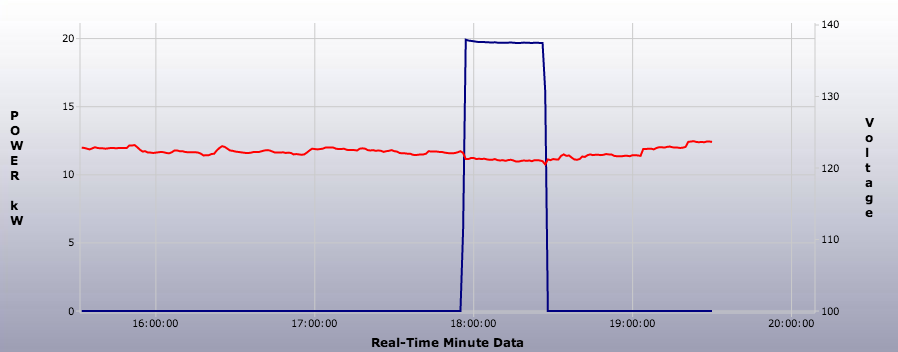
Cottonwood Here is a good sample of a HPWC charge at 80 Amps. The Tesla load caused 2 Volt deltas at the panel and 4 Volt deltas at the car; half of the resistance was upstream of the panel! Also note the bigger swings from what the grid was doing on its own...
This is a charge from 80% to 90%, getting ready for a range charge in the morning...
 �
�
Jan 18, 2014
J in MN Here's another data point towards understanding the algorithm: My third event, setup to demonstrate charge current increase, in this case from 28 A to 30 A.
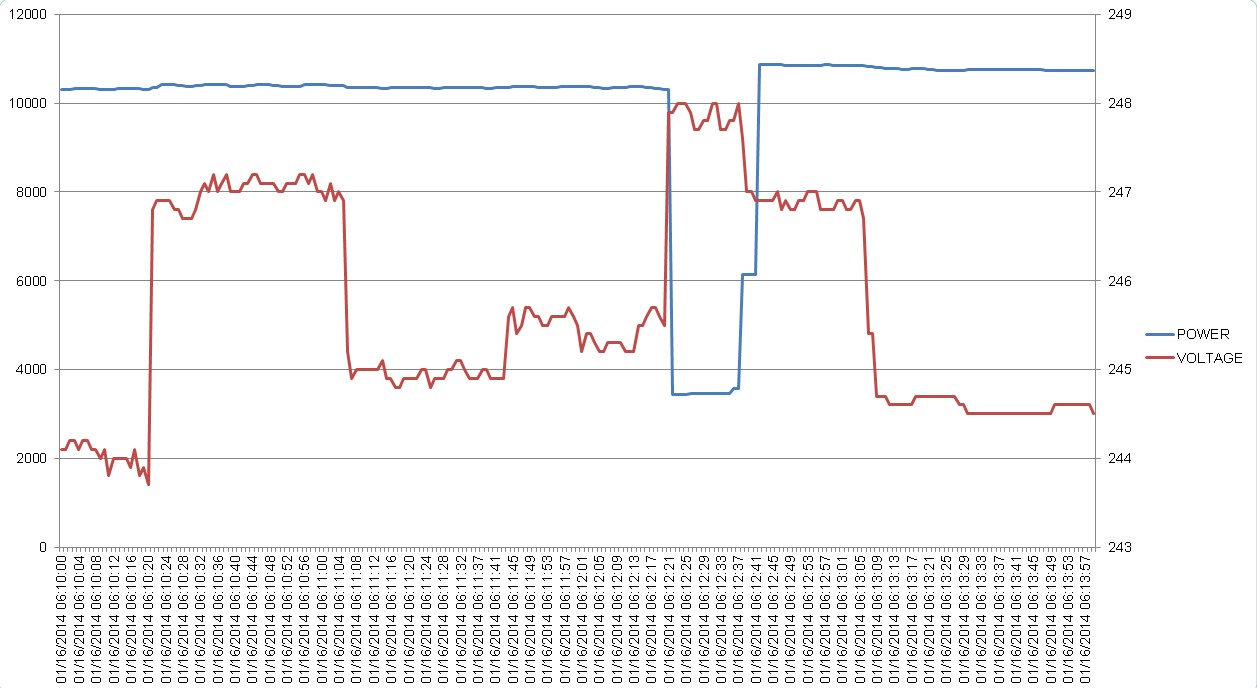
As before, it trips on a voltage rise, but notice how it survives the first rise of 3.2 V @ 06:10:21, but then trips on the ~1.4 V rise at 06:12:21. My sampling rate is not good enough to define this better.
So, it seems pretty clear that it is looking for dV/dt > x, where x > 3 V/s. Maybe x > 60 V/s (i.e. 1 V per cycle).�
Jan 18, 2014
Cosmacelf Have you sent these graphs to tesla? Having the algorithm increase amperage draw is nuts. I sent them an email about it mid week but haven't heard back other than we are looking into it.�
Jan 18, 2014
neroden Tesla's engineering department is a black hole. Information goes in, but information doesn't come out.
This is not good. There are things Tesla has engineered well, and things where they've been awful. A little two-way back-and-forth feedback could probably have prevented most of the latter group of problems, but even the service departments seem to feel like the engineering department is an informational black hole.�
Jan 18, 2014
Vger FWIW, I talked with my service advisor about this whole issue last week. He said they are getting BURIED in phone calls and emails about it. It is the #1 complaint from customers in their shop. They are equally frustrated that HQ is not telling THEM what the algorithm is, so they are just as much in the dark as us!!�
Jan 18, 2014
cinergi Still send it to ownership if you haven't. I've also sent my contacts information about the current-increase bug since it's pretty serious.�
Jan 18, 2014
J in MN First one went to ownership and service center, the rest only to the service center.
My service center seems to have good lines of communication with engineering / "inside service", and they provide me with updates when they get them, something ownership does not always do.�
Jan 19, 2014
Theshadows I'm surprised to hear that. I have sent three emails to ownership and have heard back every time.�
Jan 19, 2014
Cosmacelf Good to hear. Since this is actually a dangerous bug (and, frankly, prevents people from using home made adapters to access less than 40A electrical sources), it ought to be corrected ASAP.�
Jan 19, 2014
Cottonwood In addition, I have encountered 14-50's with 40A breakers and 14-30's with 20A breakers, had the breaker pop, found the breaker, reset it, set the current limit to 80% of the breaker, and then all worked fine. You need to be able to dial back the current and not have the car raise it above what the circuit will allow.�
Jan 20, 2014
mknox Very common here in Ontario, Canada. Most homes are wired with NEMA 14-50's in the kitchen for stoves, but are wired and fused at 40 amps.�
Jan 20, 2014
neroden I guess we need to contact *your* service center! :tongue:�
Jan 20, 2014
AndreyATC I was ok yesterday, charging at 40A with NEMA 15-40, but today, just after 2 hours of charging it went down to 30A with "check charging cable" message�
Jan 21, 2014
Rainbow This is dangerous situation. Does anyone have an idea when this problem will be resolved?�
Jan 21, 2014
Cosmacelf I just noticed that my daily midnight charging at my house has been reset by the car from 40A to 30A. I don't remember getting a message, but doesn't mean I can't have missed it when hurrying somewhere. Annoying. There is nothing wrong with my garage setup.�
Jan 21, 2014
Forty Creek Similar issue with me using my HPWC. Properly wired and inspected. Hoping for a less sensitive software 'fix' to come along soon.�
Jan 28, 2014
mnx I'm not sure if this is 5.8.4 related or not but I was at Great Wolf Lodge in Niagara Falls this past weekend, and the charge kept aborting on the 120V outlet they had there (which has been used by others to charge EV's in the past)
I tried backing down the amperage. I had to dial it down all the way to 6A for my car to not abort charging.
I suspect it was 5.8.4 related since the display said charging rate reduced before it would abort (even though it didn't actually reduce anything).�

Không có nhận xét nào:
Đăng nhận xét