Jan 1, 2016
Vigile Hey everyone, took my new 85D (just crossed 1200 miles) on its first trip from Cincinnati to Columbus and back today and wanted to share an experience I had. Essentially, I noticed a pretty big discrepancy between the estimated mileage the car showed and how the progress went as I was driving.
First, some necessary information.
I was driving from Columbus to to Cincinnati.
I was going from Exit 100 on I-71 through Ohio and the 18 miles into KY. 118 miles total.
It was about 32F outside during the drive this evening.
I never drove over 70 MPH. When the speed limit was 70, I went 70. When it was 65, I went 70. When it was 55, I went 60.
Using Autopilot the majority of the time.
Temp was set to 70F in the cabin.
I came from the east side of Columbus and went to the Supercharger at exit 100, knowing I need some juice.
I waited for the car to charge to 200 miles estimated range. (Note this is WELL after the notification showed up about the car having enough power to make the rest of my trip, using the in-car nav.)
I looked at the trip meter with the destination set and it indicated I would have 22% battery remaining when I got home. Great!
As I was driving home I just keep noticing that the miles I was actually driving were less than the range coming off the car. I started to pay attention. I noticed the battery level estimate (at the end of trip) drop to 20%, 18%, 16% and then 14%. I started to get worried. The line on the trip screen was trending well under the grey line that represents the original estimate at the start of the trip.
Here is picture I took when the car said it had 100 miles left on the range. Remembering that I charged at the SC to a 200 mile range, that gave me a good way to measure the accuracy of Tesla's info.
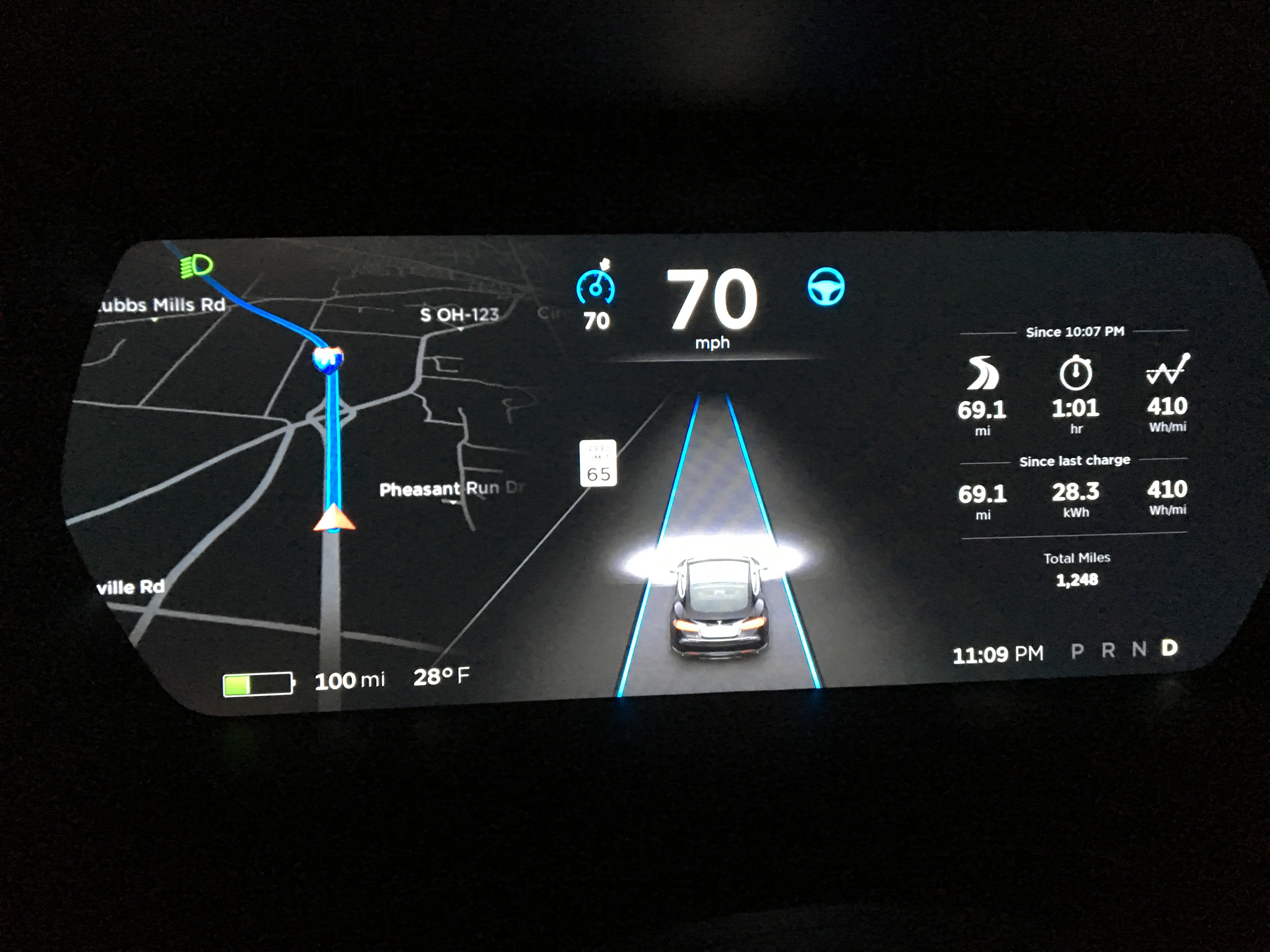
I had been driving just 69.1 miles at that point, giving me an error of 30.9 miles or 30.9% (!!!) on estimated to actual mileage.
I still had 49 miles to go on the trip so I started to get really worried. How would I possibly run out of juice on a 118 mile trip with a 200 mile estimated range? I turned down the heat a couple degrees, turned the seat heaters off (they were on 1)...
As I got closer to Cincinnati the speed limit dropped a bit to 55, so I went to 60 MPH, and that seemed to help quite a bit. (Maybe the last 15 miles.) I ended up getting home with 35 miles on the estimation. Doing the math again, with a 200 mile initial projection, and a 118 mile actual trip, gives us a 46 mile range error. Definitely closer than I was after the first 100 miles, but still a dramatic discrepancy.
I get that it was cold outside...but the car knew that and I would have though Tesla would have taken that into consideration.
The drive from Columbus to Cincinnati is pretty damn flat, as anyone that has done it can tell you.
I was the only passenger and I had only a backpack as cargo.
I know it will get better when it warms up again, but I live in KY and we have winter.
Anyone have thoughts on this? Or similar / difference experiences? I thought I had charged at the SC to a point where I would have zero range anxiety on the way home, but clearly that wasn't the case. What if I had left the SC when the software told me I had enough juice to get home? It's very possible I would have been stranded.
For a car that I am otherwise in love with, consider me somewhat concerned.�
Jan 1, 2016
stsanford I think you've just discovered one of the issues with batteries in the cold. I have had a 60 and now a P85, and cold weather (and it seems anything below 60 or 70 degrees is considered cold) really has an adverse effect on range. I have seen as much as a 6:1 range loss when doing around-town, short hop type driving in the bitter cold. More normal is a 25-30% reduction in range when the temps drop below 65 or 60 degrees...
My rule of thumb once the winter hits is to make sure you have DOUBLE the range needed to go anywhere. This is with a combined 65k miles of driving experience in the Tri-State NY area year-round.�
Jan 1, 2016
Cosmacelf Your experience is pretty typical. I always use evtripplanner.com to gauge how many rated miles a freeway long distance trip will actually use. In general, I try to add 50% rated range to a trip calculation. So a 118 mile trip, I would try to charge to about 180 miles, at a minimum. Then cold weather, speed and and headwinds come into play.
The Tesla range estimator is crap. Starting a journey, it may say 12% estimated level at end of journey, but then five minutes into the trip, it'll have fallen to 8% and dropping. Then as the trip is nearing the finish, the estimation will start to go up again.
Bear in mind that the "rated range" is for level ground, at 70 degrees, no heating or AC, no headwinds, and at 55 mph with just a driver and no cargo. Yeah, sometimes you can hit rated range on a trip, but certainly not in cold weather, and I would never plan on it.�
Jan 1, 2016
Jool Yes, cold weather really does make a huge dent in the car's range. The combination of the car having to keep the battery warm plus running the cabin heater is killer.�
Jan 1, 2016
stevezzzz First, let me say that I'm sorry you experienced range anxiety after taking sensible steps to avoid it.
Next, welcome to the wonderful world of winter. When the OAT drops below about 40� F., consumption per mile goes up dramatically and range takes a big hit.
Third, remember that your first line of defense when range becomes an issue is to slow down. The difference in consumption between 60 mph and 70 mph is dramatic, for instance.
Let's examine the information you presented and see if your anxiety was warranted. It looks like you used an extra 30 miles of Rated range in the first half of your trip, and only an extra 15 miles of range in the second half. Why? Because your average speed was lower in the second half. You said that the predicted SOC remaining dropped from 22% at the outset to 14% somewhere along the way; that's not necessarily a cause for concern, because the algorithm is projecting the remainder of the trip based on your actual performance in the early stages, so an initial drop is not an indication that the predicted SOC remaining will continue to drop as you go along. And 14% SOC is roughly 40-45 miles of Rated range, which is a comfortable buffer in most circumstances and reasonably close to what you ended up with at the end.
I hope I'm making sense; my larger point is that while you should by all means pay attention to changing conditions and adjust your speed downward if things really are going badly, you were never in any real danger of running out of charge before reaching your destination. Look at it this way: you started the trip with about 60% more Rated miles than actual driving miles, and though that buffer diminished somewhat, there came a time in the second half of the trip where you actually surpassed that initial percentage and were 'home free'.�
Jan 1, 2016
musicious This why on my 85D I have it display the energy level (% battery remaining) rather than rated range. In the winter I get about double the % battery so at 90% its 180 mile range rather than the 240 rated range. In the summer its a little more than double, around 200-210 but still easier to multiply the % times 2 and add a little than to trust rated range.�
Jan 1, 2016
Al604 I picked up a 70D on Dec 19th, i've quickly realized the "rated range" is probably in ideal weather and temperatures. My rated 385KM on 100% charge is actually about 210-220 KM of real driving in the city where the temp is at 32-40F outside with the cabin at 71F.
I'm not looking at my wh/mile or wh/km to figure out how far I could actually make it on what energy I have left in the battery.�
Jan 2, 2016
Troy The range you see in your car is EPA rated range. Their score is high because they test cars at low speeds. They do a 5 cycle test. 3 of those simulate city driving at 21.2 mph average speed. That's why 85D scored 270 miles rated range. Tesla is required to display this number. The same 270 mi number is also shown on the window sticker of your car. It would be better if their test method included only highway because that's where range matters. I think they should update their test method again. In the past their scores were even more optimistic when they did a 2 cycle test. I think they changed it in 2012. This is their more accurate version. In Europe the scores are even more messed up. If you go to Tesla UK website HERE you can see that 85D displays 330 miles NEDC rated range. This is very unrealistic but Tesla is required to use this number in their advertisement.
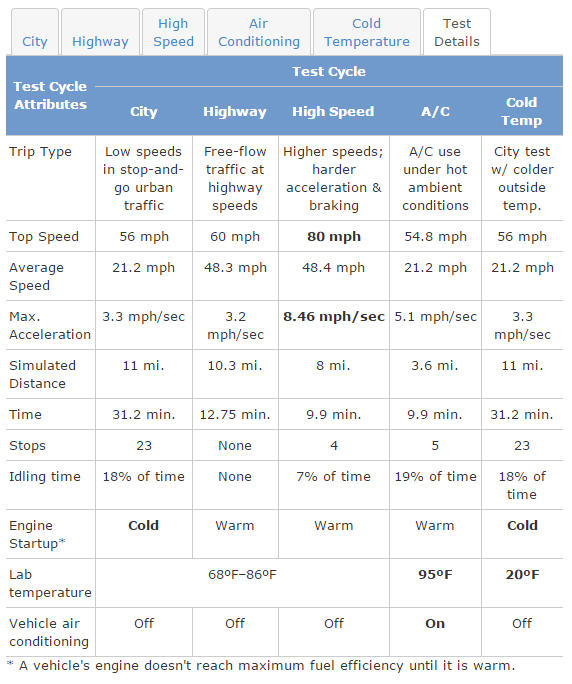
Screenshot source
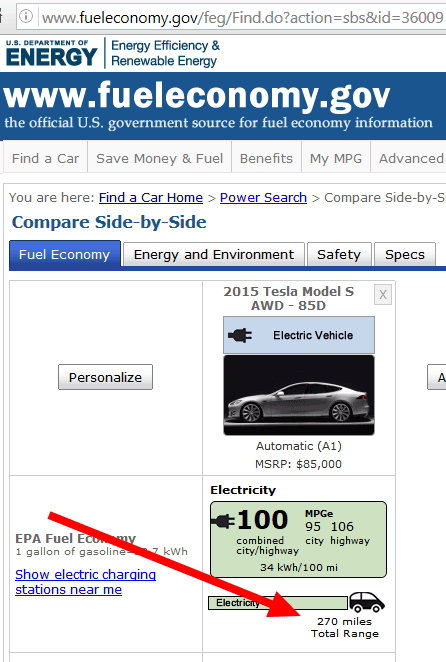
Screenshot source
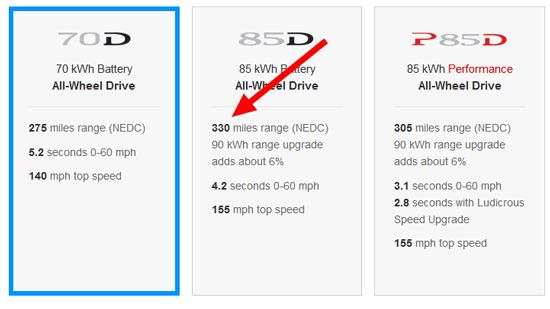
Screenshot source�
Jan 2, 2016
thegruf Nothing unrealistic at all in Europe
just we are all used to VW figures over here. ie we treat all figures from car manufacturers as a load of complete bllx.�
Jan 2, 2016
Jbailey We have the same 85D car. To get it to follow the range estimate you basically have to use about 285 kw/mile or less. You were using over 400. When I need to get range estimated miles (avg 285kw/h or less), I set cruise to 64 and don't use heat (preheating the car while plugged in and using seat heating helps). I then watch the average kw/mile to make sure this is enough. If there are a lot of hills or rain(wet roads are rough on kw/mile), I may need to slow down more. Once I am close enough to a charger or my destination and know range will not be an issue I revert back to pre-electric mentality and crank up the heat and or speed.
I live near Gainesville Florida and recently drove to Vicksburg MS. I left my house at 90%, drove fast with heater/ac on, supercharged in Tallahassee, Defuniac Springs for around 30-35 min each...No prob. However at Mobile I knew I had 222 miles to my final destination and no superchargers (and did not want to take the time to stop at a level 2). I charged to 264 miles, turned off the heat/AC, set cruise on 64, covered the 222 miles with 50-60 miles to spare and driving normal the last 50 miles. Until they get the software refined, I pretty much ignore the software advice.
I used similar strategy to drive to myrtle beach. I now have 22,000 miles on my 85D and have taken many long trips. I have never once had any range anxiety or close calls. Driving an electric car on long trips requires a little knowledge, planning, monitoring and a little more time, but well worth it. As the superchargers and other chargers increase in number it will become a non-issue.
If you remember and use the 285 kw/h number and the impact of speed, rain, heater use you will have all you need to eliminate range anxiety�
Jan 2, 2016
David_Cary There have been some incorrect posts here. Rated range is based on EPA and is not ideal conditions.
I have a 70D and ideal conditions gets me close to 300 miles and my rated is 240. But it bears repeating, you will not get rated range at 32 degrees. You will not get rated range at 70 mph. If you are doing both, you will be 30% off rated range - which sounds about what you were.
Cold air is more dense and adds to aerodynamic losses significantly. The effect on the battery after supercharging (which heated the battery fully) is actually pretty small. The dense air makes the speed penalty much worse. The difference between 60 and 70 mph is much greater at 32 degrees vs 70 degrees.
You still have new tires - that hurts range. Most people don't check tire pressures often enough in the winter so they are low and that hurts range. So bump up your tires a bit.
Seat heater uses next to nothing (typically 50-100 w vs up to 6 kw for air heating). So next time, bump the seats to 3 and turn the air down more.
Rated range is EPA and does not change with ambient temperature or driving style. If you hear all the complaints from the Leaf's GOM (guess o meter), you will realize that there is no easy solution to range estimating. Choice is good and we have that on the energy meter. An EV tripplanner algorithm combined with nav destination and ambient temp would be great. This combined with actual measurements as you drive could be great. I suspect we will get it someday. But for now - experience limits anxiety greatly. Slowing down works miracles. And getting to back roads at 45 mph even better than slowing to 60. So once you have experience, you can drive at 70 with only 5 buffer miles knowing that you could jump to a back road and have 50 buffer miles.�
Jan 2, 2016
jerry33 The energy trip graph is one of the best tools in the car because it takes speed limits and hills into account. It doesn't take cold weather or wind into account though. For an 85 170-180 miles is about right when it's below freezing. this can be mitigated somewhat by preheating the car, ending the charge just before driving, keeping the tire pressures up, and driving slower. In general, the best strategy is to start a trip using slower speeds and then speed up towards the end if there is a lot of energy left.�
Jan 2, 2016
Jim MacInnes As others have recommended and based on my own experience, a successful strategy is to start out at slower speeds at the beginning of your trip and until your Tesla trip planner graph settles in. After that you can adjust your speed upward or downward to along the way to maintain the desired battery SOC at the end of your trip. Speed makes a huge difference on battery consumption. Even a few miles per hour one way or another can make a difference and it is easy to follow on the graph when you are using up your charge faster than planned. For example, I once had 35 miles of SOC showing yet 33 miles to my destination. I dropped my speed down to 45 mph, and ended up with 10 miles of charge remaining upon reaching my destination. It was pretty amazing to watch the predicted range amount increase as I approached my destination at 45 mph. Here are some range vs speed curves from Tesla https://www.teslamotors.com/blog/driving-range-model-s-family�
Jan 2, 2016
ROCDOC Agree that this is real world range for an 85. My experience is very similar. There are many threads on here and elsewhere that advise you on how to drive in cold weather. Count on 30 - 35% less range, maybe more in very cold weather. It's really a very different car in the winter.�
Jan 2, 2016
Adm Another factor to consider is wind speed and direction. Head wind at 20MPH or 20 MPH tail wind makes for a serious difference in range. At 70 MPH that adds up to 50% more air resistance between the extremes. Add this to the temperature effect and it explains a significant part of your problems.�
Jan 2, 2016
RedSoxFan18 Took possession of my 85D on Wednesday - I live 150 miles form the service center. It was my first read drive in the car and I'll admit to driving in a spirited manner on the way home, just could not help myself I was grinning the entire time. I had planned on stopping at the Seabrook NH SuperCharger just try it out. Boy was I grateful for the SC as I went through quite a bit of charge. Forecast is for -2 F on Monday AM commute, it will be interesting to see how much charge I use.�
Jan 2, 2016
ToddRLockwood You did not indicate whether you started your trip with a cold battery. If the battery is cold when you start off, the battery heater will use roughly the same amount of energy as the drive motors do for the first half-hour of your trip. If you add the cabin heater load, you can understand why the range is greatly affected on shorter trips like this one.
If you preheat the battery while the car is still plugged in, it will use energy from the mains to power the battery heater. I believe the only way to activate preheating is from the Tesla smartphone app. While outside the car, open the phone app and select the Climate tab. Then touch the TURN ON button. Set the temperature well above your normal setting�I suggest 80+ degrees. Depending on how cold your battery is, this will take 20 to 30 minutes. Once the battery is warm, it tends to stay warm due to its high mass. Getting the interior good and warm also helps too, by causing the HVAC fan to run at a slower speed. Make sure to keep that fan speed in Auto mode.
I also recommend using the Trip Chart within the Energy app. When using the navigation system, the Trip Chart will give you realtime information about your energy use. If the percentage predicted at your destination is consistently shrinking, simply slow down a bit. Slowing from 70 to 65 will even make a difference.
Last winter I drove my P85 from Burlington, VT to Boston, MA at -10F, driving at 74 mph without any problem. I made one 30-minute Supercharger stop along the way.�
Jan 2, 2016
dsm363 Glad you made it. Agree with everyone to slow down when range becomes an issue especially at start of trip. It also sounds like you took off from the supercharger early at 200miles rated range with what would have been a good buffer under normal weather conditions. If not in a rush and at a Supercharger makes sense to get a much bigger buffer when cold out.�
Jan 2, 2016
ecarfan Good post Jerry, I agree with all of it (including parts I'm not quoting above) but want to add that the energy graph also does not take headwinds, rain, and snow (basically, "weather") into account, and they can dramatically effect range.
To the OP: I think you have seen from all the good posts on this page how to use the energy graph more realistically. I just want to add one comment, you said "the car knows the temperature" and wondered why that was not taken into account. Yes the outside temp is displayed but that does not mean it is factored into the energy graph predictions.
The energy graph is a great tool once you understand its current limitations. I find it very accurate in moderate temperatures with no headwinds, rain, or snow if you go the speed limit or a bit below that. If you go much slower or faster than the speed limit it will adjust its energy prediction during the trip. When you saw your predicted range dropping that is because it was not taking the cold temperature into account, and possibly other factors. So then you just slow down for awhile and watch the graph to see if you have slowed enough.
I prefer to charge to the point where the energy graph shows I will arrive with 20% left, that gives me a buffer, though in more severe weather conditions one should leave more of a buffer.
In the future Tesla will surely make the software smarter and include weather factors into the energy graph prediction algorithm.�
Jan 2, 2016
Vigile Thanks for all the feedback and comments on this. I understand the general consensus is that cold weather and speed dramatically lower range estimates, which makes sense.
Couple of things though.
1. Someone said that "Tesla has to use the EPA/etc rated range estimate in the car" and I disagree there. It has to display that on the car sticker and advertising, but once you own the car I'm sure that's not the case. Tesla can and should strive to make it as accurate as possible based on surrounding information once you are actually driving and depending on the MS.
2. As ecarfan mentioned above, clearly the car is not taking temp into consideration, but I have to wonder...WHY??!? The car has is starting its 5th year of production and many many people have been driving these cars in low temperatures. I see no way that Tesla is not stock full of statistics on how the car and batteries perform at a WIDE range of conditions... Is it time we start demanding more of them in this regard?
3. Also, in regards to speed - slower is better, totally understand why. But 70 MPH in this part of the country is SLOOOOWWWWW. I guess in San Jose where Tesla is based traffic is so bad that no one ever drives over 40 MPH (heh) but some highways near me have limits of 80 MPH and getting accurate range estimates while at least following hte flow of traffic would be nice.
4. The battery was very warm at the start of the trip - had been diving 40+ miles already and the heat was on and was only at the SC for about 25 minutes.
In the end, I'm not asking Tesla and the MS to magically get more battery capacity or to overcome headwinds and temperatures by black magic, I simply think that my first experience here shows that the company doesn't put enough effort into providing accurate information the driver in all conditions. If I had run out of juice somewhere before home, it could be a danger. I travel with my 6-mo old daughter, etc.
I'm still a fan here, just trying to put together some constructive criticism.�
Jan 2, 2016
William13 Vigile, most of us owners agree that Tesla should make an improved range prediction tool. They don't want to as it would be used by detractors and still be inaccurate. We can still lobby them to give another real world, temperature and speed and wind trip estimator which would be better than the current estimate.
They live in California. I'm still hoping for a heavier coat in their store. Ha!�
Jan 2, 2016
HankLloydRight Lots of helpful tips in this thread... and here's my very simple rule of thumb: 300 Wh/m.
In my experience doing several >1000 mile road trips, if I hit exactly 300 Wh/m, I'll hit the rated range on the nose. If below 300Wh/m (not very often!) I'll get much better, and of course, if I'm over 300Wh/m, I'll get proportionally less range.
In your case, you used 410 Wh/m, which is 36% more than 300 Wh/m.. so that's pretty close to your own estimate of 30.9% more energy usage for your trip.
I use the energy/trip graph occasionally, and more information is better than less, but I always fall back on the trip Wh/m.
I like using the 300 Wh/m rule of thumb because it takes into consideration all other factors -- wind, terrain, pack heating, rain, traffic, speed, etc during your trip, and allows you to adjust your speed accordingly to bring it back down into a safe range to make sure you'll get to your destination.
�
Jan 2, 2016
Sparktz I am surprised I had to get to page 3 before someone said this. It is really simple math as Hank points out.
The estimated miles shown on the dash are assuming that you use approximately (maybe exactly?) 300 Wh/m. So hypothetically, if you are using 600 Wh/m, then you are using 600/300 = 200% of the expected energy required to go each mile. So then you would take whatever mileage is showing in the dash and divide by 2 to determine how far you can actually go if you maintain that rate of energy usage.
So then lets say that you get yourself into a situation where your rated miles on the dash are equal to the number of miles that you have until your destination. You have to adjust your driving and climate control usage to force your Wh/m from that point forward to average out to no more than 300 Wh/m. This will most likely be attained by reducing speed.�
Jan 2, 2016
AWDtsla I've never achieved an EPA rated consumption/range in any car I have ever driven in any circumstance.
I'm at 236 rated vs 146 estimated right now.�
Jan 2, 2016
Vigile I thought this was worth noting.
I have a Chevy Volt that I am still trying to sell and I moved it today around the block for some reason.
As I was driving it around I realized - the CHEVY VOLT adjusts for temperature. When the temperature is high, the estimate on the car showed 40-42 miles. Today, in the same cold weather that the Tesla drove home in last night, it showed a 31 miles range with full charge.
So, even the lowly Chevy Volt is able recognize temperature and help to inform the driver to the best of its ability. It's not perfect, and it's not taking speed of driving into account, but adjusting for temperature is at least a good FIRST STEP to helping inform a buyer.
I keep getting the feeling reading these forums that some owners are making excuses for Tesla rather than discussing the deficiencies of the software. To be fair, reviewing and analyzing things is in my blood (that's been my career for 16 years) so I tend to find these things more directly than most. If Tesla wants to sell Model 3's to less and less "technological informed" buyers then they are going to have to improve this kind of thing.
Fair?�
Jan 2, 2016
CHG-ON I live in CA, where it is not as cold and I always plan on a 25% error and am usually right on. I tend to drive 75 everywhere on the highway. I see lots of posts where people have consumption in the mid to high 200's. I can never seem to get below 320. My lifetime avg is 339. And even after learning how to not constantly hammer the throttle�
Jan 2, 2016
TexasEV The premise of the thread title is wrong. The car displays "rated range", not a range estimate or projected range. If you drive using the energy consumption of the EPA test cycle then by definition you will get the rated range. If not, you won't. The energy app shows a line corresponding to this energy consumption (285 to 300 Wh/mi depending on your model) and if your consumption is above this line you will get correspondingy less range.�
Jan 2, 2016
S4WRXTTCS Here is my experiences with my 70D on trips.
I don't pay any attention to the range estimation on the instrument cluster. The way it calculates the range is not useful at all for trips.
What I use is the Trip Tab under the Energy app within the Center Console. This takes into the elevation change on your route, and the estimated speed. From my own usage I do believe it takes into account temperature, but only the current temperature. The biggest weakness of it in it's current form is it does not account for wind speed or weather events. If you have a headwind the actual usage is going to be way higher than what it estimates in the beginning. Tesla needs to implement Wind Speed/Direction in the calculation ASAP, and also rain (if it rained or is going to rain). Rain is the harder one to gauge, but they can at least do Wind.
The behavior I'm used to is the estimated range will normally always start off at X, and then it will drop to X-2 or X-3 before going back up. I think it does this because the energy usage required to get back on the freeway is higher than it uses for it's calculations.
Once i'm on the freeway I modulate the speed as the primary way of getting the range that I want. But, I never go slower than semi's. I don't see a need to because all I have to do is slip behind one for a bit with a TACC setting of 3-5 to get the energy savings I need. Not only do Semi's provide some drafting (a small amount since I'm far away), but they also tend to modulate their speed going up hills. Even if it's annoying (because they slow down to 55-60 going up them) it's a great way to save energy. As a last resort I'll lower the internal temperature in the car to also help out.�
Jan 3, 2016
russman Im in CA too and am spoiled by the warmer weather. I was stuck in the Tejon wait this holiday and wanting to free up my spot for others, I didn't charge as long as I would have. It was well past what the car said I needed with cushion. I got range anxiety pulling into the next stop because I used 40% more. So 1.42 rated miles for every real mile driven. I was using range mode. Turned down the heater, but I guess the cold, weight, and headwind played havoc. Don't know how you its in real winter can adjust.
�
Jan 3, 2016
Kandiru Thank you all, very informative thread. The mobile app preheat, seat heater over AC, and 35% winter est. range decrease should have been in the manual to begin with.
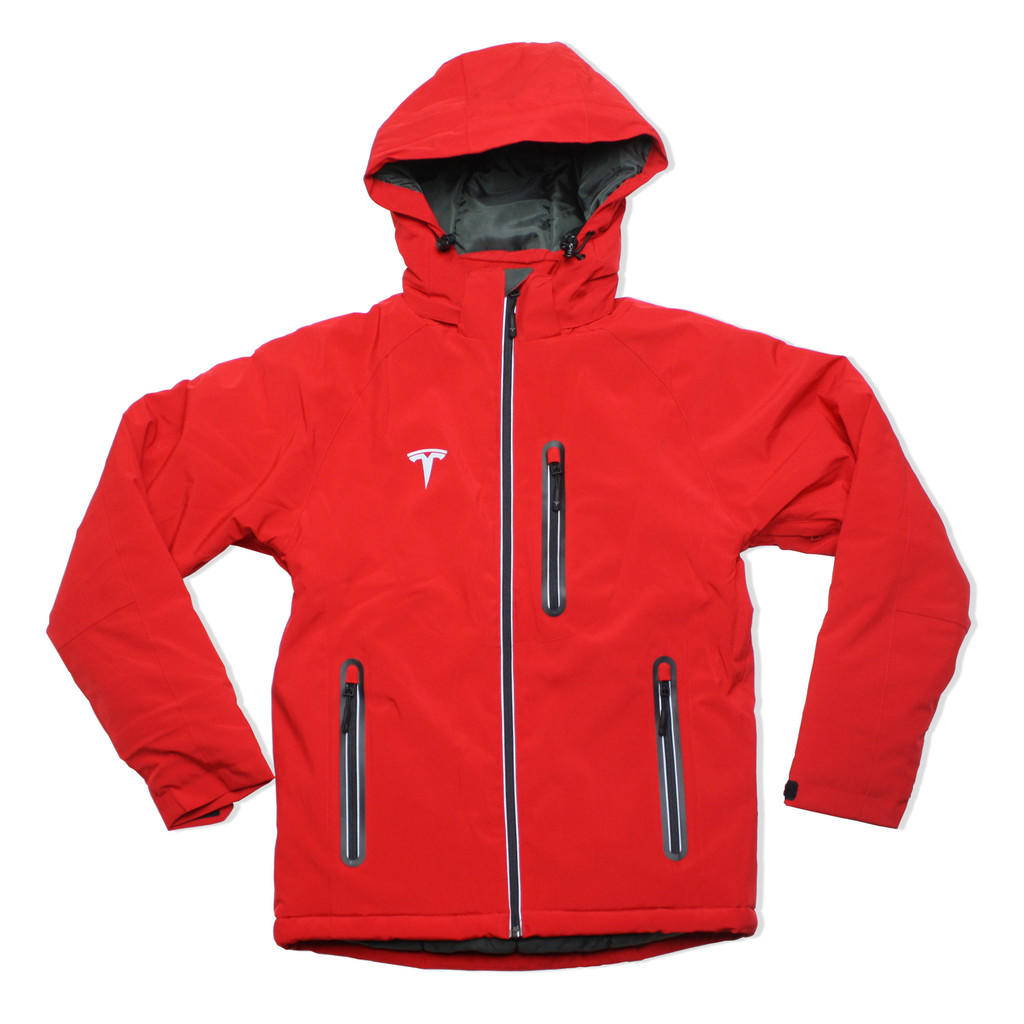
You should give the red soft shell winter coat a try, show them the Tesla app to get 20% off. If you cannot get to a store it floats on ebay sometimes. Love mine, like the earphone cable holder. It will also make you very visible in a real emergency.
 �
�
Jan 3, 2016
David29 A couple of comments.
First, I have a 70D, not an 85. For my car, the EPA rated range corresponds to 290 Wh/mi. So like the 300 mentioned above, that is what I try to achieve.
Second, for whatever it is worth, on my first (and only) long trip so far, I used an average of 309 Wh/mi over 450 miles, so a good bit more than the EPA rated range value. But the temps were milder than the OP's conditions. I was still surprised that his average was so high, though (410).
Third, the energy graph is simply based upon your own recent driving. You can chose whether it uses the last 5, 15, or 30 miles, or the last 0.1 mile (the "Instantaneous" setting). So I try to use the setting that best represents how I will be driving. So that graph does reflect whatever energy was consumed, and thus does reflect the air temperatures, speeds, wind, and elevation changes that occurred during the interval you chose. The estimated range it produces is thus a reflection of your past driving over the chosen range, and that is all. But I agree with others above that that is usually a better indication than the rated range on the instrument cluster.�
Jan 3, 2016
Raven I'm a bit shocked it took 15 posts before anyone even mentioned wind. Sorry, but I've found that the cold is NOT that dramatic of a penalty. IF, and I stress the "if", you are operating in range mode. Preventing your pack from using a large amount of energy to warm itself makes a big difference in the first 30 minutes of your drive. I've driven long distances in the double-digit negative Fahrenheit and it was ALWAYS the relative headwind component that was the deciding factor on range performance. If the headwind is strong, hot or cold, you have to slow down to compensate. Yes, the more dense air, heater use, etc., DOES reduce range, but the numbers I see attributed to cold alone with no reference to wind (or topography) are completely overblown and erroneous in my experience.
My method...If I needed to meet my displayed rated range, I slowed until my average use met up with the rated range line.�
Jan 3, 2016
tmac
Wow what agreat explanation thank you . For those of us learning lurking waiting to buy , it helps to understand every detail you provided.�
Jan 4, 2016
Raven As I said above, I still firmly believe it's simpler than Jbailey said. I've had the car for nearly 3 years now and lived in both climate extremes. For me, I display rated range because ideal is virtually impossible without going 40mph. With rated range displayed, I drive a speed that will match up my energy usage trend with the "rated range" line on the usage chart in the speedometer cluster. It's really that simple. If you have 50 miles remaining and 50 miles rated range, just slow down and keep your usage below the rated line. I have NEVER needed to shut off cabin heat or lights or any other thing doing this. When your cabin is up to temp, the heater is not that dramatic of a draw unless maybe if you keep it at 85 degrees. Maybe not, never tried it. This wearing of parkas and turning off the heat in the winter is just silly unless you're trying to milk 300 actual miles out of a charge while maintaining highway speeds.
As many others have said in different threads...simply plan on using only 80% of your range on all trips. If your rated range is 200, plan on only getting 160. This will comfortably allow for temps, wind, most topography, etc. From there you can make much smaller adjustments to speed to make your next charge.�
Jan 4, 2016
Candleflame exactly. when i see l/100km advertised my mind is already translating that to realistic driving conditions. xD�
Jan 4, 2016
yobigd20 i second this with 97k miles experience. I regularly average 400-450Wh/mi in the winter in the tri-state area.�
Jan 4, 2016
FlasherZ I just made a trip from Florida back to Illinois - north of Georgia, we were seeing highs of 45 degrees and lows of 27 (both degF). Above 36 degrees, I estimate I'll consume 330 Wh/mi (which is a 10% penalty) at your speeds. Below 36 degrees, I estimate I'll consume an average of 360 Wh/mi (which is a 20% penalty from rated) at that speed - both without wind.
As noted, it is (unfortunately) the result of the temperature and denser, colder air. This weekend, while coming north, we had one day of winds from the north at 10 mph (that really penalized me), and one day of winds from the SW at 10 mph (which helped somewhat, although the wind was slightly tangential in angle to the direction we were traveling). In the winter, the high winds across the midwest are what usually affect us the most.�
Jan 4, 2016
Raven Again, as I'm sure you're aware, if you don't have the car set to "range mode" and you're doing multiple short trips, the pack constantly trying to heat itself will KILL your range. However, with preheat, range mode, and steady-state driving I did not see the dramatic losses others are stating.�
Jan 4, 2016
FlasherZ In addition, a couple of lessons from me: when the Supercharger trip planner says you have enough energy, give yourself a cushion of 5-10 minutes charging beyond that.
I'm one of those serial Supercharger-skippers... because I carry around 4 kids with me, at least three of our charging stops will be for meals. This gives us a chance to focus on those Superchargers that will allow us to skip the next one. For example, this trip we charged to full at St. Augustine, then skipped Lake City; stopped at Tifton, skipped Macon; stopped at Atlanta. I intended to skip Chattanooga, but the winds and temps were such that I didn't think I could stretch it without having to drive 55, so we stopped for a quick 10 minute bathroom break. We stayed overnight in Knoxville, Supercharged in the morning, then skipped London, KY; then onto Lexington, skipping Cincinnati (wrong side of the city!); then to Indianapolis, Effingham, and home.
During summer, I can route from Chattanooga to Nashville to Louisville to home, but at 225 miles for the Louisville-home stretch, I'm pushing it in winter weather. I need good wind conditions and > 45 degF temps to make that work. So in the winter - until Tesla pulls its head out and looks at a map of the midwest, placing SpC's in Mount Vernon and Paducah, we're going to have to go 230 miles out of our way each direction through Indy.�
Jan 4, 2016
green1 I'm extremely jealous of those people who live somewhere where skipping a supercharger is even possible... There are so few superchargers around here that if you skip a single one you'll never make the next one. (and by "around here" I mean for the full 1000km+ run from home to Seattle, which is the only direction I can go and see a supercharger at all...)�
Jan 4, 2016
dsm363 As TexasEV said. Rated range is just a simple fuel gauge like on a gas car. Does your gas car fuel gauge take in all factors like weather...etc? I just keep the car in percentage mode now and when traveling put my destination in the Nav and look at the estimate on what percentage I should arrive at. I keep an eye on predicted and actual and how fast they diverge. If that happens I slow down or do something else.�
Jan 4, 2016
AWDtsla Actually, my previous ICE cars had miles remaining based on the economy in the last n miles driven, AND a fuel percentage. The EPA estimated range went right into the trash with the monroney sticker...
- - - Updated - - -
You know what, this sh** isn't rocket surgery. There's some data gathering and math involved, but the car should show you estimated city AND highway range based on previous driving patterns and temperature. Ideal should become EPA, never to be used by anyone again.�
Jan 4, 2016
russman Looking at all the various threads and from Tesla's site, the 85D is supposed to be more efficient than the 85, but everything I've seen seems to indicate worse. I average around 320-330 wh/mi in my 85.�
Jan 4, 2016
hiroshiy I usually target 384Wh/mile or 240Wh/km around 32F weather with no headwind. Maybe you can display energy graph and try not to consume energy over 384 (or 390). But if you are using autopilot, the only way you can reduce your power usage without heat compromise, is to reduce speed. If you are not using autopilot, you have some ways to save power - for example, set regen to normal, slightly slow down uphill, coast on downhill, minimize use of regen and never use brakes.�
Jan 4, 2016
Panoz Just last week I experienced a 40% overhead when driving 170 miles in 12 degree F weather. I'm going to take the advice of a previous comment on this thread and charge DOUBLE the range I need when it's 32 degrees F or colder.�
Jan 4, 2016
JonathanD Also keep in mind seat heaters are much more efficient than Climate Control.�
Jan 4, 2016
cpa It seems to me that an interim, quick fix for Tesla on its range estimator (trip tab) would be to have the trip tab display a chart for wh/mile to reach the next destination. For example, if the destination is 135 miles away, the software would estimate that at 75% SOC 320wh/mile means we arrive with 15%. 340 wh/mile -- 10%. 365 wh/mile -- 3%. (All figures just made up.) It would not factor in wind or climate (no change from the current iteration) but at least it would give the driver some understanding of a target wh/mile to try to attain during the leg.
This feature would permit the driver to have a choice when charging: Increase the SOC upon departure and be able to afford a higher wh/mile, or leave with a smaller SOC but be more attentive to energy usage.�
Jan 4, 2016
HankLloydRight Love it. Great idea.
But I suspect with the latest "dumbing down" of the UI to de-emphasize "range anxiety", that something like this will never see the light of day (until an API/SDK is released and 3rd party apps can deliver).�
Jan 4, 2016
RK9090 I frequently travel between Columbus and Cincinnati, and have had similar experiences with range uncertainty. I agree with the OP - traveling at the posted 70mph on parts of I-71 is impractical... traffic flows more like 80mph in some of the more rural areas.
On the topic of pre-heating, on cold weather days would the battery stay warm during supercharging or would it be advisable to flip on the cabin heat (even if I'm not in the vehicle) to keep the battery heater from drawing too much power after charging?�
Jan 4, 2016
FlasherZ It does do this, but not via Wh/mile. The car will tell you "drive less than 70 mph to reach destination" in a yellow box on the nav and on the IC. This is easier to deal with for the average person, compared to the technicality of Wh/mi. It does not take into account weather changes, but does take into account the current Wh/mi in relation to speed, which will take into account temperature and wind.
- - - Updated - - -
Charging generates heat, so you're good there. But I make it a point during Supercharging to raise the temp in the cabin in winter to a higher level (say, 78 degrees or so) so that the loss of heat is minimized as 4 kids and 2 adults are piling back in.�
Jan 5, 2016
Joules Verne Vigile, I had the same experience as you.
I had an overnight P85D test drive, which was awesome.
I took a road trip from the boston area to cape code, about 90 miles each way.
The car is rated for 253 miles (although it was charged to 207 miles), so I figured I *could* go back and forth without charging if I wanted. However, I wanted to tryout the supercharger experience, and factored-in a stop at the Sagamore supercharger.
With the cold weather (30 degrees) and my spirited driving (who drives 60 on a highway? and in a Tesla?), I watched that little battery icon drain much quicker than expected. The stop at the supercharger ended-up being necessary... both ways!
The estimated miles rating proved to be useless.
Reading all the posts in this thread, I now understand why. However, it doesn't really excuse the fact that Tesla does not take environmental conditions into account (it is a computer after all, and it has the data). I do think it started taking my spirited driving into account, as it learned I like the number 80 (I was careful not to take it to 88).
The test drive experience overall was great, but the BIG (and important) thing it did was change my expectations of the Model S range capabilities under real world conditions. Something new for me to think about.�
Jan 5, 2016
yobigd20 I always have range mode on...always. still get bad Wh/mi in winter.�
Jan 5, 2016
green1 Maybe that's partly because of the range mode. if it's on while charging and preheating the car doesn't pre-heat the pack like it does when range mode is off, which paradoxically reduces range instead of increasing it...�
Jan 5, 2016
eloder Very few car manufacturers will state how your EPA gas mileage will go down in the winter time drastically, and how factors like heating will impact range too.
Teslas also seem to do far better in winter than other EVs. My Leaf goes from about 100-110 city miles in the summer with AC, down to about 60 miles city (heat always running) when it's 20 or below. Pre-heating my car doesn't help all that much except for getting the cabin temperature high before departure. My car will still show me 70-80+ miles of range after charging it up until it catches up to reality, trip after trip.
I'm sure they're working on a more advanced trip planner to help out, though, but as a low-range EV driver myself a lot of the tips and tricks given by people here can definitely help out. I can't even make the Columbus to Cincy drive in the summertime unless I spend 4 hours at a level2 charger in Dayton, inbetween the two cities.�
Jan 5, 2016
Joules Verne Thats true, but they also do not have the estimated range displayed right there on the dashboard either.
If you're going to tell me how many miles I have left, you might as well be smart about it and factor-in the variables you know.
Given range anxiety is a thing with this technology, Tesla's goal with this metric should be to help the driver manage their trip to the best of their ability. BTW, I understand they want this too, they just are not there yet - at least not for novices like me.�
Jan 5, 2016
Max* Sure they do. Any modern car has a digital fuel gauge which reads "miles remaining".�
Jan 5, 2016
trils0n I don't think estimated range is displayed on the dash -- rated range is -- that is the range you'd get if your consumption matched the EPA test cycle (which is pretty low speeds, fair weather, etc). To get more accurate range estimates, you have to look at the energy app. That will take your last 5, 15, or 30 miles of driving and project range based on your consumption for those periods. Or you can set a nav destination, and look at the Trip Tab of the Energy App to see how your actual consumption is compared to predicted consumption. (Trip seems to take speed and elevation into consideration when calculating energy consumption for a nav destination).�
Jan 5, 2016
DCGOO Louisville SpC just came up in the last week. So maybe better now?�
Jan 5, 2016
green1 My F150 work truck did, and it was chronically over-estimating the remaining range by almost double. The MS is quite accurate by comparison.
My new Dodge Ram C/V for work also has one, I haven't had it long enough yet to gauge accuracy, but at least this one seems to take average usage in to account unlike the Ford.�
Jan 5, 2016
FlasherZ No, I was factoring in Louisville being there. In the winter, I simply can't make it home from Louisville at 225 miles distance - even to the hunting lodge, at 197 miles, is iffy in the cold weather if winds are out of the north and/or west. In the summer it will cut 130 miles each way by going through Louisville instead of Indy.�
Jan 5, 2016
Joules Verne I have two modern cars, a BMW and a Toyota.
Neither do that, but I will accept that some do.
Speaking of modern cars, I'd expect Tesla to get this as accurate as possible.�
Jan 5, 2016
HankLloydRight What BMW do you have?? I've owned several BMWs between 1995 and 2010 and they've all had remaining range available.�
Jan 6, 2016
Majariwr Another new owner here (since 12/21) and also feeling a bit of range disappointment. Been quite cold here in PA the last few days (low teens in the AM) so I'm sure the problem is about as bad as it will get. I've been searching the fora but still am not sure how to warm the big battery. Not sure I'm confident that pre-warming (I.e., turning on the heater while plugged in) the car interior for 30 minutes in the morning works. Didn't seem to do the trick this morning: took 30+ minutes for full regen, and energy usage was through the roof. Can anyone confirm that merely running the interior heater (at any temp or max? For how long?) will get it done? Better way seems to be have charging complete just before pulling out in the morning. But how long, and at what current will be sufficient to warm the battery? Is it better to recharge at max amperage, or will "low and slow" also get it done?�
Jan 6, 2016
meltoots My little tips from a cold Cleveland
Warming battery is really tough to do by charging. I have not found any advantage of low/slow vs max amp. If anything Max Amp appears to have the edge.
I leave my Driving preference on "Range Mode" to keep the heater/AC running more efficiently. I never really change that. Even in Cleveland. If I am freezing I use the heated seats. I do preheat as I just like to go to a heated car (or cooled), and that makes the range mode more tolerable. My basic rule of thumb is at 45� F you get 10% less efficient, 35�F - 20%, 25�F-30%, 15�F- 40%, 5�F - 50%, and God forbid -5�F -60% efficiency. As stated before, speed is the killer over 65 MPH.
Over time the pack will warm up, even in cold weather, and the full regen and better efficiency happens. For battery powered cars, cold is a killer for range. I must admit, I was a bit bummed at the cold range when I got mine last year in January. But after a year, the calculations and range expectations are kinda second nature now. My tips, preheat, use range mode, use heated seats/steering wheel if range mode heater doesn't keep up, drive 65 MPH and under when its deathly cold, keep tires inflated, and that is the best I can do...�
Jan 6, 2016
AWDtsla Press one of the buttons on the control stalk until your display shows your range. It will stay there.�
Jan 6, 2016
green1 The more important bit is to stop worrying about reduced regen, you'll spend far too much energy fighting it. just accept that in winter this stuff happens, your regen will be less, your range will be less, and you'll use more electricity for everything. That said, you'll still be a long ways ahead of an ICE which has worse efficiency in the winter too, but also has to worry about if it will start in the cold, won't start giving you any cabin heat for the first 10 minutes of the trip, can't be pre-heated in a closed garage, can't really keep the heat going while you run in to a store, etc.
Pre-heat enough to be comfortable in your car (20-30 mins tops) schedule your normal charge to end somewhere just before you start driving, use your seat heaters more than the cabin heat, slow down, take your time, relax and don't worry about the details too much.
Winter sucks, it just sucks a bit less in an Model S�
Jan 7, 2016
jerry33 Be sure you're not in range mode when charging or preheating. Charging is more effective than preheating to warm the battery, but I've had success with both. Getting the regen bar to 30 from 0 means that you'll have decent regen for surface streets. At close to freezing it takes 10 to 15 minutes to get full regen in range mode when starting at 30,�
Jan 7, 2016
GoTslaGo BMW definitely has this option. Just have to toggle the left hand computer switch. If you activate it you will see the range varies considerably as you drive it, and will recalculate over time.
I think Tesla should consider doing the same. Show a battery percentage only (fuel level), and a variable rated range depending on driving conditions by the driver. It would help newer drivers understand how the battery works and while it won't get rid of "range anxiety" it will be less prone to griping by everyone: e.g.--"My battery says I have 200 miles, but I only got 150 miles, driving like a lunatic, in the rain, in the snow, in the cold or whatever."
Your ICE car does the same, it just hides it better, and we worry less about it because we have over 100 years of gasoline infrastructure to not worry about it.�
Jan 7, 2016
AWDtsla This is not true for everyone. Over the last 30 miles I averaged 17 cents per mile. Cost in my ICE would have be 16 cents a mile. ICE range is not affected as much in the winter because waste heat is used for cabin heating.�
Jan 7, 2016
green1 17c/mile? what do you pay for electricity????? to do that poorly I'd need to use over a kwh/mile!�
Jan 7, 2016
AWDtsla 19.5 c/kWh. Thanks to monopoly+deregulation.�
Jan 7, 2016
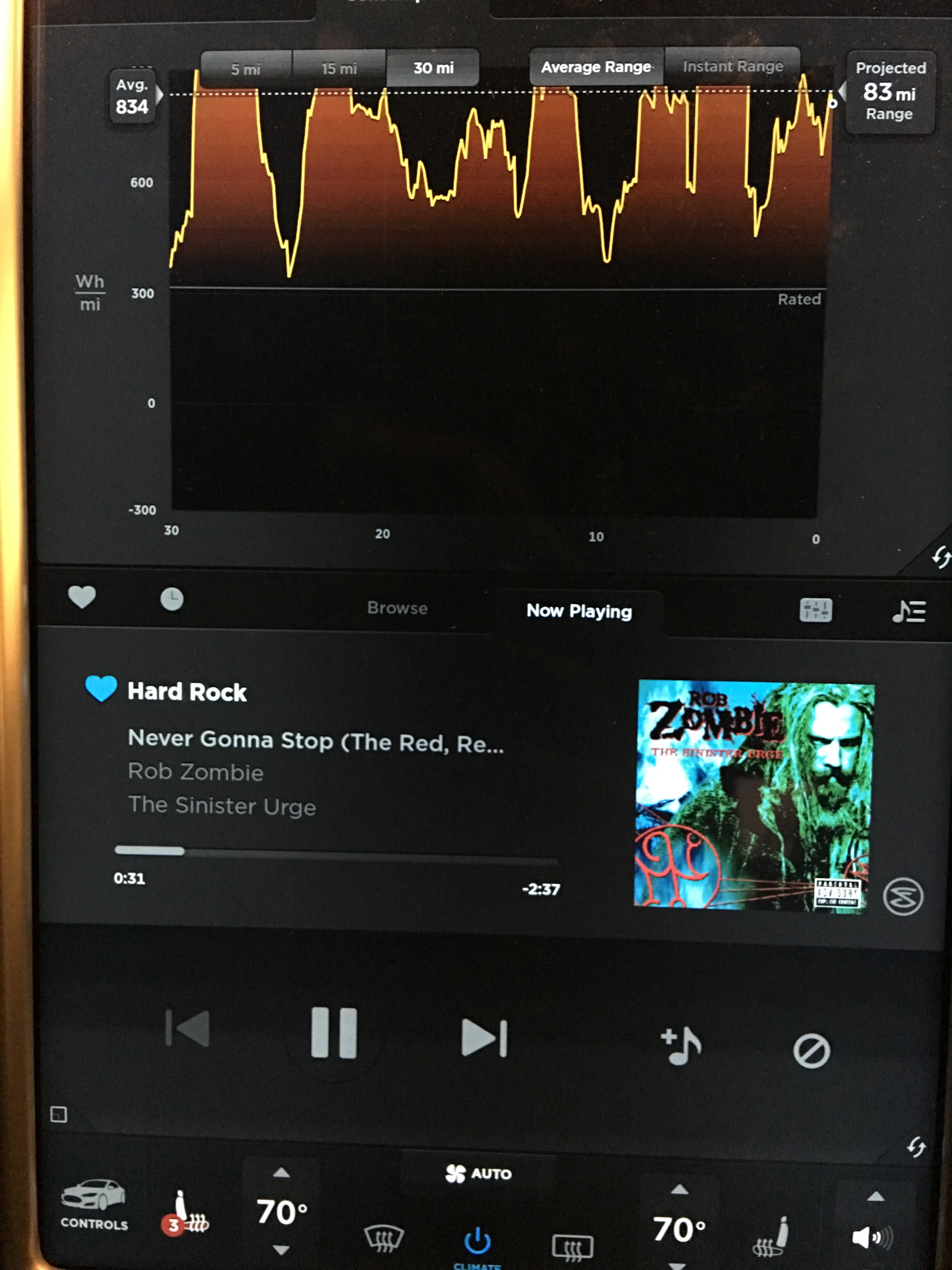
green1 871wh/mile? as an average? That's still a little tough to believe.�
Jan 7, 2016
AWDtsla It's been higher actually. Anyway this should be proof:
 �
�
Jan 7, 2016
green1 Wow... I'm not sure what you're doing, but I've never seen usage that high, in fact, I haven't seen average usage that high per km, let alone per mile.�
Jan 7, 2016
KJD You must not listen to Rob Zombie very often otherwise you would fully understand.�
Jan 7, 2016
AWDtsla Short trips + drive it like I want to + heater is on + regen is reduced or disabled for most of the drive due to cold. If regen was put towards battery/cabin in heater and finally charging I'd guesstimate that would drop to about 2/3rds of that.
Let's say you park up a giant hill. When you leave after cold soak, not only do you lose all that energy, but you have a huge draw for heating while coasting down with brakes.
edit - and to be fair I'm comparing against derated ICE mpg as well. Using ~15mpg when the car is rated for 19/25�
Jan 7, 2016
Raven I'm gonna keep beating this dead horse since no one seems to listen. TURN ON RANGE MODE. The crazy draw is not your cabin heater unless you're pre-heating for an hour prior. Your battery pack, when not in range mode, is making a huge draw in power trying to heat itself so you have maximum regen/acceleration available as quickly as possible. Turning range mode on greatly reduces this, although you'll likely not have regen for your entire short trip.
I used to live where temps were routinely never above 0F for weeks or months. I lived this daily. Drive 5-10 miles, sit for an hour(cold soak), drive 5-10 miles, cold soak for an hour, repeat. It wasn't until someone on TMC explained how the battery pack draws a ton of power to heat itself did I finally GREATLY reduce my draw by using range mode. IIRC, it took my average usage from just under 700 to just under 400 (my speed average was prob 40mph, FYI)�
Jan 7, 2016
Max*
I lol'ed�
Jan 7, 2016
AWDtsla I explicitly turned range mode OFF, as I didn't want to deal with the reduced cabin heater performance and drivetrain latency it adds.
- - - Updated - - -
Plus reduced battery heating when on shore power... Only planning on turning range mode on if I get on the highway.�
Jan 7, 2016
Raven I operated the same way. It just seems many here believe that the 600-800 draw that they get from repeated short trips will translate throughout their long range trip. It won't, unless you're driving 90mph with 50mph headwind.
For anyone curious... I routinely drove a 200 mile one-way trip. The one time being an average of -7F and speed average of 65-70mph. I arrived with 40 miles rated range remaining. Heat set to 72. 5 souls on board(albeit 3 of them tiny heathens). Small changes in elevation but net change close to zero. Wind...I don't remember but we weren't bucking a headwind nor getting a huge push with tailwind. Preheat the car on shore power. Then utilize range mode. You will be just fine.�
Jan 8, 2016
yobigd20 I don't do short trips. My trips are usually 95-250 miles each trip one way. Still bad Wh/mi in winter. And yes range mode always on obviously I know these things been an owner for 3 years now.�
Jan 8, 2016
Raven Well I didn't see consumption like you did. Maybe because you have the P? Maybe the A/S3's contribute a touch more? Your topography is likely more hilly. Who knows.
And note my VIN, I'm not some new kid attempting to scold the elders. I'm sure even I could learn a few more things about the car. But when it comes to winter, where I used to live was as cold as it gets in the lower 48. It averaged about 15 degrees colder than NY so when someone that lives in a warmer area sees a much higher draw, it's fair to assume you're doing something different than me.�
Jan 8, 2016
GoTslaGo Should Tesla incorporate a two speed transmission into future designs? This may improve the overall efficiency at higher speeds. Won't do much for inclement weather. Just thinking.�
Jan 9, 2016
jerry33 Tesla tried that with the Roadster but it wasn't very successful because the torque of the electric motor ate the transmissions in short order. Yes, you could design a transmission that would stand up to the motor, but it would add a ton of weight (possibly literally). Another way would be to limit the torque to where it wouldn't eat transmissions. I suspect that wouldn't be very popular.�
Jan 9, 2016
Malujerry So I'm a new 70D owner with 21 inch rims. I can also attest that I'm very disappointed with the range in the winter so far during my first week of ownership. I work 50 miles from home and thought the 70D would be enough at 218 miles on 90% charge. I traded in a perfectly good ISF for it. Well even with range mode on, preheating car, and leaving heat on low or even off when I started to develop range anxiety on the way back home - I was down from 90% to 20%. Yes I was driving fast around 75mph with outside temps of 30-40F. I heard the cold and speed effected range, but I didn't realize it could go from 50% expected consumption to 70% real consumption with spirited driving. With that said, the car otherwise is pretty awesome - if considering the 70, maybe get at least an 85 if you drive 100 miles round trip for your commute, driving quickly, like me.�
Jan 9, 2016
green1 You still had 20% remaining... what's the worry? sounds like you had plenty. you claim to have used only 70% of your charge (90-20) to go 100miles. with "spirited driving" and speeds of 75mph (20mph higher than the car's range is rated at)
I personally think you did well.�
Jan 9, 2016
Max* You didn't use 2x the rated range, you used 1.64x. You said you'd be happy with 1.5x, I think you're close.
218 (it'll fall to 214, that's what the 90% rated of the 70D is) minus 20% of 240 (48 miles) = 170 miles.
21" tires take 3% of range, so from the expected 240 miles you lose 8 miles. You didn't go from 100% down to 0%, so let's say the tires cost you 6 miles.
So you used 164 Rated Miles in 30F weather, with a stop in between so your battery got cold again, going 75mph and you're complaining?
Also if you had hills/etc. you'd use more range.
I agree with green1, you did well.�
Jan 9, 2016
TexasEV The rated range is what happens on the EPA test cycle, which doesn't include speeds of 75 mph. Air resistance goes up exponentially with speed--it happens in an ICE too but most people dont pay attention to the drop in gas mileage. Is there any way you could plug in at work in the winter, even to a 120V outlet? Or drive slower, even dropping to 70 mph will make a difference.�
Jan 9, 2016
green1 He got home with 20% remaining. I don't see the need to slow down... He still had lots of range left.�
Jan 9, 2016
theslimshadyist I'm really new to this stuff but I thought that I would throw this out there. My experience with purchasing new cell phones or laptops that use Li-ion batteries is that it takes several charging cycles for the calibration and break-in period to settle before I see an improvement in battery longevity. Would this "theory" apply to this vehicle as well?�
Jan 9, 2016
S4WRXTTCS With a 100 mile round trip commute I'd have no problems in my 70D with my 19inch tires.
Heck I think that's ideal for the 70. I wouldn't even be in the yellow, and I'd still be able to do +10 over the speed limit.
Instead my commute is a lousy 9 miles to work, and 9 miles home. If you want to see inefficiency that's where it's at.�
Jan 12, 2016
SmartElectric It does both.
Change your settings to show percentage instead of rated range. This was suggested multiple times upthread. It's what we use on our Tesla and we find it makes much more sense than showing rated.
The estimated range is on the trip screen. And Tesla also shows estimated battery remaining at destination, and you can choose to show round trip estimated remaining.
I personally don't find the Tesla interface wanting in any way when it comes to these aspects. Much better than the gas cars I've owned, where I constantly had to visit stations in the most inconvenient times (like right in the middle of a short trip where my time was important).
It's awesome to refuel in my garage overnight!! Lovin' our Tesla.�
Jan 12, 2016
ndwalther Doing long trip with our 90D, we charge at 90% showing 375km. Weather 3-5C and wet roads 23C inside. We always preheat the car 30 minutes before leaving. Sticking to the speed limits. After the 210km trip not flat at all (Switzerland) the battery is at 20% showing 120km range (90km projected) 230W/km. EV Tripplanner is showing the same result.
In summer we should get about 200W/km at 20C and dry roads.�
Jan 22, 2016
Malujerry Thanks to all who replied to my post. I was more annoyed that I test drove the car 3 times and no one mentioned how the cold would eat up the battery. The delivery specialist even turned off range mode and regen brakes, even though I told him my commute is 100 miles per day and I drive at least 70 mph, if not 80 mph. He made it seem like since I like to drive fast that those things weren't necessary and would hinder the fun. Then I had major range anxiety when I got to work and over half the battery was gone the first time I took it. Now I've turned those items on and I have over 20% by the time I get home on a daily basis.�
Jan 22, 2016
byan1232 Hey guys I'm wondering if I tend to drive consistently at 80-85mph, will it significantly impact my range? This is assuming little to no headwinds and normal 60F temps.�
Jan 22, 2016
MorrisonHiker Speed greatly affects range. If you scroll down near the bottom of this page to the "Range Per Charge" section, you can play around with speed, temperature, heating/cooling, wheels, etc. and see how much range is affected. Headwinds, tailwinds, etc. will affect range as well but aren't considered using this tool.

The tool only goes up to 70 mph but you can see in the JSON data that they map the speed up to 85 mph.�
Jan 22, 2016
Malujerry I did see and use this tool prior to purchase. Unfortunately it stops at 70mph.�
Jan 22, 2016
mkjayakumar That calculator does not let you select more than 70 mph�
Jan 22, 2016
AWDtsla Multiple people noticed it's useless? Apparently not Tesla though.
- - - Updated - - -
You'd probably lose more in gearing losses than gain from reducing motor RPM.�
Jan 22, 2016
ecarfan Driving 80-85 will have a major impact on your range compared to driving 65-70.
I am surprised you can regularly go 80+ without getting speeding tickets.�
Jan 22, 2016
AWDtsla If you're driving slower than that up here you're a rolling roadblock.�
Jan 22, 2016
russman ecarfan, you're in the bay area, on 280 most people drive 75 - 80+ that I've seen.�
Jan 22, 2016
McRat The posted speed limit in some of Texas is 85 mph IIRC last time I drove through. There is lower limit at night though I think because of deer.�
Jan 22, 2016
ecarfan The profile for @byan123 shows he is in Boston. Didn't know people drove that fast in the northeast.
Yes I'm in the Bay Area but I keep my max speed at 72. I mostly use the 280 and it is heavily patrolled by the CHP. I rarely see people going over 80 on that freeway, and my experience is that average speeds on the 101 are slightly lower.
Anyway, back on topic: speeds of 75+ have a major negative impact on EV range. I really don't see the point of going faster. YMMV.�
Jan 22, 2016
dsm363 It's really not different than an ICE in that cold decreases range. Slowing down to 70mph if possible would definitely help.�
Jan 22, 2016
mmccord I have a 150mi round trip commute in the northeast. I drive about a third of that, park for 2-4hr, drive another third, park again, then drive the rest. There is no charging available at any of my office locations.
This is pretty much worst case scenario range-wise, because the battery gets cold, gets warmed up, cold again, etc
In the summer, no problem. I can charge to 70% and have plenty of range left when i get home. Starting in the beginning of January though i had to schedule 100% charges every morning to finish right before i leave. I figure i'll have to do that until March sometime.
This wasn't a surprise to me though. I did a lot of research before buying.
I'm working on convincing my workplace to install charging stations (i even offered to cover the cost). Hopefully next winter i will have that option.�
Jan 22, 2016
byan1232 Yeah I'm from Boston but spend most of my time in NJ driving on I78. I should update that location haha�

Không có nhận xét nào:
Đăng nhận xét