May 13, 2013
SteveG3
I could see a lot of benefits in the system you are suggesting. To me the biggest question is could they have such mixed source packs that would maintain the safety of existing packs (i.e. crash resistance, and allow the metal-air part to receive air and water flow, and repeated servicing access to swap aluminum.�
May 13, 2013
scaesare I have it on good authority that the "answer is obvious in general concept, but unexpected in implementation."
I'd venture that means a clever swap methodology.�
May 13, 2013
Spells Here's how the existing swap technology works, and an explanation of the economics:
Future Cars: Battery Swap Stations - YouTube
The key is, batteries will get cheaper and more powerful over time. This makes buying one now to last 10 years a not-fantastic idea. But if the car company owns the batteries, and you are just paying for the electricity, two nice things happen:
1. Battery swap out means that customers don't have to worry about battery degradation over time, and refueling is very fast. These are the last two hurdles to EVs.
2. The auto company gets to sell energy, and the production costs get cheaper and more efficient over time.
This could make Bluestar a lot easier. If the customer doesn't have to pay for the 10k battery, you're knocking the purchase price down right away. You can also sell cars to people who don't have driveways/garages/fixed parking spaces.
Put the swap out stations in cities and suburbs, and supercharging stations between cities. It's perfect, if you can make the tech work.�
May 13, 2013
ModelS8794 i wonder if any of the brains here can help me with this. I have a notion that battery swap can be incorporated into a system that's designed for 2 uses instead of one: Tesla long distance travel, and demand response/ utility rate arbitrage as well. My question is, is the capacity of the 85kwh battery sufficient that it could be utilized at some scale that makes it meaningful to a utility as a demand response system but also built in a location/environment that is sensible for Tesla drivers looking for long distance travel swaps?�
May 13, 2013
callmesam This context leads to a swap but that only swaps a small onboard aluminum water battery for 100 mile boosts (maybe you can keep spares in the car)?�
May 13, 2013
FreeOfPge Wow! That is pretty crazy!!! Funny the whole conversation seems to now moved on to only swaping in the frunk. I don't think we need another new thread for frunk battery swaping, as the board is pretty cluttered but both threads on the battery swaping topic are now simoltaniously talking about this.?�
May 13, 2013
ChadS So THAT is what is meant to plug in to the opportunity space...�
May 13, 2013
cwerdna Sigh... I only watched a few seconds and immediately saw Better Place again...They were the guys who have been pushing battery swapping for a long time.
Since it seems people have ignored my prodding to look towards certain posts towards the end of the Better Place thread. I'll post them here + a few others.
San Francisco electric taxi program faces setbacks | Will Reisman | Local | San Francisco Examiner
CA spends $3M on 6 EV Taxis - the above involved Better Place (see further news further down) and Coda, that went bankrupt, so it was good $ thrown after bad
Cash crunch may lead to layoffs at Better Place - Israel News | Haaretz Daily Newspaper
Better Place Electric-Car Service: Few Users, More Turmoil
Report: Better Place laying off hundreds Tech News and Analysis
Shai Agassi Out As CEO Of Better Place Electric-Car Service
Third Better Place CEO In Four Months Departs
Better Place To Shut Down U.S., Australian Operations - Forbes
Better Place Reports Loss Of $454 Million In 2012, Is
Better Place receives "going concern" warning - Globes
Better Place needs to raise $500m - Globes
So tell me, how well have the economics worked out for Better Place?
Oh yeah, and there's Carlos Ghosn says no more battery swap cars. Remember, Ghosn is the CEO of Renault-Nissan and the Renault Fluence ZE is used by Better Place...�
May 13, 2013
Spells The economics are obvious. That doesn't mean you can't bungle the execution. Tesla has done a few things now that other companies have failed at.�
May 13, 2013
cwerdna Really? So how many others have done it and succeeded? How many are eagerly trying to get into the battery swapping station business?
As for your latter statement, yes, but Tesla's racked up about $1 billion in losses so far to get here.�
May 13, 2013
jeff_adams This was posted in another thread, but it bears repeating here. How about a simple solution like putting an Air Metal battery in the frunk cubby to act as a "trickle charger" when needed? No more range worries and no more Brodering. You could actually charge as you drive (think constant regen). Much cheaper and easier to implement. You could travel to anywhere that lacks electricity and still charge up the car overnight. Game changer
......�
May 14, 2013
cdabel For my use, I really don�t need any new or quicker kind of charging/swapping, but I am looking forward to more ammunition to shoot at the naysayers. Every time I mention my purchase of the Model S, the sceptics always ask (expecting no good come back) about three things: range, charging time and life of the battery.�
May 14, 2013
WarpedOne The best part of such a system is that it isn't necessary limited only to Tesla Model S and availability of such modules is not limited to Tesla's special locations.
It could be 'open-spec' so other EVs beside Model S and future Tesla's vehicles could use the same modules and they could be sold practically all over the globe.
Yes, this would be a game changer for EV adoption. No practical excuses left except price. "Poor" flat dwellers could completely skip home-charging and drive solely on energy from such modules.
Remaining question is could they be made cheap enough? Such a cartridge should cost less or at least not much more than gas for same miles driven.�
May 14, 2013
ToddRLockwood I would like to suggest that you have bolded the wrong part of this statement. Try this instead...
"our capability to rapidly swap out the Model S battery pack and the development of specialized public facilities to perform such swapping, which do not currently exist but which we plan to introduce in the near future."
Battery swapping stations do currently exist. BetterPlace has already built a number of them. My money is on an alumimun-air battery pack that fits into that strange space in the back of the frunk. That could be what gets swapped. Tesla has a patent covering the use of an aluminum-air battery in combination with a lithium-ion battery pack. Range with such a setup could be well beyond 500 miles.�
May 14, 2013
deonb Let's say that's true. How do you correlate having both such a plan AND a Supercharger plan?�
May 14, 2013
WarpedOne Superchargers are there for free charging for those with big batteries. No heavy lifting required, no frunk space required, no water refueling.
MA range extenders are there for people going where there ain't no SC, are willing to pay for the modules, don't mind some exercise replacing the modules and don't mind paying for them.�
May 14, 2013
deonb You envision a world where lots of people would rather stop for 2 hours rather than moving a 20lbs object for 15 feet?
There might be some narrow band where the cost and inconvenience of a MA outweighs the inconvenience of the SC, but still make it practical to sometimes want a MA. I think it's really thin though, and it would be a HUGE coincidence if they exists together so perfectly.�
May 14, 2013
WarpedOne Those two hours are closer to half an hour and those 20 lbs are closer to 100 lbs in total.
And the first is free forever (after initial 2k downpayment), while the second is not free at all, probably quite expensive.
The first is also exclusive to Tesla, while second could and should be shared with other EVs.�
May 14, 2013
deonb Not for 500 miles it's not.
That includes water though. 15 lbs of gasoline also weighs 120 lbs - nobody cares about that. You just need an efficient (and cheap) delivery system. A gardenhose comes to mind.
That one is probably true. But still. If it's too expensive, nobody will use it. Too cheap, and nobody would use SC. Hence coming back to it needing a narrow range for it to exist so that both make sense.
Don't get me wrong - I'm very much rooting for this to be the announcement, and could at least be made to fit in with Elon's tweets. I don't see how a battery swapping system would fit them at all. Certainly won't be "all over the country" or "under your nose".
If it just wasn't for that pesky upcoming Supercharger announcement... UNLESS the supercharger announcement is: "No more Superchargers!". But then you can't stagger the 4th and 5th announcements by a week.�
May 14, 2013
Lloyd Gasoline is 6 lbs per gallon or 90 lbs. for 15 gal.�
May 14, 2013
ckessel
Start with a full battery, 200 miles. Recharge for 45-60 minutes. go 200 miles, charge for maybe 15-30 minutes. Go 100 miles and trip is complete.�
May 14, 2013
deonb I stand corrected. I used the lbs per gallon of water instead. Either way, won't make much of a difference to the consumer filling up gas whether it's 1lbs per gallon or 20lbs per gallon, due to how it's delivered.
The general figure given for the Al-air is for a 500 mile extension. So 700 mile trip in total. That is because 700 miles is pretty much the max practical daily range that most people would care about (though I've driven the 1100 miles from Las Vegas to Seattle in a single day... once).�
May 14, 2013
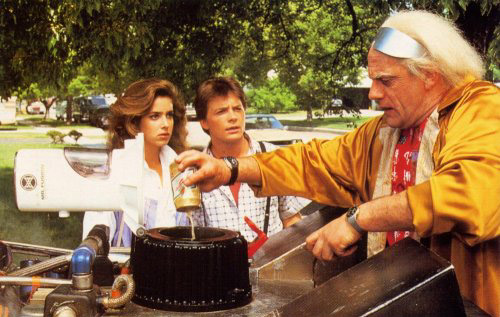
TheTalkingMule I came across this pic of someone in a lab coat combining what appears to be a water-based electrolyte with aluminum in a transportation fueling application. Could this be the air metal battery process we've been hearing about? That aparatus would easily fit in the "frunk hole".
 �
�
May 14, 2013
FreeOfPge How about mobile swaping trucks stationed at the superchergers? You get a supercharge with a swap at the same time and have mobile trucks for emegencies.�
May 14, 2013
deonb
Did Elon just solve my Supercharger announcement issue?
"Supercharger announcement pushed to next week. Something else this week."�
May 14, 2013
copyhacker It always made sense to me the original way around:
Announcement 4: "We're starting to build out the coast-to-coast Supercharger route. The first stations will be ~500 miles apart and we'll fill them in ASAP."
Announcement 5: "And until we do, how about a nice range-extending battery to go in your frunk that you can swap out at the next Supercharger? So long, range anxiety!"
BTW, I have a sneaky feeling that this is the real reason the Model X has gone dark--because the range problem will be sorted first. Speaking from experience, your biggest car is your long-range family hauler. An SUV/crossover/minivan that I can't drive to Disney is a non-starter.�
May 14, 2013
deonb
And if you do it that way around, expect:
Announcement 5 - question 1: If I have a range-extending battery that can be changed "faster than you can fill a gas tank", why would I ever want to visit a supercharger again?
Announcement 5 - question 2: As a shareholder - why are you wasting my money on building SuperChargers? You already have something that works "throughout the country".
Flip it the other way around though and announcement 5 can become: "Superchargers are really just there for us to recharge our own swapping batteries. So we're not going to be building many more of them. But feel free to stop off for a charge and a chat."
(I realize of course the glaring 60kw flaw in my argument).�
May 14, 2013
WarpedOne Isn't it obvious?
SuperChargers are easy to use, clean and use 'green energy'. You pay 2k and use them as along and whenever you wish.
You need to pay for each ange-extending battery module, time and time again, exactly the same as with gas. Only battery range extenders are more expensive.
You need to empty the frunk to replace used-up module and mount fresh one. Modules are heavy, you wife might not want to do it.
Isn't it obvious?
SuperChargers adds additional value to our cars. They are easy to use and use clean energy. They don't require any hard work, they don't take up space in the frunk.
Oh, and they are powered by the sun!�
May 14, 2013
gregincal Just to remind people, the motivation for the thread started with this piece of concrete evidence:
our capability to rapidly swap out the Model S battery pack and the development of specialized public facilities to perform such swapping, which do not currently exist but which we plan to introduce in the near future;
Some magic new metal-air frunk thing is not what they are referring to in this statement.
Edit: I also wanted to point out that this statement originated in last August's filing, when it was:
our capability to rapidly swap out the Model S battery pack and the development of specialized public facilities to perform such swapping, which do not currently exist;
Which in the March annual report became:
our capability to rapidly swap out the Model S battery pack and the development of specialized public facilities to perform such swapping, which do not currently exist but which we may introduce sometime in 2013;�
May 14, 2013
akula I don't think swapping of the battery will be it. I think an upgrade of the superchargers with a much faster charge time and our cars current ability to already handle it. Plus they will reveal more locations that are either up and just waiting to be unveiled or will be built out in the very near time-frame. I don't see battery swapping as an elegant enough solution from the engineering and infrastructure standpoint of view. Plus, the only real issue with the superchargers now is that there are simply not enough of them, not that they don't charge fast enough. I see them updating both of these points (although I see one as much more critical than the other)�
May 14, 2013
copyhacker No, that line of speculation comes from Elon's tweets about the Mystery Announcement (under your nose, recharging faster than a gas tank, throughout the country, etc). It's difficult to reconcile those with R&Ring a piece of the car the size of my dining-room table top. Even a NASCAR crew is going to have trouble doing that faster than I can fill up my Honda.
Which leads me to think that they have multiple solutions to the range issue in the works. Superchargers, aux battery... and replacement of the main battery? With, say, a higher-capacity one?
The latter is consistent with the filings and with Tesla's moves toward treating the battery as a commodity.�
May 14, 2013
jerry33 The metal-air frunk module could also be described as a Model S battery pack. Swapping the existing battery pack seems to be fraught with problems. One not mentioned previously is that the underside of the car is dirty and may be dinged. So even if Elon has a robotic system that requires no people, it's liable to have difficulty with quite a few cars. It also won't be world-wide in any reasonable amount of time.�
May 14, 2013
stopcrazypp Better Place was able to do it in under a minute, so I don't see why Tesla can't do it in 5 minutes (even manually). Even dirty or dinged, all you need is a flat tray to hold it while it comes down. It's not like the pack is in some kind of weird shape that makes it hard to support the pack if there are dents in it.
The engineering issues are not that tough, it's mainly the financial side.
As for the metal-air I'm kind of skeptical of it. The safety and specs of it are still in the experimental stage. They are not really commercially ready yet.�
May 14, 2013
gregincal Tesla always maintained the battery could be swapped "in minutes". And as far as the extent and the speed with which this will be rolled out, well we haven't had the announcement yet. Obviously this isn't a substitute for the superchargers, or they wouldn't be having a supercharger announcement. This could very well be positioned for more of a special purpose thing. I will leave this final tidbit of an Elon quote from 2 years ago (I haven't seen it quoted here):
�We�re designing the Model S to have switchable batteries,� said Musk, who has a solution to the problem of consumers not wanting to end up with an unknown pack in their expensive EV. �When people take an occasional two-way long distance trip, they�ll get a replacement pack and then pick up their original one on the way back. The issue of giving up your one-year-old pack for a three-old-one goes away.�
I suppose I find it interesting that they have always said they were going to support battery swapping, and yet people claim that Tesla doesn't know what they're talking about and it's impossible. I'm going with Elon knowing what he's talking about and it is possible, we just don't yet know how it's going to work.�
May 14, 2013
Lloyd Interesting article regarding Lithium Air technology:
http://spectrum.ieee.org/nanoclast/green-tech/advanced-cars/nanoscale-peak-at-lithiumair-batteries-promise-better-electric-vehicles�
May 14, 2013
aviators99 Could be shared with other EVs, but as ToddRLockwood notes, Tesla owns the technology.
Patent US20120041627 - Efficient Dual Source Battery Pack System for an Electric Vehicle - Google Patents�
May 15, 2013
YoungStranger May I be the first to suggest that a swappable metal air battery cartridge that can be inserted in the Frunk (and possibly be used by other marques in the future) be trademarked as the TESLA BRICK. That would be one in the eye for the naysayers:tongue:�
May 15, 2013
ElSupreme No one is saying it is impossible. Just costly, and at a marginal benefit above supercharging, at increased cost. I am not sure how the 'business case' works out. You spend hundreds of thousands of dollars on a battery swap station, that people will use Memorial Day, Labor Day, Thanksgiving, and Christmas weekends. And have them pay for this when they could wait another 45 minutes and get the same thing for free.
And doing the battery swap unmanned is probably doable. But you still need a person at the station while it is open, that cost alone seems like a barrier for these things to start popping up. Maybe on a highly traveled route that is between 300 and 400 miles. But it isn't going to get you long distances, because the stations wont get the traffic to pay for staffing, much less construction and operation.�
May 15, 2013
WarpedOne Elon said many times his main interest is in electrifying transport.
Developing swappable battery range extenders and offering them to other manufacturers suits this idea very nicely. It would mean orders of magnitude larger market for modules that could be much cheaper than if they are limited to ~100k Tesla vehicles in 5 years time. And of those 100k vehicles only about 10% using swapping from time to time. 10k drivers just can't pay for all the infrastructure and everything needed. Millions of EV users worldwide could.�
May 15, 2013
deonb You just made Sarah Palin's head explode...�
May 15, 2013
Johan Gotta love that. "Yeah man, so I just pulled in to the SuperSwapper to swap my Brick dude... it's all good".�
May 15, 2013
Trnsl8r Think he's playing on the Tony Stark inspiration theme: The Avengers (2012) - Quotes - IMDb�
May 15, 2013
gregincal Yes, but since Elon has said repeatedly in the past that they're planning on doing it I'm assuming this analysis is flawed in some way. I'm not sure how, but I'm waiting to find out. I used to feel that way about upcoming Apple announcements. I couldn't see how they could work, but when Steve presented them they suddenly made perfect sense. :wink: I've since learned to wait for the details before deciding whether an idea makes sense or not. All the talk about Metal-Air replaceable batteries just seems like so much pie in the sky nonsense to me.�
May 15, 2013
FreeOfPge Why does the idea of a mobile battery-swappingvehicle always go ignored??? It makes so much sense; 1) they would be mobile. 2)They would already have all the electricity needed to run them in the batterypack itself. 3) They can be assembled at the factory. 4) They could berecharged and stationed at the supercharger stations. 4) They could be updated/replacedeasily. 5) There would be no reason to buy expensive real estate in places bigcities. The list goes on and on.
Edit: What is the problem w/copy and paste from openoffice on tmc? Iespell will not download to my computer, perhaps it is mycomputer and not tmc?�
May 15, 2013
jerry33 Okay, tomorrow I will be traveling through TX, OK, and KS. I'll need to stop three times for charging. How much do you think it would cost to have a 4 GPM truck to deliver the battery to where I would want to swap it? What if there were other people traveling in different parts of OK and KS? How many mobile swapping trucks would you need? Kind of makes the swapping station look cheap, doesn't it? Not to mention having a fleet of trucks to recharge the Model S would pretty much nullify any carbon gains the Model S made.�
May 15, 2013
FreeOfPge
I am not saying the come to you for the swap unless there was an emergency. They would bestationed, or parked at the superchargers. They would simply be charging packswhile no vehicles are using the chargers. You could then swap the battery someother place in the parking lot. Also, about the carbon gains, I never saidand/or thought the vehicle would be powered by an ice, personally I would likefor them to be powered from a solar powered supercharger.
�
May 15, 2013
jerry33 Okay, I misunderstood what you said.�
May 16, 2013
Aphysician An interesting discussion here. Little different than the other thread. I though feel that they both complement each other. Here's what I posted on the other thread. I thought it wont be out of place here.
A add-on battery in the frunk seems to be the most logical idea. It has many advantages in addition to the one you already highlighted
- Tesla's approach to problem-solving is a very simplistic. They will not propose anything which makes the whole thing complex and then adds cost. The longer and complex the battery swapping is, the costlier it becomes. Just imagine lots of people waiting for battery swap, more people leads to more infrastructure and again hidden costs.
- People will have ownership of their battery. The whole idea of swapping with someone else's battery will not take hold. As mentioned in the post. The only way it can work is that used batteries will be swapped to the next vehicle, to keep inventories low and decrease costs related to storage. If your batteries are swapped then there is no point in owning battery and Tesla will need to refund current owners.
- If Tesla decides on main battery pack swap then leasing is the only way to go. It can make Model S even more affordable. Now how to please people who bought the battery pack, no leasing costs and no swapping costs. Charge others who lease the battery, lets say 2000 $/year for 60 kWh and 4000 $/year 85 kWh for a 6 year lease. This way you can have lower upfront costs and be flexible if life situation changes. Just agree to higher battery lease if you move and 60 kWh doesnt suit you. I still think swapping main battery is a cumbersome an unlikely idea, I like my odds with a frunk add-on.
- There is another post on forums,where owners have discussed how quickly the pack can be changed. It seems it is quite an extensive operation taking certainly more than 15 minutes, even if it is automated the time to mount the car needs to be factored in, as the cost of installing robotic machine. The add-on battery is just put in the frunk and you drive away. How easy would that be.
- They need to offer this solution to every Model S owner, irrespective of current battery size. Storing different capacity packs will again lead to increase in inventory. How about one size fits all add-on battery? No matter what your current capacity is, come and have the add-on installed and drive away. This will ensure that 85 kWh don't feel cheated by 60 kWh owners getting 85 kWh in swapping.
- They can have these add-on battery charged overnight, esp when electric rates are lower and they will be ready to go. These can be charged by solar too. Elon owns solar-city and deploying more solar panels to charge add-on batteries can only be good for that company. I think it is brilliant to use your current company to jumpstart your next big thing.
- Tesla needs to be sure, which battery tech is for future. There is lot of noise in battery tech and everyday you hear that some new battery tech will give these many miles. Point is, that battery tech is still very young and in rapid R&D phase. It would be foolish to bet big on any tech at this time and integrating that tech in large battery packs for swapping. Take the next tech, have it ready for smaller add-on packs and you can test the tech in the field. If something better comes along, then use that technology in add-on packs. This way Tesla can test many different techs at the same-time without actually integrating it in large battery packs.
- Tesla owners need freedom to roam anywhere. The battery needs to be such that it can be swapped at any service center. Somebody gave a good analogy with red-box. That's exactly the approach Tesla needs. Pick up a battery at one service station, keep it as long as you need it, return to any service center on your way. Your original battery is always on your car, no need to go back to the same service station to get your pack back.
- How should they charge? There has to be an uniform fee structure without any significant difference between 60 kWh and 85 kWh owners. Both should be equally eligible for such facility. The new gen add-on batteries will be expensive, so you only lease it for a minimum charge. Tesla can charge for the juice in the pack, free to them if they use solar to charge. Basically, the application needs to be widespread and still cheaper than buying a tank full off gas (lease cost + charge costs) for it to succeed.
- This can also earn extra revenues for the company, as supercharging is free. However offering add-on packs will reduce congestion on superchargers and will reward drivers who are willing to wait a bit, but still offer convenience to drivers who are in hurry. Ultimately everybody wins.
Hope you all like the reason. Feel free to comment. Waiting for all announcements to be over quickly. The suspense is toomuch to take.�
May 26, 2013
cwerdna For those who may have missed the news in the Better Place thread and elsewhere:
Better Place files for bankruptcy | The Times of Israel
Better Place to be liquidated - Globes
Israeli electric car venture Better Place seeks to dissolve - Business - Israel News | Haaretz Daily Newspaper
Death of Better Place: Electric car co. to dissolve | JPost | Israel News
Better Place CEO: A missed opportunity - Globes
An issue that hadn't really occurred to me, until it was written:
�
May 26, 2013
renim Firstly, battery swapping is complementary to Superchargers.
Secondly, Consider how useful are Superchargers or swap station for servicing/maintenance use?
Thirdly, how can Tesla vehicles be used as airport taxis?
Tesla's flat pack approach is the natural way to do battery swap, see old Japanese Better Place video http://www.youtube.com/watch?v=WGr9q3yHPiE , the box in the boot is not the natural way to do battery swap.
And there is zero additional costs for a Tesla to have battery swap, so if 95% of users don't want the option, its not a cost to them. If 5% of users represent business that want the option, it allows the use of a Tesla for a high mileage user that it would otherwise be ineligible for.�
May 26, 2013
cwerdna ^^^
I've seen other Better Place demos.
I haven't read this entire thread, but you're way off on "there is zero additional costs for a Tesla to have battery swap". Why do you think Better Place went bankrupt? It costs money to design and build the stations, staff and maintain them, pay other expenses (insurance, permits, licensing, taxes, utilities, etc.), keep batteries on hand and charge them.
As for your other claims that if 95% of users don't want it, well, that means a VERY high cost to Tesla and/or the users since the costs need to be spread out.
I think you need to go back and think about some fundamentals of business first.�
May 27, 2013
renim ^^^
Tesla model S has a swappable battery, it takes 10 minutes if done by manual labour, unscrewing bolts, thats all that is needed (and an activity suitable for concurrent action by a robot/jig). the battery pack is both structural and quickly removable. The electric coupling just slides in and out like a power socket and the fluids use a snap on coupling, no human interaction required. There is nil direct additional costs to make a Tesla Model S battery swap at the vehicle for the bill of materials.
Better Place had many challenges why it was premature to the market, primarily battery range, quick changeability and brand power/ desirability of vehicle. Tesla has those 3 sorted out first which greatly assists the viability of battery swap.
Tesla's rollout of Superchargers is funded by its marketing budget, If they roll out out supercharger at Service Centers they could very well be covered by the maintenance budget. After all a co-located automated battery swap facility would be very useful for Tesla Service Centers.
Tesla has a vision for Battery Swapping, but it uses 60-85kWh batterys and full country coverage of SuperChargers, with a car that won both motortrend car of the year and rated a 99/100 for Consumer Reports. Thats fundamental different than relying on outside manufacturer like Renault.
Cwerdna consider for a moment, what if the Fluence ZE had 3-4 times the range and a network of fast charging already deployed, Better Place could've operated with 1/12 the swap stations that they they were forced to deploy because of the relatively small Fluence battery. There are city bound business users who need more than 265 EPA range between charging, battery swap unshackles them, and as they are high mileage, the economics get pretty good. Its not a consumer product, its a business product.�
May 27, 2013
fizzazle Battery swapping may or may not be part of the future for BEV, but what I do not understand is how everyone keeps saying it will take X minutes to do a swap (I've heard people say anywhere from 3 mins to 10 mins).
Im sorry...but that is completely unreasonable! (NOT impossible....but just not reasonable or realistic). You are talking about lifting a car up, unscrewing the battery, bringing a new battery, bolting on new battery, AND THEN.....REBOOTING THE "COMPUTER". (Yes it's essentially a COW (computer on wheels))!!!!
the reboot with diagnostics to make sure everything is working properly takes about 30 minutes. And in a PERFECT world (state of the art battery swapping station with NASCAR pit crew trained personnel) I was told battery swap could be done in about 8 minutes. That's 38 mins total......in a perfect world with no room for any hiccups.
Enhancing and building out the Supercharging network IMHO much better/useful strategy. I'm sure a few years down the road we will be able to get a full charge in 30 mins...�
May 27, 2013
ohmslaw Reboot likely not necessary as long as external power is provided during the procedure.�
May 27, 2013
hans  �
�
May 27, 2013
FreeOfPge �
May 27, 2013
Johan What's your position at Tesla and which of the engineering departments do you work at? Are you deeply involved in the battery pack/module engineering and swapping aspect or are you primarily in the "COW" division? If so, you guys should look in to why a reboot would take a frikkin' half-hour!�
May 27, 2013
stopcrazypp Not sure how many times this has been posted already, but if Better Place can do it within a minute, I doubt the engineering team in Tesla can't get similar times:
And from what I have heard, a full reset with a fuse pull takes a couple of minutes, not 30 minutes. I'm not aware of another reset procedure that takes that long (if it does, there needs to be some engineering work to reduce that time).�
May 27, 2013
WarpedOne No, Better Place couldn't do it, so it filed for bankruptcy. Battery swapping is not a engineering problem at all. Yes it can be done even under one minute.
There just won't be enough people willing to pay the price of swapping.
People have this **** idea that somehow they won't have to pay for for the battery if it isn't theirs.
Who will pay for that battery stacks across the world, just waiting? Those batteries are getting old just as every other is.
I am willing to bet ~1k that in 10 year time there will be more than 10 times as many SC as there will be TM swapping stations.
Battery Swapping will be possible/offered at Tesla Motors Service centers. Nothing more.�
May 27, 2013
stopcrazypp Well, I'm talking purely about the engineering as there's plenty here that still feel like engineering is the biggest problem. There's already been a couple of other threads discussing the viability of various ways to do swapping.
I pointed out three different ones:
1) Monthly battery lease (like Renault/Better Place)
2) Rental battery contract (get your pack back at end of trip)
3) No-contract swap (keep whatever pack you get)
The math worked out to be that Tesla can pay for the packs (retail cost $34k) if they charged $40/cycle assuming there is no "second life" for the pack after it reaches 70% degradation. If you assume there is a second life, the cost of the pack is only $12k meaning only $14/cycle.
The packs also can be used for load leveling for superchargers during times of low swap demand. I used $.10/kWh (this gives $7k over the before-70% life of the pack) but the actual monetary amount might be higher because it reduces demand charges from the utility (which can be up to $16 per kW!).
http://www.teslamotorsclub.com/showthread.php/16730-Swapping-is-Coming-Discuss-how-it-will-be-accomplished/page12?p=342973&viewfull=1#post342973
The biggest thing that killed Better Place is a mismatch between actual customers and the invested infrastructure (much more infrastructure than customers). Fisker was killed by the same thing (planned/contracted for volumes of 15k/year, actual numbers 5x lower).
Tesla's going to have the customers first and then expand/plan the infrastructure accordingly (they are doing the same with the supercharger network).�
May 27, 2013
WarpedOne 1. What battery pack sizes did you consider? What about GenIII smaller packs? What about Gen4 packs?
2. What about costs to build a station and run it?�
May 27, 2013
TEG California rethinks battery-swap status in ZEV mandate
�
May 27, 2013
WarpedOne Prudent move.�
May 27, 2013
stopcrazypp I considered a 85kWh pack at $400/kWh (retail price Tesla is charging). Future packs will likely be less expensive (as $/kWh decreases). The lower $12k per 85kWh pack I got from Tesla's replacement pack policy.
In my original post, I was comparing two different schemes (rental vs no-contract). The sunk cost I assume to be $500k per station (same as Better Place) and that it would apply in both cases (independent of battery inventory). If you amortize it over 15 years (as typical for gas stations) you need $91 per day to pay for the station. That's assuming Tesla doesn't just use the advertising budget for it (like what they are doing with the superchargers).�
May 27, 2013
Duckjybe I dont see battery swap as a scaleable solution for millions of cars with a multitude of car models with different shapes and sizes of batteries. Elon is out to affect the move of all vehicles to electric. He and Tesla can't do that alone. If he wants to change the industry the long distance solution must be scaleable for the entire market. I don't think battery swap is the answer.�
May 27, 2013
WarpedOne That is because it isn't scalable nor sustainable. Heck, from the big perspective it is an awful and stupid idea.
If BetterPlace wasn't started by a guy like Agassi with his track record it would never got funding. And it still failed. Longtime economics just isn't there. One size doesn't fit all.
RangeExtenderModule swapping on the other hand does make a tone of sense. The tech just isn't there yet.�
May 27, 2013
dsm363 Battery swap would only seem to work if multiple manufacturers work together and all use the same battery pack. Don't see that happening in the US anytime soon.�
May 27, 2013
ChadS That's one way to make density high enough to make it work financially. But you can also have high density in a fleet based around a single location.
It can also work if what you swap in is different and more valuable than what you swap out. Imagine Gen3 being sold with a 200-mile pack, but a 1,000-mile pack rentable for road trips.
Making swapping economically feasible is very difficult, but I don't think impossible - and in fact I think gets easier as pack capacity grows. Technically it's easy enough to implement (not easy, but easy enough - clearly possible).�
May 27, 2013
stopcrazypp Infrastructure-wise Elon isn't trying to create solutions that the rest of the industry can use. Case in point: Tesla's proprietary connector and supercharger stations. I'm seeing Tesla's swap plans to be similar. All Elon needs to be concerned about is it working for a subset of Tesla vehicles (mainly to attract people to buy a Tesla).
Creating an industry-wide battery swap scheme is a whole other ball game and I believe no one is saying Tesla is trying to do that.�
May 27, 2013
aronth5 Analysts at Goldman Sachs hosted a field visit to Tesla Motors Inc (NASDAQ:TSLA)�s manufacturing facility in Fremont, California, that included a plant tour and a meeting with Elon Musk (CEO and Product Architect). The key takeaways of the tour and meeting are as follows:
http://www.valuewalk.com/2013/05/tesla-motors-inc-tsla-envisions-selling...
"They will continue to build charging infrastructure based on their customers� geographic profile. Tesla Motors Inc (NASDAQ:TSLA) is expected to make another announcement regarding the charging infrastructure next week. Longer term, Tesla Motors Inc (NASDAQ:TSLA) envisions a technology that would reduce the time spent at a charging station to be less than the time it takes to fill up a gas tank of a standard internal combustion vehicle."
It sure would have been nice to hear exactly what Elon said instead of a summary from Goldman but by referring to a charging station and not a battery swap station makes one wonder exactly what to make of this.�
May 27, 2013
andrewket I'm willing to guess that the computers can stay on during a battery swap. They are powered by a secondary 12v battery that is charged from the main pack.�
May 27, 2013
cwerdna Agree completely. I'm just still floored by people who simply don't get how expensive running a network of swapping stations is and that it REQUIRES scale (sufficient # of users at all times), esp. if it has to cover a large area.�
May 27, 2013
Duckjybe Not yet. But at some point he should share for the benefit of all and profit for Tesla. I am sure Tesla would like the industry to follow their connector and down the road other companies could easily adopt supercharger technology. Could they utilize battery swapping stations from Tesla? Maybe not so much.
Then it is a waste of time, effort and money. It's short term thinking. If it can't scale then it's not worth even starting it IMHO.�
May 27, 2013
stopcrazypp Actually they can if they decide to adopt the same battery footprint and mounting/connecting method. And for supercharging, I'm talking more about letting non-Tesla cars using it, which I expect to never happen. I see the same thing for any battery swap network Tesla builds. I'm not looking at this as Tesla trying to make a battery swap network that will be for all EVs.
I dispute that it can't scale. The math is that the max number of batteries needed to handle peak demand (for the lease and no contract swap) is the charging time divided by swap time. So for a 5 minute swap and 1 hour charging, only 12 packs per station are needed (adjust as necessary for different swap times and charging speeds). This is completely independent of the number of cars it serves (it can serve 1 million, even 1 billion cars). The rental scheme will add packs for rental (similar to rental cars).
The hard part of an industry wide solution is working with other automakers to come up with standard batteries (Better Place failed to get anyone other than Renault/Nissan on board). This is not a problem if it's Tesla only.�
May 28, 2013
fizzazle �
May 28, 2013
Johan Thanks for making my point for me�

Không có nhận xét nào:
Đăng nhận xét