Aug 21, 2013
yobigd20 utterly ridiculous, another hater.
With The Tesla Model S, Elon Musk Has Created A Nice Fossil Fuel Car - Forbes�
Aug 21, 2013
JGard I think you're being a bit defensive, but I also think the author of the article is being over-dramatic about it all.
First of all, he's absolutely correct. The Tesla cars still are fossil-fuel driven. However, what he neglects to mention are at least two items that are very important. First, the type of fuels used in major power plants is much more available than crude oil, which we use in ICE engines. So the fear of running out of those resources within the next 50 years isn't there. Second, major power plants are MUCH more efficient than an ICE. I'm sure these percentages are made-up, but I've heard that a car's ICE is something like 40% efficient. Meaning only 40% of the energy created is actually going towards moving the car. Power plants run at something over 90% efficiency, so most of the energy being created is actually going towards electricity. That's huge.
Also, it just shows (this article does) that we really need to stop being such wimps about nuclear energy and start making it more of a reality in this country.�
Aug 21, 2013
Jeff Miller It's closer to 20%:
Fuel Economy: Where the Energy Goes
There is a range but a typical efficiency for a coal plant is around 33%. Extremely efficient combined cycle gas plants can reach about 60%.
Line losses are around 7%. Electric motors are around 90% efficient. Back of the envelope, assuming a 40% efficiency for the US grid, 7% line losses, and a 10% loss from the motor, total efficiency for an electric motor is around 33%.�
Aug 21, 2013
Electric700 Some people have solar arrays/wind turbines and are able to rely on those completely to supply electricity for their EVs. Plus, in addition to fossil fuel sources and nuclear power, the energy grid has of a mix of large-scale solar arrays, wind turbine systems, and other types of green power such as hydroelectricity and these will hopefully continue expanding, making grid energy even cleaner each year.�
Aug 21, 2013
liuping Not All Telsa Cars are "fossil-fuel driven".
Solar panels provide enough for my Volt and soon Model S. I will be adding mode next year to cover the house+both cars, based on actual usage after I've have the Model S for a few months...�
Aug 21, 2013
PaceyWhitter To add to what JGard said,
One main point that these articles miss is the potential change in the future. As long as cars burn gasoline they will produce greenhouse gasses, you can make them more efficient, but you cannot get past this basic fact.
Once you shift cars over to electricity, there is the potential that cars will be able to run without producing any. While currently must electricity is produced by fossil fuel buning, electricity can be produced by solar, nuclear, wind, hydroelectric, geothermal and other methods. If and when there is a future push to clean up electrical production, electric cars will clean up right along with them. Gas cars will not.�
Aug 21, 2013
wycolo Being ~75 miles from a pair of major dams and significantly further to combustion power plants, especially if you go by 'grid miles', I've concluded that the majority of electrons I pack into my EVs is 'hydro'. Thus if my plates said HYDRO and HYDR0 it would not be a lie. Hey, I just might do that next year when they give us a fifth character on the custom plates.
--�
Aug 21, 2013
Johan Haters 'gon hate.
My S will be 100% hydropower fueled from day one, all year.�
Aug 21, 2013
30seconds Hack alert. The author clearly has an agenda that is unrelated to tesla. I think the "I love Fossil Fuels" T-shirt kind of gave it away. And, as usual, a very selective and unbalanced use of the data to support his point. While his claim that of the worlds TOTAL energy, renewables only make up a small percentage is true, he somehow fails to mention the growth rate of non-fossil fuel energy sources and also fails to mention that an electric car (as posted above) allows a shift to more efficient use of fossil fuels.
Completely unsurprising is his non-mention of how energy production in his area of Southern California are already WAY, WAY above his 1% quote. Orange County is covered by Southern California Edison, which claims that 20% of its production is via renewables
Cleaner Power | Environment | About Us | Home - SCE�
Aug 21, 2013
richkae Don't forget that refining oil into gasoline results in about a 12% energy loss.
Extracting oil from the ground is highly variable:
In California a pump jack that pulls it out of the ground may take around 18kWh or so of electricity to pump up a barrel of oil ( which works out to about a 3% loss ) but bitumen ( tar sands oil ) from Canada may have a loss of 16% ( when natural gas is consumed in the extraction ) or 30% ( when bitumen itself is consumed ).
All of that needs to be factored into the ICE number.
If its tar sands, multiply the engine efficiency by .88 ( for refining ) *.84 ( assume natural gas ) = .74 so the 20% efficient engine goes down to 15%
- - - Updated - - -
My Model S is powered entirely by solar power. Even though the US mix is about 68% fossil and dropping - I bet the average Model S in the US is powered by mostly renewable energy considering most of them are in California, Washington and Oregon.�
Aug 21, 2013
JGard
Cool, thanks for straightening that out for me. I knew the numbers I was told weren't going to be accurate �
�
Aug 21, 2013
theganjaguru I agree with the original poster. Tihs article is opinion shrouded with loose facts... AKA garbage. He clearly supports the coal industry.
First off he implys a that the battery will need replacing within the same span he would replace his iPhone, ignoring the warranty and the fact that roadster owners are still seeing 85% on well used packs.
He has to take into account world-wide energy production to attain his coal world energy figures. As though people in emerging markets will buy a light bulb, a refrigerator and then a Tesla.
Things he negates to mention:
1. A full belly won't mean very much if drinking water is contaminated from coal power run off.
2. Overall efficiency/conservation and not changing power sources is the best way to deal with energy demand/use. That is one benefit of being an emerging market, they sometimes leapfrog a head with new tech. Look at Mexico and wireless infrastructure if you want to understand more.
3. The energy and environmental costs of extracting, transporting and mining coal.
4. The whole building a Tesla battery produces more co2 than a gas car.. Well if I omit data points, I can make a Big Mac sound healthy.
5. The efficiency of an electric car.
The fact is that for the most part (yea, there are exceptions) a Tesla will be sold in a market where the power is sourced from natural gas (which is far cleaner burning than coal) or other non coal sources. The industrialized world is moving away from coal because there is no such thing as clean coal. It's only a matter of time before these emerging markets realize the same thing.�
Aug 21, 2013
brianman If you walk into a Tesla store and you open discussions with this, then you're clearly already at your conclusion and you're looking for an argument. You've lost all interest in evaluating the vehicle on its merits. As such, the conversation from there is a waste of the Tesla representative's time. Further, it comes across to me as rude and disrespectful.
At that point in the article I closed my browser window. Nothing else in the article will be worth my attention.�
Aug 21, 2013
evme If he wants to say that Tesla is a fossil fuel car because fossil fuels make up a majority of the grid is one thing, but calling it a coal car is not very accurate. It will only be a coal car in 3 or 4 states which have large amount of coal as part of the grid. In many states, coal makes up a tiny fraction of the grid.�
Aug 21, 2013
DuncanWatson The guy has an agenda and is basically completely wrong.�
Aug 21, 2013
techmaven I think some EV owners point to their grid tie solar panels and claim that they fully negate the impact of burning fossil fuels if you charge your EV at night from fossil fuel electricity generation. I don't believe that is true. In other words, if your solar panels can eliminate the need to burn fossil fuels to charge your EV, then you can claim that your EV is fossil fuel free. You may be negating your daily A/C load, or someone else's industrial use or TV watching or something else during the day with your grid-tie solar panels, but you are not negating the environmental impact of charging your EV if that electricity is coming from fossil fuels. I'm not saying that doing grid-tie solar isn't worth doing, just that it by itself doesn't negate the impact of charging an EV from coal or natural gas.
Even Tesla's supercharging stations are grid tie even with the solar canopy and local battery storage. Now, hopefully both the solar canopy and the local battery storage are then sized to almost always handle the charging load, but the importance of having the reliability of tying to the grid is not to be underestimated.
Now, it may very well be that in your local situation, charging an EV at night comes from non-fossil fuel sources like hydro, nuclear, wind, or geothermal. I think very few of us charge from some sort of storage solar energy like batteries, flywheels, molten salt or compressed air mainly because those strategies are still very expensive or otherwise impractical at the moment. In VA, most of my night time energy is nuclear. In WA, it's probably hydro. That's a compelling argument with far fewer downsides. There's a lot of extra capacity at super-off peak. It is also possible to participate in a program with many utilities where you pay a higher rate for your electricity to come from renewable sources.
This dynamic of what is really generated from what source and when versus actual consumption for what use is why examining the 24 hour or 365 day averages of electricity generation and then applying it to examine environmental impact of EVs is so misleading. It may very be EVs charge off of base load sources like hydro and nuclear at night and is supplemented with wind at super off peak hours when usage levels are extremely low. It is during the day that the fossil fuel generation plants have to ramp up for industrial/professional use and for that peak 3-5pm air conditioning time, the natural gas peaker plants are running full tilt to keep up with the load. Our EVs are usually sitting in a parking lot, sometimes sipping some juice obtained by hydro/nuclear to keep the batteries cool. That's the big reason for grid-tie solar, it's to help handle the peak afternoon usage and burn a bit less coal/natural gas. Plus, it's like buying electricity futures that help lock in your electricity rates.
Another dynamic worth mentioning is that oil has so many other uses than burning it for energy and certainly we are burning it at a pretty furious rate. The coming oil boom by fracking is only arriving because it has gotten so much harder to find and develop oil sources that the prices have reached a point that this is economically viable. That should be ringing warning bells, not a celebration of the coming U.S. oil age. Plus, this is likely to stretch our water resources to the limit. Mass scale desalination by solar may have to be one of the key industrial developments in the next 50 years.�
Aug 21, 2013
EV2BFREE Wearing a "I love fossil fuels" shirt and walking into a Tesla store sums up the author rather well. A "coal car" would mean that the energy for the car is solely from coal, which is clearly not the case. He wrote the article with his mind already made up and looked for facts to support his position. The first flaw was finding a 3 year old forum post that said the replacement battery would cost $30,000. First of all, if he was looking at the $70,000 model which has a smaller battery pack it would not cost $30,000 even if that cost was the actual price to replace the battery(which was the example he used). I can go look up a figure from 3 years ago that would say my laptop cost would me $3,000 but the only number that matters is the price of it today. A $30,000 estimate from a forum post 3 years ago would be deemed a lot less reliable then current numbers available. The author did not want to look for those current numbers because he felt that the $30,000 cost would justify his position. It seems like there is a blatant negative spin to this article.�
Aug 21, 2013
leilanimunter In addition to all the great points everyone has already made, EVs are the only car in the world that will get cleaner as the grid cleans itself up and moves to renewables. As we reach parity in the kWh price of solar or wind as compared to fossil fuels (as some other countries already have) you will see the grid get cleaner and as a result, EVs plugging into that grid will be cleaner as well.�
Aug 21, 2013
Johan BTW I'm going to make some toast in my coal powered toaster, heat some food in my natural gas powered microwave and watch a movie on my - you guessed it - TV that runs on oil. Not.�
Aug 22, 2013
mhpr262 That has got to be one of the dumbest articles I have ever read. "Hey, yeah, sure fossil fuels cause more climate related catastrophes worldwide, but what does it matter, we can always send diesel powered relief trucks!" At times it read like a satire ...�
Aug 22, 2013
djplong I notice that he quoted coal as producing 67% of the *world's* electricity. And that includes all those countries where Tesla does not yet sell.
Domestically, we have gone from just over 50% coal-generated electricity to about 40% in *just the last few years*. Notice he did NOT say THAT.
(Locally, we get most of our power from nukes and gas with coal backup)�
Aug 22, 2013
Alex Epstein I'm the author of the Forbes piece. I'm sorry that many on the Tesla forum did not like it, and I want to take the opportunity to elaborate on its argument.
The fundamental question being argued on both sides is, as I see it, whether the government should severely restrict fossil fuel use--and, as part of that policy, promote electric cars as an alternative.
In my view, because cheap, plentiful, reliable energy is so important to technological and human progress, and because fossil fuel technology is essential to providing that caliber of energy for a long time to come, governments should absolutely not be restricting fossil fuel use. (For those interested in seeing how this case stacks up in an open debate, see my recent Stanford debate with Sierra Club Senior Director Bruce Nilles.) Making this case requires addressing concerns about climate head-on, which I did.
"Perhaps the most neglected benefit of fossil fuel energy is in making us safer from the climate. Our cultural discussion on 'climate change' fixates on whether or not fossil fuels impact the climate. Of course they do�everything does�but the question that matters is whether it is becoming safer or more dangerous. Here, the data is unambiguous�in the last 80 years, as fossil fuels have increased the concentration of CO2 in the atmosphere from .03% to all of .04%, we have become 50 times less likely to die because of climate-related causes. Give thanks to the proliferation of climate-protection technology (climate control, sturdy homes, weather satellites, drought-relief convoys, modern agriculture), which are made possible by fossil fuels."
Most of the posts on this forum assume that climate change is a basis for government action, but none even attempted to address my case about the actual effects of CO2 emissions on climate safety. The underlying data here place an enormous burden of proof on anyone claiming future catastrophe. And that burden cannot be met as the catastrophic climate models are demonstrable failures at predicting climate. (As I will argue later, even if there was a big problem, advocating solar as the solution would not be logical.)
Other posts on the forum assume that the finite nature of fossil fuels implies some sort of necessary government support of electric cars. But basic economics tells us that the price of the finite commodities involved in every mode of transport will signal if and when a change is necessary. (Note: price is more important than "energy efficiency." Energy efficiency is just one form of resource efficiency, and often not the most important. If you're admirer of solar, note that an excellent solar panel is "20% efficient"--should that disqualify it?)
Given that electric cars are currently a tiny, luxury, resource-intensive niche of the transportation market, it is odd to assume that all the resources involved will smoothly and economically scale globally. We have no idea, just as we have no idea whether there will be a revolution in coal-to-liquids or gas-to-liquids will mean superior hydrocarbon fuels for hundreds of years to come. Or even whether synthesizing methanol from biomass and burning it using standard internal combustion engines will be more efficient than powering cars with energy-intensive batteries. If we're free to choose along the way, we don't have to know in advance.
Although I do not believe that CO2 emissions are a problem, even if it was the public approach of Elon Musk, Tesla, and much of Tesla's following would be counterproductive--because any constructive approach requires taking on the leading opponents of cheap, plentiful, reliable, non-carbon energy: the environmentalist movement.
I am an adamant supporter of nuclear power and hydroelectric power, as are some of you; the environmentalist movement is the leading opponent of both forms of power--the Sierra Club being a particularly egregious example. These organizations are the ones who made nuclear power uneconomic; without them, there is a strong case nuclear would have won out worldwide on the free market. (For more on this issue, see my pro-nuclear Facebook page, I Love Nuclear," as well as Petr Beckmann's classic "The Health Hazards of NOT Going Nuclear."
Elon Musk should use his public position to every anti-nuclear group. Instead, he endorses their empty promise that solar can power our civilization. That's why in my article I focused on solar--that's what Tesla assures us will replace the fossil fuels it opposes (but uses).
To be solution-oriented means to advocate the best options--and that could also include geo-engineering, also opposed by environmentalists--not just the politically correct ones.
To be solution-oriented in this context also means to look for *global* solutions that would actually work. In my article I cited the fact that globally solar and wind produce less than 1% of the world's electricity--and that must be backed up by a reliable source, usually fossil fuels. Several posts on this forum took me to task because their Teslas run on a higher percentage of solar and wind. No one addressed the point about requiring backup--usually "100% solar means a reliable source of energy is providing 100% backup (which doesn't scale). And more broadly, no one acknowledged that solar/wind is a luxury good. It's very expensive and it scales very, very poorly. If we're talking 80% global CO2 reductions, the fact that your particular Tesla uses X% solar is completely irrelevant because few can afford it and the "solution" wouldn't scale if more could.
If you believe that catastrophic global warming is the problem of our age, then the solution is to take a hard line against the environmentalist movement and look for global solutions on the scale of the problem. It is not to, forgive me, be self-righteous about your Tesla.
I bring up the self-righteous point because I very much admire the Tesla, and I think it deserves to be supported in a spirit of pure enthusiasm for technology and humanity--not defensiveness and partisanship.
When I write an article trying to convey that the Tesla S is testament to the unacknowledged virtues of fossil fuel energy, and the response I get in the Tesla forum is to be labeled a "hater," that is partisan.
It is also partisan to dismiss me because I support fossil fuels. A few people wrote me off for wearing an "I Love Fossil Fuels" shirt to a Tesla store, or period. Well, I do love fossil fuels and the fossil fuel industry and I came to that love honestly, for reasons that I hope are clear. (For more reasons, read my book.) I believe it was an incredibly appropriate shirt to wear to the Tesla store. Incidentally, it was not premeditated--I just happened to be wearing it at the Fashion Island mall, but I'm glad I did.
I hope that clarifies where I'm coming from. If you're interested in learning more about how to think about environmental issues from a consistently humanist, technological perspective, I hope you'll take a look at my book and my essay "The Industrial Manifesto."�
Aug 22, 2013
DuncanWatson This is the kind of ridiculous thinking that has become mainstream in the US. Utterly counter-logical and deliberately so. I weep that this is in Forbes since my namesake Great-Uncle used to be an editor there. This propoganda piece is so stupid it hurts. Coal is on the decline and for good reason.�
Aug 22, 2013
Dutchie No, he is not correct. That whole coal driven Tesla argument is just bullocks. If you say Tesla runs on fossil fuel you might just as well say an ICE runs on (very old) solar fuel. A Tesla runs on electricity PERIOD. How that electricity is generated is not to be accounted on Tesla but on society as a whole. We have to start somewhere in transforming our society away from fossil fuel, and Tesla is doing it's part in the whole process. We have to get rid of these dirty electricity plants as well but that is a different project and not to be accounted on Tesla
�
Aug 22, 2013
richkae Good points, but even if you want to look at the fuel that generates electricity the statement "the Tesla is a coal car" is false.
Coal provides less than 40% of US electricity so he is wrong.�
Aug 22, 2013
techmaven The articles on the Forbes website are often written by "contributors" which makes it only one step above Yahoo! Finance message boards and is on par with Seeking Alpha. This will eventually kill the Forbes brand, but right now, people look at the brand and assume that the articles are written by someone with at least some journalistic integrity. Sadly, I find that is often not the case.�
Aug 22, 2013
PwrOutage This is a tricky subject. I googled Gasoline vs Coal and found this 5 year old answer: http://answers.yahoo.com/question/index?qid=20080927100559AAq4lTM In conclusion he says that coal is actually more carbon efficient if you take into account all the processing and shipping of both.
Even if it's about carbon equal there are many other sources of electricity in the USA.
The store should of shown him the http://www.teslamotors.com/goelectric site where it answers the "How is Electricity Generated" even though it only shows the CO2 the cars emit.�
Aug 22, 2013
liuping "fully negate the impact of burning fossil fuels" and "eliminate the need to burn fossil fuels" are not the same thing. I can claim the first one easily, but obviously not the other.
Since I produce more from solar than I use to charge, no additional additional Fossil (or nuclear) fuel was needed for my charging. Therefore, I have "eliminated" the impact of charging, which is my main goal.�
Aug 22, 2013
techmaven That's what I'm saying is not true. Since the electricity from your panels are not used by your EV when charging at night, it does not offset. You are offsetting some other electricity use during the day. I'm not saying that the grid tie solar is not a good idea or that it doesn't help overall carbon footprint. It does. But for EVs which usually charge at night, you *have* to use something else - it must exist or your EV won't charge. Therefore, when going out and evangelizing the benefits of EV especially as part of public policy, I think we have to be clear about how the electricity is generated for EV charging.
In the northeast, we have a lot of baseband nuclear generation. In many places, hydro is the baseband load source. In some places, wind is also available intermittently at night. We may actually have a higher coal generation at night than natural gas. It would be useful for some think tank or the EIA to actually report night time electricity generation so we get a more accurate picture of what EV's use to charge. Right now, people use 24 hour and annual averages that are very misleading. The solar offset argument is too easily dismissed by the critics because they rightly point out that nighttime charging often isn't done with solar (yet). I think pointing to grid-tie solar actually weakens the pro-EV argument.�
Aug 22, 2013
liuping Since not a single ounce of additional coal, oil or natural gas was used to produce the extra electricity needed to charge my car, I am definitely "offsetting" my fossil fuel use. This is the same concept as carbon offsetting.
It does not matter if the exact electrons are used, just that no new ones (metaphorically) were generated from fossil fuels.
Also, this does not take into account the true elimination of the fossil fuel burned by my previous car (approximately 40 gallons a month)�
Aug 22, 2013
brianman The word "fungible" comes to mind.
(I'm not agreeing or disagreeing here.)�
Aug 22, 2013
SCW-Greg Yeah total coal consumption for the U.S. is 37%
What is U.S. electricity generation by energy source? - FAQ - U.S. Energy Information Administration (EIA)
Further state-by-state many don't use coal at all, many more only use a small percentage, while a few use coal heavily.
Click on the states within this map to find out about your own state's energy mix...
http://www.eia.gov/state/
Tesla used to have a function on their site that showed how much the Model S saves via the pipe. That's gone now.�
Aug 23, 2013
yobigd20 Now this is an interesting article. Makes the case that one day the power grid won't really be necessary. Haven't read it full yet. But I like how he explains the domino effect of how ad electricity prices rise more people are switching to solar which causes them to raise electric rates to stay in business and that only causes more ppl to switch to solar as its cheaper. Makes the point that solar has reached equal costs now to switch or will be cheaper everywhere within the next 2-3 years. This domino effect and dramatic rate increasing rate rate of conversion to solar year over year means in the next 10-20 years the power grid will become obsolete and unnecessary!!
Why the U.S. Power Grid's Days Are Numbered - Businessweek�
Aug 23, 2013
yobigd20 Btw I could do a better job explaining that but I'm driving now lol�
Aug 23, 2013
bhzmark The author's response: (note: this is not me! -- but my comments in [brackets])
from: http://industrialprogress.com/2013/08/22/the-tesla-debate/
I�m sorry that many on the Tesla forum did not like it, and I want to take the opportunity to elaborate on its argument.
The fundamental question being argued on both sides is, as I see it, whether the government should severely restrict fossil fuel use�and, as part of that policy, promote electric cars as an alternative.
In my view, because cheap, plentiful, reliable energy is so important to technological and human progress, and because fossil fuel technology is essential to providing that caliber of energy for a long time to come, governments should absolutely not be restricting fossil fuel use. (For those interested in seeing how this case stacks up in an open debate, see my recent Stanford debate with Sierra Club Senior Director Bruce Nilles.) Making this case requires addressing concerns about climate head-on, which I did.
�Perhaps the most neglected benefit of fossil fuel energy is in making us safer from the climate. Our cultural discussion on �climate change� fixates on whether or not fossil fuels impact the climate. Of course they do�everything does�but the question that matters is whether it is becoming safer or more dangerous. Here, the data is unambiguous�in the last 80 years, as fossil fuels have increased the concentration of CO2 in the atmosphere from .03% to all of .04%, we have become 50 times less likely to die because of climate-related causes. Give thanks to the proliferation of climate-protection technology (climate control, sturdy homes, weather satellites, drought-relief convoys, modern agriculture), which are made possible by fossil fuels.�
[so what? previously past tech developments were from the horse and buggy, or due to the telegraph, or due to simple wood burning -- we replace old tech with new tech when it is better. Pointing to past developments doesn't justify future use when there are better alternatives being developed. And does it follow from this historical fact that we should now discourage fossil fuel use or at least make the cost include externalities? does it follow that we shouldn't incentivize alternatives to fossil fuel? no. ]
Most of the posts on this forum assume that climate change is a basis for government action, but none even attempted to address my case about the actual effects of CO2 emissions on climate safety. The underlying data here place an enormous burden of proof on anyone claiming future catastrophe. And that burden cannot be met as the catastrophic climate models are demonstrable failures at predicting climate. (As I will argue later, even if there was a big problem, advocating solar as the solution would not be logical.)
[Climate change is a collective action problem. It usually takes government to solve collective action problems. Go to Somolia if you want to be free from all government regulation and enjoy their collective action problems. The author is looking like one of those simple minded Ayn Randians who never took econ beyond the simplistic perfect market micro econ models.]
Other posts on the forum assume that the finite nature of fossil fuels implies some sort of necessary government support of electric cars. But basic economics tells us that the price of the finite commodities involved in every mode of transport will signal if and when a change is necessary. (Note: price is more important than �energy efficiency.� Energy efficiency is just one form of resource efficiency, and often not the most important. If you�re admirer of solar, note that an excellent solar panel is �20% efficient��should that disqualify it?)
[again, the author shows an ignorance of basic econ on externalities.]
Given that electric cars are currently a tiny, luxury, resource-intensive niche of the transportation market, it is odd to assume that all the resources involved will smoothly and economically scale globally. We have no idea, just as we have no idea whether there will be a revolution in coal-to-liquids or gas-to-liquids will mean superior hydrocarbon fuels for hundreds of years to come. Or even whether synthesizing methanol from biomass and burning it using standard internal combustion engines will be more efficient than powering cars with energy-intensive batteries. If we�re free to choose along the way, we don�t have to know in advance.
[sure just choose at prices that reflect all externalities.]
Although I do not believe that CO2 emissions are a problem, even if it was the public approach of Elon Musk, Tesla, and much of Tesla�s following would be counterproductive�because any constructive approach requires taking on the leading opponents of cheap, plentiful, reliable, non-carbon energy: the environmentalist movement.
I am an adamant supporter of nuclear power and hydroelectric power, as are some of you; the environmentalist movement is the leading opponent of both forms of power�the Sierra Club being a particularly egregious example. These organizations are the ones who made nuclear power uneconomic; without them, there is a strong case nuclear would have won out worldwide on the free market. (For more on this issue, see my pro-nuclear Facebook page, I Love Nuclear,� as well as Petr Beckmann�s classic �The Health Hazards of NOT Going Nuclear.�
Elon Musk should use his public position to condemn every anti-nuclear group. Instead, he endorses their empty promise that solar can power our civilization. That�s why in my article I focused on solar�that�s what Tesla assures us will replace the fossil fuels it opposes (but uses).
[Musk should do what he is good at, which is already considerable. He made a superior product and can remain agnostic on how the electricity should be generated -- let the market figure out how to create the electricity and let tech developments improve that creation. But do price products appropriately so that externalities are accounted for.]
To be solution-oriented means to advocate the best options�and that could also include geo-engineering, also opposed by environmentalists�not just the politically correct ones.
To be solution-oriented in this context also means to look for global solutions that would actually work. In my article I cited the fact that globally solar and wind produce less than 1% of the world�s electricity�and that must be backed up by a reliable source, usually fossil fuels. Several posts on this forum took me to task because their Teslas run on a higher percentage of solar and wind. No one addressed the point about requiring backup�usually �100% solar means a reliable source of energy is providing 100% backup (which doesn�t scale). And more broadly, no one acknowledged that solar/wind is a luxury good. It�s very expensive and it scales very, very poorly. If we�re talking 80% global CO2 reductions, the fact that your particular Tesla uses X% solar is completely irrelevant because few can afford it and the �solution� wouldn�t scale if more could.
[elec car tech won't scale? we are at the beginning and people like this author are going to look so foolish in the years to come. This is like someone saying in 1993 that the internet won't scale. . . ]
If you believe that catastrophic global warming is the problem of our age, then the solution is to take a hard line against the environmentalist movement and look for global solutions on the scale of the problem. It is not to, forgive me, be self-righteous about your Tesla.
I bring up the self-righteous point because I very much admire the Tesla, and I think it deserves to be supported in a spirit of pure enthusiasm for technology and humanity�not defensiveness and partisanship.
When I write an article trying to convey that the Tesla S is testament to the unacknowledged virtues of fossil fuel energy, and the response I get in the Tesla forum is to be labeled a �hater,� that is partisan.
[Tesla can be completely agnostic on the source of the electric. Who cares. Tesla is about the car and how it works and how it compares to other cars. And on the externalities it imposes on others. -- e.g., Tesla avoids the externalities and inefficiencies of ICE cars: smog from the tailpipe, increased maintenance, traditional car dealerships, and other deadweight losses on society. ]
It is also partisan to dismiss me because I support fossil fuels. A few people wrote me off for wearing an �I Love Fossil Fuels� shirt to a Tesla store, or period. Well, I do love fossil fuels and the fossil fuel industry and I came to that love honestly, for reasons that I hope are clear. (For more reasons, read my book.) I believe it was an incredibly appropriate shirt to wear to the Tesla store. Incidentally, it was not premeditated�I just happened to be wearing it at the Fashion Island mall, but I�m glad I did.
[What does it mean to "support fossil fuels"? That seems like supporting telegrams, or gopher, or chariots -- sure helpful in their time, but technology moves forward.]
I hope that clarifies where I�m coming from. If you�re interested in learning more about how to think about environmental issues from a consistently humanist, technological perspective, I hope you�ll take a look at my book and my essay �The Industrial Manifesto.�
- See more at: The Tesla Debate | Center for Industrial Progress
[if the reasoning and factual support and analysis in the book is anything like the above, I think I will skip it.]
�
Aug 23, 2013
doug The author actually responded in this thread himself in this post above. The post was automatically caught in moderation by our software since he is a new member and included a lot of self promotional links. Anyhow, I just noticed it and released it.�
Aug 23, 2013
J1mbo Don't forget that your solar panels also have a carbon debt too (payback time is 3.5 years in CA assuming 1,700kWh per m[SUP]2[/SUP] per year - link ) - make sure you include that in your calculations
It's an interesting debate where there is no real answer and lots of emotion on all sides. For example, greener alternatives to the MS exist - according to nextgreencar, the Panamera 3.0 hybrid is a greener car than the MS! Trains.. bikes... living close to where you work and walking ... all greener.
All we can really say is that the MS improves local air quality where used. We can hope that the source of the electricity in the MS is being managed in a "green" way, but, realistically, we all know that on the whole it isn't. As for the non-recoverable carbon debt and other environmental impacts of manufacturing and eventual disposal of the car ...
IMO, the Forbes post is correct in that the MS is a luxury product, that most drivers will charge with power partially derived from fossil fuel. I accept that and still will be enjoying it for what it is, without wasting my life trying to justify it as something that it is not.�
Aug 23, 2013
TomLaney The author's response is really good. He demonstrates that he is the one who is pro technology, be it Tesla S or fossil fuels. As he said, Musk should be championing technologies that actually produce energy, namely fossil fuels and nuclear, instead of taking a partisan anti- fossil fuels position.�
Aug 23, 2013
brianman Nothing he said in the reply corrects the ridiculous title of the original article/post/whatever.�
Aug 23, 2013
Objective1 This is good debate to have, and kudos to Mr. Epstein for putting facts into the discussion. Folks on these forums embarrass themselves sometimes with their hating of the "haters."
Anyway, CO2 in the concentrations we see in the atmosphere isn't an unhealthy pollutant (doesn't cause lung disease, for instance). (Coal and petroleum exhaust particulates are another matter.) So the question is: is it otherwise a positive or negative externality?
The Model S was billed to be the best car. That's the most inspiring thing about it.�
Aug 23, 2013
wycolo > Here, the data is unambiguous�in the last 80 years, as fossil fuels have increased the concentration of CO2 in the atmosphere from .03% to all of .04%, [Alex Epstein]
"To all of .04%" oh, so tiny!! But not when impinged by a function arriving at an unfortunate angle. Or even worse, a curve. How 'unambiguous' is our equation now, Alex?? Here we see two false value judgements you include right in the beginning of your statement. Sorry, you better work on Cause & Effect and Sense of Proportion, then get back to us.
--�
Aug 23, 2013
TomLaney He addressed many of the objections and raised a number of issues that would need to be addressed: the inability of solar/wind to scale, the need for backup, and the huge expense of these sources.
He explained why the claim that a small number wind/solar users in a luxury market does not refute the fact that the Tesla S is made possible by fossil fuel energy and will be powered by fossil fuels at least for the foreseeable future. This is not a criticism of the Tesla S, it's a celebration of both the technological achievement that is Tesla S and the fossil fuels that make it all possible.
To be solution-oriented in this context also means to look for global solutions that would actually work. In my article I cited the fact that globally solar and wind produce less than 1% of the world�s electricity�and that must be backed up by a reliable source, usually fossil fuels. Several posts on this forum took me to task because their Teslas run on a higher percentage of solar and wind. No one addressed the point about requiring backup�usually �100% solar means a reliable source of energy is providing 100% backup (which doesn�t scale). And more broadly, no one acknowledged that solar/wind is a luxury good. It�s very expensive and it scales very, very poorly. If we�re talking 80% global CO2 reductions, the fact that your particular Tesla uses X% solar is completely irrelevant because few can afford it and the �solution� wouldn�t scale if more could. - See more at: The Tesla Debate | Center for Industrial Progress�
Aug 23, 2013
drees Good topic for discussion.
If one wishes to continue business-as-usual - not a bad argument.
Red herring. Just because fossil fuels have obviously allowed for great advances in society, that does not mean that continuing to burn them at an unrestricted (or even promoted) rate is a good idea.
You have that logic completely backwards and really, is the core of your viewpoints on fossil fuels. The correct view is that continuing to burn fossil fuels is continuing to increase the global average temperature with great risk to climate. It is the burden of those who continue to promote unrestricted fossil fuel use and CO2 emissions to prove that there will NOT be any future catastrophe.
Another red-herring. Harvesting solar using solar PV or solar thermal is actually one of the best ways to harvest energy. Everything else (including fossil fuels which are just another source of solar energy, just energy that has taken millions of years to concentrate) is by far, less efficient overall.
No, companies who continue to ignore risk and take short cuts in design of nuclear plants are the ones who have increased the cost of nuclear. Just look at Fukushima Daiichi and San Onofre (SONGS) for example. As far as large scale hydro (Sierra Club is not against other forms of hydro, such as run-of-river), large scale hydro has enormous negative effects on the surrounding environment including many important fisheries.
More red-herrings - just because wind and solar currently produce a small fraction of the world's total electricity, it is also very clear that wind and solar are the fastest growing sources of electricity.
See above. Wind/solar are the cheapest form of electricity in many markets and continue to get cheaper while fossil fuels only get more expensive.
It's clear that you are a talented debater. It's too bad that once you get down to the core of your argument, the facts are completely wrong.�
Aug 23, 2013
liuping I know there is carbon debt to the panels and the car itself, but there is also carbon debt for producing fossil fuels and non ev cars. Besides the extraction, production and transportation costs, there are other subtle costs like the amount of CO2 produced by all the cars in the US just driving to the gas station to get more gas.
My solar panels will be carbon "debt free" in a few years, as you point out, but fossil fuel cars only go deeper in debt each and every day.
Also, the cost of fossil fuels is not just about CO2. I'm also concerned about the long term damage we might be doing by using fracking. I'm pretty sure in 100 years people are going to look back in disbelief that we pumped massive quantities of toxic chemicals into the ground just to get cheaper natural gas and oil. I hope I'm wrong...�
Aug 23, 2013
Julian Cox
General Rebuttal to Alex Epstein:
Alex.
You are smart and articulate. You are clearly smarter than David Nilles of the Sierra Club. It is both selfish on your part an a loss to society to have you arguing for self evident wrong.
Nobody, not David Nilles nor Musk is arguing for an energy deficient future. Your arguments focus on the evident benefits of cheap abundant energy, that point is not only accepted but promoted by all but the likes of Dr Ozzie Zehner (author of Green Illusions) and the author of an IEEE article Unclean at Any Speed - IEEE Spectrum .
Nilles made an interesting point and sadly failed to stick it to you, not because he was wrong, but because the more sophisticated party was on the wrong side of the debate. The example given was the banning of lead in paint. Naturally the result of that was not an end to painting, it was the innovation of increasingly excellent paint without lead. The likes of Nilles are useful not because they have all the answers or even a rounded viewpoint. When the Sierra Club succeeds in forcing a rethink about technologies with undesirable trade-offs, the market and technology will invariably innovate to maintain supply to meet demand and in the best case scenario that will lead to a general improvement of economics, living standards and the elimination of an unpleasant compromise only.
You and Zehner commit the same error, blaming a clean technology for speculative assumption of additional reliance on a dirty technology. You both commit the "temporal anomaly" error of projecting future EV populations onto the current grid mix. You cannot do that in all honesty. You must project the grid mix forwards to the same point on the time line to make an honest impact assessment of EVs on the grid. The current impact of EVs on the grid is negligible, and the current grid mix is predominantly fossil fuel driven. The future impact of EVs on the grid may well be considerable, but that will be impacting on a grid that is more than likely predominantly clean. One of the likely reasons for a boom in economic productivity surrounding the Solar and Wind industries is that it will be driven by the advent of compelling EVs and the combined political and economic demand of EV owners to be supplied with clean power and to silence the likes of you. No doubt the real reason why you have targeted Tesla with your Forbes piece. Panasonic et al are far more likely to install a local solar array if they have not done so already in order to crush embedded energy criticism than to cease battery production. There is no environmental debate about Tesla. This is the answer the world has been waiting for: An end to compromise between the interests of the personal and the natural environment. There is only the vain hope of pro-pollution extremists to create the illusion of one.
Tesla for example is already fully offset by private PV installations (estimates run to 85% of all Tesla Model S owners), and even more significantly by sister company Solar City, a company that installs more MWh and at a faster rate than the entire lifecycle energy consumption past present and future of the entire Tesla fleet. There is no reason to think that this trend is not scalable when it is scaling exponentially right now. There is no argument that fossil fuels made the seed investment with regards to energy for all of this, but there is also no justification to promote fossil fuels as the end of the line of advancement. There are obvious economic advantages and nothing to prevent a solar cell manufacturer building out an array to power its own operations. It is entirely specious to suggest such operations can only derive energy from fossil fuels to compound their own scaling.
Even if you were to reduce the concept of the environment from natural/planetary, to societal, right down to personal how could one possibly criticize a machine that you can refuel for somewhere between $0.00 and $9 of electricity and drive 265 miles on the equivalent of 2.5 gallons of gas with a combination of performance and safety to out class anything on the road at any price. You talk of fossil fuels generating a high standard of living and life expectancy. That was then baby, this is now.
To suggest Tesla is Coal Powered is simply and completely wrong when set correctly in its proper context. We are soon approaching an inflection of cost per KWh in favor of solar vs mining and burning. It is therefore absolutely disingenuous to promote fossil fuels as a source of cheap and abundant energy, when it is heading to becoming a source of relatively expensive and abundant energy before becoming a source of expensive energy in diminishing supply. Already investors in Solar (Such as Total Oil) have far greater rewards from investment in Solar (SPWR) than they are able to obtain from investing in either drilling or hydraulic fracturing. In other words, fossil fuels have passed their sell by date. Not only are they socially and environmentally unwanted in the context of alternatives, there is simply a load of BS separating fossil fuels from becoming economically unwanted also. Conversely new investment in fossil fuel infrastructure is at total risk of obsolescence before break even. Nobody is suggesting that it is possible to build an ICE vehicle to take market share from Tesla. The purchase of a new Merc S Class right now is at huge risk with respect to residual value because it simply does not have a modern drive train. The same is true of drilling and fracking beyond the cost per KWh inflection in favor of solar.
Zehner is clearly an idiot, you unfortunately are not, you actually smear Tesla with Coal reliance and then go on to claim coal is beneficial. That is positively sociopathic.
I watched one of your lectures to members of the coal industry teaching them how to lie in retaliation to legitimate concerns about their industry. You offer two clever but fundamentally dishonest approaches:
1. A play on words with the use of the term Environment and a stack of cards built on top of it laden with emotional cues. This is a foul abuse of the power of an educated mind over those less fortunately endowed in that capacity. The Environment of concern with respect to CO2 is the natural environment, the one that supports life on Earth of any quality or level of prosperity. Not to be confused by diversions pertaining to the personal environment modified by clothing, HCVAC systems and so on. Cheap abundant energy of any source will supply the latter, fossil fuel consumption most decidedly puts a question mark over the former.
2. The disingenuous deployment of a time machine to make a case. You take an hypothetical example of a man from 300 years ago and show him the personal environment made available by advances in technology fueled by hydrocarbons. Your audience is of course impressed. You fail to take the same man 300 years into the future. On the current exponential trajectory of atmospheric CO2 concentration (the path that you shamefully promote), you would need to impress him with the advances in personal breathing equipment irrespective of any changes in the natural environment beyond that. Most likely if you landed in Manhattan 300 years into the future, your tour of modern amenity would commence with several hundred mile swim to dry land. Joking aside I would find it much more credible that 300 years into the future on the current trajectory, human populations will have been devastated, more than likely as a result of resource wars for living space that is safe from the sea, agricultural land that remains productive and fresh air that is breathable without assistance. On the current trajectory fresh mountain air (as measured at Mouna Loa) will have reached well in excess of 2000ppm, plus another 600ppm indoors without a scrubber designed to tackle it. 1000ppm is unpleasant indoors. No escape from 1000ppm concentration is on the cards in a time span of less that 100 years unless we change course of the energy economy drastically and urgently.
The status-quo of an outdated energy economy based upon fossil fuels is not an outcome to promote under any circumstances and your contribution to indifference and inaction when it comes to dealing with it is most unwelcome, sir. Truthfully there is nothing status-quo about fossil fuels. They are a relatively recent occurrence in the history of mankind, and they are a change agent with respect to the status-quo of what appears to be a key control lever of the planetary life support system. There is no proof that this is not the case, and the burden of proof regards the safety of changing the atmosphere must rest with those who wish to profit from changing it.
I will highlight a third dishonestly based upon another play on words. Climate. The climate of concern is the overall energy content of the natural environment. Not to be twisted into the concept of the weather or the temperature inside a car or a home. The thermal energy content of the natural environment has steadily increased across the industrial age and the sensible thing to expect is an increase in entropy (chaos in layman's terms). It is entirely true that the specific weather in a specific time is unpredictable at the best of times. It is an increase in unpredictability that is the entire problem, for agriculture in particular. When farmers increasingly lose the ability to predict what food crop is likely to survive in any given location and face ever increasing risks of any crop being parched or washed away, the abundance of diesel fuel makes only a marginal difference to the ability to sustain a healthy population.
Your oft used phrase "climate models that cannot predict climate" is self-defeating on both counts mentioned above. Thirdly, the dishonesty of stating that temperatures have not risen is to fail the test of your other much flaunted phrase "taking into consideration the whole context". Air temperatures are not the whole context, far from it when the oceans are a comparatively enormous heat sink. The majority of the energy accrued to the climate has been absorbed by the oceans and in in melting the world's ice. That energy is very much present, not absent as a cause for concern.
To round off the time machine debate. In fact just to dispose of the time machine and run a single normal linear time line of consecutive events against a simple and agreeable goal. Zehner aside (who would prefer for us all to use bicycles and birth control) most folk would agree that the ideal goal is to live as well as possible now and not have to fear the future. Fossil fuels can assist with one but not both of those objectives (and only if you are a long way away from a high density of exhaust fumes). To achieve both objectives of that goal, we need cheap abundant and clean energy. We also need desirable, efficient and fun devices (Tesla Model S is a prime example). You attempt yet another diversion by declaring that cheap abundant energy provides localized technology to fend off the worst of climate-related deaths. I assume you are referring to the ability to build dams, early warning systems and emergency rescue services by land sea and air. This is a ridiculous paradigm to promote, equally ridiculous as taxing or otherwise taking profits from the sale of cigarettes to pay for lung cancer treatment centers and claiming therefore that cigarettes are a boon to societal health.
The simultaneous advancement of mankind's private environment and natural environment in the direction of betterment, without accepting the compromise of a future disaster in the making some time between now and when fresh air is no longer breathable, has to be a common goal for all intelligent and capable men and women. It is absolutely sickening to see a capable man such as yourself working against that outcome. There does however lie a great deal of hope that you and those like you who ardently defend the indefensible are but clever fools. In other worlds, action to silence you may well in fact accelerate the pace of positive change that could never have been achieved by environmentalists alone.
Finally its is disingenuous to suggest that climate change concern rests on computer models of climate change. Climate change concern rests upon the historic correlation between atmospheric CO2 and climate and the fact that industrial era CO2 is off the charts with unknown survival consequences for the whole of humanity. It is not a counter argument to suggest that access to fossil fuels is a safeguard against a natural planetary-scale reaction to our presence as an irritant. The total solar energy hitting the earth and accumulated in the sea puts our total fossil fuel energy output to shame. We literally do not have the combined power in every machine at our disposal to stop any natural event even on a regional scale, let alone on a global scale. I have many times looked out in awe over a snow covered landscape that the next day or two is thawed to green grass. That's hundreds of gigawatts of power right there witnessed in a simple an normal event that we are literally powerless to prevent.
If the same environmental determinacy observed in the ice records indicates a return to natural CO2 levels over our dead bodies, it will happen irrespective of the full power of mankind to do a damn thing about it. We have but one sensible choice when it comes to nature: Cooperate or else.
It is not for "environmentalists" to promote the risks of out of control CO2 levels. It is for the fossil fuel industry to prove beyond any and all reasonable doubt that doubling background CO2 levels in a flash of geological time is a good idea. Until that is proven beyond all doubt, ideally somewhere other than our home planet, then with all gratitude to the giant leaps corresponding to fossil fuels, prudence dictates that we stop taking planetary-scale survival risks given the increasing availability alternatives.
Postulating that digging stuff out of the ground and burning it in the air we all breath is the pinnacle of human progress is a gross insult to the human condition. A very useful stepping stone it has been. If one were to design human progress from 300 years back to 300 years in the future, there may well have been a place for fossil fuels somewhere along the time line, but to argue that this is a desirable destination is nonsensical.
Right now the atmosphere is accumulating CO2 annually at a rate of 63% of everything we pump into it from industry and transport. We can wring our hands and tear our clothes about it, or we can take it as an opportunity. The rate of increase is within our grasp to fix (it is 63% of amounts under our direct control, not 163%), and every man, women and especially young person and child that is concerned about this represents a marketplace of seven+ billion customers for the biggest economic boom in the history of mankind. That is an opportunity available to businesses in the immediate. The company you have targeted with your criticism is case in point with greater than 400% gains in market cap in a single year to date. Exxon Mobil: 6% gains + 2.5% dividend in the same time span. Where do you see the economic benefits for mankind again?
I should also like to overturn the mantra regarding delivering the benefits of electricity to the 1.4bn without it. This does not necessarily demand coal and grid and given the political instability in many of these regions nuclear is pretty much out of the question. It is even questionable whether a hydro dam could be protected for more than a few years at a time. Imposing the cost of an electricity grid over vast regions of Africa (for example) is completely unproductive when modern solar with battery back-up can deliver electricity directly from abundant sunshine. The same principle of skipping the grid has applied successfully to the delivery of wireless telecommunications in a similar setting. In the same way it would seem to be practical for emerging economies to go direct to solar and EVs.
In your manifesto you concur with Ayn Rand's observation that a poorly-formulated environmental policy disingenuously lumps together the human and non human environment. Then you go on to do exactly that by countering concerns for the natural environment with arguments for the human environment. Beyond this hypocrisy it would appear to be gross arrogance overlook the fact that the Randian distinction breaks down at a juncture when we simply do not have the power to defend ourselves from impingement from the natural environment. Natural forces out-gun the sum total of of human power output from all sources including fossil fuels by a gargantuan margin. We cannot stop a single tsunami let alone a general seal level rise. In a game of cat and mouse with nature, we are not the cat despite all appearances to the contrary. We can carve out a habitat within reasonable bounds. Misguided "save the planet" environmental nonsense aside we cannot save ourselves from an overwhelmingly hostile planet and risking that outcome when instead we can get richer and happier not risking it is foolishness. I would argue that your promotion of such foolishness is on-balance a destructive force.
The undulations in CO2 levels on the 800,000 year ice-core data are not just what should be happening, until proven otherwise, it is what does happen on this planet. We can either create a boom of economic activity in the business of cooperating with the natural determinacy of CO2 levels or most likely CO2 levels will be corrected to the median of around 240ppm whether we approve of the process of getting there or not. Alternatively we can spend the remaining few years or generations of this species fighting the tide both literally and figuratively, until natural forces, including our natural propensity to combat each other for scarce resources flattens human populations to as close to nil as nature requires.�
Aug 23, 2013
evme Why can't solar/wind scale exactly? The need for backup works for all energy sources if you want redundancy.
The car will be powered depending on what energy source you use. Many countries and states have committed a deadline to be 100% renewable energy. So while using fossil fuels is one option, there are many options to chose from.
Solutions need to be made on a case by case basis. There will never be a solutions that work on a global. But the best way to start is local solutions. Because we are not hooked up to a global grid, we are hooked up to a local grid.
To be honest there is no way of really knowing unless the solar/wind is accounted for. If your using solar locally, that won't show up on any statistic. Of course the same can be said of running a diesel generator and the like. You can though easily back it by hydro, tidal power and thermal. Pretty reliable. Then there is nuclear.
With current rebates and leasing options. solar and wind are by no means a luxury good and pays itself off. Solar is actually quite cheap now, what is keeping costs up is installation.
Well first of all, just by using an EV, regardless of what the power source is, your reducing overall CO2. But change take time and is a transition phase. The grid is getting cleaner every year here in the US and other countries as well. As we adopt the technology, price goes down and the technology becomes more affordable in other places. Improvements doesn't start with others, it starts with ourselves.�
Aug 24, 2013
SCW-Greg No did the author get the energy (coal) mix numbers right, as stated from the gov. Particularly when you look at the state by state evolution away from (or completely away from) fossil fuel.
Or, people please remember, the Roadster, or the Model S, or the Model X, aren't supposed to be *the* solution here. But that we're working our way to something that is closer to it... the Gen III. $35k, unsubsidized. When that happens, and the infrastructure is in place, then meaningful change will occur.
To not understand that about Tesla, or to make statements that diss the Model S (as just another long tail pipe, as others have said, without considering true externalities of all fuel production) -- certainly as some authoritative work -- is disingenuous, or naive.
Further, as Elon as stated many times, (paraphrasing) to keep pumping out CO2 as we are, is a huge gamble. That our Eco system might be able to handle it, or maybe not, but that we only have one. Shouldn't we try to do what we can (to not fry it)?
Their are scientists on both sides of the isle (not necessarily 50/50 split mind you), about whether the earth is warming or cooling now, or that man has had any impact on it -- but from a purely logical point of view -- if the problem is as potentially as big/catastrophic as it might be, shouldn't we take strides to mitigate it?
Isn't this (Tesla) one of those better steps, in that right direction???
Certainly better than the status quo.
And if for no other reason, I'm tired of the status quo. 100 years of the same technology, and we haven't evolved to something better? Common we're an innovative country, we can do better. Tesla is.�
Aug 24, 2013
CalDreamin Indeed, it's not 50:50. About 97-98% of scientists studying this issue -- the world's experts -- say AGW is real. Most of the other 2-3% are undecided.
Nearly every scientific society/association of national or international significance on the planet has issued a written position statement saying AGW is real, something that is unprecedented in human history. There are no major scientific societies/associations that reject AGW. None. The global scientific community has said, repeatedly, that AGW is a major threat. Their level of confidence has been increasing year after year, though one would never know that from the nonsense the mainstream news media spews out.
I've spent more than 20 years working for oil companies, as a chemical engineer. Engineering is an applied science. I learn about science from scientists. I do not learn about science from the news media or politicians, nearly all of whom do a horrible job understanding and reporting about science. Worse, most have done a criminally incompetent job on the issue of AGW even though the scientific community has done an absolutely unprecedented and massive job trying to educate us. Apparently some refuse to be educated. There is no option for me to not "believe" AGW. Beliefs are the realm of religion, not science. If anybody should have sufficient cognitive dissonance on this issue leading to a rejection of AGW it should be people like me, having worked a career for oil companies. But I can no more reject AGW than I can reject gravity. I don't get to reject science. I don't like the implications of AGW, but I don't have an option to reject it.
My current employer is one of the world's largest oil companies. My "big oil" employer is absolutely convinced that AGW is real, and has publicly called for MORE government regulations of GHG emissions to mitigate the threat. They know that humanity can either address this threat with long-term, well thought out solutions, or we can wait until the s** has really hit the fan and be forced take drastic and MUCH more costly measures. My employer understands that governments must urgently create the price signals through regulations to move us in the direction we need to go. Governments have already delayed action past the point of being able to implement the least costly, gradual solutions. As each year of inadequate action goes by, both the inevitable damage and the solutions are becoming more costly.
I'm well aware that fossil fuels have led to great advances for humanity. But it's time to transition off of fossil fuels.
The author of the Forbes article is a fine writer but is grossly ignorant about the core issues.
Tesla is not going to 'save the planet', a strawman that is frequently used to attack any rational approach that's a step in the right direction. But Tesla is a key driver in hastening the transition of transport to a lower GHG footprint through electrification, and transport is one of the major contributors to GHG emissions. I would hazard to guess that Tesla will drag the rest of the auto industry along toward electrification perhaps 5-10 years faster than they would otherwise have moved. Transitioning our electricity generation to lower GHG emissions also needs to occur, and is happening. But even with today's grid, electrification of the U.S. transport fleet leads to lower GHG emissions. And with each year the grid gets cleaner, EV transport gets cleaner with it.�
Aug 24, 2013
Mike200
Given the level of computer-model swindling involved in a lot of the research of "climate scientists" the catastrophic claims are without any merit and the fact that the global scientific community thinks we are facing climate apocalypse only confirms that having strong or high expectations about the consensus on this issue is unwarranted . It's simply overly politicized: strong funding incentives to push public messages beyond what the science can support. The very most we should be doing is imposing a small carbon tax that can be ramped up quickly should things look more desperate later on.�
Aug 24, 2013
Doug_G Personally, I don't find computer models at all compelling - I've worked on computer models (unrelated field) before and they have their weaknesses. They are at best useful for helping understand the possible impacts.
That said, it's a straw man argument. The scientific consensus isn't based on computer modeling.�
Aug 24, 2013
EarlyAdopter There's an important point I haven't seen raised yet in this debate: base load generation.
Coal generation plants can't simply be spun up during the day and shut down at night. It takes several days for a coal plant to reach critical temperature and they must be run continuously, 24/7, to maintain that temperature. Coal plants are sized for daytime load. At night they continue to run but the majority of their generation goes nowhere, as night time demand is significantly lower than daytime and large scale electrical storage is expensive.
The majority of EVs charge at night. This means that even on a 100% coal fuel mix the additive load of EVs at night results in, that's right, 0, zip, nada additional coal consumption. We're already burning that coal at night for no reason other than to keep the coal plants at critical temp. I've seen varying calculations, but a large percentage of cars in the US could switch to EVs overnight, and, so long as they charge mainly at night, would result in no additional coal consumption, no additional CO2 emissions.�
Aug 24, 2013
Krugerrand Because money solves everything?�
Aug 24, 2013
Mike200 the scientific consensus goes well beyond the scientific evidence available, the laundry lists of organizations with impressive names notwithstanding and the problematic climate models used are not divorced from that consensus as you are trying to claim.
�
Aug 25, 2013
Raffy.Roma Of course the grid is (unluckily) powered mainly from fossil fuels. But it's up to us to make cleaner grids powered by renewable energies.�
Aug 25, 2013
Julian Cox
Personally I think the computer models are an earnest attempt to illustrate an obvious point, and while the obvious point remains the computer models are seized upon as though it does not.
There is really not much excuse for a debate about this. We have an energy economy with an unintended consequence of loading up the atmosphere with more CO2 than is getting absorbed. The data is directly measurable and unambiguous. With the burden of proof where it belongs, there is no proof that changing the composition of the atmosphere this drastically outside of natural norms is a good idea. Meanwhile the consequences of it turning out to be a really bad idea are inescapable because we only have one atmosphere. Not a prudent risk profile. We can see a historic correlation between CO2 and temperature, and when the ice caps start melting into the sea in our own lifetimes (in a big way which they are) this justifiably gives pause for thought.
The obvious counter argument to doing anything about it is simply to say that we like the wealth and modern amenity that comes from fossil fuels more than we perceive a real and present danger of biblical-scale problems with agriculture, weather-events and tides. This is all very well but it misses the point of what we really want: Ideally we want the wealth and modern amenity that we associate with oil and NOT have to worry about a biblical scale wipe-out of our species.
Introducing the ideas represented by Tesla and Solar City.
The remaining concerns come down to folk that have gotten comfortable making money from fossil fuels who are too fat, lazy and lacking in imagination to make their next fortune in non-polluting energy technologies.�
Aug 25, 2013
Mike200 Barring a technological breakthrough in the very near future, electric cars are fossil-fueled. Worse yet is that the use of electricity to power automobiles is a far less efficient means of powering them than internal combustion is. Fossil fuels must be burned to both generate electricity and then to transmit that electricity over vast distances where that energy is just "lost" to the ether via resistance. If you look at BTU comparisons, you'll find that it takes more to propel an electric car one mile than it does a car powered by internal combustion.
- - - Updated - - -
Until John Galt comes along and builds a motor that can efficiently grab static electricity from the air, AC will never be as efficient as internal combustion. Until that day, I will never own one because they are less economical (both in terms of sticker price as well as operation) than internal combustion-powered vehicles. Yes, I realize that the electric cars actually run on DC power, but the DC is supplied from AC stations and transmission lines.�
Aug 25, 2013
ggr Fossil fuels don't produce energy! They store up solar energy for millions of years. That is why they are exhaustible and have a second-order effect (pollution) when the energy is reclaimed in other forms. (To be sure, on the large scale, nuclear and solar energy are the same; the difference being that we're not in immediate danger of depleting them, and despite what some people say, we can manage the waste products better.)�
Aug 25, 2013
JRP3 That is not true. Coal plant's do in fact ramp down overnight, they don't shut off or go below a certain level, but they do indeed reduce their output. Generated electricity always goes somewhere. So in a coal area an EV charging at night means the coal plant will simply not be ramped down quite as much, therefore more coal is being burned.
- - - Updated - - -
It's rather a good thing that conventional nuclear did not win out worldwide, if it had there would have been a much higher number of Fukushima and Chernobyl type events, not to mention even larger amounts of nuclear waste that we don't know what to do with. However there is good evidence that Liquid Fluoride Thorium Reactors, LFTR's, might be a better more viable alternative.�
Aug 25, 2013
Raffy.Roma Excuse me. But internal combustion engines haven't to respect the second principle of thermodynamics? I never calculated the dispersion loss that the grid experiences to carry AC energy from the source to the users but considering that internal combustion engines have an efficiency of about 20% while electric engines have an efficiency of 80% I think that electric engines are far more convenient.�
Aug 25, 2013
richkae Your information source for this is completely wrong. Regardless of where you start the cycle comparison EVs use less energy to drive the same miles, the total conversion losses in the EV chain are far less than the ICE one.�
Aug 25, 2013
JRP3 Let's run some quick, basic numbers. Combined cycle NG plant 60% efficient, 7% transmission losses, EV has 10% charging losses, 10% operating losses, = 45% efficient. Petroleum extraction + refining 80% efficient, ICE 20% efficient, = 16% efficient. I assume you will now be buying an electric vehicle....�
Aug 25, 2013
richkae Nuclear done right would be much better for mankind than coal. The reactors can be designed to consume the fuel far more effectively and leave less waste. They can also be built to operate safely. I am confident there were engineers who built and operated Fukishima and Chernobyl that raised safety issues about the design but were ignored by the bean counters. LFTR may be better and may provide less opportunity for catastrophic failure, but whenever humans are involved we have the possibility of some bean counter shaving the safety margins and causing a huge disaster.
Coal has been killing millions quietly while nuclear has harmed fewer in much more dramatic fashion.�
Aug 25, 2013
jerry33 Quite right with the exception that Fukushima's problem was that it was a 35 year facility that was operated longer than the engineers designed it to be operated (mostly because the anti-nuclear crowd didn't allow new ones to be built). The big problem here was "old" and not "nuclear". Also what harmed folks at Fukushima was not the reactor but the government's handling of the problem. The Fukushima reactors were hit by an earthquake 5X the size they were designed for. Even so they shut down properly. Then the tsunami hit wiping out the emergency generators. Battery backup still worked for the eight hours it was designed to work for but they couldn't get power to replenish the batteries in time. No one has yet been harmed by radiation from Fukushima. (Two workers died during the non-nuclear tsunami, and a third died from a heart attack.) In other words, this was a worst case scenario and there were only minimal problems. The coal industry kills tens of thousands of people a year, but it's subtle so it doesn't make headlines. Fracking will kill even more with its earthquakes and ground water pollution.�
Aug 25, 2013
doug I understand the rationale behind what you believe here, but it's a flawed rationale based on partial understanding and comes to an incorrect conclusion. You have to do the math (with a basic understanding of thermodynamics) to actually make the comparison. Not just what you feel should be true.
Which comparison are you looking at?
Here's one from Argonne National Labs: http://www.transportation.anl.gov/pdfs/TA/273.pdf�
Aug 25, 2013
Mike200 Quantitative and computer-based methods and models can help - or hinder - the transformation of data into knowledge. Whether they help or hinder depends on how well their designers and users know the strengths and weaknesses not only of computers, but of their own minds. The climate modelers, show what happens when the perils of confirmation bias, and of other defects of intuition, are ignored by those whose job it is to build knowledge from data. They are mired in methodological errors that replicate the errors of historical parapsychologists.
There is plenty of reasons to have this debate least of which is the level of speculation, catastrophism (on the alarmists side of things) and confirmation bias (on both sides) involved in this issue which you seem quit eager to make an excuse for.
On the ideas represented by Tesla and the Solar City, I guess I am not impressed. Solar lacks a serious efficient industrial-scale mechanism to store solar power for later and your Tesla car owes its presence to fossil fuels (the plastics, the fabrics, the metal and the mining and transportation of it all). Given the recent using of fracking and horizontal drilling the ideas presented here are by people who don't seem very much concerned about pollution from fossil fuels but instead like to dabble on the edges.�
Aug 25, 2013
NuclearPowered The multiple regulatory agencies, at least in the US, do a good job at preventing the plants from 'shaving safety margins.". Generally, the industry as a whole understands it is under a microscope and behaves accordingly. It is impossible to have a Chernobyl type accident in a US facility.�
Aug 25, 2013
Julian Cox
Mike, sorry that is simple not true. The Tesla Model S is not coal powered now and there is no reason to suspect that the trend of Model S + Solar will not continue to saturation.
The uptake of solar alongside the Model S is anecdotally 85% (private PV installation) and corporately alongside Solar City is very much net carbon negative. The rate of PV install in this group is faster than the rate of Model S energy consumption in for both manufacture and operation. Tesla and Solar City have yet to announce the redeployment of ex vehicle batteries in grid storage. Economically this is inevitable, and with that comes a compete and utter trashing of embedded energy argumentation as well as objections to the indeterminacy of solar and the cost of battery upgrade and replacement for the Model S.
There is absolutely no valid argument in either your point or in the points made by Alex Epstein. Note that Epstein evades the issue of global ice-melt. He is a very clever salesman but we do not need what he is selling nor is there any need for a center for industrial regression.�
Aug 25, 2013
JRP3 I agree, and I think that nuclear done right means LFTR's, and is probably the way we would have gone if not for the demands of nuclear bomb creation. Now we have an entrenched nuclear industry that has little knowledge of LFTR technology, yet we have access to low cost and inherently much safer Thorium.�
Aug 25, 2013
Johan ... Or integral fast reactors, which technically, economically and scientifically is bascially a no-brainer. But politically a very hot potatoe due to the fact that part of the integrated concept is a breeder/enrichment facility. And no politician cares about the fact that if you integrate these different stages of the process tightly enough there is no possible way that anyone would be able to ever remove any of the enriched uranium, plutonium etc.
But we're straying here and I once again state what I have already stated in this thread: My Model S will be hydropowered from day one, all year long. That is just a fact that cannot be disputed. Energy in Norway - Wikipedia, the free encyclopedia�
Aug 25, 2013
kevin99 I am utterly appalled by the author. The way he assumed morally and intellectually superiority over the Tesla store rep. Who is the one being ignorant?
"Elon Musk, you�ve created a great coal car. Don�t stop others from creating a great coal life."
If this is his point of the whole article, I can care less what else he is trying to convey. Pointless.
The only author I follow on Forbe is Mark Rogowsky. His latest article is worth reading:
Numbers Don't Lie: Tesla Is Beginning To Put The Hurt On The Competition - Forbes�
Aug 25, 2013
dsm363 Not true but ok. Are you including the energy to explore, drill, transport, refine the oil into gas and then transport that gasoline to the gas station as well in your analysis? A power plant is much more efficient than the ICE in a car.�
Aug 25, 2013
drees Yes, exactly. And unfortunately what that also means is that coal is the cheapest source of energy in the middle of the night, meaning charging your car in the middle of the night ends up increasing coal usage. Counter-intuitively, charging during peak hours when coal plants are already maxed out means turning up gas turbines which means that charging your EV during the day can be cleaner than charging at night. One really has to look at their local grid to determine this which is not usually easy to do. In other locations it might be the complete opposite where renewable plants (hydro/wind typically) are being restricted because of too little demand. In this case any additional demand truly is emissions free.
So say Fukushima was hit but a tsumami 5 years after it was built... The real problem isn't that it was old - the real problem is that it was never engineered to be completely fool proof. Just because you design a plant to withstand a 1-500 year event does not mean that a 1-1000 year event may hit the plant and then you are SOL.�
Aug 25, 2013
jerry33 Your basic argument is that we shouldn't drive cars now because forty years ago cars weren't designed as safe as they are today. Forty years ago (more like 45 now) plate tectonics had only recently been accepted in the scientific community, and the fault lines weren't mapped nearly as well as they are today. I think the engineers did a heck of a job with the information they had at hand at the time. Could they have done better? Sure, but compared to Chernobyl where they didn't design even minimum safety, they did a state-of-the-art job for the time.�
Aug 25, 2013
brianman Tom, nothing in your post refutes my assertion that nothing in Alex's reply corrects the ridiculous title of his original piece.
Read his title above again.
I live in Washington state. Here is some .gov data for this state:
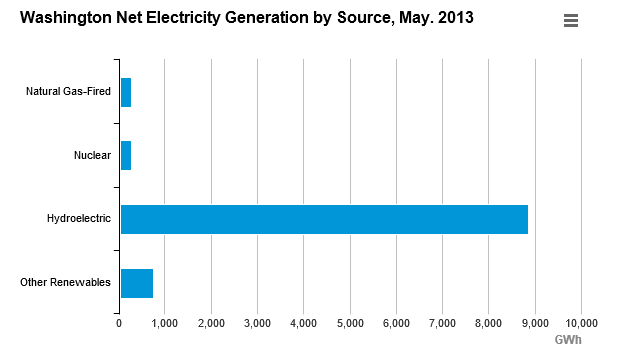
I have solar panels on my roof. Some of my power also comes from that.
Should I then say that my Model S runs on solar fusion and water? No. That's ridiculous. So is Alex's title.
The car runs on electricity. If you want a cleaner profile (by whatever metric you want), then change the grid. The car isn't the problem (if there is one), the grid is.
EVs are the only vehicles that give complete control to address these concerns to the grid and, further, they automatically participate in any improvements made in that grid.
So basically the only conclusion I can come to is that, going by the title of his piece, the rest of what he has to say is -- at best -- suspect given how he opens the discussion. Just like how he opens the discussion with the Tesla representative. Frankly, if I was in that representatives shoes I'd be moving on to any other person on the planet after that opening line. Anything else is just a waste of his/her time.
I can't make it any clearer than that.
"And another thing"...
This has nothing to do with how I feel about this particular societal and global debate. It has to do with journalistic integrity and quality. Without integrity and quality, no useful discussion can be had on any topic.�
Aug 26, 2013
wycolo > Nuclear done right would be much better for mankind than coal. [richkae]
Using nuclear power to boil water is way primitive. There is so much more energy in there (the LFTR references).
Harnessing falling rain to generate electric power is about all you can do with it, unfortunately, from an energy perspective. Then use it for irrigation.
--�
Sep 3, 2013
neroden Solved in the lab. Just waiting to commercialize it.
- - - Updated - - -
On nuclear:
Tell it to the state of Vermont regarding Vermont Yankee (same defective GE Mark I design as Fukushima). It is actually true that the state regulatory agencies did a good job, but the federal one didn't and it overrode them.
At least the state finally won. A few days ago. Through economic pressure, not through regulation.
http://www.cnn.com/2013/08/27/us/vermont-nuclear-reactor-shutdown/
I have nothing against nuclear "done right", but in the US commercial environment, it is generally *not* done right. I get very offended when nuclear shills pretend that it is.
Technically true since the US doesn't have graphite reactors, but it's really really easy to have a Fukushima type mega-disaster in many US facilities: Fukushima was a GE Mark I, which are a horrendously bad design with no fail-safe features. There are 23 of them operating in the US, and they're all time bombs.
https://org2.democracyinaction.org/o/5502/p/dia/action/public/?action_KEY=6111
They are well past their original planned lifetimes, and GE Mark I is certainly one of the worst nuclear reactor designs ever -- the control rods have to be shoved up! (Chernobyl and Windscale were arguably the only worse designs). The fact that the Nuclear Regulatory Commission has not ordered the GE Mark Is shut down, and instead keeps extending their licenses, shows that the US Nuclear Regulatory Commission is currently not to be trusted and that's why I will not support any nuclear facilities in the US at this time -- we need a competent regulator first.�
Sep 3, 2013
JRP3 How's that going, any progress?
LFTR's, immune from even incompetent regulation :wink:�
Sep 11, 2013
huntjo Articles like this are interesting to me. It is good to hear all the different perspectives and compare the data and variables that each side is using. What astounds me is that someone can say with a straight face that it is more efficient to haul oil out of the ground, transport it to a refinery, transport it to gas stations, then put it in a tiny engine and not expect that the losses will be way higher than loss of electricity across a wire from a utility station (with any of several more efficient sources of power: coal, solar, geo, hydro). It is just plain willful ignorance to think ICE cars consumption of energy is anything close to a battery powered electric. Regardless, these rants are always good to hear, because i get to hear the counter arguments which I consider educational.�
Sep 12, 2013
Mario Kadastik Oh they had safety systems in Chernobyl, even three of them. However on the night of the incident one of them was undergoing repair and the other one failed. The third if I remember right caused the plant to start to die down, but the operators being afraid of their new rods going to waste and getting shouted at by their bosses slammed the rods in causing the process to restart .. and go out of control. Oh and they were conducting experiments at the time, Chernobyl you have to understand was a military source of nuclear weapon material first and a power plant secondly. So it was repairs, failure and operator idiocy combined that caused the disaster.
I, being a nuclear physicist, consider nuclear power to be the only high scale energy source that is reasonable and cheap. Solar and wind are good energy sources only in certain locations and I agree that California fits the bill for solar usage as it does get a lot of the solar radiation year-round to be used. However during the night it has to be utilized from other sources and I would prefer that the nuclear plants were the main backbone with solar and wind providing extra power during their working hours hopefully in correlation with actual higher usage during daytime.�
Sep 12, 2013
neroden Are you seriously talking about Fukushima? That's a GE Mark I. No, it was NOT a state-of-the-art job for the time. Simple example: The control rods have to be forcibly shoved up in order to shut down the nuclear reaction. The experimental reactors used during World War II had safer designs than the GE Mark I -- for one thing, the control rods *dropped* to shut down the nuclear reaction. The GE Mark I is a slipshod design which should never have been permitted in the first place.
- - - Updated - - -
Gah. I'm not even sure what the current delay is.
Apparently, in the meantime, my friends are publishing the mechanism for stabilizing the electrical grid so that arbitrary amounts of renewables can be added to it without trouble (yes, that seems to be solved too). That should be published first.
I'm in favor of anything which is immune to "regulatory capture" failure.�
Sep 12, 2013
kilpatds Um, I'm guessing here, but my guess is "No, he's not talking about Japan. Rather, Russia."�
Sep 15, 2013
JMO The only thing it clarifies is how stupid and ignorant your "thinking" is. It is just a bunch of bs.
bS�
Sep 15, 2013
bonnie Unnecessary - fine to disagree, but keep it civil.�
Sep 15, 2013
JMO LOL..... LMAO..... very well said
- - - Updated - - -
Believe me.... I did�
Sep 15, 2013
bonnie Oh stop. You're an adult. You didn't keep it civil.�

Không có nhận xét nào:
Đăng nhận xét