Jan 16, 2016
cciesingh I am a PG&E Customer in CA and have recently had solar installed and activated by PG&E
I have also switched to the EV Rate whic is cheaper charging at night but higher charges in the day.
I have no idea what is the best rate to use for me, but I usually tend to charge my vehicle at night every 2-3 days. There is also an E6 rate.
Any suggestions what would be my best options?
Is Solar sufficient for charging the vehicle in the day? If so should I should switch back to the E1 rate??�
Jan 16, 2016
CHG-ON If you can limit your charging to only 11PM-7AM weekdays, the EV rate is by far the best plan. Especially since you can now run, or supplement, your house with solar during the day. I only drive about 800-1000 miles per month. But my electric bill actually dropped 100/mth after moving to the EV rate, compared to before I bought the car. I now run my hot tub and other energy users at night, during the EV rate. I would do solar in a second. But I live in the mountains and while I get lots of light, I don't get enough direct sun all year to make it pan out.
The thing to keep in mind is that, depending on the season, the peak rate can be 4X more than the night rate. That adds up fast if you charge during the day. Whether your solar array can power your car would depend on what it's output is when collecting those valuable rays.�
Jan 16, 2016
Electricfan I'm in Texas. I have free electricity after 9PM, and its 16.5 c/kwh after 6am.
I obviously charge at night, and do my washing/drying at night or before 6am.
I'm thinking of getting an on-demand water heater.
My solar panels produce about 5 kw during the sunniest part of the day, and this covers all my house needs. It exports power most of the day.
I feel like you can't go wrong with a plan that lets you charge your car at night, but I don't know what they're charging you during the day, so can't say for sure.
All this gets more complex when Powerwalls become available. Not sure what I'll do then. But I know I want one!�
Jan 16, 2016
tanner Just charge after 10pm during "super off-peak" - the time may vary for you. However, I have Souther Edison Electric and they sent me out a little fridge magnet after I switched over to the EV Rate plan (see attached image).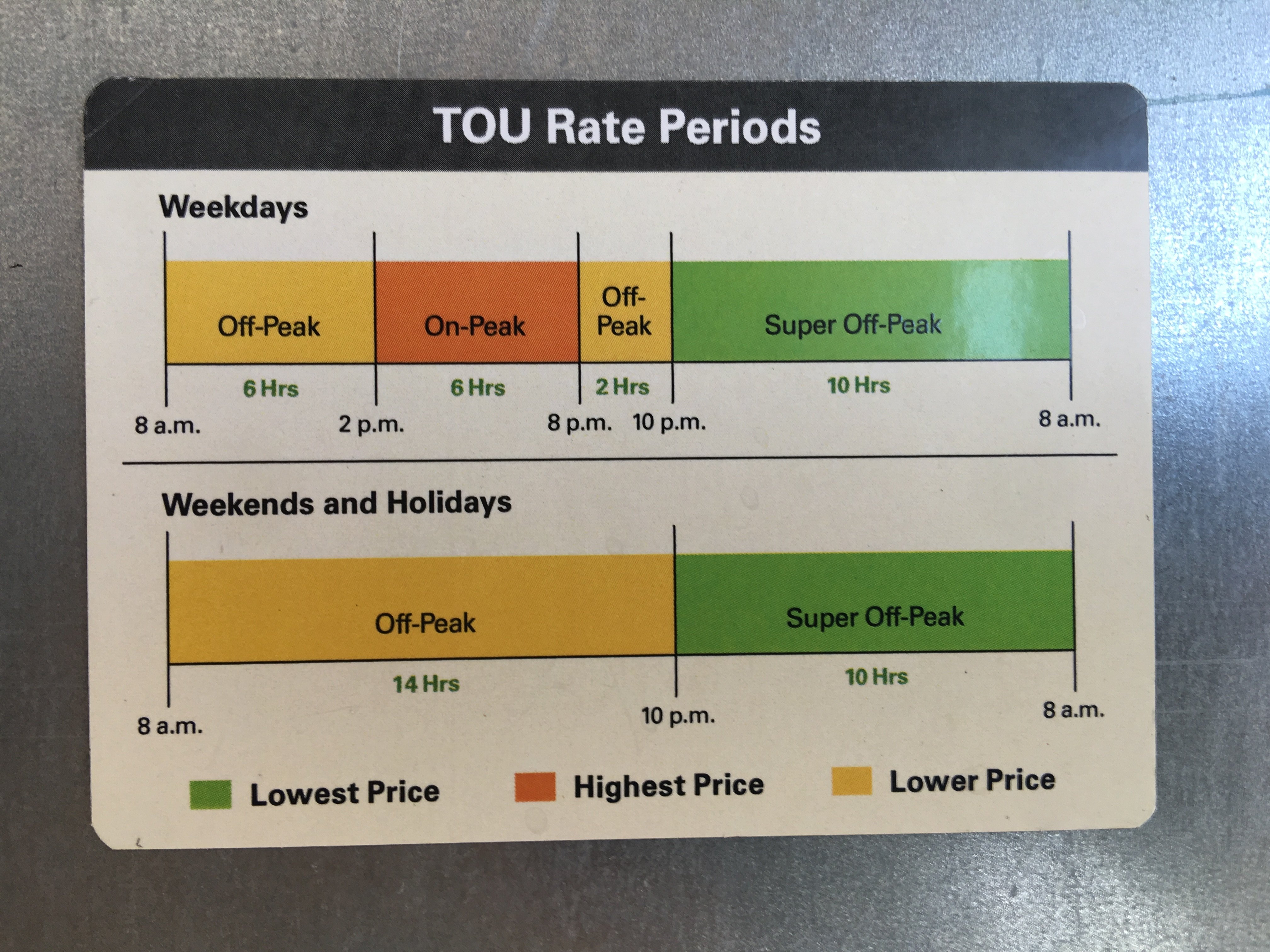
As for whether solar is sufficient for charging during the day (note you can still charge during off-peak and not have to pay much), we'd need more information on the type of system they installed.
Updated: after some ninja searches, I found the corresponding chart for PG&E: Electric Vehicles - Making Sense of the Rates | PG&E - just note that off-peak has been replaced with "partial-peak" and super off-peak with just "off-peak".�
Jan 16, 2016
SanCarlos Note that the OP has solar and so this may not be correct for someone that has both EV charging and solar generation. There have been a number of threads here (I believe) and on other forums and I think the general consensus has been that if you don't install a separate meter for the EV rate (and the cost of doing that eats up a lot of savings), then the E6 rate which is optimized for solar works best. The E6 rate has high rates at peak times, but those rates are also what PG&E pays for excess solar energy generated. I think that this generally offsets the slightly higher off-peak charges for times when you are charging an EV.
All of that said, these calculations are really complicated and depend on how much energy you use and when you use it and the size and orientation of your solar system. Two suggestions for the OP: First, go to the company that installed your solar and see if they can help. They usually have sophisticated calculators for this sort of thing. I am surprised that they didn't have you switch to the E6 rate in the first place, but there may have been something about your usage that makes the E1 rate better. This is also an urgent question for the next few weeks because PG&E is changing its rate structure and only E6 customers will be eligible for grandfathering in to a new solar rate that is upcoming. (My solar company emailed me to make sure that I was on the E6 rate for this reason.) Second, google PG&E solar rate and EVs and you will find other discussions of this topic. In some cases, posters have developed spreadsheets that you can download. Make sure you read only recent threads since things have changed since last summer. Good luck!�
Jan 16, 2016
tanner If they're doing other things during the day, their solar system won't be enough to power it all and they'll start pulling from the grid.�
Jan 16, 2016
SanCarlos That is true. However, most solar systems are sized so that they produce excess power during the day.�
Jan 16, 2016
tanner yes, but hardly any utilize a battery system to store said excess energy - hence Tesla's reason for developing the PowerWall.�
Jan 16, 2016
cciesingh I will go into the specifics.
I have 16 panel solar, changed to EV rate as it seemed a good idea, did not research it.
i drive 800 - 1000 miles a month.
i can charge at night or day but currently charge after 11pm due to EV rate.
Given my situation would it make sense to stick to EV rate or go to E6 or E1?
i have also heard that the E6 rate will be removed in March�
Jan 16, 2016
SanCarlos That won't be enough information if you want someone to to do the work for you. :wink: How many kW is your solar system? Different solar panels put out different wattage. How many kW do you use driving a month? Some people use a lot more than others for the same miles. What percentage of your electricity usage does your solar system produce? I'm not expecting answers. Just pointing out that no one will be able to answer the questions. The E6 rate goes away for new customers in March. Existing E6 customers will be grandfathered in until 2021. So it is good that you are looking into this because you have to make a decision quickly. Here is a blog post that details this. You can also call the PG&E solar hotline at 877-743-4112 and they may be able to help.�
Jan 16, 2016
tanner +1.�
Jan 16, 2016
mechapreneur When I was investigating Solar, I heard many different stories about the way PG&E buys back the daytime power. The solar sales rep claims that they pay market rate during the day (roughly $0.36/KWh) and then you buy it back for cheap at night, which multiplies the KWh you generate during the day by a factor of 2-3. However, that seems to be the old net-metering method.
I also heard that you simply get KWh credits during the day to offset your KWh usage at night. Any extra credits you have at the end of the year can be rolled to the next year or "trued up" for $0.03/KWh, which is well below the cost of solar. Therefore, you do not want to over provision your solar system.
I never got a really straight answer from anyone as to which of these scenarios is true. And I did not buy the solar system so I have no actual experience with net-metering. But we did get the Model S and we did switch to the EV rate and our power cost has gone down substantially despite the massive increase in usage. I also moved our pool pumps to run 11pm-7am to take advantage of the low EV rates.�
Jan 16, 2016
FlatSix911 Here is the PG&E Solar rate calculator posted by a member on another thread that is very useful. Thanks to Miimura
�
Jan 17, 2016
Shaggy For comparison: Austin and solar
The way Austin Energy does it: I buy every kW I use at various rates (Residential Electric Rates Line Items). They then buy every kW I produce at an annually set rate. 9 months ina dn I've yet to pay a penny. They offer time of use rates, but I have a big enough system that neither TOU or a battery system make financial sense. Current rules carry any negative balance forever and likewise never a check payout (a gift to the city). AE has the right to buy my production and claim green credits for 20 years (in exchange for their rebate). If I sell the house, the buyers have to agree to the same thing I did, but lose any credit I've built up.
Currently my 20 SunPower e20 panels are slowly building up a surplus. It was sized based on my last year of bills when I had my PHEV.
All this but our PHEV credit specifically excludes Tesla...�
Jan 17, 2016
aesculus Figuring out what your solar net at PG&E is not easy. The simplest way to explain it is that it works in reverse of your usage. Usage is on Tiers (4 of them). The more you use the more it costs you. Net energy metering follows the same Tiers. The more you produce each month the better rate you get (but it's in credits and not cash). So you work against your credits that offset any use you may consume. The Tiers are calculated month to month. Each month the Tiers are reset.
At the end of the year if you have any remaining credit it is not given to you as cash, but they then apply a different rule that pays you a flat fee for the amount of total yearly over production and the credits are wiped clean. Last time I looked the payout was about 4 cents a kw hr. Not too good so it does not make sense to overproduce. In fact the best value for me seems to be when I produce just enough to stay within usage Tiers 1 & 2. It depends of course how much you paid for your solar system and the cost to run it.�
Jan 17, 2016
cciesingh I have been conducting some further research:
I have recently moved into a new solar home and was on the E1 Plan, I only have one bill for 21 days which shows that I used 432 KWH (solar was not activated at the time)
I switched to the EV Plan at the same time I activated my Solar and Picked up my TeslaMy first bill on this plan is generated on 25th January.
Looking at my circumstances from a High Level i think the E6 plan is perfect for me, I Work From Home Full Time therefore use energy at peak-times, not sure if Solar covers what I use in the Winter.
Also I charge my Vehicle every 2-3 days for approx 4-5 hours at a time.
The E6 Plan which is unavailable to enrol into from 1st March offers a slightly higher premium for off-peak charging (2c) but offers much cheaper Peak time rates and has a much longer off peak window.
The EV Plan it seems is suitable for folks with Electric Vehicles and high charging requirements.
If you have Solar then the best option is E6�
Jan 17, 2016
.andrew If you have an iOS device, there is a great app that will look at *your* usage and do the math for each of PG&E's plans.
Costs a few bucks but if you consider what it could save you, definitely worth the purchase.
My PG&E Toolkit by Ndili Technologies, Inc.
My PGE Toolkit on the App Store�
Jan 17, 2016
SanCarlos That looks like a terrific app for $4.99. Going to download it and check it out. As everyone has noted it is almost impossible for a civilian to analyze these rates.�
Jan 17, 2016
ohmman I have run the numbers. I have a 9.5+kW system, am in the Bay Area, and EV-A is a clear cut winner over E6 for me. That said, I shifted my pool pump and cleaner to nighttime as well. My daytime utilization is near zero, so I sell back at almost 40c/kWh while purchasing at 10c. I run and forfeit a significant credit at each true-up. Regardless, we're adding more solar so that we can offset our energy use instead of just our energy costs.�
Jan 17, 2016
FlatSix911 I have a 4kW solar system and E6 is the best for my usage pattern based on My Spreadsheet for PG&E rate comparison
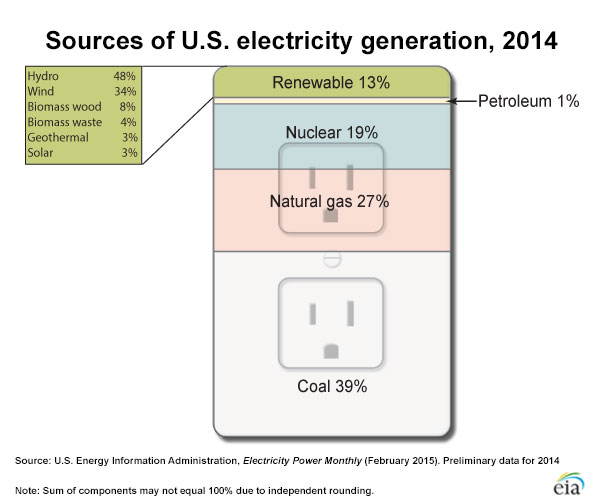
Interesting article posted on InsideEVs today http://insideevs.com/heres-u-s-electricity-comes/
 �
�
Jan 18, 2016
Darren Donovan I have E-7 schedule, I don't think it's available anymore. I've had it since 2007. Do I have to switch to E-6?
Thanks,�
Jan 18, 2016
FlatSix911 Here is what I found out regarding the old TOU rate plans ... E-6 can be closed to new customers on any date beginning January 1, 2016.
It's likely to be March, and has to be no later than June, but there are no guarantees and no requirements for PG&E to give any advance notice.
�
Jan 19, 2016
cciesingh It seesm that E6 is not available after March 2016..... So if I enroll before this date how long can a customer stay on the E6 plan?�
Jan 19, 2016
FlatSix911 See my quote above ... Those on E-6 before the new TOU rates go into effect will be allowed to remain on E-6 until January 1, 2023�
Jan 19, 2016
Merrill I find it hard to believe that PG&E is not required to notify those who are on E7 that the above is going to happen.�
Jan 19, 2016
aesculus Hard to say how they notify anyone these days. We don't get a paper bill and certainly did not notice anything on the last statement about the E7 plan going away. I did a full scan of our December bill and used March as a search term too and there is nothing stated about E7 going away in March.
If you go to the My Energy website and look at your rate options it clearly states E7 it is being terminated in March. You can then select another base plan. E6 states it will be closed for any new applications after March.
So I called PG&E today just to confirm that the E7 plan was going away and they acknowledged it. They also said they have new plans coming soon and I would get one of those. Could not be specific because the plans were not finalized. I confirmed that I could move to E6 now and then choose one of the other plans later. So I used the online base rate change request and in a few minutes got an acknowledgement that in the next one or two billing cycles I would be moved to E6. Note when doing this it also prompts you that if you switch you cannot go back to E7, which is moot because its been terminated.
So I figure why not move to E6 for a few billing cycles until the new plans come out and then you can decide. If you do nothing now you will not have the E6 option later.�
Jan 19, 2016
Incredulocious I'm on PG&E in Santa Cruz with solar for the past four years. Yes, you do earn dollar credit based on your rate plan. If you're producing more than you consume during the peak rates, you're banking the dollar amount in peak rates. Later, when you're consuming more than you produce (like overnight), you're spending from what you banked, ideally at the lower rates. This works over the course of the year. You "true-up" at the end of the year and pay the balance. If you produced more than you consumed over the course of the year, you're paid for your excess kWh's at something close to the wholesale rate, something paltry... you don't get paid any excess at the full consumer rate you were accumulating over the year.
I'm on E-6 to maximize the value of what my solar panels can produce during the day, despite the overnight off-peak rates with E-6 not being as low as the EV rate plan. I also opted to put in a system that would overproduce for a while for several reasons: I knew I would be using more of this energy over time as I converted more of my home (and vehicle) energy use to electric, getting off of propane and gasoline. I also know that my solar panels will produce less energy over time, like down to 80% at 20 years, so this initial overproduction will help cover that. The difference in upfront investment wasn't really that much and... it's just really cool to be able to produce enough energy to cover all your home energy use!
Besides the basic, home electrical needs (and mostly LED lamps, of course), my home has a water well pump, septic system pumps, and pumps to pressurize the water. Over time I've converted my home to now be heated (and cooled) by an electric heat pump, dryer converted to electric, went from a LEAF to an electric RAV4 (handling even more of my yearly driving), my girlfriend got an electric RAV4 as well and, as of today, I just replaced my propane cooktop with induction (electric)! All that's left to convert is the water heater still burning propane (not counting a couple of gas fireplaces). As a result, each year my excess production has become less and less and will probably reach zero this year or next.�
Jan 20, 2016
ohmman Sounds like we have similar goals. How is the electric heat pump working for your heat? I've been considering a move in that direction. My gas cooktop cutout is an odd shape, so I can't find an induction cooktop to replace it at this point. I'm going to wait until we remodel the kitchen in a few years. Drives me nuts, though.�
Jan 20, 2016
ecarfan Impressive conversion to electric! I am also curious about using a heat pump.
I have had an induction stove for 8 years. Best cooktop I've ever had. Faster and more responsive than gas, and energy efficient.�
Jan 30, 2016
FlatSix911 I want to remind everyone of the discussion on this Forum from a few weeks ago about the fact that the E-7 rate plan will no longer be available after Feb. 29, 2016.
If you are on that plan, you should switch to E-6 by calling PG&E. If you are on E-7 today and don't proactively switch to E-6 by Feb. 29, you will have lost your chance to get on E-6 and will be put on the new E-TOU plan, which is less favorable.�
Jan 30, 2016
Lloyd Have you compared E-6 to EV A/B rate plans with solar?�
Jan 30, 2016
FlatSix911 Yes, I have a Solar PV array and E6 was cheaper for me due to the favorable rates during the peak TOU that I generated solar KWh.�
Jan 30, 2016
Lloyd I recently switched to the EV rate. I'll let you know how it goes.�
Feb 3, 2016
Incredulocious The heat pump works great. It's a Lennox XP17-060 5 Ton. It's an air source heat pump (as opposed to ground source) since I live in a mild climate (Santa Cruz, California) where it's rare to get freezing temperatures. I kept my propane furnace as the backup heat system rather than putting in electric resistive strips. I think my cut-off for the backup is set to 40 degrees Fahrenheit, as per the installer. I haven't been able to find reliable information as to whether it will run well at lower temperatures. Anyway, I love the fact that I can heat (and cool) the whole house and still be completely offset by my solar generation for the year!
And yes, the induction cooktop is fantastic. I only had a couple of choices which would fit my existing cutout but I really like the design of the controls of what I ended up with, the 36" GE Cafe.
You might find this table I put together of cut-out dimensions for 36" models helpful (the third column is cooking power):
Code:[FONT=Courier New]Miele KM6375 35 19.32 Miele KM6370 34.50 20.375 2500/3850 Miele KM5773 36.125 19.6875 3350/3850 Thermidor CIT365KBB 34.75 19.88 2600/3700/4600 Thermidor CIT36XKBB 34.75 19.88 3600/4600 Bosch 800 Series 34.75 19.88 3400/4500 Bosch 500 Series 34.75 19.88 Bosch Benchmark 34.88 19.88 KitchenAid KICU569XBL 33.06 19.31 = Jenn-Air JIC4536XB GE Cafe Series 33.875 19.125 3700, better controls GE Profile 9036DJBB 33.875 19.125 3700 Wolf Transitional 35 19.5 2600/3700 Wolf Contemporary 35 19.5 2600/3700 Electrolux 35.875 20.375 3700/4800 Bertazzoni 33.875 19.6875 3000[/FONT]�
Feb 3, 2016
ohmman Thanks so much for the feedback. I'm definitely on board with the heat pump. I will ask for a price and get the ball rolling on that.
My cutout is 21" deep for my cooktop. Sadly, your excellent table confirms that I'm stuck replacing the cooktop or waiting on a remodel. I'm pretty eager, regardless.
Thanks again!�
Feb 3, 2016
aesculus If I had to chose again I would NOT go with a heat pump. I have split systems in my home since 1987. Prior to that we had another house with a heat pump. If the temp goes below about 45 degrees and you have any measureable amount of humidity, you are going to be spending all of your money on defrosting and heat strips. Plus the heat is not very warm and they are noisey in the areas of the house adjacent to the outside units.�
Feb 3, 2016
Incredulocious Well, perhaps the systems have improved? I don't have heat strips (because I still have my original propane furnace as backup) and while I frequently see high humidity outside (coastal fog in the Santa Cruz hills here), I don't have any trouble with humidity in the house or this defrosting issue you mention. And it definitely blows very warm air.
Noise-wise, I was told that these Lennox XP17 units were the quietest heat pumps on the market. Here's an article I just found on the topic:
http://604goodguy.com/blog/2013/02/08/lennox-vs-trane-vs-carrier-heat-pumps-which-brand-is-best/
Of course the whole point for me was to be able to have my solar generation cover the heating of the house along with everything else. With solar, I'd rather go with electric resistive heating than buying and burning propane or natural gas and the heat pump is much more efficient than any sort of electric resistive heating.
- - - Updated - - -
You might find that a unit specifying over 20", like that Miele or that Electrolux will work. They don't require exact cutout measurements. My cutout was about 34.125" by 19" and the GE Cafe specified 33.875" by 19.125". Width wise it was fine, depth-wise I had to push the downdraft unit back an 1/8" to just fit it.
So, I suggest looking more into the models that are close to your cutout size and see if it will work.�
Feb 4, 2016
Incredulocious I want to add that, in that article, they describe a survey of heat pump installations and find that many were not installed properly. That may well be the case with your two systems. They say that the choice of installers can matter more than the brand or model of heat pump. For example, I had one bid that came in at half the cost of my three other bids but they were making suggestions to address my existing furnace problems I was experiencing that didn't make sense even from a basic physics understanding (later confirmed by others, including my other bidders).�
Feb 4, 2016
brucet999 You should consider that solar, while it is generating, displaces whatever grid power you would have been consuming. If your panels are active in the afternoons when time-of-use rates are highest, then the value of your solar power would be highest. Pulling power in the middle of the night at lowest rates ($0.11/kWh for PG&E?) to charge your Tesla makes economic sense and it displaces load on the Grid to slack time, helping to avoid overloading the system during peak usage times.
When I was considering which way to go, I called SoCal Edison and asked the customer service lady to pull my usage from certain representative weeks during the past year (under summer rates and winter rates) to determine whether I would have been better off with basic Tiered Rates billing or Time of Use. It turned out that TOU would have been very slightly cheaper than tiered rates even before adding Tesla charging to the picture.
Now I charge Blue Max at $0.12/kWh during the night instead of pushing my usage into Tier 4 at $0.31/kWh. We also run the dishwasher in Super Off Peak time by using the delayed start button.�
Feb 4, 2016
Mog I've had solar for 5 years and my Tesla since Apr 2013.
I used E-6 for all but this last year when I switched to EV-A.
As mentioned by others, it is complicated to figure out what you will pay with E-6. On the other hand, EV-A is quite a bit simpler. I took my data from a 12 month period while on the E-6 schedule and made a simple spreadsheet to see what it would cost me on a EV-A schedule for the same usage. For me, it showed that I would save about $100/year by switching to EV-A. So I did.
I only charge the car at night since I'm much better off getting the higher rates paid during the day for my generation and then paying low charging rates.
Your mileage (usage) will vary.�
Aug 8, 2016
Crush E-7 is one of the cheapest and best rate plans that PG&E has ever offered. I would never switch off of it because you will never be able to get it back.�
Aug 8, 2016
aesculus Too late. They forced everyone off of E7 a few months or so ago. E6 is the next best thing unless you can completely adapt to EVAs schedules. We were going to go E6 but doing the numbers has us on EVA and really watching our consumption during peak hours.
But I think this is only a passing thing as soon as they get a fully developed sub metering plan in place. Then cars will be charged at their own rate and everyone will have to pick a standard TOU plan.�
Aug 8, 2016
Merrill Knowing PG&E it would not surprise me as more homes go solar that they will take away net metering. It suprised me when the CPUC voted not to allow them to do that in California, but who know what the future holds and as long as there is no one to stop these monopolies they can run rampant.�
Aug 8, 2016
ohmman Being that PG&E is a decoupled utility, I think their rate structure is more of a reflection of their (in)ability to run efficiently. They're heavily regulated by the CPUC, who determines how much money they can make. So I do think there are some checks and balances in place. The solution for them with solar could be to invert rate tiers and make energy cheaper during the day and expensive at night. This would likely harm owners who are at work all day and charge their cars at night, but it could also make it much more cost effective for businesses/workplaces to offer EV charging during working hours.�
Aug 8, 2016
Merrill Decoupled is a nice word for what they do, I have other words that are not as nice.�
Aug 8, 2016
bmah How tied are the rate structures of community choice aggregators to those of PG&E? If PG&E were to do some dramatic change to their rate structures (as you postulated above), do the CCAs have to follow suit?
Bruce.�
Aug 8, 2016
aesculus The Munis are not regulated by the PUC. They can be influenced to some degree, but set their own rates since they are not investor owned and in fact, are sort of owned by the municipalities they serve.
One reason a muni is so much cheaper is that they don't have to support such a diverse ecosystem as the three IOUs'. So they sort of have the cream of the crop in terms of infrastructure support, client cost per mile and less outages too. I bet everyone one of them would jump at the chance to dump all their rural customers if they could.�
Aug 8, 2016
miimura As an original NEM customer, I'm guaranteed 20 annual true-ups under the original terms of the NEM tariff. However, PG&E can monkey with the "Otherwise Applicable" rate schedules such that it is much less advantageous to solar customers. They have already done this by making the peak rate run from 2pm-9pm. That forces me to self-consume the power I generated during that period and I don't get the benefit of banking credit at the high price. However, these hours do match the actual peak on the CA ISO grid, so I understand why it is set that way.
I am certain that before my last true-up on the NEM tariff in 2022, I will have some kind of home energy storage system so that I won't buy any power at peak rates and I may even let the existing portion of my solar feed into the grid during that time for maximum credit. I would probably add more solar when I get the battery storage system. The most energy productive empty section of my roof is SE facing, so it's not good for direct grid tie, but would be good for charging batteries in the morning.�
Aug 8, 2016
javawolfpack I know I have solar & soon will have a Tesla... but I'm likely going to stay on E1 until I can get a PowerWall as agree with some others that the EV-A has peak hours that are when solar isn't generating power and I have computer servers running + home entertainment I'm using during those hours that would possibly result in a higher overall bill if I switched to EV-A. With the PowerWall it might be possible to selectively determine when I push energy back to the grid or almost go completely off grid for everything but the EV and thus benefit from the lower charging times overnight.�
Aug 8, 2016
Xminus6 Solar and EV drive on PGE here in Northern California. EV-A, which is the rate for a single meter, works out best for me. There was someone on here who advertised the app they made called PG&E Toolkit that would monitor your usage, net metering, and energy cost across all available energy plans for PG&E and EV-A wins nearly every time except in a few occasions where it's less than 1% higher than EV-B. EV-B isn't worth it because of the high cost of installing a separate meter only for EV charging. It's a very informative app.�
Aug 8, 2016
Xminus6 Yeah. It is confusing. Here's what I've gleaned.
When you're producing during Peak Hours you sell back at retail price. So, yes, one kWh of generation during peak hours pays for 3 kWh of off-peak energy. That's why I'll occasionally have days where my overall energy usage is positive but I still have a $ credit for that day. My PV was only turned on in March of this year, so I'm offsetting the money I paid to PGE during the first couple months of the year with excess generation. So it is paying back at retail rates.
At the end of the year, if your electricity bill is completely offset by the credits from your PV system, they will buy back the additional kWh at a wholesale rate, which is something like $.03/kWh. At that point, you're better off finding something to do with the electricity rather than selling it back for almost nothing. This is why the solar contractors will try to size your system to offset about 80% of your usage. The payback for having a larger and larger system decreases the closer you get to or exceed your overall energy consumption. The cost of an additional panel at $800 (or whatever) takes forever to pay off when you're selling at only $.03/kWh.
It's very confusing because there are two metrics that they seem to use and they switch between them. There's the dollar amount and there's the energy usage amount. You're paid back in dollars UNTIL you're overall energy usage goes negative, then you're paid back at a low wholesale rate for each kWh.�
Aug 8, 2016
SoccerMan94043 I just got billed for my first month entirely on EV-A. It added roughly 120.00 to my bill as I have a young family that needs to run the dryer pretty much all the time (and likes to waste energy otherwise) on top of the Tesla charging for around 4 hours each night (at 24 amps).
I need to do some calculations to see if the standard rate would be less :\�
Aug 8, 2016
miimura It's actually very simple.
1. If your True-Up bill is positive, you pay that amount.
2. If your True-Up bill is negative, but you still pulled in more kWh than you pushed into the grid, you owe $0 and receive $0. There is no credit for the monthly minimums that are now just over $10/mo.
3. If your True-Up bill is negative and you pushed out more kWh than you pulled in from the grid, then they pay you something around $0.04/kWh for your Excess Generation.�
Aug 8, 2016
ohmman Ouch.
If you have a swimming pool, running the pump at night instead of the day (at least for some portion of your turnover time) will likely flip everything in your favor. If not, you need to pay attention to the clock and shift everything away from 2-9pm. Weekends and holidays are more favorable on times (3-7, I think), so you can offload to then as well.
I run my pool pump at night mostly, and charge both cars at 3am. On EV-A, I run a ~$1k sacrifice credit at true-up, but that represents about 1MWh of consumed energy. I've got bids going to install panels on our new pool house so that I can net out energy despite the finances.�
Aug 8, 2016
miimura You really need to run the numbers for yourself. I see you're in Chico, so your daytime energy use in the Summer is probably very different than mine. Off-Peak charging is so much cheaper than E-1 that it's not even close in my situation.
My calendar year 2015 rate comparison for estimated annual True-Up charge:
E-1 $1,786
E-6 $1,418
EV $908
I have a small 4.3kW solar system and the above includes about 16,000 miles of EV charging overnight spread across two cars.�
Aug 8, 2016
Xminus6 Here's my results for July.�
Aug 9, 2016
ohmman Make sure you look at the year as a whole. Winter/Summer rates differ, and your usage changes quite a bit as well.�
Aug 9, 2016
javawolfpack My only concern about this app is when I tried to visit their homepage it was flagged as a potential phishing webpage when I was on campus... I can't find much information in terms of reviews of the company/app either. And it sounds like it needs to be able to log-in to my PG&E account to work...�
Aug 9, 2016
Xminus6 Good advice. I can tell from even my early days with it in March that the production will vary wildly. My brother in law has a system on his house and he estimates that he generated around ? of his summer production during the winter. So I'm not sure if we'll actually zero out our bill over the course of a whole year, but it's definitely taking out a significant chunk of it.
As far as the PGE toolkit app, it does, my necessity, need access to your PGE account information. I haven't noticed anything odd since I started using it though.�
Aug 9, 2016
SoccerMan94043 My wife put in a SPA (50 AMP circuit) a year ago and it self regulates during the day, running on an off on it's own, but not a lot. I'm looking into whether the SPA can be programed for time of day (I don't think it can). Are there circuits that have timers?�
Aug 9, 2016
EV-lutioin Amazing that solar is only 3% of renewable energy.... boy that really puts the upside potential of a Solar City merger in perspective. I have a 7K solar array and I recently switched to the PGE EV rate and my July bill went from $80 in 2015 to a credit of $60 in 2016 and that is with the addition of my Model X. Having a solar powered car is a dream I have had for 30 years.... I am so happy�
Aug 9, 2016
rays427 I have a 12 KW solar system and am on EV-A PG&E rate. I charged about 10-11,000 miles at home in the past year. As a example my December, January, and February bills were $297, $326 and $289 my cost on E-1 would have been $419, $468 and $367. May, June and July were $11, -$162 and -$87. E-1 costs would have been $75, -$33 and $-87. At this time of the year I charge the car at night at 11.466 cents per Kwh and they pay me from 24 to 44.4 cents per Kwh when I generate more than I use during the daylight summer hours. So for me the EV-A rate is much better than the E-1 rate.�
Aug 9, 2016
aesculus I would be surprised if your SPA (sold in Calif) cannot be programmed. My 20 year old one can. It's limited to 4 periods a day where new ones have more flexibility and the ability to tailor weekends etc.
Absence of that you could get a inline 240V timer. A bit pricey but probably less than the utility charges.�
Aug 9, 2016
miimura You need to give the app your actual PG&E login credentials so it can log in and download the data for you. Personally, I would recommend either changing the password to a temporary one before you use the app then change it back when you're done, or just permanently change your password on the PG&E site after you're done using the app.�
Aug 10, 2016
AndreSF Dunno if it's option for you, but I've switched to natural gas dryer when my kids were little, and laundry was happening at all hours of the day. Made a considerable difference in our electricity usage/bill.�
Aug 10, 2016
SoccerMan94043 My boss keeps telling me to do that. I have gas pretty easily accessible to the location, but would need to look at dryer costs. I've also thought about moving to a gas oven.�
Aug 10, 2016
ohmman Funny, I've trying to do the opposite. I want to shed my natural gas consumption so that I can replace it with offsetting PV. Water heater and dryer are decent loads, though. The tankless electric water heater we put into our pool house requires 40A on the panel. Add a Tesla charger and you're rapidly chewing up your available service.�
Aug 10, 2016
jeffb The EV-A rate is working pretty good for me.....10kw system (was designed to cover 100% of my house usage, not including the car)....
Here we are in mid August and the Toolkit app calculates my potential balance under E1 as $348 YTD......while my actual balance is -$171 under EV-A. A difference of $519. And I charged my Tesla the entire time! 13k miles since January. So far my Tesla costs less than zero to power....
We didnt do any major changes to our energy use times, we just try to avoid running the dryer until after 9 but we mostly do laundry on the weekends anyway.
Here in Central California its HOT in the summer so we have a lot of AC use in the evenings and at night, but obviously I'm making more than enough power "on peak" with the solar system to offset it.�
Aug 10, 2016
AndreSF I think oven/cooktop usage pattern is easier to regulate and I was thinking natural gas too, but now not so sure... With good solar system it might make sense to shift more appliances to electric source, but I don't have yet solar system (will do it in a year or two when my roof gets replaced).
EV-A is a decent plan IMO, but does require some shifting of usage to less common hours or the weekend, as it was mentioned in this thread.�
Aug 10, 2016
SoccerMan94043 The upside, beside cost, is that I might be able to convert my wife to an electric car in the future; we've tapped the available 125 amp load to the house and expanding is not an option (between 30 and 40K) so I was thinking about converting to gas to free about about 50 amps.
I'm also intrigued with the solar tiles from Tesla I just read about (My roof is 40 years old).�
Aug 10, 2016
aesculus If you don't have heavy AC load (or heat pumps in the Winter), EVA is a no brainer. Jury still out for me. Even with 2.5 kW or solar my bills in the summer are still around $150. Some of that could be attributed to the car of course. But you make some pretty big lifestyle changes during the afternoon and evening. For example forget cranking up that big electric oven to cook a pizza and don't even think about running the AC in the afternoon until 9 PM. I try to cool my house to 75F until 2PM and then it's set for 83F. You kind of have to ride out the heat wave so to speak. Sometime on 100F days the AC units comes on anyway for about 10 minutes an hour, especially on the upstairs unit.�
Aug 10, 2016
SoccerMan94043 That's a bad trade off for me/my family. I'd rather pay I think�
Aug 10, 2016
AndreSF Wow, 40K for electric service upgrade!
Unless you are using your dryer at night, not sure switching it to natural gas will be affecting nightly EV charging. BTW, obviously, don't know what your load is, but 125Amp service is not that bad IMO for an avg house in Bay Area and charging multiple EVs at night, unless you have some especially high load off peak.
Good luck!�
Aug 10, 2016
ohmman I think it's a perfectly reasonable trade-off. I alluded to it, but the service size limitations are a real problem for a lot of homeowners when it comes to EVs. I have 400A (!) service, which I upgraded from 125A. I didn't pay the numbers you're talking about, but it wasn't cheap ($7k-ish, for the record, and that was because of weird limitations on our property). Even with 400A, we have it split between two buildings on the property and 200A disappears rapidly when you try to replace all of your gas appliances.
Good luck figuring it all out.�
Aug 10, 2016
miimura I don't know the details, but back in 2013 I heard that PG&E had a $2,500 subsidy available to offset service upgrade costs if you need it for EV charging installation. So, you would have to pay for the larger main panel and installation and the larger conductors pulled to the pole, then deduct $2,500. PG&E never charges residential customers for transformer upgrades that may be necessary for your service. Obviously, this doesn't make much of a dent in a $30k upgrade.�
Aug 10, 2016
SoccerMan94043 The problem is that the end point is a couple of houses down the road that need to be trenched and sidewalk torn up... 30-40K is the estimate
The point of moving to gas to to allow the dryer to run during the day (which my wife insists on) and to also free up some amps for my car or another.�
Aug 11, 2016
aesculus What's your solar potential? It's a bit tricky but PG&E can probably help you here. With enough solar you could offset your load to the grid locally. Then you would just have to upgrade your panel and not your secondaries (which is where most of your costs are coming from it sounds like).
Adding a Powerwall might make this work too so your local load can be higher than your supply load. All of this in combination is possible. You would have to work with PG&E, your local building department and a talented electrician in order to pull it off. But with $30-40k at risk you have a lot to work with.�
Aug 11, 2016
SoccerMan94043 Solar is a good option based on the google tool. Problem is a 40 year ceramic tile roof that will likely need to be replaced in the next 10 year and the lightly hood of us moving over the next 4.�
Aug 11, 2016
aesculus OK. Plan 2. Powerwall but really that is not the best because 7 kWh will be eaten up in seconds with AC, dryers and the car.�
Aug 11, 2016
bmah Er the Powerwall can't discharge all that energy in a few seconds can it?
Bruce.�
Aug 11, 2016
Kbra Log into Pge.com and go the various rates. It has the option to analyze your usage to determine your best plan based on smart meter data. Thats also assuming you've had the car for awhile and have historic data of the kwh usage.�
Aug 12, 2016
javawolfpack That's the brunt of my problem... will need more data. I haven't even had my house for a year yet... can't get a powerwall without a year of power data. But likely need a year of Solar & EV data to gauge my power needs and best plan.�
Aug 12, 2016
aesculus No. The seconds term was figurative. Like an hour.�

Không có nhận xét nào:
Đăng nhận xét