Apr 14, 2014
Cosmacelf ...if you have the dual car charger option. There is a thread over the Tesla Motors forum where we have found a Canadian user who happens to have dual chargers who has been able to charge at 24A from a TT-30 adapter. I have a single car charger in my car, and I can only charge at 20A with 120V. The few people that have tried charging with TT-30s must also have had single chargers because this is the first time I've heard of anyone charging at 24A from a TT-30.
If anyone here has a dual charger car and access to a 30A 120V source and has the appropriate home made adapters, it would be great if we could confirm this finding, but at this point, I don't have any reason to doubt it.
I still believe that the single charger 20A limit at 120V is a software limitation put in by an over zealous programmer who didn't realize that things like 30A TT-30 outlets existed.
----------------------------
Update 4/17/2013: At this point, the evidence is pointing to higher VIN cars being able to charge at 120V, greater than 20A, rather than dual versus single chargers.�
Apr 14, 2014
FlasherZ A home-made TT-30 adapter, i.e., TT-30 to 14-50? Or is there some Tesla TT-30 adapter I don't know about?
Last time I tried (~4.0 or so) it limited at 20A. I could rig something up I suppose fairly easily, just move L2 to neutral and give it a spin.�
Apr 14, 2014
Cosmacelf Do you have dual chargers, FlasherZ? Yes, I am talking about a home made adapter, Tesla hasn't made a TT-30. And yes, you could rig something up to test it as you suggest - but again, it should work at 24A only if you have dual chargers (at least that's the current working theory).�
Apr 14, 2014
donauker Still limited to 20 amps at 120 volts with dual chargers on version 5.8.10.�
Apr 14, 2014
FlasherZ Confirmed. 5.9 is limited to 20A - dual chargers. I just wired a set of P and R adapters 14-50 to L1-N instead of L1-L2 and the car showed "20A/40A" at 121V, remained there for several minutes.
I did not try, however, to reduce the charge current to 24A to see if it would balance differently. I might have time to do that later but dinner dates call. �
�
Apr 14, 2014
Cosmacelf Well, the other forum poster said he had v5.9. I'll try to find out what subversion he has. He also has a Canadian car if that makes a difference.
- - - Updated - - -
And what subversion of 5.9 do you have Flasher?�
Apr 14, 2014
qwk I don't see how only a dual charger car would only have this capability, as a single charger car can handle 24A at 120V just fine. I really doubt that Tesla would modify the software only for the dual charger cars.�
Apr 14, 2014
AndreyATC I ordered this
NEMA 14-50R to TT-30P RV Plug Adapter
I'll test the charge rate as soon as I get it�
Apr 14, 2014
Incredulocious Previous discussion about this is over here:
http://www.teslamotorsclub.com/showthread.php/18898-NEMA-TT-30�
Apr 14, 2014
FlasherZ .94
- - - Updated - - -
I would like to see a screen shot of 120V/24A charging. I can't reproduce it here. Maybe there's something w/ Canada cars. I dunno.�
Apr 14, 2014
Cosmacelf I'll ask the OP over at the Tesla forums for a screenshot...�
Apr 16, 2014
linkster Cos,
4 additional amps @110v for the electrical maven ?
Is the juice worth the squeeze ? sorry, I had to....�
Apr 17, 2014
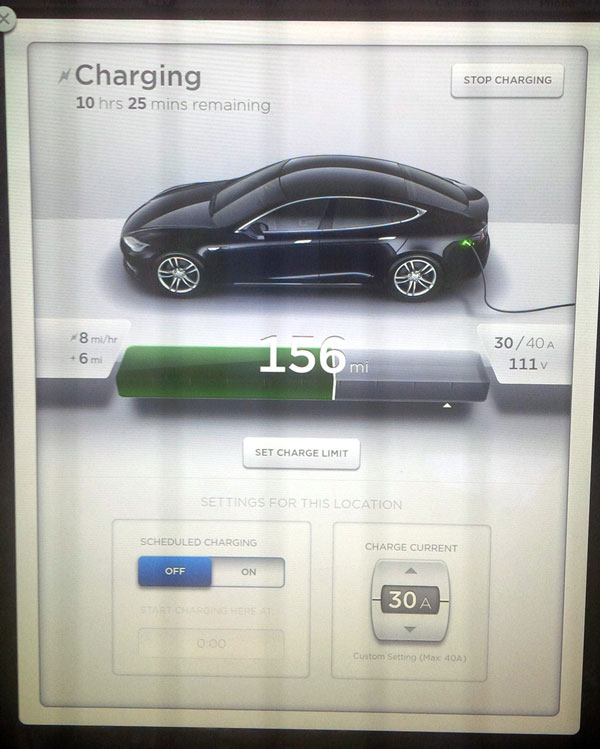
Cosmacelf So here's the thread, and near the bottom is thierrY's post where he posts pictures. It definately works for him. He's on .94 as well and has dual chargers, but his car is Canadian spec. Hmmmm. I sent an email into ownership asking about this, but they referred me to my service center. Yeah right.
Anyone know the charge rate for a standard 120V/30A RV outlet? | Forums | Tesla Motors
- - - Updated - - -
Thinking more about it, it could also be VIN related. The Canadian poster's car is only three weeks old. My car is over a year old, and Flasher's car is even older. So it might not have anything to do with Canada versus US, or dual versus single charger, but instead have to do with how recent your car was made.
So, anyone reading this thread, if you have a VIN great than, say, 10,000, and you can test with a high amp 120V source, please let us know...�
Apr 17, 2014
gimp_dad I know you were probably just joking anyway but if you are in the desperate position of needing to charge on a 120V outlet, I am guessing that, yes indeed, 5 hours difference could be important to you (approximately 24 hours at 24A vs 29 hours at 20A for 70kW of charge).
- - - Updated - - -
Sorry if I missed this in the thread, but is he wiring to one hot and one neutral on the 14-50R to TT-30P adapter? I believe others have achieved higher amperage by wiring the 120V source to the two hots of 14-50. The car thinks you are at a 14-50 source with really low voltage. Maybe this doesn't work anymore now that the MS charger algorithm more carefully monitors the voltage but it used to work in the old days and would allow you to turn up the current on a 120V source.
�
Apr 17, 2014
FlasherZ This has never worked. I tried it way back in the v3/v4 days on my Sig car and tried it again the other night. If the car detects ~120V (I don't know the exact threshold), it will limit charging to 20A. Even if you set it up to 40A, it still shows (20A/40A).�
Apr 17, 2014
Cosmacelf English is so imprecise. FlasherZ took a hot and the neutral from his 14-50 receptacle and wired it to the Tesla adapter 14-50's hot and hot. That way he was able to test charging the car with a high amperage 120V source.
That's essentially what a specially wired-for-Tesla-charging TT-30 adapter does.
To be precise, the car doesn't know that a 14-50 adapter is plugged into it, all it knows is that whatever adapter is plugged into the UMC is advertising a 40A maximum draw.
And that's the issue we are trying to solve - why certain people can charge at 24A on a high amp 120V source and others are limited to 20A.
Can you charge at 24A on 120V?�
Apr 17, 2014
FlasherZ Hmm, when the wife comes back I'll try playing with the amperage setting to see if I can convince the car to boost it a bit.�
Apr 17, 2014
Cosmacelf I really think our cars are too old, Flasher. We need someone else with a relatively new car to test this...�
Apr 17, 2014
FlasherZ No luck...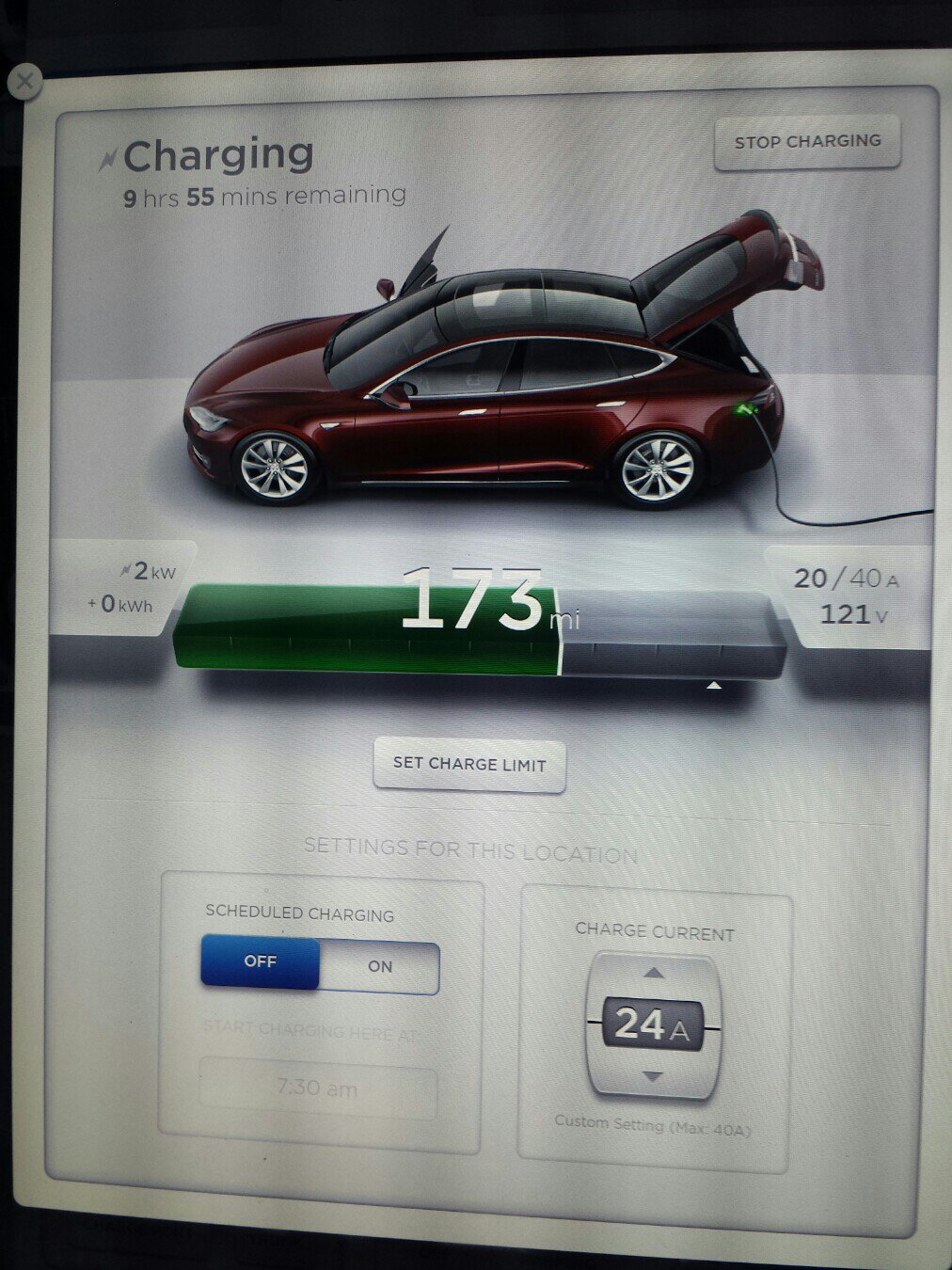 �
�
Apr 17, 2014
Cosmacelf Yes, but here's what the guy in Canada got with his 3 week old car:
 �
�
Apr 17, 2014
gimp_dad I'll try it with my adapter as soon as I am near a 30A outlet. My car is Aug 4, 2012 so I am guessing it will not work.�
Apr 17, 2014
FlasherZ I saw his 24A one in the thread... perhaps it's a firmware-on-the-charger item or something. Maybe future software packages will uprev the chargers so we can do that too.�
Apr 26, 2014
AndreyATC I finally got my adapter and just tested TT-30
A bit disappointed. Only 6mph and 20A rate
I'm on 5.9 (.94)�
Apr 26, 2014
Chris TX Here's the problem with trying to go over 20A @ 120V:
The single hot line of 120V is only rated at 20A. You put two together to get [email�protected] If you're pushing a single 30A hot leg through the UMC's internal relay and wiring, you're going to have a bad time.
If the UMC was rated for 60A, I could see it working.�
Apr 26, 2014
Cosmacelf None of what you wrote is correct. First, we are talking about 120v sources that are rated for 30A. Second, we aren't putting two 120v sources together. Third, even if we were, you wouldn't be doubling the amps.�
Apr 27, 2014
Chris TX So how are you taking a TT-30 connection (that historically has a 20A and 10A from the same phase) and running them through the UMC? Surely, you aren't running the 20A down one side and the 10A down the other. It wouldn't complete the circuit since there is no neutral used.�
Apr 27, 2014
davewill There's so much wrong with what you've written it's hard to know where to start. The TT-30 has one 30a hot conductor, not two smaller ones. When connecting it to the UMC you connect the single hot and the neutral to make a 120v 30a circuit. The UMC has conductors sized for 240v @ 40a and they can easily carry 120v @ 30a. The limiting factor seems obviously to be that the car won't use both chargers @ 120v.�
Apr 27, 2014
qwk There is a lot of confusion in this thread. The car uses at least one 10kw charger. The charger will accept 95-277V and 5-40A. As long as the amperage and voltage is within those limits, it will work. You could charge at 120V 40A if the car software would let you(even with one charger), but Tesla has decided that 20A is a good limit, so that's where it stops.�
Apr 27, 2014
Cosmacelf And just to add further confusion it seems that later model S, maybe built this year, don't have a 20a limit on 120v sources.�
Apr 27, 2014
FlasherZ A TT-30 is a receptacle providing a 120V nominal circuit by taking the AC voltage between one ungrounded ("hot") conductor and the grounded conductor (neutral), or what we call L-N voltage. It is rated for 30A @ 120V or 3.6 kW.
When the Tesla uses 240V, it does not need the neutral in a 14-50 receptacle because it uses the voltage derived between two ungrounded conductors, either from a 240V/120V split-phase system, or a 208Y/120V three-phase derived system.
To accomplish 120V charging, the Tesla NEMA 5-15 and 5-20 adapters connect the ungrounded ("hot") conductor to one of the line power inputs and the grounded ("neutral") conductor to the other line power input. So yes, for 120V, it uses neutral.
To simulate a TT-30, we simply create an adapter that takes L1 and N from a 14-50 plug and connects it to the L1 and L2 prongs of a second receptacle.�
Apr 27, 2014
TonyWilliams
To add to the database, all the Toyota Rav4 EV (Tesla powered) are limited to 20 amps at 120 volts. I don't know what the threshold is to eliminate the 20 amp restriction, but obviously somewhere between 120 volts and 208 volts.�
Apr 27, 2014
Chris TX Re-reading some of my previous posts in this thread, it appears I am on drugs. Now that I think about it, I WAS on drugs at the time! (fighting a cold
As for the [email�protected] charging (limited to 24A) I'm thinking the 14-30 adapter would be better so it automatically dial down the amps to expect a 30A circuit.
Also, I wonder which VIN#s support this "feature" and if there's a chance Tesla will officially support it or release firmware to block it. I'm going to make one of those adapters (TT-30 to 14-30) and try it out on our next camping adventure.�
Apr 28, 2014
fluxemag I made the 14-50 to TT-30 adapter but have never tried it out. I have a mid 2013 Model S. If I ever see a TT-30 in the wild I will give it a shot.�
May 2, 2014
FlasherZ DANGER: Do not attempt to alter or change equipment or parts, there is a risk of shock and fire.
�
May 2, 2014
FlasherZ You have the 20A limit as well it seems.�
May 2, 2014
RiverBrick DANGER: Do not attempt to alter, modify or change equipment or parts as intended, there is a risk of shock and fire.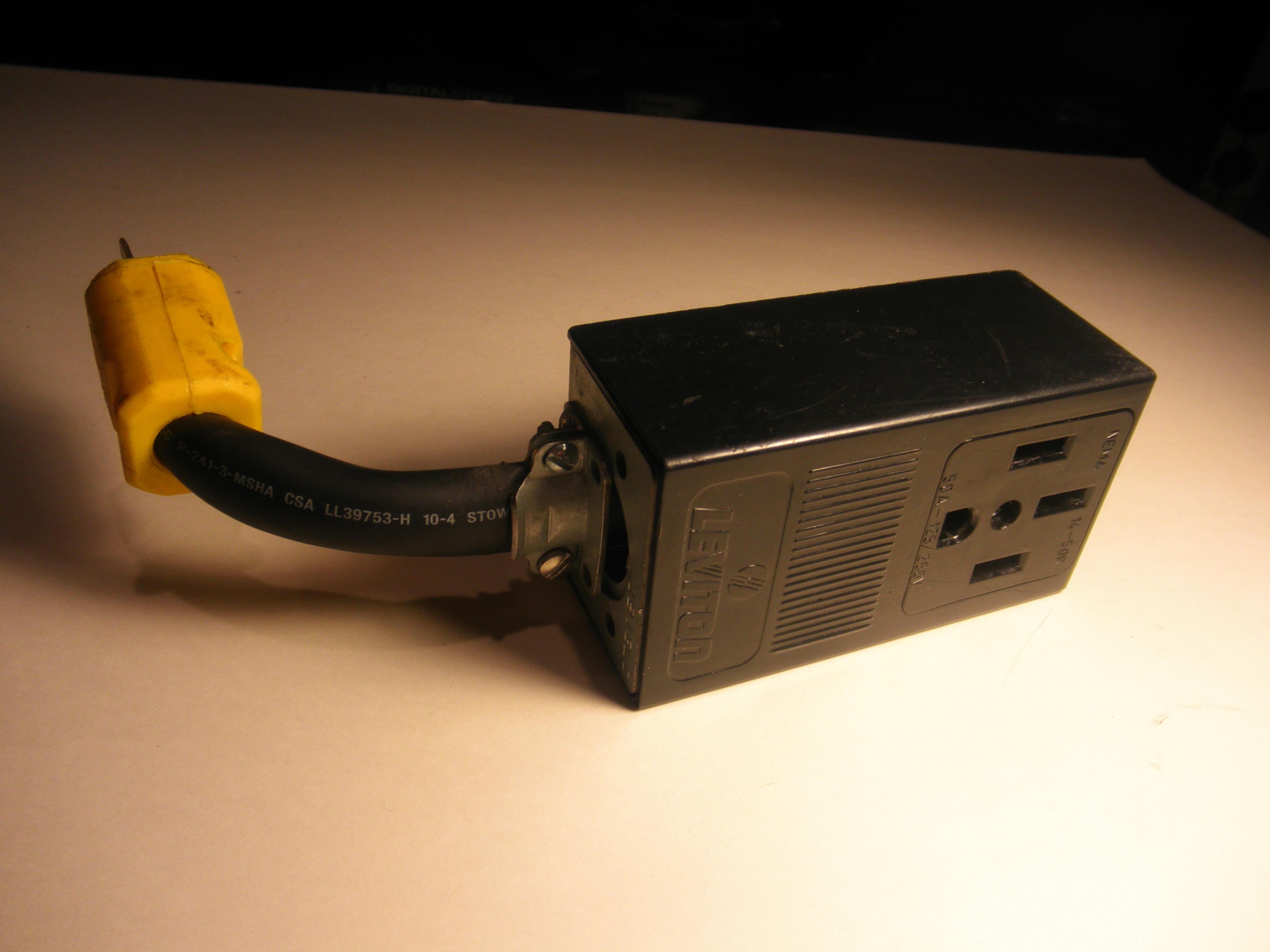
- - - Updated - - -
it is on a 20a breaker. I took a picture and stopped it there. I would like to go to 30a at 120v because some campgrounds do not have 240v but have 30a 120cv plugs.�
May 2, 2014
Chris TX Your setting shows 24A, but your car is only displaying 20A. That's what happens when you have the 20A limit in your car. I suppose your picture could simply be as the car is ramping up, but I suspect it's more of the limitation in the car's software - earlier cars have a 20A limit when voltage is 120V.
For example, I wired a 15-40 to 15-40 adapter to use 120V instead of 240V, and the car displays 20A/40A and refuses to go up from there.�
May 17, 2014
Cosmacelf Since it's on a 20a breaker, isn't it risky to draw more than 16a?�
1/1/2015
guest Come to think of it, if you want to test it just cap off one of the hots in the 14-50 outlet and swing the neutral over to it. You'll get 50A @ 120V to play with and see just how high it can go.�
1/1/2015
guest Yes, that's what Flasher described above. It has to be the correct hot you use or don't use though. The UMC/car is picky about which hot 120V comes in on.�
May 21, 2014
TonyWilliams
Yes, it is. You need the correct polarity.�
May 23, 2014
Chris TX Which terminal does the UMC 14-50 like to have hot? X or Y?�
May 23, 2014
Cosmacelf If you look at the face of a NEMA 14-50 receptacle with the ground on the bottom, the hot should be the left blade for a 120V feed. This is the opposite blade that a NEMA 5-15 receptacle would have.�
Jun 1, 2014
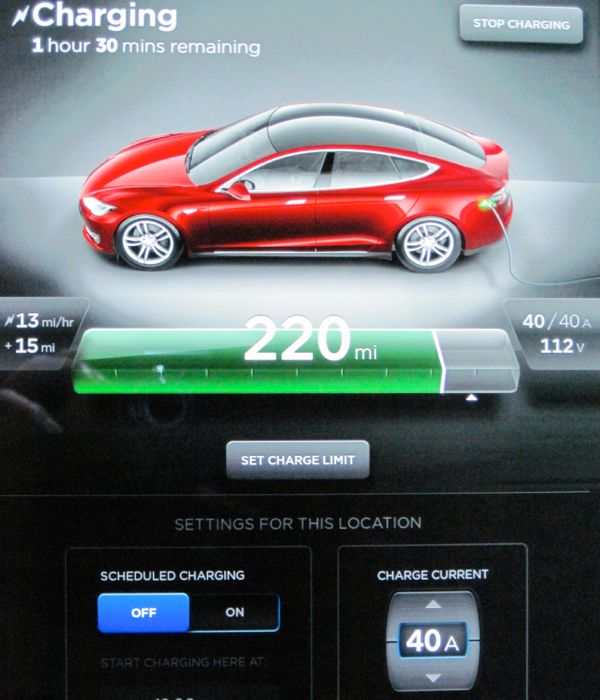
MN_Bob 40 Amps at 112 Volts!
It seems that cars built fairly recently are capable of 40 amp charging on 120 volts. To test this, I temporarily wired my 6-50 outlet so one formerly hot side went to neutral instead of to the 50A breaker. I have the single charger, built March 2014, 85KWH. Don't try this unless you know what you are doing.
 �
�
Jun 2, 2014
TonyWilliams Awesome news that we will never see on the Toyota Rav4 EV.
20 amps is all we get on 120 volts.�
Jun 2, 2014
Cottonwood This is the same 20 Amp, 120 Volt limit on early MS's. That limit is less of a concern for me than the 90 kW Supercharging limit. I can count the number of times that I used a TT-30 on the fingers of one hand; for those few times, the difference between 20 and 24 Amps is not an issue. Arriving at a Supercharger with a small SoC is a much more common event!�
Jun 2, 2014
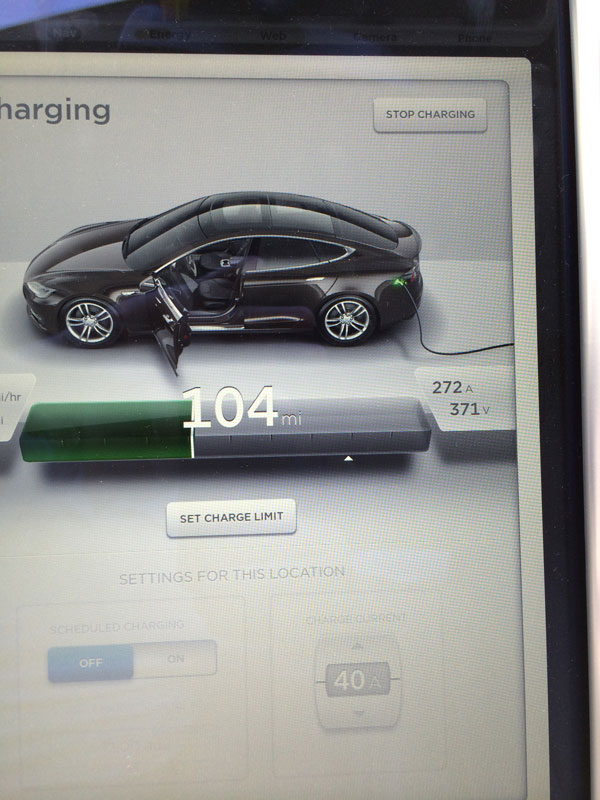
Cosmacelf I wonder about that 90 kw limit. I supposedly have an "A" battery too, but this is what I got recently charging at a new 120 kW Supercharger recently - the numbers multiply to 100 kW...
 �
�
Jun 2, 2014
TEG �
Jun 3, 2014
Cottonwood The problem is that those RV, 30-to-50-Amp "dogbones" won't work with a 14-50 UMC. The Tesla needs a different set of connections that won't work with the RV...�
Jun 3, 2014
bluetinc Would you mind verifying that you have an A battery? Did your main pack need to be switched out at some point?
(Mods, Both of our posts prob. belong somewhere else
�
Jun 3, 2014
Cosmacelf Gawd - I thought I was losing my mind there for a while. I just checked my battery and it is a B battery, not an A. I was POSITIVE I had an A battery. So I hunted around, and found a photo I took about a year ago of the battery label. And sure enough it WAS an A battery. I went through all my Tesla service center paperwork (I have brought it in for a few things) and there is no mention of them swapping my battery, but obviously they did at some point.
So not only have I not lost my mind (yet), I have a newer battery. Yea! Good start to the day.�
Jun 3, 2014
TonyWilliams Every time I walk into any service center, there is always at least two new batteries in wooden crates just waiting for a car like yours!!!�
Jun 3, 2014
AndreyATC I'm very jealous
Back, a few weeks ago i was asking members how to pull the most amps of 120v lines
I ended up using TT-30 RV plug, but it's limited to 20A
I'd love to have 40 instead
�
Jun 3, 2014
trigga71 This is interesting. Can anyone else confirm and post the VIN?�
Jun 3, 2014
Cosmacelf The most you could have gotten with a TT-30 is 24A anyways - not that much more than 20A.�
Jun 5, 2014
trigga71 It may not be 40 or 80 amp but its better and the quicker you can get enough miles to move from slow to faster, maybe to a public charger or better yet a supercharger the happier everyone involved will be.�
Jun 29, 2014
jweinstein Could the 20A vs. 24A 120V charge limit be related to having an A or B battery pack?�
Jun 29, 2014
Cosmacelf No. I have a B pack but a 20A limit.�
Jun 29, 2014
jweinstein Interesting... What other hardware limitation could be at play in the older vehicles that's absent in the newer ones?�
Jun 29, 2014
Cosmacelf I suspect a firmware limitation rather than hardware. I know Tesla says that their updates also update firmware but maybe the charger isn't part of the automatic update system or tesla doesn't think the 20A limitation is a big enough deal to bother updating everyone.�
Jun 29, 2014
FlasherZ And I have a D pack and 20A limit. Perhaps the charger.�
Jun 29, 2014
jweinstein Off-topic- How does a D pack differ from a B pack? Is there a C pack? Is there a thread on the topic? Thanks!�
Jun 30, 2014
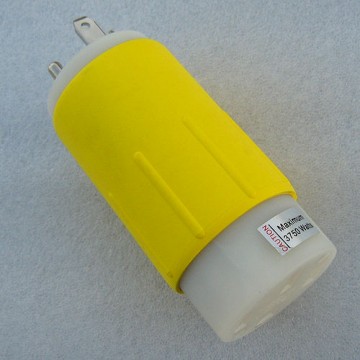
GuyHall It appears that EVSEAdapters makes a NEMA 14-50R to TT-30P RV Plug Adapter. One review indicated success: "
"Worked fine for me. I had no 20 amp limitation from my Tesla S. Set to 24 amps, I get a solid 14 km/h charge rate (8,75 miles/hours)."
http://mon.pq.org/depot/monpq_534f1f95de45d.jpg
 �
�
Jul 2, 2014
tiblot
I bought this from them - it didn't look like this whatsoever. It came as a dogbone with a plug and a outlet. However, it worked fine - I charged 8 MPH @ 24 amps.�
Jul 2, 2014
GuyHall Strange...�
Jul 2, 2014
jweinstein When was your car delivered?�
Jul 7, 2014
Chris TX So here's a silly question: If the charger is now capable of pulling 24A @120VAC, could it theoretically pull 48A @ 240VAC, somehow? I've plugged into HPWC and a 70A Clipper Creek unit and it's never gone over 40A.�
Jul 7, 2014
qwk No, because the charger limit is 40A.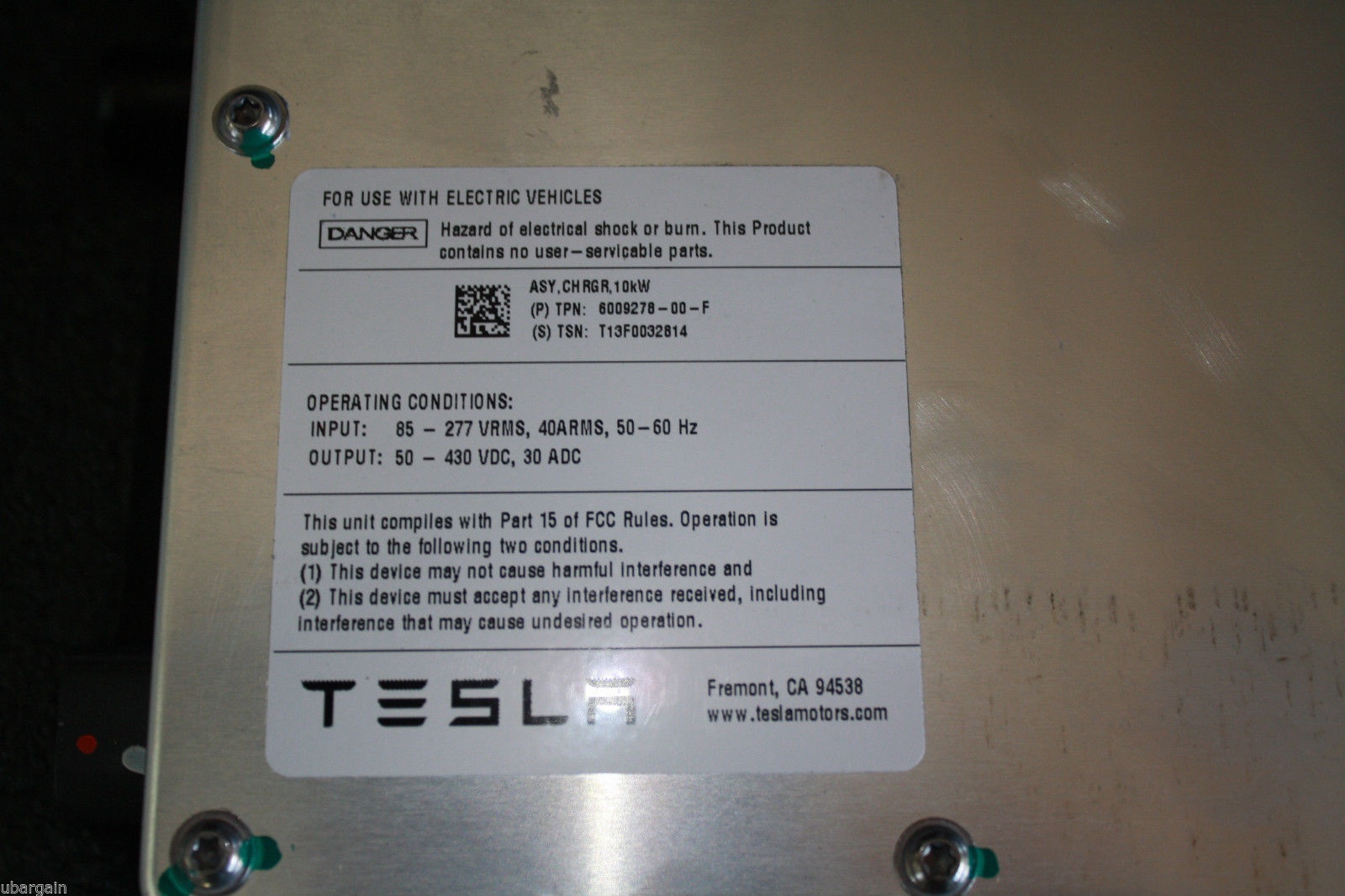 �
�
Jul 7, 2014
Cosmacelf Only if you have dual chargers in your car. With dual chargers, you can charge at up to 80A at 240V.�
Jul 7, 2014
Chris TX Has anyone ever charged at 277V?�
Jul 7, 2014
TonyWilliams Yes, I have, however the amperage drops to 36 amps to keep the "10kW" rating. My theory of how a 120kW Supercharger (they all operate at 277 volts) with 12 Tesla chargers inside that would normally only pull 36 amps are just bumped to 40 amps.
Viola... 133.5kW with the exact same 12 little chargers in one big Supercharger case.�
Jul 8, 2014
Cottonwood 277 Volts is the L-N Voltage on a 480 Volt, 3-phase system and is what most of the new Superchargers are connected to. 480 Volt, 3-Phase has 480 Volts, L-L, and 277 Volts, L-N, which is proportional to Voltages on a 208 Volt, 3-Phase connection which is 208 Volts, L-L, and 120 Volts, L-N.
If you have ever plugged into a 120 kW or 135 kW Supercharger, the chargers in the Supercharger were getting their AC at 277 Volts.
This does bring up an interesting question: If you were in a commercial location with 277 Volts available, could you connect an HPWC to that via a 100 Amp breaker, and charge at 277 Volts and 80 Amps; that would be about 22 kW AC (or 62 mph) like the Europeans can get with dual chargers!�
Jul 9, 2014
qwk No. As Tony stated above, for some reason the US chargers are software limited to 10kw(per charger), while the European cars get the full 11kw.�
Jul 26, 2014
dutch Dual charging at over 40 amp on non Tesla HPWC chargers
I had understood that the dual charging only works on a Tesla HPWC charger, are you saying that it can also dual charge on other types of chargers such as a 70 amp/240 V Clipper?�
Jul 27, 2014
TonyWilliams Any Tesla Model S with dual chargers will charge up to 80 amps with ANY J1772 charge station, yes. Tesla is 100% compatible with J1772, or "Type 1" in Europe.
The only thing extra required is the adaptor to physically plug it in. That adaptor is supplied with every USA delivered car.�
Jul 27, 2014
tga To add to what Tony said, there's nothing magic about the HPWC. Electrically, it's just a standard J1772 80A EVSE with a proprietary plug. The car can't tell the difference between charging on a HPWC and any other EVSE with the same current capacity (ie, same pilot signal).
The only difference between the HPWC and any other EVSE is the non-standard plug and the button/transmitter to pop the door.�
Aug 4, 2014
earcandy Yesterday, I was up at Watson Lake, AZ, and tried out my TT-30 to 14-50 adapter for the first time. I also hit the 20A cap. (Occasionally it would hover above and hit 21A.)
Have we determined it's the newer VIN chargers, or is there a possibility it's newer UMC's that allow the higher limit?�
Aug 4, 2014
tiblot I charged at 24A recently. My VIN is 4050. See sig for buildout and dates.
Used a TT-30 to 14-50 with no issue.�
Aug 4, 2014
Cosmacelf Yes, so far we've found that people with cars built in 2014 can charge at greater than 20A at 120v.�
Aug 5, 2014
bluetinc Titblot, I think you are missing the first digit of your vin. Do you mean P44050?
Peter
�
Aug 5, 2014
Cottonwood I'm VIN 37 with an "A" battery. I can confirm that with a TT-30 to 14-50 adapter (the correct Tesla variety), my charge rate at 120 Volts is limited to 20 Amps.
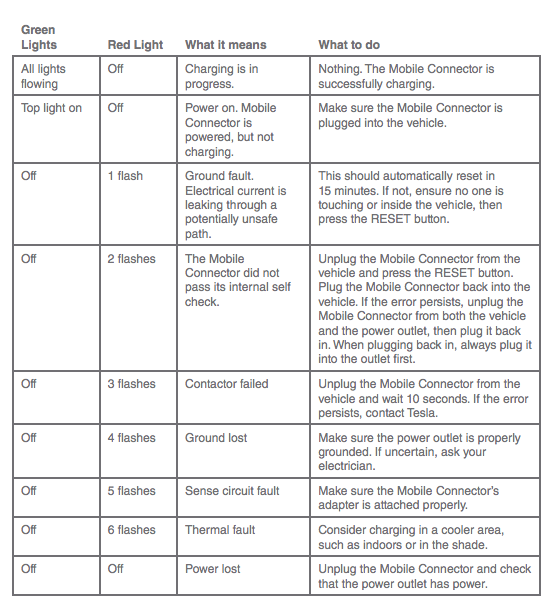
I can also confirm that if the neutral and line are not connected the way the UMC expects 120 Volts, then the UMC complains with 4 red light flashes and won't charge. 4 flashes indicates "Ground Lost" so I guess the UMC expects ground to be close in Voltage to the assumed Neutral for 120 Volts. I have a home made multi-adapter extension cord that swapped L1 and L2 by accident. I corrected the swap and the UMC charged my MS at 120 Volts/20 Amps just fine with the adapter feeding the extension cord, feeding the UMC, feeding the MS...
 �
�
Aug 5, 2014
earcandy I'm VIN 3340, with a B Battery, and get the same results.
The owner at Point of Rocks Campground in Prescott, AZ likes the idea of electric cars, but only has a couple 50 amps available, so I settled for a 30 amp just so I could test out my TT-30, since it wasn't too urgent. In the name of experimentation!�
Aug 6, 2014
dutch Wait "any" J1772? Also ones that are only30 amps like the Blink EV chargers? Also how do I know if our Tesla has dual chargers, my husband bought it and he is quick in ordering stuff and can't remember if he ordered dual chargers. I just checked and our car is currently charging on the Tesla HPWC at 240 Volt - 50 Amp. The car is set at 50 amp max., can I try and set the car to 70 amps to see if we have dual chargers or will that trip the circuit breaker.�
Aug 6, 2014
Cosmacelf He meant any J1772 charge station that can deliver more than 40 amps. If the charge station can only deliver 30 amps, then having dual chargers will not allow you to charge at greater than 30 amps from the station.
If you are drawing 50 amps from an HPWC, then you do in fact have dual chargers. The maximum you can charge at with a single charger is 40 amps from an AC charging station.
Whether or not you can charge at more than 50 amps depends on how the HPWC was installed. At installation, the electrician sets a dip switch inside the HPWC which limits its output to anywhere from 40 amps to 80 amps, depending on what kind of breaker he used. You can also limit current draw inside the car using the touchscreen. Someone might have just dialed down the current on your touchscreen to 50 amps for some reason.�
Aug 7, 2014
dutch Thanks, this is what is going on. We are planning a big road trip from Eugene Oregon to Amherst Mas and back again, figuring out where to best charge. I will contribute to plug share and post findings here. Will our Tesla with dual chargers automatically set the amp higher when encountering a charger over 40 amps or do I need to set it higher in the car? Can I ever set it too high and cause damage to the car?�
Aug 7, 2014
Cosmacelf No, you can't set it too high when using either the Tesla UMC with Tesla adapters or a J1772 charging station. The Tesla UMC adapters and the J1772 charging station has a mechanism to tell the car the maximum current draw it can give, so the car auto limits to that amount regardless what you ask it to do in the touchscreen.
In general, the car will try to draw at the maximum amount the charging station (or Tesla adapter) allows when you are charging at a new location, but it never hurts to check and potentially raise up the amount via touchscreen.
The touchscreen max amps setting is location aware meaning it'll remember what it was set at the last time you charged at a particular location and reset itself to that amount until or unless you change it.�
Aug 7, 2014
Cosmacelf For such a long road trip, I would highly recommend buying all the Tesla charge adapters that you don't already have. Of course, find hotels that you can charge overnight at...�
Aug 7, 2014
dutch Yea, doing that, actually overnighting at RV camps, one only has 30 amp and my 30 amp adapter will come in today. Going to test that one this weekend. Any suggestions for taking extension cords, I was thinking a 30 feet cord for emergency for the newer version dryer outlet or is it better to go with the old style dryer outlet. Should I set the amp lower when using an extension cord?. I figure that an extension cord for a normal 110V outlet isn't worth it after the voltage drop on the cord.�
Aug 7, 2014
Cottonwood 30 Amp RV outlets are only 120 Volts and will only give you a charge rate of 5-7 mph, almost not worth it; if you are going to spend the night at an RV Park really try to find 50 Amp service, and if possible, a cabin. A 50 Amp RV outlet is at 240 Volts and that will give you 28 mph charge rate, much more interesting.
If you get a 12 gauge or larger extension cord for 120 Volt outlets, you can at least get 3 mph and it works fine.
A 30 Amp extension cord for a dryer is lighter than a 50 Amp extension cord for an RV outlet, and is probably all you need. Get either a new 14-30 or old 10-30 cord, and make or have someone make an adapter to plug into the other; a 10-30 cord will be lighter because it has one less wire, and the 14-30P to 10-30R adapter that goes with it is safer. Older houses generally have 10-30's and newer houses generally have 14-30's. A 30' or so cord is probably what you need. The laundry room is often close to the garage and makes a great place to grab some Joules for your jewel; 17 mph charging can add up.
Enjoy!�
Aug 7, 2014
Cosmacelf 30A RV plugs are actually called TT-30 plugs. Tesla does not make an adapter for it. And they are indeed only 120V, giving you about 8 mph of charging. They work fine for overnight use, assuming you don't need a full charge. You would have to make your own adapter though. Instructions for that adapter and more are available here:
http://cosmacelf.net/Home%20Made%20Adapters.pdf
Obviously, if you can find an RV park that has 50 amp connections (those are 240V), then that is better.
Based on the poll results, it seems that there is about an equal amount of dryer plugs out there that are NEMA 14-30 and NEMA 10-30. So if you are planning on charging at a dryer plug, you need both adapters, and probably an extension cord since unless the dryer is in the garage, your 20' UMC cord won't reach.�
Aug 8, 2014
tiblot Yeah that's correct. @24Amps, you'll pull 8 MPH.
However, many cars older than 2014 seem to only charge @ 20amps, pulling something like 5-6 MPH.�
Aug 15, 2014
fluxemag Finally got to try out my custom made 14-50 to TT-30 adapter that I built from instructions on this site. I didn't need to charge really, but was at my parents' camp site nearby and wanted to give it a shot. I was limited to 20A like many others. I have a 40kwh car delivered in May 2013. Everything appeared to be fine, but then charging stopped after about 30 minutes and it said contact Tesla service, with the charge port red. I unplugged, plugged back in and got another few minutes before it stopped again. The TT-30 wasn't quite plugged all the way into the outlet, so I secured it better and things worked until I left a few hours later. Not sure if it was related/temperature type issue. At least I have the option to use it in a pinch, but not really all that useful at 6mph.�
Aug 15, 2014
GuyHall I think this info may have been lost as this string has grown.
EVSEAdapters makes this adapter for the TT-30 plugs. I just finished the T5:Tesla Tijuana To Tundra Tour, much of which was in upper BC, the Yukon and Alaska. I had more than 15 RV stops with most of them NOT having 50 amp (14-50) service. The most common was the 30A (TT-30, 110V). service. If you are going to use RV parks, this adapter is a must. It's also small and packs well. Here are pics from two of the campgrounds.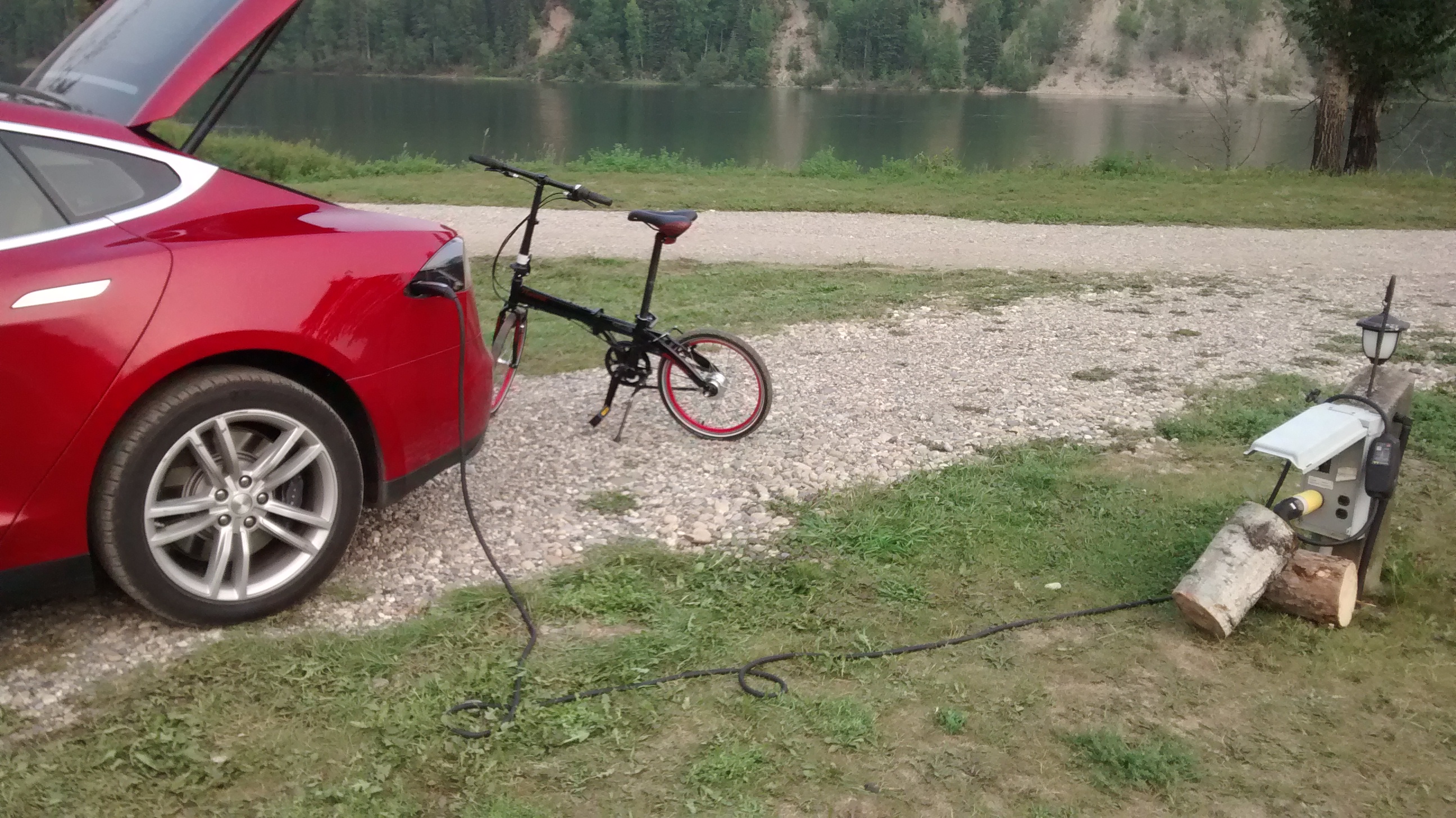
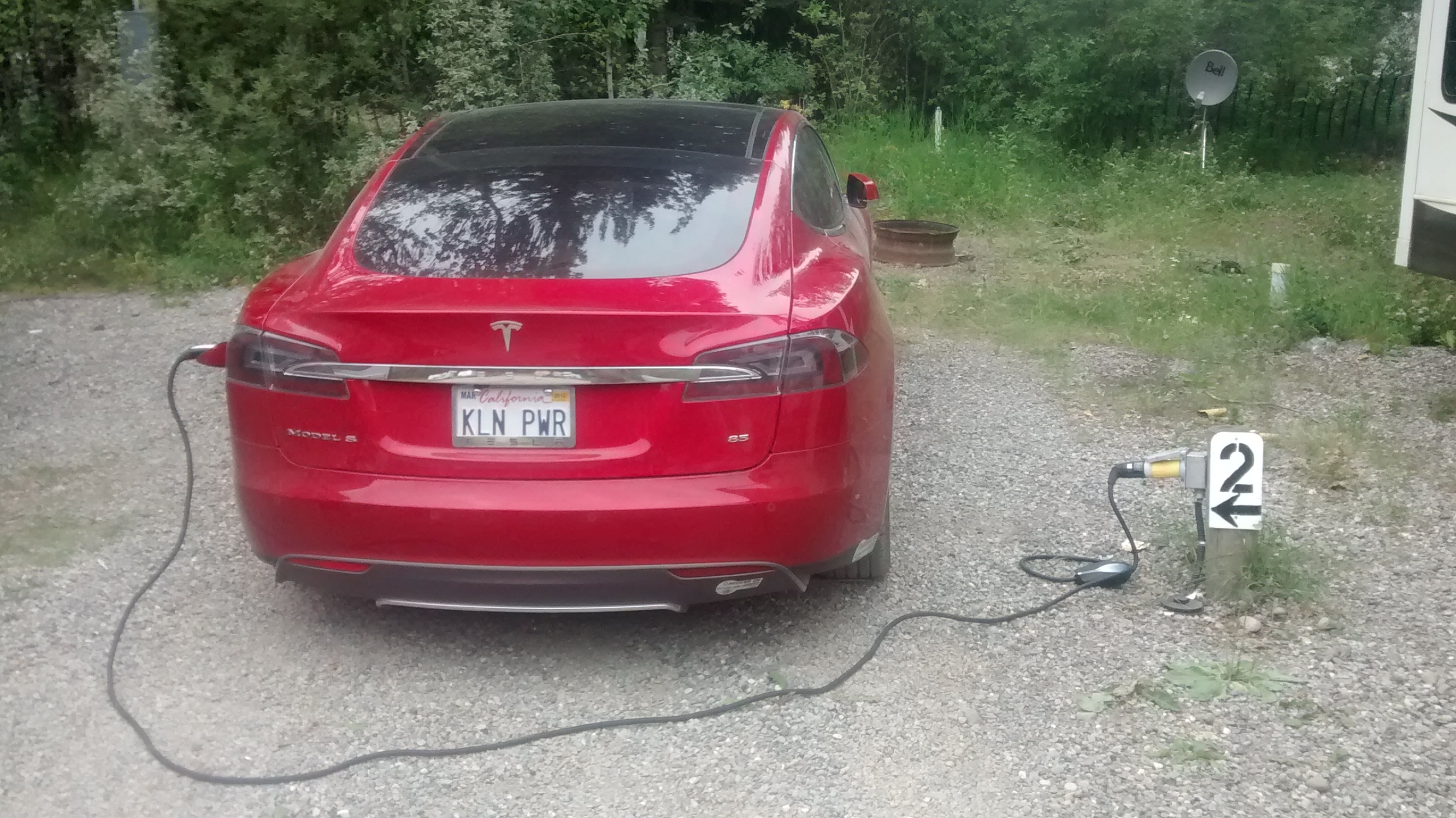
The only drawback is that the combined weight of the 14-50 and TT-30 adapters may be too heavy for the socket and you may need to find something to prop it up or wrap the cord over the top of the mount.
Remember that the TT-30 adapters sold for RVs will not give you the extra power this adapter does.�
Aug 16, 2014
Cottonwood
Wow! At 7 mph charge rate, it takes 30 hours to get 210 range miles of charge. Did you stay 2 nights at these places before heading on to the next location?�
Aug 18, 2014
GuyHall Sometime's that's the best you've got. I'd typically get 9 miles of range per hour on 24A. 15 hours overnight gave me 135 miles, enough to my next stop which might have 50A, 210V sites. Or I'd be coming through town and my next stop was barely within my range, so I'd stop for 2 hours to add 18 insurance miles.
Guy�
Oct 1, 2015
Tripple_T OK, since we last talked about the TT-30 on this thread, I opened a conversation with Tesla about the TT-30 and the 20A limitation on the older (pre-2014) cars. I went as far to send pictures of a newer Tesla charging at above 20A (got up to 30A, probably could have gone to 40A). As well as my car limited to 20A. Here is the results of the conversation:
Tesla: "I�ve reached out to engineering, and it appears that your vehicle is operating as intended. Your Model S , P031XX, is equipped with the first generation on-board charger and is intended to operate at a maximum of 20 amps when the voltage supply is in the 120 volt range. I wasn�t able to determine why the second Model S, P38XXX, does not have the same 120 volt supply limitation of 20 amps"
Me: "Did the engineering team say the older chargers could be software upgraded to support more? Could this be included in a future update?"
Tesla: "I wasn�t able to get a definitive answer to that, however it seemed unlikely"�
Oct 1, 2015
Cosmacelf Translation: the guy who wrote that crappy firmware has long, long left Tesla. We don't even have the source code for it anymore.�

Không có nhận xét nào:
Đăng nhận xét