Apr 1, 2016
viperboy
- Here's what we know:
- EM states base Model 3 gets 215 miles of range
- Model s Range is already published
- EPA Range for 70 is 230
- EPA Range for 70D is 240
- 90D is 288
- P90D is 270
- From one of the "first ride" videos, the driver states there will be single and dual motor options. Therefore we have to assume that the base model is a single motor unit.
Extrapolation:
I took some liberties here but I think my assumptions come out to a reasonable conclusion. The main assumption I came up with is that the Model 3 will be 20% more efficient than the Model S (due to a lower weight and lower drag coefficient).
Model S 70 (non-D) gets 3.285 miles per kw (230 / 70). If the model 3 is 20% more efficient, that comes to 3.94 miles per kw. Given the 215 base range you can back into a 55kw base pack.
- efficiencies of dual motor give you 4.11 mpkw, resulting in 226 mile range
The largest model S pack is 30% larger than the small pack. Applying this to the model 3, you get a large pack of 71.5kw. (This fits in quite nicely with a 70 kw pack they already designed, manufacture and sell). I applied the same math of efficiency to the 70kw pack and come up with 274.6 mile range for the M3 70D and a 257 mile range for the top of the line PM3 70DL.
Second exercise: Assume the model 3 is 30% more efficient:
- Base 50kw gets a range of 213.5
- 50D gets a range of 222.9
- 70D gets a range of 297.44 (Matching the specs leaked on electric.co)
- P70D gets 278.9
�
Apr 1, 2016
AWDtsla 20% reduction in drag area times reduction in Cd, plus other efficiency improvements. I assume 3rd gen inverter for more drive and regen efficiency.
I would guess 45-50kWh base with rated 210Wh/mi
I counted 8 bricks, with what looks like room for 2 more bricks under the rear seats. If there was 70% fill in the regular bricks, going to full bricks brings it to about 80kWh, or about 360 miles for the top model.�
Apr 1, 2016
WarpedOne Fairytale. That is higher efficiency than i3.
Motorcycle territory.
This is a car. Base is 55 - 60kWh. S60 had 208 EPA range.
Don't expect magical efficiency.�
Apr 1, 2016
smilepak I wonder if that is true and it aloe larger battery pack like 65kw or 70kw. That should exceed 280 miles if above Calc is true�
Apr 1, 2016
Rashomon Motorcycles actually suck at highway efficiency because their aerodynamics suck. A 450-pound Zero S consumes 15kW at 75 mph, not that substantially much less than a MS. The BMW i3 also has reasonably bad aerodynamics. It's tall so it's A is high even though it's narrow, and it's CD isn't anything special. It's CdA is about 0.7 meters-squared, 20 percent worse than a model S which is about 0.58 meters-squared. BMW designed it to be a city car, where its light weight really helps on an urban cycle. I've been assuming, based on the published rumors that Tesla was trying to reach a 0.20 or better Cd on the M3, that its CdA will come in about 0.45 meters-squared, so almost 20 percent better than a MS. We'll see, as no data to verify that was given yesterday, but it's at least conceivable that the M3 will consume substantially less power than a MS.�
Apr 1, 2016
SageBrush WAGs:
Cd: 5% improvement
Frontal area: 20% less
Tyres: 5% less RR
Weight: 20% less
Weight is not a clear variable to me when it comes to highway driving,
but overall a weighted 20 - 25% reduction in energy/mile seems reasonable.
4 miles/kWh strikes me as conservative,
4.5 miles/kWh would be a home-run
A a comparison marker, both the new Prius plug-in and BMW i3 are around 180 Wh/mile at 60 mph.�
Apr 1, 2016
SageBrush I find this photo a nice place to start guessing games:
![[?IMG]](https://lh3.googleusercontent.com/blogger_img_proxy/AEn0k_sOvURftnMyGfBWrFuU95m1COq3d_vca9CQ8XE9bfdSh7bsETJO8vJYeQzdJRNNYJA3Mr7EE9tOYC47YZWJ-clIKpFIEI0BNSntpmRY7kHgGVXLUjvL3fZNd9c4Qf1A=s0-d) �
�
Apr 1, 2016
CarlitoDoc I'm no rocket dentist, but wouldn't another factor to consider be improved efficiency in batteries? 2 years is a long time, things will likely improve.�
Apr 3, 2016
AWDtsla Elon just tweeted Cd of .21. Using the 90D as a model, that scales down the EPA consumption to 213Wh/mi.. I was only off by 1.5%, LOL.
Ok so 50kWh will exceed 215 miles..�
Apr 3, 2016
SageBrush Cd of 0.21 is a bit better than fantastic.
And all the more surprising given the air dam in front.
We can guess about 24 ft*ft frontal area, for a CdA of 5.04
Once we know car weight and tyre RR, we can get a good estimate of energy economy.
By the way, google says that a kWh of Li-x battery weighs about 6.7 Kg, so about 335 Kg for 50 kWh before packaging.
If my arithmetic is right, starting from
CdA - 5.04 ft*ft
Air density - 1.225 kg/meter_cubed
I get a power requirement of 7.3 kW to oppose the air at 65 mph.
If that is about half of total power, then ~ 15 kW to for flat road, steady state 65 mph travel, or 224 Wh/mile�
Apr 3, 2016
AWDtsla 20% smaller means 20% smaller. You're taking too little off the frontal area.
Pack should be lighter than Model S since we know Tesla is likely optimizing cell size (and therefore pack mass).�
Apr 3, 2016
Rashomon That Cd of 0.21 produces a CdA of about .47 meters-squared (maybe a little high depending on the A estimate), but that compares to about 0.58 meters-squared on the MS. I'm assuming new-generation tires will have a very exceptional rolling resistance coefficient of about 0.007, so the M3 will require about 15 kW delivered (after powertrain losses) at 75 mph, or roughly the same as a Zero motorcycle at that speed. That's assuming the base model weighs about 1750 kg (3850 pounds). It might be a little lighter than that. I think this all argues for a pack size under 55 kWh for the base model, maybe as low as 50 kWh depending on motor and inverter efficiency. I think the published rumor of a 65 kWh pack just might be referring to the big pack!
The Panasonic cells that Tesla are currently using weigh a little more than 4kg/kWh, and every indication is that the M3 will get new, larger, and more energy dense cells. That might bring the cell weight down to 3.5kg/kWh or less, so a 55 kWh pack would have 193 kg of cells -- or less. Tesla's current packs are fairly heavy relative to cell weight, and I'm sure they're looking at some improvement there. Perhaps the small pack will come in at 280 kg or better, maybe 60 percent of the weight of a MS large pack.
Again, we're not seeing a vehicle as efficient as an EV1, which was a moonshot effort in an attempt to make bad batteries work in an EV by improving efficiency everywhere -- but it's not that far off, and in an immensely more practical and visually acceptable (even beautiful) vehicle. It also tells everyone else that they have to go back to first principals. The Bolt and i3 are nowhere close to this level of efficiency on the highway. There's a reason Mercedes' last show car was one that achieved a sub 0.20 Cd! The Germans (at least at Mercedes and Porsche) certainly get it.�
Apr 3, 2016
Saghost That splitter on the nose has to be a big part of the reason for the low drag numbers, even if I don't understand it fully - there's no reason they picked it for appearances.
I think the 24 square feet is high - that's barely 5% less than a Model S, while the car is visibly lower and I believe is also narrower?�
Apr 3, 2016
Rashomon I'd love to have a width measurement . . . The A is almost certain to be within 10 percent of that of the MS, but we're just guessing right now how much less. 5 percent is reasonably conservative. As for where the low drag coefficient comes from, it comes from everywhere! You're looking at Tesla's aerodynamicists running CFD models on a supercomputer or near-supercomputer for 1000s of hours, and iterating with the structural engineers and the ID department to get the result Musk just tweeted. There's not a surface on the car that didn't change because of that analysis and those iterations. I've chased drag reductions on products before, and it's hard, tedious, iterative, and -- often -- non-intuitive work. And keep it in mind when all the aspiring car designers on the internet post sketches of how the M3 can be improved visually -- they're not having to work with the aerodynamacists!�
Apr 3, 2016
Saghost Agreed. The point I was trying to make, however poorly, was that Tesla would never have adopted that nose if they didn't think it gave them an advantage in drag - written in response to a prior comment which seemed to suggest the nose was causing more drag that they had to make up elsewhere.�
Apr 3, 2016
SageBrush I didn't know about the 20% frontal area decrease compared to the Model S. Do you have a reference ?
If true than the CdA of the T3 is 25.2*0.8*0.21 = 4.24 ft*ft
Wow
Using that number, a quick Google Doc spreadsheet based on the drag formula then gives
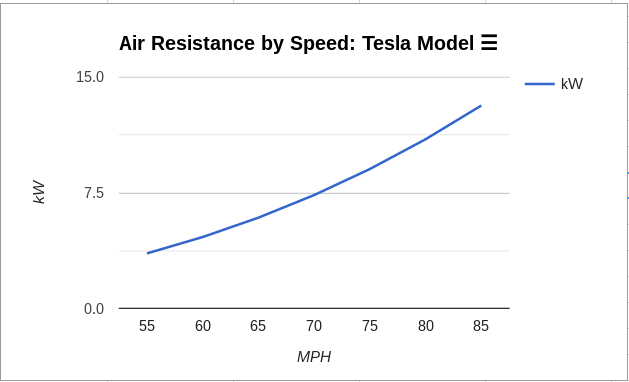 �
�
Apr 3, 2016
Rashomon Has he erased the Cd on Twitter already? I just looked and couldn't find it. I hope someone got a screenshot . . .�
Apr 3, 2016
AWDtsla Elon Musk on Twitter�
Apr 3, 2016
Saghost It's still there - it wasn't a tweet, but a reply, so you have to be viewing tweets and replies to see it:�
Apr 3, 2016
SageBrush Another Guess-a-graph, in case the frontal area reported by AWDTesla is optimistic:
Sea level
0.21 Cd
Classic drag formula
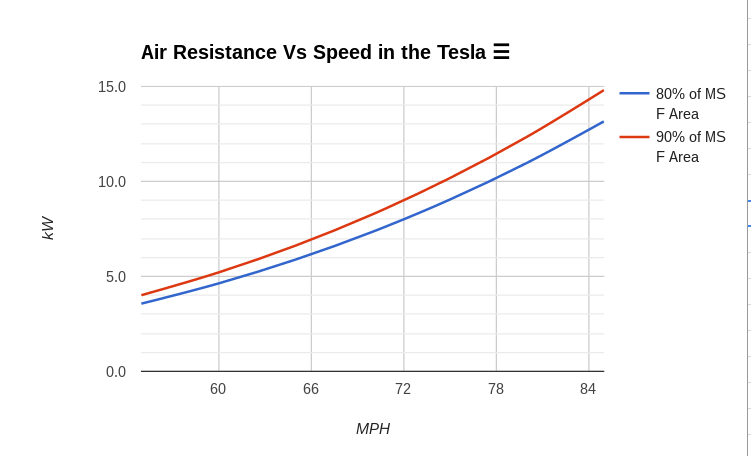
At 65 mph ( ?? ~ EPA ) and presuming a 15% unused battery, 45 - 50 kWh required �
�
Apr 3, 2016
AWDtsla 20% reduction in size has been mentioned several times in interviews. Since the car is effectively a surface, being mostly empty space inside, then that means both 20% reduction in structural mass and 20% reduction in surface area, including the front.�
Apr 3, 2016
SageBrush hmmm .... not so sure about that. I'm more inclined to think that 'size' is a volume with a width, height and length -- sort of like a long box. I'll not be surprised to learn that compared to the MS, the M3 height is a bit less, and the length quite a bit less, while the width is not that much different. The frontal area is of course not affected by the change in length.�
Apr 3, 2016
Saghost I'm expecting to see a decrease in all three directions, based on the pictures and video we have. The 20%/80% is more likely to be volume, though - which if it's balanced across the three would be 93% linear in each, or 86% cross sectional.
The two reference cars we've been told about are the BMW 3 series and Audi A4. The 3 sedan is 182 inches long, the A4 is 186. Compared to the S's 196, that's 93% and 95% respectively - which means if they really are reducing the *exterior* volume to 80% and modeling dimensions off of the above pair, the cross section has to fall to ~86% or a little lower.�
Apr 3, 2016
AWDtsla It's definitely less wide, we have comments from the event.�
Apr 3, 2016
SageBrush Sounds reasonable to me, so I'll avoid weighing down the thread with yet another graph and instead suggest eyeballing a virtual curve between the two plotted.�
Apr 3, 2016
Snowdog It also says "Hopefully .21". Also cars tend to be more consistent on width than length.
I expect it will still have 60KWh pack. Realize you use power just standing still on climate control, lighting, computers, sound, battery temperature maintenance etc...
So it isn't like you drop your drag by 20% and gain a full 20% in range.�
Apr 3, 2016
zer0cool I had thought maybe a 50kwh battery would achieve 215 miles. However given the battery size in the Chevy Bolt, I think it's harder to gain efficiency at the lower end, due to certain fixed energy usages and that the car's frontal surface area isn't really much less, etc. So I think it will be a 60 and a 80 battery.�
Apr 3, 2016
SageBrush I'm playing the game of estimating energy consumption per mile and pack size based on EM's statement of 215 EPA miles.�
Apr 3, 2016
Snowdog Yes, and I think you estimates are too optimistic.
Every percent of drag reduction isn't going directly convert into a similar reduction in pack size. You have all the residual, non motion drains. You also want a healthy reserve, probably even more healthy than before because you plan to ship a lot more of them, and a little more reserve is a little more protection against people complaining about capacity.
Even if you go with the most efficient EV on the market (Carbon Fiber i3) it would need about 58 KWh battery for 215 miles, and that doesn't count how much efficiency would go down given the increase in weight for the much larger pack.
So even 60 KWh might be too optimistic for 215 miles.�
Apr 3, 2016
Cebe i3 advertises 206.4Wh/mile (12.9kWh/100km) without the details on the speed, using 16.7kWh out of the 18.8kWh battery capacity to do 81 miles. Adjust that to 215 mile range, you get 44.3kWh. They should be able to do a 50kWh model and hit the 215 miles, but knowing what a disaster it would be dip under 200 miles, I'm guessing they're aiming for at least 55kWh if not 60 as others have suggested. Probably not worth the risk (to Tesla, dipping under 200 mile range) to save a few bucks on the base model...�
Apr 3, 2016
SageBrush If it helps, here are the numbers used for my estimates...
Then I (as my son loves to say) plugged the numbers into the drag equation for Wh/mile and then used
- Cd 0.21
- Frontal area 90% of MS
- 65 mph
- 50% aero, 50% other losses at 65 mph
To calculate the battery pack size.
- 215 mile range
- 15% battery reserve
�
Apr 3, 2016
Snowdog
I thought we were talking about EPA range, not advertised numbers.
i3 has a 22 KWh pack and delivers 81 EPA miles of range. So it is pretty straight forward:
215miles/(81miles/22KWh)= 58.4 KWh
EPA test heavily impacted by vehicle weight and there is no way the Steel/Aluminum M3 is lighter than a Carbon Fibre i3.�
Apr 3, 2016
SageBrush i3 has a much higher Cd, and I suspect a greater height as well.
Due to the low weight it gets great city energy economy, but much less impressive on the highway.�
Apr 3, 2016
Snowdog i3 is still about 10% better than a Model S on the EPA highway as well. EPA "highway" test has lots of stop and go. It is unrealistic to expect the Model 3 to come with less than 60 KWh battery and get an EPA range of 215 miles.�
Apr 3, 2016
omgwtfbyobbq Using that CdA, I'm getting ~11kW at 65mph assuming a ~4k lb car (w/ me in it) and 17" LRR tires (.007 Crr).
Aerodynamic & rolling resistance, power & MPG calculator - EcoModder.com�
Apr 3, 2016
SageBrush I apologize for being lazy and not checking the calculator you linked to. The general friction equation in wide use is:
tyres: mass*G*RR
air: 0.5 * rho * CdA * speed * speed
metric units
mass: kg
G: 9.8
rho: 1.225 kg/cubic meter
CdA: meter*meter
speed: meters/second�
Apr 3, 2016
Cebe I was getting the 18.8kWh number from the BMW site: BMW i3 : Technical Data, but I understand they also mention the 22kWh.�
Apr 3, 2016
Snowdog It's a 22 KWh pack, 18.8KWh is the amount they use from the pack. Just like Tesla won't use all of it's pack.
22kWh lithium-ion battery pack
It's straight forward calculation. Even the most efficent EV you can buy today would require almost 60KWh to have 215 miles of EPA range. And that would only be true if it gained no weight while upsizing the pack from 22 KWh to 60 KWh and we know that isn't true.
EPA test is heavily influenced by weight, both on highway and city numbers, so anyone fiddling around with numbers showing packs significantly smaller than 60KWh is just blowing against the wind.�
Apr 3, 2016
Cebe So, 18.8kWh at 129Wh/km gives about 146km, or about 91 miles, not 81. But, I suppose that's "this is what it can do" vs. EPA.�
Apr 3, 2016
ELRev Does anyone have/remember the figures on the original cost of battery upgrades on the S? I believe the original S started with a base 40kWh battery, with 60 as the upgrade. Is that right? I know they dropped the base model quickly cause no one was buying it, but does anyone know the history of the battery upgrade costs?
Right now, the 70D to 90D upgrade is $13000. Elon said earlier today on Twitter that the D upgrade on the 3 would cost less than it currently does on the S (5k). I'm trying to piece together as much info as I can to find the right direction for my upgrade options given my budget.�
Apr 3, 2016
zer0cool I am thinking D will cost 3k more instead of 5. So that's 38k. I think it's reasonable if the higher range version is 20kwh more, it would be around 50-52k, with 0-60 at around 4.7, to compete with the likes of 340i or C43.�
Apr 3, 2016
Snowdog Yes, and it is EPA range we are talking about, not Wh/Mile at set speeds. It's a lot of stop and go and the weight penalty brutalizes range.
The i3 is currently the most efficient car on the road, tested by the EPA
i3
~2600lbs/22KWh/81 mile EPA range. = 3.68 mile/KWh, for 215 miles = 58.4 KWh.
It would be freaking amazing if the Tesla M3 which will probably weigh 1000+ lbs more, could actually come near the i3 efficiency.
It's total fantasy to think it would be significantly better than the flyweight i3.
The M3 pack will be at least 60 KWh.�
Apr 3, 2016
omgwtfbyobbq I think it's possible. The S85 is already more efficient than the i3 at a steady cruise.
http://avt.inl.gov/pdf/fsev/fact5658bmwi32014.pdf
http://avt.inl.gov/pdf/fsev/fact4500tesla2014.pdf
The weight difference between the S and the i3 is why the i3 gets better mpge ratings. If Tesla can shrink that difference to ~800lbs while substantially reducing CdA, the 3 will likely have a higher EPA rating than the i3.�
Apr 3, 2016
cokata One thing you are forgetting that the motor and inverter should me more efficient too. I would also expect more than 60kw regen being available. The Model 3 will be lighter so it should also have narrower tires. Combining lower weight with narrower tires will equal a substantial reduction of rolling resistance.�
Apr 4, 2016
rEVhappy If the S60 has an EPA rating of 208 miles, then a 4% efficiency improvement cumulatively due to the motor/inverter/battery pack improvements will give the 3 a range of 215 with a 60 kWh pack.
This is not counting lets say a weight loss of 10% (due to higher density, smaller physical pack, smaller dimensions), less frontal area, slight bit less rolling resistance, or 10% improvement in cD, and little things like less power draw for electronics(ie; single 15 inch monitor, fewer LED's, smaller standard speakers), more efficient cooling/heating ventilation system(mentioned in test ride), etc.
Considering all those factors, a 55 kWh battery pack may be able to do 215 miles, and works out to be just about 20% less than a 70 kWh currently offered (70 kWh minus 20% is around 56 kWh).
Also using the weight density of the old 85 kWh pack, a 55 kWh pack will weigh in at most 776 lbs and a 60 kWh pack will be at most 847 lbs. Going from a 55 to a 60 kWh pack gains at most 70 lbs. So, question we have to ask is have they made enough efficiency improvements altogether to shed another 50-60 lbs (remember this is Tesla, they don't include a spare; reason being the weight will hurt range) and just go with the 55? This will also give them some bragging rights saying they can do more with less compared to a Bolt.
I'd like to go with a rough number like 58 but Tesla plays with increments of fives. So, I'll just go out on a limb here and say they'll go with a 55 rather than a 60 (More with less as their motto) if they have made enough efficiency improvements throughout.�
Apr 4, 2016
maekuz Which means Tesla will sell the base model with a battery pack of 60 kWh and handily beat the Chevy Bolt and any other BEV at that price point.�
Apr 4, 2016
PeterW Elon's reply was "hopefully 0.21", which to me means that is what they are trying to end up with. So the current range of 215 miles is not with a cd of 0.21 but the base range will improve if they can reach 0.21�
Apr 4, 2016
rEVhappy IMO, the 3 will be more efficient than the i3 during stops (less power draw), steady cruise at 55, 65, or 75 mph (due to lower cD), and possibly during regen braking (more mass, more aggressive regen?) only losing out to i3 during acceleration runs on the EPA cycle (due to weight). Little things like how often and hard they accelerate during those acc. runs will give us a good hint as to what to expect. But if even half the EPA cycle is steady state cruise with plenty of stops, the 3 may be able to do it with a 55 kWh pack.�
Apr 4, 2016
cokata 215 mile range should be doable with 50-55kwh battery. It also depends on how much of the battery capacity is usable. It might be an 50kwh battery but with bigger usable percentage of that, so at the end it will not have much less energy than the old 60kwh battery.�
Apr 4, 2016
ZBB While you can't buy a new Model S 60, keep in mind that it's EPA rating was 208 miles. 215 is 3.3% higher -- and low rolling resistance tires get close to providing a 3% efficiency gain.
The Model 3 will be more efficient than a Model S... Battery will be either a 50 or 55 depending on how comfortable Tesla is in beating the 215 minimum target.�
Apr 4, 2016
rEVhappy Is this true? Not saying I don't believe you but has this been proven/verified with some aftermarket low resistance tires? If so, I think it's a given the 3 will have at most a 55 kWh.
All things being equal (even weight), if the S60 had a 55 kWh pack instead, it would have had 190 miles of EPA range, so consider that they have to make up just enough ground for 25 more miles. Sounds pretty easy given 10% reduction in just weight and cD*A.�
Apr 4, 2016
schonelucht Let's do physics : there are three components of work an electric car in motion needs to deliver. The rolling resistance from the tires, the drag resistance from moving through air and finally the static load like keeping the battery and car itself at temperature.
For a model S 85 I take weight 2000kg and tire rolling resistance coefficient 0.009, frontal area 2.35m^2 and Cd of 0.24. At 80km/u we get for the rolling resistance 80/3.6*m/s*2000kg*9.8*m/s^2*0.009 = 3920W. For air drag we get 0.5*1.225km/m^3*(80/3.6m/s)^3*2.35m^2*0.24 = 3790W. Assuming a model S using 78kWh travels 500km at that speed=6.25 hours. So it really draws 12480W from the battery. Substracting air and tire resistance that gives us 4770W for the static load.
How do all these numbers change for a model 3 that's 20% smaller in volume?
Rolling resistance scales with weight which we assuming more or less equals volume : 3136W. Air resistance Cd becomes 0.21 and frontal area becomes 85% (=0.8^3/2) of 2.35m^2 = 2820W. Let's assume 300W of the static load is indifferent of the car volume (on board computer system, screen, lights, ...) and the rest scales with volume (AC, keeping battery on temperature, inefficiencies in inverter, ...) = 3876W. Total power draw of the model 3 according to this model = 9832W. To reach equivalent S85 range (500km at 80km/h steady state) we'd need 61.5kWh plus bricking reserve. Let's be generous and say 70kWh. The model 3's base range is more like a S60 range. Proportionally this comes down to just under a 50kWh battery.�
Apr 4, 2016
rEVhappy A lot of the things you mentioned DO NOT scale with weight or volume though. And a 20% reduction in volume doesn't correspond with a 20% reduction in weight, power draw, etc. either (If only life were this easy, haha) I'll be amazed if they can pull it off with a 50. Highly improbable.
Also I think it's best to use the EPA test as the standard which as mentioned has a lot of stop and go, not just steady state cruise�
Apr 4, 2016
rEVhappy Let's also be optimistic and say Tesla can get the cost per kWh down to $100 by 2020. That means they save at least $500 per car if they drop down 5 kWh per any given model 3 they manufacture. If they make 500,000 model 3's by end of 2020 (not all in one year), that's a net savings of at the very least $250 million! And that's just on the model 3's alone.
This is as much savings as they got in deposits these past few days, so imagine all the deposits disappearing. That's the cost of going to a 60 kWh. I'm sure they have thought about the savings and are trying any which way to make the car just a wee bit more efficient to eke it out with a 55 pack at least for the first couple years.�
Apr 4, 2016
scaesare Yet it seems they flubbed the Model S drag area?
If the Cd and frontal area numbers are correct, the drag area should be 6.0 ft^2.
�
Apr 4, 2016
schonelucht It'd help me understand your point if you could be specific and argue how each individual component would scale instead. I agree there is a case to be made that some parameters will rather scale with the cube-square root instead. That's 85% instead of 80%. Total power draw would then become 3332W + 2820W + 4100W. That puts us at 64kWh before brick protection. But I took a very large brick protection : 9kWh (more than the current 85 model S) partially to offset this low ball number. 6kWh is an equally likely reserve so I think my numbers in the end up hold up pretty well.
I am looking forward to your model.�
Apr 4, 2016
SageBrush Nice catch! Either their arithmetic is off or Cd and/or frontal area is wrong.�
Apr 4, 2016
SageBrush At fueleconomy.gov the window sticker is reported as 250 Wh/mile city, 300 Wh/mile highway.
At ~ 65 mph, aero resistance is about half of the total. Since the M3 might weight some 50% more than the i3 but the i3 has a 50% greater CdA, that would suggest that the T3 will end up having a similar highway energy consumption of 300 Wh/mile. Note however that this includes charging losses, so the on-road consumption is around 85% of that amount, or 268 Wh/mile. If we say that 15% of the nominal battery capacity will be a reserve against bricking, we are back to 300 Wh/mile.
This is considerably more than the drag equation suggests, so there you are. Pick you favorite number and make yourself comfortable for the wait ;-)�
Apr 4, 2016
Snowdog Yes. My thoughts exactly.
They are not fighting to shave 5KWh off the pack.
They put in a 60 KWh pack and keep refining the car towards production. Today they know they can achieve ~215 miles with the prototypes, and think they can do better with the final production model.
I think this is more about where final range lands with a 60KWh pack, than about how much they might shave off the pack.�
Apr 4, 2016
Rashomon I actually threw some numbers into a model, and only at about 30 mph or below is an i3 likely to be more efficient than a M3. Even at 40 mph, an M3 uses less power than a non-REx i3. Aerodynamics kick in quickly. The assumptions are about .47 meter-squared CdA for the M3, 0.7 meter-squared for the i3, 1250kg and 1750kg for respective weights, and 0.007 rolling resistance for both. The i3 already has pretty special tires, and what Tesla has asked Michelin for -- based on Michelin's public comments -- are likely to be at least as good. Low rolling resistance minimizes the effect of weight differences. I would bet a very large sum of money the base battery in the M3 is 55 kWh or less. And I suspect I'm a little conservative on the M3 CdA, as I'm using an A that's conservative.�
Apr 4, 2016
rEVhappy Your assumption that a 20% reduction in volume will correspond to a 20% reduction in weight, which will then correspond to a 20% reduction in rolling resistance, power draw from components like AC, battery cooling, etc doesn't quite work out so cleanly in the real world. If there were a bigger sample size of ev's using Tesla's components other than the S and X, I'd gladly show you a 'model'.
And EPA testing isn't done at steady state 80 km/h cruising, so your initial premise is flawed.
IMO the fight to 'shave off' 5kWh was done quite a while ago. Otherwise, why would the improvement over a S60S be a mere 7 miles. That's only a 3.3% improvement in 5 years. With lighter overall weight, better overall battery density and efficiency, better Cd, smaller footprint for less frontal area, small improvements in motors/inverters, and other incremental improvements, all they could pull off was 7 miles? That's a pretty conservative estimate, and Tesla usually doesn't do conservative. Just my 2 cents.�
Apr 4, 2016
SageBrush Ahh ... OK. I am wrong on the weights.
So if the M3 is about 1.4x heavier and about 0.667x lower Cd
Then if all else is equal and the energy split at 65 mph is 50% aero, then the M3 will be about 1.4*0.667 = 0.924x the i3 highway energy consumption.
At i3 of 300 Wh/mile, that puts the M3 at 277 Wh/mile.
The EPA number includes about a 15% charging loss estimate,
so the on-road energy economy works out to 277*0.85 = 235 Wh/mile
My estimates are starting to converge�
Apr 4, 2016
Rashomon This also points to the future of the MS. It's due for a substantial refresh by the time that the M3 is in production. I think a redesign will address issues addressed with the M3 (more rear seat headroom) and go for similar efficiency improvements. It is, after all, generally easier to get a lower Cd with a longer vehicle. If it gets a redone pack with the new more energy dense cells at the same time, I think the top of the line MS is likely to see a very substantial range increase, on the order of at least 25-30 percent. That will help justify the price difference with the M3.
And, guys, don't use standard assumptions that at 65 mph aerodynamic drag is half the load. With low-rolling resistance tires, the cross-over where aero equals rolling drag is more like 45 mph for a M3, and that's very dependent on weight, CdA, and tire characteristics for a given vehicle. By 65 mph, well over 60 percent of a M3's power will be overcoming aero loads.�
Apr 4, 2016
Snowdog Is it really 5 years, do we see example of improvements in most recent Tesla Models? They would have modern electronics, not 5 year old electronics. Results for the electronics are already great, so this is diminishing returns.
Again, (as you noted) not talking about aerodynamic dominated steady state cruising here. EPA is dominated by weight, not Aerodynamics, as even the EPA Highway test has a low average speed and many stops.
The bottom line is that a ~3600lb Tesla is unlikely to leap ahead of ~2600lb i3, on a weight dominated test like the EPA combined range.�
Apr 4, 2016
Rashomon
These are the actual test cycles. The M3 is going to spank the i3 in the Highway cycle, even though it's much, much lower speed than current real world highway use, at least if you're not in the Northeast US or someplace like Sweden with very low speed limits. It will lose in the urban cycle to the light weight of the i3, though good regeneration helps take the edge off of weight differences. The combined is likely to be pretty close . . .�
![[?IMG]](https://lh3.googleusercontent.com/blogger_img_proxy/AEn0k_vkfpkNacSbY13zNQqd2mtCd0rgX_2NkiXzzo2mASSaZrmWIQG80NRo-_39fMkQLg8OzuQqOPZ0DOaJeR2R6zfsWwto1z6D3Ya_u2vaVBDzwxbVJnBcPU8B3247ifLK9DkVtat1p54alD8PI6bFGGCOIaKrSMxtu_y5jHBsOY8ZC514=s0-d)
![[?IMG]](https://lh3.googleusercontent.com/blogger_img_proxy/AEn0k_vy6em3wU7NrW1IjJ-NKTJV10YGEaGXkzOAQTk0wZCRGRG-rdBVfcAF-IU2vHI-59VMK8BQaE3G4s2VJMfC0S9Tx8QtOxCrZddqc_DVvfHU0ZCbtnylBjsVY2YfSGYwoY4JmCTcInBJeTXI=s0-d)
Apr 4, 2016
Snowdog There are 5 cycles. AFAIK, the AC cycle and High speed cycle combine with your link to create the highway numbers. So there are stop/accelerations mixed in as well.
When all is said and done the final EPA combined number is heavily weighted to stop and go driving, and a fairly low overall average speed.�
Apr 4, 2016
SageBrush Yes, 5 cycles, but IIRC only three are used for the 'highway' number. Do you remember if the cycles are equally weighted ?�
Apr 4, 2016
Rashomon No they're not. The old "55-mph" highway cycle seems to be about 81 percent of the highway portion, but then it's blended again with the AC test, reducing the contribution. See page 92 of: https://www3.epa.gov/carlabel/documents/420r06017.pdf. The formula is somewhat complex. The EPA also seems to allow -- at a company's discretion -- use of the original two cycles with a correction factor for the post-2009 fuel-economy ratings for EV autos, but you really have to dig through a lot of regulations to see what is actually required. And anytime there is discretion, someone will start gaming the system.�
Apr 4, 2016
aronth5 ] View attachment 170732 Interesting video put out by Teslarati showing the large 3D CAD rendering displayed behind Elon. Slowed down the video and it highlights a lot of good information.
At 7:26 is shows the cell sizes are larger using 8 battery modules going length wise compared to the S and X which are side ways.
Plus lots of other great info from the test ride earlier in the video.
�
Apr 7, 2016
Thomas Edison So if they aren't using 18650's then what are they going to use?
�
Apr 7, 2016
MP3Mike New cells that they are designing and producing at the Gigafactory. (They said that they were sizing them to maximize the energy density.)�
Apr 7, 2016
aronth5 Speculation is the 18650 cell format will be replaced with something like a 20700- format (20 mm diameter, 70 mm length) so roughly 10% wider and taller.�
Apr 7, 2016
Snowdog Yep and that gives you over 30% more volume, and thus 30% more capacity. Depending on current spacing they might have enough room to squeeze in nearly the same amount of cells, or say 10% less cells, they still get a net win.�
Apr 7, 2016
Thomas Edison Interesting
![[?IMG]](https://lh3.googleusercontent.com/blogger_img_proxy/AEn0k_tLNXNq6X7C58FmtTNlQEgdw-se09MhXDqJcq2HZ4VpDlfGfG07jt_zE1iycGUVmyuKfMnvDozOs5q6-4d3Es5qCeAjGgN5wOTlu3yQ1SnmzI-8NyXw=s0-d) �
�
Apr 7, 2016
SageBrush Back to the drawing board ...
Comment deleted�
Apr 9, 2016
LargeHamCollider Some good discussion, I ran my own M3 numbers well before the reveal under the assumption that Tesla's EPA range target was around 230mi. I calculated a ~55kwh battery was needed to hit that figure.
Rather than present my own numbers I'll second Rashomon's, they're very good, and I'll add that much of my data was adapted from this Tesla document (and yes it is data straight from Tesla): Roadster Efficiency and Range Excel File
Also by way of speculation I'm guessing that tesla goes from 18650 cells to 18750 cells, it's the height that constrains Tesla and keeping constant radius minimizes the reduction in cell power density that comes with increasing cell size. 8 Model S modules of 18750s would get you ~50kwh which is what I guess M3 will start with.
The argument that Tesla will want to match Bolt's 60kwh pack has some merit though.�
Apr 9, 2016
MP3Mike They have actually said that the new cells will be ~20% larger in both directions to maximize energy density. So expect them to be something like 20750 cells.�
Apr 11, 2016
Jayc Can someone summarize the best guess so far with regard to battery size and price ?
I am probably going to go for the lowest spec AWD version, any thoughts on what the battery size and price of entry AWD will be ?
In the UK, from April 2017 there is going to be an annual surcharge tax imposed for cars over �40,000 and I am hoping I can just about get into Model 3 AWD and also avoid the tax.�
Apr 11, 2016
LargeHamCollider You will be fine unless the pound seriously plummets, base plus AWD will be less than $40,000 USD per Elon tweet on AWD price.
There exists significant disagreement on base battery size, personally I'm quite confident it will be 50-55kwh; but who knows what it will be marketed as...�
Apr 11, 2016
Ubbe That, and most important of all -to enable decent Supercharger charging times. I don't believe Tesla will settle for "good enough" when it comes to key features like that.�
Apr 11, 2016
Rashomon The base M3 will be the 'good enough' model, like the S60 was. It will have the smallest acceptable pack, because even at $125 to $150/kWh, 5 or 10 kWh is a huge cost adder. When you're trying to hit an aggressive price target, 'good enough' takes over unless the feature has immense marketing benefit. In the case of the M3, 215 mile range (which will probably be 220-225 when they're done) is 'good enough' -- and actually superb by the standards of near-term EV competition. If Tesla can save $625 to $1500 on OEM cost with the minimal pack that meets that range, they will. Remember, the bigger pack will be available at a price that will increase Tesla's margins while satisfying customer's wants and relieving pressure to make the base model better. I would bet with any one individual on this forum who wants to take the wager that the pack comes in at under 55kWh.�
Apr 11, 2016
Zoomit Something else to consider is that they may be aiming to have the Model Y use the same battery as the TM3. That vehicle would be heavier and draggier, but it also needs to comfortably beat 200 miles in range.�
Apr 11, 2016
Rashomon Assuming the bigger pack is 15kWh bigger to put range at about 280 miles EPA, it's cost delta to Tesla might be around $1800-2500. They could make it a $5000 option with a very positive effect on margins, though I suspect they may be greedier. They'd bracket the Bolt with a car that gets better range at a $2500 lower cost, and one that just kills it on range and passenger room for only $2500 more. The twin motor model, assuming increased efficiency, might get close to a 300 EPA mile range.�
Apr 12, 2016
cokata i expect the highest end models to have over 300 mile EPA range and ~500hp. The one thing they need to fix is the cooling. Now probably it won't be a problem for the base model, but it will be embarrassing if the performance versions suffer from the same overheating problems as the Model S does.�
Apr 13, 2016
nd4spd569 I'm just hoping that the larger battery isn't a 20 mile improvement over the base like the x. I'd want at least 50 improvement.�
Apr 14, 2016
MP3Mike Why would you compare to the X which is a bigger heavier SUV? If you look at the S it goes from 240 to 294, for a 54 mile increase, which is probably more like we will see for the Model 3. (I think we will probably see an even larger range increase.)�
Apr 16, 2016
Saghost Might already be fixed. Have you seen the reports from folks that took Ludicrous cars to the track? Apparently it is much, much harder to get a Ludicrous car into power limiting (which presumably indicates that the primary purpose of the power limiting was to protect the battery pack main fuse.)�
Apr 27, 2016
rEVhappy From recent news, it's very likely 60kWh is out for the base model. Only question is by how much? I'm still going with 55kWh, unless Tesla abandons their increments of 5/10kWh tradition.
Assuming Tesla's battery costs are ~$180/kWh, this will be a savings of $900 per car for Tesla, not an insignificant figure for what will already be a low margin (appx 10% profit) car.�
Apr 27, 2016
dhanson865 Musk and JB have said that Model 3 will be closer to 20% profit. They've repeatedly said cheaper doesn't mean low margin even if margin is a couple of percent lower than model S they will have a markup for optional features.�
Apr 27, 2016
rEVhappy I was mainly referring to the base model. I do not doubt that an AP equipped dual motor with a larger pack will ring in 20%+, but the $35k model (possibly $37,500 with AP) will not have the same margins as a well equipped model.�
Apr 27, 2016
dhanson865 And while I'll agree that a stripped Model 3 will have lower margin than a fully optioned Model 3 I don't think they'll leave it as low as 10% on the stripped model.�
Apr 27, 2016
rEVhappy Switching on Autopilot at say.. $2500 (which I'm assuming will have a very high take rate) will put them at over 19% instantly.�
Apr 27, 2016
rEVhappy Let's also remember that the Volt engineer on the earnings call (who was indirectly responsible for the new information by Tesla) expected the Model 3 to have a 60 kWh pack and for it to break even at $36500, so he figured the base car will be a loss leader. So we do have to assume that all the costs incurred in R&D and tooling will not give Tesla as much wiggle room to eke out 20% on the stripper model.�
Apr 27, 2016
dhanson865 Pick your attitude then, you can't have it both ways.
Either they are selling the vast majority of the cars at 20% profit or they aren't. Why mention your theory of a low margin for the stripper if you think the vast majority will be above 20%?�
Apr 27, 2016
ken830 We know actual margins of the Model S vehicles that people actually buy, but do we know the margin for a base-no-options car? Now? Back when the 40kWh and 60kWh were available?�
Apr 27, 2016
rEVhappy This has nothing to do with my 'attitude'. I primarily mentioned the base stripper car for $35,000 because that's what most of the discussion and back n forth in this thread has been about. It is pretty damn obvious that the base car will be low margin, while the higher optioned cars will be higher. This is how it works throughout the entire car industry.
Why I'm mentioning the low margin car is due to speculation on the base pack for the absolute base car and the costs associated with making that happen, just in case you weren't paying attention to this thread. Even the Chevy guys were thinking the base $35k car will be a loss leader, and we know that even an addition of an extra 5Kw will add appx $750-$1000 to each car. Back track in this thread if you have to, and drop the personal comments.�
Apr 28, 2016
Rashomon There's a big difference between cell and pack level costs. Tesla/Panasonic equivalent cells have been under $175/kWh for some time. I got quotes based on 10 MWh/year 15 months ago, and they were at that cost or a bit lower then. Tesla buys orders of magnitude more cells than that, and I'm sure they've driven Panasonic's margin down to perhaps single digits. The Japanese think strategically in rapidly expanding markets, and will price to be one of the gorillas when the growth phase is over -- then they'll have more pricing power.
Packs are complex, and add substantial cost. It's impressive that Tesla is under $190/kWh with current product, but not really very surprising. If the gigafactory drops costs by 30 percent as they're claiming, they may be down to $145/kWh before too long at the pack level. I still think the small pack for the 3 will be between 50 and 55 kWh (now with some Tesla support for that position), and deliver an EPA 5-cycle average that squeaks past Musk's 215-mile range claim. The fact the car will be very aerodynamic will mean it will do better range at 75 mph on the highway with say 52 kWh than a Bolt with 60 kWh. The Bolt may have better pure urban range. The big pack for the 3 will probably be 30-35 percent bigger, priced under $10000 (perhaps substantially under), and give somewhat less than 300 miles EPA range. By the time the Model 3 is fully ramped, Tesla could easily launch a true second-generation Model S with similar efficiency improvements and well over 400 miles EPA range, justifying the price difference.�
Apr 28, 2016
Fred Thompson I would like to see Tesla engineer the battery packs into modules that can be easily added or replaced. The engineering could include plug and play where the system recognizes an added module(s) and balances the system accordingly. Using modules would save money when there is a failure where only the bad module would need to be replaced and Tesla would benefit from increase sales by selling additional modules as customers want more battery range.�

Không có nhận xét nào:
Đăng nhận xét