Nov 29, 2013
dm33 This thread is NOT intended to debate if there is an increased fire risk from collision with road debris. There are plenty of other threads to discuss that.
This thread assumes that there is an increased risk. If you don't agree, debate it in other the other threads.
The question here is, if you assume an increased risk, what are the possible outcomes of the NHTSA investigation?
Possible outcomes I can think of include:
1. NHTSA decides to do nothing. Increased risk is deemed acceptable. There have been no injuries so far. Crash test results have been excellent. No markedly increased risk of injury. Possibly state an increased risk of damage or maybe a slightly increased risk of injury but nothing significant enough to warrant any changes to the vehicle.
2. Some action required of Tesla. Could be as simple as raising the default height, which Tesla has already done. Or a requirement to further reinforce the battery, possibly with a steel shield, more compartments, additional fire retardant, etc. This seems to be the biggest question. What can reasonably be done to improve its fire resistance in this type of accident and is NHTSA likely to require some action.
3. NHTSA declares the battery technology too volatile or requires a level of battery protection that is an unreasonably large design change to the model S, such as requiring it be moved from the bottom of the vehicle.
I tend to think its #3 that the market is worried about. If this were to occur it might mean the end of Tesla. This does not look like a realistic outcome. NHTSA would have little to stand on to require a major change to the Model S given its safety record regarding injuries. I would assume the benchmark should be: is there a significant and blatant safety defect that can be reasonably corrected that puts the Model S at clearly higher risk of injury vs. an ICE. That bar is no where near reached. This outcome thereby looks highly unlikely.
If #2 occurs and NHTSA requires some action, what is the likely effect to Tesla stock? If its a minor change such as raising the car height, then the stock may rally. If its a more complex but still minor fix, the financial impact of slowing production and raised costs would factor into the equation. Stock may stay where it is or go down slightly. A more significant change would affect the stock more.
If #1 occurs, the stock should rally.
Thoughts, comments? (Assuming heightened risk. If you don't agree debate in other threads)�
Nov 29, 2013
tray loader IMHO it will lead to a reinforcement of the bottom, but not a severe recall.
� with a recall BOTH parties, the NHTSA and TSLA will loose their face.The NHTSA for negelecting the teething problems of a vital field in worldwide future transportation technology and/or being not up to par to a new technology at all.The documents of the lockheed subsidiary in New Mexico who`s running the torture tests for the battery industry already showed a severe delayed reception in this field.
TSLA for listening to bean counters and wall street instead of customers.So they�re all in this together and some behind the scenes negotiations going on.
� a shutdown and bancrupcy of TSLA will politically and geo strategically never happen.It�s one of the last innovative hardware fields of the USA, the only alternative amongst the "not willing to move auto industry".This would run much deeper than to merely loose a company.SpaceX would get hurt, Obama would loose his face.Tea party would have the last word. Won�t happen.�
Nov 29, 2013
ItsNotAboutTheMoney NHTSA is not going to put in a one-for-them rule. Anything rule change would affect new cars. Theee are a number of low-riding cars affected by debris.
Road debris is a known problem, and it is also known to cause direct injury through piercingthe floor. I suspect they'll be happy with the results of increased default ride height and user configurability. (At 11/29/2013 it's 23 days since last fire). But I'm sure they'll also work with Tesla to see if they can agree an easy enhancement because that's something that'll look good politically.�
Nov 29, 2013
Raffy.Roma + 1.�
Nov 29, 2013
Zythryn Without knowing what their investigation concludes, speculation about what they will do is pointless.
You basically are speculating about speculations.�
Nov 29, 2013
Chickenlittle You start with the assumption of increased fire risk. I assume your next post will be let's assume that the aluminum in teslas rust. Looking at your past comments is very instructive to see the purpose behind this. Also believe once you put a post out there you cannot tell people how to respond. It is very worthwhile to point out that there is no evidence of increased risk of fire yet and hence your postulate is speculation at best�
Nov 29, 2013
AudubonB This is a terrific thread.
It belongs right up there with the "IF you are to be commended for no longer beating your wife, how might your parole officer be treating you"?
Or,
How do you spell "agenda"?
Sheesh.�
Nov 29, 2013
NoMoGas I object to this entire thread. It's beyond ludicrous to "assume" there is an increased risk... THERE ISN'T. There is a reason Elon Musk ASKED FOR the NHTSA investigation, to put this nonsense to rest.�
Nov 29, 2013
EnergyMax Exactly. People are clearly not understanding risks and overall safety. If there are any directives placed on Tesla, then the logical followup is that all ICE manufacturers will go bankrupt with the corresponding recall.�
Nov 29, 2013
Raffy.Roma I agree with the last posts. My previous post meant that there will be no recall because the starting hypothesis of heightened fire risk is wrong.�
Nov 29, 2013
Norbert The next step is a trolls-only thread.
None of the numbers we have support any theory that the risk is "heightened". The risk is just *different*, subject to different causation.
I have no idea what your real intent is with this thread, but it sounds like using sugar-coating and formalities, to get a foot in the door for this forum to tolerate the claim that there is a problem above the accepted level of other (gasoline) cars.
Apart from a low sample size in a statistical sense, we'd still have to expect the risk to be significantly lower, in so far as we want to draw any preliminary conclusions at all. And BTW, I think the distinction between new and old cars is FUD for as long as there isn't any reason to believe that old batteries are more prone to fire than new ones. And as far as I know there isn't. That being the case for gasoline cars is a non-sequitur.
But maybe you just chose an unfortunate form to express whatever you really wanted to say.�
Nov 29, 2013
ItsNotAboutTheMoney Nissan Leaf
Chevrolet Volt
Toyota Prius Plug-in
Ford CMax Energi
Ford Fusion Energi
The total number of these vehicles on the road in the USA is much greater than the number of Model S, and as far as I am aware none of the above cars has had a battery fire (other than the test Volt) let alone one caused by road debris. Sure, the OP's a drum-beating troll, but you fight trolls with light, not lies. The Model S has a specific heightened risk of battery fire. It does not apparently have a hieghtened risk from battery fire. Please direct your vitriol at the troll's leading choice of words such as "no markedly" instead of "negligible if any" which presupposed the risk from the fire.
Also, go back and read Elon Musk's statement: it does not say that they asked the NHTSA to investigate, it says that hpthey asked them to complete a full investigation as soon as possible.�
Nov 29, 2013
Norbert Sorry, I can't follow you on that one. In the context of a NHTSA investigation, the comparison level is cars-in-general, which means gasoline cars. Not low-capacity EVs with small batteries.�
Nov 30, 2013
Chickenlittle reminds me of a picture someone posted with a totaled volt that didn't catch fire with the driver standing next to it on crutches with huge cast. What outcome do you prefer? Both cars totaled but no injuries in tesla
- - - Updated - - -
Remember it's about safety not preservation of the car�
Nov 30, 2013
abasile This thread seems reasonable to me. Tesla has made a set of design choices that are rather unique. It is my hope and expectation that NHTSA will properly consider the overall picture rather than exaggerating the importance of a particular area of vulnerability. As others have pointed out, to achieve long driving range, Tesla has expertly engineered around a battery chemistry that is less stable than the chemistries used in today's short range EVs. If I were to run over a large piece of road debris in my LEAF the chances of that leading to a battery pack fire would be virtually zero. On the other hand, I highly doubt that the LEAF would do as good a job as the Model S in protecting me from injury. With a conventional car, the odds would be worse still.
I would have absolutely no hesitation to purchase a Tesla S, continue to believe it is an extremely safe car, and hope to purchase a Model X after first reaching some other financial goals.�
Nov 30, 2013
neroden I'm not sure what you mean by "increased risk". Relative to *what*?
I believe that the risk of fire caused by collision is lower in the Tesla Model S than in an average ICE car, or even an average recent ICE car.
I believe that there is probably some obscure individual extant model of ICE car which has risk of fire due to collision which is lower than the risk of fire due to collision in the Model S.
I also believe that the risk of fire in a Tesla Model S due to collision is higher than the risk of spontaneous fire in the Model S.
I also believe that the risk of injury due to fire in a Tesla Model S is far, *far* lower than the risk of injury due to fire in an ICE car.
It can be very hard to state things clearly and unambiguously... I guess that's what symbolic logic is for...�
Dec 1, 2013
Mario Kadastik I think any kind of comparison to Nissan Leaf etc is b******t because who in their right mind would take a Nissan Leaf onto highways for high speed driving? Going at 70-80mph the range of the car would be what 30-40 miles at best? So high speed impacts with road debris is going to be a very infrequent event for those cars because first off they're not driven at high speed and they aren't really driven that much on highways where such debris would occur in the first place. Majority of those cars are city dwellers and perfect for it. Model S is the first EV to really do long distance highway driving and therefore much more likely to get involved in a debris accident. Again, apples, oranges and pork chops in the comparison...�
Dec 1, 2013
woof I commute to work daily in a non-Tesla EV 30 miles each way--20 miles of which are on highways at speeds of 55-75 MPH. I was going to get a LEAF, so had I not gotten the ActiveE, I'd be driving a LEAF today on the highway instead. Right now I've about 30K miles on the ActiveE, and as it used solely for commuting that translates to 20K high speed miles. I believe I am in my right mind in doing so. I doubt I'm the only one. :biggrin:�
Dec 1, 2013
TSLAopt You are not the only one of course but you are one of a very small minority relative to Tesla owners. In my own observations, I rarely see any electric cars on highways. However I have seen more and more Teslas on the highway over the past 6-9 months and I live in the NY metropolitan area and am on the highways everyday.
I also see a lot of more Leafs on the road now too over the past year or so, just rarely on the highways.�
Dec 1, 2013
dennis We see lots of EVs on the highways in California, especially in the HOV lane. :wink:�
Dec 1, 2013
stopcrazypp Slow lane or fast lane? There's a big difference in speed in the far left and far right lanes (HOV excepted, where anything goes). Of course that does also affect the probability of debris.�
Dec 1, 2013
Grendal Interesting enough, the one thing we know for certain is that there is an increased chance for a fire in an older ICE car. Fuel lines wear out, oil leaks and spills when adding oil mean that there is a buildup of combustibles sitting on hot engine parts, and gasket leaks mean that there is a much greater chance of fire in an older ICE than a newer one. It is very unlikely (I have never heard it to be true) that a Model S will be any different as they age. So there is no increase in the chance of fire over the life of the car. The result is that looking at the overall fire risks of a gas car is valid when comparing to an EV and a Model S. This whole argument of car age is again trying to make a comparison to a ICE car. It is also a way for detractors and the uninformed to try and poke holes in EV adoption and Tesla in particular.�
Dec 1, 2013
abasile Debating how often LEAFs are driven at speed misses the point I was trying to make. The LEAF's battery chemistry is inherently very stable, so much so that there's not even a battery cooling system in the LEAF. Tesla's batteries need to be more actively managed in order to keep them safe. The tradeoff, of course, is that Tesla vehicles can achieve far greater driving range. It's a very worthwhile tradeoff, IMHO. But one that NHTSA will need to understand with a proper sense of perspective.�
Dec 1, 2013
Grendal Agreed. No one says to gasoline and diesel ICE manufacturers that they need to use less volatile fuel even though there are numerous fires and deaths every day because of them. No one has gone to the car companies and told them to use vegetable oil instead of gasoline just because it is less flammable. You work with what you have. Tesla has chosen to go with the battery chemistry they did. They have built their pack around that chemistry to deal with the repercussions that could possibly result. The results we have seen is they were very successful. Their packs are safe and when damaged badly they have responded well. I'm sure that Tesla is going to continue to build their packs even better in the future based on the batteries and new chemistries they receive. Will they be 100% successful with absolutely no deaths and no serious injuries? Of course not. That is unrealistic. Cars use a lot of energy and drive at high speeds which make them inherently dangerous. For most of us they are the most dangerous things we deal with on a daily basis. They are useful tools but we don't hand them over to children and we all have to take tests and pass them in order to get behind the wheel. From what we've seen Tesla has done their job and made a very safe car. There are still a lot of people that don't understand that though.�
Dec 2, 2013
stopcrazypp People say it as a matter of fact, but I would like to point out that although the Leaf's cathode (lithium manganese) is more thermally stable than Tesla's (NCA), a battery is not solely made out of cathode. There's also the anode, electrolyte, and separator. As discussed elsewhere, even though the Leaf's cathode is supposed to do better in a wide temperature range, Nissan skimped on the separator which has resulted in accelerated calendar losses (subject of a lawsuit).
And I don't agree on the conclusion that the Leaf is necessarily safer in a pack puncture. Any battery type can short circuit from a pack or cell puncture (evidence of this an a123 pack in a Prius that caught fire from short circuit despite using chemistry many times more thermally stable than even the Leaf's). Plus the Leaf''s battery, like most batteries, still uses flammable electrolyte.
The fact is the Leaf is simply have not experience pack puncture (and people are discussing why), but not necessarily that it will do better in the same scenario.�
Dec 2, 2013
TEG http://www.nhtsa.gov/pdf/ev/nissan_presentation-bob_yakushi.pptx
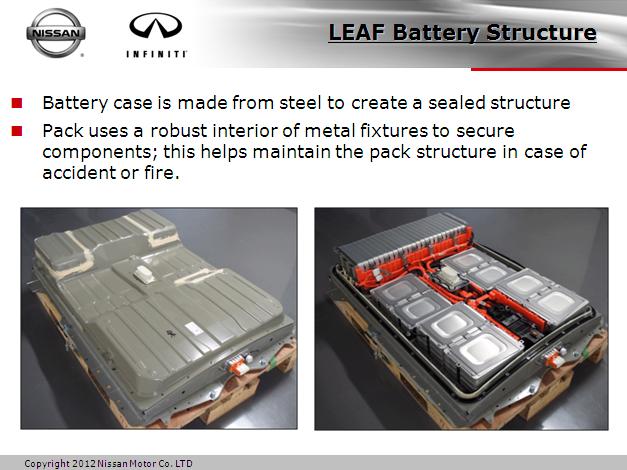

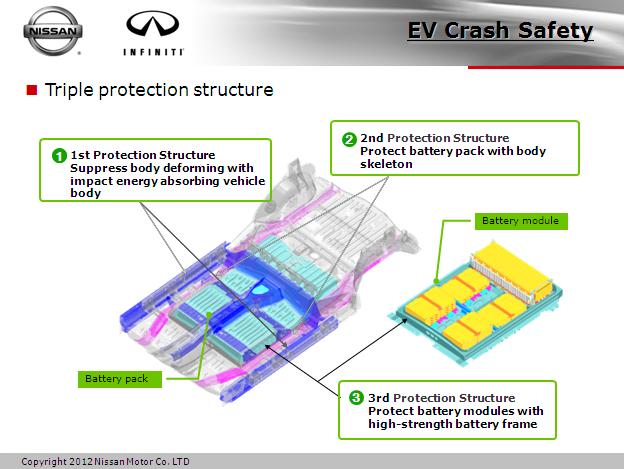 �
�
Dec 3, 2013
dm33 This thread has gone all over the place. To try and get back on subject, the point is to debate how NHTSAs outcome will affect the stock price. This is in the investor portion of the forum. Its not useful to debate if there's a heightened risk. If NHTSA determines there's no heightened risk, the result is pretty obvious to be the stock rallying. Look at the German counterpart's press release effect on the stock today.
Meanwhile, NHTSA has sent a formal request for information to Tesla which has a demanding tone. Doesn't look like they're giving Tesla a pass.
NHTSA Issues Legally Enforceable Request to Tesla for ALL Model S Specific Information
I'm leaning towards thinking NHTSA will make some token requirement for a minor change to the Model S so that they can prove that they did something. I would assume the stock would rally some on the news (at least from the 120s, maybe not from the 140s). Only potential downside of such a requirement as well as their request for information, is that it may indicate that they want to be more involved going forward with Tesla's product development, which can only slow it down.�
Dec 3, 2013
stopcrazypp I'm surprised too at the effect, but I'll wait until the day ends to see if it's just some over-optimism.
I am hoping the NHTSA would remain engineering focused rather than political. They didn't make some token requirement for the Volt when it got even bigger political flack, so I hope they don't for Tesla.�
Dec 4, 2013
Chickenlittle No i think you are off tarjet with postulates that are false. in addition to wrong assumption of increased risk you are now adding that the request for information is somehow out of the ordinary. where did you get that they want to be involved in tesla product development more than any other car?????
why would tesla be interested in a pass? i dont believe there will be any concerns they need to be worried about. the posters here are right on track. your tactics are transparent.
got to wonder how much you lost yesterday (since as you point out this is an investors section). care to share?�
Dec 4, 2013
30seconds
i would guess that dm33 didn't short as he was pointing out his assumption for a minor change. This would hardly payoff big for a short position.�
Dec 4, 2013
dm33 Why are you trolling this thread? Why does discussion of tesla stock illicit such an emotional response. Do you invest or own and trying to justify some past decision? Anyway, the ignore list is useful at times. You can just ignore this thread if it upsets you.�
Dec 4, 2013
Chickenlittle huh just responding to what your writing. please answer the questions i posed. why do you think the request for imformation is not the standard operating procedure?
why do you think the ntsb is signaling their taking more control of the design process
if you think asking you to explain your statements are not reasonable please report this to the moderators. i resent the "troll" label. remember your supposed to respond to issues and not name calling.�
Dec 4, 2013
NigelM Everyone play nice. And let's knock off using the "troll" label; next time everything's going youknowwhere.�
Dec 4, 2013
Chickenlittle
Thanks�
Mar 28, 2014
dm33 Tesla deploying titanium shield.
This is the most extreme of possible solutions Tesla could have done and shows that NHTSA did determine there was an elevated risk of fire and Tesla was forced to respond.
I had hoped that Tesla would have be able to get away with a minor software change such as raising the car. A titanium shield is the most expensive solution other than changing the battery chemistry which would have been a death knell.
This should alleviate the risk.
Interesting that the stock is not moving this morning. Recalling all existing cars and retrofitting with titanium should be relatively expensive.�
Mar 28, 2014
sleepyhead http://www.marketwatch.com/story/tesla-to-install-new-battery-shields-on-model-s-2014-03-28-81034331?link=MW_home_latest_news
I don't know, it doesn't sound that expensive to me. How much can it cost? A couple hundred bucks? I really don't know, but even if it costs $500, then that is a small price to pay for the safety of its customers.
And if you don't see any fires for the next year then people might start believing that this car is indeed extremely safe.
$500 means that TSLA will reach 27.5% gross margin instead of 28%, but I am sure that they can sneek in a price hike to recover the investment. If not, then the increase in demand from hightening the safety will more than offset the cost.
I am extremely pleased with this announcement.�
Mar 28, 2014
markwj I didn't see the recall word mentioned (even taking into effect Elon's aversion to that word). The article listed it as for new cars, and an option the owners can choose if they want.�
Mar 28, 2014
sleepyhead And it looks like the market agrees with my assessment of the situation as well �
�
Mar 28, 2014
bonnie It's not a recall. And it appears the market understands that. It doesn't hurt that the NHSTA closed their investigation independent of this. (I suspect Elon wanted the investigation closed first.)�
Mar 28, 2014
dm33 The question is the hit to the bottom line. Titanium is MUCH stronger than aluminum and the strongest material they could have reasonably used. Its only disadvantage is cost. It does make the Model S MUCH safer. Everyone should get the retrofit. The triple shield should make the battery literally bullet proof.
Interesting that the stock went down to $120 based on NHTSA fears, but once the worst reasonable outcome occurs, the stock rallies from $207.�
Mar 28, 2014
mitch672 In the last paragraph, the NHTSA mentions "Teslas increased ride height and increased underbody protection should reduce both the frequency of strikes and the resultant fire risk"' so it was probably mutually agreed to, so they can both save face.
http://www-odi.nhtsa.dot.gov/owners/SearchResults.action?searchType=PROD&prodType=V&targetCategory=A&activeTab=1&searchCriteria.model_yr=2013&searchCriteria.make=TESLA&searchCriteria.model=MODEL%20S&searchCriteria.prod_ids=1839811�
Mar 28, 2014
EarlyAdopter Note that it's just additional shielding up front and not the entire length of the battery. Cost is therefore likely very small.
There have been no fires since the fluke two impalements (I discount the Mexico high speed drunk driving accident as it was willful negligence), despite the fact there have been more miles driven by Model S since the fires than before. This to me bolsters the stastical safety argument. But that's not enough for some people.
A year from now when there have been no more fires and the statistical safety argument has been long forgotten, people will have something more tangible to use to dismiss fire concerns thanks to the titanium plating.
Conversation a year from now:
Last Remaining Tesla Skeptic: "Yeah, nice car, but don't they catch fire when they run over things?"
Everyone Else in the World: "Not since they added titanium armor."
Much better than:
Evergone Else in the World: "Naw, that was a fluke one time thing."
You can see how much more convincing and definite the first response is versus the second, which still leaves some overhanging doubt.
Good move by Tesla and worth a few hundred dollars per car.�
Mar 28, 2014
ckessel I noted this in the short term thread, but that verbiage makes me wonder if Tesla is going to be allowed to change the ride height back. If part of the reason to close the investigation was the raising of the ride height, that'd seem to preclude being able to lower it again.�
Mar 28, 2014
sleepyhead In the last sentence it says:
The closing of the investigation does not constitute a finding by NHTSA that a safety-related defect does not exist, and the agency reserves the right to take further action if warranted by new circumstances.
Does anyone know if this is common language for NHTSA?�
Mar 28, 2014
SteveG3
EarlyAdopter this makes a lot of sense. This solution is far better at addressing the emotional aspect of consumer evaluation of the cars.�
Mar 28, 2014
Familial Rhino I don't see that as a necessary conclusion from that wording. I think the new armor changes the equation, since it allows the car to withstand the worst impacts imaginable.
I think Tesla wouldn't have included lowering in the 5.9 firmware if NHTSA disagreed.
- - - Updated - - -
It appears so. I found the same phrase used when they closed previous investigations. For instance, see here.�
Mar 28, 2014
ckessel Yea, that's why it puzzled me. The NHTSA verbiage talks about the problem being solved as a combination of raising the ride height and protective additions. Yet, there's no recall, so I guess neither is required? Rather mixed set of messages from the NHTSA wording.�
Mar 28, 2014
772 Doesn't the adjustable lowering in 5.9 come with a disclaimer about possible increased risk from road debris? The position of Tesla was that the car was already very safe even without this additional reinforcement... the Model S fire rate is much lower compared to ICEs, and there were no injuries due to the fires. I guess NHTSA agrees, too, since Tesla thought it was OK to enable auto-lowering again even without the additional reinforcement.�
Mar 28, 2014
mitch672 I'm confident enough to buy Jan 16 $230 leaps, should be well ITM before then, 20 months of time left.�
Mar 28, 2014
smorgasbord Yes, I agree but the NHTSA goes on to state "A defect trend has not been identified." So, there does appear to be some wiggle room. If I were in charge, I would only let shield retro-fitted cars go back to the previous low ride height. We'll see how Tesla approaches it - the last thing they need is to enable lower ride height and then have another fire.
At any rate, my prediction of Tesla needing to add more under armor has been validated. Musk should never have said it wasn't needed. That comment made me very concerned about holding onto the stock. I'm more comfortable about adding to my holdings now.�
Mar 28, 2014
PeterJA Musk said it wasn't needed for human safety, and he still says that, because it is still true.�
Mar 28, 2014
brianman No, it does not.�
Mar 28, 2014
smorgasbord We can split hairs if you like. From CNN's report at the time:
Retrofit is not recall, but I do wonder what behind the scenes negotiating went on. Something did, because otherwise how would the NHTSA know about the retrofit before the rest of us?�
Mar 28, 2014
brianman You think the NHTSA and Tesla announcements today were the worst reasonable outcome? Wow, we have very different imaginations and understandings of reality.
- - - Updated - - -
In charge of NHTSA or Tesla? If I were in charge of either organization, I wouldn't introduce this new restriction.
- - - Updated - - -
"Relevant disclosure" to the interested enforcement agencies does not imply negotiation.
For example, would you expect the seatbelt retrofit information would have been provided to NHTSA before or after customers were told? I would expect before. Does this imply that there was negotiation regarding the seatbelt retrofit? No it doesn't. Do I think there was negotiation for the seatbelt retrofit? No.
That said, I seems totally reasonable that discussions have been ongoing (at a slow, government pace) since before the first comment by the NHTSA about any of this drama.�
Mar 28, 2014
Familial Rhino Agreed. To my mind, the worst outcome would have been if there was something inherent in the Model S design that made the car vulnerable and which couldn't be fixed without a complete re-design.
As it is, I just think it will put to rest any lingering concerns about safety, real or imagined. Anyone bringing up questions about Tesla's safety will now be met with a barrage of "yeah? how does your car behave when driving over an alternator/concrete block/steel spike?".
The only thing is the added cost, but people pay $thousands more for leather seats and audio upgrades. I mean, even if the cost isn't absorbed by Tesla (at a negligible hit to their margins), I think buyers wouldn't even blink at a $700 increase in sticker price (or whatever the cost may be, likely lower.)�
Mar 28, 2014
PeterJA You are implying that NHTSA found a safety defect and negotiated with Tesla to correct it with the retrofit. This implication is contradicted by all evidence, including the agency's statement that "A defect trend has not been identified."
NHTSA is an acronym for National Highway Traffic Safety Administration, not driver-convenience-and-public-perception Administration. Tesla's stated reason for the retrofit is driver convenience and public perception, not driver safety. There is a large difference between those alternatives, IMO, not a hair to split.�
Mar 28, 2014
mitch672 Everyone should take some time to read the "Complaints" section on that NHTSA site for the Model S.
Apparently the "shorts" have nothing better to do than to comb threads on this website, then file reports on the NHTSA website. Not one report had a VIN number, I believe most of the reports are from non-owners, looking to damage TSLA
Edit: 2 of the 19 reports have a VIN
http://www-odi.nhtsa.dot.gov/owners/SearchResults.action?searchType=PROD&prodType=V&targetCategory=A&activeTab=1&searchCriteria.model_yr=2013&searchCriteria.make=TESLA&searchCriteria.model=MODEL%20S&searchCriteria.prod_ids=1839811�
Mar 28, 2014
Auzie Tesla Motors ?@TeslaMotors 11h
Tesla Adds Titanium Underbody Shield and Aluminum Deflector Plates to Model S: https://medium.com/p/544f35965a0d
View summary
I am so impressed with how Tesla handled this investigation and with the extensive measures taken to improve the car. Videos of crumbling road debris under the speeding car are so reassuring.�
Mar 28, 2014
smorgasbord No, I'm stating the obvious fact that Tesla told the NHTSA that they were doing a retrofit to all cars before the NHTSA finished their report. Then I'm speculating that that wasn't the only communication between them.
Clearly the NHTSA felt that the retrofit was pertinent enough to include it in their conclusion. I believe it had some bearing.
- - - Updated - - -
Will you back that statement up by not bothering to have the retrofit applied to your vehicle?�
Mar 28, 2014
MikeC I think that NHTSA knew they were "offering" a retrofit but that it was not mandatory for owners to accept. Similarly, NHTSA probably knew they were providing the option to keep it from going to low mode. NHTSA would be overstepping its bounds to mandate those based on the limited number of incidents, but in the interest of consumer protection I think they wanted to ensure that owners could take extra precautions as they see fit.
I will not be getting the armor - I didn't think there was a problem before and I still don't.�
Mar 28, 2014
brianman I'm considering not installing it on my vehicle, yes. But that has nothing to do with my assertion that you quoted.
I'm not a fan of government or business agencies taking away flexibility from citizens or customers willy nilly.�
Mar 29, 2014
PeterJA When the battery-puncture fires occurred last year, there was lots of discussion at TMC about possible solutions. Several people suggested cowcatcher-like deflectors for road debris. But as I recall, no one suggested Tesla could build a shield that simply smashes debris to pieces before it reaches the battery. Several engineers read this forum, but none of them thought of that.
Tesla's ability to think outside the box, and invent surprising solutions that smash obstacle after obstacle, is one reason I am heavily invested in their stock.�
Mar 29, 2014
capt601 It sounds like the same person for each one. Lots of "allegedly". Really? And they keep these on and don't verify?�
Mar 29, 2014
smorgasbord The NHTSA process uses an on-line questionnaire from which information is extracted to create the reports you see. My guess is that the NHTSA inserts the word "allegedly" into complaints since they don't verify each complaint individually.
From http://www-odi.nhtsa.dot.gov/recalls/recallprocess.cfm
�
Mar 29, 2014
smorgasbord After more careful reading, that's not just what I'm implying, that's what I believe almost certainly happened. Let's look at the facts as we know them. There were two incidents, and the NHTSA covers them separately. No-one else is looking at the statement that way, but it's very instructive when you do.
First, the NHTSA investigation process includes frequent contact with the manufacturer:
OK, so the process includes discussions with the manufacturer. Let's look at this specific case. The following paragraph from the NHTSA statement says alot:
1. The NHTSA knew about the tests Tesla conducted before Tesla published some of them in their blog (NHTSA statement came out first).
2. The NHTSA agreed that the change in ride height already conducted (5.8 I believe) mitigated the fire risk.
So, there are movies we haven't seen that show that running over the trailer hitch with a low ride height will indeed damage the battery enough to cause a fire. And there are movies we haven't seen that show that increasing the ride height reduces or eliminates that damage.
Those are facts. The logical conclusion from the wording is that since Tesla already issued what was effectively a recall that reduces the risk to acceptable levels, the NHTSA did not feel it necessary to insist on making what was already done a new official recall. You may come to a different conclusion.
Let's look at the investigation into the second incident:
The NHTSA saw the results of testing performed by Tesla before those were made public, so again they were in communication. Matter of fact, they conducted a meeting on March 10! And during that meeting Tesla said it would conduct a free-of-charge service campaign to modify the SVs. And, Tesla showed the results of their testing that these worked.
Neither of us were at the meeting between between Tesla and the NHTSA, but it seems obvious to me that what was happening can logically be described as a negotiation. Maybe the NHTSA said they would move the investigation into the EA phase. Maybe Tesla was simply being proactive in conducting the EA for the NHTSA, and providing a solution, in the hope that the NHTSA would not characterize the result as a recall. We weren't there, so we can't say for sure, but it seems far more likely that the discussion was more of a negotiation than a "well, here's what we've done, now we'll shut up so you can decide what you want to" kind of thing.
Now, time for the way-back machine. Remember back in Jan when Elon said that their over the air update and swapping out of 14-50 adapters was not a recall because "no Tesla vehicles are physically being recalled" () or Jerome Guillen saying: "calling Tesla�s fix a �recall� was outdated because it did represent a physical repair but rather a software update conducted wirelessly while the owners� cars were parked in their garages. �We are going to be having some discussions about the appropriateness of using a word that has no physical sense,� Guillen said.
And now we have physical vehicles coming in to be modified and somehow that's not a recall? Well, turns out the NHTSA isn't making a unique exception for Tesla. As this Bloomberg story says:So, whether the terminology is "voluntary campaign" or "retro-fit", the NHTSA only cares that the manufacturer is doing something that appropriately reduces the risk without charging the customer directly for the fix.
Kudos to Tesla for getting in front of the situation, especially after Musk himself said that the car did not need to modified.�
Mar 29, 2014
gpetti No, the most extreme of possible solutions would have been mandating the battery be relocated which would have destroyed the car as it's whole design revolves around the battery. I'm not sure if tesla had been warned of any negative outcome but clearly they have been working on this seemingly ingenious design for a while. It seems more like they have preempted the NTHSA's findings and as a result, no further analysis was required. My only concern is how much weight this adds; however, the batteries could get lighter in the future and having this weight low down in the car is part of its great handling.�
Mar 29, 2014
brianman This is incorrect. Options like this were discussed. In fact, some of us were talking (unseriously) about lasers.�
Mar 29, 2014
smorgasbord You're forgetting that Tesla increased the ride height after those. And the NHTSA statement specifically said that increasing the ride height reduced the risk of fires from hitting something like the trailer ball & hitch.
But, the NHTSA also said that increasing the ride height wasn't enough:
That's why Tesla is doing the voluntary retrofit. As noted in my previous response, this appears to be typical: as long as the manufacturer is making the change for everyone free, the NHTSA doesn't seem to care what label is used to characterize the change.
Tesla said they conducted over 150 tests. We've seen movies from only 3 of those tests. The NHTSA refers to Tesla tests that reproduced the fire damage from the Tenn. incident with the 3 ball hitch. Anyone not preforming the retrofit on their car and nevertheless running at a low ride height is taking on an unnecessary risk.
And, it'll be interesting to see if Tesla actually lets you get away with them not retrofitting your car next time it's in for service. My guess is they'll practically insist on it.�
Mar 29, 2014
kenliles While true- I'd argue it's unnecessary due to Tesla's offer. The actual risk however (unnecessary or not) is less the risk taken everyday by every ICE car on the road. you might argue, given the lack of comparative miles we don't actually know that- and I'll give you that. But it works both ways- we don't actually know, so it's not a given that there's more risk being taken by a ModS (unmodified low rider) vs any existing ICE driver.�
Mar 29, 2014
PeterJA Risk of what?
I repeat: There was never any significant risk to human safety (because of the Model S's multiple safety systems). There was a minor risk of inconvenient damage to the car (which can now be eliminated with the retrofit).
Your very long posts obscure that essential difference, which you called "splitting hairs." A car is not a person. Risk to a car is not the same as risk to a person.�
Mar 29, 2014
Auzie Most people, especially people that frequent TMC, would agree with your evaluation of comparative risk taken by ice drivers vs Mod S drivers.
NHTSA are likely to evaluate each specific risk that they are investigating 'on its own merits', not in comparison to other cars. I would be surprised if a body like NHTSA decides to 'let a car off the hook' for a risk that is highly specific to that car (battery impact by road debris) just because it is safer than other cars that do not have that specific risk. Tesla's response of mitigating their specific risk is outstanding.�
Mar 29, 2014
kenliles I think that's true. And consistent with their actions in this case as well. A customer makes a more wholistic decision than NHTSA, as it should be. My personal decision would be to not modify if there was a cost involved. I would see it as unnecessary. If I were Tesla I'd tie it to their warranties (fire and lease value programs), and suggest it to insurers, all to help force idiots like me to get it retroed.�
Mar 29, 2014
smorgasbord The fact is that a risk of the car burning up is a risk to people inside or near the car. Suppose a disabled person was inside Model S - is there no risk that they couldn't get out in time, or if they could get out that they could get far enough away in time? What about children in child seats? Could the driver unbuckle and carry 4 children away from the scene in time?
I'm sorry you're having trouble reading more than a few paragraphs, as your take on my "very long posts" is quite incorrect.
Finally, despite his statement that no modification would be necessary, Musk did what I originally suggested - say that even the safest car can be made safer.�
Mar 29, 2014
RABaby This modification is more about perception than safety. The cost in money or performance is insignificant compared to the benefit the company earns in the eyes of everyone who envies the car, and the virtual elimination of concern about fire risks. No matter what is done, there will continue to be criticism by everyone who has an interest in seeing Tesla fail.
The risk of the car burning up with people inside has not been altered by this change. Elon stated in his letter:
"The onboard computer warned the occupants to exit the vehicles, which they did well before any fire was noticeable. However, even if the occupants had remained in the vehicle and the fire department had not arrived, they would still have been safely protected by the steel and ceramic firewall between the battery pack and the passenger compartment."
Tesla Adds Titanium Underbody Shield and Aluminum Deflector Plates to Model S | Blog | Tesla Motors
So whether there were disabled or young children as occupants who were incapable of walking out on their own and were forced to sit inside and watch the vehicle burn, I have to accept Elon's word that they would still be safe. And if that is true, then there is no risk to human safety, and risk to safety would be the reason for a recall. What Elon did was to come up with a simple, elegant solution that enhances value to owners and shareholders without the need to qualify any previous statement he has made about safety. Since the modification is optional, I don't see how it can be considered safety related.
I will certainly have the modification performed because I would prefer to damage debris rather than be inconvenienced when out on a trip. That is the more significant enhancement. Elon has made the safest car on the road more durable.�
Mar 29, 2014
kenliles But aren't those facts always true,
before, now and forever?
Even now the ModS can be made much safer than it is even with the plate mod. Especially for the examples mentioned (kids, disabled etc.). I think the harder equation is safety relative to risk and function. Otherwise I think we'll just go in circular discussion. And If I'm going to be dizzy anyway, I'd rather it be from the Cabernet I'm sitting next to (fortunately, safely while not in one of those flamin' ModSs- hang on, just checking my lounge chair for one of them new-fangled titanium plates under my ass.... nope could be safer. Think I'll have another pour)�
Mar 29, 2014
Auzie Good that market is closed now. It might be an idea to keep that Cabernet safely locked up during market hours.:wink:�
Mar 29, 2014
kenliles Now that's a good safety tip. Will do !�
Mar 29, 2014
PeterJA Exactly.
Maybe it's a small point, but I don't like to see people sneering that Elon reversed himself (with the implication that he can't be trusted) when he really didn't.�
Mar 29, 2014
smorgasbord You infer something I did not imply.
But, let's face the facts: Elon did reverse himself. I'm glad he did - he should not have said what he did at the time. If he had adopted this path from beginning, which I did suggest at the time (not that he'd listen to me), Tesla would have been better off. Instead, Tesla has been in damage control mode for the past few months and he admitted it did affect demand. I'm glad it looks like things are going to work out, but let's not sugar coat the truth.
- - - Updated - - -
What makes you think it's optional? It's performed "upon request or as part of a normally scheduled service."�
Mar 29, 2014
RABaby The Model S has no normally scheduled service. If you recall, the $600 service is not mandatory and the warranty remains intact. So without normal service, it isn't required.�
Mar 29, 2014
ItsNotAboutTheMoney It temporarily affected demand.
He didn't reverse his position: he said in November that there wouldn't be a recall and that if the NHTSA found a way to improve the car it'd be offered as a free retrofit.�
Mar 29, 2014
smorgasbord If you buy a Honda, no-one forces you to bring it in for normally scheduled service, but it's still called normally scheduled service. Tesla's normally scheduled service is no different.
- - - Updated - - -
He originally said there would be no recall and no physical modification.
A couple weeks later, Tesla said:So, I guess what happened is that the "highly unlikely" thing did happen, and something was discovered that resulted in a "material improvement in occupant fire safety."�
Mar 29, 2014
RABaby Tesla does not manufacture ICE vehicles. Service on an ICE is done to maintain the engine. There is no engine in an S. Service is not required.
You took a position on this being a recall and a safety issue and are unwilling to move on that. This is a position many others do not share and some have stated that clearly here with their rationale. Stating a position and letting it stand is fine. To continue this back and forth is infantile and not worth my time because it accomplishes nothing. If Elon or Tesla comes out to declare this a recall or a requirement, then you can say I told you so. Until that time, more responses on the same issue is serving some other purpose.�
Mar 29, 2014
smorgasbord A Tesla is more than an electric motor. The brake pads, discs and fluid, air conditioning, power steering fluid, etc. all need regular servicing, as do EV-specific things like battery coolant replacement. Regular service is indeed required for your Tesla.
Why you and others have degenerated an argument on the safety retrofit into something else is beyond me.�
Mar 29, 2014
AlMc Regardless of the ongoing debate, the retrofit does not appear to change the driving dynamics of the car much. I would encourage everyone to get this plate. It may seem great to go 'commando' but sooner or later a 'commando' battery pack is going to sustain a puncture that could have been prevented by having the plate installed. While this may not be a human safety issue and Elon has stated TM will replace any car damaged by this type of accident the mission of the company, as well as the value of the company, will be compromised by additional battery fires.�
Mar 29, 2014
kenliles That sounds like good advice to me. Tesla's made the cost benefit on this a no brainer.
Keep up the good work Elon and team�
Mar 29, 2014
ItsNotAboutTheMoney He also mentioned the modification in November without reference to fire safety.�
Mar 31, 2014
jerry33 A good scientist or engineer will change their opinion when new facts come to light. That's the scientific method. I don't see any problem here.�
Apr 1, 2014
gpetti True enough. Originally I was thinking the change was a factor of about .1 which would mean about 40kilometers for me; however on rereading the announcement I realized that this was .1 percent, or a factor of .001 which is basically irrelevant if accurate. Given this would mean almost no downside, I can't see why I wouldn't opt for even more safety, no matter how unlikely the event. Above all if we can eliminate any further statistical debates and reduce or eliminate FUD opportunities that would be awesome. One thing I'm curious about is whether this hampers battery swaps in any way.�
Apr 1, 2014
AlMc Apparently the apparatus sits infront of the battery pack and does not hinder the swap. I had my 12K mile service sceduled for April 9th weeks before the 'fix' was announced. I called Friday to add the 'fix' to this service call and if no one else reports about battery swapping first hand, I will ask.�
Apr 2, 2014
Chickenlittle Moderators isn't it time to rename this thread? "Assuming heightened fire risk" has been disproven. I believe since it has been proven that it is not more likely to catch on fire tan ice cars (not even the shorts are claiming this anymore)
That line should be deleted. Might as well have a topic with a title including assuming the earth is flat�
Apr 2, 2014
Robert.Boston Good idea; title has been updated.�
Apr 9, 2014
pz1975 Not sure where to put this, but this seems like the right place.
I had a small service issue to deal with today with my Model S and I asked the SC guy about the new battery plate. He said it is in total about 1 foot in width and about 2/3 the width of the car in length, weighs about 1-2 pounds and is made of titanium with an aluminum coating on the surface. He said the total labour time for installation (retrofit) is 1 hour.
I think with the weight of it being so low, the actual materials cost is going to be very small (did someone have a quote of titanium cost by weight?). The labour is 1 hour but this is split up among the dozens of SC's out there and can be done slowly over time scheduled in when they have empty space so it shouldn't result in any 'extra' labour time than what they already had available for at the SCs.�
Apr 11, 2014
Auzie This thread seems to be the best fit to post GM's response to faulty ignition switch. That fault most likely caused some deaths, and resulted in $1.3b recall of 2.6mill GM cars.
GM places 2 engineers on leave in inquiry
I find GMs response wrong on so many levels, but scapegoating 2 low level employees tops it. The way GM handles its corporate responsibility tells me a lot about its culture. Looks like blame game push down.
If any low level employee can derail GM in such significant way, that tells me a lot about that company's internal control processes.
I find GMs response hard to believe and impossible to respect.�
Apr 11, 2014
JPP The reason for the engineers getting disciplined is this:
"Mr. DeGiorgio has been identified in documents as the engineer who approved a change to improve the switch in 2006. But the change was never cataloged as a new part, and G.M. did not recall cars with the original, defective switch."
If GM never assigned a new part number to a revised/re-engineered ignition switch, then you don't know when in forward production the newer version appeared. Thus GM now has to recall millions more vehicles, many of which likely have a 'good' ignition switch.�
Apr 11, 2014
Auzie It is hard for me to accept that blame for such huge damage can be assigned to 2 relatively low rank individuals. If that is the case, then GM internal control processes are insufficiently guarding against allowing individuals to derail the company in such significant way. These two engineers were not particularly high in the corporate hierarchy so how could they have a capability to cause so much damage.�
Apr 11, 2014
RABaby Those engineers did not on their own decide to make a change, and this is a significant change considering its function.
It came about because of a problem and changing the part would be the resolution to the problem.
The way things typically work in engineering and manufacturing is that when a part is changed (form, fit, function) it gets a new part number and that new part number is entered as an equivalent, or preferred, or required replacement in the parts list. If GM does not have this sort of system, there is a bigger problem that needs to be addressed.
Assuming they do have part numbering standards, the engineers only do the design and there is a protocol for numbering. The decision to not change the part number would have involved others, who may have been very careful to avoid a paper trail, but this was all about money.
Until proven otherwise, I believe the engineers were instructed to use the same part number.
In the aerospace industry, there are debates about whether a part number should be changed when there are very minor changes and there is a debate about form, fit, and function, but if it is an improvement that affects safety, there is no debate.
So I believe the engineers are scapegoats, or possibly paid co-conspirators because they should have blown the whistle, and the real criminals disregarded the impact of their decision in the desire to hide the problem and save money. This is not the first time similar penny pinching efforts have taken place in the auto industry - remember the Pinto. If there were executives responsible for directing the engineers to not change the part number, they should be located and prosecuted for manslaughter. The existence of a system and standards can be easily answered and the avoidance of direct answers by executives (we are researching it) is just stalling to work out a defense.�
Apr 11, 2014
Auzie Thank you RABaby for detailed insight into this murky matter. The scenario in which engineers acted on their own accord does not make sense to me for many reasons. The main one being that there is no pay off and there is significant downside risk for salaried employees to act contrary to business systems and procedures.�

Không có nhận xét nào:
Đăng nhận xét