Apr 8, 2015
vandacca The Tesla Motors Website has been re-designed and a new 70D option is available (60 appears to be gone). There were discussions (speculation?) that Tesla was moving to a new battery cell that is slightly larger than the original cells, thereby reducing weight (due to less packaging) while keeping capacity the same. That would also provide the option to increase capacity, while keeping the weight the same (and everything in between).
I wonder if they'll be upgrading the 85kWh packs too?�
Apr 8, 2015
dirkhh My speculation is that the 70D still uses the same cells, just more of them. Which would mean that 105 is still not quite possible within the space constraints given...�
Apr 8, 2015
CarlK 85 will likely go up some. There is too small a gap between 70 and 85.�
Apr 8, 2015
timf I think it's a pretty safe bet the 70D is being released in advance of it being the base Model X model. Even though Elon played a bit coy in interviews and said it "could" be offered on the Model X, I don't see any other reason behind the timing of this other than to be in preparation for Model X.
Someone did the math elsewhere that if the 70kWh pack does use the same form factor of the 60kWh pack only with upgraded cells, that would work out to a proportional increase to about 99kWh for the 85kWh pack. They would probably just call it 100D to keep the numbers nice and round.�
Apr 8, 2015
vandacca If they did come out with a 100D, what would be the estimated range. I understand that if they can get beyond 300miles, they would qualify for further energy incentives.
Also notice that there is only 1 option now for rear-wheel drive: 85. I predict that all Tesla vehicles will be AWD in the future.�
Apr 8, 2015
trialcritic I suspect that they need about 100kwh in Model X to get 300 mile range as it has 10% more weight than Model S. I know it sounds silly, but I am hoping and wishing for the range to become 400 miles. Probably in about 5 years, I guess.�
Apr 8, 2015
CarlK Elon has said 300~350 real range is the sweet spot. Anything more will add cost and weight with diminished return. The strategy seems to be more and quicker SC to make long trip more convenient in the future.�
Apr 8, 2015
ItsNotAboutTheMoney It doesn't mean anything other than 60 not being enough for the base X.�
Apr 8, 2015
scaesare I tend to agree with this. Rolling out a new battery chemistry would be a rather big deal I suspect. There would be some significant logistics and cost issues maintaining two different cell types for different packs destined for the same platform, etc...
Given that we already know that the 60kW pack simply omits some cells to reduce the capacity, it would be far simpler to omit slightly fewer cells in the already proven design than to implement a new chemistry in the low-end car.
That's not to say they couldn't have already switched everything over to a newer higher-capacity chemistry, and be omitting cells in the new 70 as well as omitting cells in the 85KW pack to keep it's capacity down... but that's seems terribly unlikely. I give it precisely a 0.0394% chance of being true.�
Apr 8, 2015
vandacca I agree that upcoming Tesla battery packs do not have a new battery chemistry. There are a lot of changes possible in Lithium ion batteries (e.g. cathode, anode, chemistry, shape, etc.) and I suspect that if there are changes, they will be subtle and improve things like charge time, longevity (i.e. increase number of charge cycles), capacity, weight, etc.
With regards to the latest battery changes, I heard from a source who spoke to a Tesla employee that the Panasonic batteries in upcoming vehicles were a larger cell in order to reduce weight. This is obviously hear-say, so take it for what its worth.�
Apr 8, 2015
1208 As I said in another thread, I think it does mean a 100D for the X�
Apr 8, 2015
dirkhh So you assume the X will not share the same size battery with the Model S?�
Apr 8, 2015
Andex23 I think an intriguing aspect might be the performance characteristics of a P1xxD. Elon already hinted in a tweet about the 2.8s possibility. A larger battery pack in the same space could allow for these improvements. I think it is just a matter of time that the 85 is upgraded, and doing it inline with the X reveal would make sense.�
Apr 8, 2015
airj1012 They already have these logistical issues. There are battery packs A-D and maybe even more versions that that now. I think its almost a certain that they will have a larger capacity for Model X. With the extra weight and towing capacity, they will need some extra juice. Tesla has already said that they're increased efficiencies in their cells. Its also 3 years later after the first Model S has rolled off the floor. I see no reason why they wouldn't have been able to make some sort of increase in that amount of time. Granted the 70D could a scaled back version of the 85D, which is how the scaled back the 40, but someone else put the math together today as well.
"If you take a 60kwh pack and replace the current 3100mAh cells with the newly available 3600mAh cells, you get exactly 70kWh. Now, if you do the same thing to an 85kWh pack, you get a 100kWh pack."
Again, I think there is no reason why they couldn't or shouldn't increase the capacity. I think the launch of the Model X will provide milestone for the greater range, but it will then be offer to Model S as well.�
Apr 8, 2015
scaesare Do you have a source for this?
It's even simpler to fill in the holes in the existing modules with the same cells you use everywhere else. Occam's Razor and all that.�
Apr 8, 2015
airj1012 No but I think it was in one of their earnings call. It wasn't the last one though. It's been a while...�
Apr 8, 2015
scaesare Hmm, I don't recall ever hearing of, or seeing discussion about, their current cells being more efficient, than previous versions. As a matter of fact, Tesla has been largely silent on their cell details...�
Apr 8, 2015
Aljohn From an X standpoint -- note also on the Model S design Center there is NO LONGER any single motor options. Everything is Dual Motor. Also there are a number of new Colors available. I did "my standard" P85 Configuration to gain a sense of the Model X pricing. The P85D config I have been using (21 Tires, 3 Gen Seats, upgraded interior, metallic paint, carbon fiber interior, upgraded sound, air suspension -- no pano roof) and found the actual cash price was lower. It seems the P85D Package dropped in its base price slightly, and they split out the Tech Package into two options - autopilot and enhanced features.
It seems Tesla is now aligning the Model S Chassis and the "expected" Model X to be on a similar chassis regardless of options. Please check my math. They also changed the site to show a price after incentives and gas savings, so the REAL cash price is at the bottom of the column now.�
Apr 8, 2015
dirkhh Quite a few people seem to be confused about this. There still is a single motor / RWD S85. You just have to FIRST select the S85D, THEN you can go back to select only one motor and get a $5k "credit" for that.
Not the most intuitive design in the "design studio" :-/�
Apr 8, 2015
Foodnut The 70D introduction is definitely a preparation for the upcoming ModelX.
On the Model S 70D, EPA is 240 miles... (vs. 85D with 270). 35 miles range worth $10k? I think many more will opt for 70D now for ModelS.
Based on 10% weight gain, and less aerodynamic, would it be reasonable to speculate that the Model X 70D would get ~220 miles range?
If they introduce the Model X 100D, I'm hoping for 300 miles range.�
Apr 8, 2015
Bangor Bob "Efficiency" is the wrong word, cell capacity is the proper metric. I believe it was discussed in the Roadster 3.0 thread. Also the Panasonic NCR18650A cell is 3100mAh, the NCR18650G is 3600 mAh. We've heard Elon and JB say the Tesla chemistry is slightly different, but it also fits that a change from the A to the G revision of the cell would be responsible for the capacity increase. Presumably production capacity on the G cell hasn't ramped up to the point where they can supply all production yet? But yeah, I'd say a 99.8kWh pack (100kWh with slightly adjusted charge limits, or just rounding) is quite likely soon.�
Apr 8, 2015
scaesare Cell capacity (in Watts) for the "new" Roadster cells is still less than that for existing Model S cells.
While different Roadster cells were selected for the "3.0" pack. This does not imply any changes to Model S cells.
Cells for the Model S, while manufatured by Panasonic, do not map to any specific Panasonic cell model. Newer cell introductions by Panasonic do not equate to Tesla using higher capacity cells in the Model S.
Again I ask: what source is there for Tesla using different cells of greater capacity in current packs?�
Apr 8, 2015
dirkhh This has been pointed out by others, but just to make sure it doesn't get lost. The blog post talks about "240 miles at 65mph". That's what Tesla calls the "cruising range" and there the 85 (and P85D) used to be listed as 285, the 85D even with 295 miles (see this old blog post). My suspicion is that the "240 miles EPA" range is a typo in the design studio that will be fixed. Assuming a similar cruise/EPA range as with the 85D the 70D more likely will see a 220-225 miles EPA range... so the difference to the 85 is more like 45 or 50 miles (and 55 miles in "cruising range")...�
Apr 8, 2015
ScepticMatt I feel that's because the S85 is getting the axe next.�
Apr 8, 2015
dirkhh I doubt it. But then I've been wrong before.
For some odd reason Tesla wants four different Model S.
40 / 60 / 85 / P85
60 / 85 / P85 / P85+
60 / 85 / 85D / P85D
70D / 85 / 85D / P85D
There were brief times with fewer or more models, but usually within a few weeks they went back to having four models. Not having a RWD model would seem like a big mistake. There are so many people who don't need or want AWD. Look at all the posts lamenting the fact that there is no longer a P85+. And to the best of my knowledge, the 85 is their best selling car...�
Apr 8, 2015
strangethingintheland Actually, IIRC he said 250-350 is the sweet spot. I wouldn't be nitpicking but for the fact that it has implications for market positioning of the model 3 as well as today's announcement. See this thread started by efusco: Model 3 Range per 3/19/15 Press Statements�
Apr 8, 2015
WSE51 My family is scheduled to take delivery of an 85D in 3 weeks (our family's second Model S) and I just texted my contact at Telsa, who is a very senior person in the sales organization, to ask whether it will soon be retired in favor of a 100D or whatever.
His reply was "85D is not retiring"�
Apr 8, 2015
Bangor Bob It's conjecture, just like everything else in this thread. However, 3600/3100 just happens to be within 0.5% of 70/60. Convenient, no?�
Apr 8, 2015
scaesare I'm talking about the source for your points about changes to existing Model S cells here that wasn't conjecture but attributed:
The Roadster thread discussed all sorts of variations that may be used in the Roadster, but in the context of this thread about Model S cells airj1012 said "Tesla has already said that they're increased efficiencies in their cells.". You then corrected that to say: "Efficiency" is the wrong word, cell capacity is the proper metric."
So I'm asking for either where in the Roadster thread, or in any of the earnings calls (I've listened to many of them, and read transcripts), is there a source for increased efficiency or capacity for Model S cells?, as has been asserted as having been stated or discussed?
As an aside, you seem to think that Tesla has been rev'ing their cell's in step with Panasonic's model revisions? I highly doubt that, and have seen no evidence of that.�
Apr 8, 2015
brianman This is hard to gauge. One reason it's hard to gauge is they tend to have faster delivery on the top end configuration. Taken to the extreme the entire fleet would be P85D. We're not seeing that, of course, so it's not quite that simple.�
Apr 8, 2015
lodenthal I believe the 70kw battery is for the Model X. The X won't be as aerodynamic as the S and to get a similar range they would need a bigger battery. Obviously, this is highly speculative but to get approval for the new battery, they needed a"currently available" car. My guess is that the Model X might come out with a range similar to the 60kw Model S. But....that's pure speculation on my part! LOL!�
Apr 8, 2015
dirkhh I realized I should have provided a source. When our local service center had all these P85D to deliver in March I was joking with one of the folks there that this must be just like every quarter with mostly top of the line cars and his response was "no, this is the first month that the plain 85 wasn't the most frequent car we delivered".
So sample of one, unauthorized, and unscientific source.�
Apr 8, 2015
goneskiian Nobody said they thought the 85D was going away. They said they thought the S85 might be next to get axed.�
Apr 8, 2015
nwdiver OK... the first person to get a 70D needs to get it weighed... then compare that to the weight of a 60.... OR tear open the pack and count the modules... whichever is faster :wink:�
Apr 8, 2015
Alysashley79 The main reason for this change is to support the D functionality. Let's face it. The D doesn't get as good of EPA rated miles as the RWD counterparts. So 70D is logical so that those people that don't need the full 85Kw pack can still have AWD�
Apr 9, 2015
vandacca Actually, D gets better EPA mileage than the RWD. The reason is because they replace the 1 big motor with 2 lighter ones that are geared differently. Since the original Roadster, Tesla has been trying to work on a gear box to allow the single motor to work within its most efficient RPM range, but they couldn't come up with a reliable solution. That is, until they decided to put two separate motors. Now they effectively have 2 gears and the motors are both tuned to different speeds.
I'm surprised - Tesla and Elon mentioned many times how they improved the mileage by going to the D.�
Apr 9, 2015
dirkhh Yes, he keeps talking about it. Yet no one has actually seen it in real life. And since the "EPA testing" is done by Tesla and not by an independent third party, so far there doesn't appear to be independent proof of this claim.�
Apr 9, 2015
scaesare I got a PM from somebody who wished to remain private with an excerpt from the Q2 2014 conference call purporting to provide the conference call source for changed cell chemistries:
This problem is that this context clearly states it's referring to cells that will be produced in the gigafactory. Those cells are not in production, as the GF isn't even close to being finished yet. This in no way supports the idea that current cell chemistry have changed and thus there are new cells in the 70KW battery pack.�
Apr 9, 2015
vandacca Do you think they will be building these brand new, state-of-the-art cells for the first time in the brand-new GigaFactory? Or do you think they'll work with Panasonic with the new design/chemistry, who will start building them for Tesla, whom will then test them and then eventually put them into their vehicles with the eventual plan to mass-produce them in the Giga factory?�
Apr 9, 2015
Rashomon Any new cells will be first produced in a lab in Japan, then on a pilot line, then likely test manufactured at speed in on a standard manufacturing line in Japan, all before equipment to make them is shipped to Nevada. They would have extensive use, aging, and abuse testing at the cell and pack level before they were ever approved for mass manufacture. I would bet they are already running in Tesla mules, perhaps even in Elon's own S. Generally, the cell companies are very, very conservative with automotive products, because the life of the vehicles is so long and warranty issues could be so incredibly expensive.
As to the S60 versus S70 cells, that's a very interesting question. I have seen claims that the S60 runs different, lower energy (2.6Ah) cells than the 3.2Ah S85 cells, cells that were at a sweet spot in the cost versus energy trade-off. If so, changing to the S85 cells would have been sufficient to get the increase. Someone on this forum almost certainly knows whether this is true or not.�
Apr 9, 2015
scaesare No doubt there will be test samples, pilot production, long term testing, production ramp up, etc...
I don't believe that Tesla is doing that by slip-streaming them in to the current 70KW car.�
Apr 9, 2015
vandacca My point is that there is no reason why the first batch of production-ready cells can't come from Panasonic Japan, prior to the opening of the GigaFactory. It would make more sense (to me anyway) to have the first production-ready cells come from a mature manufacturing site. If that were the case, then its possible that Tesla already has their hands on such cells and have begun using them.
Sure, when the GigaFactory gets rolling, they'll be able to produce a lot more of them and the price will come down, but until then its business as usual.�
Apr 9, 2015
scaesare No doubt. But to suggest that comments made about such future plans is evidence such cells are in the 70kwh pack today doesn't add up. Yet that's what folks (including the starting premise of this thread) are doing (note the title of this thread)...
Folks are quoting all sorts of things out of context, including Roadster announcements and Gigafactory future plans. Evidence of this is in the thread title... people are speculating that a 105kwh pack could be imminent because of newer cells (the 85 pack is full of cells, so it couldn't be simply more of the existing chemistry cells).
There's no evidence of this being the case.�
Apr 9, 2015
Nubo Seems entirely possible to me. Improvements to cathode and anode materials or electrolyte wouldn't necessarily require major changes to manufacturing lines. They might save the geometry changes for Gigafactory since existing factories are geared to make billions of 18650 cells.�
Apr 9, 2015
brianman Yay for data! Thanks for sharing that info.�
Apr 10, 2015
trialcritic Do see this article from the MIT Technology Review
http://www.technologyreview.com/news/536336/inexpensive-electric-cars-may-arrive-sooner-than-you-think/
The true cost of lithium-ion batteries in electric cars is a secret closely held by manufacturers. And estimates of the cost vary widely, making it tough to determine just how much lower they must go before electric vehicles with long ranges can be affordable for most buyers. But a peer-reviewed study of more than 80 estimates reported between 2007 and 2014 determined that the costs of battery packs are �much lower� than widely assumed by energy-policy analysts.
The authors of the new study concluded that the battery packs used by market-leading EV manufacturers like Tesla and Nissan cost as little as $300 per kilowatt-hour of energy in 2014. That�s lower than the most optimistic published projections for 2015, and even below the average published projection for 2020. The authors found that batteries appear on track to reach $230 per kilowatt-hour by 2018.
If that�s true, it would push EVs across a meaningful threshold. Depending on the price of gas, the sticker price of an EV is expected to appeal to many more people if its battery costs between $125 and $300 per kilowatt-hour. Because the battery makes up perhaps a quarter to a half of the cost of the car, a substantially cheaper battery would make the vehicle itself significantly cheaper too. Alternatively, carmakers could maintain current EV prices but offer vehicles with much longer ranges.�
Apr 10, 2015
vandacca Thanks for the link. That bodes well for current Tesla owners. I can imagine booking a 10-minute appointment with a Tesla Service station for a battery replacement in 10 years. Might only cost $3000 or less.�
Apr 10, 2015
lamps seem nice This could become an excellent money maker for Tesla in the future. Sell the newest battery tech to vehicle customers, where range and battery performance are top selling points.
Then recycle the "old" packs from customer vehicles and reuse the slightly dated cells/modules in large scale stationary storage applications where energy density is much less important.
By reclaiming the value of the "old" cells and modules, Tesla could lower the cost of upgrading to the latest battery tech for their vehicle customers, while maintaining a steady supply of cheap second hand batteries for stationary storage customers.�
Apr 10, 2015
1208 Good idea! and Welcome to TMC forum. :smile:�
Apr 10, 2015
trialcritic Do see the talk by JB Straubel in SoCal energy summit. His notable comment,
"Tesla was not founded to make more electric cars, it was founded to drive a revolution in energy technology."
It is estimated that the 2017 Model S/X with 115 kWh battery is going weigh less and cost less than the 2012 Model S with 85 kWh battery. As the cars weigh less the 2017 model S/X will be more efficient than the 2012 because it will weigh less with the larger battery.
I may not be surprised if the electric battery work becomes their main focus and they give up the car manufacturing to another company. After all, car making is a well contested business and someone can catch up with them, but the batteries are needed and not available (volume, improvements with time) currently.�
Apr 10, 2015
pr0teu5 Some great stuff here, but this raises a few questions. We know that the S60 uses the NCR18650A at 3100mAh, but remember that the S85 uses the Panasonic NCR18650B rated for 3400mAh. So assuming that the V/i curves for the cells were completely flat, they're not but that's an ok approximation, we find that switching to NCR18650G for the S85 would result in a pack that ~90kWh not the 99.8kWh that comes from your comparison with the 3100mAh cells.
However, there are unconfirmed rumors of a Panasonic NCR18650C with a 4120mAh rated capacity at 4.35V(recharge) rather than 4.2V. If these cells are real then Tesla could create a pack on the order of ~105kW.
So I think that this really all comes down to whether the NCR18650C is a real cell or not. If it isn't then I see no reason for tesla to update the S85 for a measly ~5kWh capacity increase. However, If the 4120mAh supercell is a real thing I could definitely see something like an S105 in the near future.
As an aside. A 105kWh pack would allow for something like ~340 miles of range in the S105D configuration. This would put ~100 miles of range between the S105D and the S70D, which could be useful from a marketing perspective. So at this point I would say that an update to the capacity of the S85 capacity is perhaps slightly more likely than not, with a very large uncertainty around that assessment.
Edit: Also there's reason to think that Panasonic would be able to produce something like the NCR18650C in 2015. In 2009 Panasonic promised a 4000mAh cell to be produced in 2013 with a silicon anode that never really materialized. The NCR18650C could finally be the production of such a cell. This has the added benefit of explaining why the recharge voltage of the rumored NCR18650 is higher than 4.2 volts, as the silicon anode may have higher over-potentials than the graphite used in more standard chemistries.
Edit 2: There seems to be a good chance that I might be wrong here. It looks like there may be a discrepancy between what most people are using here to report battery capacity; some people are using the minimum cell capacity while others are using the average capacity. I look into it and see if I can correct my mistakes.
Edit 3:
The teardown from wk057 show the discharge curve for the batteries in the 85kWh and comes up with a 2.9mAh number meaning that it has to be the NCR18650A and not the NCR18650B.
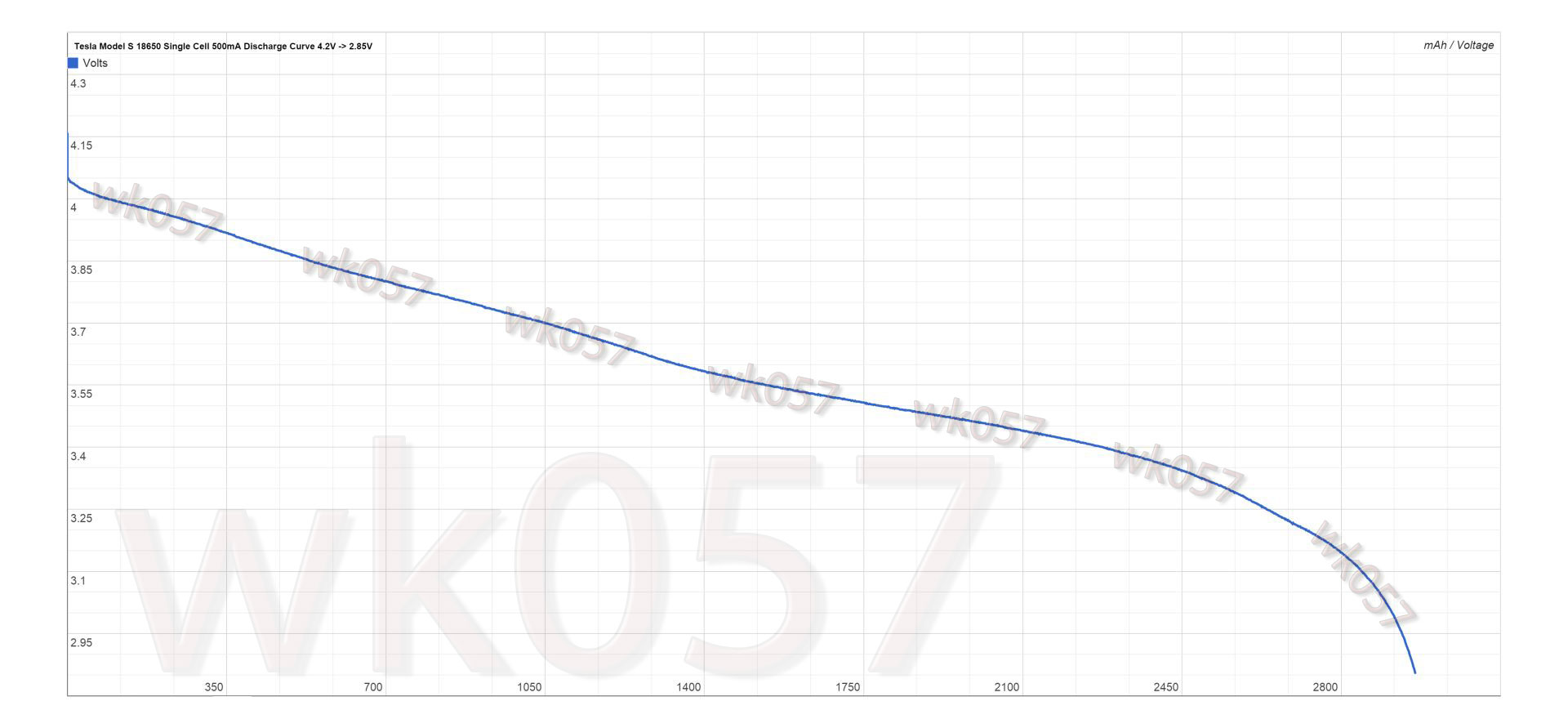
This means that Bob's original thoughts are correct.�
Apr 11, 2015
Red Sage 40 + 20 = 60
60 + 25 = 85
85 + 30 = 115
85 + 35 = 120
85 + 50 = 135
85 + 65 = 150
85 + 85 = 170
85 + 135 = 220�
Apr 15, 2015
Macgaver I have a feeling the Model X will use the 85KWh battery pack for the cheaper model (at the same price than S85D) and have a new 105KWh battery packer for the higher model....�
Apr 15, 2015
Drucifer Chevy has rolled out new chemistry on the Volt twice already, as has Nissan on the Leaf at least once. Probably not that big of a deal to implement.�
Apr 15, 2015
Paul Carter Since the 70D is just more of the same batteries, I now doubt we'll see anything more than an 85 for the initial X.�
Apr 15, 2015
wk057 I mentioned elsewhere, but I'd bet money that the 70D is just a pack that uses 14 of 16 modules used in an 85 pack, similar to how the 60 pack was configured with 14 modules with fewer cells. This would eliminate a part (the 60-type module) completely and streamline pack production (either has the front two oddball modules or it doesn't). Perhaps it uses modules that use cells that binned a hair below spec compared to the 85. But I doubt it is different cells.
As for my discharge curve, I think there is a flaw in my test setup that would cause a lower voltage read. I'm going to retest after I eliminate the potential error in my setup and expect a higher Ah number. (mentioned this in the other thread)�
Apr 15, 2015
anticitizen13.7 I'm going to make a wild guess that the 85 kWh battery will be the only battery in the Model X, at least initially.
Tesla ultimately deemed the 60 kWh battery to be insufficient to create the kind of experience they want to give to customers. Elon's comments were that 200 miles + 20% buffer, or 240 miles, was ideal. A 70 kWh battery in Model X could reasonably be predicted to yield similar range to the 60 kWh Model S, due to extra mass and taller profile. I don't think Tesla wants to sell anything less than a 240 miles EPA rated vehicle.
It's my guess that the 85 kWh battery is the only pack that will achieve 240+ rated EPA in the Model X.�
Apr 15, 2015
Paul Carter Just a reminder that the Model X webpage was updated to say "Offered with multiple battery and performance options" (removing the 60 and 85 reference). Perhaps because they knew the 60 was going away and it made sense not to disclose that and hence the more generic battery options. So I still think we'll see a Model X 70 and Model X 85 at launch. And to quote Scotty, no bloody "A", "B", "C", or "D".
�
Apr 16, 2015
Bgarret Please reserve Mr. Scott for either 1) when there are problems with the warp coil, or 2) when the x is unveiled. Leave him in the bar with his Scotch til then.�
Apr 16, 2015
Paul Carter Aye Aye mon Capitan. �
�
Apr 16, 2015
Red Sage Hmmm... 'Initial'. As in, if you want a Model X Signature, with the 70 kWh battery pack, be prepared to wait until February 2016 for delivery. If you instead want your Model X Signature with the 85 kWh battery pack (or higher), you just may have it before Christmas 2015.
Methinks... 70 kWh (200 miles), 85 kWh (240 miles), and 120 kWh (300 miles)... Maybe.�
Apr 16, 2015
Paul Carter I'd go for the 120 if it were available. The 60 is fine for my S, but if I were to do it again I'd go 85.�
Apr 16, 2015
ohmman I'd stick with the 85, as with my S. It's plenty of range for comfortable road tripping, at least from where I live in Norcal. Might feel differently if I lived in West Texas.�
Apr 19, 2015
Earlian Took this from the Model S Thread, where they talk about April,30 announcement.
Seems the bigger capacity will come from the start, because of that reason.
Makes no sense, to introduce, the worlds first SUV-EV and then come with lower range.
Speaking of that, can anyone imagine, what performance that 100kwh+ ModelX will give us?
They schould search for a new Mode-Name. "Insane" won't last for long, especially, when they also give it to the S.�
Apr 21, 2015
Gerasimental Why would a higher capacity battery give better performance? If it uses the same motors as Model S, it will have the same power. However the car itself will be heavier than Model S and a 100kWh battery back is heavier than an 85kWh one. Same power, more weight = less speed.
Still, even an SUV doing 0-60 in 3.5s would be 'Insane' and it'll be hilarious to watch it out accelerate purpose-built high performance sports cars.�
Apr 21, 2015
Kevin Harney I am no expert but here is my basic understanding of it. A larger battery can be charged and discharged faster because the C rate is lower. Discharging faster yields more power. Like I said not technical.�
Apr 21, 2015
brianman If they follow the Model S pattern, you won't have the option to get anything but the highest battery capacity flavor for Signature.�
Apr 21, 2015
WarpedOne Bateries 101: Two cells provide twice the power of single cell. Same applies to one cell with higher capacity.
There are caveats that can bend this general rule but in general it still holds true.
P85D is limited by maximum discharge power around 415kW. 415/85 = ~4,8C.
4,8C in 100kWh battery gives 480kW. Motors alone are capable of over 500kW.�
May 31, 2015
Gary and Rachel Yes, if I could select 120kwh battery, I'd do it. Done, it's that simple.�
May 31, 2015
Incredulocious Yes, same here. Road trips for me are often to remote locations (even in California) where there is no charging available (including 120V) and too far away from the nearest DC fast charging. Looking forward to greater than 300 mile range (plus further build out of fast charging stations) and getting rid of any need for a gas-burner!�
May 31, 2015
Gary and Rachel The Model X will not be used as a in town drop off for the kids car. We will not be using 7 full size people either. Most of the time only two will be regular driver, riders. At times another couple for going to dinner or day to two day road trips off the main routes. The extra battery capacity will be needed because SC'ers will not be as abundant using back roads. Destination chargers will be more likely. I am a bit concerned that the X is shorter on range already than the S and I would really want a 300+ to 325 mile range X to match what we are doing in our Lincoln Navigator. We are retired and we are already doing this kind of driving, we just want to switch cars. If I drive my F-150 and drive curse control at 55 mph I am getting 700 to 765 miles per tank. An option to remove the 3rd row seats and have more kWh's and luggage space I'll be driving the perfect car. Also this car is going to be about right for my mid 60's by having assested or auto pilot to help back us up and help to make our driving a safer experience. The timing is perfect and very well could be my last car.
I'm just going public on voting for the higher power pack. More mileage equals more back road options.
Thanks for letting me rant.
G & R�
May 31, 2015
scottf200 Rant away. I would select in that option in a heartbeat as well. I want to travel off the SuperCharger "railroad" in any state.�
May 31, 2015
adiggs I'm in the more is better camp also, not that my vote really counts much one way or the other regarding availability.
Two thoughts I have about the bigger battery - one of them is getting me thinking about whether to carry through on the Signature reservation or not.
The first thought is how you'd feel if you got an 85, and <x> time later, the 105 or other bigger battery option for Model X was announced - would that bother you badly? I realize that technology moves fast and that I need to buy the vehicle that I'll be happy with, whatever and however the technology changes the next day. For me, a bigger battery in the next year or 2 when I think they are going to be arriving quite soon - that will bother me. Thus the thought that I let somebody else get into the Signature queue, and I slide down the line waiting for the bigger battery (and yes - realizing that could turn a 2 and a half year wait into a 4 year wait - a Roadster is very nice for staving off the pain).
The second thought is an observation I got from somebody that works at the Portland showroom. She was out doing a test drive with somebody in a 60 DURING the sales conference call when they were told about the 70D and discontinuance of the 60. She missed the call because of the test drive. When she got back, she was told about the product line up change, and oh-by-the-way - there's the new 70D test drive car, the 60 is outta here. She expects any Model X test drive vehicles and similar product changes to happen in that same fashion - they won't exist, until whatever is being replaced doesn't exist.
I expect that is what will happen with the bigger battery. I sort of expect it won't happen in 2015 unless it happens in time for Signature Model X's to order the bigger pack, so passing on the Signature reservation will push me out to at least 2016 for a Model X.�
Jun 1, 2015
Gary and Rachel
I don't want to share my idea/plan to change your mind. Non of us knows how things will roll out. I was never a guy who would stand in a line for three days to get a new phone. With that said. I have been waiting almost 10 years for a Tesla. In 2005 I loved what I saw in the S. I passed on being the first trusting that things would go well and I would catch one a bit later. This did two things for me. It gave me time to hear about the X and also I saw the P and D happen. I was glad I waited. Now I was at San Jose the night they first showed the X. I knew I had found MY car. I think that was 2008 or 9. So what I learned from the S observation I wanted to put into buying the X.
Elon is promising that this will be a special car over the prototype and from the launch it already is. Two motors, auto pilot, performance, etc. But when I read the expected range I knew that was a bit short for me and if I see it I am sure Tesla sees that. But now they have a huge battery plant I think they can be a bit more liberal about spreading them around a bit I think.
I'm drifting off topic a bit but I only have a 5,000 investment at this point and I read on the website that placing an order today could be delivered around July I think. So I can live with that standing on my head in that it's only a smidgen off the ten year wait so far. I may have to hold off my order just a little longer for a longer range.
But if I already had an order and was so close to the front of the line as you and with 2 1/2 years only invested I would want one as soon as I could get one. On YouTube where I see videos of owners of the first S models I don't see them feeling like they ordered to soon, in fact I see someone who has over 100,000 miles and have enjoyed everyone of them. So why wait, I have different needs than most and if I had more money I would want to be like them. Having already driven over 100,000 miles and getting the X later next year.
Today my wife and I are planning on renting a P85D and going for a day or two to catch some of the fun while we wait. Good luck and I can't wait till I read how much fun driving your new Model X is.
Gary and Rachel�
Jun 1, 2015
favo Model S reveal was March 26, 2009. Model X reveal was February 9, 2012. "Objects in the rear view mirror may be closer than they appear?" :wink:�
Jun 1, 2015
Gary and Rachel Wow, thx for the reboot my brain needed. Ever since I retired every day has been Saturday. I can now see how I have been fooling myself about not being effected by waiting. I felt I was typing a mistake but had no notes near me. Anyway my message stands, I'll take a bigger battery please.�
Jun 1, 2015
WarpedOne A bigger battery is almost a given.
Kimbal Musk in a recent interview stated Model X will have similar range to Model S.
I don't see how a bigger (frontal area) and heavier SUV can have similar efficiency as a sedan/hatch.
Efficiency will be lower hence similar range can only be attained with bigger battery. Battery will be ~15% higher, and efficiency will be %10 to %15 lower canceling each other out.
At later time that battery will come to Model S as another big event, taking EPA number over 300.�
Jun 2, 2015
mulder1231 Probably already suggested by someone (and perhaps rebunked) but I'd like to see Tesla offer the possibility to load backup battery packs, like the Powerwall, into the trunk to extend the range when going on road trips. Getting rid of the third row seats would make space for two or three Powerwalls, adding up to 30kWh of backup power for about 100 miles extra range. The extra weight of the packs in the order of 200lbs per pack, not that more than that of an adult siting in the rear.�
Jun 2, 2015
vandacca I can't imagine this happening, due to engineering challenges. The packs have to be temperature controlled (heating/cooling), have to be designed to withstand various impacts and have to be designed to protect passengers from a run-away reaction. It is not a trivial matter to add more battery modules, and if you include all the supporting infrastructure, the actual weight of the battery pack would be significant, which has an adverse effect on range. Its usually best to keep the design as simple as possible.�
Jun 2, 2015
WarpedOne And there is additional problem of balancing both packs. If onboard battery had lower voltage (lower SOC) it would drain the AddOn batteries or vice-versa. There would need to be a balancing device that would limit this surge current not to damage the batteries.�
Jun 2, 2015
mulder1231 That's probably true. The pack would have to be modified to be suitable for non-stationary use, and have the ability to DC to DC charge the main car battery. As for add weight, though, if you have to give up a couple of third row seats, that's about 400lbs to pay with.
- - - Updated - - -
The add-on battery would be used to (quick) charge the main battery. As a backup pack, like the ones you bring with you to charge your phone. Not directly drawing power from it while driving.�
Jun 2, 2015
vandacca When replacing that small area with batteries, half the weight will be due to the redundant systems (heating/cooling/shielding/electronics/etc.) and therefore, you get very little additional range from a significantly more expensive solution. Also, whenever you add additional boundaries, efficiencies always drop, and in this case I would expect it to drop significantly. The only way I can see there being an extended battery pack, is if Tesla replaces the 3rd row seats with batteries by extending the existing battery pack into that area. That way you could use the existing heating/cooling infrastructure and all the control electronics.
But that would mean having two different chassis, which complicates things for Tesla. I don't see Tesla opting for this solution. I think if we wait long enough, battery efficiencies will improve and this becomes less of an issue. If it was that easy to add more batteries, Tesla would have done it long ago. Instead, Tesla went from the opposite direction and decided to build out an incredibly large SuperCharger infrastructure.�
Jun 2, 2015
trialcritic Given the weight increase of Model X compared to Model S, the increase in battery will probably make the range about 300 miles.�
Jul 19, 2015
Gary and Rachel Someone was listening. Wow, big news that the 85 battery pack for the Model X will now have an upgrade option to the New 90 battery pack. I am not sure of the distance specs for Model X but 230 miles was posted once. Reports are the new battery pack 90 will offer 15 more miles to the total distance of a Model S. So let's just for the easy math say 230 + 15 = 245 miles. Hmm, I am going to have to accept a SUV/MiniVan that on a full charge is going to be a vehicle that comes with a half size tank. This will only be a small adjustment for our road trips on back roads. Will just take the Ford Pickup on those trips and keep the Model X for super highway trips. Was looking forward to doing Route 66 on as much of the original roads as possible, with advance planing and making calls to motels for charging it can be done. Hwy 49 and other fun roads will fall into this as well. I belong to an antique car club and we run back roads that make these trips look even look like big highways. Lincoln Highway and Route 66 are the King Roads while Yellowstone and Sturgis are back highways. Will find a few superchargers I'm sure. Looking forward to Dodge City, Tombstone, and all the historic towns. (Bucket list stuff)�
Jul 19, 2015
scottf200 I attempted a spreadsheet here: Estimated range of Model X +5.9% and -5%�

Không có nhận xét nào:
Đăng nhận xét