Apr 12, 2014
pl804 I'm a new Tesla owner, and wrote up my Tesla story on this website:
Tesla Model S - Cost of Ownership vs. Honda Odyssey
It includes a link to a cost of ownership model that was a big factor in my purchase decision.
Would love feedback from the community!�
Apr 12, 2014
rjcbox Nice work!�
Apr 12, 2014
pl804 Thanks, rjcbox!�
Apr 12, 2014
Discoducky I came to that exact conclusion as well. Odyssey vs 60kWh S. But was guessing on a whole bunch. We are 20k miles in and its looking like we could already be cheaper than a touring Odyssey as the car hasn't really cost is much to drive with so much free charging and depreciation is trending very well.
happy driving!�
Apr 12, 2014
rolosrevenge Hm, I'll have to run your spreadsheet for the 60 kWh config that I would like. If it truly is cheaper, I may have to get it when my other car inevitably dies.�
Apr 12, 2014
pl804 Great to hear your story. I do miss, however, the RES options for the Ody. I'd love a synchronized dual-screen option with front seat playback controls. I've been searching but haven't found anything reasonable for the Tesla. There was the iMagnet tablet mount, but the mfgr no longer sells it. So still on the search.
- - - Updated - - -
Curious to see how it looks - I think it should be pretty solidly in Tesla camp.�
Apr 13, 2014
David_Cary Come on. Saving 20k on depreciation. So a $45k Ody after 8 years is worth $10k and the $85k Tesla is worth $70k. If Tesla is successful long term, 8 years from now a comparable car to the Model S new should cost $50k so an 8 year old one would be lucky to garner $30k.
For your next trick, living in a 5000 sqft ocean front mansion is cheaper than living in a 1000 sqft apartment.�
Apr 13, 2014
gglockner Enjoy your Tesla. But it is silly to justify the Model S in terms of cost. Justify it because you like it, or you want to use less oil. But of you try to justify it in terms of cost, it looks silly - there are many other fine cars that are comfortable and cheaper - even if gasoline doubles in cost.�
Apr 13, 2014
andrewket The OPs numbers seem a bit off. Having said that, I sold our sienna minivan which had a v6 gas guzzler for a volt. From a fuel perspective it's night and day. Two very different cars though. I definitely gave up some flexibility. The volt is driven about 65 miles and charges twice per day. 99% EV.�
Apr 13, 2014
lolachampcar PL804,
Nice write up. Now, if you do the numbers on owner/builder solar and then plug those into your cost of energy �
�
Apr 13, 2014
pgiralt
Did you actually look at his model? He projects exactly what you stated - that an 8 year old Model S would be worth $30k. His numbers look pretty sound. The gas prices might be a little high (for this area) but his electricity prices are high too, so I think that averages out. In general I agree that the resale value will be the biggest variable as to whether it ends up being more or less expensive and it is pretty difficult to come up with that number given how fast the technology is moving. That said, I think $30k seems pretty reasonable for a Model S 8 years from now.�
Apr 13, 2014
pl804 Cool! I used $30,160 for residual value after 8 years.
- - - Updated - - -
Thanks, andrewket. Welcome any input into more accurate numbers. I've been adjusting them with input from experts.
- - - Updated - - -
1st of all, thanks, lolachampcar, for all the help while shopping - I actually need to edit the site to give you proper props.
I'm actually scoping out solar now and trying to see how this influences matters. I spoke with the former CTO of SolarCity on Fri., and have started comparing figures from SunPower, Cobalt, and my local roofer.
- - - Updated - - -
Thanks for clarifying, pgiralt. Yes, I am using California/Silicon Valley gas prices and Palo Alto electricity. That's a good point - the discrepancy will probably be a little less with lower fuel prices.�
Apr 13, 2014
David_Cary He said that a Model S saves $20k in depreciation vs a Honda Ody. That is what made no sense.
But as I look at the spreadsheet - he does have $30k as residual.
So something doesn't add up.
A $90k car that is $30k after 8 years but the NPV is $40k - despite $60k in depreciation.�
Apr 13, 2014
Muzzman1 Great info! Thanks!
Any Way you can publish the google doc so we can download and plug in some of our own values?? Thanks!!�
Apr 13, 2014
pl804 You are totally right. I should've put these on opposite sides. I'll update it later today and report back. Thanks for catching that.�
Apr 13, 2014
omgwtfbyobbq Isn't the NPV for any car going to be negative? All they do is depreciate and use resources... And for the electricity use, shouldn't that be from the wall (~400/500Wh/mile)?�
Apr 13, 2014
tga +1 - For me, gas is cheaper and electricity is more expensive. Plus, my miles/year is much higher.�
Apr 13, 2014
pl804 Yup, all negative. Was lazy so didn't put negatives everywhere but good point. Will add to notes on the model, incl. specs for the S I ordered.
For electricity use, used 3 Mi per kWh so 333 Wh per mile. This seemed in line with what others were reporting. Are you seeing 400-500 Wh per mile on your S?�
Apr 13, 2014
tga You use 333 Wh/mi from the pack. But it takes more than that to charge the pack, due to charging losses (primarily heat losses in wire, charger, and battery). I have no idea what the total drawn from the outlet is per mile.�
Apr 13, 2014
David99 I'm pretty confident the resale value will be good. Increasing gas prices will make ICE cars less attractive in the future. The Model S is a wonderful premium car that can and most probably will be easy to upgrade with better battery technology unlike other EVs. This will keep the value of the Model S.
The cost savings over gas/petrol depend so much on how much you drive. It can be a lot more than in these calculations. In the 18 days I have owned Model S I already drove 2800 miles and saved aprox $500 on gas. Most of my miles are long distance trips with Superchargers. I don't have a home charger so I depend 100% on public charging. I have found many free chargers in the areas I frequent.
There are of course emotional reasons to buy this car and reasons connected to climate change, pollution, foreign oil and all these things. But even if you look at it from a finacial only perspective the Model S looks pretty good.�
Apr 13, 2014
omgwtfbyobbq No S yet, but I think the EPA already uses the from the wall charging efficiency, so you can just plug and chug with those figures for an apples to apples comparison.�
Apr 13, 2014
pl804 Thanks for the comments, everyone. I updated the paragraph re: depreciation, and added notes to the model.
If you want to copy the model and input your own values, you can click on the direct link to the model (bottom of the home page, or at the bottom of the embedded model). Here's the direct link as well:
Google Drive�
Apr 13, 2014
johnnyS Most likely you will find that you will drive your model S more miles than you typically drive your other cars which will help the model. As an early purchaser, I had no idea about resale value, so my justification was that I would drive it a long time as long as it is reliable.
For me having HOV access is a huge time savings which translates into billable hours for my line of work. If I save 1/2 hour driving to and from an appointment a couple of times a week, it adds up quickly. We have a supercharger trip planned the week after Easter which will save $350 in fuel costs.�
Apr 13, 2014
GDH Meh, it's not going to be that good. Besides gas prices have been coming down....at least in Oregon they have.�
Apr 13, 2014
clintons Thank you for the spreadsheet link. I think that one should consider setting aside some amount annually ($2,000?) for the traction battery as it will need to be renewed at some point. Perhaps there will be an improvement in the battery technology with a retrofit exchange available but at some point the original will need to be replaced as would any wear item.�
Apr 13, 2014
pl804 BTW, this wound up reaching #4 on Hacker News ... but within an hour, it somehow got flagged I think? and fell to 40 and then off the charts. But interesting discussion inside there.
Tesla Model S – Cost of Ownership vs. Honda Odyssey | Hacker News�
Apr 14, 2014
Alysashley79 @pl804
very nice write up. My husband and I loved the way the tesla looked. Or at least he did and then he wanted a test drive so I arranged it for him and "went along" and I ended up being the one obsessed with the car and how can we get the car. We had a honda pilot which was a fantastic car but a complete gas guzzler. So while this car for us was an emotional decision it was probably 90% driven by the fact that over 5 years it would save us $. Many people say that this car isn't one that will save you $ and is more of an emotional decision. I disagree. The people that say that are people that have been driving luxury cars already and are moving from one expensive cargo another IMHO. I was spending $800-900 per month on gas just for MY car that doesn't even take into consideration what my husband was spending on his is car. I spend less on my tesla payment! AND I love this car!�
Apr 14, 2014
AndreyATC FWIW, It looks like MS takes about 1.25kw for every 1kw it drives
This is my rough estimate through observation (kw spent vs time to charge at 9.6kw)
So multiply that by whatever your math is doing in 330whm section�
Apr 14, 2014
pl804 Thanks. What are you seeing in the car wrt Wh / mile?
- - - Updated - - -
Thanks for sharing your story. I think for lots of driving, the picture is even clearer, as you write. I put 30K into the model and the Model S moved to #2, behind only the RAV4 EV (which doesn't have quick charge or long distance capabilities).�
Apr 14, 2014
AndreyATC My short average (i recently reset my trip computer) in this warm weather is a tick below 290wh/m
I'm sure it's gonna go up as it's hard to drive this car in granny style
Now with low suspension setting and summer 21inch tires i get constant urge
Also, for your calculations it probably makes sense to use higher number for someone in cold climate
Average for a year will go up a bit
Mine was 400-420whm during this crazy winter�
Apr 14, 2014
Theshadows Awesome write up.�
Apr 14, 2014
David_Cary You know of course that if you put in 30k miles per year that the battery won't last 8 years. Dreaming that the replacement cost will be $12k doesn't make it so - even Tesla realized that.
TCO wins just fine against a loaded BMW 5 series.�
Apr 14, 2014
Canuck Sure looks like it...
Historical Gas Price Charts - Oregon Gas Prices
NOT!�
Apr 14, 2014
johnnyS David: The Tesla warranty is for 8 years unlimited mileage for the S85. So if it fails in that time frame, it will be Tesla's nickel.
I have not bought any gas in a couple of months, but the price is definitely up here in California!�
Apr 14, 2014
ecarfan That depends on how you define "last" as regards the battery's useful life.
There have been many discussions on TMC about how there is some evidence to support the thesis that after 100K miles or so the Tesla battery may lose about 20% of its capacity but from that point on further capacity loss may be minimal. We won't know for sure for a few years yet.
It is possible that at 200K miles or more an 85kW battery may still have 200 miles of range remaining, in which case it would still be quite useful and may not be worth replacing.
It is also entirely possible that 8 years from now replacement 85kW batteries will be much cheaper than they are today, perhaps half the price. In which case replacement cost could be $12K. Certainly over the next 8 years battery costs are going to fall by a significant amount. They are not going to be anywhere near today's cost (measured in inflation-adjusted dollars).�
Apr 14, 2014
David_Cary Of course the 8 year warranty does not cover degradation. Any claim that the battery will be the same as new at 200k miles in 8 years is just wrong. Any likelihood that Tesla will replace such a battery when warranty specifically excludes degradation?
I find it unlikely (not impossible) to get 200 miles from a 200k battery. I suspect 20% per 100k miles with only minimal slowdown for the second 100k miles. There maybe no slowdown as the depth of charge will tend to increase.
It is entirely possible that degradation will speed up and 50% is about what a 240k mile battery will have left.
Does anyone know what the performance of a P85 would be with a 50% degraded battery? It sounds like the P model taps the battery maximally. So if the battery is 50% degraded, does that mean 50% less power?
The current battery retails for $40k. Expecting 50% price drop in 8 years is IMO wildly optimistic. 30% I could see.�
Apr 14, 2014
ecarfan If that is in response to my post , that is not what I was claiming. And certainly no Lion battery is going to be "as new " at 200K miles. There will be significant degradation.
I agree that could happen. If that is the case, a battery with 200K miles could still have some useful life left in it. But many owners will consider replacing the battery. What the replacement cost will be in 8 years, no one can say with much certainty.�
Apr 14, 2014
jerry33 Battery life != warranty period. Does the engine in an ICE car fail at the 36K mile warranty?�
Apr 14, 2014
tliving I did a similar analysis for my own needs versus getting another Acura MDX:
Cost Justification a tie? | Tesla Living
Not quite as mathematical but we all have to justify things our own way to get to the end result.
6 more days to delivery...�
Apr 14, 2014
rcc For battery life, I think you need to factor in battery cycle pattern as well as mileage.
I think the battery is going to be happier if you're doing three 40-mile trips per day with recharging in between instead of one 120 mile trip per day.
I ferry my kids around and my driving pattern looks like lots of 5-20 mile trips with charging in between. But I put 20K miles per year on the car.�
Apr 14, 2014
pl804 Hi all, I made 2 important updates to the model. (1) electriclove on HN discovered a bug in one of the formulas where the Ody's fuel cost was being overcounted. (2) I added in $1200 every 3rd year for tires. The end result is the Ody is now $37K and the Tesla is $42K, a slightly less than $5K difference or about $600/yr.�
Apr 14, 2014
EarlyAdopter Charging losses are 15% from the wall, as measured by the EPA, me, and several other people here. So if you averaged 333 Wh/mi driving, then your meter draw will be 383 Wh/mi charging.�
Apr 14, 2014
gglockner There's too many assumptions for my taste. For starters, there is no consideration that the Tesla Model S costs $50K more up front. If you are buying with cash, you could buy the Odyssey, invest the $50K and make another $25K or so.�
Apr 14, 2014
AndreyATC I am having a hard time to believe that Ody will only spend 2700/y on gas
22mpg seems too optimistic, almost EPA-ideal, not real life average you'd get
I had many cars with 27-30mpg highway rating and drove them roughly 14k a year
My gas bill for a year was always around 4K
There are winters, traffics, idles, etc, this "bus" is not averaging 22mpg
It's be lucky to get 17, just like my friend's Ody�
Apr 14, 2014
SFOTurtle I agree. Our Highlander averages about 17 as well despite having 22 highway rating, and I think Odyssey is pretty much the same. With gas prices here in CA now north of $4/gallon again after having been in the mid to high $3s for most of the past 12 months, I would have spent about $3500-3750 in gas over the last year if I had driven the Highlander for the same miles. Having good access to work charging stations and maybe half the miles on road trips with Superchargers and other free charging, I'm estimating I spent only about $300 on my utility bills powering my Model S over the past 12 months, with much of that spent before I switched to EV rate plan, so I no longer get dinged at the end of the billing cycle on higher kWh rates.
Geez, just in the two months I've probably put on 2,000 miles just on the weekend using Superchargers for long roadtrips (granted I forked over $2K to enable my 60 for this option). But I figure at the rate I'm using the Superchargers, I will have made back the $2k investment in gas savings sometime over the next year.�
Apr 15, 2014
B.TSLA Tesla Model S is cheaper than a Honda Odyssey minivan in the long-run
I've explained this simple concept to many people over last few months and many couldn't wrap their heads around the concept of long term vehicle cost. I've found the barrier for most is the starting price and they can't move beyond that.
Have a read.....
http://www.extremetech.com/extreme/180443-tesla-model-s-might-be-cheaper-than-a-honda-odyssey-minivan
Cheers�
Apr 15, 2014
David_Cary EPA - hwy 28; city - 19. People who study these things have shown repeatedly that Honda does the best relative to the EPA ratings (ref - Wayne Gerdes)
15k miles a year at $4 for $2700 puts his mpg at 22. That is a pretty pessimistic assumption - worse than the weighted average city/highway. Getting 30 mpg out of a Ody on the highway is probably simple.
I made a 8 year comment in reply to someone who posted that if the battery doesn't last 8 years, then it is on Tesla. That is a false assumption. Of course the battery will still have some life after 8 years but unlike an ICE, it will degrade over time. The ICE may completely fail but I suspect the failure rate for a Honda engine at 8 years is very low.
OP - did you put the residual value in as your cost rather than depreciation? That would be a $30k mistake and makes sense.
NPV seems like a fairly complicated concept for us non-accountants....
It really is pretty simple - pay 90k for a car that is worth $30k after 8 years and you are $60k poorer. Throw in time value of money, and you are even poorer. Sure you will save some money in fuel - usually to the tune of $2k a year for average drivers. You may save some money on maintenance (or you may not) depends on the comparable car.
TCO wins out best comparing a luxury car driven a lot of miles. You can then save $4k a year in fuel and that $32k really makes a dent. Then it can beat even an Ody (but you still have to neglect the time value of money).�
Apr 15, 2014
No Tailpipe Pl804
THANK YOU, Needed this to convince my friends that a Teska isn't "that" expensive compared to a regular gas vehicle. Now I have the data to support.
+1 to you!�
Apr 15, 2014
mkjayakumar I have had my Ody van for 10 years and 120k miles and I averaged around 18 to 20 mpg.
That is around 5500 gallons and at $3.50 it cost me $19k+ to fuel it.�
Apr 15, 2014
tga The writeup on transportevolved.com refers to your fellow HBS alum as a "Brain consultant with a PhD in Physics" :smile:�
Apr 15, 2014
cantdecide Another data point... Our Ody was getting 17mpg... Replaced it with the model s at 301wh/m.�
Apr 15, 2014
tga I'd be careful about using a 10 year old version of any car as a proxy for today's models, MPG or otherwise. I have a 2004 Mini Cooper S and a 2004 911 GT3. Both are 2 generations back from the 2014 models, have completely different engines, etc. The 996 GT3's engine is bulletproof. 991? Well, not so much...�
Apr 15, 2014
pl804 McKinsey forecasts a drop from $600/kWh in 2012 to $200/kWh in 2020 (6 years away).
Battery technology charges ahead | McKinsey Company
- - - Updated - - -
EPA ratings for Ody vs. Tesla:
http://www.fueleconomy.gov/feg/Find.do?action=sbs&id=33717&id=34775
I used the 2014 combined EPA ratings for the Ody, and worse than the EPA rating for the Tesla (255 instead of 265). I gave the Tesla a penalty to be conservative. From the conversation so far, it sounds like this should cover the add'l draw from the wall, but I'd love to see more data there.
Residual in both the depreciation and cash flow models comes back as income in Year 8. The time value that you mention explains why the cash flow model has higher values than the depreciation model.
- - - Updated - - -
Haha, that's hilarious. Maybe they thought my write-up had a typo there. =)�
Apr 15, 2014
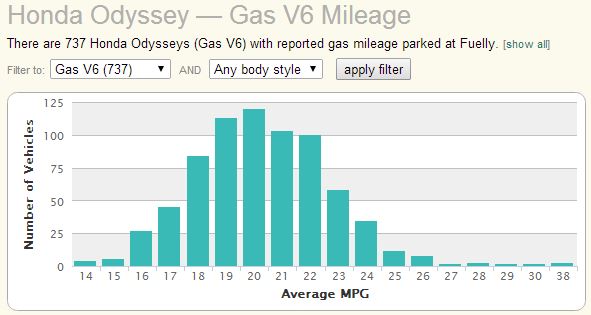
clintons The following info graphic courtesy of Fuelly - Track and Compare Your MPG shows real world usage reports for the Odyssey with the 2014 models averaging 21 MPG.
 �
�
Apr 15, 2014
David_Cary The problem with that McKinsey study is that $600 per kwh in 2012 is/was not what Tesla paid. No one seems to know for sure what Tesla pays but they charge just over $40k for 85 kwh or $500 (give or take). Presumably they pay more like $350 based on their margins. I think it is reasonable to presume $200 in 2020 but that is not really a 50% decline. And since when is McKinsey a reliable technology forecasting company. As far as I can tell, the lead author has never written anything else about the subject.
Tesla has been a low priced battery all along.
Even at $200, you are talking $17k + 25% markup or $21k. Not insignificant.
I would definitely concede to fuelly on the real world MPG of the Ody but 21 is awfully close to 22.
Again I ask, how does $60k in depreciation not trump everything else? Usually the unrealistic TCOs have an unrealistic residual value. How do you have $60k in depreciation and have that magically cost less than a $45k vehicle. Fuel only costs so much....�
Apr 15, 2014
fdog Which line in the google doc captures the cost of insurance?
I'm not seeing those costs reflected, and of course, insuring a Tesla Model S is going to be substantially higher than insuring a Honda odyssey. I applaud your otherwise thorough writeup, but you can't do a total cost of ownership analysis and ignore insurance...�
Apr 15, 2014
David Witt Great analysis
Hi Paul,
A very interesting story and analysis.
I'd very much like to receive a copy of the xl file to do some sensitivity of my own as I am in Canada.
Would that be possible?
I am reached on gmail or at [email�protected]
Thank you,
Dave�
Apr 15, 2014
rv1458 I like your analysis, though I do have one comment and one question. I am curious how you got such a great deal on your Rav4 EV. Please PM me, I'd like be able to replicate that
As for my comment, I think your depreciation is less than it should be. Tesla's 3 year guaranteed buyback price is roughly 47% and you're using 65% at three years. At 5 years, I would expect the Tesla to be at about 30%, and you're using 50%. At 8 years you're using 32%, which is clearly too high, though it's hard to say what it would be. My guess is that 20% would be generous. Your residuals for the other models are high too. I would check out http://www.cars.com/go/alg/ for better residual data to improve your assumptions.�
Apr 15, 2014
ken830 It would also be nice to add in a "Supercharger-enabled Roadtrip Miles per year" field. That number of miles would be subtracted from the Tesla's annual fuel costs computation. This change would apply to many families' use-case. If the car isn't used for long-distance road trips, then a RAV4 EV would be a better pick than the Tesla is most cases anyhow.�
Apr 16, 2014
Objective1 A couple questions:
The spreadsheet seems to be assuming electricity cost of recharging at $0.12 per kWh. That is very low for California, New York, and many other places Tesla buyers live, isn't it?
And it assumes gas retail prices will rise over 8 years. Why is that? Gas prices are not on an upward curve the last couple years, and a production revolution is underway thanks to fracking (and not, in the long term, just in the US).
Thanks for any insight you can provide.�
Apr 16, 2014
ecarfan This topic should be merged with the pre-existing topic that was started by the guy who put that spreadsheet together.
@Objective1, in the San Francisco Bay Area with PG&E on their EV rate plan, off peak rates are $0.11/kWh.�
Apr 16, 2014
Yuri_G Fracking doesn't affect gas prices, however oil prices do. Oil prices rise and fall based on global demand, which has been rising steadily the past 15 years.
Motor Gasoline Sales Through Retail Outlets Prices�
Apr 16, 2014
Objective1 In my state, the price of gas isn't much higher now than it was in 2006, and it's been floating up and down around that point. Oil prices are like all prices, they are affected by both supply and demand. Fracking in the US hasn't driven down oil prices so far, but that's because it's world-wide impact on supply has hardly begun to be felt.�
Apr 16, 2014
RobStark Southern California Edison Tier 1 is $0.13 per kWh and there are various EV rate programs available to lower the cost. This to incentivize overnight charging while the grid is usually idle. I would say $0.12 is a high estimate.
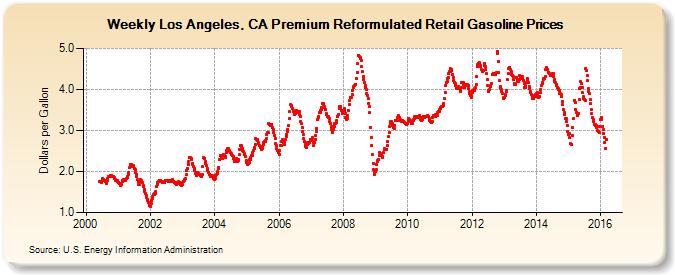
Gasoline price fluctuations are strongly linked to global demand and supply for oil. Spikes in prices not related to global demand and supply are generally short time price fluctuations in the US.
While fracking will increase domestic supply and put downward price pressure on global prices in will likely be overwhelmed by increases in global demand.
Any fall in prices the next two years is likely to be short term.�
Apr 17, 2014
AndreyATC One thing to add, which affects electricity pricing, is supply charge
My kw cost is only $0.06 (delivery charge), but with additional $0.10 per kw supply charge it comes to about 0.16 on the bill�
Apr 18, 2014
GDH But Batman drives the Odyssey so did anyone take that into consideration?
CLICK ME�
Apr 21, 2014
russman I'm in CA and have solar. I'm on a Time of Use plan and my low cost usage is about $.085 for the lowest rate. So $.12 is actually high, but doesn't hurt.�
Apr 25, 2014
bluedevil30 Thinking about buying a Tesla and enjoyed your spreadsheet. A few comments after a very quick review:
-Did you include the cost of installing the home charging station in your initial costs?
-I think total cost of ownership - total and per mile (3,5,8 yrs) is a more relevant comparison tool than NPV
-This model would be way more accurate if Tesla offered a true lease option - then residual value can be eliminated.
Since the Company is now very stable the biggest risk in my mind is residual value. In five years, I don't want to have a new twice as efficient model come out for 50% of the price and crush my resale value. Nobody really knows the resale market for a used Tesla yet.�
Apr 28, 2014
JonathanD The 3-year buyback guarantee is good for piece of mind. By then we should have preliminary estimates on Model E pricing and can see how the resale market has been doing.�
Apr 29, 2014
VolkerP There is a bottom for efficiency established by physics. Don't worry. But we can expect Tesla to improve EVs dramatically in the years to come.
The only way to justify a Model S on a financial basis is, if you plan to keep it for a long time - 8 ears or more. Then the biggest risk will be failure rate and cost of repair when out of warranty.�
Jun 23, 2014
tnagpal The model really bothered me for a while since the CPO Mercedes came out horribly. A used car should definitely come out better in just about every case.
The problem is the 10,20,30% depreciation assumption that is applied across any car. A better assumption should be ~30% in the first year and roughly increase 7.5% every year. For a used car, you depreciate at 7.5% the first year and then incrementally at the same rate.
I took depreciation numbers from cars.com for a Mercedes Benz E350, and then for the used MB E350 car, I started with the incremental depreciation in year 3 since the first year hit is usually the largest. What you get then is that buying a used car saves you a massive amount of money.
You can take a look at the revised numbers here - would appreciate anyone catching any errors or critiques.
https://dl.dropboxusercontent.com/u/712730/Tesla%20Model.xlsx�
Jun 23, 2014
Larry93428 I have both a Model S and an Odyssey.
Service on that Od is expensive.
Last service on the Od they wanted to replace the serpentine belt at $1200. They said this is routine.
One of the sliding doors is starting to fail. That will cost a lot to repair!
Are such maintenance costs included in this thread?�
Jun 26, 2014
vevans I have these vehicles also. I find it amazing how it is difficult for people to grasp how much they spend in fuel. Someone I know said it best they are just used to buying fuel. This is called a paradigm something we are used to doing even if it costs more. Anyone with basic business skills should be able to understand why a Tesla makes sense with gas prices hovering around the four dollar mark. I really think the Tesla will hold its value alot more than what is shown.�
Jun 26, 2014
brianman "Pair of dimes grift"�
Nov 17, 2014
alexv I'm sorry to burst everyone's bubble, but there are two glaring problems with this spreadsheet.
TL; DR: MS actually costs ~$25K more than the Ody over 8 years, given OPs assumptions.
First, and most importantly, the spreadsheet misinterprets depreciation-based TCO model. I'll try to explain the mechanics of the model the way I understand it (not taking discounting into account yet):
1. At the end of every year of ownership, you perform an imaginary sale of your car at its then-current resale value
2. The difference between the price of the car at the beginning of that year and the price at which you "sold" plus all other expenses (gas, service, taxes, what have you) is the total cost of ownership of the car for that year.
3. If you intend to keep the car for another year, you immediately perform an imaginary buy-back of the car (at the same resale value you just "sold" it for)
4. If you don't intend to keep the car, you just turn that imaginary sale into a real one.
The beauty of the model is that it works for any number of years, and whether you intend to keep the car for another year (i.e. whether the sale was imaginary or not) has NO effect whatsoever on the TCO calculation for the previous year(s).
The problem with OP's spreadsheet is that on year 8 (cell J46), it deducts the resale value of the car from that year's cost of ownership, supposedly because that's when the car is actually sold. But you can't do that! The model already took the sale into account!
This is (apparently) not easy to grasp, so let me provide a couple of examples to show the flaws in the spreadsheet.
First, imagine that our beautiful MS has no depreciation whatsoever (for example, it's mister Musk's own car, or whatever). Delete all the values from the "Depreciation factor" row. See the NPV? It's MINUS $53K now. That means that you paid $92K for your car (plus taxes, minus tax incentives), then paid each year for tires and electricity, then sold it for the same $92K (so no profit), and came out with a $53K discounted(!) profit COMPARED TO INVESTING SAID $92K AT 5% RATE (sorry for caps)!
For a more realistic example, imagine you sold the car after the first year. It's pretty clear from the table, that your total cost of ownership for that year should be around 20K (again, without discounting). However, if you remove all the years after first and perform that resale value subtraction in C46, the NPV becomes minus $50K! That's more than 50% profit, and you get to ride an awesome car for a year! How is that possible, you ask? Well, it isn't.
Anyway, after getting rid of that deduction (but leaving everything else untouched), discounted MS TCO for 8 years comes up to $62K. However, I argue that, since we're doing NPV discounting, even that has to be adjusted. To see why that is true, again imagine we only own the car for one year. For simplicity, also imagine the depreciation for that year is 0, there were no taxes or fees to be paid and no tax incentives, and also you charged the battery for free. Remember that we're comparing to investing the money at 5%, right? So, you buy the car for $92K, spend nothing else, and at the end of the year sell it for $92K. Does it mean that you suffered no losses compared to investing? Of course not! You have to prorate the initial investment ($92K) and only THEN subtract resale price from it to get the year-end cost of ownership, in this case $4.6K (or, after discounting, $4.3K NPV). So for the real calculation, for each year we have to prorate the resale price at the beginning of the year and subtract year-end resale price from THAT - to get adjusted incremental year-end depreciation.
I've updated the formulas for all the cars in the original spreadsheet and put it here: https://docs.google.com/spreadsheet/ccc?key=0Aoyh3mqbEkS4dDNXQ1pGOF8tdEdUSUlGWUZkZ05tU2c
With OP's original assumptions, MS TCO comes up to $83K - that's $2K more than even the MB E350'14 , and $25K more than the Ody.�
Nov 17, 2014
alexv Edit: reverted Miles/yr back to 15,000 and made another small fix - now MS is $1200 less than MB E350 '14 (yay!). Still $25K more than the Ody though.�
Nov 18, 2014
llavalle I always found the calculations a bit over-optimistic. Before buying my S85D (last month), I did a TCO comparison between the S and my current car, a 2013 Volvo S60 T6. (bought for $52k CAD + taxes)
With the current situation in Quebec, Canada, I was getting a break-even point at around 80months, and that's with a base model S85D with dual charger and tech package.
Current prices in QC :
Electricity : 8.26c /kWh.. in CAD, that's $0.0731 USD at the current exchange rate. We also get the first 30kWh per day at 5.57c!
Gaz : We're paying around $1.40 cad per LITER (regular unleaded), that's around $4.70 USD a gallon
As you can see, electricity is cheaper and gas costs more...I found it very weird that with the prices you guys have on both of these you could beat a Honda Odyssey (worth 2/3 of my Volvo) after 8 years... it just did not add up.
Thanks for noticing this flaw in the calculation!�
Mar 16, 2015
brucet999 Solar Panel TCO Model
I did just that for my location in Huntington Beach, CA.
4.5KW self-installed array with 96% inverter efficiency, azimuth 270 inclination 22� would cost about $12,000 less 30% tax credit and projects to produce 6,500 to 7,000 KWh per year. Enough to offset all charging costs for 12,000 mi per year plus reduce home usage by 2,500 to 3,000 KWh per year; at SoCal Edison tiered rates, would reduce my electric bill about $500 per year.
To get a $0.12/KWh rate here, you have to install a second dedicated meter for EV charging at a cost of about $2700 (You need an electrician to cut and splice Edison's incoming lines) and charge during off-peak hours - 10pm to 8am. 5-year TCO for my proposed $90,000 list price MS using Grid power comes out to $47,800. Solar panel scenario comes out to 5yr TCO of $48,300. Sale of house in 5-yr scenario (likely for us) would increase home value by at least as much as Solar array cost, (likely $5k more using commercial installation price) and makes fuel cost a negative $500 per year; 5yr TCO becomes $36,300
For roughly comparable cars in size and luxury I chose Lexus ES300h and Lexus ES350, both pretty loaded, at $43,900 and $42,500 respectively. 5yr TCOs for those come out to $35,000 and $38,300 respectively. Even my best scenario, with zero cost for solar, MS costs $1300 more than ES300h. Still, the premium to own a Tesla works out to less than I had expected.
BTW, I include tires at around 30k and 60k miles for all three cars (according to Lexus and Tesla service departments) and brakes according to Lexus. Depreciation for Lexus came from Edmunds.com TCO and for Tesla from used prices in the area discounted for typical used car dealer trade-in price. For 2014 and 2013 MS those prices were unexpectedly high, giving depreciation rates of 18% first year and 23% 2nd year, using today's new sales prices comparably equipped as basis. (I did not want to try to figure out prices from a year and two years ago, even though I know that they were somewhat lower then.) For depreciation in years 3,4,5, I used Edmunds' rate progression for Lexus as they had been close in the first two years. Given that Tesla will be busy rolling out the Mega battery facility, Model X and Model 3 through at least 2018, I doubt that they would lower Model S pricing even if their battery costs decrease, so I wouldn't expect a collapse in resale prices.�
Mar 16, 2015
GreenPenguin You don't need to install a second meter you just need the TOU-D-A/TOU-D-B rate plan. Super-off peak 10pm-8pm is actually $0.11.
So a little cheaper.�
Mar 16, 2015
30seconds why would you use the ES and not the LS or GS?�
Mar 17, 2015
Drucifer This may be useful in discussions with my better half
Much thanks.�
Mar 18, 2015
brucet999 I don't understand NPV calcs, but TCO model works for me
I read your blog and was excited by the NPV result that put a Tesla nearly the same NPT as Honda Odyssey, so I copied the spreadsheet and entered values for the cars I am comparing, namely Lexus ES350 and Lexus ES300h hybrid. The numbers looked pretty good for those too, but the more I looked, the more common sense got in the way of my enthusiasm. Maybe I just don't understand what I am looking at, so can you help me?
If I understand correctly, NPV is a tool meant to produce a present value for an annuity or other fixed return investment at some future date.
By common sense I calculate upfront outlay ($102.2k for a Tesla) ($45.7k for an Odyssey) plus operating costs for 8 years minus residual value yields the true cost of ownership (TCOO). So Tesla's upfront $102,200 + $9,000 maintenance - $30,160 residual = $81,040 TCOO. For Ody. $45,700 + $28,950 - $16,800 = $57,850 TCOO. Tesla therefor costs $23,190 more to own over 8 years. The difference is even greater when residual values are discounted to a PV of about $20k and $11k respectively, yielding a TCOO difference of about $28,000.
Your NPV produces a difference of only $4,848 between the two. Please help me to understand that.
In your model, you discount maintenance costs, which then must assume that price of shop labor rates, replacement parts and materials (antifreeze, oil and waste fluids disposal fees, for instance) will remain constant over 8 years. I would imagine that maintenance costs would increase about the same as inflation, canceling out the discount.
In your model you discount the paper expense of depreciation as if it were an actual additional expenditure of cash and not a measure of devaluation of original outlay. I don't understand.
BTW, given the benefit of another year of actual resale figures, I found Model S depreciation values in SoCal for 2014 to be around 18% and 2013 about 23%, making your conservative assumptions a year ago of 20% and 28% for years 1 and 2 look pretty safe.
THANK YOU! In spite of my doubts of the usefulness of the NPV figures, I must thank you for producing an excellent framework to account for operating costs and residual value, which I used in a modification of your model to convert results to TCO. Relatively high scheduled maintenance and more frequent brake jobs on ICE models greatly narrows the initial outlay gap such that the difference between MS and Lexus ES300h ends up at 5 yr about $12k and at 8yr about $18k (greater depreciation amount even at same depreciation rate makes difference grow each year) The non-hybrid ES 350 differences were only about $8k and $12k. So for an average $2,250 or less per year I can drive a fantastic car instead of a very nice car and make less impact on the environment as well.
When I figured in cost and savings of self-installing a solar array on my house big enough to offset the Tesla's consumption and most of our present electrical usage, and realizing that upon sale of the house (a likely prospect for us in the next several years) we would at least recover the cost of the solar array (probably plus $5k, but I did not add that in), then the Tesla TCOO becomes only about $5k more than the ES300h and $4k less than the ES350 at 8 years. As a bonus, by driving on sun energy, we would conserve 300 to 500 gallons per year of non-renewable energy resources and emit 6,500 to 11,000 lb less CO2 per year.�
Mar 24, 2015
chriSharek This is a great article. I'm a Volt owner currently and my next car will be a MS. What does NPV stand for in your spreadsheet?�
Mar 24, 2015
yobigd20 it's not only cheaper than a honda odyssey, it's free!! How To Drive A Tesla Model S Electric Car Free For 18 Months�
Mar 24, 2015
Cyclone 18 month old S85 with 50k+ miles will likely sell for less than $77k and thus, LeonardV's 18 months will no longer be free -- but still totally worth it!�
Mar 29, 2015
gameboy I came across your cost of ownership article and thought it was great. If you are comparing an electric car with an ICE, you should consider adding in value of time to your cost somewhere. If you own a Tesla, time is probably worth a lot to you because of your profession. As we get older, our limited time is worth even more.
I have a P85+ with 17000 miles. I used to drive a gas guzzler Jeep that I'd fill its near empty 24-gallon tank about every 250 miles. Each visit to the gas station must have taken me at least 10 minutes...pressing NO to rewards card, NO to car wash, YES for receipt, swiping credit card, filling up, and waiting for receipt to print.
So, I estimate the time to fill my Jeep costs: 17000 / 250 = 68 fill-ups * 10 minutes = 680 minutes = 11.3 hours. That's a lot of time I've saved with my Tesla, not to mention wasting an hour getting in line for an oil change every 5000 miles; that's 3 hours lost right there. Now supercharging might eat up some time for recharging during road trips. I don't supercharge during my commute. Anyway, this is just a thought. How much time is taken filling up in a Honda Odyssey? How much is your time worth to you?
Here is an interesting article about the cost of filling up:
THE TRUTH ABOUT GAS: Here's How Much Of Your Life Every Year Just Goes To Filling Your Tank - Business Insider�

Không có nhận xét nào:
Đăng nhận xét