Jun 27, 2013
jeff_adams I was pondering Tesla's decision to delay European production until the beginning of Q3 and this thought hit me.
We've seen evidence of other companies having to slash prices on their EV/Hybrid cars to stimulate more sales. There are also rumors that ICE sales have been strong.
Could some of the quicker build times we notice have to do with "batching to get more credits"?
Are Canadian orders coming as fast as US ones? Are California orders given highest priority?
If the credit market is there for Tesla, it would make a lot of sense to do it this way. Every one of those sales would be "double dipping" on profits.�
Jun 27, 2013
sleepyhead I am pretty sure they were being conservative with there estimates. Such as modelling in $0 from ZEV credits in Q4 - they will most likely have some ZEV rev in Q4 too.�
Jun 27, 2013
Citizen-T I think we've been sandbagged in just about every metric.�
Jun 27, 2013
ShortSlaver Yes. One of the advantages to have had such low expectations is they can promise nothing and deliver everything.�
Jun 27, 2013
strider I've heard (no source cited however) that Tesla already has more credits than buyers so if that's true there would be little incentive for them to skew production to California. I would assume it has to do with regulatory and delivery system build-outs.�
Jun 27, 2013
slyastro I have a friend here in Quebec who bought a loaded P85 (multi-coat red) and he took delivery in less than 7 weeks (he received it last week) after making his reservation / deposit !!
That's quite fast !!�
Jun 27, 2013
deonb P85's have always been fast. I received mine months ahead of schedule.�
Jun 27, 2013
jeff_adams Yeah, thanks for that info.
I just wonder if car makers purchase the credits ahead of time based on assumed demand of ICE and compliance cars. So if the ICE sell well and the compliance do not, they are short on credits. You wouldn't want to wait until Q4 to buy, because if others are short you will find the credits going to the highest bidder.
Tesla expects to sell few to none in Q4 because everyone should have hedged their position. Maybe the phone started ringing at the end of May and Tesla decided to delay the EU deliveries to take advantage of the credit demand right now.�
Jun 28, 2013
maekuz June U.S. sales projected to hit highest rate since late 2007
At the moment the mandate is 12% of new car sales have to be ZEVs. And its only Tesla and Nissan selling pure ZEVs. I dont see them to satisfy the demand of 12%.
Tesla cleans up on California ZEV credits | ChargedEVs�
Jun 28, 2013
Nicu.Mihalache This is completely wrong. From those 12%, only a small fraction of credits have to be generated from ZEV vehicles, the rest can come from hybrids and various clean vehicles. See for example page 51 of
http://www.arb.ca.gov/msprog/zevprog/factsheets/zev_tutorial.pdf
It clearly says that for 100k cars sold, you need 790 credits from ZEV. Model S generates 3-5 credits per car (5 if the battery swap is "validated" as a fast refuel car) so about 200 MS could cover ZEV credit needs for 100k ICEs sold. And this is only in a dozen states. Sorry to interrupt the happy talk(so it amounts to 0.2% - that if we forget there are Leafs and Volts around)
�
Jun 28, 2013
maekuz Well...for 100k cars sold you need 12,000 ZEV credits and you must use 790 credits from ZEVs and you may use 10,210 credits from Enhanced AT PZEVs, AT PZEVs and PZEVs. So the questions is: Can you pony up enough credits per Hybrid Car sales and other ZEVs (other than the Model S)?
We could start here: May 2013 Dashboard - HybridCars.com
Looks like homework for the weekend!�
Jun 28, 2013
Nicu.Mihalache Talking with people who are wrong by almost two orders of magnitude and then come back with cocky answers is not too interesting for me, sorry. You may have to do your homework yourself, I'll just get busy placing my bets for the earnings call.�
Jun 28, 2013
brianman It didn't feel that way from June to November of last year.�
Jun 28, 2013
maekuz Actually that the homework remark wasn't directed at you and it was meant to say its homework for me.
Anyhow, I think its interesting how big the demand for ZEV credits in 2013 could get and how many ZEV credits are actually getting produced (especially by PZEVs and the like). The sales figures from hybridcars.com could provide for an estimate and i will try my best.�
Jun 28, 2013
Nicu.Mihalache That definitely sounds more reasonable. My bad then, I will happily wait for the results.�
Jun 28, 2013
sleepyhead What bets are you looking to place? It sounds to me like you are looking at placing bearish bets?
I think that this might be a blow-out quarter for Tesla, and I might be going all-in long on Tesla right before the earnings. Just today I sold all my non-TSLA stock in my 401k and bought TSLA in case Elon Pre-announces earnings this weekend. I hope he doesn't, because I plan on buyin a lot of calls before earnings; some deep out of the money options too.
I think their is 70% chance for a huge quarter and only 30% chance for a bad quarter. I will take my chances.�
Jun 28, 2013
Nicu.Mihalache I still have about $20k worth of July TSLA calls and much less in July and September puts. I am trying to liquidate the calls, as they will expire in three weeks anyway. If we go higher in the short term, I will definitely get August puts and roll up my September puts (increase the strike for cheap). There will probably be an opportunity below $95 before earnings so I could get some speculative August calls, in the unlikely event of (very) good news.
The only upside I see is 5500+ cars delivered and better margins. But from my point of view, there is at most 15% chance for positive EPS (GAAP). Even the worst result will be presented in a good light, some will bite and some won't.
If you want my opinion on your recent moves, even if you're right this time, the risk is extreme and you will get wiped out the second or the third time. You have to buy from pessimists and sell to optimists, not the other way around�
Jun 28, 2013
Benz That's the way to do it.�
Jun 28, 2013
Nicu.Mihalache Tesla pre-announced earnings only once, so inquiring minds want to know why. I would bet that they needed some weight in the "leasing" arrangement negociations. So I think it is very likely that it won't happen again soon. But they have done some unpredictable things lately, so there is still a chance that they will, especially if Elon want to treat shorts as Pavlov treated his dog.�
Jun 28, 2013
clmason Has tesla released any data on zev credit customers? What about transaction info? Are they priced at a flat rated or based on demand? Could they make more by withholding sales towards the latter part of the year when customers are itchy to fill their quotas?�
Jun 28, 2013
sleepyhead I agree and even mentioned in another thread that I think that Tesla should not pre-announce earnings, because then everyone expects it every quarter.
I look at risk differently than most people and that is why I have been successful thus far. The market is not "expecting" an announcement and most likely there will not be on. If there is an announcement it will be good and lead to a 10%-20% increase in stock price, but if there will not be one then I will sell a portion of my TSLA stock and not really lose anything. I look at this as a low risk/high reward scenario. Or in other words, it is a free option! Can't beat that in the investment world.�
Jun 28, 2013
Citizen-T It is pretty common practice to preannounce when your results are drastically different from your guidance. For instance, if you guided a loss but will actually make a profit. I don't think Tesla is setting any kind of precedent that they will be doing this for every beat. If the guidance is way off, they should preannounce.�
Jun 29, 2013
CapitalistOppressor You need to re-read your own tutorial. The ZEV "requirement" for 2012-2014 is 12% of sales. Here is their example -
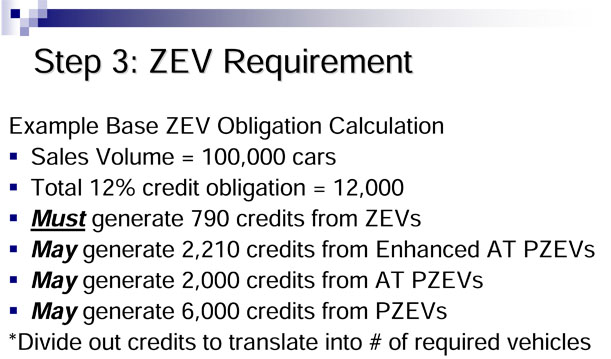
Note that the total obligation is 12,000 ZEV credits per 100,000 vehicles sold. Here are the key slides -
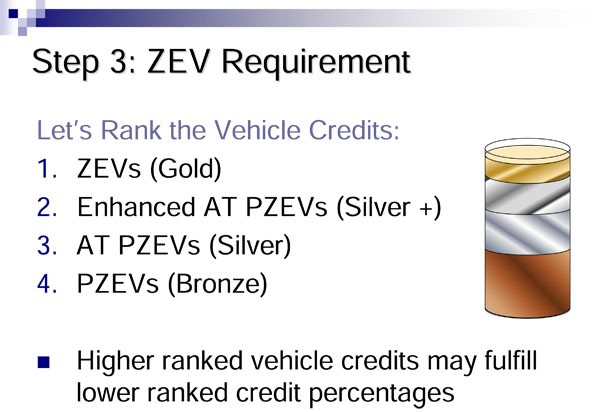
and
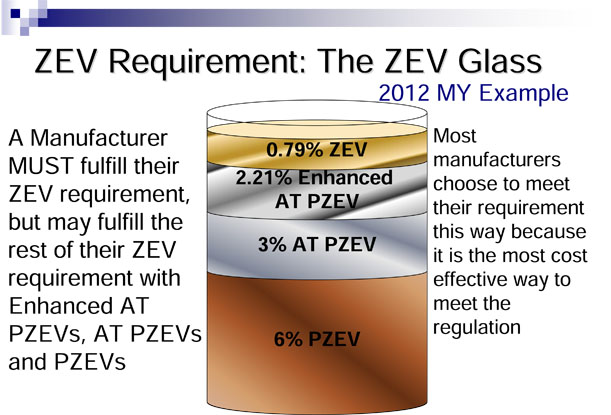
You are required to "fill up the glass" with credits. But you can only fulfill a maximum of 6% of the requirement with PZEV's (Prius Hybrid), 9% with AT ZEV (Volt/PiP Hybrid), 11.21% with Enhanced AT PZEV (Volt/PiP when they give it a 150k mile warranty) or NEV (Big golf carts), or all 12% with pure ZEV. The program is structured in this way to prevent Toyota (for instance) from being able to satisfy the entire ZEV requirement with just credits generated from the Prius. At the same time California wants ZEV's, so they allow each level of technology to satisfy more of the requirement.
So if Toyota sells 100k Prius's (and no other cars) they will get 20,000 Bronze level ZEV credits (Edit: 0.2 credits/prius). Their ZEV requirement is 12,000, but the maximum number of bronze credits they could allot to their requirement would be 6,000, so they would still need to purchase 6,000 superior credits on the West Coast Exchange.
- They could purchase 6,000 gold credits
- or 3,000 silver and 3,000 gold
- or 3,000 silver and 2,210 silver+ and 790 gold.
Because gold credits can satisfy 100% of the requirement, they are the most valuable credit when selling on the exchanges. But if manufacturers fail to meet their 12,000 vehicle quota (with 100,000 sales), they are fined $5,000 per credit, period. So when it's all said and done manufacturers must meet the entire quota, and to the extent that they are deficient they need to pony up $5,000 per credit.
- - - Updated - - -
Tesla doesn't release anything. California will release credit balances, and net manufacturer transactions for 2012 in September.
The minimum price for a credit is $5,000, but the price tends to be more than that depending on supply and demand.
ZEV credits are traded on two exchanges, the West Coast Exchange for all states west of the Mississippi, and the East Coast Exchange for all Eastern states.
Tesla could withhold credits, but I don't see why they would. I don't buy the itchy hypothesis.
Also, a question you didn't ask, but folks need to understand, is that manufacturers have until September to fulfill the quota from the year before. So by September 2013, they need to have enough credits in their account to fulfill their 2012 quota or face regulatory action and fines. Also, if a manufacturer is short on credits, they must purchase any available credits on an exchange (doesn't matter which, since they can shift them back and forth).
In addition, folks seem to miss the fact that 15 states, representing ~50% of the total U.S. market, are subject to this quota. Carry rules let you satisfy some of the requirement in state B with sales in state A (at least until 2017), but you can't look at just California.�
Jun 29, 2013
drinkerofkoolaid Any idea what the figures are for ZEV sales this year? Has any manufacturer fulfilled the .79% of total sales requirement for Zero Emissions Vehicles? Is that .79% of the vehicles companies sold in the USA or the world?�
Jun 29, 2013
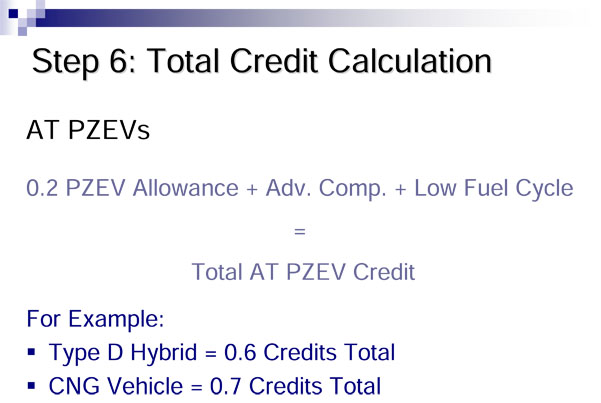
CapitalistOppressor Another point in Tesla's favor that I often forget is that not all cars are created equal when it comes to actually generating credits. A Model S apparently generates 7 credits because of battery swap. A basic Prius or similar hybrid only generates 0.2 credits. A neighborhood EV only generates 0.3 credits. An AT-PZEV like the Volt or PiP doesn't even generate a full credit until they manage to upgrade them to Enhanced status with the better 150,000 mile warranty (which is really referring to the total emissions lifecycle guarantee as opposed to a consumer warranty).
- - - Updated - - -
- - - Updated - - -
Tesla (obviously) and Nissan have both probably fulfilled the 0.79% requirement for 2012. Toyota is getting close because they are doing massive incentives on the RAV4, and it's long range generates a significant number of credits. Nobody else is probably even in the ballpark, though I haven't looked at the sales numbers. And I am morally certain that there are massive ZEV deficits overall, once you count the total 12% ZEV requirement, and the low number of credits that are generated from inferior (non EV) technologies.�
Jun 29, 2013
drinkerofkoolaid This could be very interesting. Tesla and Nissan could end up the only manufacturers making money on Zero Emissions Vehicles, with Tesla being the main company profiting from the sale of Gold credits.�
Jun 30, 2013
Nicu.Mihalache I think you have to re-read my post, because that'e exactly what I was saying. Only a small portion from those 12% has to come from ZEV, the rest can come from the low hanging fruit of hybrids and other shorter range pseudo-EVs. Manufacturers will always choose the easiest / cheapest way to satisfy regulations.
Wrong again. $5000 is the maximum price of a credit, otherwise the manufacturer just pays the $5000 fine.
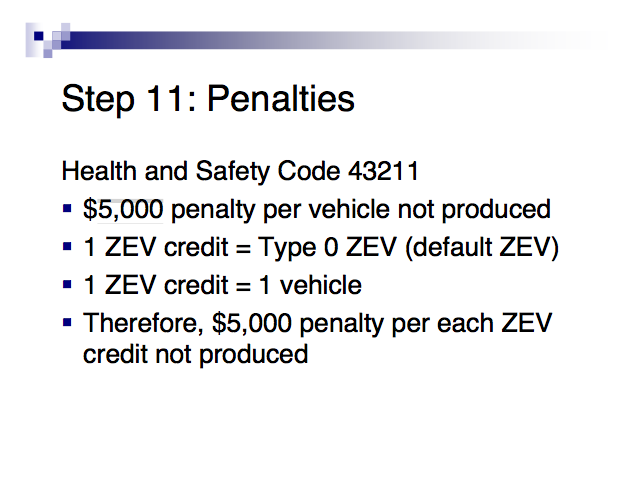
- - - Updated - - -
Wrong again. To get 7 credits per car (after the swap will be validated as FR = fast refueling - I do not know if the network has to be there, or simply the theoretical possibility for the car is enough) you need 300 mi range, which is obviously not the case for Model S.
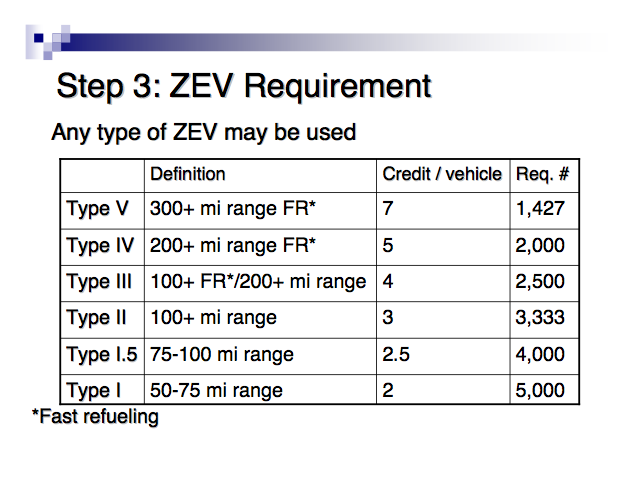
From which table we can also see that the Leaf will get two credits per car, or at 0.79%, one Leaf can be used to sell 253 ICEs.
Model S will get 3-4 credits if swap does not qualify yet as FR, or 4-5 credits if it does. In any case, about 500 ICEs could be sold using the credits from one Model S.�
Jun 30, 2013
blakegallagher This is incorrect ..... it has been stated that 5000 is a floor and they are willing to pay it because when they have to pay the fine they have to pay lawyers and litigation will quickly push the cost per credit way up.�
Jun 30, 2013
Citizen-T Model S has been getting credit for fast refuse from day 1. We've been through this before. Tesla apparently demonstrated the swap capability by using a team of technicians in a "pit stop" style swap. That approach qualified.
Also, this chart does not specify how the range is rated. At the time the program was created the EPA 5-cycle test was not in use yet. In the 2-cycle test Model S can achieve 300mi.�
Jun 30, 2013
Nicu.Mihalache I have never seen any report with any kind of independent official test that said Model S had 300 mi range. Can you provide a link please? And another one for the pit stop and it relationship with ZEV credits? Both are news to me and I am genuinely eager to see any kind of proof (but opinions on forums would not qualify).�
Jun 30, 2013
maekuz
Model S Efficiency and Range | Blog | Tesla Motors
�
Jun 30, 2013
Nicu.Mihalache This is neither official, nor independent, nor a test, just a goal in a blog. Do you think other manufacturers will hand Tesla $35k per car over this?�
Jun 30, 2013
Johan Yes, if the official agencies recognize it as "300 mile range" thus awarding Tesla 5 credits. There was a document (official) from the state of New Jersey where the 85 kWh was listed as getting 5 credits, right? ( Sorry unable to find the link).
Also perhaps slightly less than 5k per credit, since that's the penalty (unless there are other adminstrative penalties added to factor in - "handling fees" or similar)�
Jun 30, 2013
stopcrazypp Look a bit further down:
As you may know, CARB uses the LA-4 range (city cycle) and the 2-cycle range is usually lower than that, so given the Model S got a 320 mile 2-cycle range, they are definitely over 300 miles for CARB purposes.�
Jun 30, 2013
EVNow IIRC, the range they use is the LA03 (UDDS or the city) cycle. That is why Leaf gets 100 miles - I think P85 would get 300 miles in that.
BTW, since someone else is asking, usually all these numbers don't need independent tests. Even the EPA numbers are given by the manufacturer - EPA only tests a handful.�
Jun 30, 2013
Nicu.Mihalache That would be relatively cool, but it also means the Leaf gets 3 credits? Therefore much easier to oversaturate the market for ZEV credits. Once it is clear that the market will be saturated, the price will not stay anywhere near that $5k. And once enough credits have been purchased, their price falls to $0. The whole question is how fast is Tesla going there. Will they still have enough of them to approach $0 EPS this quarter? In the improbable case their EPS will be slightly above 0 (and if it is near 0, a bit of creative accounting will do the trick), we may even have a pre-announcement tomorrow. Nothing will make me happier in the short term, as I have a bunch of Jul calls I have to sell to some optimists�
Jun 30, 2013
jeff_adams So you can increase your Axiom portfolio, right? They could use your investment right now.�
Jun 30, 2013
Nicu.Mihalache Off topic.�
Jun 30, 2013
stopcrazypp Here's the source for the pit stop:
http://www.teslamotorsclub.com/showthread.php/16709-Proof-of-Tesla-s-plan-for-battery-swapping/page4?p=338264&viewfull=1#post338264
I've asked GSP for verification/evidence, but he did not respond.
This bloomberg article implies Tesla is already getting the max credits:
http://www.bloomberg.com/news/2013-06-21/tesla-adding-model-s-battery-swap-for-faster-refuels-credits.html�
Jun 30, 2013
CapitalistOppressor I think it's pretty amazing how often you incorrectly assert that I am wrong.
Lets start at the top. The "low hanging fruit" you mention is indeed how the regulation is structured. Unfortunately for your thesis, reality has overtaken events and manufacturers have failed to grasp your precious fruit.
87.8% of all vehicles sold in California in 2012 were sold by LVM's subject to the regulation. With 1,529,000 autos sold that makes ~1,342,000 subject to the ZEV quota, which means that manufacturers need ~161,000 credits.
There were ~108000 hybrids registered in 2012, which would have generated ~21,600-64,800 credits depending on the technology mix (hybrid registrations include PiP and Volt. Maximum credits are only generated if every hybrid was a plugin, which is far from the reality)
There were 6197 EV's sold in 2012. If every one had been a model s that would generate 43,379 credits. Unfortunately only 2,400 were Model S's. So tell me. Is this market saturated?
http://www.cncda.org/secure/GetFile.aspx?ID=2500�
Jun 30, 2013
Nicu.Mihalache From the Bloomberg article
"Battery swapping capability currently satisfies that �fast refueling� requirement, David Clegern, a spokesman for the agency, said by e-mail. CARB is considering a rule change that would remove pack swapping as a fast-refueling option, he said."
As for the pit stop, it seems to it is only speculation. Thanks.
- - - Updated - - -
For the 12% vs. 0.79% thing, I was only pointing out that logically you are misinterpreting what I said (theoretical possibilities remain important, as 2013 will not be alike 2012 wrt to ZEV and EV sales).
Given the additional data (thanks), it seems that for 2012 there were not enough credits, so ZEV will represent more than 0.79% in practice. Do they have until September to get those credits or was it by the end of the year? In the former case, lots more EV sales will happen in the meantime. In the latter, 2012 is history and does not matter anymore, therefore only 2013 matters for Q2 earnings.
No comment about $5,000 being a minimum or a maximum?
I see only anecdotical evidence that Model S was considered FR before the swap demo. And some anecdotical evidence that they will change regulation so that it is not considered FR anymore.�
Jul 1, 2013
Nicu.Mihalache Depending on many factors and exceptions (that's why we would need someone who works in this area and has not only experience with those laws, but also a global view of the situation), an enhanced hybrid (Volt would definitely qualify) could have more than 1.5 credits, even in 2012
 �
�
Jul 1, 2013
Johan This is all very interesting to me. I find it strange that there are no official data - that we can't even find an official figure on how many credits the different Model S's are getting. I mean it's not like this is in the future, they are selling these credits and pocketing the money as we speak, so why all the secrecy? Maybe we should just find the responsible individuals on the CARB board or whatever abd send them an e-mail?�
Jul 1, 2013
CapitalistOppressor Yes, the Volt did not qualify for enhanced at PHEV initially, and was only worth 0.6 credits. But apparently they updated it in late 2012 and now it's worth 1.57 credits, along with PiP. I found the NJ document listing all of the classifications, and I'll post it when I get a chance (the firewall that my laptop is behind wont allow me to access TMC so I am on my iPhone).
Basically, the Model S 85kwh is type V and worth 7 credits, while 60kwh is type IV and worth 5.
The real surprise to me is that several vehicles (including Volt) are now TZEV, which they weren't in 2012 when I studied this. So Volt, Cmax Energi and PiP are all TZEV.
In addition, all hybrids now qualify for AT PZEV, so 0.6 credits, and some conventional cars are PZEV and worth 0.2 credits. When I calculate the quota, and look at actual sales, my first pass shows that there is more trouble at the Macro level with fulfilling the bronze quotas, so there is a lot of backfilling with superior credits.
Still though, it's very complex, and at the company level there are many holes that need to be filled. Plus, outside of Tesla, Toyota holds like 40% of all credits, but because they are by far the largest seller, and bizarrely because their cars are all high tech (no PZEV's) they don't have as big of a surplus as you would expect, and they don't come close to fulfilling their 0.79% ZEV minimum (they are like 1500 credits short).
Also, because Nissan is big in ZEV they have a gold surplus, but it doesn't look huge because they don't have regular hybrids to help generate lessor credits.
And Honda looks to be in terrible shape. It's no wonder they have a contract with Tesla.
But so far I count like 108k credits for a 2012 quota of ~162k. I haven't calculated PZEV contributions yet, but the conventional cars with that designation would need to sell over 250k units to make up the difference.
- - - Updated - - -
Btw, that doesn't count Tesla credits. Also, I am using iffy methods to estimate California sales, and it occurs to me that I haven't checked that against the dealer report I posted earlier. So 108k is super preliminary.�
Jul 1, 2013
CapitalistOppressor First, here is the New Jersey clean cars list. Model S 85kWh is clearly a type V and 60kWh is Type IV, which is worth 7 and 5 credits respectively. All the other types are listed as well.
Here is a link with the national breakdown for 2012 plugin sales. Many of these cars are only sold in California or other ZEV markets.
Here is the California Dealer's Association document listing sales.
The total ZEV requirement for 2012 is ~161,118, with only 10607 golds required. This is based on marketshare for all manufacturers who are LVM's. LVM's are defined by having a marketshare greater than 4% in California. Together, these LVM's account for 87.8% of all sales.
Hybrids
We know 108,774 were sold in California.
Last year, Prius was the top hybrid in Cali, with 60,688 sold (out of 108,000 total hybrids!). PiP sold like 12,750 units nationwide, so lets give 6,375 of those to California. So 53,688 Prii ([email�protected]) and 6,375 PiP([email�protected] gives Toyota 32,588 silver credits and 10,009 silver+. So ~43,173 credits total (inc. Rav4, see below).
That leaves us with 47,312 hybrids.
GM sold 23,461 Volt's nationwide and "more than half" were in Cali. Lets give them 52%, which is ~12,[email�protected], which is good for 19,154 silver+ credits. (no actually not, see note in manufacturer breakdown)
Ford probably sold ~1,200 Cmax Energi in Cali, so = [email�protected] = 2237 silver+
That leaves us with ~33,912 conventional [email�protected] worth 20,347 silver credits. (I haven't looked up conventional hybrid sales to break them down by manufacturer, but it would be useful to do so).
EV's
Ok, we know that there were 6,197 EV's registered in Cali in 2012. ~1,200 were Tesla's. As far as I know, the other EV's on this list are only sold in California, so I am going to assign only 3,439 Leaf's to Nissan, which is a bit less than the 50% of national sales I originally was assigning them (50% of national sales would be ~4,400). I feel like an assumption is wrong somewhere (maybe some models WERE sold outside of Cali?) but I am using this data for now.
Lets say ~3,439 California Leaf's (9,819 nationally). Type [email�protected] so 16,500 golds.
Toyota also sold 192 RAV4's, which is a Type [email�protected], so 576 golds.
685 Focus EV = Type [email�protected] = 2055 golds
588 Mitsubishi imiev = Type [email�protected] = 1470golds
93 Honda Fit EV = Type [email�protected] = 279 golds
2012 Credits identified:
52,935 Silver
31,400 Silver+
14,697 Golds
Total - 99,032
That gives us a deficit of ~62,068, credits, most of which could be satisfied with bronze credits. PZEV's which qualify for bronze are a mix of conventional cars, many of which are not fuel efficient. If those cars marked as PZEV sold more than ~311k units in 2012, there isn't any deficit at all. Looking at the list of PZEV's, I seriously doubt that is the case, but I have not researched the sales figures yet. Whatever their sales, they get 0.2 credits per car.
Top 5 Manufacturer Breakdown?
Note:THESE FIGURES DO NOT INCLUDE PZEV BRONZE CREDITS
Toyota: 21.4% Marketshare
Total Quota: ~39,270
ZEV Sub Requirement: ~2,585
Identified Credits: 42,597
Deficit/Surplus: +3,890 overall
- Silver: 32,588
- Silver+: 10,009 silver+
- Gold: 576 golds
Toyota is ~21.4% of the market, and generate like 26.5% of the overall ZEV quota, despite not generating any bronze credits cause they are too advanced for that ish. Now that they are massively incentivizing RAV4 sales, they shouldn't even have a Gold deficit for 2013.
- Gold: -2,010 needed for purchase
- silver/silver+: +5,900 available for sale
Honda: 13% Marketshare
Total Quota: ~23,856
ZEV Sub Requirement: ~1,571
Identified Credits: ~3,540
Silver: ~3,260
Silver+: 0
Gold: 279
Deficit/Surplus: -20,316 overall
Honda is getting less than 3% of the hybrid market right now, while being even more pathetic in EV's. So clearly the awesomeness of Toyota isn't a Japan thing. It's no wonder they have a purchase contract with Tesla for ZEV credits.
- Gold: -1,292 needed for purchase
Ford: 11.7% Marketshare
Total Quota: ~21,470
ZEV Sub Requirement: ~1,414
Identified Credits: 4,292
Deficit/Surplus: -7,478 overall
- Silver: ~9,700est (see note)
- Silver+: 2,237
- Gold: 2,055
Ford only has 4,292 credits on this chart. Obviously they must have many more credits from regular hybrid sales, but I haven't tracked those numbers down yet (those credits are located in the unallocated hybrids). Going off of their 16% market share for national hybrid sales, that implies ~16,200 conventional hybrid sales in California, worth ~9,700 silver credits.
General Motors: 10.1% Marketshare
Total Quota: ~18,534
ZEV Sub Requirement: 1,221
Identified Credits: <19,154 (see note)
Deficit/Surplus: probably a substantial deficit (see note)
- Silver: unknown
- Silver+: <19,154 silver+ (see note)
- Gold: 0
Some fraction from 2011/2012 production generated silver credits before the modifications made to qualify for silver+. Any Volts produced in 2012 before the switchover would reduce their credit total by 0.97/unit. It's very likely GM actually has a substantial deficit for 2012, but I am just assuming they got full credit for all Volts produced.
- Gold: -1,221 needed for purchase
- silver/silver+: probably none
Nissan: 8.9% Marketshare
Total Quota: ~16,332
ZEV Sub Requirement: 1,076
Identified Credits: 16,500
Deficit/Surplus: +168 (see note)
- Silver: 0
- Silver+: 0
- Gold: 16,500
- Gold: +168 available for sale (see note)
Take these figures with a grain of salt until we have better sales data for Leaf in Cali. The extra 1,000 Leaf sales I want to give them would give them a surplus of ~3,168 golds, and looking at the clean vehicle list, they have more then their share of PZEV's generating 0.2 credits each.�
Jul 1, 2013
brian45011 Try Anna Wong: [email�protected] (916) 323-2410 or Elise Keddie : [email�protected] (916) 323-8974.�
Jul 1, 2013
CapitalistOppressor I sent an e-mail to Anna about a year ago about this issue, and never got a response. Coulda been she was on vacation or something, so it's obviously worth trying. The big question for me is how exactly the travel/carry provisions work with the Section 177 states.
As to the credit balances, and net transactions, they post those in September or October (manufacturers need to get their final revisions in by Sept 11 if I recall correctly). They have the data from 2011 up, but that is pretty useless because those balances were accrued under the 2009-2011 rules, so you can't infer much except that Toyota generates a lot of credits.�
Jul 1, 2013
Bgarret C.O....thank goodness you had access to a computer for this analysis and didn't have to do it on your phone. In reading through this analysis and your previous analysis - Regulatory Credits - How BMW and Daimler Will Fund Tesla's Conquest of the World I wanted to know if this made sense...excuse the imprecise numbers, this is a bit of a back of the envelope calculation:
Total California ZEV credits short for 2012: 4523 (2010 Toyota, 1292 Honda, 1221 GM)
Potential California remaining ZEV Deficit: 62,068 - (minus) credits for fuel efficient cars.
2013 - Same as 2012, with approximately 10% growth and 0 gold needed for Toyota because of Rav-4 shenanigans
Summary of California Gold needed 2012-2017:
2012 - 10,607
2013 - 12,000
2014 - 13,000
2015 - 50,000 (change to 3% from .79%)
2016 - 55,000 (3%)
2017 - 60,000 (3%)
Total California ZEV 2012-2017: 200,607 Gold ZEV
Total Model S/X needed to fulfill @ 6/car: 33,434 or approx. 6,700 Tesla's per year at 6 Gold ZEV/Tesla
(This is where I am unclear about other section 177 states)
2011 Auto Sales in relation to other 15 Section 177 states - (Source http://www.nada.org/NR/rdonlyres/C1C58F5A-BE0E-4E1A-9B56-1C3025B5B452/0/NADADATA2012Final.pdf
The irony of using NADA data for my analysis is not lost...it's not a TESLA smile, but is it close...
Total new auto sales - 2011:
California - 1,220,000
15 states - 3,779,000 (or about 3-1)
If ZEV requirements are the same for the 15 other Section 177 states, that would mean that an additional 648,000 Gold ZEV credits would be required between 2013 and 2017 or an additional 20,060 Model S/X for a total of approximately 26,760/year of full ZEV revenue per unit of auto production.
In the out years, the numbers really get crooked....
California (2018-2021) @ 16%: 1,100,000 Gold ZEV credits + other 15 states 3,300,000 Gold ZEV credits=4,400,000 Gold ZEV credits or 733,333 Tesla(s) that average 6 credits/car.
Summary:
With little movement among ICE manufacturers to rapid adoption of EV technology, and with CO's analysis of ZEV credits and the efficacy of buying credits today for the ramp up in requirements in 2015/2018, it would seem to be in auto manufactures interests to a) Bank known credits today in the event that Tesla goes out of business, b) Partner with TSLA on drivetrains similar (but more effectively) to Toyota RAV4E...which should be easier with the exclusive intellectual property agreement with Daimler expiring....today and c) emphasize a need to TSLA to go to scale with Gen III to provide the volume necessary for increasing requirements.
I know it is difficult to project out 8 years of different administrations and changing regulatory requirements - but it is just as difficult for the analysts at the various car companies, and TSLA looks like a great hedge against fines, litigation and escalating requirements.
CO, Johan, Maekuz, Jeff, EVNOW, Brianman, sleepyhead, citizen, shortslaver,deonb, drinker, blake, stopcrazy...and...Nicu et al
I would be interested in your thoughts.
G�
Jul 1, 2013
Citizen-T I think that the auto manufacturers probably assumed that they could get the regulation declawed when they got to 2015 and there were still no viable EVs. Tesla has given the regulators something to point at and say, "why can't you do that?" The big guys are not prepared for this.
Licensing Tesla technology might be the only way to earn enough credits for those later years.�
Jul 2, 2013
Nicu.Mihalache That is one extra reason some of them hate Tesla with all their heart!�
Jul 2, 2013
CapitalistOppressor The major manufacturers counting on the ZEV market failing was a key reason that I invested in Tesla originally. If Tesla succeeded (not as obvious in summer 2012, lol) they were going to have the majors over a barrel.
Folks seem to forget that California created the ZEV mandate in 1991(!!!!). It was killed by the majors over a decade ago (think EV1; that program was ended when they killed the regulation).
If you look at their current product offerings, you can pretty much conclude that they didn't start taking the mandate seriously until around 2010. Only the Volt and Leaf were real attempts to be in compliance.
Many of them even rolled out compliance cars in 2013, a year after the mandate went into effect. As a result they are starting in a hole. That's true even of Toyota. Toyota is only doing so well because the rule was designed with them in mind as the model that California wanted emulated.�
Jul 2, 2013
CapitalistOppressor I am emphatically not comfortable making pronouncements about Section 177 rules. But if I read it correctly, some portion (of this I am certain) of sales in any 177 state count against the requirements in other states, and in principle you could only sell cars in California and satisfy requirements everywhere.
But where I am fuzzy is the proportionality rules. Because every state has a different quota, there are rules about proportions. So maybe if the quota is 10 in California and 5 in New York, a sale in California is worth 0.5 credits (1/10th of the quota). That's how I think it works, but I haven't spent the hours of study I need to be sure.
Also, I'm not sure at all if the same car can simultaneously get credits in California and New York, or if you have to transfer the credit. If its simultaneous then if the California quota is 10, and if proportionality works how I suspect, then 1 credit in California generates credits in every Section 177 state equal to 10% of that states quota.
However it works, that all goes away in 2017. At that point those travel/carry provisions go away and you need to meet the quota for each state. You will be able to transfer surplus credits from the western exchange to the Eastern one, but you have to transfer like 1.35 (1.25?) credits to get 1 to the other side.
In an unrelated note when I wrote the previous thread you linked, I was pissed because it looked like California had killed the 2018+ ZEV regulation. The reality was it just wasn't posted on the website yet. I recently posted some information on those years in some random thread somewhere and need to cross post it to the ZEV thread.
But basically, starting in 2017, the pure ZEV mandate is rolled back slightly to 2% (from 3%). Then it increments up by 2% per year, so 4% in 2018, 6% in 2019, etc until the entire mandate is pure gold in 2024.�
Jul 2, 2013
Johan Ok, sorry if this has been brought up before, but I found and read these documents that have been made public by the Department of Environmental Protection of the state of New Jersey:
http://www.nj.gov/dep/cleanvehicles/NJ%202011%20MY%20Zero%20Emission%20Vehicle%20Credits_122112.pdf
http://www.nj.gov/dep/cleanvehicles/2010ZEV.pdf
From these you can see in actual numbers that in the period between October 1, 2011 and September 30, 2012 Tesla "transferred out" 8.831 ZEV-credits. OK first of all I assume that means 8 point 831 (not eight thousand something). Second, "transferred out" I guess means cars were registered in NJ that created credits, which were then sold to other car manufacturers? What's kind of weird with this table is for example Honda which, for the same time period, is listed as having 74.550 credits "transferred out" but at the same time 15.469 credits "transferred in" (also, Honda's out credits were AT PZEV, Advanced Technology Partial Zero Emission Vehicle, while credits transferred in were ZEV, Zero Emission Vehicle). Can someone explain this to me?
For the time period between October 1, 2010 and December 19, 2011 Tesla is listed twice for some reason (Model S + Roadster???) with a sum of 21.409 credits "transferred out".
So then I find this, which is basically the same but with the state of California:
Zero Emission Vehicle Credits
From this document I find a table titled "California Zero Emission Vehicle Credit Balances as of September 30, 2012 (g/mi NMOG)"
Now, what's weird is that in this table Tesla is listed with 0 (zero) under all types of credits. (Nissan, Toyta and Honda are in the lead)
Further down, in the table called "California ZEV credit transfers out between October 1, 2011 and September 30, 2012 (g/mi NMOG)" Tesla is listed with 31.605 credits transferred out. This number seems small or was it very few Model S's registered prior to Sept 30 2012?
Perhaps the reason why Tesla is listed with "0" in the first table is because they didn't "keep" any credits in California, but instead sold them all and the buyers decided to "transfer out" those credits? It makes no difference for Tesla, since they will never have need for credits anywhere.
The above page (the California one) has this on top "This page last reviewed October 12, 2012", which I guess means that we're in for a treat at the beginning of October this year, when data for the time period Oct 1st 2012 to Sept 30th 2013 is published? But would it be possible to obtain better data before this date?
The next question of course is if it will ever be possible to get direct data on how much these credits are actually selling for? I guess not, but if we could find good data on how many credits they are earning in a given time and if they disclose a precise figure for revenue from sale of ZEV credits in their earnings report, we could deduct the average price at least.�
Jul 2, 2013
kenliles Chevrolet Sees Upsurge In Volt Sales For June - HybridCars.com�
Jul 2, 2013
stopcrazypp I explain how NMOG numbers work over here (it's also explained on the bottom of the CA ZEV credit page:
http://www.teslamotorsclub.com/showthread.php/16221-ZEV-credits?p=328112&viewfull=1#post328112
Basically when you earn a credit for a car, it's multiplied by the fleetwide average g/mi NMOG number for that model year. That way the credits are weighted, and gives you an advantage if you sell EVs earlier (as the fleetwide NMOG goes down with time typically).
So to get the actual credit number, you have to work backwards and divide by the g/mi NMOG for that model year.
Take for example:
8.831 g/mi NMOG / 0.035 (fleet average NMOG for 2010+ model year) = 252.314 ZEV credits
31.605 g/mi NMOG / 0.035 (fleet average NMOG for 2010+ model year) = 903 ZEV credits
The NJ number for Tesla is not an integer likely because of the Section 177 rule proportionality rules that CapitalistOppressor talked about.�
Jul 2, 2013
Johan Thanks! So is the $5000 penalty for an actual missed credit, or for a weighted credit???�
Jul 2, 2013
stopcrazypp The ZEV tutorial is quite clear that it's the unweighted number (with no NMOG multiplier):
http://www.arb.ca.gov/msprog/zevprog/factsheets/zev_tutorial.pdf
The exact formula is on page 29 here:
http://www.arb.ca.gov/msprog/zevprog/zevregs/1962.1_Clean.pdf
For 2009-2014, the NMOG credit deficit amount is divided by the fleet average requirement for that model year, which would convert the NMOG credit numbers back to an equivalent of the unweighted credits before applying the $5000 penalty per credit.
2015-2017 does not have NMOG weighting which is why the credits don't have to be divided.�
Jul 3, 2013
Johan Thanks again for being so patient with a slow learner like myself
So when we start think about what these ZEV credits may actually be worth in $$$ to Tesla I figure that first of all: it's a seller's market seeing how virtually all the big manufacturers will be low on credits, even counting their own ZEV and PZEV credits that they're earning. Now strictly economically it would make sense to buy a ZEV credit from Tesla for $4999 instead of paying a penalty of $5000, however looking at this from a more realistic angle I would think that as the price approaches $5000 per credit the competitors would argue that if the difference is small maybe it's better to pay the $5000 penalty rather than lining the coffers of one of their up-and-coming competitors? On the other hand, at say $1000 per credit it would be very hard for them not to buy from Tesla rather than paying the penalty. So my point is that there is probably a curve here with an infliction point (correct term?) where if the price goes over this point it makes more overall sense to pay the penalty rather than Tesla. Where do you guys think this price point lies?
My next though is could there be some kind of agreement with Tesla's primary business partners Toyta and Daimler where they have "first rights" on buying credits, maybe at set prices, or is this a totally fluent open market where the highest bidder gets to buy? Does anyone have any insight in to how these credits are actually traded? Is there some kind of inofficial "exchange"?�
Jul 3, 2013
CapitalistOppressor This is specifically prohibited. If credits are available for sale on the exchange, the automakers are required to purchase those credits, before they can pay the fine.
I am skeptical that credits will ever be sold for less than the fine. Beyond the prospect that it might not even be legally possible, there just isn't much incentive to do so (at least by Tesla). As a credit monopolist, Tesla should want to maintain prices at an acceptable level. They should just put extra credits in a bank, instead of fighting over the crumbs that a few automakers will manage to snatch up in the exchanges.�
Jul 3, 2013
EVNow Interesting that Nissan didn't transfer any credits.
For anyone trying to figure this out - note that Leaf is selling much better this year. Almost 10k this year. Yet, it is supply constrained. 3k per month is likely once the inventory builds up. BTW, about 50% of sales is in CA. You can get all plugin sales numbers here.
My Nissan Leaf Forum View topic - Worldwide Plugin Sales Numbers
What Tesla can sell (in terms of price) depends on what Nissan does - if Nissan just banks, Tesla rules the market.�
Jul 3, 2013
Nicu.Mihalache When total number of cars sold increases 8% and green cars sold increases 35%, the probability that the ZEV (all metals combined) will be saturated increases as well
June green-car sales jump 35% over 2012 numbers�
Jul 3, 2013
stopcrazypp Nissan has never considered selling credits (banking them for now). But a recent interview did have someone from Nissan comment they might look into it.
I think it has to do with the fact they are relatively weak in the other non-ZEV credits (they don't have much hybrids or PHEVs), so banking credits is a safer bet for them right now.�
Jul 4, 2013
stopcrazypp A couple of points:
1) diesels need to be excluded and CNG included from those numbers.
2) a large portion of that 35% is going to be in California and CA sales outpace US sales (with the green car sales contributing)
For example for last quarter from the cncda link posted previously:
US sales up 7.2% (includes fleets; excluding fleets probably closer to 8%)
CA retail sales up 13.9%
Hybrid+EV retail sales up 14.6%
http://www.cncda.org/secure/GetFile.aspx?ID=2500�
Jul 4, 2013
EVNow For Nissan it is probably a combination of various factors
- Their estimate of future Leaf sales
- Do they even want to help out their arch rivals like Toyota & Honda by reducing the price of credits
- Do they look at Tesla as a long term competitor and want to reduce the money they can make off of credits
- Do they need to meet some short term Leaf profitability goals ( they may also do this by internally selling credits to the ICE divisions)
BTW, even though this won't come into picture in Q2, we have to wonder what new EVs coming into the market will do. Specifically BMW i3 or Mitsu Outlander PHEV. My guess is BMW wants to sell enough i3s to cover their entire ZEV needs. If Outlander PHEV is a big hit, as some of us expect it to be, we may be looking at thousands of them sold every month and it could dilute the market.�
Jul 8, 2013
Robert.Boston A question on the counting rule:
In states where Tesla doesn't have a dealer's licence (e.g. Texas), the sale technically occurs in California. Does this sale generate ZEV credits based on the point of sale or point of registration?�
Jul 8, 2013
ItsNotAboutTheMoney I've seem them use the words "delivered for sale in CA or other CARB state", so I think it's only sales to CARB customers. Using dealers the company has no control so it's only fair it stops where they deliver to.
http://www.sec.gov/Archives/edgar/data/1318605/000119312510068933/dex1032.htm has sold and placed into service in ...�
Jul 8, 2013
stopcrazypp Page 13:
"The vehicle must be delivered for sale and placed in service in a Section 177 state or in California in order to earn the total credit amount."
Page 30:
�Placed in service� means having been sold or leased to an end-user and not to a dealer or other distribution chain entity, and having been individually registered for on-road use by the California DMV.
http://www.arb.ca.gov/msprog/zevprog/zevregs/1962.1_Clean.pdf
Here's the list of the 15 "Section 177" states (Texas is not one of them):
http://transportpolicy.net/index.php?title=US:_Section_177_States�
Jul 20, 2013
EVNow We have all been assuming Nissan sells 50% of Leafs in CA. Not so anymore. in 2013 it is just 27%. Ofcourse, if we are looking at all the CARB states it is probably a very high %.
Nissan Needs More LEAFs To Catch Up To Demand
�
Jul 25, 2013
sleepyhead So what is the consensus on ZEV credits for Q2? For Q1 we had $68m.
Any reasonable estimates out there?�
Jul 25, 2013
maekuz $50m (gut feeling)�
Jul 25, 2013
erha Do we know that it will decrease? Are there any good reasons for it to do so, except tesla saying they expect so?�
Jul 25, 2013
gym7rjm I think it is probable that ZEV revenue could shrink much less than people anticipate. The shareholder letter gives the lower projection based on the assumption that there will be a higher mix of 40 and 60 kwh cars sold. The two events that happened during the quarter not projected were the battery swap presentation and a large number of loaners sold. I'm not sure if this is confirmed, but I think the battery swap presentation bumped the 85 kwh MS into the Type V category earning each car 7 credits. This in combination with the unexpectedly higher rate of loaner cars sold could mean they earned many more credits than expected.
Another important aspect to keep in mind is that Q2 car sales volume in the US (across the big three) was much better than projected. The sales volume bump was especially high with pick-up trucks, which clearly don't generate credits of any kind (ZEV, AT PZEV, or PZEV). This could mean a higher than expected demand for credits from the manufactures.
So this being said, I'm confused because I thought that Tesla already had a surplus of ZEV credits for the rest of 2013. So I thought the limiting reagent for ZEV revenue was the demand from other manufactures. Tesla's Q1 letter, however, reads like the limiting factor would be how many credits they can produce. Maybe someone with deeper understanding can shine light on this.�
Jul 25, 2013
pGo I believe CapOp presented NJ documents somewhere showing MS already earning highest credits. So, battery swap may not help. More CA sales for sure will.�
Jul 25, 2013
jeff_adams I believe I read that the ZEV credit calendar ran from September to September. If that is true, then Q2 is the "end of the year" quarter for the automakers. If they are short credits, they need to buy enough to cover this quarter. Since sales were higher than expected, some car makers could be short. Tesla could be making some nice profit this quarter if that is true�
Jul 26, 2013
Nixx I cannot see how this can be the case when Elon has said Q4 will have NO ZEV credits. If the year reset in Sept, he would have expected tons of ZEV selling.�
Jul 26, 2013
Johan No he said 25% gross margin with no ZEV credits.�
Jul 26, 2013
sleepyhead That is actually how I interpretted it too. Many people mistakenly assumed that he meant that Tesla would get no ZEV credit revenue starting in Q4, but that is not true.
Going back to the Sep to Sep theory, someone else pointed out that it is possible that most manufacturers already estimated how many credits they will need for the year and already bought most everything they needed in previous quarters. Not sure if this makes any logical sense for the companies to act this way, but it is a realistic possibility.�
Jul 26, 2013
jeff_adams It can make sense if the going rate was cheaper at the beginning of the calendar year. Sort of like buying Christmas supplies after Christmas. Now the manufactures are stuck having to cover at "the seller's rate" because they don't have room to negotiate. The news that sales have exceeded expectations could mean credit shortages that favor Tesla.�
Jul 26, 2013
imherkimer IMHO Tesla will always underestimate ZEV and other credits significantly.
One reason is that they don't want to have these considered as a dependable part of their long term margins at each earnings report.
Another is that this is a great opportunity for always beating expectations. The sale of credits remains an Ace in the sleeve of Tesla, and they deliberately strive to underestimate it, so that it only helps on the positive side, and does not reinforce a notion, inside or outside the company, that profits are dependent on these credits.�
Jul 26, 2013
Nixx I don't know how Elon's statements could be misinterpreted.
"Yeah, so we�re expecting a decline in the credit revenue for Q2 and then probably fairly significant decline in Q3 and as I said back right now, we�re not expecting anything in Q4."
He's clearly talking about zev credit revenue, and how there will be none in Q4. How can you read anything else in this statement?�
Jul 26, 2013
Johan This! And the beatuy of it is that a dollar in revenue is a dollar no matter where it came from!�
Jul 26, 2013
jeff_adams Problem is Peterson and all the other anti-Tesla crowd like to hang the ZEV credits around Tesla's neck like a badge of shame. It makes it easier for them to stir up anti-Tesla emotions in the uneducated masses.
Bottom line, revenue is revenue. Whether it's T-shirt sales, licensing battery packs or carbon credits, it's all part of trying to be profitable. For shareholder's benefit, Tesla should be maximizing ZEV credit profits irregardless of the FUD it generates.
Haters are going to be haters no matter what.�
Jul 26, 2013
Johan Agreed. But I also agree with Tesla's official position: Tesla must achieve a high and stable gross margin regardless of ZEV credits, since it is a form of revenue they have no control over, it's a political project that could disappear from one day to the next. Hence, don't count on it. But not counting on it is something entirely different from taking it a having it be a (important) revenue item in Q2 and possible for quarters to come.�
Jul 26, 2013
jeff_adams Not only that, but Elon has mentioned time and again that his mission for being involved with Tesla is to accelerate the EV market penetration. He would be happier if ALL manufactures sold a lot of EVs and there was no need to sell ZEV credits.
Since they are not in a hurry to do that, Tesla should continue to take advantage of the rules and profit from the credit sales.�
Jul 26, 2013
TonyWilliams For 2015, we get a whole bunch of new players to the ZEV game, in addition to the six Very Large Manufacturers (GM, Ford, Fiat/Chrysler, Toyota, Nissan, Honda):
"BMW, Chrysler, Ford, General Motors, Honda, Hyundai, Kia, Mazda, Mercedes, Nissan, Toyota, and Volkswagen must comply with the new requirements. Four additional manufacturers would also be required to comply with the ZEV requirements, but would be allowed to meet their obligation with PHEVs."
I'm going to guess Subaru (Fuji Heavy Industries), ?, ?, ?�
Jul 28, 2013
CapitalistOppressor My understanding is that the non-VLM's which will be bailed into the VLM category (which I thought BMW already was starting in 2012) still have a ZEV mandate. They are not required to produce EV's (which generate Gold credits), but they still have a very substantial burden of PZEV (Bronze) credits that they must fulfill even now.�
Jul 28, 2013
CapitalistOppressor There are several assumptions baked into that statement.
First, the most likely reason for the initial decline that is expected for Q2 is that they were projecting that they would only sell ~4500 cars in North America (with a proportion of those being in ZEV states), while they would be putting ~500 cars on a boat to Europe. In addition, they seemed to be assuming an increase in the number of 60kWh cars sold as a proportion of the total fleet (thus producing fewer credits). And they also were assuming that automakers would generate a certain number of credits of their own for the 2013 quota.
Neither of the first two assumptions appears to be valid. Certainly, Tesla never put 500 cars on a boat to Europe, and the available data points to around 5,000 NA sales (or a bit more). In addition, my own data is pointing to 60kWh sales being much closer to the underlying sales average of ~25% in Q1 (deliveries were a bit higher because of the wait list). Together those factors seem to point to credit generation equivalent (or superior) to Q1.
On the downside, it's obvious that Tesla really hammered their California sales channel to pump up the numbers at the end of Q1, and it's not so obvious that they did anything similar in Q2. Still, on balance those factors point to credit generation that is similar to Q1. On the revenue side, ZEV credits have supposedly fallen somewhat in value, while the Federal government substantially increased the social cost of carbon that underlies the GHG and CAFE credit markets.
How all of those moving parts fit together is a mystery, but on balance I expect a slight decline at best for Q2, and there is no good reason not to suppose that revenue could in fact increase.
Q3 is a different animal, since I would guess that Tesla has a good estimate for the total 2012 market. My thesis is that Tesla will just pull additional revenue forward to Q2 from Q3 credit revenue. So a "good" Q2 quarter just means a smaller amount of revenue in Q3 when considering the 2012 quota in isolation.
The wildcard in Q3 (and going forward) is that the overall quota is increasing as auto sales accelerate in California (and other Sec 177 states), and its uncertain at this point whether credit generation is increasing at the same rate. At this point, I feel like automakers are digging themselves a hole in 2013 compared even to 2012, but its too early to say. Regardless, it seems almost certain that there will be a large market for 2013 credits, which automakers will have until September of 2014 to fulfill. So the assumption that there will be no ZEV revenue in Q4 seems at this point to be based on a corresponding assumption that credits generated by Tesla in that quarter will just be sold anyways in 2014.�

Không có nhận xét nào:
Đăng nhận xét