Oct 16, 2015
Papafox We can make the transition to AutoSteering safer for the Tesla community if we share information about the current potentially troublesome areas of the autopilot system so that we can learn from others and not have to learn every lesson by trial and error. I also want to post some Driver Beware cautions that may not be related to any weakness in the autopilot but are issues that could potentially affect safety of driving with autopilot engaged. Software update 7.0 gives us great tools to use in our driving. Let's be smart in how we employ them. I'm hoping you and others will contribute to this knowledge base. I hope to consolidate some subsequent contributions in this first post so that the information isn't too spread out.
Most important: Tesla says autosteer is only to be used when a center divider is present. Please find language in this post. You cannot expect autosteer to keep you safe without a center divider if Tesla prohibits such an operation.
Let me continue with a known rough-spot: off ramps.
Off ramps from straight highway segments- On a 3 hour drive on Interstate 80 from Reno to Sacramento and return today I passed many such off ramps while in the right lane. Typically, my Model S veered slightly toward the exit and then corrected back ok. People traveling on other highways with different markings may have had different experiences. If so, speak up.
Off ramps at the beginning of a left turn of the highway
This type of off ramp was problematic for the autosteering. The car is going straight, the off ramp continues to go straight, but AutoSteer needs to begin a left turn at the proper moment. See photo below.
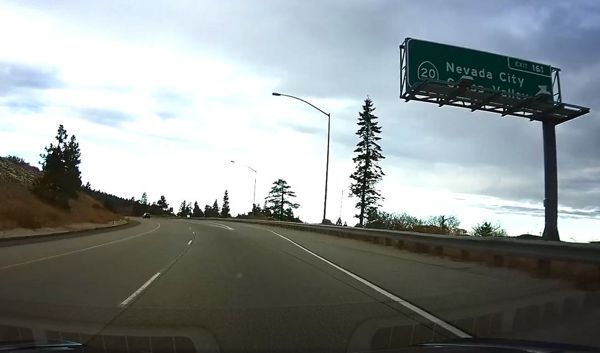
Off ramps at the end of a right turn of the highway
Off ramps at the end of a right turn of the highway can be problematic. The car is turning right, the off ramp is positioned well to accept the car on its current trajectory and now the highway veers left of the current path.
Lanes that split
Lanes that merge
Lanes that are marked by a series of white raised circles (botts_dots), rather than lines (reported by a friend in Hawaii and confirmed by mainland users as well)
Lines painted on highway that compete with lane marker lines for directing AutoSteering (see this post in this thread)
Lack of edge lines on highway (solid yellow on left side of left lane, solid white on right side of right lane) Look for these.
Southern California HOV Lane:
A thread participant reports here: "... Its a double yellow which changes to dashed white when you are allowed to enter and exit the lane. My car wanted to exit most of the times the white dashes were transitioning back to the double yellow."
Wet Pavement at Night with Glare: Sometimes this situation interferes with autopilot according to this post.
Driver Beware:
Driver Beware: People on the highway
I came over a hill today on Interstate 80 to discover a vehicle parked on a narrow shoulder, its door opening into my lane and someone jumped out. Fortunately, the other lane was open and I hand-steered into the other lane. You would waste far too much time asking autopilot to bring you into the other lane. Turn the wheel, the AutoSteering will kick off.
Driver Beware: Challenge piled on top of challenge
If you pile one challenge on top of another challenge on top of another, you make a more difficult driving solution for man or autopilot. I suggest you getting comfortable with your autopilot performance and learn how responsive it is before really giving it difficult solutions that includes multiple simultaneous challenges such as:
* sharp or high-G turns at fast speeds
* narrow lanes
* lanes where barriers give little room on one side of the lane
* lanes where a semi-truck or other vehicle is crowding that lane from the adjacent lane or even crossing over the lane markers or swaying from side to side
* poor lane markings
* wet surfaces
Example of challenges piled atop challenges (submitted by Cyberax): narrow lanes, bus in adjacent lane and crowding the Tesla's lane, lane marked by white dots instead of lines.
Need further Input:
* Ability of sensors to pick up buses and large trucks reliably when abeam the Tesla. Some drivers believe that shadows created by large trucks might make lane markings between truck and Tesla difficult for Tesla to see. Please look to see if blue lane marker on autopilot dashboard indicator disappears when next to truck. In meantime, please do exercise caution when abeam a big truck.�
Oct 16, 2015
aja2460 Autopilot 7.0: When to be most on your toes?
For the next year or two...�
Oct 16, 2015
Cyberax * Driving beside a bus or a trailer truck. AP sometimes has problems with detecting it.
* When a slower vehicle merges into your lane. AP does NOT track cars in other lanes efficiently. It's almost as bad as TACC before it.�
Oct 16, 2015
Papafox Cyberax, when you say that autopilot doesn't detect trucks and buses sometimes, do you base this upon the visual spherically shaped images that are supposed to appear on the side of the car that is displayed just below the speed, or are you basing this statement on something else? It'd be interesting to get other people to verify your observation.�
Oct 16, 2015
Cyberax I was driving on SR-520 (Seattle) bridge today - and AP almost collided my cur into a bus at the adjacent lane. Lanes there are narrow, (and delineated using the raised dots, not lines) and the bus was at the very edge of its lane. I was slowly overtaking it and I was watching both the IC and the road - there was no indication on the display that the AP sensed that the lane to my right was occupied. And then it started to veer right (as it generally likes to do).
The car actually beeped the side collision warning _after_ I took over.
I've seen the same happen with trucks as well - they are not reliably detected. I think the high ground clearance of buses and trucks foils the side sensors into thinking that there's more space to the right.�
Oct 16, 2015
nanimac Thanks Papafox for adding the HAWAII dot issue..others on the mainland have reported the same issue too!�
Oct 17, 2015
RDoc I've also seen the problem with cars merging from the right. I wonder if the autosteering system doesn't have a way to predict the other vehicles path, that is, it only looks at the instantaneous relative position rather than it's trending position?
This seems to me to be a serious problem that should get fixed.�
Oct 17, 2015
stevezzzz Kudos to Papafox for starting this thread; I was feeling the need for something like it and went searching, so I'm happy it already exists.
Highway exits and lane splits deserve to be high on the list: nearly every reviewer, myself included, has noted the problems:
Firmware 7.0 - Page 62
There's a YouTube video going viral right now (titled something like 'Tesla Autopilot tried to kill me') that shows how fast things can go pear-shaped if a driver ignores the system's struggles in difficult conditions. To me, the lesson there is that the way Autosteer manages the handoff back to the driver's manual control is a very important piece of the puzzle, and needs improvement.
Autopilot tries to turn car against incoming car�
Oct 17, 2015
garygid This 7.0 version (2.7.56) version of AutoPilot appears to be a simple merger
of the old TACC and a new Lane Steering function. On many well-marked
freeways, where the curves are gentle, the speeds are appropriate for the
road situations, and the lane markings are easily-recognized lines on both
sides of the lane, the steering seems to do a rather nice job: smooth, gentle,
and keeping the car well centered.
All other conditions should be considered suspect, with hands instantly
ready to take over the steering.
Situations, like exeting a freeway onto a curvy, low speed exit ramp are
not handled by any automatic speed control (reduction), so it is usually
not appropriate to leave the TACC in control in this situation that normally
requires much reduced speeds to safely negotiate steering around the curves.
So, situations that required manual speed control, still require manual control.
Even though the steering function might evolve to calculate the
turning radius rather than just react to being off-center (which makes
the steering control a bit late on sharper curves), it would need to
learn to reduce speed when necessary to handle the aproaching
road conditions. But, for now, the TACC seems to be blindly determined
to go as fast as it can whenever it does not detect an in-lane vehicle ahead.
So, use the new features VERY cautiously, realizing that the TACC (and steering) were
only designed for a very limited subset of driving conditions, where no/few surprises
are expected. Please consider SAFETY first.�
Oct 17, 2015
stevezzzz There is at least one common situation where TACC does limit speed below the set point: while accelerating to the set point and turning at the same time, TACC reliably stops accelerating until the turn rate is reduced by the driver.�
Oct 17, 2015
Papafox Cyberax: I've used your situation as an example of multiple challenges in the first post of this thread. I've also asked for more input on sensing buses and large trucks abeam the Tesla
Stevezzzz: Thanks for the heads up about this incident. Looks like the driver was entirely too relaxed driving on autopilot with no divider between oncoming traffic in a very difficult autosteering situation.
Garygid: Well put!
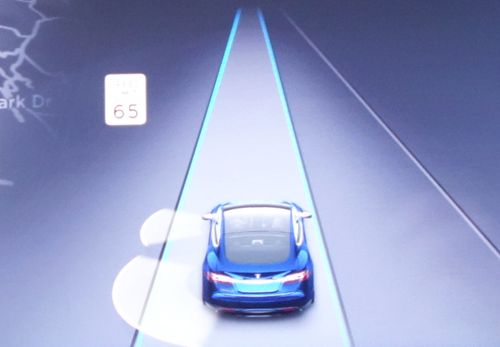
Let's start looking at other clues as we discuss autosteering functioning. Stevezzz brought up the lack of blue lane markings in another thread, so let's whenever possible refer to the indications that the Tesla display gives us. From what I can see, the display thinks out loud by drawing semi-circles when it detects nearby objects, with grey being the first indication, yellow being the caution distance, and red being the warning distance. Whenever possible, please state display indications at time of autosteering challenge. See image below.
 �
�
Oct 17, 2015
mspohr I've also noticed the AP limiting speed when driving around a sharp bend. I took a drive over Mt. Rose (a steep, winding road over a 9000 ft. pass) where the speed limit is 50. I had the AP speed set to 60 and noticed that on some of the hairpin turns, the AP lowered the speed to as low as 35 (which I felt was too low for some of the turns) and on others it lowered the speed but not as much as I would have liked.
My conclusion is that the AP does adjust the speed for curves. It may not do a very good job of estimating the "right" speed but hopefully this will improve as more data gets into the system.�
Oct 17, 2015
cmu5p TRACTOR TRAILERS: I routinely drive on a stretch of interstate heavily populated by tractor-trailers and have noticed auto-steer turning off a couple of times when next to or in the shadow of a tractor trailer. It has always seemed to be on my right. I think the shadow maybe obscures the lines? Will keep looking for patterns. It surprised me there was no warning, just 'ding-ding'-> autopilot off. Am pretty vigilant so I am hands off, but at the ready to take control anytime. Still pretty amazing technology.�
Oct 17, 2015
Papafox Here's another situation to beware of. On I-80 Westbound from Reno to Auburn, Ca., Exit 139 provides an unusually tough solution for autosteer. Notice that two sets of white lines exist: the regular road lines and a thinnner set of white lines that leads the driver towards the turnoff, which is a hairpin turn and cannot be taken at highway speed. My Tesla detected that something was wrong, handed control back over to me, and I made a small correction to the left, back into the highway lane and away from the turnoff. This is precisely the type of setup that needs either attention by Caltrans to get rid of that second set of white lines or some type of exception transmitted to the Tesla through a Tesla database, to provide the right solution to the problem of multiple white lines on the highway.
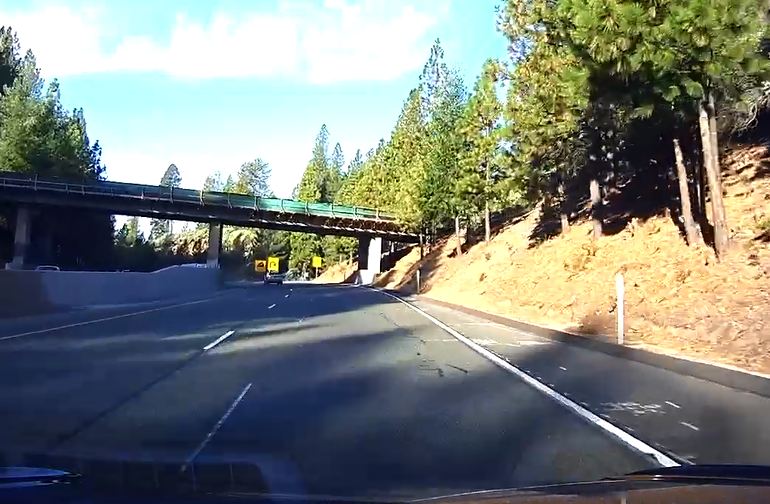
Notice one of many thinner white lines in a row, diverging to the right from the highway lane marker
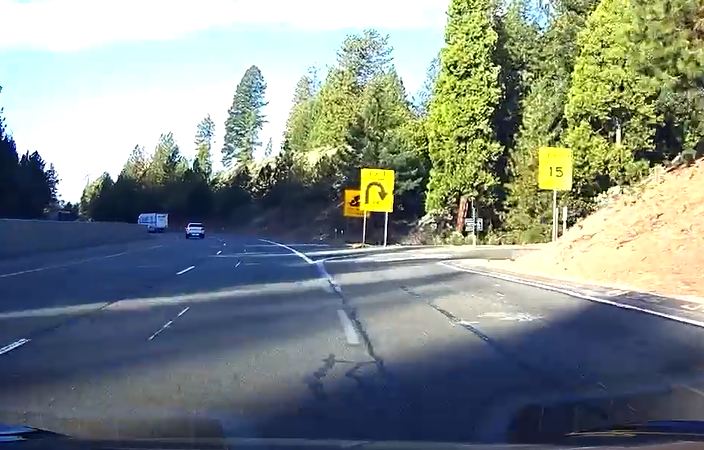
In this photo, you can see additional white lines trying to lead the Tesla right towards the hairpin turnoff. Fortunately, the Tesla AutoSteer had already turned control back over to the driver at this point and the driver was ready to act if AutoSteer didn't disconnect�
Oct 17, 2015
dsm363 It doesn't like roundabouts either.�
Oct 17, 2015
Mj�lner Best ever dsm363 :tongue:�
Oct 17, 2015
johnbro23 Good thread.
Doesn't tesla already have all this data on how people typically drive? It has a fleet of 200k cars doing a few million miles / day. It doesn't seem like Tesla has factored in enough of this GPS-related date to AP, but seems like it should be. Can someone with more of a technical background explain what is the holdup?�
Oct 17, 2015
brec Thread page numbers are unreliable because of forum Settings::General Settings::Thread Display Options::Number of Posts to Show Per Page
To refer to a specific post, a link to it is best.�
Oct 17, 2015
Papafox Done. Thanks.�
Oct 17, 2015
Khatsalano Good thread.
I do think lane-biasing has a lot of potential. For example:
- detect vehicles that are laterally near you ... lane bias away from them.
- detect large semis or trailers that have high sway ... lane bias away from them.
- in a curve, lane bias should be towards inside of the curve as you enter, then fan out to center. Except when:
..........in a curve to the right and you're in the leftmost lane with room, lane bias to the left throughout the curve, especially with a car to the right
- when in the rightmost lane, deference should be given to the left lane marking, not the right one due to exits
- in overtake lanes, the car should know how to at least follow the slower vehicle in front, or, choose the rightmost lane. Right now, it just freaks.
- when in the leftmost lane and there is sonar detectable k-rail, the car should still bias left instead of right so it stays away from traffic. Barriers don't jump out at you, but other drivers do. Even centered is better than the current right bias. Exception when the barrier is closer than say, 4 feet.�
Oct 17, 2015
Denarius I did extensive testing (4 hours of driving) last night on a two lane highway with windy roads. My Model S tended to hug the left line through the curves, which was very bad, as cars coming the opposite direction when entering to fast tend to go wide, coming close as well. 8-10 times I had to override autopilot to hug the right side of the lane to prevent a collision or at the very least a close call.�
Oct 17, 2015
bmah Indeed. I'd be much more comfortable with AP if only the first of these was implemented.
Some of these heuristics need to be flipped left-for-right in countries where people drive on the left side of the road.�
Oct 17, 2015
S4WRXTTCS What I'd like to see at a minimum is
Lane bias away from large/close vehicles
Dampening of the auto-steer. It feels like I'm with some driver who is looking immediately front and not down the road. I've been testing it with a few fingers on the steering wheel and there is way too much steering input going on.
Better handling of exits on the left and right lane. Default to not exiting.
In my experience with it performed great on I5 between Everett, WA and Shoreline, WA. I imagine this stretch was extensively tested by Tesla.
It didn't handle 405 all that well between Bothell, WA and Bellevue, WA in the left lane (next to the HOV lane(s)). The issue was the HOV has sections where you enter it and that confuses the autosteering. It performed much better in the middle lane.�
Oct 18, 2015
MikeBur When SOC is at 100%
One thing related more to TACC, though happened when testing Autosteer first, is that the car doesn't maintain set speed when going downhill when fully (100%) charged with TACC engaged. Does work as expected when not fully charged.
First discovered this Thursday after charging for long drive then setting TACC speed limit, and watching tesla not brake at all going downhill. I understand regen is not available, though was very surprised brakes aren't applied. It was most disconcerting and unexpected, you just don't expect to be doubling your TACC speed when engaged.
hadnt noticed this prior to 7, though maybe it's in 6.2, just coincidence I was trying this... Is this normal?�
Oct 18, 2015
simonog The other challenge is that in Europe (including the UK) cars should keep to the inside lane at all times except when overtaking slower traffic. Travelling in an outer lane with nothing on say a middle lane can be penalised.
it makes for more disciplined driving (overtaking only on the outside for instance) but is a challenge for any auto-positioning as the car cannot choose any empty lane.�
Oct 18, 2015
stevezzzz To me, the 'additional, thinner white lines' look like leftover markings from an earlier alignment of the lanes (note that the lines continue beyond the exit), lines not thoroughly removed after the newer markings were added. Worn, ambiguous highway markings were cited by Elon a few months ago as a reason Autosteer was not ready for release as quickly as anticipated. I think we're all coming to realize he was not just blowing smoke.�
Oct 18, 2015
kirkbauer They are talking about position within a single lane, not which lane to drive in, the driver chooses that.�
Oct 18, 2015
Khatsalano This may be stylistic, but auto-lane change is too aggressive in the line it chooses. I would prefer the angle of entry to be maybe -20%. Here's why. Right now, it feels like a lane change is a Z instead of an S curve. After the lane change, the recovery steer is just so aggressive it feels cheap or badly engineered to have that much lateral deceleration for a simple maneuver. It's the difference between touching down nicely on the runway (you know that feeling, especially as a passenger!) vs. impacting the tarmac hard because the pilot judged the flare wrong. I would strongly prefer a gentler lane change angle with subsequent gentler recovery steer.
- K�
Oct 18, 2015
LetsGoFast If your charge limit is such that regen is disabled, I think it is normal. It appears that the speed model used by the car assumes regen and it doesn't accurately predict your speed when regen is off.
Interesting. I think it is sylistic, because I think many people take way too long to execute a lane change and think Tesla hits it pretty well on a straight road. If you perform a lane change on a curve, I do think it sometimes steers a bit too abruptly on the recovery turn. There are a number of stylistic tweaks I could imagine. For instance, I'd prefer to shade my lane position depending on the circumstances. I prefer to stay a bit left in the leftmost lane, giving center lane traffic a wider margin of error (especially when passing oversize vehicles). On a two lane highway, I'd prefer to stay further right to give oncoming traffic the widest margin. I'm noticing a lot of subtle things I do as a driver that autosteer can't easily replicate. In the center lane, I'd try to stay dead center unless either of the other two lanes has a temporary barrier, then I'd try to stay a bit away from that lane and so on. Some people prefer very long, gentle lane changes and others prefer to minimize the time spend astride the lane markers.�
Oct 18, 2015
Papafox In the agreement each of us okayed in order to accept the beta use of autosteering, Tesla clearly insists that a center divider be present between you and the oncoming traffic. Here's the language:
"Autosteer is for use on highways that have a center divider and clear lane markings, or when there is a car directly ahead to follow. It should not be used on other kinds of roads or where the highways has very sharp turns or lane markings that are absent, faded, or ambiguous. Similar to the autopilot function in airplanes, you need to maintain control and responsibility for your vehicle while enjoying the convenience of Autosteer.
Do you want to enable Autosteer while it is in Beta?"
I think what you've discovered is that Tesla has good reasons for putting out that restriction on the autosteer at its current level of development. No doubt the product will improve before Tesla sanctions autosteer without a center divider. I am adding this center divider issue to the initial post of this thread.�
Oct 18, 2015
mspohr Interesting quote from the autosteer beta agreement.
I don't see anything similar for the general release. The part about "use on highways that have a center divider" seems to be missing from the general release of the software.
I don't know if they feel more confident about the software and now feel that this warning is not necessary.�
Oct 18, 2015
Papafox Mspohr, you make a good point that the center divider language should be added to the release notes, as well. From reports I've seen, autosteer without a center divider is clearly not ready for prime time yet. Since drivers need to acknowledge the one paragraph statement from Tesla that addresses the need for a center divider as a condition for beta testing autosteer, I feel confident that the acknowledgement language is controlling.�
Oct 18, 2015
lg_golfs Did not see this listed. Apologies if I missed it.
Southern California HOV lanes. Its a double yellow which changes to dashed white when you are allowed to enter and exit the lane. My car wanted to exit most of the times the white dashes were transitioning back to the double yellow.�
Oct 18, 2015
Papafox lg_golfs,
I haven't heard of that challenge to autosteer yet. I'll include it on the first post. Thanks.�
Oct 20, 2015
MikeBur Thanks.
I don't believe it was this bad previously; though range charging is a rare occurrence a heavy car going down a steep hill rapidly increases speed is unexpected behaviour for me. Still I've said my piece �
�
Oct 20, 2015
MikeBur Bad scare this morning
Had a bad scare this morning. If you saw a Model S do an impromptu sliding maneuver, in the rain, at 60mph, this morning on the I90 east bound near Seattle, that was me...
Not the fault of autopilot. A brand new (paper sticker) Mercedes 300 swerved into my lane and would have caused an accident if I had not been paying attention. Again, no fault of autopilot as the driver weaves sharply into my lane without indication or blind spot check. By the time the collision alert chimed I was already swerving into the hov lane to avoid. You know things are going to be fun when time slows and you purposely have to try to not react harshly - no time to curse or gesticulate - one of those moments...
Anywho, what does this have to do with autopilot? Well, autopilot was on - my hands actually resting on the wheel - when I had to swerve. I ended up over-correcting as the extra 1/10th of a second to overcome the "reluctance" of the wheel to cede control caused me to turn harder than I would normally have done. Then, when the lane steering disabled, the steering wheel became a lot more compliant and I was turning a lot more than I anticipated. I did slide a little and managed to get the car under control quickly, though I thank goodness that I used to rally drive many years ago. I had broke traction and at that speed in heavy traffic I was extremely grateful that I remembered some of my rainy Tarmac stages and didn't spin out.
Think it's worthwhile contacting TM and see if they want to pull and analyze the logs?
Btw I resisted the temptation to road rage the Mercedes; rather I continued behind them (on Autopilot) and watched them do the same thing to a motorbike. This took the proverbial biscuit, so I continued to follow them off the freeway, take some photos of the car and paper sticker, then passed this on to the authorities with the intimation they were likely drunk.�
Oct 20, 2015
Burt Reynolds MikeBur, that is crazy! Thank goodness for your attentiveness, quick action, and WRC skills!
I've had the same thought cross my mind when the car unexpectedly veers onto an exit ramp. As an attentive driver, you rapidly observe what is happening and you immediately take corrective measures. But your hand is met with a surprisingly reluctant wheel and a degree of force that is far in excess of any steering input that the Tesla has ever requires. This certainly delays the proper corrective steering input by a half second, and then throws off the rest of your corrective inputs when the stiff steering goes suddenly compliant. Perhaps the "I'm taking the wheel" programming needs to soften the effort necessary to take control. It's a bit of a wrestling match right now!�
Oct 20, 2015
jeff_adams You know, I think it might be a good idea if Tesla were to team up with a dash cam manufacturer and make a unit that could do a streaming upload to Highway Patrol or local police. Instead of road rage, just send in the evidence of reckless driving and let the authorities deal with them. With Geo location capabilities, the police should know exactly where the bad guys are at.�
Oct 20, 2015
DuluthDad Interesting comments about auto steer having problems transitioning from solid to dashed lines. In Atlanta, driving down I85 from Duluth to the city, the major highway has such a set up as you move thru a set of HOV/Toll lanes. I took this route to the airport Monday morning (daylight) and TACC and Autosteer performed well. It didn't attempt to "exit" when the lane line transitioned from solid white double to dashed white double lines. The only trouble AP had was navigating a few sharp left turns at the I85 and GA400 intersection and the I85 and I75 merge. Then back around to the left and right at the Grady Curve. For the majority of the 30 mile drive, AP was engaged and did about as well as I could expect. The biggest problem TACC has is seeing far enough ahead to slow the car down more gently than it does. Visual line of sight can see a standstill about a half mile away, TACC waits for about 1/10th of a mile at best and brakes hard. Looking forward to continued improvements - but this owner is very satisfied with the capability of this 'beta' software. Looking forward to watching it learn as I make this same drive every week.�
Oct 20, 2015
Soolim I set my steering to sports, so quite used to the "more effort" type of steering. Hence the transition from AP to driver is not that bad for me. If Tesla were to set the torque sensing lower, it may discourage people to comply with the hands on wheel approach, due to too early AP to driver switch.�
Oct 20, 2015
AlMc Wet pavement at night with glare from street lights/other vehicle headlights.....NOT all the time but can happen suddenly.�
Oct 20, 2015
kirkbauer That seems like bad road design... drivers (and autopilots) are trained to stay to the right of yellow lines...�
Oct 20, 2015
mspohr The electronic stability control may have helped. The logs would record this.�
Oct 20, 2015
MikeBur Thanks. Never in WRC (unless the W in case was Wrexham inside joke)).
There's definitely a balance required and I actually think it's about right. I wouldn't want auto steering to disable when just resting your hands on the wheel. My comments are primarily to warn others of this consequence in this rare situation.
- - - Updated - - -
Love it. Maybe a shame site would be enough for the default upload? ;-)
- - - Updated - - -
Was thinking the same. There's a definite balance. Nice idea on sports setting though I thought, when set to Normal, the steering wheel increases in resistance already? Might be psychosomatic though ;-)�
Oct 20, 2015
garygid Most likely the AP software is thinking that the approaching double yellow lines are
the division between your direction of traffic and oncoming traffic, and it wants to
get you back to the right of those "center" lines to avoid possible oncoming traffic.
So, apparently driving in HOV lanes is not yet a supported lane-marking type.�
Oct 20, 2015
kirkbauer Well, the HOV lanes that I'm used to use double white lines, not yellow, and I have no issue with them here in GA.�
Oct 20, 2015
cmu5p Update on TRACTOR-TRAILERS: had many opportunities to test this out this week and it seems to be a shadow phenomenon. Only consistent time this happened is driving south in the afternoon, passing in the left lane in the large truck's shadow. I think AP may sense it as an obstruction (although the proximity sensors (white/yellow, etc) don't go off) and suddenly will veer car to the left. No "hold wheel" warning, either. I have used AP passing no-shadow trucks without issue. Will keep testing......�
Oct 20, 2015
Papafox I'm on a highway trip at present and will look for similar behaviors. When you say, "veers left" does the autosteer shut off, does the car stay in its lane but change to the other side of the lane? Please give a bit more info. Thx.
- - - Updated - - -
Noted on first post. Thanks Al.�
Oct 20, 2015
AlMc What has happened to me is that the camera/car 'hunts' for the other lane line which it lost because of the shadow and tries to 'jump' behind/into the truck's lane.�
Oct 20, 2015
Papafox What interests me most at this time is whether the blue line for that lane on the autopilot dashboard image disappears at such times. We ought to keep an eye out for that situation. I have videos from a webcam and from a video cam aimed at autopilot image from today's drive and will try to see if blue lane disappears next to truck casting a shadow.
I will beef up a statement about big trucks on the first post because of these continued reports.�
Oct 20, 2015
AlMc Papa: It is certainly not all the time. The shadow and your car's position has to be 'just right'. I have tried to duplicate it unsuccessfully, at times.�
Oct 21, 2015
cmu5p Papa, et. Al.: (see what I did there?
yes, the circumstances have to be "just right". I thought the car veered away from the truck but in retrospect may have veered towards the truck, then I take the wheel and over correct left towards the guardrail on a two lane southbound interstate. This happened three times on day 1 of use. Will do more road research, but in the last days, have been traveling that stretch of interstate at night, so no shadows. Stay tuned.�
Oct 21, 2015
Papafox cmu5p and all,
One of the positive aspects of the autopilot display on the dash is that it thinks out loud on many items. If you see a blue line drawn on both sides of your lane, the display is telling you that it is making it's computations based upon usable lane markers. Those blue lines sometimes extend far (level ground) and sometimes shortened (Tesla is cresting the top of a hill). We see the grey, yellow or orangish-red semi-circles flash on the left or right front or rear sides of the Tesla image when it detects objects to the side. In the coming weeks, we will each become more familiar with these images and use their status at the time of an event to help explain what the autopilot was doing at the time.
Note: Often you simply can't be looking at the autopilot display because your gaze is needed to be outside in order to protect your lovely Tesla. One must be careful to avoid cutting your margins too thin because you're glancing inside instead of outside at a critical moment. Safety is number 1.
To speed up my learning curve, I decided to install a video camera facing the autopilot display and then sequence these videos with the look-ahead video from my dash-cam. Through this process I am learning the autopilot better. Take the following example from my drive yesterday.
I had the video camera rolling because I was on a winding mountain road which had a concrete barrier very close to the left side of the left lane. This is not a comfortable situation if the turns are too steep. Add a semi-truck in the other lane and using autopilot in such a situation would be poor judgment.
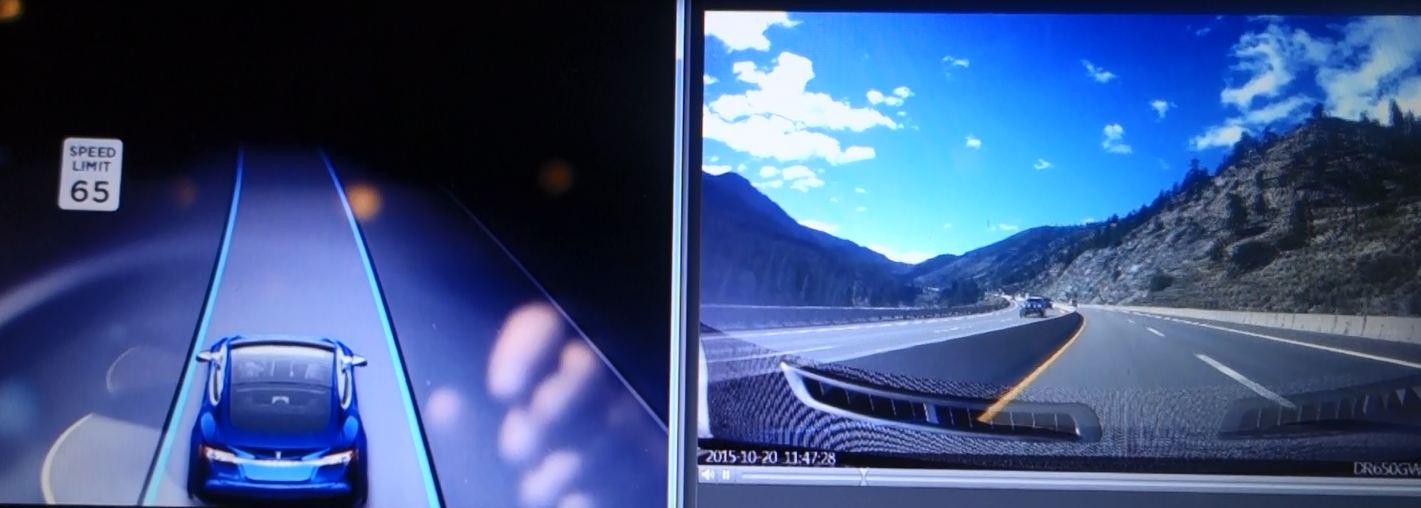
Figure 1. On the display you can see the grey semicircle showing that the Tesla is aware of the obstacle to the left of the car. The Tesla then moved more towards the middle of the lane. Notice that I have white dashed lane markers to the right and a solid yellow line marker to the left.
Now I cross the state line and pavement turns to concrete. Something else important happens.
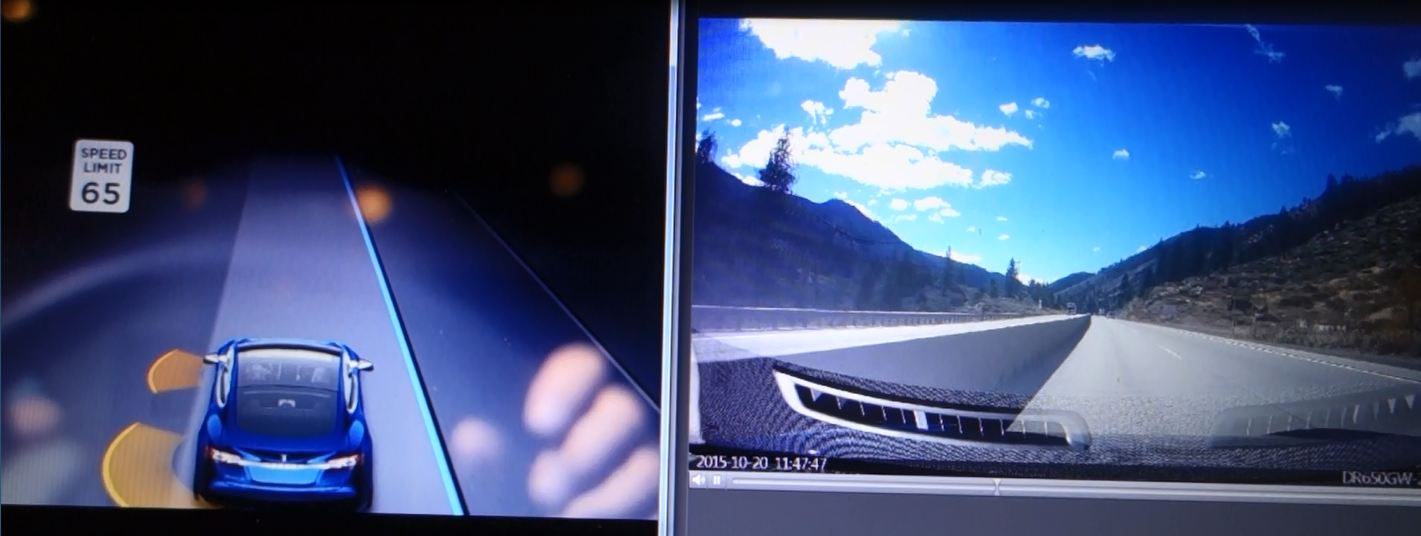
Figure 2. Notice that the car is closer to the concrete barrier and I was about to disconnect and take over manually, but the car then proceeded to adjust and give more room to the left.
Can you see why the car behaved worse in the second photo compared to the first?
At the time, I was unaware of the details and watching the distance to the concrete like a hawk. Relaxing at my desk, though, I see that there is no blue land marker on the left side in photo 2 in the Tesla autopilot display, but there are two lane blue lane markers in figure 1. Why is this? The reason, of course, is that the yellow line marking the left side of the left lane has disappeared! Lacking a lane edge marker on the left side, the Tesla was limited in moving to the left primarily by the side sensors, which were picking up the concrete barrier. I moved into the other lane shortly after figure 2 timeframe.
We need to learn to see the road as the autopilot sees the road until the autopilot evolves further. We need to look for lane markers (or the lack thereof). Heading on Highway 680 from Vacaville to Walnut Creek, I saw a section of highway under repair that lacked edge of road lines and that had those circular bumps instead of stripes to mark lanes. I chose to hand-drive this segment because it would clearly compromise the performance of the autopilot.
On the positive side, after learning autosteer on winding mountain highways, the use of autosteer between Sacramento and Vacaville on well-marked highways with gentle turns was a delight, both in day and at night.�
Oct 22, 2015
S4WRXTTCS This is precisely why I won't really be using auto-steer anywhere around busy areas when driving at speed. Even if everything is working perfectly it's going to change the dynamics of the reaction. In your case it turned out okay because of your mad skillz. But, most of people won't have that. We're in this weird stage of giving up control to the computer, but we still have to maintain control. So that means there is this momentary transition time.
This kind of situation isn't all that rare either especially given how many people are texting while driving, or who are impaired (drunk, high, etc). We desperately need self-driving cars, but the transition to them is a rough one.
So aside from training/testing the autosteer (when I'm more attentive than normal) I'll stick to using it either in traffic jams or in the middle of nowhere when I can relax.�
Oct 22, 2015
MikeBur Mad skillz? ;-)
in in all seriousness, after driving another 250 miles today I prefer auto-steering for empty freeways rather than congested ones. I was really impressed at the ability of auto steering to cope well with pretty heavy fog at 5-6am on SB I5 today. There were areas where the system was disabled, though this was only for a few miles. Off freeway (single carriage way) roads were pretty good, requiring manual intervention only a few times.
One thing I have noticed is that the system is a LOT better ignoring exit ramps now, though the number of "hold the wheel" warnings have increases - I strongly suspect that these warnings are where others have overrode the system, eg approaching a number of bridges I had this happen, and I can imagine at certain times of day there is a hard shadow.
i am still thoroughly impressed by this system overall!�
Oct 22, 2015
Papafox Some drivers on other threads echo your views that the number of exit departures by autopilot are on the decline. Some believe that the system is learning your most heavily traveled routes. On a recent drive on I-80 I still encountered some attempts to depart on an off-ramp, so caution is advised. Still, it's a good trend.
I don't blame some drivers for being conservative in their choice of when to use autopilot. Let us all develop our particular comfort zones. These are beautiful cars that we want to protect. That said, as we define and better understand the potential challenges to autosteer, we become smarter about when autosteer can perform easily and when it is challenged. The net result is that we can better predict when autosteer will be functioning within our particular comfort zones.
The other night I was tired and driving on a highway with only shallow curves and good markings. I turned autosteer on and really appreciated having the help with the driving. Autosteer performed beautifully and was a very positive addition. This technology is already very useful and will become more so at a rather rapid clip, I suspect.�
Oct 23, 2015
Papafox Road Construction Areas
In many cases, highways undergoing road work are poor choices for autosteer usage. Think of the rules that the autopilot functions by as a game of "Simon says". The autosteer only does what it is allowed to do, but in a road construction area, cones across lanes can ask for behaviors that are not allowed. Consider a conversation between the driver and the autopilot as the Tesla approaches a road construction zone.
Driver: Clicks speed control down one large push, "Simon says speed 60 mph"
Autopilot: "Your wish is my command"
Driver: Clicks speed control down one more large push, "Simon says speed 55 mph"
Autopilot: "Your wish is my command"
Driver notices cones directing all traffic to cut left through two lanes to follow a narrow corridor on the left edge of the highway
Driver: "You're not following the cones!"
Autopilot: silence (but thinking "I need to hear Simon says and an allowed command. I cannot cross lane edge until turn signal is activated, and I follow lane lines, not cones")
Driver: Turns wheel, autosteer clicks off, proceeds to follow cones
Many times, I see a lack of striped lane markers and solid side of highway lines in a construction zone. Consider your average road construction area to be a little shop of horrors for an autopilot unless you assess the painted lines and purpose of cones and find them suitable.�
Oct 23, 2015
garygid When a lane splits, selecting the right or left might not be your
desired path, but crashing is usually an issue of appropriate
speed for the selected path, not simply a steering issue. Taking
an exit or left turn lane might require drastic speed reduction,
whereas taking the "main" path could often be done at much
higher speeds. If the car being "followed" by the TACC takes the
other path, all of a sudden your car might be faced with totally
stopped traffic, slow traffic, an accident or obstruction, etc.
So, splitting lanes is not a "trivial" left or right issue.
Handling merging lanes is a comparative nightmare situation
which almost always requires significant human attention,
usually to anticipate what the drivers of the merging vehicles
will attempt to do, and attempting to cooperate to avoid crashes.
- - - Updated - - -
In the first pictures, it appears that the car is too far left of centered
between the lane lines, perhaps because it is on a curve?
In the second pictures, it appears that the sensors are overestimating
the distance to the divider wall, and that the car might be centered
between the percieved wall position and the lane marking on the right.
However, the sensor arcs might not be drawn to scale, and the car still
appears to be too far to the left.�
Oct 23, 2015
robertvg Correct, one of the problems with current TACC is that it will launch you overtaking other cars on the inside when a car you were following in that lane takes an exit and moves out from in front of you. If you had TACC set to a higher speed you will speed up and surprise other drivers. You can also be penalised for it. I can see this not being a problem in the US following a 'keep your lane' policy but with a 'keep your speed' system it doesn't work.�
Oct 23, 2015
mspohr Drivers in the US are so bad... they all want to drive in the left lane. I've found I can make better time on the outside lanes. Today I was driving on the Interstate and it went from 2 lanes to 3 up a hill. Everybody kept to the left. I moved to the empty right lane and passed them all.�
Oct 24, 2015
Papafox I just reviewed the video of these two moments close to the left concrete barrier. The first instance is just as you said, the result of a rather quick turn and the car had not yet re-centered itself in the lane at the conclusion of the turn. In the second instance, the one that produced yellowish-orange object warnings, the car had completed a left turn but it was a little slow coming out of the turn since a left side of lane stripe no longer existed and it apparently based its steering upon the existence of objects sensed off the left side of the vehicle. Since the Tesla was drawing yellowish-orange semicircles, it was indicating that these obstacles are close and of an immediate concern. I can tell you from my pucker factor at the time that we were as close to that concrete barrier as I wished to go and I would have disconnected autosteer through turning the wheel, but autosteer did its own correction back to the center of the lane.
The lesson I learned? Don't drive in the left lane of a winding mountain highway if a concrete barrier defines the left side of the lane and yellow edge-of-highway markings are absent. Autosteer did okay, but it exceeded my comfort zone. The combination of three challenges (turns, close concrete barrier, and a lack of lane edge markings) is more than what I wish to trust autosteer with at this stage of its development.�
Oct 24, 2015
Papafox Robertvg, Here's a tweet from Elon: Elon Musk ?@elonmusk Oct 23Autopilot 1.01 coming soon: curve speed adaption, controller smoothness, better lane holding on poor roads, improved fleet learning!
Perhaps that "controller smoothness" will address the launching after a slow car clears your lane. Although personal preferences vary, I agree with you that TACC is too aggressive for my tastes and for best energy economy iwhen it accelerates this quickly after a slow car gets out of the way.�
Oct 25, 2015
cmu5p @Papa fox UPDATE RE: Tractor Trailer shadows-
So far, no more erratic steering or sudden disabling of auto steer next to big trucks in the last week of testing on the interstate. Either:
1) I've not been able to reproduce the right shadow angle, etc. OR
2) I've been more vigilant about paying attention when it says "Hold steering wheel" (which I have, although, AP hasn't done this next to a tractor trailer in the last week) OR
3) AP is getting to know my driving patterns.
Either way, I'm a happy camper. 40 miles of interstate commute each way to work with 30+miles of it handled solely by Autopilot.
Drive on, AP.�
Oct 26, 2015
Vger Yes, and also saw this while driving southwest in late afternoon after a rain shower. The glare off the road surface made the lane markings intermittently almost invisible, even to me. I noticed it and grabbed the wheel, just before AP imposed me to do so! If you cannot see the lane marks, the camera cannot either!
- - - Updated - - -
I also THOUGHT I detected another possible problem in sun-shower conditions: One of the windshield wipers crosses in front of AP camera. Of course that is necessary to clear rain and snow. But during an intermittent swipe by the wipers in a light shower, the AutoSteer gave a sharp wiggle. PERHAPS, this was due to being momentarily blinded by the wiper at some critical moment for lane recognition. The AP did not panic, but I instinctively grabbed the wheel to correct the wobble.
Anyone else?�
Oct 27, 2015
Papafox cmu5p, that's great to hear. If your experience changes, please let us know, and with as many details as possible, please.�
Oct 30, 2015
garygid Some have reported TACC slowing in areas where a new road does not
follow the same path as the old road that the dash-nav shows.
I found that AP passing a truck that was a bit too close to my right-side lane
line would move my car a bit left, but usually only after I had mostly passed
the truck. It seemed that either its response was slow, or that only the
rear side-sensor was operating properly, or both.�
Oct 30, 2015
cmu5p in retrospect, I think this may have been what happened to me on day 1:
AP next to tractor trailer drove too close to right lane, I abruptly over correct to the left, turning off AP. Happened three times on day 1, not since. Turns out could be operator error, not necessarily AP error.�
Oct 31, 2015
calisnow Big problems: cresting hills causes Autopilot to literally dive into the left lane or attempt to shoot off to the right.
Autopilot had severe problems on a two lane (no center divider - yes, I know, it isn't designed for this) stretch of I-395 running north-south between I-15 and Highway 14 both yesterday and the day before (both directions).
The challenge was not curves or the way the road is marked, it's that this particular section of highway has numerous sharp hills and dips (or "whoo de whoops" as I've heard them called). Testing yesterday and the day before found Autopilot to lose the lane markings and not just shut off, but also turn sharply left or right (seemed random as to which way - couldn't find a pattern) while sounding the "take control immediately" buzzer. To be clear the road had no curves in it - only hills and dips.
Again, the problem is not just that it shuts down - it's that something about cresting sharp hills causes it to veer sharply to the left or right as it loses the lane markings where they disappear on the crest of the hill.
And yes, I let it go all the way across the center line of the road before manually correcting to see what it would do. Quite frightening if someone wasn't on top of the situation.
I would think this behavior could easily be programmed out of it with some gps data telling it that the road is straight ahead.
PROS: I haven't seen it display any sketchy behavior when traveling near semi trucks or trailers as others have reported. Has been rock solid in heavy traffic.�
Oct 31, 2015
Papafox I believe Tesla's strategy is to create a database of roads so that when the road's characteristics do not allow good tracking with the visual sensors it will receive help from the database. The issue of cresting steep hills is important enough so that I will add it to the first post. As for turning left or right after the autopilot shuts off, I don't see any mechanism that would promote such behavior. Maybe the bounce after coming over the crest of a hill is destabilizing, but at that point you would have your hands on the wheel and correct for any tendency to go left or go right, I would suspect. What does the wheel feel like after you come over the crest of a hill and the Tesla settles?
I know the bumps in the southern portion of 395 because I drove them a month ago, northbound. You're right that 395 at that point is a real roller-coaster. Since there's no center divider, Tesla does not recommend using autopilot, so you really need to have hands on wheel and be ready to take over in that environment.�
Oct 31, 2015
Khatsalano I'm not sure how well-implemented self learning is, but I was one of the members who posted issues when lanes split and when lanes merge in the first week.
Well, several weeks later, umm ... I think the car learned. On 280 N going into SF at the Daly City/Downtown split after the US-101 split, the car used to freak out at the lane splits both from 2 to 3 lanes, and then again at the Daly City/Downtown split. Now, it handles it! It's not smooth, but it doesn't freak out with the red hands beeping anymore. Neat.
- K�
Oct 31, 2015
cmu5p I agree. I've started taking some empty curvy highways late night/ early morning and have noticed it is no longer asking me to "Hold steering wheel" at the usual curves. I'd "float" my hands over the wheel, but now no longer getting the visual prompt. It is creepy and amazing (but more amazing).
And, Yes, I know for interstate use is best. Was very cautiously trying out AP's abilities on various roads.�
Nov 1, 2015
calisnow Yes that's exactly the moment when the car decides to veer off the shoulder or into oncoming traffic - not just before the crest, but *during* the crest - the part where you feel weightless. And for whatever it's worth the car I was driving was a 2015 70, RWD with the traditional coilovers - not the air suspension.�
Nov 1, 2015
mspohr I've driven that road recently (before AP) and if you're going weightless you're probably going too fast for AP. There are limits to what's possible. I've noticed that even on the I80 over Donner summit it gets dodgy over 75 mph.�
Nov 1, 2015
calisnow Yeah I would say speed was under 75 but over 65 - probably 70.�
Nov 1, 2015
ilovemycoffee I suppose these observations are obvious, but I wanted to share this everyone.
We drove yesterday on two lane highways and concluded that AP does not work very well in the rain at night. The glare of lights from oncoming traffic essentially prevents the camera from visualizing the road (just like human eyes). Water on the road and leaves can mess with AP, day or night.
AP does not like passing lanes yet, wants to keep to the left. Hopefully it will learn our little highway. It actually did well in the daylight and light rain.
I still appreciate the auto windshield wipers and auto high beam dimming though. Helps to keep your eyes on the road.�
Nov 1, 2015
Khatsalano Sometimes, the car will do a weird swerve right or left within the lane for no detectable reason to the human driver ... that is scary. Especially on CA-152 E today when it swerved right within the lane by itself, then it did the red-hands/beeping freakout because it caused itself to run into the next lane. Yes, the sun was lower in the morning hours, but this is not excusable, even for beta. It's a safety issue ... my hands were on the wheel and I had to rescue, but still scary.
- K�
Nov 16, 2015
Discoducky I spent sometime this weekend with the 2.7.7 (I think) and it wouldn't change lanes on I-90 when the lane dividers were *only* botts dots (no lines, but just those round white bumps).
https://en.wikipedia.org/wiki/Botts'_dots
Anyone have luck with auto lane changing with no lines, but just botts dots?�
Nov 16, 2015
kirkbauer Two situations I have found, both of which should be obvious but who knows...
1) You aren't supposed to be using it on surface streets, but if you are be careful going through intersections, especially if you aren't following another vehicle and/or if it is a large intersection and you are going slow (longer time with no lines to follow) and/or if the lanes shift on the other end of the intersection.
2) If traffic is stopped in say the left lane, and you are driving in the right lane, and the road is curving to the left, there may be somebody stopped in the right lane but AP might not know that soon enough as its view is being blocked by the left lane's traffic.�
Nov 16, 2015
Papafox In Hawaii, many of the lane markers are the white dots, rather than painted lines, and AutoSteer is reported to not do nearly as well with them as painted lines. For the next release of the autopilot, Elon Musk tweeted that autopilot 1.01 coming soon with ... "better lane holding on poor roads". Let's hope that the Botts'_dots are considered in this upgrade.
Discoducky, let me check with a friend in Hawaii and get back with you (my autopilot car is on the mainland at present).�
Nov 16, 2015
Papafox kirkbauer, thanks for the heads up. Can you give some additional details?�
Nov 16, 2015
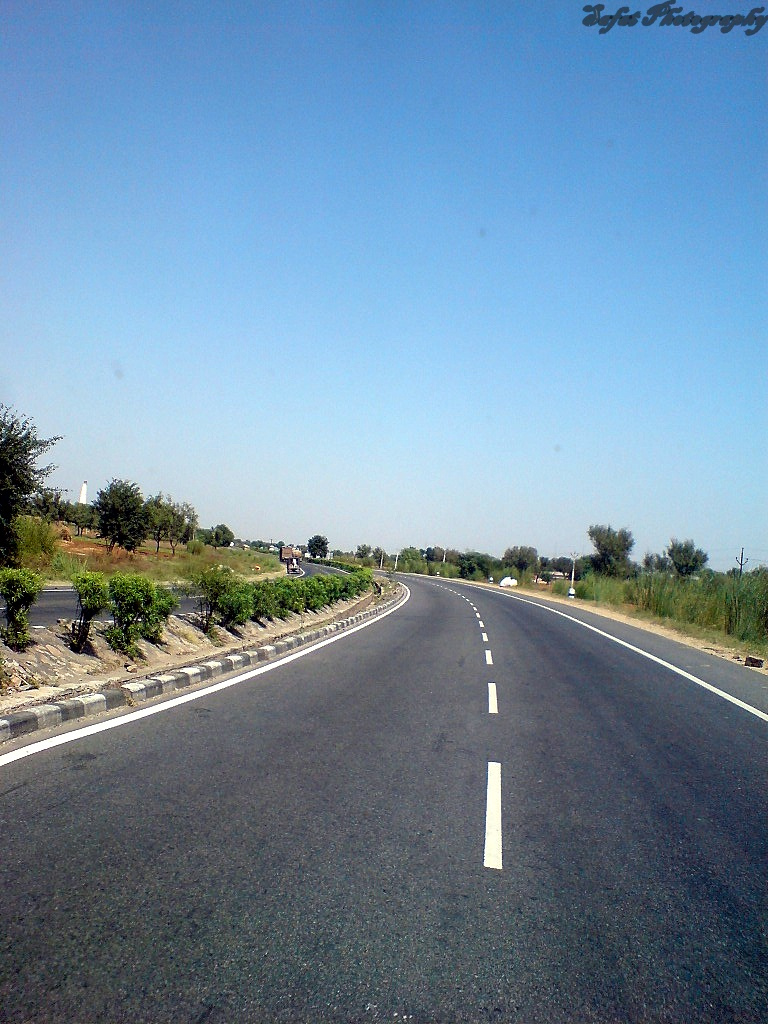
kirkbauer It's hard to describe but basically it can't know what it can't see, and as humans we can predict. Take the image below and imagine it is a one-way road. You are driving down the right lane but the left lane is stop-and-go traffic. This means your view of the right lane is obstructed due to the turn, so neither you nor AP knows if there is a stopped car ahead in your lane nor how close they are.
Now if I let AP do its thing perhaps it would have stopped, but it was coming around the turn at a speed greater than I was comfortable with considering I assumed there would be a stopped car just ahead.
 �
�
Nov 17, 2015
garygid In my version 2.7.56, the botts dots are not recognized as a lane delimiter.
Thus, the AP does not see another lane available to turn into.�
Nov 17, 2015
Papafox Discoducky, I checked with some autopilot users in Hawaii, where the botts dots are the norm as lane markers. Both of the two respondents said that they could get their Model S to change lanes with botts dots if they used the turn blinker, but one said that once the lane change takes place the Tesla sometimes has issues with remaining in the new lane and AutoSteer may shut off. One said that her Tesla does okay in the far right lane because it has a solid line marking the far right side of the lane to follow. Clearly, the botts_dots need to be addressed in a future release of the software, and let's hope they're addressed in the next release. Until then, recognize that this is something that you'll want to be careful with. I have already addressed this issue in the top post on this thread.
- - - Updated - - -�
Nov 17, 2015
Papafox Kirkbauer, I had heard that one component of autopilot was supposed to shoot a beam under the car in front of you to see what's going on beyond that car. In theory, such a beam could detect a car stopped in your lane. It'll be interesting as we gain more experience to see if that theory holds true or not.�

Không có nhận xét nào:
Đăng nhận xét