Aug 15, 2015
edgrzy My neighbor who does not work on cars just had his 12 volt battery replaced. He does not look forward to doing this every 12-18 months. He asked me if I could hook up a Battery Tender to his 12 volt battery. It looks pretty simple to me to do this. He would like to top off his 12 volt battery for 8 hours once a month. He intends to do this while not charging the main battery. Any one have any concerns on why he should not do this ?�
Aug 15, 2015
Cottonwood Not a bad idea, but you will need more than a little battery tender for 8 hours a month.
Do some math:
- The thirsty Vampire drinks about 1 kWh per day.
- That is an average of about 42 Watts. 1,000 Wh/24hours
- At 12 Volts, that is about 3.5 Amps. 42 Watts/12 Volts
To keep the Vampire from sucking down the 12V battery, you should get an 8 Amp charger like the BatteryMINDer 12 Volt 2/4/8 Amp Wet/Gel/AGM Battery Charger. Of course, to avoid having to reprogram it to 8 Amps and AGM on every plug in, you will want to leave it in the Frunk, connected to the 12V battery, and just plug in its AC plug every time you get home.
The Vampire is very thirsty and it takes way more than a little wall wart charger plugged in occasionally to feed it...�
Aug 15, 2015
wk057 Makes little sense when Tesla already has charging for the 12V built in. Just plug the car into 120V instead.�
Aug 15, 2015
CHG-ON I don't get this at all. The main pack charges the 12V whenever needed. I am not sure that a battery tender would solve the deep discharge issue that is inherent in the MS design.
I would love to learn more about this.�
Aug 15, 2015
SteveS0353 The vampire drain is such that the 12V battery is cycling (charge - discharge cycles). That's what kills batteries. All rechargeable batteries have a wear-out mechanism related to the number of charge - discharge cycles. A battery tender (a decently powerful one, as Cottonwood mentions), connected whenever the car is parked (when practical) will supply the vampire load and avoid cycling the 12V battery. The significant deduction in cycles over time will mean the 12V battery will have a longer and happier life.�
Aug 15, 2015
Cottonwood The only reason to do this is that something like the 8 Amp BatteryMinder that I mention above would keep the battery always charged and avoid the "Death by a 1,000 Cycles" that the Tesla greedy Vampire creates. It is the constant discharge/charge cycling that typically kills the 12V battery in a Model S every 12-18 months.
Personally, I consider this to be Tesla's design problem and just let them replace my 12V batteries under warranty.�
Aug 15, 2015
S85D How do you get to the 12v battery to hook up the battery charger? What do you have to take off, etc?�
Aug 15, 2015
smorgasbord I think the profile for lead-acid battery cycle life is quite different than lithium-ion. What kills lead-acid batteries is deep cycling - taking the charge down too far. Heat is also a factor. Assuming Tesla's 12V charging algorithm is proper, I have a hard time understanding how a battery tender can significantly help. But, I'd be interested in hearing the mechanism(s) involved if you know.�
Aug 15, 2015
SteveS0353 Indeed, the wear out cycle count is not a linear function of discharge depth. Cottonwood and I have contributed to a detailed engineering discussion on this in this thread -> Near annual replacement of 12V battery is typical according to Tesla Service Tech. specifically entry #32 in that thread. Bottom line, the cycling of the 12V battery to support the 1.2kWh per day of vampire load will lead to that battery wear-out in 12-18 months. Tesla's battery charging algorithm may be proper, but the real issue is the level of vampire load requiring frequent recharging of the 12V battery. The reason a battery tender would help is that it would supply the vampire load from the shore power, removing the need to cycle the 12V battery so often, or at all.�
Aug 15, 2015
jbcarioca I agree. especially since i have just received a new 12v from Tesla today. If I did not think that I'd put an 8amp 12v charger in the franc, connected to the battery and connect it immediately when i connect the main charger cord.
The problem really is that the 12v continues to work at all times handling the charge port door, the communication to Model S and tesla reporting, charger communications, essentially everything that goes through the CANbus. That means the 12v discharges and is recharged as many as 6-8 times per day when the car is parked. As everyone agrees Tesla need a better solution for these requirements. By 'everyone' I mean Tesla service people also, This may be the largest single warranty budget item because so many cars must be retrieved and carried to the SC by tow truck. The cost of that is ridiculous. I predict a better solution is almost ready to emerge because they cannot survive the cost and inconvenience of this situation as production ramps.
It looks easy to solve, but I suspect it will take some careful engineering to do. After all, nearly all the vehicle systems were designed for 12v systems and are parts used in order high end cars. It ought to be easy to solve, but it is not, so I am told. Some people here are more competent than am I on this subject so maybe somebody knows how to solve these issues.�
Aug 15, 2015
st50maint Why doesn't the car charge the 12 volt battery more often?
The 12 volt battery would not discharge as deeply and I assume the amount of energy required from the main pack would be similar on average?�
Aug 15, 2015
scottm Or why not make all the accessories run off 400V and just leave the contactors closed all the time? �
�
Aug 15, 2015
blanche Because most accessories (lights, wipers, etc.) are standard parts sourced from the auto industry supply chain. The standard in that industry is 12 volt power. So running everything off 400V would require custom building every single accessory, which is neither financially nor logistically a possibility for Tesla. Plus, I'd be a bit worried about 400V running through every single accessory in the car. That sounds like a real bad accident waiting to happen.�
Aug 15, 2015
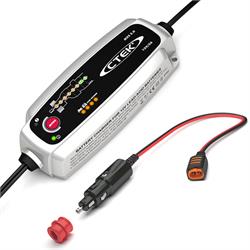
FlatSix911 It sounds like a simple 12V charger is the answer. I use a model that plugs into the 12V accessory outlet ... easy!
http://www.amazon.com/CTEK-56-864-Automatic-Battery-Charger/dp/B006G14FK8/ref=sr_1_1/188-5984494-0169137?ie=UTF8&qid=1439678435&sr=8-1&keywords=ctek+battery+chargers
 �
�
Aug 15, 2015
Cottonwood That unit puts out 4.3 Amps, so it might be just enough for the incredibly thirsty Vampire in the MS if it is connected continuously, but there is also the problem that the MS disconnects the 12V CLR from the 12V battery after 10-20 minutes and then there is no way for this unit to charge though the CLR.�
Aug 15, 2015
stevezzzz For a minute there I had a picture in my head of a battery charger powered from the 12V accessory outlet providing a charging current to the 12V battery terminals... :wink:�
Aug 15, 2015
snort a switching power supply that converts 400VDC to 12VDC is a trivial thing--there's one in the car already to charge the12VDC battery. Functionally the same thing as the external trickle chargers you're suggesting. Why doesn't tesla run the 12VDC components off of that and dispense with the 12V battery?
No engineer capable of doing any part of this would overlook that possibility unless there was a darned good reason. My guess is that the 12VDC loads fluctuate wildly and the worst case is several tens of amps. They chose to go with a small trickle charger and a bigger lead battery. That's probably a bunch cheaper than having a 12VDC power supply big enough to supply the worst case 12V load and is available off the shelf.
my guess is that the external trickle chargers won't help the problem at all....if they do, simply building a slightly bigger trickle charger into the car than the one that's already there would solve the problem trivially and telsla would have already done it. my guess is that they're working on whatever the loads are that give the 12V system a hard time but that they're proving challenging. do any of the folks that have put current monitors onto the 12VDC system have any thought what they may be?
--Snortybartfast�
Aug 15, 2015
Larry Hutchinson My guess ts that they don't want the 400V connected to anything unless the 12v system validates that it is safe to do so.
So a continuous 12V charger is out.�
Aug 15, 2015
SteveS0353 The architecture of the Model S has a safety feature involving the 12V battery. There are contactors inside the LiIon battery pack, which are normally open, to isolate the high voltage inside the pack. The contactors and closed by the 12V system when the car is operating. In the event first responders need to intervene to extract someone from the car, all they have to do is sever the 12V loop which is in the frunk to ensure those HV contactor stay open. That isolates the HV to inside the pack, making it safe for first responders to work around the car as long as they don't puncture the HV battery.
To feed the 12V from the DC-DC all the time would require the contactors stay closed; not a safe situation. If the contactors are allowed to open, then the architecture requires an external power source (i.e., the 12V battery) to close the contactors to get power to the drive drain when you want to drive the car.
The vampire drain is typically 1.2kWh per day. That's 1200 / 24 = 50W running continuously on average when the car is off. We don't know for sure what makes up that level of power, but here are some potential contributors...
3G/LTE radio (needed all the time for access to the mothership, unless on WiFi)
WiFi Radio (needed 100% of the time when in a hot spot)
Bluetooth radio (might be powered off when the car is off)
Key fob radio (needed 100% of the time when the car is off to detect approaching key fobs)
Center console CPU and memory subsystem (could do done much more economically by reducing the CPU frequency when the cars off)
Battery Management System (BMS). This is probably a big contributor to the vampire load.
In any event, 50W continuous on average is a HUGE vampire drain. A 12V charger from the shore power capable of supplying 50W (4.5A, say) would eliminate the deadly cycling of the 12V battery. That's a band-aid. The solution to the 12V battery longevity is to reduce the vampire drain by an order of magnitude at least.�
Aug 15, 2015
tga Safety. You don't want the HVDC system energized unless necessary. Plus it gives a little bit of run time to put the car in jack mode and run the flashers after your main contactors go boom. :wink:
I have a 36A 12V switching supply that I use to power ham gear. I bought it from these guys: http://www.12voltpowersupplies.us/ (it's the S-400-12 model)
It would work as a "battery tender on steroids", but, as Cottonwood points out, it's seems like a lot of hassle while the car is still under warranty.�
Aug 15, 2015
sorka My P85D is drawing 1.7 kWh / day or about 70 watts. Even if I used a real charger to keep it from being drained, my peak power cost is 42 cents / kWh. Given the average number of hours per day during peak that I'm home, this would cost me more in electricity than the cost to replace the battery in just a year.�
Aug 15, 2015
snort then why wouldn't providing a similar singular link from the 12V power supply provide exactly the same safety?
the 3G, WiFi and Bluetooth are exactly the same sort of radio as is in my phone, and the keyfob is even lower power. It's able to idle for days on a 5whr LiPo battery, even if I use it for a few minutes a day. so that's probably not it, although they could have foolishly chosen a high power design.
the center console (several processors, not just a cpu) uses more power but again, unless they made a foolish decision, not much more when idling.
If I understand what it is, the battery management system is a relatively simple computer controlling a bunch of big relays. if the design is such that the electricity is fighting a big spring at all times, that might be doing it. it shouldn't be necessary, although they may have chosen an off the shelf contactor for proven reliability. on the scale of a thing that's plugged in, 1-2kwh is not a big drain, but it is a lot for a battery...it's probably more than the entire capacity of the battery.
the thing is, the car should be able to keep this thing topped up by turning on the trickle charger every hour or so. it may be that they have to turn too much of the car "on" to do this frequently and are trying to save power. but if it's plugged into a charger, this shouldn't matter.�
Aug 15, 2015
SteveS0353 Assuming we maintain the HV contactor architecture for safety, what you are proposing is this; HV battery via contactors -> 400V -> DC-DC converter -> 12V used amongst myriad other things to close the contactors. Sure, it would be safe for first responders to sever the 12V which would de-energize the contactors to open them. That would be safe. But when the car is powered down under normal conditions, the contactors open (for safety) which would mean no 12V to close them -- that's a critical deadlock. That's the function of the 12V battery; provide an independent power source to close the HV contacts to begin operation of the car. It's a classic bootstrap, 12V battery provides power to the electronics which closes the contacts, which powers the DC-DC converter, which provides 12V from the much larger capacity HV battery to recharge the 12V battery and power the electronics. Without the 12V battery, it would not be possible to power up the car in that architecture.
It's pure speculation on my part, but I think that in the rush to get the Model S released, the engineering team didn't pay the necessary attention to the electronics power consumption. As you point out, it should be possible to design a modern hardware / software system, including sophisticated battery management, including the necessary safety features, for a whole lot less power than 50W on average.
The key to improving the 12V battery longevity is to significantly reduce the vampire drain, which will significantly reduce the need to discharge - charge cycle the 12V battery.�
Aug 15, 2015
jdbob I don't have any info on the Tesla, but the Ford Energi uses a similar configuration of a 12V lead-acid battery charged with a DC/DC converter from the HVB. In the case of the Ford the DC/DC converter is capable of supplying up to 145A, quite a bit more than a trickle charger. Seems like overkill, but maybe with subwoofer blasting away...�
Aug 16, 2015
tga Thinking out loud (before finishing my second cup of coffee) - maybe move the DC-DC converter inside the battery pack, allowing it to stay powered up continuously without energizing exterior HVDC connections.
Or a small, secondary DC-DC inside the pack, with sufficient capacity to power the vampire load and energize the main contactor, thereby powering the main (higher power) external DC-DC when the car is running.
The pack could have a small access panel to replace the internal DC-DC without complete pack teardown.�
Aug 16, 2015
gavine Sounds like a lot. Do you have your car set to "always connected"?�
Aug 16, 2015
scottm Bingo! Not bad for a one cup coffee day... you beat me to the post: put the dc dc inside the pack.
You know if Tesla crowd sourced some thinking, the faster we'd get to a perfect car. Not just a car that goes faster. Which they seem bent on.�
Aug 16, 2015
ZsoZso It maybe a stupid question (I do not know enough of batteries, I'm a software architect), but wouldn't the problem be solvable by using a Li-ion or NiMH based 12V battery instead of the Lead-acid ?�
Aug 16, 2015
SteveS0353 It would change the situation, but not resolve it. All rechargeable batteries have a wear-out cycle count, even Li-Ion; that's why main pack degradation is not covered by the 8-year unlimited mile warranty. Deploying a Li-Ion or NiMH battery would move the wear out point, but not eliminate it, and at a cost. The real solution to 12V battery longevity is to significantly (order of magnitude or more) reduce the vampire drain on it.
- - - Updated - - -
Moving the DC-DC inside the pack, or adding another smaller DC-DC to it, and powering whatever is in there all the time would simply increase the vampire drain because nobody has yet designed a DC-DC converter that is 100% efficient.
The way to resolve the 12V battery longevity is to significantly reduce the vampire drain on it, in line with what we see in other EVs (Nissan Leaf, Ford Energi, ...).�
Aug 16, 2015
sorka Yes, of course I do as most do. I tried it the other way for a while and it's a pain to wait so long for the app to finally connect. The reason I tried it the other way was to see if it made a difference and it didn't. The draw was exactly the same. There was a huge thread on this and mine is exactly the same as many other posted. When I first got my PD, it was in the 40 watt range but then about 3 updates in 6.2 land it changed and made a big jump and has stayed there ever since.�
Aug 16, 2015
wk057 I had thought about the whole DC-DC inside the pack thing previously. A few things came to mind though.
First, there really is just no room for a DC-DC inside the pack. That thing is jam packed already.
Second, I think that there are a bunch of issues with this all around considering that there would now need to be some kind of better way to isolate the HV to the pack. If the pack itself can generate the power needed to control the contactors without an external component then this is a potential safety issue for first responders. I can imagine an impact or damage that would cause the internal DC-DC to stay running and closing the contactors while a first responder goes to cut out a passenger only to be greeted with 400V DC.
Probably would require a full redesign of all of the HV safety systems.�
Aug 16, 2015
S85D I was Googling 12 volt battery replacement and found the following 2 links. I am sure that either solution would not be a total replacement for the Model S 12 volt battery, but maybe Tesla should consider putting something like this in parallel with the 12 volt battery to reduce the number of discharge / charge cycles.
https://www.youtube.com/watch?v=GPJao1xLe7w
https://www.youtube.com/watch?v=8miq6sDy0wA�
Aug 16, 2015
sorka The overall amp hour capacity is too low so you'd have to close the contactors and charge it up a lot faster. Still, in a large enough configuration, I could totally see this replacing the battery. In fact, it might be a much better application than what this guy is pedaling for your car. If I replaced my regular battery with one of these in any of my cars, it would be dead in about 3 days from the system drain while the car is off.�
Aug 16, 2015
siai47 I hope my car runs when I return but I didn't like all of the cycling of the high voltage system to keep the 12 volt battery charged. I have a summer home in the North and parked the Tesla at the end of May at my house in Florida. I pulled off the nosecone and attached a 6 amp battery charger used in a standby generator set to the terminals located behind it. Every time I poll the Tesla with the remote app, the main battery pack shows the same remaining range as when I left the car (the charge limit is set well below the remaining range and the car is plugged into the wall connector as a backup if the 12 volt charger fails for some reason). I am not returning until the fall so it will be interesting what actually happened over the summer. I only wish I had remembered to connect my "killawatt" energy monitor to the charger before I left. It would be interesting to know if you are using more energy to balance the "Vampire load" by using the car's internal charging solution for the 12 volt battery then a small external charger.�
Aug 16, 2015
SteveS0353 I think that's a smart thing to do if you are leaving the car for such a long time.
My prediction: your 6A charger will take care of the vampire load entirely, and your rated range will not reduce much, if at all, indicating that the car has not performed a charge cycle from the wall connector. Please update this thread periodically when you interrogate the car with the app, and of course, when you get get back to it. I think it will be just fine with this strategy!�
Oct 26, 2015
siai47 Well I just got back to Florida. So from the end of May until now, the Tesla has been sitting plugged into the HPWC and also a six amp charger connected to the terminal stud located behind the nose cone. Everything worked out well. The car had never charged (from the HPWC) over the summer. The rated range when I parked the car was 199 miles and was unchanged from that level upon my return. The internal charger in the car was set to recharge below 139 miles and would only have recharged to that level so that verifies that the only support the car got (or needed) was from the six amp charger. The next time I leave the car for a extended period I will hook a watt hour recorder to it to see how much power is being used by this method vs. relying on the internal DC-DC power supply to maintain the 12 volt battery. At least by using the external battery charger, the car doesn't appear to be going through its powering up, checking and charging and powering down routine. The fact that the 12 volt battery is being float charged (not cycled charged) and the HV power system is not being cycled to charge it should be better overall for the car. For those that need to leave the car parked somewhere for just a few weeks and have access to a 120 volt outlet, this would be a great way to eliminate vampire losses from changing the vehicle range from the range remaining when you parked it.�
Oct 26, 2015
Cottonwood Great experiment and data! Thanks!!
Your results match my expectations, but it is amazing that there was zero self-discharge in the main traction battery over 6 month.
For others doing this, my only recommendation would be to get a good, multi-stage charger/maintainer that is temperature compensated, and can supply over 4 Amps.�
Oct 26, 2015
scottf200 And from this Chevrolet Volt presentation: "Accessory Power Module (APM) converts high voltage to 12V electricity 2.2kW, Max Current ~165A @ 12V" http://nctcog.org/trans/air/programs/evnt/ContractorInspectorOutreachTexasMay2011.pdf�
Oct 26, 2015
SteveS0353 Excellent outcome! Thanks for sharing the details and the data. I'm a little surprised that the rated range did not reduce at all, but it confirms that the only reason for rated range reduction is servicing the vampire drain cycling the 12V battery.�
Oct 26, 2015
AB4EJ Has anybody tried swapping out the standard 12v small battery that Tesla provides, with a big deep cycle battery (like you use on a boat)? (Yes, I expect this would not fit in the existing space behind the nosecone and would have to be strapped down in the frunk). Is that a possible solution?�
Oct 26, 2015
BerTX I doubt the "deep cycle" would help much unless the charging algorithm was changed to allow for it. The car would not know it could suddenly allow the battery to discharge further. Maybe a boost converter would be able to allow the battery to drain more.
The "big" part of the battery suggestion might help, as the battery would discharge more slowly, thus cycling less often. But that involves more weight or a more expensive battery technology.�
Oct 26, 2015
Wander Did anyone ever try to do a "Parasitic Draw Test" to see which system uses this much current?
I've been looking under the maintenance panel (see the user manual page 142) but the 12v battery is pretty hard to reach. The fuses are easy to reach though....�
Oct 26, 2015
Vger Respectfully, putting a heavy battery into the crash structure area of the car, where it could be thrown toward the occupants in a crash does not sound wise.�
Oct 26, 2015
brkaus There is a easy solution for Tesla. They could integrate a trickle charger into the charge path. When a tesla is plugged into AC it would float charge the 12v and offset the vampire.
A high quality float charger is $150 max.
They recommend keeping the car plugged in when possible anyway.
Of course addressing the vampire is the preferred solution.�
Oct 26, 2015
Vger Bingo! Having them do it rather than us, and take the HV battery totally out of the loop, seems completely reasonable.�
Oct 26, 2015
miimura How much power does the HPWC consume itself when holding the contactor closed to pass AC power to the car? I think it may be more than the vampire load. While I think the idea of integrating the 12V battery maintainer in the car is a good idea, doubling the utility power consumption to maintain the battery does not sound efficient. However, in cases where you don't actually need to charge the traction battery, a 120V EVSE may have much lower internal power consumption.�
Oct 27, 2015
tga I brought this up a while ago. Someone countered with the fact that the charger commands the EVSE to kill AC power to the car when it is not charging.�
Oct 27, 2015
SteveS0353 The way it works now is that the car is the master of the charging circuit. The EVSE (HPWC and UMC are Tesla's versions of the J1772 standard with a proprietary connector) simply advertises how much current it can supply via the pilot circuit, and the car commands the EVSE to close it's contacts and supply power. When the car is done charging, it commands the EVSE to open it's contacts to interrupt the supply of power. There is a safety issue here; the plug at the end of the EVSE charging cable is not energized unless it's plugged into the car and the car commands the EVSE contacts to close. That's how scheduled charging works too; the car controls the EVSE to supply power at the programmed time. Just adding a trickle / float charger on the car charge port with the current charging architecture would be worthless. The trickle / float charger would not be powered unless the car is charging, but when the car is charging the DC-DC converter in the car is charging the 12V battery anyway so the trickle / float charger would be redundant.
Now, Tesla could design a change to the charging architecture. One way would be to include another set of high current contacts in the car under software control to isolate the on-board charger from the charge port. This would not require any change to the EVSE. The car could energize the EVSE charge cable the moment it's plugged in and de-energize it when it's removed (safety feature), and control charging the HV LiIon battery via the additional high-current contacts in the car. This way, the change port would be energized whenever the car is plugged in to the EVSE, but the car could control start and stop charging internally. Under those conditions, a trickle / float charger from the charge port to the 12V battery would be effective.
Since the car can control the magnitude of the charging current, it might be possible to add the trickle / float charger and change the software without adding any additional hardware to the car. In that case, energize the EVSE when the cable is plugged in to the charge port, but reduce the current to zero until the scheduled charge time is reached and when the charge is complete, but leave the EVSE contacts closed to energize the trickle / float charger while ever the EVSE is plugged in.
Of course, both of these schemes waste power in the EVSE holding the contacts closed when the car is not charging.
But, I agree wholeheartedly that significantly reducing the vampire drain is the preferred solution. 40-50W running continuously is simply enormous, and that's why the 12V battery is under such stress.�
Oct 28, 2015
siai47 OK one last post. I hooked my car back up to the trickle charger for 24 hours. The needs of the car are surprisingly low. With the car in the energy saving mode, the charger consumed 265 watt hours of electricity (from the wall) over the 24 hour period. At my Utility rate here in Florida about 4 cents per day. The cost would have been lower if I was using a better charger as the power factor at the light load was only .45. The battery was maintained at 13.3 volts, the HPWC was disconnected. DC draw on the charger was a maximum of .49 amps to a minimum of .35 amps. Doesn't sound like much but withdrawing that amount per hour from a small 12 volt battery will deplete it over time. The car never "came on-line" to check the 12 volt level nor did I loose any range overnight---as I expected. One point of interest, the 12 battery was in a high state of charge when I connected the trickle charger. This was after it was sitting for a while. The battery was almost 14.5 volts and who knows what it was when the DC-DC converter was running. Seems high for a gel battery that should be on "float".�
Oct 28, 2015
tga Are you sure the DC-DC wasn't energized? The battery won't show 14.5 if it's not being charged. Should be around 12.6-12.7 no load, less if the vampire drain is running, more if charging. 14.5 w/out the DC-DC energized doesn't make sense.�
Oct 29, 2015
siai47 The DC-DC was not energized. The car had been shut down about 30 minutes. The car wasn't connected to the wall connector, doors closed, nothing running. I'll check it again but that seemed abnormal--as is the number of 12 gel battery failures on the model S. I am going to pick up a connector so I can more easily connect the charger on a daily basis (not having to remove the nosecone). I found that many trickle chargers use what is known as a "SAE" connector which is a two prong molded rubber connector with a cap on it. You can get them with either clamp ends or ring terminals. On the S, without drilling any holes, you can attach the ring terminals to the posts behind the nosecone, fish the wire down to the grille and pull the end out under the nosecone. Not the best solution but good enough for confirming everything without modifying the car in any way.�
Oct 29, 2015
SteveS0353 265Wh over 24 hours is an average of 11W continuous, and .35A to .49A is 4.2W to 5.9W (@12V) The difference probably represents the energy loss in the charger itself.
However, less than 6W draw from the charger to supply the vampire load is a surprise, and raises more questions than it answers. A single 24 hour period may not be long enough to establish an average. The average vampire drain for a lot of cars is 1.2kWh per day, but there is a pretty large variation to that number depending on various factors (energy saving mode on or off, temperature, age and state of the 12V battery,...). That would make the vampire load more like 4A. You are reporting currents a tenth of that. What is your car's normal vampire loss range? Can you repeat the experiment with energy saving mode off?
The 14.5V is an anomaly. You should only see terminal voltage like that when the 12V battery is actively charging. A healthy 12V battery when fully charged without a load would maybe exhibit a terminal voltage of 13V, not more.�
Oct 29, 2015
green1 Maybe I'm missing something, but wouldn't the preferred solution for long term storage be to disconnect the 12v battery instead? doing so would open the pack contactor preventing draw from the pack at all, and with the 12v battery disconnected no system could drain it either.
Not sure why keeping a charger on the battery would be a better option than simply isolating it?�
Oct 29, 2015
FlatSix911 This should work fine ... used on many vehicles to prevent battery drain during storage
http://www.harborfreight.com/battery-disconnect-switch-97853.html
 �
�
Oct 30, 2015
SteveS0353 If you disconnect the 12V battery, then the car will be totally isolated. As you say, nothing will be powered. That includes the radios (3G/LTE, WiFi, Bluetooth, key fob,...). Remember, unlike other cars, the Model S has no physical key to open a door and relies on the radio signal between the car and the key fob for physical access to the car. You would need to carefully plan access to the 12V battery in the isolated state so you can reconnect it (or close the battery isolation switch should you choose to install one of those) to power the electronics so that you can essentially "boot" the car. Also, Tesla would not be able to access the car from their network to unlock it since the 3G/LTE would not be powered. Your smart phone app would not work either.
Also, the 12V lead-acid battery has a self discharge, so without a trickle / float charger, the 12V will eventually discharge itself, and you would be faced with "jumping" the 12V anyway.
I think I would prefer to keep the car alive and "well managed".�
Oct 30, 2015
scottm For long term storage yes, a battery disconnect, why not?
But for daily driving (over-night), I keep my car "online" so I can start interior heating from inside the house, and start charging to top up 5% in the morning just to get tractor battery temps up to speed too.
- - - Updated - - -
What about just leaving the charger onboard the car, permanently connected to battery terminals either at the battery or nosecone, and bringing the 120V plug out ("block heater style") either at the front or rear of car. Having 120V plug hanging out the frunk lid is so-ICE... retro. I know. It might be better having the 120V plug come out near the charge port, so you do all your plugging there. Maybe slap a fake exhaust pipe under the car and have a retractable cord hanging out of it, you pull out to plug in the wall. Weird but symbolic. Given that I normally back in to parking stalls where EV charging is provided, it would be awkward to have cords on both ends of the car. At work for example, I charge rearend in first to stall that just has a normal duplex nema 5-20. One port for my mobile charger the other port for battery maintenance.
With the battery cycle benefits you're showing with a trickle charger on the 12V, I'm pretty sure I'm going to be doing something like this. Especially when it comes off-warranty.
Anybody know if the 12V battery is considered part of the 8 year unlimited drivetrain warranty? or is it excluded?�
Nov 1, 2015
zzzzdoc Late to the party on this thread, but it's somewhat frightening to think that we are proposing fixing something on a Tesla with something from Harbor Freight...�
Nov 1, 2015
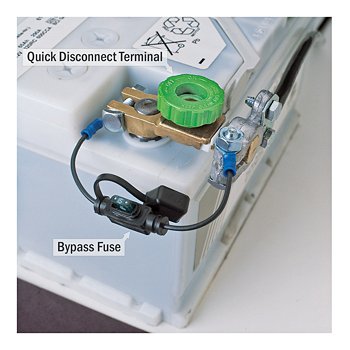
FlatSix911 If you are frightened, feel free to pay twice as much at a boutique
http://www.griotsgarage.com/product/quick+disconnect+terminal.do?sortby=ourPicks&refType=&from=Search
 �
�
Nov 3, 2015
Oba So, you "disconnect" it by leaving a 15amp fuse connected? Maybe that makes sense to somebody, but 15 amps will kill a 40 amp/hr battery in just a few hours. By the way, for all the cheap folks who think this is a smart way to "save" your 12v battery, just know that the BMS works 24/7 and needs the 12 volt battery to operate.
Get a simple battery trickle charger / tender.�
Nov 3, 2015
Oba ...�
Nov 4, 2015
Cottonwood That Battery Tender is only 1.25 Amps. With the thirst of the Vampire, you really want a smart charger that can put out more than 4 Amps to keep up.
Here is my choice: Amazon.com: BatteryMINDer 12 Volt 2/4/8 Amp Wet/Gel/AGM Battery Charger. It's multi-stage, temperature compensated, and will put out 8 Amps. The only problem with this choice is that you have to select "AGM" and 8 Amps every time you plug it in.�
Nov 4, 2015
Oba And if the grid power fluctuates while it's in long term storage, then it defaults to the 2 amp setting and non-AGM?
I think any "plug it and forget it" option needs gross simplicity for starters.
"The Battery Tender Plus is a 1.25 amp battery charger designed to fully charge a battery and maintain it at proper storage voltage without the damaging effects caused by trickle chargers. Included is a quick connect harness for hard to reach areas. This unit is perfect for charging motorcycle, ATV's or any powersport vehicle and will do an excellent job maintaining car and farm equipment batteries. Temperature compensated to ensure optimum charge voltage according to ambient temperature. Automatically switches from full charge to float charging mode. Battery Tender at 1.25 amps will charge as fast or faster than any 3 amp charger available. Reverse Polarity Protection to ensure user safety. Red & Green Lights Alternately Flash in this condition. Complete 4-step charging program (Initialization, Bulk Charge, Absorption Mode, Float Mode). 10 year Warranty!"
What do you suppose they mean with the bold text?�
Nov 4, 2015
dhanson865 I think it means battery tender likes snake oil.
Personally I have the CTEK 3300 US (a 3.3a unit) but If I didn't have that I'd go for the 4.3 amp version Amazon.com: CTEK (56-864) MUS 4.3 12 Volt Fully Automatic 8 Step Battery Charger: Automotive�
Nov 4, 2015
Cottonwood The BatteryMinder uses the 12V side for continuity. If the grid goes down and come back it keeps its settings. If for some reason, it did go back to the default, 2 Amps and non-AGM are safe for the AGM, it just won't keep up with the thirsty Tesla Vampire.
That unit seems to meet the most important requirements of more than 4 Amps and temperature compensated; plus, it seems to be plug and play. On the other hand, I have no experience with it. I do have a lot of good BatteryMinder experience.
Why the 4 Amp requirement?
- Depending on sleep mode and model, the Model S Vampire seems to drink about 1 kW-hr or 3 rated miles per day.
- 1 kW-hr/24 hours = 42 Watts
- 42 Watts/12 Volts = 3.5 Amps
- To add a little margin, and for round numbers, get a 12 Volt Battery Maintainer that can put out more than 4 Amps continuously.
Nov 4, 2015
FlatSix911 I agree on the 4 Amp requirement for the Model S and have used the CTEK 4300 with no problems.�
Nov 5, 2015
green1 That pictured disconnect is marketed as a security device for ICE vehicles, when "disconnected" there's still 15A of power available to keep all your accessories powered (mainly it's just to keep the radio presets and the clock working) but if someone tries to start the engine the fuse will blow and they won't be able to go anywhere, without knowing what happened they'll likely give up and not bother.
I still don't understand the desire to trickle charge the battery, for short term (eg. overnight or a weekend) it doesn't seem to make any sense as the onboard charger is perfectly capable of this task, and for long term, you use a whole bunch of electricity, to avoid using electricity from the charger, seems disconnecting makes more sense for that use case.
a 4A charger to avoid firing up the Tesla chargers? are you actually saving anything? you're certainly adding complexity!�
Nov 6, 2015
SteveS0353 It's not about saving energy; it's about saving the 12V battery. The 12V battery gets somewhere around 6 discharge / charge cycles per day, each about 30% depth, to supply the vampire load. The 12V battery has a specified cycle limit to wear out. Doing the calculations, it would seem that the mean time to wear out of the 12V battery is 18 months, with a large variance due to all sorts of factors. Lots of owners have reported 12V battery replacement in the 12-18 month time frame.
Assuming you leave the 12V battery connected, one way or the other, you will need to supply the vampire load, either from the HV Li-Ion battery recharging the 12V (and literally cycling it to death at some point) or by supplying the vampire drain directly from the trickle charger and avoiding any cycling of the 12V battery. Losses and efficiency aside, trickle charging the 12V battery from shore power will use the same energy as charging the 12V battery from the Li-Ion battery pack via the DC-DC converter.
Certainly, disconnecting the 12V battery will eliminate any discharge / charge cycling and reduce energy consumption (if that's your goal), but the vehicle will be unpowered and totally isolated (no 3G/LTE/WiFi, no phone app, no key fob radio). Eventually the 12V battery will self-discharge and need to be charged before the car can be brought back to life.
Personally, I would prefer to keep the car powered, secure and connected, but eliminate the 12V cycling to increase that battery's life expectancy.�
Nov 6, 2015
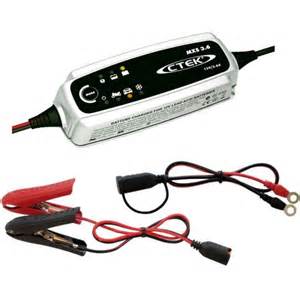
FlatSix911 I keep one car on a CTEK charger to maintain the battery using the lighter plug that is always on.
It works well and never lets the battery discharge and deep cycle to prevent premature failure.

Regarding the Tesla, the lighter plug is a switched power supply that will not work to charge the battery.
So we have to use the direct wiring of the charger directly to the front trunk 12V battery terminals.
 �
�
Nov 11, 2015
Tree95 See this post. There is a relay dedicated to the 12v port. Just remove it and plug a jumper wire in its place.
Near annual replacement of 12V battery is typical according to Tesla Service Tech - Page 15
This shows the relay location:
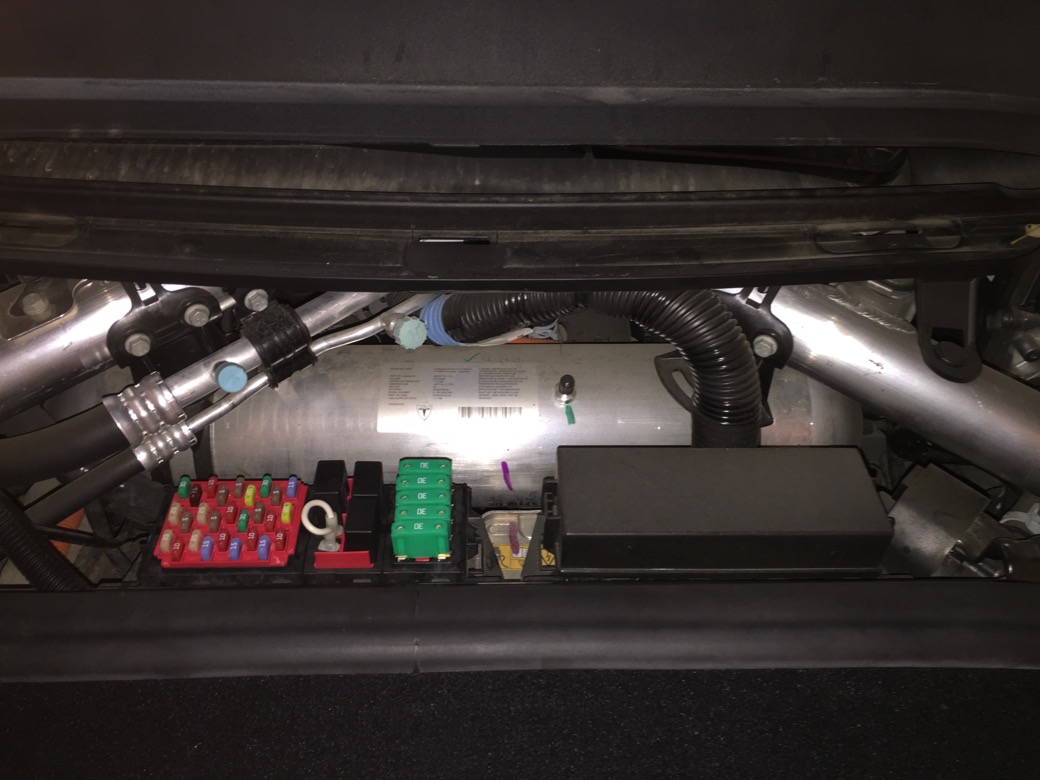
and a closeup showing where to plug in a short jumper with spade lugs:
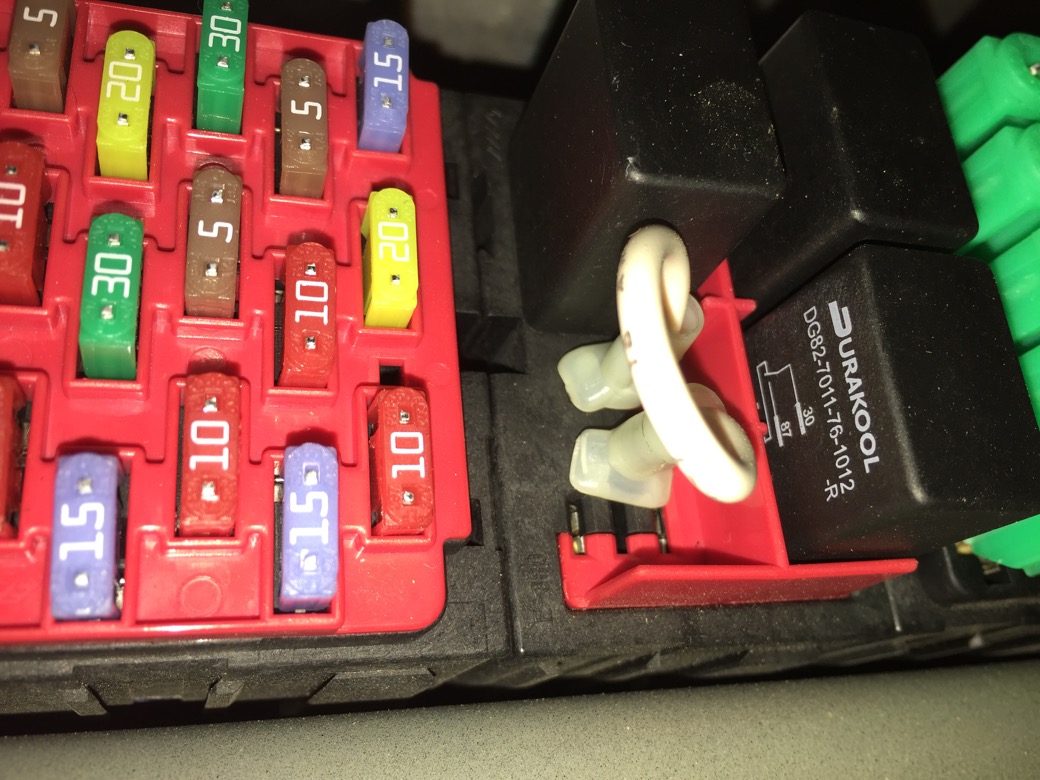 �
�
Nov 11, 2015
FlatSix911 Good post. I am going add the jumper to keep the 12V accessory plug always on.
Then I will use my CTEK charger to keep the 12V battery topped off in the garage.
Here is a photo of the 12V battery location on a P85D above the front electric motor.
Note that the article states it is not an easy task to replace the deep cycle battery...
http://insideevs.com/wp-content/uploads/2015/01/Want-to-know-what-it-really-looks-like-under-the-hood-Imgur.jpg
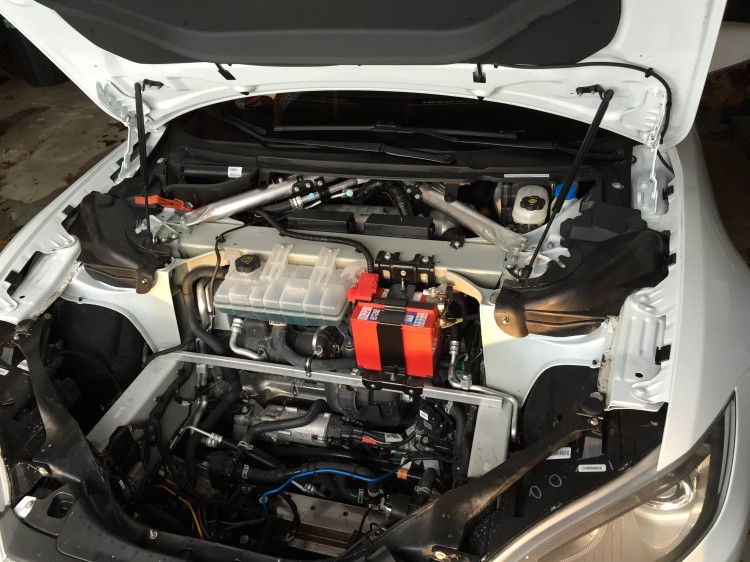 �
�
Nov 14, 2015
DaveG Just one question! Why are you calculate with 42 watts? As I remember this was measured 'from the wall', so it includes the
and also affected with the efficiency of these components (battery chemical efficiency etc)!I think the big part of the vampire load is used by the 'recharging process' itself not by the standby devices!siai47 measured about half-amp load on the 12v circuit when feed directly with 12v!
- HPWC relay's
- AC-DC converter's
- DC-DC converter's
- HVDC relay's consumption
�
Nov 14, 2015
Cottonwood The measurements that I have seen, and that I have done, have been done with the car unplugged; the rough number is 3 rated miles per day lost from the traction battery. From there to the 12V battery, the only thing left is the DC-DC converter and the traction battery relay. The DC-DC converter is probably 90% or better efficiency and even if the traction battery relay draws 40 Watts, its duty cycle is only a few percent. That leaves an overall efficiency of close to 90%; that means my calculations for 12V current could be reduced by 10%. I would still recommend a battery maintainer of with 4 Amps or more capability if you want to feed the vampire.�
Nov 14, 2015
DaveG I think it's not about the charger size rather than about the entire fleet's vampire drain, so how could TM re-design this part of the car. Are the coolant pumps starts when maintaining 12V from the main pack etc? I think the current 12V standby consumption can be only estimated by measuring current from external 12V feed and not calculated from rated miles. If just few watts (0.5A-->6W) as I think than the question is not how to reduce vampire but how to increase the efficiency of the 12V charging circuit. For example a second AC-DC charger is a good idea as brkaus wrote here.�
Nov 14, 2015
scottf200 What I did: replaced the weak 12V bat with a 85Ah deep cycle battery, put one of those in the trunk:
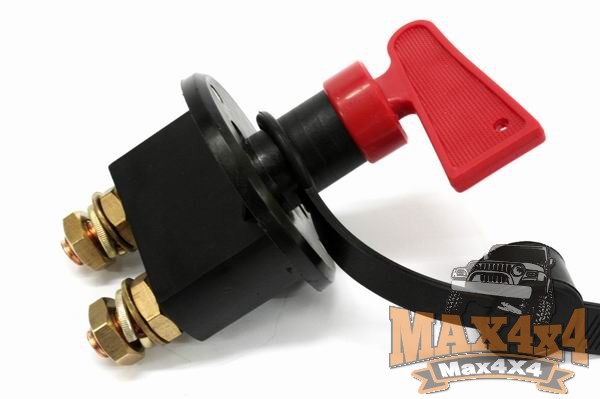
Works like a charm�
Nov 14, 2015
S85D Can you explain how you typically use it (how often, scenario).�
Nov 14, 2015
FlatSix911 It disconnects the 12V battery from the car, it was meant to be used for long term storage of the car, but ended up being used almost everyday since it prolongs the longevity of the battery, and lowers vampire drain to.. 0�
1/1/2015
guest Tree, I have 3 questions:
I just bought the CTEK 4.3A charger and adapter plug to plug into the console 12V plug. My S85D is 15.5 months old and the I have not had to replace the battery yet. I think I may wait until the battery is replaced before I start using the charger. Getting the battery replaced under warranty and then start using the charger sounds better than using it now that replacing the battery when it is out of warranty.
- Where did you get the parts to make the jumper, specifically the silicon boots that go around the spade terminals?
- Do you leave the window open or leave the door ajar to plug the male plug of the charger into the 12V socket on the console?
- Where do you put the charger while the car is charging? On the garage floor outside of the car, or sitting on the seat inside the car.
�
1/1/2015
guest I can't speak for Tree, however I can share my experience...hope this helps.
1. I used crimp on terminals that have the silicon boots attached.
2. I just leave the window open about a 1/4 inch for the charging cord.
3. My CTEK charger is plugged into my overhead garage door opener above the car.�
1/1/2015
guest Thanks Flat for the information...�
1/1/2015
guest Does "what" like a charm? And how is the 85Ah battery wired?
Did you even do this in Tesla, or trunk of some other car (there's nothing in your sig to know)?
Did you truly replace (omit) the factory 12v battery and stick a 85Ah battery to do its duty?
And do you disconnect this replacement battery each time you park?
(a bit of a pain and now nothing works on the car, and I'm assuming you have a manual hatch ??)
An idea of your wiring plan would go a long way toward explaining what is clear in your mind, but a mystery to me.
Just not getting the usage pattern and purpose of the switch in a Tesla.�
1/1/2015
guest To take this one step further...
If the lighter socket makes a viable charging point with this jumper in place... that means you have a charger in the interior of the car and the concern of having to get the plug out to an outlet (through a window was suggested.) Not good for winters here, or rain.
Why not just make the relay jumper with an extra leg pigtail off one side so the ctek charger can be located in the frunk and use the jumper as the charge point.
I was originally thinking of putting my ctek in the frunk and attaching right to the battery terminals.. but why bother? (my 12v battery is buried in that awkward spot that original RWD cars have).
I was also thinking of getting one of those coil-o-matic extension cord winders and mounting somewhere hidden up front. THen having a 120V plug hanging out / accessible from the exterior of the car somewhere low out the front... just grab it and pull out and plug in. I have a 120v outlet handily located in my garage at the front of the car.
So ... I'd do a double plug-in at night, HPWC at the rear, and this 12v tender at the front.
For dramatic effect at EV events or parking lots... I could just nose up to any 120v outlet and pull out the coiled plug from the front of the car and tell people I'm "charging up"... it wouldn't be lying.�
1/1/2015
guest I had other reasons for shunting the relay to keep the 12v socket live. And, once I'd done that, since I park inside in a garage, the simplest (for me) was to plug the charger into the 12v socket. The charger itself is outside the car in my case as there it came with a decently long cable on the 12v output side.
There are lots of valid alternatives like yours.
I do end up doing a 'double plug-in' at night.
I just came back from a 2-week vacation, and the 12v charger was plugged in the whole time, but not the HPWC (which is unusual for me to leave out, but before I left, I was doing things in the garage and didn't want to dance around the HPWC cable, so it wasn't plugged in. I forgot to plug it in before leaving, but it didn't matter. With the 12v charger connected, the rated range was 195mi when I left, and 195 when I came back - no vampire drain on the big battery to occasionally recharge the 12v battery as the car's internal always-on stuff was being powered by the 12v charger. And, no cycling (wear) on the 12v battery constantly being discharged and recharged. If I had remembered to plug the HPWC in, there would have been no difference; the car would have never drawn power from the HPWC (Your mileage may vary if parked outside in super cold temps with HPWC plugged in; the car may decide to warm itself)�
1/1/2015
guest Here is a photo of my 12V charging setup ... the CTEK charger is plugged into the garage door unit and serves both the Model S and P car.
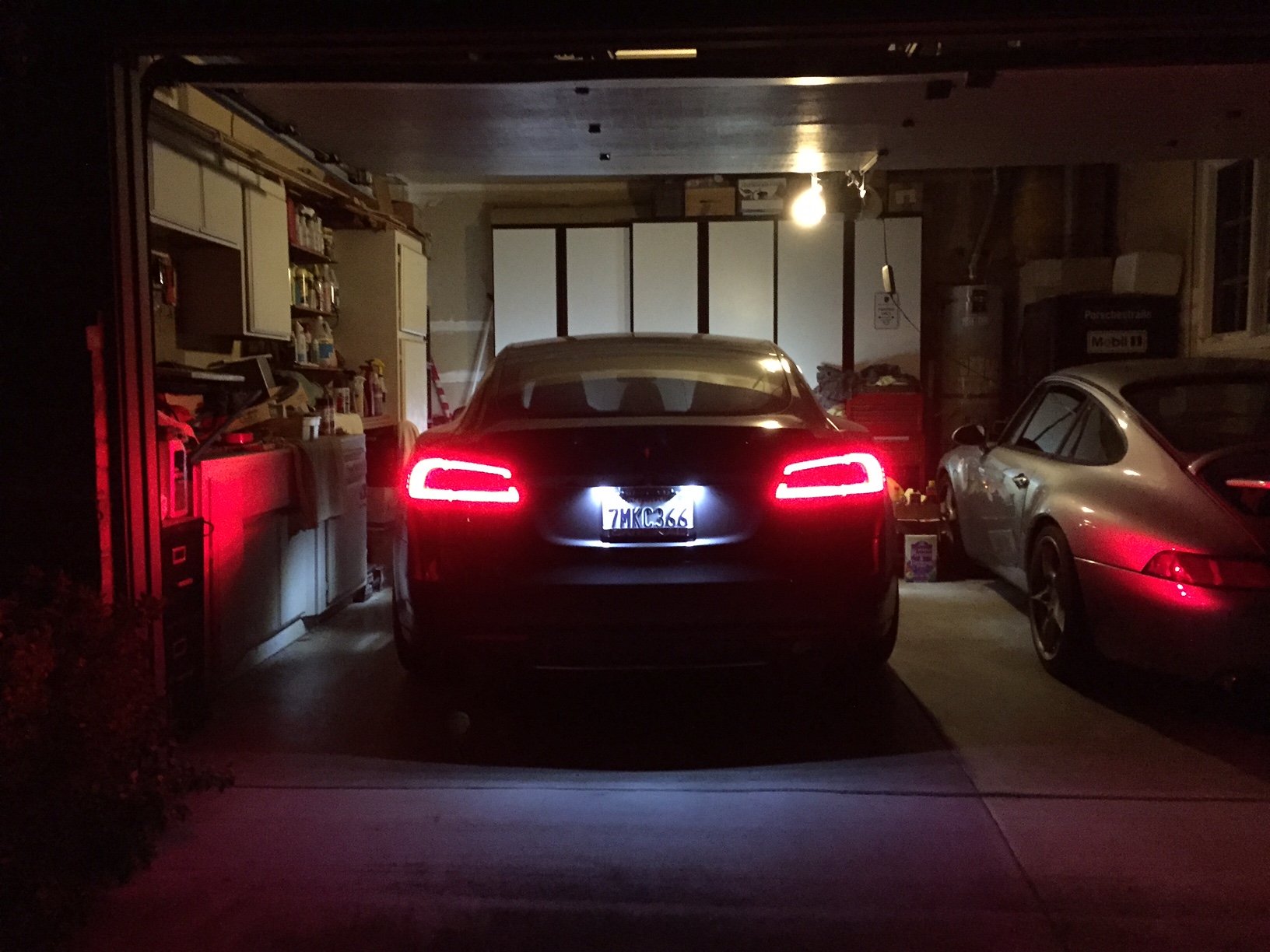 �
�
1/1/2015
guest Because you don't need to?.....�
1/1/2015
guest ZsoZso I agree with you. I'm no expert either, but if 12V lithium car batteries can be cycled 5-10X more times than lead acid, the extra cost may be a wash, or better; and worth it if it means changing it out less often. At least a good bridge until better solution to deal with vampire drain.
And because Tesla and Gigafactory....�
1/1/2015
guest Update: well i did justwhat I said and made a relay jumper with pigtail, and attached my ctek 4.3 to the pigtail as its charging point. Now Ive got an always on lighter socket too, which is good because i wanted dashcam to continue rolling while parked and unattended which it can now (i choose when i want this because I'm using the ligther plug to power the cam
I haven't done the wind-o-matic extension thingy yet, so the 120v side of the ctek is hanging out a popped open frunk.
It's drawing power from the wall about 20W, and getting warm, doing its LED sequence thing... so all seems good. I have a kill-o-watt meter on the outlet so I can see what it draws.
Question to the crowd, what step in the sequence does the LED spend most of its time on when trickle charging like this, for those who have a ctek?�

Không có nhận xét nào:
Đăng nhận xét