Mar 26, 2014
Super Gizmo We contacted Jerome Guillen VP, W W Sales & Service yesterday regarding the loss of range on our and many others' Model S and what the solution was. To our pleasant surprise we received a prompt reply from him today which should allay everyone's concerns regarding this issue which has generated several threads on this and the other forum. We decided to post his reply on the forum to help ease everyone's worries and bring back the "Tesla smile". So, here is his reply to our query -
Thank you for your message and bringing this concern to my attention.
Recently, some Model S owners have been concerned regarding displayed decreases in their vehicle's predicted range. We understand the importance of accurate range prediction, and have taken these concerns seriously. After investigating many of the cases, we have found no indications of actual battery problems in the vast majority of these cases. However, we have uncovered a software problem that, under certain charging conditions, yields incorrectly low range estimates over time.
The range estimate displayed in the vehicle is based on several different factors. One important factor is the battery's actual capacity at a given point in its life. This is the amount of energy the battery can hold when fully charged. Since battery capacity cannot be measured without fully charging and discharging the battery, this value is calculated in software. We have found that in cases where the battery is consistently charged to a lower state of charge- between 60-80% -capacity estimation becomes less accurate and tends to underestimate the true capacity of the battery. The result is an incorrect reduction in the displayed range estimate. This does not affect the true range of the vehicle, as the end-of-drive conditions are based on real-time battery measurements of reducing battery power rather than software estimates. In any case we recognize the inconvenience and negative user experience associated with this incorrect and reduced range estimate and we are developing a solution.
The inaccuracy of the capacity algorithm will show up in any Model S that is regularly charged under the conditions mentioned above (it seems it is the case for your Model S). We will develop and implement a firmware updates in the coming weeks (timing TBD) to address the concern you outlined. That being said, the amount of actual energy stored in the battery has not changed. The physical distance you can drive the vehicle from full to empty remains the same, only the displayed estimate has changed. You are correct that avoiding charging to high states of charge optimizes battery capacity retention. You should continue this behavior as best meets your daily range needs. We also recommend opportunistically charging, i.e, charge frequently, charge often. Avoiding deep discharges is another best practice for optimum capacity retention. The advice by the Service Center to "let the range drop down to about 20 miles and then charge it to max Daily Range" is misleading. They are correct that it will mitigate the inaccuracy of the capacity algorithm, resulting in a higher displayed range, but it is misleading as the actual amount of stored energy does not change.
I hope that this addresses your concern. Please let me know if I can be of any additional assistance.
Thanks for your continued support. Best regards,
Jerome Guillen I VP, WW sales and service
P.S. By the way we installed 5.9 last evening prior to a max Daily charge and noticed an increase of 12 miles immediately!�
Mar 26, 2014
Odenator So if Jerome is correct, and he understands what his engineers are telling him, is he saying that I could have driven more than 40 miles past 0 rated miles as displayed on the battery bar based upon the apparent loss of range as assumed to be from an unbalanced pack (264 miles - 231 miles + 15 hidden miles)?�
Mar 26, 2014
Doug_G I would not leap to that conclusion. Actual driving distance depends on power draw and battery state. If you drive fast and draw more than about 280 Wh/mi, you're not going to get the full rated range of the battery - no matter what it displays.�
Mar 26, 2014
brianstorms If I drive like a saint, observing the speed limit and carefully accelerating and so on, no matter what I do, I get over 300Wh/mi.
I don't think I've ever been able to get it below 300 for any length of time.
I mostly drive local, and it's hilly. I had the same problem with ICEs: I routinely got 10-12mpg on cars rated 18city 23highway.
All that said, I'm eager to see if the new changes Jerome mentions will improve my rated range. I always charge to about 120-150mi of range, so I keep the battery essentially at one-half full. Only on long supercharger drives do I either max out, or, more often, charge to around 200mi. I suspect this puts me in the use case Jerome describes.�
Mar 26, 2014
Kraken So all this seems to jive with what I've been saying in the other thread. It also seems to explain why the actual battery symbol in the past (pre 5.9)seemed to indicate that there was quite a bit left (maybe 40 miles of rated range) even though the numbers were near 0.�
Mar 27, 2014
rcc I'm sure it does. You also want to think about how deeply you discharge the battery. The battery will probably be happier if you charge to 80% and draw down to 40% than if you charge to 50% and draw down to 10%.�
Mar 27, 2014
jaenoh So, deep charging gives you more accurate (increased) measure of the range but the real range goes down because the deep charging is not the method for "optimum capacity retention"?
Kinda ironic...
I wonder how much of this inaccuracy is fixed by the 5.9.�
Mar 27, 2014
Martini No because of this: as the end-of-drive conditions are based on real-time battery measurements of reducing battery power rather than software estimates.
The displayed range estimate at low levels probably relies more on this than on the software estimate. The inaccuracy will be only at high states of charge.�
Mar 27, 2014
VolkerP Exactly. You can measure if a battery is nearing empty because the voltage approaches the lower discharge limit. You can measure the voltage approaching the upper limit when charging the car. But you cannot measure the amount of energy contained in a battery. It requires software guesswork depending on charge current measurement and a lot of other factors. That is the area affected by the FW fix announced by Jerome.�
Mar 27, 2014
ThosEM I submit that Tesla should calibrate and monitor the battery capacity in absolute energy units.
This business of introducing a rated range between owners and the real capacity of the battery just introduces confusion and uncertainty regarding the time evolution of battery capacity. I suppose it does provide Tesla with some wiggle room, but I'm not sure I want them to have that. I'd prefer that we mutually agree on what the best interpretation of battery state is at any given time, without questions about software that implements a range calculation.
FWIW...�
Mar 27, 2014
scaesare Wow... your terrain/conditions must be really working against you. During warm weather I've taken several road-trips here in the mid-Atlantic region and managed overall averages in the 270-280's while driving 70+ on highways...�
Mar 27, 2014
FlasherZ I have the same problem. I live in a rural area, about 2 miles from the state highway, and it's hilly with turns. The first 2 miles and the last two miles always come out @ 400-500 Wh/mi, unless you're driving < 40 mph and trying to baby it. The small villages spaced out on the 55 mph two-lane create the need to accelerate for about 3-4 miles then slow back down to 30-35 mph for a mile or so.
I can generally make a long trip turn into ~280-300 Wh/mi, but the short 15-30 mile trips always come in at ~350ish.
EDIT: I'm happy to see there is knowledge of what is happening. This affected the people who charged to 90% too, although it was very minor (recovering maybe 1-2 mile when a trip allows for recalibrating). Anything we can do to get the estimates better!�
Mar 27, 2014
yobigd20 gee, this is the exact same thing I've said time and time again on those many threads. I guess because I'm not a "Tesla executive", nobody believes what I was saying as true. Now you have your official answer which is the exact reiteration of everything I've said. Thank you.�
Mar 27, 2014
Kraken The typical way to doing this is a percentage of battery (think about how your cell phone shows that). We've seen images suggesting that they might do that in the future, but they were trying to give us something more practical.�
Mar 27, 2014
bonnie I don't think it's personal. I think people were looking for an answer from someone within Tesla who could speak from fact, rather than speculation (no matter how reasonable the speculation seemed).�
Mar 27, 2014
scaesare I'll point out that even if using "absolute energy units" (I assume you mean Wh...), determining S0C anywher other than "empty" or "Full" is still an exercise in estimation. Displaying "52.7 Wh remaining" is not necessarily accurate.
Your point about not introducing yet another estimate on top of that one (mileage) is well taken, however. I'd support user-selectable options for displaying pack capacity estimates in Wh or percentage...�
Mar 27, 2014
dennis But now you have confirmation that you are smarter than everyone else (at least on this topic). :biggrin:�
Mar 27, 2014
yobigd20 sorry, I'm a bit grumpy today. Just getting over this stomach bug that's been going around that really knocked me down for a few days.�
Mar 27, 2014
FlasherZ The problem with using a percentage is this: a percentage of what? Original design capacity? Or last known full capacity of that battery?
The former provides a way to estimate "miles per % of battery at a given Wh/mile", but means that on a range charge, it may only show 82% when "full" with degradation.
The latter provides a true indication as to the relative percentage of charge left, but the number of miles you'll get out of a % of the battery will begin to vary. This is what we get with cellphones, when people start saying that their phone seems to be sucking more and more juice over its life. 20% comes much more quickly.
Knowing absolute energy units isn't useful to me because I have to do units conversation to tell how far I can drive. This is why rated miles, as flawed as they can be, is more useful. Knowing the battery has 57 kWh of power left doesn't really tell me how far I can go. I can learn over time, of course, but it's easier for me to know that 150 rated miles is roughly 140 miles for me in summer or 120 in winter, because I'm using the same units, rather than learning that 50 kWh roughly means 130 miles.
Think about how you use the fuel gauge in an ICE. I used a combination of the fuel gauge to give me a rough indication of where I was fuel-wise with the "miles to empty" calculation to advise me when to stop.
YMMV, of course. Scientists and battery engineers and die-hard technophiles have the ability to think about this constantly. I, unfortunately, have to constantly worry about having duct tape on hand so the little knowledge I have won't fall out of my head.�
Mar 27, 2014
roblab But I said it months before! So *I'M* smarter. Oh, well, you people will learn, someday:smile:�
Mar 27, 2014
teslasguy What a great response from Jerome. Now this is the Tesla many of us love and find so refreshingly unlike the traditional dealership models! I have openly accused Jerome on these forums of responding with "blow off", traditional car company jargon without seeming to give any real credence to the issues I've submitted. But I believe in also being just as open with praise when deserved. Jerome obviously listened, took the issue seriously and had a credible investigation done. And then finally delivered a great response. Now I'm ready to go "sell" another 10 Teslas!!�
Mar 27, 2014
Alfred This would be less practical. You want to know how far you can go. The Roadster shows two ranges: One based on how you drove (and heated), taking an average over your last 60 km or so and another based on a standard, very economical way of driving. Experience teaches you what you can expect between those two, based on your knowledge of the driving conditions ahead of you. A step ahead could be integration with your navigation system, including a link to meteorological data. Head winds e.g. can make a much larger difference to any estimate than small, mostly single digit variations of battery capacity estimates.�
Mar 27, 2014
qwk It's going to be very interesting comparing all of the year+ old cars rated range on this new more accurate firmware, to brand new cars. Maybe this new update will finally tell us how well the battery is faring? Up to this point all of the algorithm changes have done nothing but create panic and speculation.�
Mar 27, 2014
dennis +1.�
Mar 27, 2014
Cal1 Originally Posted by ThosEM

I submit that Tesla should calibrate and monitor the battery capacity in absolute energy units.
This business of introducing a rated range between owners and the real capacity of the battery just introduces confusion and uncertainty regarding the time evolution of battery capacity. I suppose it does provide Tesla with some wiggle room, but I'm not sure I want them to have that. I'd prefer that we mutually agree on what the best interpretation of battery state is at any given time, without questions about software that implements a range calculation.
FWIW...I disagree and feel this is a self inflicted wound. Conventional displays have us conditioned to look for absolute energy levels. EVERYONE knows what a 1/4 tank means, and no one expects anybody to tell them how far they will go. Gee, they actually figure out (on their own) that a 1/4 tank means drastically different things on a truck, sports car etc. Just give me a display with an absolute amount of current left, somewhere! I'll figure out how to use it. Kind of like understanding that if I have a 1/4 tank of gas left, I might want to refuel sometime soon. This codependent attitude of assuming they have to give us accurate estimations of how far we are going on a tank is insane. Of course 5 gallons will go a lot further if I'm driving on a flat road with no head wind. I can't realistically expect an onboard computer to calculate anything but a SWAG.
But if I knew from day 1 that my battery started out storing X number of KW on a 90% charge and now after 14kmiles it only stores Y on the same charge... well I think I've got something to really work with. If I left the house with X number of KW and my display only shows Y ... I think most folks will quickly figure out when they need to refuel and start thinking about how far they can go on a full, half or quarter charge. I don't propose the abandon the current range display, just add something else and let us figure out how to use it.
UNLESS (dark conspiracy side rising) Tesla knows absolute watt storage varies or is falling and they don't want to open that can of worms. Of course this is a whole different Oprah show.�
Mar 27, 2014
qwk It's next to impossible to get absolute numbers from a battery. Gasoline and Diesel are both liquids, so there is no guessing. Having said that, having a percentage readout in addition to the battery bar and rated range would be a big help. Tesla software engineers of all people should know this, as their coast to coast trip cars have this ability. If it didn't help in range estimation, they would just run stock firmware.�
Mar 27, 2014
Obsoletion I agree and also note that on my ICE vehicles they have a miles to empty that works fairly well as it estimates this remaining range based on the current/short term average it is getting. But, it also has a fuel gauge. I would like a % of battery life gauge/read out and the estimate range remaining.�
Mar 27, 2014
Incredulocious I was just about to say the same: it's very difficult to determine the charge state of a battery; it's not like measuring the contents of a liquid fuel tank. And this same discussion about wanting a percentage display (even if not super-accurate) has persisted in the Nissan LEAF community.
I find it fascinating how strongly people want a percentage display despite how all these vehicles do have a visual representation of remaining charge (similar to an ICE vehicle's fuel gauge) that allows you to roughly judge the remaining "fuel": 1/2, 1/3, 1/4, etc. I presume the manufacturers chose to do this over giving a more precise percentage number because of how difficult it is to estimate the remaining charge accurately. Nissan did relent though and added a percentage charge display to the 2013 LEAF.
It's interesting that even with 250-ish miles of range in the Model S, this concern over the range estimate and the wish for a more precise display persists, despite the similar lack of concern for such displays in our ICE vehicles.
Maybe folks will relax when we get to 500+ miles range....?!? But seriously, we'd be worrying about the last 10% much less often and be much less concerned about degradation with so much to spare.�
Mar 27, 2014
cinergi IMO this range estimate thing *IS* necessary on EVs until sufficient infrastructure (read: superchargers) exist such that I don't have to plan. That's why "1/4 tank of gas" works -- because as I get lower, I can just stop anywhere and fill up. Not so with an EV. Yet.�
Mar 27, 2014
Doug_G Have you ever checked the "miles to empty" thing? Whenever I got a new ICE car I make a point of running the car down to empty, then fill the tank all the way to see how much gas it takes. I always found that those "distance remaining" displays are ridiculously conservative.�
Mar 27, 2014
Super Gizmo Thank you, Bonnie for pointing this out. That is why I posted the response on both forums to put people's mind to rest because many have been worried about this issue - understandably.�
Mar 27, 2014
Odenator I am still confused by this statement: "The physical distance you can drive the vehicle from full to empty remains the same, only the displayed estimate has changed."
As I have posted on other threads, my battery on Nov '13 showed my rated range to be 231 miles on a 100% charge. After doing all that voodoo the SC told me to do to get back my miles, I am now back to 264 rated miles on a 100% charge.
Here is my question to all the smart people on the forum: Could I have driven 264 actual miles back on Nov '13 when my battery only displayed 231 rated miles if I drove conservatively so that my actual miles equaled my rated miles (about 300Wh/mile I think)? Please ignore the hidden reserve.�
Mar 27, 2014
Super Gizmo + 1�
Mar 27, 2014
qwk I don't think that anyone can answer this. I would think no, but if what Jerome said is true(it was just a software estimation error), then it sure sounds like it. I wouldn't want to be the one taking a road trip which depends on that range.�
Mar 27, 2014
dave +1
This has annoyed me since i bought the car back in 2012. Based on the early info I believed that I would actually be able to get 300 miles under ideal conditions at 55MPH and 265 miles at 65MPH, however I have never been able to get those numbers, even under perfect conditions. Even driving 55, there is no way I'd get 300 miles out of the car.
Love my Tesla, but I'm still upset about this.�
Mar 27, 2014
liuping I have no problem staying under 300Wh/mile if I drive conservatively. I usually don't, but that is not the cars fault
Do you run with heat/or A/C?�
Mar 27, 2014
Mario Kadastik I don't think you can ignore the hidden reserve. Very likely the algorith change is indeed in the hidden reserve so that the car kept putting more and more conservative estimates hence if you drove past your 231 miles you could probably have gone another 33 miles with charge now message. i have in fact on two occasions driven my Model S below the charge now mention. The first time I did ca 12 km of it and by the battery gauge and used kWh I estimated another 15-20km was there... And that was after one month of ownership �
�
Mar 27, 2014
Trnsl8r Without implying that I'm one of the smart ones on the forum... but yes, that's exactly what Jerome said. The range estimate displayed on the screen is just that, an estimate. The distance you are/were able to drive remains the same (assuming status quo and no degradation in between).�
Mar 27, 2014
dave I drive however I like when range isn't an issue - fast, HVAC, etc. However on road trips I turn HVAC off completely and I can still never get a 1:1 ratio of miles on the dash to actual miles driven. I had hoped to plan for 265 mile legs, slowing down if conditions required. I have a regular trip to Indianapolis and back of 240 miles I was hoping to do in the Tesla, but I have never been able to come close to this and am unable to make this trip.
I can't fathom everyone who report numbers under 300. In winter I'm at 450, and in summer I'm averaging 375.
Anyways, enough negativity. I also applaud Jerome's response and am grateful for the accurate information! I still love my Tesla!�
Mar 27, 2014
Trnsl8r The problem is not the unit, but estimating how much energy is actually in the battery. Jerome states that the only way accurately measure that is to fully discharge and then charge the battery (which you don't want to do), so instead software estimates it. Now whether you display that estimate in rated/ideal miles or as a percentage is not going to affect the accuracy.
- - - Updated - - -
One time, when hypermiling to make it to a supercharger, I averaged 285 for about 90 miles by keeping the cruise control at 53mph. (Not fun to be passed by truckers on a two-lane highway, but what could you do...)�
Mar 27, 2014
djp I doubt they've changed the "buffer" below zero. I think it's more likely that the inaccurate estimates meant the rated miles would roll off at an inconsistent rate as the SOC dropped.
We know the mid-level estimate was a WAG. The estimate gets more accurate at lower SOC since the voltage cut-off is a fixed point. At mid-level the algorithm probably ticked down the rated miles at a constant rate, but then would realize it was getting ahead of itself as the estimate became more accurate, and respond by slowing down the rate that rated miles rolled off the display.
I think the zero point is still where it always was, but the rated Wh/m should be more consistent now.�
Mar 27, 2014
Lou in SoCal If you click on the battery icon, it gives markers for every 10th percentile of charge. It's easy enough to determine the percentage that way.�
Mar 27, 2014
Cal1 Not sure I understand why measurement is so hard. We measure everything else. In line ammeters are common and pretty straight forward in current measurement. Voltmeters can easily measure voltage levels. I don't see why a basic software app couldn't give us something. Not trying to be augmentative, just don't see the problem. And it would satisfy a portion of owners wanting something other than changing range guesses. Given Tesla's repeated assurance that nothing is really changing, they must have something they are basing this on. Exactly what are they basing these claims on?�
Mar 27, 2014
Kraken it's clear that they did some changing of the buffer below zero. Look at my pictures in the other thread. 5 miles left clearly has far less battery left than 7 miles did previously according to the pictures�
Mar 27, 2014
djp It could just be the graphic that's changed, but no difference to the actual SOC at zero miles.�
Mar 27, 2014
djp Advanced ICs Simplify Accurate State-of-Charge Measurement for Lithium-Ion Batteries�
Mar 27, 2014
aronth5 Agree.�
Mar 27, 2014
Doug_G Odd. In summer I can get rated consumption at 90-95 kph (56-59 mph) in reasonably good conditions.�
Mar 27, 2014
Cal1
Thank you so much for this link!�
Mar 27, 2014
aviators99 I don't buy this answer (for my car, anyway). I've been comparing rated miles on different vehicles running the same firmware, and have noticed material differences between "A" and "B" packs. So yobigd20, you can feel satisfied that I have always given you just as much credence as a Tesla Exec.�
Mar 27, 2014
MikeC I think if the miles "are really there" then it could be that the amount of energy to go 1 rated mile varies by car but is consistent throughout the SoC for a given car (due to the algorithm). This might explain why people have a different value for Wh/mi when projected and rated miles match (per cinergi's thread).�
Mar 27, 2014
stevezzzz All this discussion brings up a real puzzler: why is it easy for some people to get Wh/mi consumption below 300, and for others it is impossible? I just drove about 80 mostly highway miles this evening at 296 Wh/mi; and I wasn't even trying, with speeds of 65-80 over much of the distance. My lifetime average through two winters and a summer is 313 Wh/mi.
Here's what I think I know about what makes these numbers possible:
- 19" wheels, S85
- 5000'+ elevation (lower air density means less aero drag)
- reasonably level terrain except when I drive up into the mountains.
- moderate climate; low average wind speed.
BTW, my Rated miles remaining equals Projected Average miles remaining when the average consumption reads 302-303 Wh/mi. Some others have reported that they have to get consumption down into the 280's before this is true for them.�
Mar 27, 2014
Kraken Proper tire inflation, air suspension or not, battery pack type, firmware, bad alignment, etc.
for all we know the main culprit here is that some peoples tires aren't properly inflated. Their car is using more energy per mile and the algorithm is thus getting confused.�
Mar 28, 2014
Chipper When I had owned my S for only 3 weeks I drove it from my house to Vanderbilt Medical Center in Nashville (148.2 miles) and back home on a single charge. I arrived home with 4 miles rated range showing. I drove 65 MPH going over to Nashville and a little less on the way back.�
Mar 28, 2014
djp Yes, if the algorithm underestimated range then you could match rated range at a higher Wh/m (ie. miles would come off more slowly), which could explain the differences that people were seeing on cingeri's thread. I wouldn't assume it's linear though, I'd expect a curve as the estimate gets better at lower SOC.
The "Wh/m to match rated" should be the same for all cars (given consistent tire inflation, temperature, altitude, alignment, etc). It'll be interesting to see if the new algorithm brings everyone's rated Wh/m numbers closer together.�
Mar 28, 2014
RDoc Do you generally have the wind behind you?�
Mar 28, 2014
scaesare I suspect some of what you mention are indeed factors. I recently had a P85 loaner... while I initially had some fun "evaluating it's increased performance envelope", my following couple of commute cycles didn't allow me to drive any different than I did normally. For the same temps on identical routes ant identical speeds, the power consumption was probably 10-20% higher.
I noticed because I was getting high 300's for a consumption rate in my Standard... the perf was in the low 400's.
21" Tires?�
Mar 28, 2014
WarpedOne This "range estimation drama" steems from simply "too precise" prediction. Estimation simply cannot give the correct answer.
What ICE car predicts the range in one mile increments? Any when you drive it, you actual range differs every single time.
What added value is there in such precise number? Tesla shoudl simply display SOC in % and maybe give an estimation of range in 5% of max range steps.
Anything above 95% should read 270 miles and then decrease in ~5% steps but alwous rounded to nearest 10mile multiple (ie. 260, 250, 240, 230, ...).
People would not obsess about 1 mile drop in max range nor would they count on those 5 mile range left being enough for their 3 mile trip to next charger.�
Mar 28, 2014
dave Since all the firmware updates, algorithm / balancing debates, I've been less concerned about what the rated range number is, and more concerned about exactly this - how many miles I'm actually getting on a charge and the average Wh/mi.
I would also like to know why I can't get the rated range as easily as other people here. I'm going to ask Tesla to take a look at it next time I'm in, because something is just not right. I do have the P85, and I do have a spoiler installed. I wonder if either or both of those things come into play? We do have rolling hills here, but they are quite mild. Perhaps I'm underestimating how bad they're affecting my range?
My tires are inflated properly, and I'm currently on the stock 19's as well.�
Mar 28, 2014
rlang59 My wife's CRV.�
Mar 28, 2014
martinwinlow Blimey! Enough flannel already! Can someone who has an S with apparent range reduction *please* just go out and see if they can do 20, 30, 40 miles or whatever past zero and prove Mr Guillen's theory is correct� or not? Thank you!�
Mar 28, 2014
brianman +1 for still missing the projected range option for the instrument cluster
- - - Updated - - -
My other car lists range to empty in miles (or km) as well.�
Mar 28, 2014
WarpedOne I left out "correctly".�
Mar 28, 2014
Baiao Latest firmware update shows my Model S at 135 rated range from 126 !!�
Mar 28, 2014
ElSupreme Here is a quick read. To determine a SOC of a battery you typically use two methods. Voltage reading (which is subject to changed based on discharge rate, and temperature among others). And coulomb counting which adds up all the current leaving the batteries. Both have issues. Voltage is variable based on conditions. Coulomb counting has long term drift if '0%' and '100%' are not hit every now and then to recalibrate.
http://en.wikipedia.org/wiki/State_Of_Charge#Voltage_method
State of charge - Wikipedia, the free encyclopedia
The 'Kalman Method' is using both of the above and monitoring other outside environmental affects and compensating for them. Tesla has likely just changed their formula to be more accurate after having much more data. But these calculations can only be as good as their instrumentation. And there will always be some error.
What you are suggesting is exactly what they are doing. But determining the actual state of the cells, much less the collective of the cells, are a bit finicky and thus hard to nail down to such precision.�
Mar 28, 2014
ThosEM The best way to determine out how much farther you can go at any moment is the touchscreen Energy app, with its projected range based on adjustably averaged recent consumption.
The rated range is evidently a number proportional to estimated battery state of charge in energy units (with a secret offset at the low end to create a "reserve"). The constant of proportionality is the rated consumption, which I make at 302 Wh/mi, or 188 Wh/km, after subtracting from 85 kWh an untouchable reserve of about 5 kWh set aside to preclude "bricking". So you can estimate the energy in kWh as remaining rated range divided by ~3.3 in miles or ~5.1 in km.
And now with software 5.9, we have a "blue" rated range component that can't be used until the battery is warmed sufficiently. That will be interesting to track at low SOC next winter when cold weather returns...�
Mar 28, 2014
Kraken No.. The best way you can find out how far you can go is to fully range charge and then hop in i-80 in Kansas and just drive 55 until your car stops.�
Mar 28, 2014
mknox Same here. Even at 32 degrees, on my 80 mile round trip commute I come in at under 300. It's mostly freeway and I'm driving normally, HVAC not on Range etc. In the summer, I can see "Since Last Charge" numbers for this trip as low as 260. I actually was wondering if my reduction in rated range was being made up on the other end with these unusually good efficiency numbers in the algorithm somehow.�
Mar 28, 2014
jerry33 Alignment
Tire type
Tire pressures
Road surface
Weather and Temperature
Traffic
Driving style
Terrain
Practice (a lot of practice)�
Mar 28, 2014
Kraken Possibly even smaller factors: radio volume, which apps you leave open (I could see displaying the camera using more), which radio source you are using, brightness/night mode, seat heaters, kids seats (weight), stop and go traffic vs highway, speed, total passenger weight, regen. Some aren't much, but it all adds up.
In my p85+ i can get 300 easily by doing 55-60 on a highway, but as soon as I'm at 65-75 I'm 330-370.
side note: is this the week tesla decided to solve almost all of our biggest issues on the forum? Decreasing rated range, no auto lowering, fire issues... Were knocking them out now... Some of our longest threads might be obsolete soon.�
Mar 28, 2014
Super Gizmo Isn't that wonderful!!!!�
Mar 28, 2014
tomas A battery charging limitation still out there. That's the biggest one because costs $$ to solve.�
Mar 29, 2014
digitaltim As an EE, I have always assumed some method of coulomb counting was going on since voltage methods are difficult with Li-ion. This article is worth a read:
Hearst Article
I have some IEEE related links I can post but they get pretty technical.�
Mar 29, 2014
stevezzzz The mythical I-80 in Kansas, or the actual I-70? :biggrin:
By the way, I've driven I-70 through Kansas in my S and it's got way too much elevation change to be a good test: you descend almost 3000' from Goodland to KC.�
Mar 29, 2014
Chris Naps Finally an official statement!�
Mar 29, 2014
tomas There's that Kansas stereotype at work! Isn't the flattest state Florida?�
Mar 29, 2014
Kraken Yeah... but there's too much traffic there.
Yeah, I-80 is probably Nebraska, I didn't bother looking at a map and just took a stab at it.�
Mar 31, 2014
AmpedRealtor I'm in the Phoenix area where the terrain is largely flat. I drive a combination of freeway (70 MPH average) and city streets (5 MPH over limit average). My lifetime consumption is 290 Wh/mi. Most of my trips are in the 280-290 Wh/mi range.
P85
19" wheels w/ Primacy tires (3% range boost)
500'-1,000' elevation
I don't even have to try to hit those numbers. If I drive with a focus on efficiency, I can get the numbers below 270 Wh/mi.
I recently drove a S85 loaner w/ 21" wheels and I could not get that car under 305-310 Wh/mi. I think the type of tires, wheel size, tire inflation and the quality of your alignment make all the difference in the world.�
Mar 31, 2014
ecarfan I'm on 5.9. Have an S85 with out 6K miles on it. Compared to 5.8 I have seen a slight improvement in rated range. When I first got 5.9 I noticed that after charging to 90% I got 233-234 instead of the usual 230. Then two days ago I did a range charge and got the same 265 mile range I've always had, but what was interesting was that the next day I got 237 miles of range after a 90% charge. That is the highest I have ever had at 90%.�
Mar 31, 2014
drees All of these items are not likely to affect power draw by more than 25-100W at most, which is negligible compared to the amount of energy required to move a car down the road.
If any of those things requires more than 100W, it is poorly designed and should be fixed.�
Mar 31, 2014
Doug_G Most of the stuff you mention is really pretty meaningless in terms of power draw. Let's say playing the radio loud takes 40W. Driving at modest highway speed takes 25 kW. You're talking about something almost a thousandth of the drive train power as if it matters. It doesn't, unless you're worried about falling feet short of your destination. Slowing down 1 mph will have massively more impact.
The two things that really matter are speed and cabin heater use.�
Mar 31, 2014
Kraken I said they were all minor, but they all add up. Most car audio amplifiers range between 120-1200W... So it isn't completely negligible. Even 500w would be 2%.�
Apr 1, 2014
ElSupreme
Amps are sized based on instantaneous draw. Even a 1200W amp isn't going to put out 500W continuous. I bet a blasting stereo at 11 doesn't pull more than 200W average over the length of a song.
Besides running the stereo that loud basically necessitates rolling down the windows, which will probably cause way more than 200W of drag.�
Apr 3, 2014
Doug Gallarda A month ago I took the family on a road trip in my 60. I hit zero much earlier than I expected. I turned on range mode, turned off the HVAC, and started driving slow. To my surprise, I was able to go almost 40 miles with "Charge Now" on the dash before reaching my destination.�
Apr 3, 2014
Doug_G Uh, no. That's peak output. Average output would be pretty darn small. We're talking a fraction of a percent for any reasonable sound output level.�
Apr 4, 2014
Kraken I understand that, I worked in audio... I wasn't just talking about the sound. I was saying there was enough other factors that can add up. Clearly it isn't huge, but probably noticeable.�
Apr 4, 2014
bluetinc Please post the other links if you can, I'm always up for some good reading!
Peter
�
Apr 9, 2014
Kipernicus Wow that's living on the edge. I think with version 5.9 you won't be able to do that.�
Apr 9, 2014
Jason S After driving a bit on Oregon highways, I'm thinking the road condition matters too. Those Oregon roads were ROUGH; tons of pitting and road noise.
Edit: ... which, of course, jerry33 mentioned in his list:
Alignment
Tire type
Tire pressures
Road surface
Weather and Temperature
Traffic
Driving style
Terrain
Practice (a lot of practice)�
Apr 10, 2014
VolkerP An empty Tesla S-60 goes further than a fully charged Chevy Volt :tongue:�
Apr 10, 2014
bluetinc On the 5.9, at the point at which the range is 0, the battery is truly in exactly the same state as it was in 5.8 (and before). That hasn't changed since I've had my car (4.0).
Peter
�
Apr 10, 2014
Cottonwood Has anyone actually taken a 5.9 car "below 0" to verify that this is just a change in how the battery indicator is displayed for 0 rated miles and "charge now"?�
Apr 10, 2014
qwk This is false. Tesla shifted the rated range, but the battery bar vs. voltage has remained the same. Zero miles is definately not the same battery voltage from FW 4.2 to 5.0+.�
Apr 10, 2014
bluetinc Do you have any proof of this? I have actual data I have taken since 4.0 on my car that shows it has not moved at all, other than a small (<1.5 miles) adjustment that may or may not have been there when it is very cold out that I had to retest with warmer weather.
- - - Updated - - -
My reference point is that actual battery pack voltage at 0 not the displays on the battery indicator. I have not taken my car much into the "Charge now" area, so I can't say that they haven't changed the actual reserve they allow one to use.
�
Apr 10, 2014
qwk Look at the pics below. The first one is FW 3.X, the second is somewhere in the 5.X. The battery bar has always stayed the same vs. voltage. Tesla has never(even the roadster) let the cells charge over ~95%, and there is also a small buffer in the lower rage to prevent bricking. The only thing that has shifted is the rated range.
In addition to the above, Jerome also stated that there is an upcoming FW change to address the issue of "range drift", for those who only use a small percentage of their pack, which throws the estimation of rated range left. Most people don't have the degradation issue that you speak of. It's just one of the many factors that skew the numbers shown.
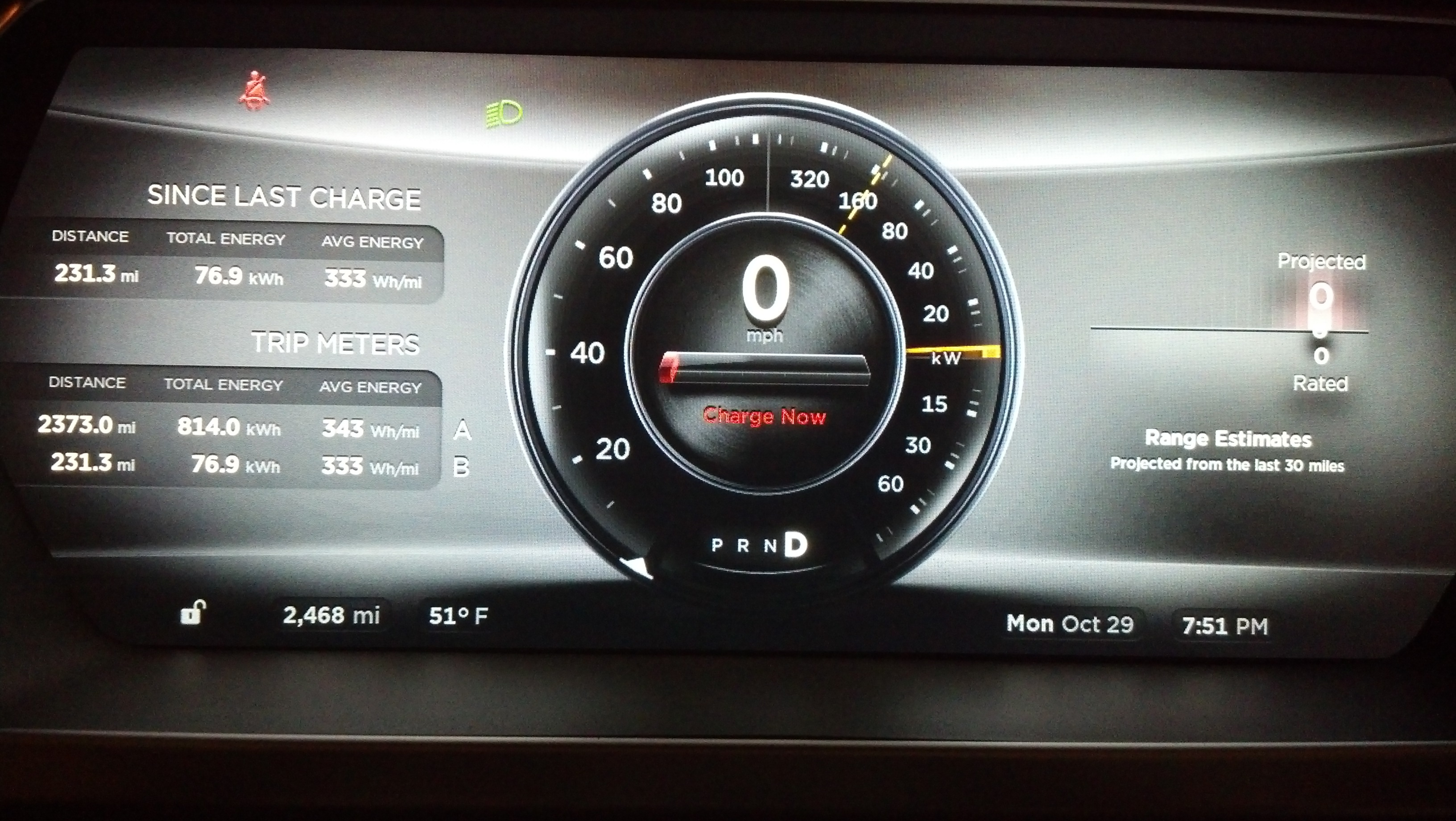
- - - Updated - - -
I hope YoBigD doesn't mind me reposting his pic.
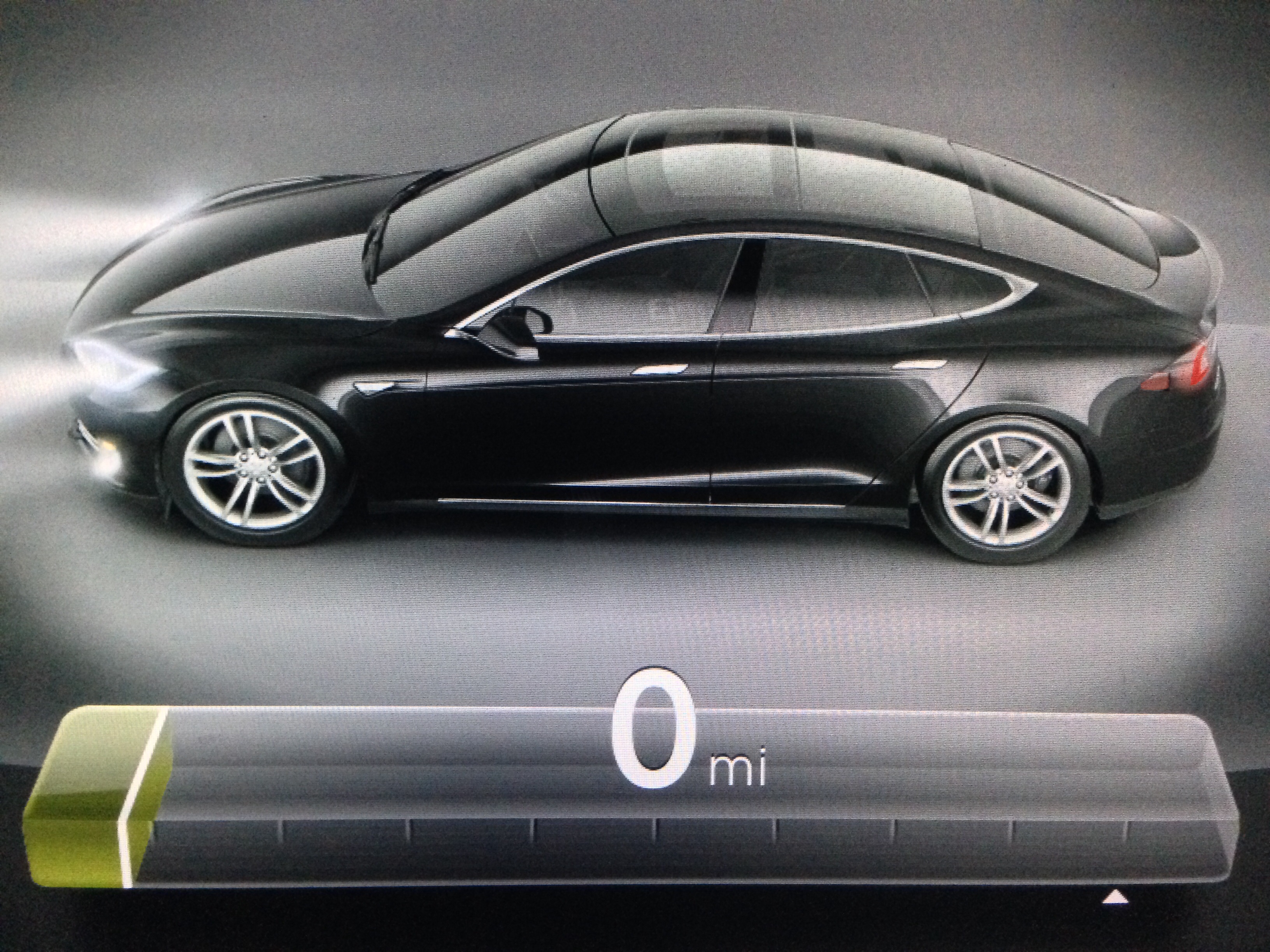 �
�
Apr 10, 2014
bluetinc I'm afraid that you are false drawing conclusions from something that isn't real. The time at which the display shows a red battery changes due to temperature (and posibbly other things) and doesn't really represent anything in itself. I have had my battery bar show both yellow and red, and at both times the SOC from VT was shown as the same and MUCH more importantly the battery pack voltage was the same, 316 V. You really can't compare a visual display representative of the battery with actual Voltage. As all my statements have clearly specified that the software versions that I can compare are from 4.0+, so if you are really dipping back to 3.X, you are placing words in my mouth that I never stated.
Perhaps we can talk real data and measurements rather than pointing at Jeromes future statements that seem to be more management PR and damage control than fact. Speaking for my car, I have real numbers of useable capacity of my battery dropping by 10% now, 80kWh -> 72kWh. I don't care what the range says, if it's correct, or incorrect, the actual amount of useable energy my battery can provide has dropped by 10% at the same pack voltage points.
I am by far not the only person seeing this. But, I agree that most people don't have the same degradation that I do, and all those seem to have B packs..... If you feel that my degradation is skewing my numbers, please elaborate on how this is and how we would be able to determine it.
�
Apr 10, 2014
qwk You are assuming too much. I wasn't going off of the color of the bar(which does vary due to conditions). The bar clearly changes in small segments, which translate into battery percentage(note that this isn't true battery percentage, but Tesla's usable parameters). I can dig up more of these pics if you are still stuck on this(which span all different FW versions). The two pics clearly show two different states of charge at the same rated range. You cannot change this fact. The bar moves every 1-2%.
How exactly are you measuring battery voltage? A multimeter measurement at the pack is useless because not every module has the same voltage as the entire pack. Since rated range takes this into account, your conclusions are nearly useless. I'm basing mine off of the few times I have seen the battery management screen, which tells you exactly how Tesla's rated range changes were implemented.
For some reason you are trying to prove battery degradation, which in most cases simply isn't there.�
Apr 10, 2014
bluetinc It sounds like you are determined to be correct regardless of data or discussion. Perhaps you would like to share this insight into the BMS showing you the changes that Tesla has made? But, instead of this, you respond with uncertainty and doubt and a vague assertion that you know more than you are letting on.
I find it totally baffling that you propose to use a software generated graphic line to show the 0 range point, rather that an actual battery pack voltage. (note this is what we started with, not a degradation discussion). Further you go on to state that a pack voltage is useless? Perhaps you don't realize that the pack voltage is all those small cells stacked up on each other?
Lets just call this quits as it's clear that you are determined to say that degradation is not happening and discount any discussion that might conflict with that.
Peter
�
Apr 10, 2014
qwk I'm not determined to be correct. I am, otherwise I wouldn't post incorrect info. Do I have the ability to post pics of the BMS screen, no. I do care about accurate data, therefore I try to correct posts that are simply inaccurate.
You claim to know sophisticated battery systems, yet fail to get the basic things correct. In order to a sense of what Tesla is doing with the software changes, one needs very precise information. Rated range or any battery capacity info for that matter is very sensitive to information inputs. If one just gets a rough idea of what the numbers are, there is no way to come up with anything that is for sure.
Please go look at the different battery percentage pics for different firmwares all over the web with zero rated miles left. There is an indisputable difference of battery capacity left. When you couple that with the fact that with the early firmwares the car stopped just under zero rated, and later firmwares allowed the car to travel 15-10 miles after zero, this alone proves that the rated range was merely shifted, and the battery bar was left alone. These two facts debunk your entire conclusion without even taking battery voltage into account.�

Không có nhận xét nào:
Đăng nhận xét